
Best AI for Writing Fanfiction in 2026: 5 Tools Tested on Real Fics
We tested 5 AI writing tools on actual fanfiction projects - canon consistency, character voice, trope handling, and AO3-ready formatting. Here is which tool writes the best fics and which ones butcher your favourite characters.

Quick Answer
The best AI for writing fanfiction in 2026 is Inkfluence AI for multi-chapter fics that need plot continuity and character consistency across 30,000+ words. It maintains character voice through a context window that carries details between chapters and exports directly to PDF or EPUB for offline reading or print. For one-shots and experimental prose, NovelAI offers the most stylistic control with its fine-tuned fiction models. ChatGPT works for brainstorming scenes but loses character details after a few chapters and cannot export formatted fics.
Fanfiction is one of the most demanding forms of creative writing. You are working with characters your readers already know intimately. Get a voice wrong and they will notice in the first paragraph. Ignore canon details and the comments will eat you alive. Mix up relationship dynamics and your ship tag becomes a lie.
Fanfiction is also one of the largest bodies of creative writing online - Archive of Our Own alone hosts over 17 million works across 77,000+ fandoms - and AI tools have finally gotten good enough to help write it. But most are built for original fiction or business writing. They do not understand canon, tropes, or the difference between a slow burn and enemies-to-lovers. We tested 5 AI tools on real fanfiction projects across multiple fandoms to find out which ones actually respect source material and which ones produce generic prose that reads like it has never watched a single episode.
What Makes a Good AI for Fanfiction?
General AI writing tools are not built for fanfiction. Here is what actually matters when evaluating AI for fic writing:
- Character voice consistency - Can the AI write dialogue that sounds like the character, not a generic protagonist? Does it maintain voice across 10+ chapters?
- Canon awareness - Does the AI understand (or can it be told) the source material? Relationships, settings, lore, power systems, timeline events?
- Trope handling - Fanfiction lives on tropes: enemies-to-lovers, hurt/comfort, found family, coffee shop AU, time loop. The AI needs to understand and execute these patterns.
- Long-form continuity - Most fics are multi-chapter. The AI must remember what happened in chapter 3 when writing chapter 15.
- Tone flexibility - Fanfic ranges from crack fic to angst to smut to gen. The tool should adapt tone without defaulting to "professional" prose.
- Export options - Readers want to download fics. PDF, EPUB, and AO3-compatible HTML formatting matter.
Fanfiction by the Data: What People Actually Write
Most "best AI fanfiction" roundups only compare features. We can show something none of them can, which is what writers actually generate, because we run one of these tools. Across the 4,231 fanfiction books created on Inkfluence AI, spanning 1,892 distinct fandoms, Harry Potter leads at roughly twice the volume of the next fandom, followed by My Hero Academia, Naruto, One Piece and Jujutsu Kaisen, with a long tail that runs from K-pop to classic literature. The pattern is consistent: fanfiction demand clusters around a handful of massive fandoms, then spreads into thousands of smaller ones.
Two things stand out for anyone choosing an AI fanfiction tool. First, the writers who get the best results give the AI real detail to work with, so a brief of a few hundred words beats a one-line prompt every time. Second, the format people reach for most is the multi-chapter fic, not the one-shot, and that is exactly where continuity separates a usable AI fanfiction generator from one that forgets who confessed to whom by chapter five.
Quick Comparison: 5 AI Fanfiction Tools Ranked
| Tool | Best For | Character Voice | Long Fic | Tropes | Export | Price |
|---|---|---|---|---|---|---|
| Inkfluence AI | Multi-chapter fics, long fic | ★★★★☆ | ★★★★★ | ★★★★☆ | ★★★★★ | Free / $9.99+ |
| NovelAI | One-shots, prose style | ★★★★★ | ★★★☆☆ | ★★★★★ | ★★☆☆☆ | $10/mo+ |
| Sudowrite | Literary fic, prose polishing | ★★★★☆ | ★★★★☆ | ★★★☆☆ | ★★★☆☆ | $19/mo+ |
| ChatGPT | Scene drafting, brainstorming | ★★★☆☆ | ★★☆☆☆ | ★★★☆☆ | ★☆☆☆☆ | Free / $20/mo |
| Claude | Character analysis, plotting | ★★★★☆ | ★★☆☆☆ | ★★★☆☆ | ★☆☆☆☆ | Free / $20/mo |
Detailed Reviews
1. Inkfluence AI - Best for Multi-Chapter Fanfiction
Inkfluence AI is a dedicated AI book writer that works exceptionally well for long fanfiction. Where it shines is structure: you create an outline with chapter summaries, and the AI generates each chapter while maintaining continuity with what came before.
What works for fanfic:
- Chapter-by-chapter generation maintains character details and plot threads across your entire fic
- You can describe your characters, their relationships, and canon details in the project setup - the AI references these throughout
- The outline system keeps your plot on track even for 50+ chapter longfics
- Export to PDF, EPUB, or DOCX - you can format your fic professionally for offline reading
- Free tier lets you write a complete fic without paying
Limitations: Does not have fine-tuned models specifically for fanfiction communities. You need to provide canon context in your prompts rather than the AI knowing the source material inherently. Works better for plot-driven fics than heavily stylistic experimental prose.
Write your next multi-chapter fic with AI that actually remembers chapter 1 by chapter 20.
Try Inkfluence AI Free →2. NovelAI - Best for One-Shots and Prose Style
NovelAI is the fanfic community favourite for a reason. Its models are fine-tuned on fiction (including fan-contributed creative writing), which means it understands tropes, character archetypes, and fan-style prose natively. The "lorebook" feature lets you define characters, settings, and relationships that the AI references during generation.
What works for fanfic:
- Lorebook entries for characters, relationships, locations - the AI pulls from these automatically
- Best prose quality of any AI tool for creative fiction
- Understands tropes without explicit prompting - write "enemies to lovers" in the scenario and it executes the arc
- Multiple AI models with different strengths (Kayra, Clio)
- Strong community of fanfic writers sharing tips and presets
Limitations: No chapter structure or outline system - you write linearly and the AI continues from your last paragraph. For longfics (30K+ words), the context window fills up and the AI starts forgetting early details. No native export to PDF, or EPUB on a paid plan. You have to copy-paste into another tool for formatting.
3. Sudowrite - Best for Literary Fanfiction
Sudowrite is built for serious fiction writers and it shows. The "Story Engine" feature can generate chapters from outlines, and the "Describe" and "Rewrite" tools are useful for polishing prose. It handles literary fiction and character-driven writing better than any general-purpose AI.
What works for fanfic: Excellent prose polishing tools, good character consistency within a story, strong at emotional scenes and internal monologue.
Limitations: Expensive ($19/mo minimum). Not designed for fanfic specifically - no lorebook or canon-management features. The AI tends toward literary prose style which can feel wrong for anime fandoms or genre fic. Limited export options.
4. ChatGPT - Best for Brainstorming and Scene Drafts
ChatGPT is where most fanfic writers start because it is free and easy. It is good for brainstorming plot ideas, generating dialogue for specific scenes, and working through writer's block. You can paste canon details into the system prompt and it will reference them.
What works for fanfic: Free tier available, good at brainstorming "what if" scenarios, can role-play characters for dialogue testing, understands popular fandoms.
Limitations: Loses context rapidly - by chapter 3 of a multi-chapter fic, it forgets character details from chapter 1. No project structure, no chapter management, no outline system. Cannot export formatted documents. Content filters can block certain genres and themes common in fanfiction.
5. Claude - Best for Character Analysis and Plotting
Claude excels at understanding complex characters and relationships. It is the best AI for asking "how would this character react to X?" or "write a scene where these two characters have their first argument." Its longer context window helps with medium-length fics.
What works for fanfic: Excellent character analysis, longer context window than ChatGPT, nuanced handling of emotional dynamics, good at outlining multi-chapter plots.
Limitations: Same structural problems as ChatGPT - no project management, no export, no chapter system. Best used as a brainstorming companion alongside a dedicated writing tool rather than as your primary fic-writing platform.
How Each Tool Handles Common Fanfic Tropes
We tested each tool on 5 common tropes to see how they performed:
| Trope | Best Tool | Notes |
|---|---|---|
| Enemies to Lovers | NovelAI | Nails the tension arc. Inkfluence AI handles the slow build across chapters well. |
| Hurt/Comfort | Sudowrite | Best emotional prose. Claude is also strong for the comfort half. |
| Coffee Shop AU | ChatGPT | Handles low-stakes slice-of-life well. All tools manage this one since it is less canon-dependent. |
| Time Loop | Inkfluence AI | The chapter structure and continuity tracking helps maintain loop consistency. Others lose track by loop 3. |
| Found Family | NovelAI / Claude | Both handle ensemble dynamics and group bonding well. |
Fanfic Writing Workflow with AI
Here is the workflow we recommend for writing fanfiction with AI, regardless of which tool you use:
- Canon document first. Before writing anything, create a document with key canon facts: character descriptions, relationships, setting details, timeline events, speech patterns. Paste this into your AI tool's context or project setup.
- Outline your fic. Use AI to brainstorm plot points, then organize them into chapters. Knowing where you are going prevents the AI from wandering off-plot in later chapters.
- Write chapter by chapter. Generate each chapter with the outline as a guide. Review and edit before moving to the next chapter - catching voice inconsistencies early prevents them from compounding.
- Edit for voice. AI prose tends to be "correct" but bland. Your editing pass should add the specific speech patterns, slang, and mannerisms that make characters feel real.
- Format and export. Use Inkfluence AI to export to PDF, or EPUB on a paid plan for sharing, or copy to AO3's rich text editor for online publishing.
5 Myths About AI Fanfiction (Debunked)
Myth 1: "AI fanfiction is just plagiarism with extra steps."
AI models do not copy-paste from existing fics. They generate new text based on patterns learned during training. Your AI fic is original writing, even if it draws on tropes the model has seen before. The same is true of every human writer who has ever read other fics in their fandom.
Myth 2: "AI cannot write good dialogue."
Generic AI dialogue is flat, yes. But when you provide character-specific speech patterns, example lines from canon, and relationship context, AI can produce dialogue that captures a character's voice surprisingly well. The key is your input, not the AI's default output.
Myth 3: "Real fans do not use AI."
AI-assisted writing is already mainstream across the author world: a 2025 survey of 1,200+ authors found about 45% are using AI somewhere in their process - mostly brainstorming, outlining, and editing rather than full text generation. Fanfic writers are part of that shift; they just do not always announce it.
Myth 4: "AI will replace fanfic writers."
Fanfiction is personal. Readers follow specific authors for their interpretation of characters, their humour, their emotional style. AI is a tool that helps writers produce more and get past blocks - it does not replace the human perspective that makes fanfic worth reading.
Myth 5: "You have to choose between AI and writing it yourself."
The best workflow is hybrid. Use AI to generate a rough draft or brainstorm scenes, then rewrite in your own voice. The AI handles the blank page problem; you handle the creative decisions that make the fic yours - and the more human editing you layer on top, the more it reads like you wrote it.
Keeping AI Output Canon-Compliant
The biggest challenge with AI fanfiction is canon compliance. Here are specific techniques that work:
- Character bibles in your prompt: Include 3-5 sentences about each major character: personality traits, speech patterns, relationships, physical description, key canon events that shaped them.
- Reference specific scenes: Instead of telling the AI "write an angsty scene," say "write a scene with the same emotional tone as [specific canon scene]." This grounds the AI in the source material's style.
- Correct and regenerate: When the AI gets a canon detail wrong, do not just edit it - regenerate the section with a corrected prompt. This teaches the AI within the conversation context.
- Use the outline as a guardrail: If your outline says "Chapter 7: Character A confronts Character B about the betrayal in Chapter 4," the AI cannot accidentally skip this plot point.
- Tag your AU divergence points: For AU fics, explicitly state where your timeline diverges from canon: "Everything is canon up to Season 3 Episode 7. After that, Character X survived and..." This prevents the AI from mixing post-divergence canon events into your AU.
The pattern we see most often with fanfic writers: the first two or three chapters stay perfectly in character, then the voice quietly drifts as the fic gets longer and the original prompt fades out of the model's context. That is why a tool that re-reads its own earlier chapters before writing the next one matters far more for a 20-chapter fic than for a one-shot. For short pieces almost anything holds. It is length that exposes which tools actually carry canon forward.
Formatting and Publishing Your Fic
Once your fic is written and edited, you need to get it to readers. Here are your options:
- AO3 (Archive of Our Own): The most popular fanfic platform. Copy your text into AO3's rich text editor or use the HTML editor for precise formatting. Add tags, warnings, and relationship tags carefully - they are how readers find your work.
- PDF/EPUB for sharing: Inkfluence AI exports formatted PDFs and EPUBs with a cover page, chapter titles, and professional layout. Great for sharing longfics in reading groups or Discord servers.
- Wattpad: Good for reaching younger audiences and readers who prefer mobile-first platforms. Chapter-by-chapter publishing works well for building a readership.
- Tumblr/Dreamwidth: For shorter fics and one-shots, posting directly to fandom blogs is still effective for reach within specific communities.
Turn your fic into a professionally formatted PDF or EPUB in minutes.
Write Your Fic Free →Frequently Asked Questions
Can AI write good fanfiction?
AI can write solid first drafts of fanfiction, especially for plot structure and dialogue. It works best as a co-writing tool where you provide canon knowledge and creative direction while the AI handles the prose generation. The best fanfic still needs human editing for voice accuracy and emotional nuance.
Is it okay to use AI for fanfiction?
Community norms are evolving. Most fanfic platforms (AO3, Wattpad, FFN) do not ban AI-assisted writing. However, many readers and communities prefer transparency. Tagging your work as "AI-assisted" is considered good practice. Using AI for brainstorming and drafting while doing substantial editing is widely accepted.
Which AI understands my fandom best?
No AI has built-in knowledge of every fandom. The key is providing canon context in your prompts or project setup. NovelAI's lorebook feature makes this easiest. Inkfluence AI lets you set character and world details in the project setup. For popular fandoms (Harry Potter, Marvel, anime), most AI tools have enough training data to understand basic canon.
Can AI maintain character voice across a long fic?
Only tools with chapter-based structure can do this reliably. Inkfluence AI maintains continuity through its outline and chapter system. NovelAI uses a lorebook but has a limited context window. ChatGPT and Claude lose character voice within a few thousand words unless you re-paste character details at the start of each session.
How do I make AI-written dialogue sound like the character?
Include 2-3 example lines of dialogue from canon in your character description. Note specific speech patterns: "Character X uses British slang, speaks in short declarative sentences, often sarcastic." After generation, edit to add character-specific verbal tics that the AI missed.
Can I publish AI-written fanfiction on AO3?
AO3 does not currently ban AI-assisted content. Their terms of service focus on content type (not creation method). However, AO3 has considered requiring AI disclosure, and community norms may push for tagging. Being transparent about AI assistance builds trust with readers.
What about fanfiction that uses real people (RPF)?
AI tools have varying policies on real person fiction. ChatGPT and Claude restrict content about real people. NovelAI and Inkfluence AI are more flexible since you control the prompts and character descriptions. Always follow the platform guidelines where you publish.
Is NovelAI or Inkfluence AI better for fanfiction?
NovelAI is better for one-shots and short fics where prose style matters most - its fine-tuned models produce the most natural creative writing. Inkfluence AI is better for multi-chapter longfics where plot continuity and structure matter - its chapter system prevents the AI from losing track of your story across 50+ chapters. Many writers use both: NovelAI for experimenting and Inkfluence AI for structured projects.
Related guides
- What 2,200 AI Fanfiction Writers Actually Write About (2026 Data)
- Best AI for Writing Novels (2026): 6 Tools Compared
- Best AI by Fiction Genre (2026), including an honest section on spicy and explicit fic
- AI Fanfiction Writer - Write Fanfic in Character
- AI Novel Writer - Write Complete Novels
- AI Romance Novel Writer
- How to Write a Romance Novel with AI
- Best AI Ebook Cover Generators (2026)
- How to Publish AI-Generated Books on KDP
- Free AI Book Writer

Founder, Inkfluence AI
Sam is the founder of Inkfluence AI. He built the platform to make book creation accessible to everyone - from first-time authors to seasoned publishers.
Helpful links
Ready to Create Your Own Ebook?
Start writing with AI-powered tools, professional templates, and multi-format export.
Get Started FreeRelated Articles
 AI Writing
 How to Make a Children's Picture Book with AI: Idea to Printed Book in a Day
The complete 2026 workflow for making a fully illustrated children's picture book with AI: age-band word counts, page planning, consistent characters, cover design, and publishing it on Amazon KDP with the right disclosure.
 AI Writing
 The 9 Best Ebook Creators in 2026: AI, Formatting, and Design Tools Compared
Not every "ebook creator" does the same job. We compare the 9 best tools of 2026 across three categories: AI generators that write the book, formatting tools that typeset it, and design tools that make it beautiful, with verified pricing for each.
 AI Writing
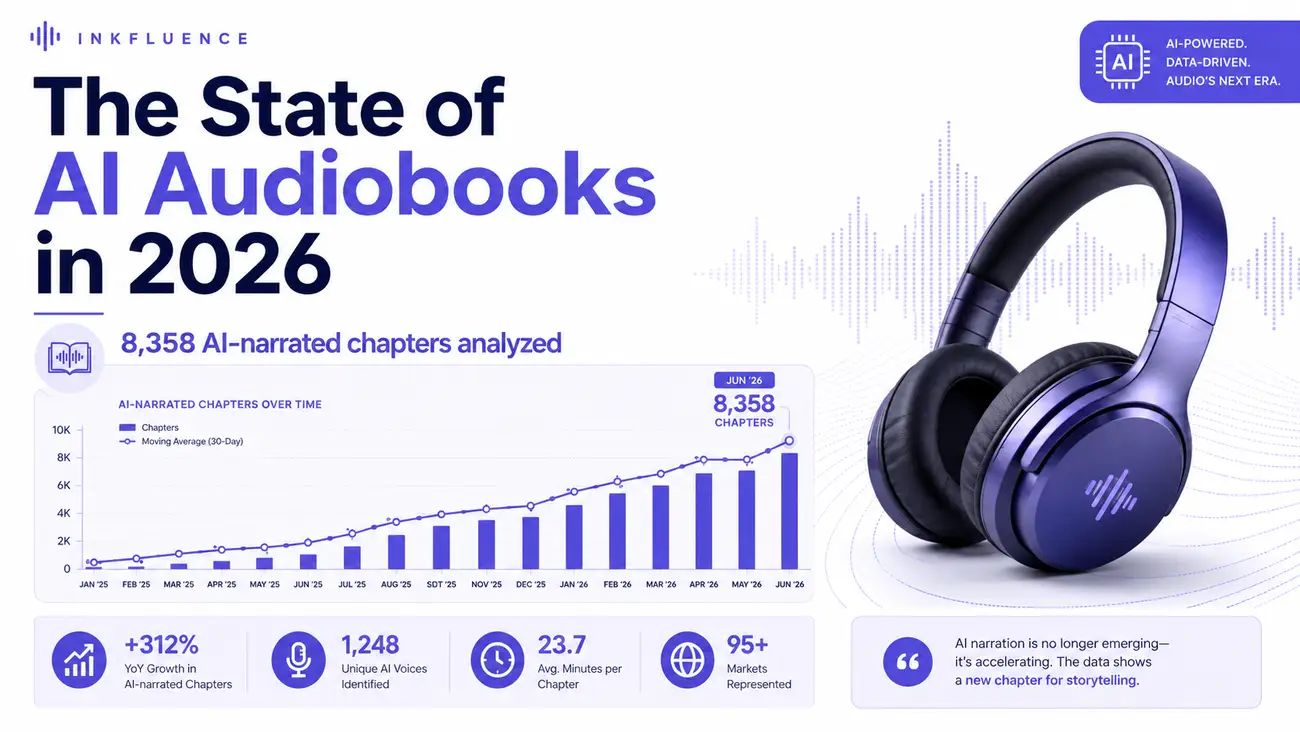
 The State of AI Audiobooks in 2026: What 8,358 AI-Narrated Chapters Reveal
We looked at 8,358 chapters our users narrated into audiobooks with AI. Monthly narration grew from a handful of chapters in late 2025 to nearly 3,000 a month by mid-2026, 99% of jobs finished cleanly, and listeners consistently pick natural, conversational voices over dramatic ones. Here is the first-party data and what it means for authors.
Get ebook tips in your inbox
Join creators getting weekly strategies for writing, marketing, and selling ebooks.