
Prix Pascal: The New Literary Prize for Novels Written with AI, and How to Enter by 30 November 2026
France's new Prix Pascal is a literary prize that asks entrants to say how they used AI instead of hiding it. The rules in plain English, what 300,000 characters means in words and chapters, the technical file, and a five-week plan to submit a French novel on time.
Quick Answer
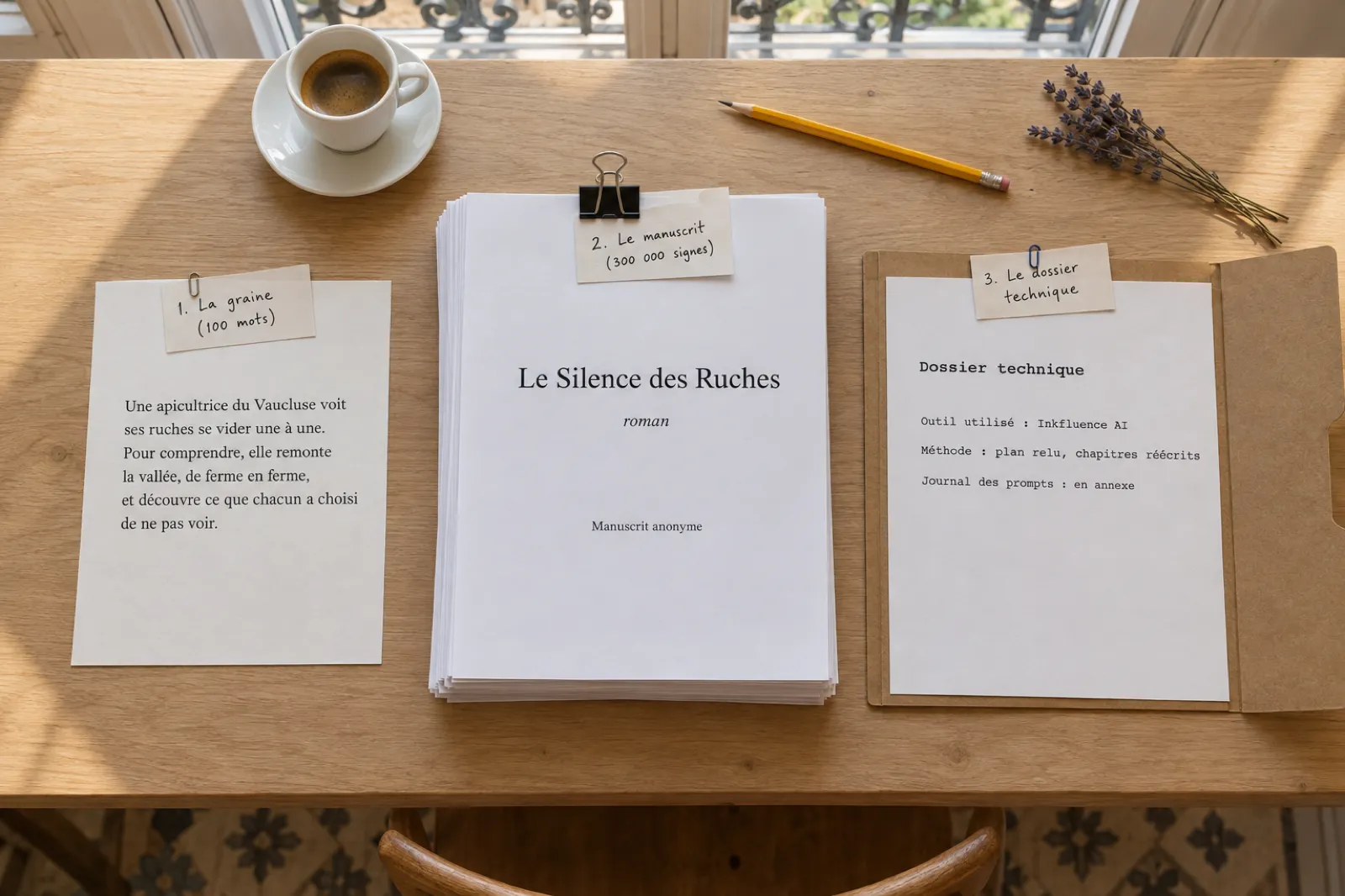
The Prix Pascal de Littérature IA is a new French literary prize for unpublished fiction written in collaboration with AI. Anyone in the world can enter, with no publisher, as long as the book is written in French. You submit three things before 30 November 2026 at 23:59 Paris time: a "graine" (the seed of the book, 100 words at most), an anonymous manuscript of about 300,000 characters including spaces (roughly 52,000 French words), and a technical file describing the AI tools, prompts and method you used, which only the jury reads. The winner gets publication and a media campaign. You can write the whole novel in French with Inkfluence AI by describing it in French, then spend your remaining weeks editing.
For most of 2026, AI and literary prizes have met as a scandal: a finalist accused, a winner denying it, a jury asked what it knew. On 20 October a group of French founders tried the opposite approach. The Prix Pascal de Littérature IA only accepts books written with AI, and it asks every entrant to explain exactly how. The Guardian covered the launch the next day, and applications close at the end of November, so anyone who wants to enter has about five weeks.
Disclosure up front: Inkfluence AI is our product, and the step-by-step part of this guide uses it. The rules, the length maths and the advice on the technical file apply whatever tool you write with. We read the official rules (the règlement) on 22 October 2026; where press reports and the rules disagree, this guide follows the rules and says so.
Lire en français : Prix Pascal : participer au prix littéraire des romans écrits avec l’IA, avec un compteur de signes et un planificateur de chapitres.
Updated 22 October 2026. Rules checked against prixpascal.fr and its published règlement on that date. Check the site again before you submit: the jury is due to be announced in early November.
In this guide:
- The Prix Pascal at a glance
- Why this prize is different
- The three things you submit
- How long is 300,000 characters?
- The theme: a problem facing humanity
- A five-week plan to 30 November
- Writing the entry with Inkfluence AI, step by step
- What to put in the technical file
- Six premises that fit the brief
- What other prizes say about AI
- FAQ
The Prix Pascal at a glance
Everything below comes from the prize's website and its rules. The prize is named after Blaise Pascal, the seventeenth-century French mathematician and philosopher who built one of the first mechanical calculators, which is a neat choice for a prize about writing with machines.
| Question | Answer |
|---|---|
| Who can enter? | Anyone, a person or an organisation, of any nationality, living anywhere, with or without literary experience. No publisher needed. |
| Language | French only. |
| What kind of book? | Unpublished fiction written in collaboration with one or more AI tools. |
| Length | About 300,000 characters including spaces (the site says "de l'ordre de", on the order of). Press reports quoted 10,000 to 50,000 words; the rules give characters. |
| What you submit | A graine (the seed of the book, 100 words maximum), an anonymous manuscript as a PDF, and a technical file describing the AI tools, prompts and method. |
| AI disclosure | Required, in the technical file. The site calls it information for the jury, not a reason to eliminate an entry. Major models are all accepted. |
| Theme | The book should be useful, raise the alarm, or help solve an ecological, social or ethical challenge in an original way. |
| Opened | 20 October 2026 at 19:00 Paris time. |
| Deadline | Before 30 November 2026 at 23:59 Paris time. |
| Jury | Five members (writers, critics, publishers, philosophers, journalists), announced in early November. |
| Shortlist and winner | Ten nominees at the end of November; the winner at a ceremony in early December 2026. |
| Prize | Publication of the winning book and a media campaign. The website also mentions a cash award but gives no amount. |
| Entry fee | None mentioned in the rules or on the site. |
Why this prize is different
The Prix Pascal arrives after a year in which AI use, real or suspected, followed some of the best-known prizes in literature. The Guardian's launch report lists the Commonwealth short story prize, the Caine prize and the Prix Goncourt among the awards caught up in arguments about whether a finalist or winner had used AI. In each case the question was the same: did the writer use a tool they had not declared?
The Prix Pascal turns that question around. Using AI is the condition of entry, and the only requirement is honesty about how. That changes what a jury is judging. It is not asking "did a machine touch this?" but "what did this writer do with the machine, and is the result good literature?" The site is blunt that it is "not a technology contest": the jury rules on aesthetic, narrative and stylistic quality.
For writers who already work with AI, this is a literary jury promising in advance to read the work on its merits. It also gives everyone a public record of what an AI-assisted novel can be, which is a useful thing to have when the subject usually comes up as an accusation. If you want the broader picture of where AI sits in publishing right now, our piece on how AI is changing the book industry covers it, and Can AI write a novel? deals with the question everyone asks first.
The three things you submit
An entry is three documents, uploaded at the same time through the form on the prize's website. Getting any of them wrong is the easiest way to lose an entry before the jury reads a page, so here is each one in plain English.
1. The graine (the seed): 100 words at most
The graine is the idea the book grew from: a premise, a situation, even a single sentence or a number. The rules cap it at 100 words. The website describes it more loosely, as about 4,000 characters or two pages "in any form", but the rules are the binding document, so keep it to 100 words. It stays confidential: it is only made public after the announcement, and only if the winner agrees.
If you write with AI, the graine is very close to the first prompt you gave it. That is a gift. You already have to write a clear one-paragraph premise to get a good book out of any AI tool, so write that paragraph carefully once, in French, and use it for both.
2. The manuscript: about 300,000 characters, anonymous, as a PDF
The rules and the site set the format:
- a PDF, up to 10 MB;
- a readable font at 1.5 line spacing, with standard margins;
- a title, and a subtitle if you want one;
- a back-cover text (in French publishing, the quatrième de couverture);
- page numbers or a table of contents;
- no author name anywhere: the manuscript is read anonymously;
- unpublished: a book already on sale anywhere does not qualify.
3. The technical file (dossier technique)
A free-format PDF describing the AI tools you used, your prompts, your methods and any specialised agents. The rules reserve it for the reading committee and the jury and say it is never published. The site adds that declaring your tool is "information for the jury, not a criterion for elimination". We cover what to put in it further down.
How long is 300,000 characters?
French publishing counts in characters (signes), spaces included, where English-language publishing counts words. Here is the same length in the units you are more likely to plan with.
| Unit | 300,000 characters is about | How we got there |
|---|---|---|
| French words | 52,000 | French fiction written on Inkfluence averaged 5.7 characters a word, spaces included |
| Standard typed pages (feuillets) | 200 | The French standard page is 1,500 characters |
| Inkfluence fiction chapters | 26 to 40 | Fiction chapters run about 1,200 to 2,000 words; a book holds up to 40 chapters |
Two practical points follow. First, plan about 30 chapters. That lands near the target for most styles and leaves room to add chapters if you come in short, or to cut a weak one if you run long. Second, measure the real count before you submit, not an estimate: in Word, the Statistics window shows "characters (with spaces)"; in LibreOffice it is under Tools, then Word Count. The site's wording ("on the order of") suggests some tolerance, but a manuscript far from 300,000 characters invites a question you do not need the jury to ask.
By English-language standards 52,000 words is a short novel, which suits a five-week deadline. If you want to know how AI tools cope with the length, our roundup of the best AI tools for long novels compares them on exactly this.
Start the draft in French today
Describe your book in French and Inkfluence AI plans it, keeps a story bible of your characters and places, and writes every chapter in French. Try the opening chapters free, then write the full book on Creator or Premium.
Start your entry freeThe theme: a problem facing humanity
The rules ask for a work that is useful, raises the alarm, or helps solve an ecological, social or ethical challenge in an original way, and that brings something new rather than reproducing an existing format. Read that as a brief, not a lecture topic. A novel about a beekeeper whose hives are emptying is about ecology; a novel that explains pesticide policy for 300 pages is a pamphlet with names in it, and a literary jury will treat it as one.
The strongest entries will probably do what good novels about big subjects always do: make the problem personal, specific and local. One family, one village, one job, one decision. Let the reader arrive at the large question through a small, concrete life. That also happens to suit AI-assisted writing, because a tightly defined premise with a few named characters and one setting gives any AI tool far less room to drift into generic prose.
Three questions to test a premise against the brief:
- Whose problem is it? Name one person who has to decide something because of it.
- What does it cost them? A theme without a cost is an essay.
- What would a reader do differently afterwards? That is the "useful" in the rules.
A five-week plan to 30 November
Five weeks is enough to write and edit a short novel with AI, but not enough to start late. The plan below works back from the deadline, leaves the last week for reading and paperwork, and keeps a day spare before the closing time, because upload forms fail on deadline nights.
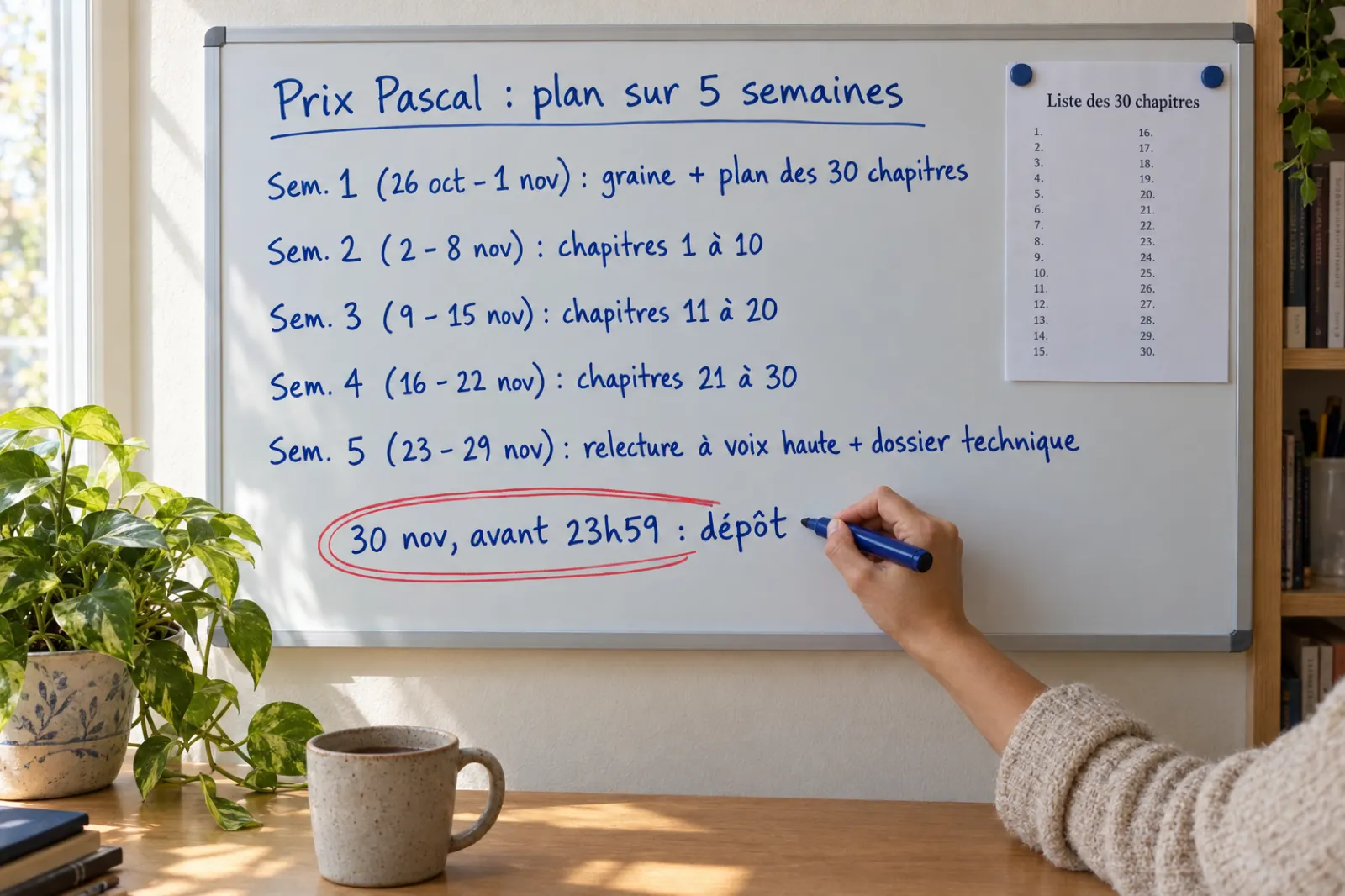
| Week | Dates | Goal |
|---|---|---|
| 1 | 26 Oct to 1 Nov | Write the graine. Review the outline of 30 chapters until every chapter has a clear event, then write the full draft. Start the prompt log. |
| 2 | 2 to 8 Nov | Edit chapters 1 to 10. Rewrite the opening chapter by hand. Check the jury announcement. |
| 3 | 9 to 15 Nov | Edit chapters 11 to 20. Check continuity against the story bible as you go. |
| 4 | 16 to 22 Nov | Edit chapters 21 to 30. Rewrite the ending by hand. Measure the character count. |
| 5 | 23 to 29 Nov | Read the whole book aloud and fix what you stumble on. Write the back-cover text and the technical file. Export the anonymous PDF. |
| Deadline | 30 Nov | Submit before 23:59 Paris time. Better: submit on the 29th. |
Writing the full draft takes minutes, not weeks, so why does the plan run to five? Because the draft is not the work. The work is reading every chapter, deciding what is wrong with it and fixing it, and ten chapters a week is a pace that leaves time to do that properly instead of skimming. Edit in order: a change to a character in chapter 4 is easier to carry through chapters 5 to 30 than to retrofit from the end.
Writing the entry with Inkfluence AI, step by step
Inkfluence AI is built for book-length work, which is what this prize asks for: one story, about 50,000 words, with characters and facts that stay consistent from chapter one to chapter thirty. Here is the workflow we would use for an entry.
Step 1: Describe the book in French
There is no language menu. Inkfluence writes in the language you describe the book in, so type your premise in French and the outline, the story bible and every chapter come out in French. It writes natively in French rather than writing in English and translating afterwards, which matters for a prize judged on style. The help centre article How to write a book in another language shows the steps. Start from your graine: it is the same paragraph. Add the length in the same sentence ("Un roman en 30 chapitres sur...") so the book is planned at the right size.
If your French is not strong enough to judge literary prose, be honest with yourself about that before you start. You can write in English and use the book translator to produce a French edition, but a translated draft still needs a fluent French reader before it goes in front of five critics. Our comparison of Kindle Translate and AI book translation explains where machine translation of fiction is strong and where it needs a human pass.
Step 2: Set the chapter count and review the outline
For an entry, start from New Book, then Write a book with AI. That set-up lets you choose the chapter count (about 30; the length maths are above) and shows you the outline before anything is written: rename chapters, rewrite what each one covers, and drag them into a new order. This is the cheapest place to make the book better. Give every chapter one clear event, make sure the problem at the heart of your theme gets worse before it gets better, and decide the ending now. The changes you make here are also the first thing to describe in your technical file.
Step 3: Write the draft, then read every chapter
Fiction on Inkfluence is written in order, one chapter after another, with a story bible that tracks your characters, places, objects and what each character knows, so chapter 24 remembers what happened in chapter 3. The whole draft takes minutes. Then the real work starts: read each chapter, mark what is wrong, and fix it in the editor, in order, so a change early in the book is carried through the rest. Our AI novel writing guide goes deeper on keeping a long story consistent.
Step 4: Rewrite the chapters that carry the book
A jury reads the first page, the turning point and the last page more closely than anything else. Rewrite those chapters yourself, in your own words. Use the editor's assistant for line-level work (tightening a paragraph, varying a sentence that starts the same way as the last three), and run the whole-book review to find chapters that sag. Write down which chapters you rewrote by hand: it goes in the technical file and it is exactly the kind of method the jury wants to see.
Step 5: Read it aloud
Prose that has been through AI shows its seams when spoken: repeated rhythms, a favourite image used twice, a character who explains a feeling the scene already showed. Reading aloud is the fastest way to hear them. If you would rather listen than read, an audiobook of your draft makes a good second ear; narration follows the book's language automatically.
Step 6: Make the manuscript anonymous and export it
- Remove your name. Each book stores its own author name. Click the pencil next to the title in the editor and clear the author field so it does not print on the title page or the cover. Turn the copyright page off in the export settings.
- Remove branding. On the free plan the PDF carries a small Inkfluence footer and closing page. Creator and Premium PDFs do not, which keeps the manuscript clean and anonymous.
- Check the layout. The rules ask for a readable font, 1.5 line spacing and page numbers or a contents page. The PDF export includes a contents page with page numbers. If you need to adjust the spacing, export a Word file (Creator and Premium), set 1.5 spacing, and save it as a PDF from Word.
- Add the back-cover text. Inkfluence can draft a book description for you; rewrite it in your own voice and place it after the title page.
- Keep it under 10 MB. A text-only novel is far below that. If you added images, check the size.
Thirty chapters in French, one month
Creator ($9.99 a month) includes 35 chapters a month, enough for a 30-chapter draft with a few regenerations. Premium ($19.99 a month) has no chapter limit, if you expect to rewrite a lot. Both remove Inkfluence branding from your PDF and add Word export. The free plan writes 5 chapters, enough to test your premise and opening.
Write your opening chaptersWhat to put in the technical file
The rules leave the technical file free-format. They list what it should describe: the AI tools used, the prompts, the methods and any specialised agents. Nobody outside the jury and the reading committee will see it, so write it for five careful readers who want to understand how the book was made.
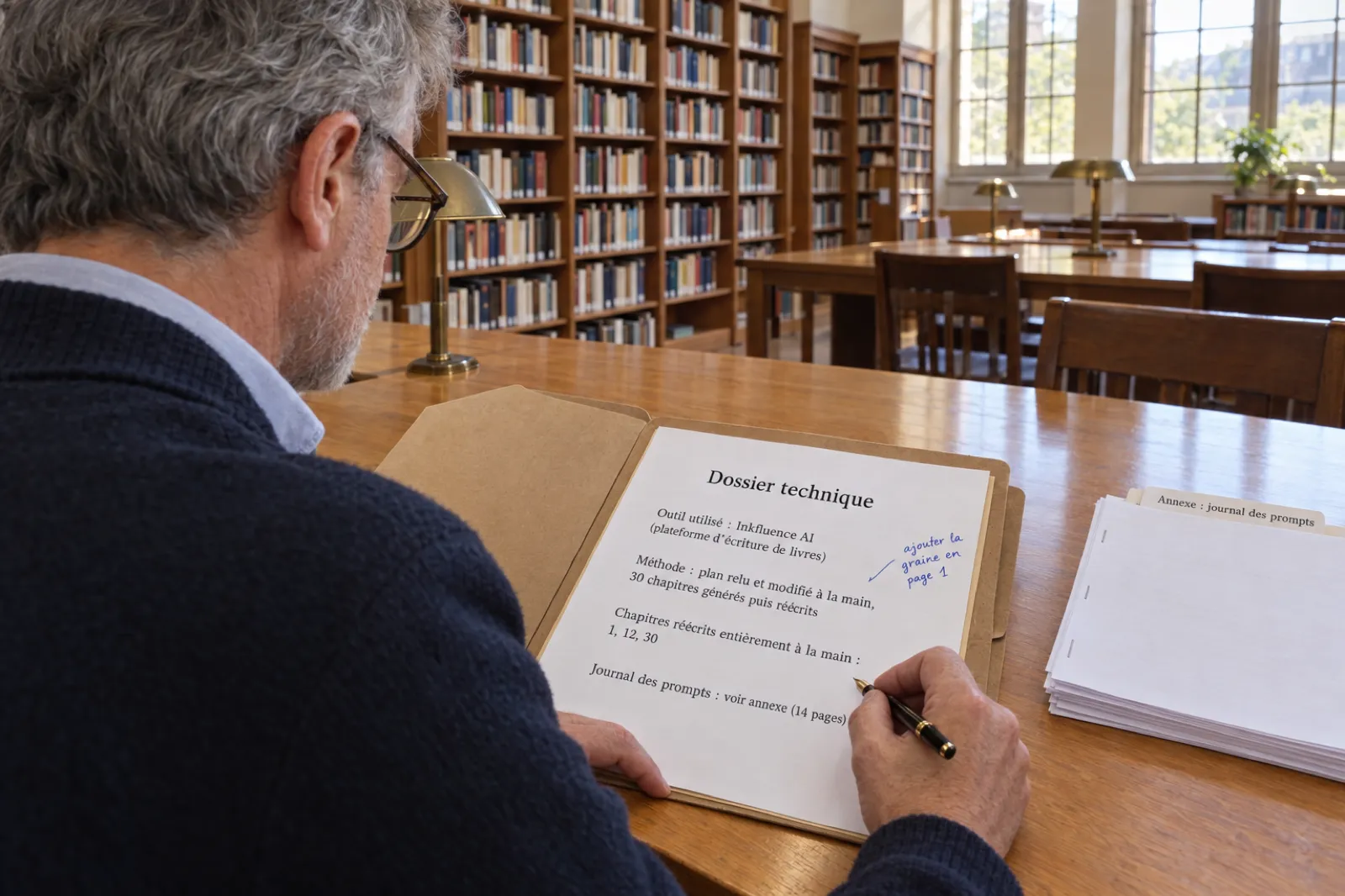
A structure that covers what the rules ask for:
- Tools used. Name every tool. If you wrote with Inkfluence, say so plainly: "Inkfluence AI, a book-writing platform". If you also used a general chat assistant for research or a translation tool, list those too.
- The graine and the starting prompt. Show the paragraph the book began from. If your graine and first prompt are the same text, say so.
- Method. How you worked, in order: how you edited the outline, how many chapters were generated, how you read and corrected them, which ones you rewrote entirely by hand, and why.
- Prompts. The rules ask for prompts. Keep a log from day one (a dated document where you paste every instruction you give, with a line on why) and attach it as an annex. A log written as you go is far more convincing than one reconstructed in week five.
- What you kept and what you changed. A short, honest account of where the AI was strong and where you overruled it. This is the part a literary jury is most likely to find interesting.
One practical note. The website's form refers to the type of AI model used. A writing platform like ours runs on large language models but is not itself a model you choose by name, and that is fine: the site says the declaration is information for the jury rather than grounds for elimination. Name the platform, describe how you used it, and if the form insists on something you cannot answer, ask the organisers at the contact address on the prize's website.
Six premises that fit the brief
Each premise below takes on an ecological, social or ethical challenge through one specific life, which is the shape the rules reward. They are written in French, so "Write this" starts a book in French with the premise already in the idea box. Treat them as starting points: the strongest entry will be the one only you could have written, so change the place, the job and the person until it is yours.
| Challenge | Premise (French, with English) | |
|---|---|---|
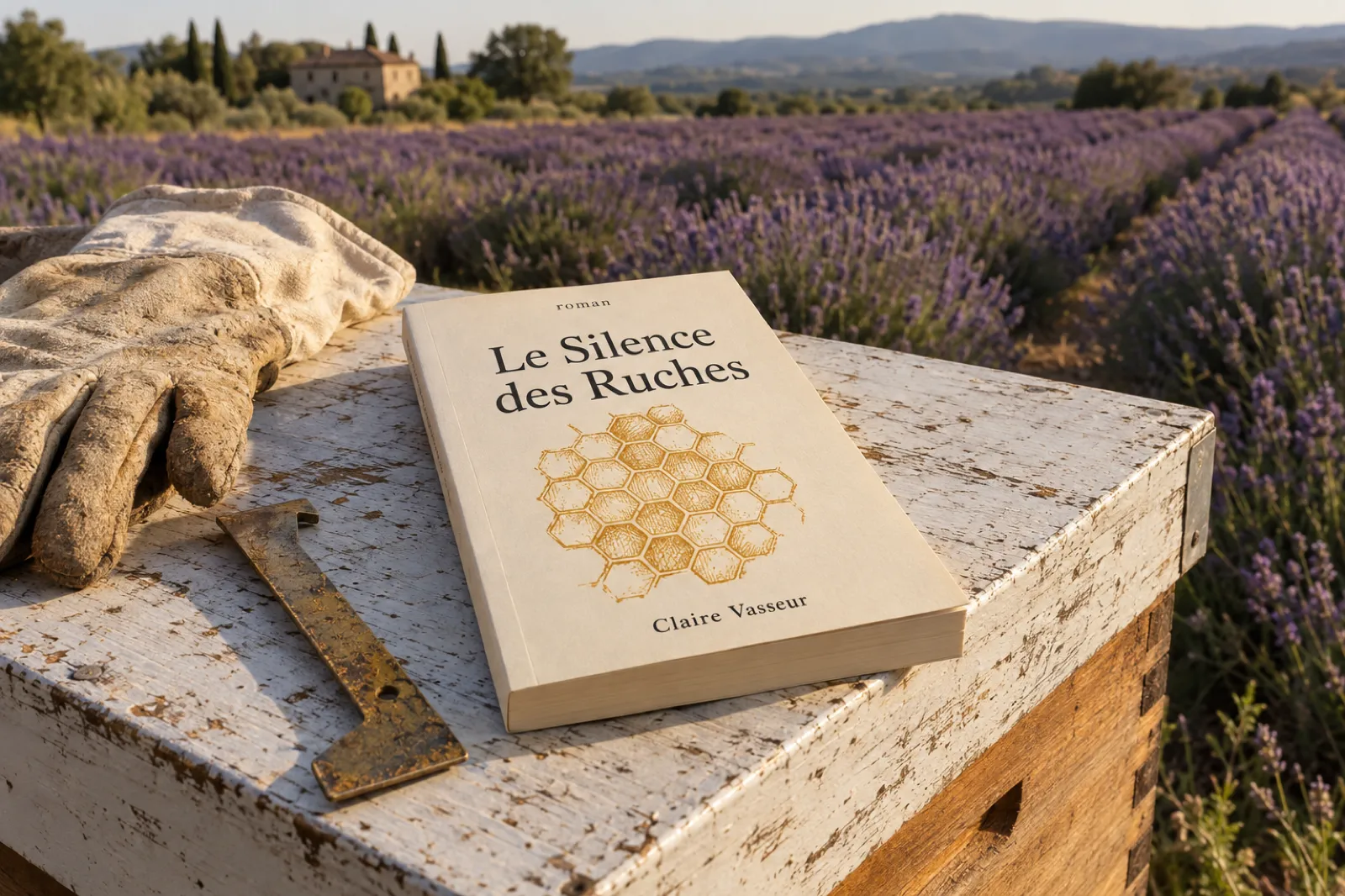
| Ecology | Un roman en 30 chapitres sur une apicultrice du Vaucluse qui voit ses ruches se vider une à une et remonte la vallée, de ferme en ferme, pour comprendre ce que chacun a choisi de ne pas voir. A beekeeper in the Vaucluse watches her hives empty one by one and walks up the valley, farm by farm, to find out what everyone chose not to see. |
Write this |
| Ethics | Un roman en 30 chapitres sur une infirmière de nuit dans un hôpital de province qui découvre qu'un logiciel décide désormais quels patients voient un médecin en premier. A night nurse in a small regional hospital finds out that software now decides which patients see a doctor first. |
Write this |
| Climate | Un roman en 30 chapitres sur deux sœurs qui héritent de la ferme familiale en Bretagne l'année où la mer commence à reprendre les champs. Two sisters inherit the family farm in Brittany in the year the sea starts taking back the fields. |
Write this |
| Work | Un roman en 30 chapitres sur un livreur à vélo de Lyon qui pousse ses collègues à exiger de connaître les règles de l'application qui les note chaque soir. A bike courier in Lyon pushes his colleagues to demand the rules of the app that scores them every night. |
Write this |
| Language | Un roman en 30 chapitres sur une traductrice qui comprend que la langue bretonne de sa grand-mère ne survivra peut-être plus que dans une machine. A translator realises her grandmother's Breton may survive only inside a machine. |
Write this |
| Mountains | Un roman en 30 chapitres sur un village des Alpes qui doit décider s'il garde sa station de ski alors que la neige ne vient plus. An Alpine village has to decide whether to keep its ski resort now that the snow has stopped coming. |
Write this |
Whatever you choose, test it against the three questions in the theme section: whose problem it is, what it costs them, and what a reader would do differently afterwards.
What other prizes say about AI
Most established literary prizes and writing competitions either require human authorship or say nothing about AI at all, and the arguments of 2026 came largely from prizes in the second group, where nobody had agreed in advance what counted. If you write with AI and want to enter anything else, read the rules for the words "artificial intelligence", "AI-generated" or "original work by the author", and when the rules are silent, ask the organisers before you submit rather than after you are shortlisted.
Publishing is clearer. Amazon KDP lets you publish books written with AI as long as you disclose AI-generated content when you set the book up; our guide to publishing AI-generated books on KDP walks through the screens, and the KDP AI disclosure policy explains what counts as AI-generated. Note that the Prix Pascal requires an unpublished manuscript, so if you plan to enter, do not put the book on sale until the prize is decided.
FAQ
Can I enter the Prix Pascal if I am not French?
Yes. The rules are open to any person or organisation of any nationality, living anywhere. The only language condition is that the book is written in French.
How many words is 300,000 characters in French?
About 52,000 words. French prose averages a little under six characters per word once spaces are counted, so 300,000 characters lands between roughly 48,000 and 55,000 words depending on style. Measure the real count with your word processor's "characters (with spaces)" figure.
Do I have to say which AI I used?
Yes. The technical file describes the AI tools, prompts and methods you used. It is read only by the reading committee and the jury, never published, and the site says the declaration is information for the jury rather than a reason to eliminate an entry.
Can I enter a book written with Inkfluence AI?
Yes. The prize accepts work written with one or more AI tools, and books you make on Inkfluence are yours to use and sell on every plan. Name Inkfluence AI in your technical file and describe how you used it. The manuscript must be unpublished, so hold off selling it until the prize is decided.
Does the book have to be fiction?
Yes. The rules ask for a literary work of fiction, and it should take on an ecological, social or ethical challenge in an original way.
Is there an entry fee?
Neither the rules nor the website mention one.
What does the winner get?
Publication of the book and a media campaign, according to the rules. The website also mentions a cash award but does not give an amount.
When is the deadline?
Before 30 November 2026 at 23:59 Paris time. Ten nominees are chosen at the end of November and the winner is announced in early December 2026.
Five weeks is enough. Starting next week is not.
Write your graine tonight, describe the book in French, and have the outline and first chapters by the weekend. You keep everything you write, whether or not you enter.
Start writing in FrenchRelated reading
- Can AI Write a Novel?: what AI does well in long fiction and where you still need to step in
- The AI Novel Writing Guide: outlines, continuity and editing for book-length fiction
- AI Novel Writer: write a full novel with a story bible that keeps it consistent
- Prix Pascal (en français): this guide for French-speaking entrants, with a character counter and chapter planner
- Écrire un roman avec l'IA: our guide in French
- Kindle Translate vs AI Book Translation: if you write in English and need a French edition
- How AI Is Changing the Book Industry: the bigger picture behind prizes like this one
- Publishing AI-Generated Books on KDP: for after the prize is decided
Sources

Founder, Inkfluence AI
Sam is the founder of Inkfluence AI. He built the platform to make book creation accessible to everyone - from first-time authors to seasoned publishers.
Helpful links
Ready to Create Your Own Ebook?
Start writing with AI-powered tools, professional templates, and multi-format export.
Get Started FreeRelated Articles
 AI Writing
Sudowrite vs Novelcrafter (2026): Price, Built-in AI vs Your Own Key, Story Bible vs Codex
Sudowrite ($10 to $59 a month, AI built in) against Novelcrafter ($4 to $20 a month, AI from your own provider): price, how the AI is paid for, Story Bible against Codex, drafting, editing, export and series, read on both vendors' sites on 17 October 2026, with a picker.
 AI Writing
Which Claude Model Is Best for Writing? Opus 5.5, Sonnet 5.5, Haiku 5.5 and Fable 5.1 Compared (October 2026)
Which Claude model should you write with in October 2026? Opus 5.5, Sonnet 5.5, Haiku 5.5 and Fable 5.1 compared on what Anthropic actually publishes: which plan includes each one, API prices, context and output limits, speed, and what each is built for. Plus the maths of fitting a whole book, and when a book tool is the better pick.
 AI Writing
Best AI for Editing a Book (2026): 9 Tools Compared by Editing Job
Which AI should edit your manuscript? We compare ProWritingAid, Grammarly, AutoCrit, Sudowrite, Novelcrafter, ChatGPT, Claude, the free checks in Google Docs and Word, and Inkfluence AI by the job each does best: grammar, line editing, story feedback, or editing and publishing in one place. Prices checked 2 October 2026.
Get ebook tips in your inbox
Join creators getting weekly strategies for writing, marketing, and selling ebooks.