

Quick Answer
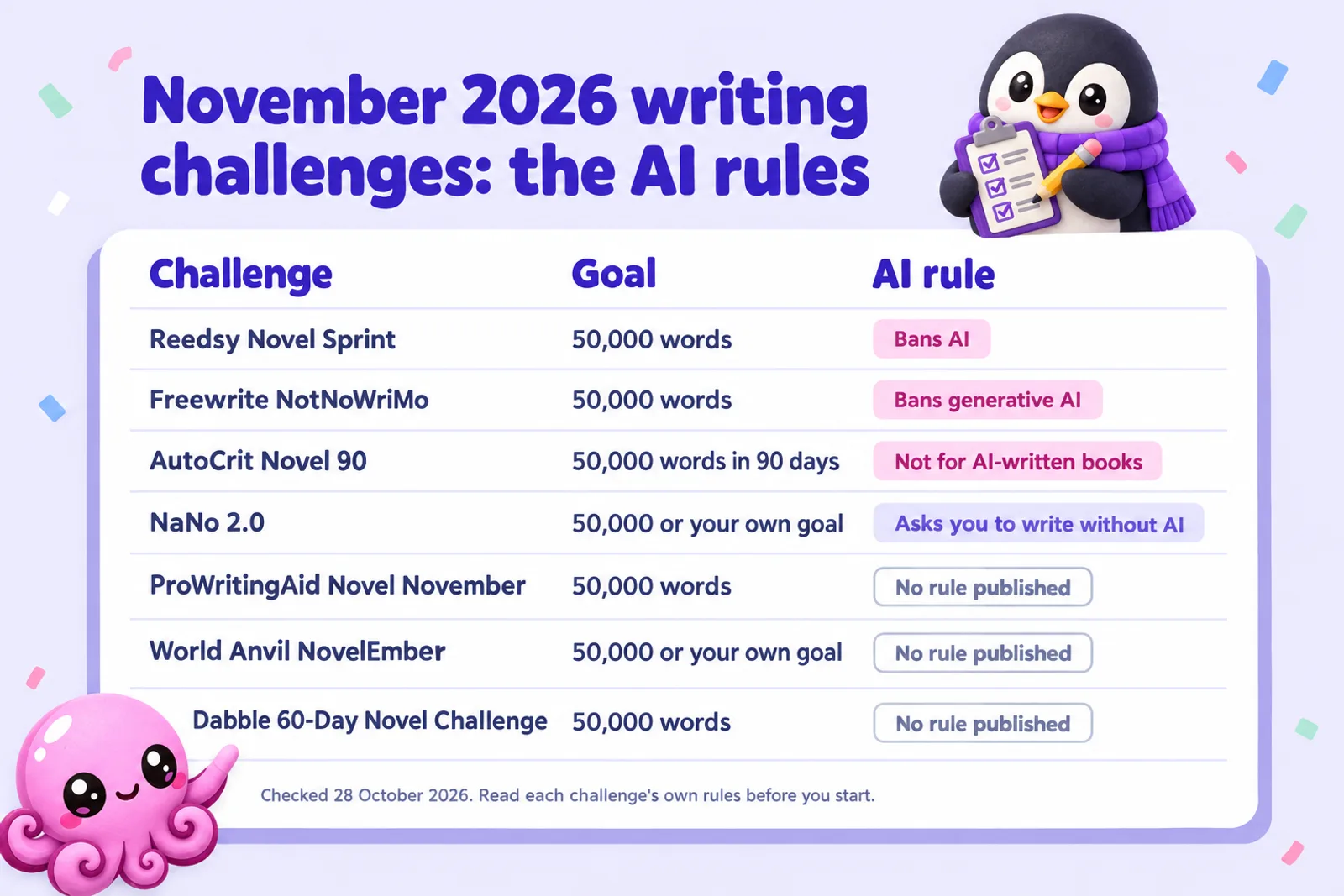
NaNoWriMo closed in 2025. In November 2026 the main alternatives are ProWritingAid Novel November, the Reedsy Novel Sprint, the volunteer-run NaNo 2.0, World Anvil NovelEmber, Freewrite NotNoWriMo, AutoCrit Novel 90 and Dabble's 60-Day Novel Challenge, most with a 50,000-word goal (1,667 words a day). On AI: Reedsy and Freewrite ban it, AutoCrit says its challenge is not for AI-written books, NaNo 2.0 asks you to write without it, and the rest publish no rule. If you want to use AI to write a book this November, do it as your own project rather than inside a challenge that counts your words.
For twenty-five years, November meant NaNoWriMo: write 50,000 words of a novel in 30 days, alongside hundreds of thousands of other people doing the same. The organisation behind it is gone, but the habit isn't. Several companies and volunteer groups now run their own November challenges, and between them they cover almost every kind of writer: people who want prizes, people who want community, people who write by hand, screenwriters, and people who need more than 30 days.
There are already good lists of these challenges. What none of them answers is the question a lot of writers now have: which ones let me use AI, and how do I use it without breaking anyone's rules? This guide answers that challenge by challenge, using each organiser's own words where they have published any, and it is plain about where they haven't. Then it gets practical: the word-count maths, a planner you can set to your own November, and two 30-day plans, one for writing every word yourself and one for using AI to go from idea to a published book by early December.
Disclosure: Inkfluence AI is our product. It is an AI book writer, so we have an obvious interest in the second plan. We have tried to be fair to the challenges that don't want AI anywhere near them, because that is a reasonable position and they are entitled to it.
Checked on 28 October 2026. Dates, goals, prizes and AI rules come from each challenge's own page, read that day, except where a row says the details are from a third-party listing. Rules can change after publication, so read the official page before you rely on anything here. Links are in Sources.
In this guide
- What happened to NaNoWriMo
- Every November 2026 challenge compared
- The AI rules, challenge by challenge
- How to choose a challenge
- What counts as your words
- The word-count maths
- November word-count planner
- A four-day Preptober
- Track 1: the challenge, every word yours
- Track 2: an AI-assisted November
- What to do with 50,000 words on 1 December
- Frequently asked questions
What happened to NaNoWriMo
National Novel Writing Month started in 1999 and became a nonprofit in 2006. Its challenge was simple: start a new novel on 1 November and reach 50,000 words by 30 November. At its peak it had a large website, a word-count validator, local groups run by volunteers, and a young writers programme.
In September 2024 the organisation published a statement on AI that declined to condemn it and suggested that blanket opposition to AI ignored class and disability issues. Many writers were angry, some authors left its writers board, and the organisation revised the wording within days. That came on top of earlier complaints about moderation and safety on its forums. At the end of March 2025 it announced it was closing for good. Coverage at the time, including Literary Hub, reported the main reason as money: the nonprofit had been running at a loss for years.
That history matters for this guide, because it explains why so many of the replacement challenges say something about AI. Many of the people running them were long-time NaNoWriMo participants, and several have drawn their own line.
Every November 2026 writing challenge compared
Here is every challenge we found running in or around November 2026, with the details that decide whether it suits you. "No rule published" means we could not find any statement about AI for participants on the challenge's own page. It does not mean AI is welcome; it means you should ask.
| Challenge | Dates | Goal | Cost and where you write | AI rule | Prizes and perks | Age |
|---|---|---|---|---|---|---|
| ProWritingAid Novel November | 1 to 30 Nov (your local time); prep from 1 Oct | 50,000 words | Free account. Tracks words from Word, Scrivener or Google Docs; handwriters log manually | No rule published for participants | Profile badges and milestones; no cash prizes | Not stated |
| Reedsy Novel Sprint | 1 to 30 Nov | 50,000 words | Free. You must write in Reedsy Studio | Bans AI | $5,000, $2,500 and $1,000 plus a 30-minute literary agent consultation for the top three; finishers get 3 months of Studio's Craft and Outlining add-ons | Under-18s can write but not enter the contest |
| NaNo 2.0 | 1 to 30 Nov | 50,000 words or your own project | Free, all-volunteer. Any app, with the NaNo 2.0 word tracker | Asks you to write without AI | Tracker badges; no cash prizes | 16 and up |
| World Anvil NovelEmber | November | 50,000 words, or your own goal as a "rebel" | World Anvil account; honour system | No rule published | Winner's certificate | Not stated |
| Freewrite NotNoWriMo | November | 50,000 words | Free. Stats and leaderboard on Freewrite's platform; you don't need their device | Bans generative AI | Badges, sprints, device discounts | Not stated on the page we could read |
| AutoCrit Novel 90 | 1 Oct to 31 Dec (90 days) | 50,000+ words | Free, inside AutoCrit's challenge area | Not for AI-written books | Teams, sprints, coaching; possible prizes for finishers | 18 and up |
| Dabble 60-Day Novel Challenge | Planning from 1 Oct; writing 1 to 30 Nov | 50,000 words | Free to join on any platform; the template and tracker need Dabble | No rule published | Dabble discount and an in-app theme | Not stated |
| Order of the Written Word November Challenge | 1 to 30 Nov | 30,000 words of a novel, or 15 poems, or 8 short stories, or a revision goal | Free; Discord with a WriterStats bot | Not found (details from a third-party listing) | Community | Not found |
| Novlr Draftsgiving | 1 to 30 Nov | 10,000, 25,000 or 50,000 words | Free Novlr account | Not found (details from a third-party listing) | Not found | Not found |
| First Draft November (screenwriters) | 1 to 30 Nov | 90 screenplay pages (3 a day) | Free; any screenwriting software, or a notebook | No rule published | Optional free month of the organiser's editor | Open to anyone |
The volunteer group behind NaNo 2.0 also keeps a longer 2026 round-up of writing communities, including fan-fiction challenges, gamified writing apps and year-round groups such as Shut Up & Write. If none of the challenges above fits, start there.
The AI rules, challenge by challenge
Here is exactly what each organiser says, or doesn't. Where we quote, the words are theirs.
Reedsy Novel Sprint: AI is banned
Reedsy's sprint requires you to write your 50,000 words in Reedsy Studio, its free online writing app, and its guide says there is to be no cheating, adding that "we'll know if you copy/paste or use AI!" The contest part of the sprint is judged on your first chapter, submitted at the end of November, with $5,000, $2,500 and $1,000 for the top three plus a consultation with a literary agent. Contest entries must be in English, and under-18s can take part in the sprint but can't enter the contest. If you want to use AI anywhere in your drafting, this is not your challenge. If you want a real prize for writing every word yourself, it is the strongest on the list.
Freewrite NotNoWriMo: no generative AI
Freewrite makes distraction-free writing devices, and its November challenge puts the AI question in its name. The challenge is 50,000 words in November "without the use of generative AI". You don't need to own one of their devices to take part. The rule is short and clear: everything you count is your own writing.
AutoCrit Novel 90: for writers writing their own books
AutoCrit's challenge runs for 90 days, from 1 October to 31 December, which makes it the gentlest pace on the list (about 556 words a day). Its FAQ asks "Will we be writing our books with AI?" and the answer begins "No", going on to say the challenge is designed for writers who want to write their own books, not those who want a machine to do the work. It is free, runs inside AutoCrit, and is for adults only.
NaNo 2.0: asks you to write without AI
NaNo 2.0 is the closest thing to the old NaNoWriMo: free, run entirely by volunteers who were long-time participants, open to writers aged 16 and up, with a word tracker that goes live on 1 November. Its FAQ doesn't ban AI in so many words. It says: "We hope you'll give yourself the gift of creating without AI intervention in November." It also says it never gives participants' writing to AI companies and has an anti-scraping clause in its terms. Read that as a clear request from the community. Counting AI-written words toward a NaNo 2.0 goal would go against the spirit of the event, even without a formal rule.
ProWritingAid Novel November: no participant rule published
ProWritingAid's challenge is the largest; its page says "Join 100,000 writers worldwide". It is free with an account, tracks your words from Word, Scrivener or Google Docs, lets handwriters log their words manually, and gives badges rather than prizes. ProWritingAid's own software uses AI for feedback and editing suggestions, and the page promises that "your work is never used to train any algorithms". We found no rule for participants about AI-generated words, either way. The honest reading: the challenge is about drafting 50,000 words yourself, and if you want to count anything else, ask them first.
World Anvil NovelEmber, Dabble and First Draft November: no rule published
World Anvil's NovelEmber runs on an honour system: you set your goal, you judge whether you met it, and you can download a winner's certificate. Dabble's 60-Day Novel Challenge pairs October planning lessons with November writing. First Draft November asks screenwriters for 90 pages. None of their pages says anything about AI. On an honour system, if you plan to use AI in your drafting, say so openly or keep that project out of the count.
Order of the Written Word and Novlr Draftsgiving: check the source
We couldn't reach an official page for either during our check, so the details in the table come from Reedsy's list of alternatives. The Order of the Written Word was founded by a former NaNoWriMo volunteer leader and runs its challenge on Discord. Novlr's Draftsgiving offers 10,000, 25,000 and 50,000-word tiers. Look up the current rules on their own channels before signing up.
The short version
- Banned: Reedsy Novel Sprint, Freewrite NotNoWriMo.
- Not what the challenge is for: AutoCrit Novel 90.
- Asked not to: NaNo 2.0.
- No rule published, so ask: ProWritingAid Novel November, World Anvil NovelEmber, Dabble, First Draft November.
- Openly welcomes AI-written words: none we found.
How to choose a challenge
If your friends are doing one, that is a fine reason to pick it. Otherwise, start with what you need most from November.
- You want a prize to aim for. The Reedsy Novel Sprint is the only one with serious cash. Remember you have to write in Reedsy Studio and AI is banned.
- You want to keep your own writing app. ProWritingAid (Word, Scrivener, Google Docs), NaNo 2.0 (any app, log in its tracker) and NovelEmber (honour system) let you write anywhere. Our guide to the best novel writing software compares the apps themselves.
- You write by hand. ProWritingAid lets you log words manually, and First Draft November accepts a notebook.
- You want the old NaNoWriMo feel. NaNo 2.0 is volunteer-run, free and community-first, for writers 16 and up.
- You need more time. AutoCrit Novel 90 spreads 50,000 words over 90 days. Dabble's challenge front-loads October with planning lessons.
- You want a smaller target. The Order of the Written Word sets 30,000 words, Novlr's Draftsgiving starts at 10,000, and NaNo 2.0 and NovelEmber let you set your own goal.
- You write scripts. First Draft November: 90 pages in 30 days.
- You want to use AI to write the book. None of these is the right home for that project. Run your own November instead, with the plan in Track 2 below, and if you also want the community, join a challenge for a separate project you write yourself.
Under-18s: NaNo 2.0 is 16 and up, AutoCrit 18 and up, and Reedsy lets younger writers take part but not enter its contest. For younger writers, our guides to writing fiction with AI for free and how to write a novel are a gentler starting point than a 50,000-word race.
Writing a book with AI this November instead?
Set it up as your own project: give Inkfluence AI your idea, choose the number of chapters, shape the outline, and it drafts the book chapter by chapter while keeping track of your characters and what has already happened. Then you rewrite it into your book.
Start my November bookWhat counts as your words
Every word-count challenge is built on one idea: the number on the tracker is words you wrote. AI muddies that, because it can help at many stages, from a list of names to a whole chapter. A useful way to think about it is to ask who produced the sentences you are counting.
| Use of AI | Whose words are counted? | In a no-AI challenge | In your own AI-assisted project |
|---|---|---|---|
| Generating chapters or scenes | The AI's | Breaks the rule. Don't count them. | Fine, and you then rewrite them |
| "Continue this paragraph" or autocomplete | The AI's | Breaks the rule | Fine |
| Rewriting your paragraph in a new style | Mostly the AI's | Breaks the rule | Fine |
| Brainstorming plot ideas, titles or names in October | None yet; you write the book | Not addressed by the rules we found. Ask if unsure | Fine |
| An outline or character bible from AI | Notes, not prose | Not addressed. Ask, especially for NaNo 2.0, which asks for no AI at all | Fine |
| Research questions (how a lighthouse works) | Facts you then write up | Not addressed. Check facts against a real source either way | Fine |
| Spelling and grammar checks in December | Yours, corrected | After the challenge ends, the challenge rules no longer apply | Fine |
Two firm lines come out of that table. First, if a challenge bans AI, no AI-generated sentence goes into your count, however much you edit it afterwards. Second, where a rule doesn't cover something, the organiser decides, not us and not you. A quick message to a moderator costs nothing.
There is also a reason beyond rules to write some Novembers entirely yourself: it is how you find your voice. If you are curious what AI can and can't do with a long story, our honest answer is in can AI write a novel?, and how to keep an AI-assisted book original covers the habits that keep the result yours.
The word-count maths
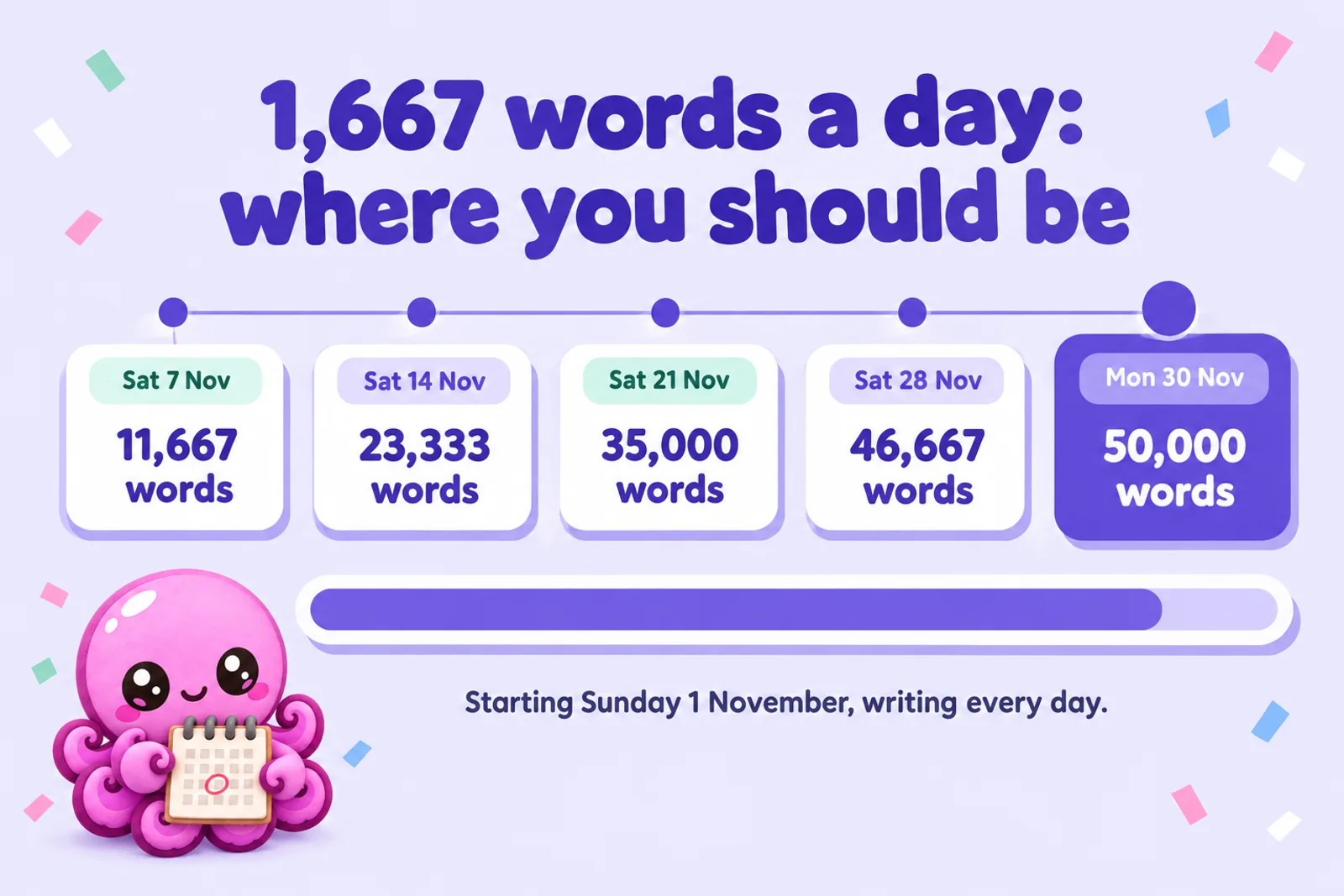
50,000 words in 30 days is 1,667 words a day. That is the number everyone quotes, but very few people write the same amount every day. November 2026 starts on a Sunday and has 21 weekdays and 9 weekend days, so here is what the target looks like for the common patterns.
| How you write in November 2026 | Writing days | Words per writing day |
|---|---|---|
| Every day, 1 to 30 November | 30 | 1,667 |
| Every day except Thanksgiving (26 Nov) and the day after | 28 | 1,786 |
| Six days a week, Sundays off | 25 | 2,000 |
| Starting late, on Thursday 5 November | 26 | 1,923 |
| Weekdays only | 21 | 2,381 |
| Every day, writing twice as much on weekends | 30 | 1,282 on weekdays, 2,564 on weekends |
| Weekends only | 9 | 5,556 |
Catching up. Falling behind is normal; the maths of catching up is kinder than it feels. If you reach the end of 10 November with 10,000 words instead of 16,667, you need 40,000 more in 20 days: 2,000 a day, only 333 more than the original target. Leave it until 20 November with 20,000 words and it is 3,000 a day for 10 days. The earlier you adjust, the smaller the change.
How long a day takes. Time yourself for one 25-minute session and multiply. If you draft 800 words in 25 minutes, 1,667 words is a little over 50 minutes. Many people find two short sessions easier than one long one.
Is 50,000 words actually a novel? Just about. A novel is usually counted as 40,000 words or more, and most published novels run 70,000 to 110,000 depending on genre; our guide to how many words are in a novel has the figures by genre, and novella vs novel covers the shorter forms. The book length calculator turns a word count into pages if you are planning a paperback.
November word-count planner
Set your goal, the days you can actually write, and any days you know you'll lose. The planner gives you a daily target and a day-by-day schedule with running totals, so you always know whether you are ahead. If you're starting late or already behind, set today's date and the words you have.
Your daily target
| Date | Write today | Total by tonight |
|---|
How it works: the words you still need are shared across your writing days, with weekend days weighted as you choose. Running totals are rounded so the last day lands exactly on your goal. Nothing you enter leaves your browser.
Plan my book in Inkfluence AIA typical result: 50,000 words with weekdays only gives 2,381 words a day across 21 days. Add Saturdays and it falls to 2,000. The planner works for any goal, so you can also use it for a 30,000-word Order of the Written Word target or a December editing goal.
A four-day Preptober
October is traditionally "Preptober", the month for planning. If you're reading this on 28 October, you have four days, which is enough if you spend them on the things that save the most time in November.
- Day 1: the premise. Write one paragraph: who wants what, what stands in the way, and what happens if they fail. If you're stuck, a plot generator or our list of AI writing prompts can give you starting points to argue with.
- Day 2: the people. For each main character, write a name, an age, what they want, and one thing they would never do. A character name generator saves an hour of dithering, and a character bible keeps eye colours and surnames straight in week three.
- Day 3: the shape. Write 25 to 30 one-line chapter summaries. You'll change them, but a list beats a blank page every morning. The book outline generator gives you a chapter-by-chapter skeleton to edit.
- Day 4: the setup. Pick your challenge and sign up, choose the app you'll write in, block your writing times in your calendar, and write your first sentence so 1 November starts with momentum.
If you are entering a no-AI challenge and want to keep your planning AI-free too, do the same four days with a notebook and index cards. The steps are the same; only the tools change. For fantasy and science fiction, a story bible for places, rules and history is worth an extra evening.
Turn four days of notes into a full outline
Put your premise into Inkfluence AI and get a chapter-by-chapter outline and character notes to argue with. Carry them into an AI-assisted book in November, or into any challenge whose rules allow AI planning.
Build my outline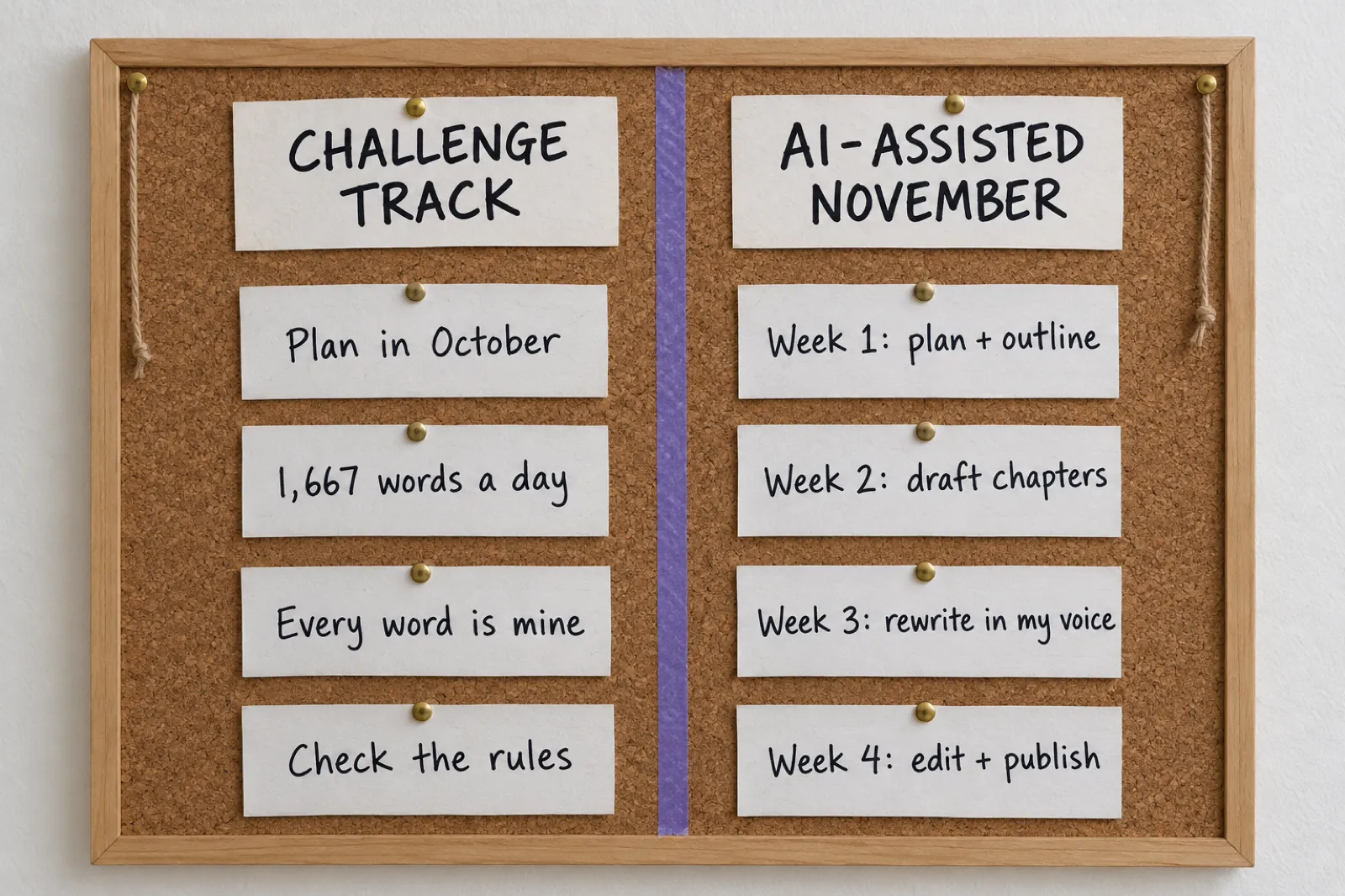
Track 1: the challenge, every word yours
This is the classic November: one new draft, written by you, logged in a challenge with other people doing the same. The aim is a complete first draft, not a good one. Here is a week-by-week plan at 1,667 words a day.
Week 1 (1 to 7 November): the opening, to 11,667 words
Write the opening chapters from your outline and don't go back to revise. Week one is usually the easiest, so bank extra words if you can: anything over target is insurance for week two. Log your words every day so your streak and your community can carry you.
Week 2 (8 to 14 November): the dip, to 23,333 words
Week two is where most people stall, because the opening energy has gone and the ending is far away. Keep sessions short and frequent. If a scene won't come, write a note in square brackets ("[fight scene here, she loses the map]") and move on to the next one. Notes like that count as a plan, not words, so don't count them.
Week 3 (15 to 21 November): the middle, to 35,000 words
The middle is where your story raises the stakes. Re-read your outline, not your draft. If the story has changed shape, update the outline in five minutes and keep going. Word sprints in your challenge's community (15 or 25 minutes, everyone writing at once) are the best tool for this week.
Week 4 (22 to 30 November): the ending, to 50,000 words
Write the ending even if the middle has holes. A finished draft with gaps is worth far more than a polished half. In the US, Thanksgiving falls on 26 November, so bank words on the weekend before. Validate your count with your challenge, collect your badge or certificate, and then stop. Don't start editing on 1 December.
Want more on getting the draft down? Our step-by-step guide on how to write a book covers the craft side, and Inkfluence for novelists shows what you can do with the draft once the challenge rules no longer apply.
Track 2: an AI-assisted November, from idea to published book
This track isn't a challenge, and you shouldn't count it in one. It is a 30-day plan for writers who want to use AI to produce a finished, edited, published book by early December. The AI drafts quickly; most of your time goes into reading, rewriting and deciding. Done honestly, you end the month with a book that sounds like you, not a pile of generated text.
We'll describe it with Inkfluence AI's novel writer because that is what we know, but the stages are the same with any tool. For the full method, see our guide on how to write a book with AI.
Days 1 to 7: idea, outline and characters
- Write your premise in your own words: a paragraph is enough. The more specific it is, the less generic the book.
- Generate an outline and then rewrite it. Move chapters, cut the ones that don't earn their place, and add the scenes only you would think of.
- Build your character and world notes. Inkfluence keeps a story bible for fiction, so names, relationships and who knows what stay consistent from chapter to chapter.
- Decide your length by chapter count. A chapter usually lands somewhere around 1,000 to 1,500 words, so more chapters means a longer book. There is no exact word target, so plan by chapters.
Days 8 to 14: draft, then read everything
- Generate the draft. That part is quick; the reading is what takes the week.
- Read every chapter in order, as a reader would, with a notebook. Mark what is flat, what is wrong, and what you'd never say.
- Regenerate or rewrite chapters that miss the point of the outline. Our guide on avoiding generic AI output covers the usual fixes.
Days 15 to 21: rewrite in your voice
- Rewrite the opening chapter yourself, line by line. It sets the voice for everything after it.
- Go through dialogue scene by scene. Dialogue is where readers hear an author, so make it yours.
- Add what only you know: the place you grew up, a job you've done, the joke your family tells.
- Run an AI chapter review for continuity slips, pacing drags and repeated words, and an AI beta read for how the book lands. Then ask one human reader for a week of their time.
Days 22 to 30: edit, package and publish
- Line edit and proofread. The AI book editor handles a first pass; our guide to what book editing costs helps you decide whether to pay a human for a final one.
- Write your title and blurb. The book title generator and book description generator give you options to edit.
- Make or commission a cover; see the AI book cover generator.
- Format the ebook and paperback (how to format a book for Kindle), answer KDP's AI questions honestly (KDP's AI disclosure rules), order a printed proof and submit.
Genre matters. Romance has its own beats (how to write a romance novel with AI), and so do fantasy and mysteries and thrillers, where clues have to be planted in the right chapters. If this book could become a series, plan that now; writing a series continues book one rather than starting over.
Start your AI-assisted November tonight
Open a new book, write your premise, and shape the outline before 1 November. Inkfluence AI drafts the chapters, keeps your characters consistent, and takes you through editing, export and the audiobook in the same project.
Open a new bookDoing both at once
You can join a challenge and run an AI-assisted project in the same month, as long as they are separate books and only the challenge book counts. Some writers draft a novel by hand for NaNo 2.0 and use AI for a non-fiction side project, like a short guide to their day job. Keep the counts apart and you have nothing to explain.
What to do with 50,000 words on 1 December
Whichever track you took, you finish with a draft. Here is what to do next, in order.
- Back it up in two places, today.
- Rest it for at least a week. You'll see it far more clearly.
- Read it once without editing, noting the big problems: a missing middle, a villain who disappears, an ending that doesn't pay off the opening.
- Fix structure before sentences. There is no point polishing paragraphs in a chapter you're about to cut. A challenge draft written by you can now go through AI editing tools if you want: the challenge has ended, and editing help doesn't change who wrote the book. KDP calls that AI-assisted, which you don't need to disclose.
- Grow it if needed. At 50,000 words most genre novels are short. Expanding to 70,000 or more usually means adding subplots and scenes, not padding the ones you have.
- Package it: title, blurb, cover, formatting. Our guide to self-publishing on KDP walks through each step, and formatting a book for KDP covers the files.
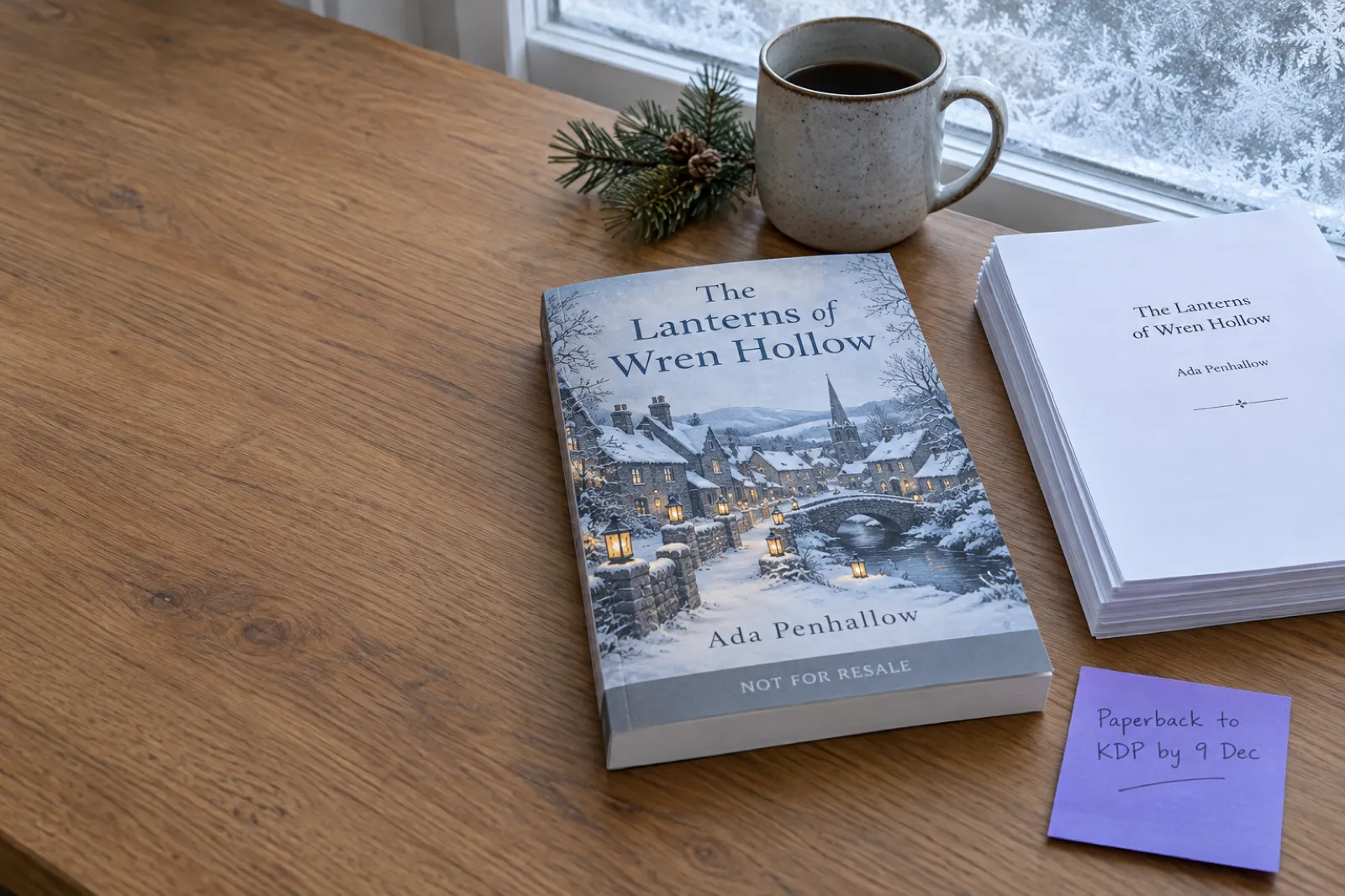
Can you publish before Christmas?
Possibly, but be honest with yourself about the edit. Our KDP publishing calendar counts back from 25 December. To be in Amazon search for the main Christmas shopping window, a book should have been live by about 10 November, which a November draft can't do. After that, as of 19 October 2026, the calendar's last practical dates are about 9 December to submit a Christmas paperback so it can still catch the last delivery dates, and 16 December for a Kindle ebook to be live and in search a few days before Christmas.
That works best for short books with a seasonal hook: a Christmas novella, a holiday romance, or a picture book (see personalised Christmas books for kids). For a full-length novel, January gives you time for a proper edit and a printed proof (paperback publishing on KDP), and a book published well beats a book published fast. Thinking about Kindle Unlimited, now called Kindle+? Kindle+ for authors explains what changed this month.
Once the ebook is out, the same file can become an audiobook; our AI audiobook generator narrates it chapter by chapter, and where to sell an AI audiobook lists the stores that accept labelled AI narration.
Turn your November draft into a finished book
Import your manuscript into Inkfluence AI, run a chapter review on the free plan, and export Kindle-ready files when the book is ready. The whole-book editorial letter is on Creator ($9.99 a month).
Import my draftFrequently asked questions
Is NaNoWriMo still running in 2026?
No. The National Novel Writing Month nonprofit announced at the end of March 2025 that it was closing, citing money problems after several difficult years. The idea of writing 50,000 words in November carries on through other challenges, including ProWritingAid Novel November, the Reedsy Novel Sprint, the volunteer-run NaNo 2.0, World Anvil NovelEmber and AutoCrit Novel 90.
What is the best NaNoWriMo alternative in 2026?
It depends on what you want from November. For cash prizes, the Reedsy Novel Sprint ($5,000, $2,500 and $1,000, writing inside Reedsy Studio). For the classic community feel with any writing app, NaNo 2.0 (free, volunteer-run, 16 and up). For the biggest crowd and automatic tracking from Word, Scrivener or Google Docs, ProWritingAid Novel November. For a gentler pace, AutoCrit Novel 90 gives you 90 days.
Which November writing challenges allow AI?
None of the challenges we checked invites AI-written words. The Reedsy Novel Sprint and Freewrite NotNoWriMo ban AI, AutoCrit Novel 90 says it is not for writing books with AI, and NaNo 2.0 asks writers to create without AI in November. ProWritingAid Novel November, World Anvil NovelEmber, the Dabble 60-Day Novel Challenge and First Draft November publish no AI rule for participants, so check with the organiser before counting anything AI wrote.
Can I use AI to plan my novel for a no-AI challenge?
The bans we found are about the words you write and count. Reedsy says it will know if you copy and paste or use AI in Studio; Freewrite asks for 50,000 words without generative AI. Neither page spells out whether brainstorming or outlining with AI before November is acceptable, so if it matters to you, ask the organiser and follow their answer. Keeping every counted word your own is the safe line.
How many words a day do I need to write 50,000 words in November?
1,667 words a day if you write all 30 days. If you write only on weekdays, November 2026 has 21 of them, so you need about 2,381 a day. Writing six days a week (25 days) needs 2,000 a day, and taking Thanksgiving and the day after off (28 days) needs about 1,786.
Is 50,000 words a novel?
Just. A novel is usually defined as 40,000 words or more, and most published novels run 70,000 to 110,000 words depending on genre. A 50,000-word November draft is a short novel or a strong first draft of a longer one.
Can I publish my November novel on Amazon KDP before Christmas?
Yes, if you move quickly. To be in search for the main Christmas shopping window, a book should have been live by about 10 November. After that, our KDP publishing calendar (as of 19 October 2026) puts the last practical dates at about 9 December to submit a Christmas paperback and 16 December for a Kindle ebook. A book drafted in November usually needs editing first, so many authors aim for January instead.
Do I have to tell Amazon if I used AI to write my book?
KDP asks you to disclose AI-generated content: text, images or translations created by an AI tool, even if you edited them afterwards. Text you wrote yourself and then edited or checked with AI tools counts as AI-assisted, and KDP says you do not need to disclose that.
Can I write and publish a book with AI in 30 days?
Yes, outside the no-AI challenges. A realistic 30-day plan is one week to plan and outline, one week to draft and read every chapter, one week to rewrite in your own voice and review, and one week to edit, format, design the cover and submit. The time goes into reading and rewriting, not generating.
Whatever you write this November, finish it
Write every word yourself in a challenge, or use AI on your own project and spend the month making it yours. Either way, Inkfluence AI is there in December for editing, formatting and publishing.
Start freeSources
Each challenge page was read on 28 October 2026. Where a page would not load for us, the row says so.
- ProWritingAid: Novel November 2026 (dates, 50,000-word goal, tracking, badges, "Join 100,000 writers worldwide")
- ProWritingAid Help: What is Novel November?
- Reedsy: NaNoWriMo guide and the Reedsy Novel Sprint 2026 (AI rule, prizes, age and language rules; also the source for the Order of the Written Word and Novlr Draftsgiving details)
- NaNo 2.0: FAQ (all-volunteer, free, 16 and up, AI wording)
- NaNo 2.0: Our 2026 round-up of writing communities and challenges (also the source for Freewrite's "without the use of generative AI")
- Freewrite: NotNoWriMo (did not load for us on 28 October; rule confirmed from the round-up above)
- AutoCrit: Novel 90 writing challenge, fall 2026 (dates, 18+, AI answer in the FAQ)
- World Anvil: What is NovelEmber? (honour system, rebel goals, certificate; page blocked automated reading, details from its published summary)
- Dabble: 60-Day Novel Challenge
- First Draft November (90 pages, 1 to 30 November 2026)
- Literary Hub: NaNoWriMo is shutting down (1 April 2025)
- CBC: National Novel Writing Month defended the use of AI. Now authors are stepping down from its board (September 2024)
- KDP: Content Guidelines, artificial intelligence content (AI-generated vs AI-assisted)
Related reading
- How to Write a Book with AI in 2026
- Can AI Write a Novel?
- Best AI Tools for Long Novels
- How Many Words Are in a Novel?
- How Many Pages Is a Novel?
- Book Outline Generator and Writing Prompt Generator
- KDP Publishing Calendar
- Prix Pascal, a literary prize that asks entrants to say how they used AI
- Inkfluence for first-time authors

Founder, Inkfluence AI
Sam is the founder of Inkfluence AI. He built the platform to make book creation accessible to everyone - from first-time authors to seasoned publishers.
Helpful links

Ready to write your own book?
Write with AI, make it yours, and export PDF, EPUB and KDP-ready files from one project.
Keep reading
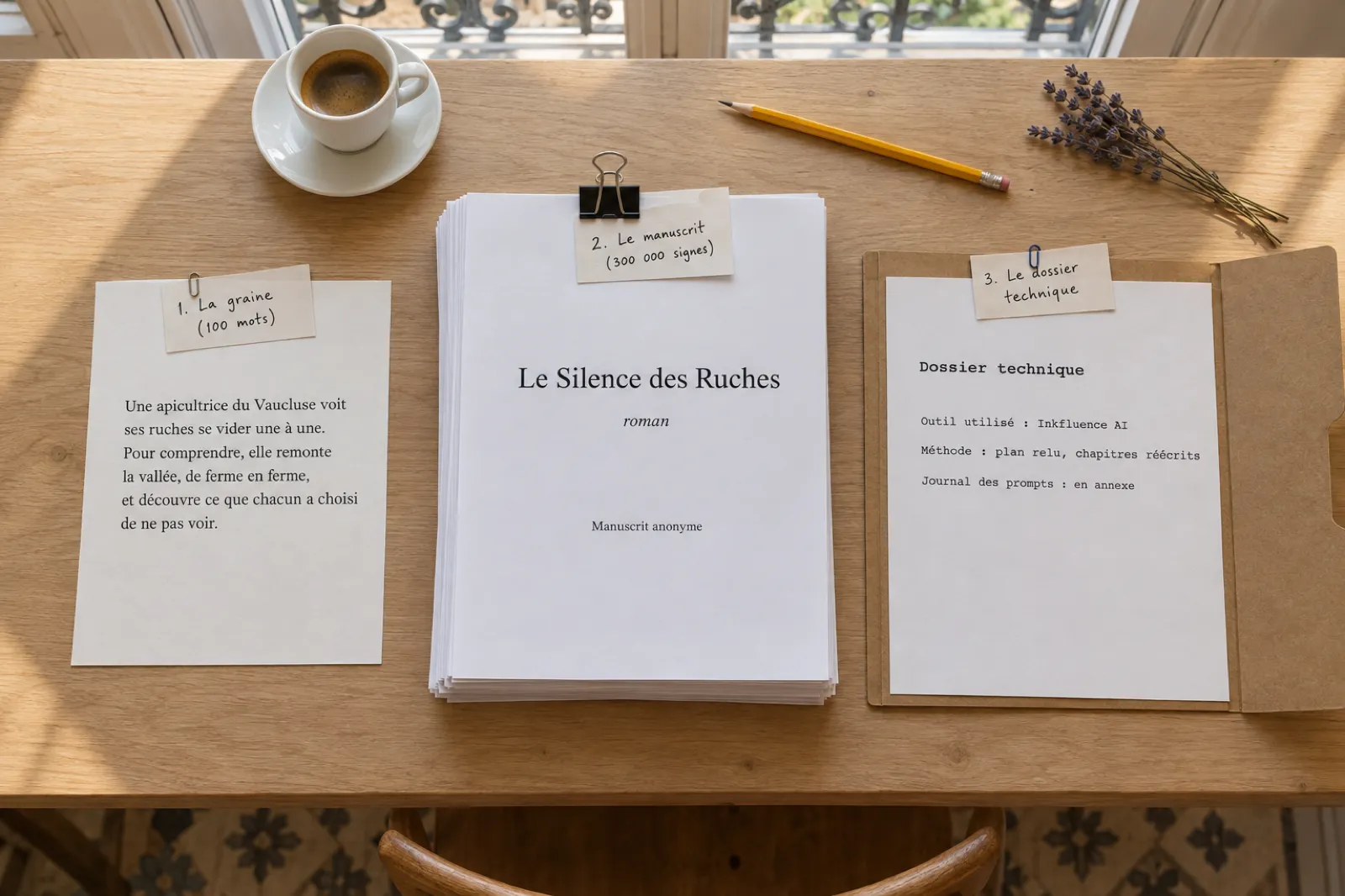 AI Writing
Prix Pascal: The New Literary Prize for Novels Written with AI, and How to Enter by 30 November 2026
France's new Prix Pascal is a literary prize that asks entrants to say how they used AI instead of hiding it. The rules in plain English, what 300,000 characters means in words and chapters, the technical file, and a five-week plan to submit a French novel on time.
 AI Writing
Sudowrite vs Novelcrafter (2026): Price, Built-in AI vs Your Own Key, Story Bible vs Codex
Sudowrite ($10 to $59 a month, AI built in) against Novelcrafter ($4 to $20 a month, AI from your own provider): price, how the AI is paid for, Story Bible against Codex, drafting, editing, export and series, read on both vendors' sites on 17 October 2026, with a picker.
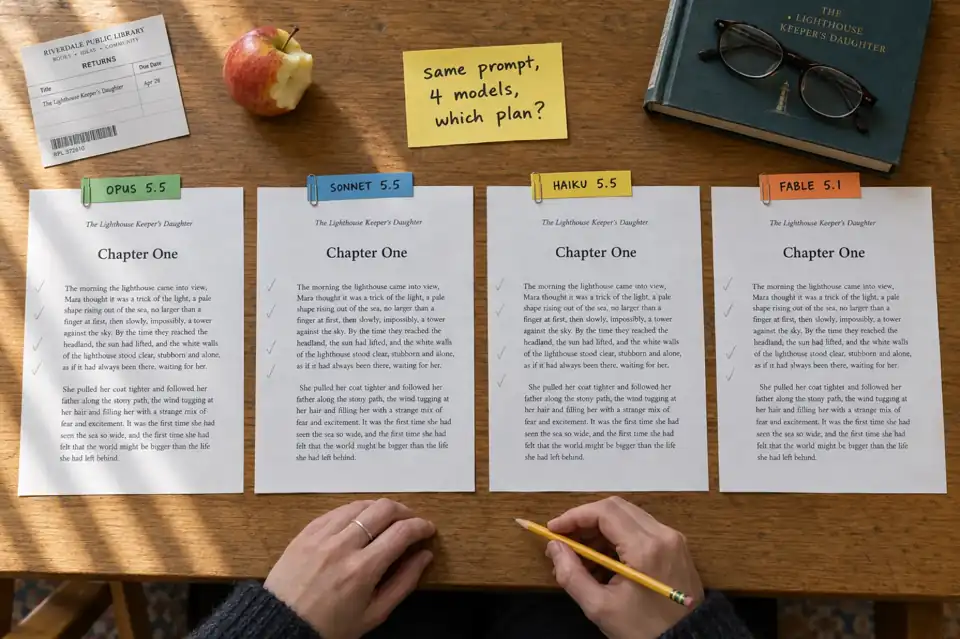 AI Writing
Which Claude Model Is Best for Writing? Opus 5.5, Sonnet 5.5, Haiku 5.5 and Fable 5.1 Compared (October 2026)
Which Claude model should you write with in October 2026? Opus 5.5, Sonnet 5.5, Haiku 5.5 and Fable 5.1 compared on what Anthropic actually publishes: which plan includes each one, API prices, context and output limits, speed, and what each is built for. Plus the maths of fitting a whole book, and when a book tool is the better pick.

Get ebook tips in your inbox
Join creators getting weekly strategies for writing, marketing, and selling ebooks.