
Plot Generator
A free story idea generator that gives you whole plots, not fragments. Pick a genre, a tone and a shape, then write the book from the one you like.
Three complete plots per click · Twist on or off · Seven protagonist types · Send any plot to the book writer
Quick Answer
A plot generator gives you a complete story idea to write from: a main character, what they want, the event that forces them to act, the opposition, a turn in the middle and an ending. This one builds three plots per click from hand-written lists for ten genres, free and unlimited, with filters for tone, story shape, twist and protagonist type. When one fits, Write this book sends it to Inkfluence AI, which builds the outline and story bible and writes the chapters. Writing dark romance or fanfic? Those have their own generators.
Live Tool
Generate a plot
Set the filters, or leave them on Any, and press Generate. Three new plots every time, as many times as you like.
Plots are put together in your browser from hand-written lists, so you can generate as many as you like. Write this book opens the plot in the Inkfluence AI dashboard as your book idea, ready to edit before anything is written.
Direct answers about the plot generator
The questions writers ask first.
Is there a free plot generator with no limit?
Yes. The Inkfluence AI plot generator is free, needs no sign-up and has no cap. Each click gives three complete plots, and you can click as often as you like.
What filters does it have?
Genre (ten plus a mixed option), tone (light, balanced or dark), story shape (short, novella, novel or series opener), a twist switch, protagonist type (seven) and an optional character name.
Can I turn a generated plot into a book?
Yes. Write this book sends the plot to the Inkfluence AI dashboard as your book idea. It builds an outline and story bible, then writes the chapters. The free plan covers the first 5 chapters.
Does it work for romance, horror and fantasy?
Yes. Each genre has its own lists of characters, settings, inciting events, obstacles and twists, so a horror plot reads like horror and a romance plot is built around two people.
What a Plot Generator Gives You (and What It Doesn't)
Most writers who search for a plot generator are not short of imagination. They have half an idea, or six, and none has turned into something they could start writing tomorrow. The missing piece is usually structure: who the story is about, what that person wants badly enough to act, and what stands in their way. A plot generator supplies those parts in combinations you would not have reached alone, which is often enough to unstick the idea you already had.
It helps to separate four words that get used as if they mean the same thing. A story idea is a spark: an image, a what-if, a character. A premise is the idea with a situation attached ("a lighthouse keeper finds a map of a road that no longer exists"). A plot adds desire, opposition, stakes and an ending, so you know what happens and why it matters. An outline breaks the plot into chapters. This tool gives you a full plot, which is the stage most generators skip. For the chapter-by-chapter stage, the book outline generator takes over.
What a generator cannot give you is the reason the story matters to you. Use each plot as something to react to: you read it, think "no, but what if the mentor was her mother", and that reaction is the start of your book.
You can use any plot you generate as your own. In the US, copyright protects the way a story is written, not the idea behind it: the Copyright Office's Circular 33, Works Not Protected by Copyright, lists ideas and concepts among the things copyright law excludes (checked 4 Oct 2026). That is why two writers handed the same premise end up with two different books, and why changing the details of a generated plot is encouraged rather than required. This is general information, not legal advice.
The generator here covers ten broad genres. Some subgenres need controls of their own, so they have their own tools: the dark romance plot generator handles tropes, heat level and boundaries, and the fanfic plot generator builds prompts around a pairing and a trope for any fandom. If you want more say over horror or science fiction premises, the horror story generator and the sci-fi story generator add genre-specific choices.
How the Plot Generator Works
Each genre has its own lists of characters, settings, inciting events, goals, stakes, obstacles, midpoints and twists. The filters choose which lists it draws from.
Set the filters
Choose a genre or leave it on Any for a mix, then pick the tone, the story shape, whether you want a twist and what kind of main character. Add a name if you already have one in mind.
Generate three plots
Each click builds three complete plots, each with a logline, the opposition, a midpoint, a low point, an ending and, for longer shapes, a subplot. Click again for three more. There is no limit.
Send one to the writer
Click Write this book on the plot you like. It opens in the Inkfluence AI dashboard as your book idea, where you can change anything before you start.
Outline, write, edit, export
Inkfluence AI builds the outline and story bible, writes the chapters, and you edit in the built-in editor. Export a PDF on the free plan, or EPUB and Word on a paid plan.
What each filter changes
- Genre picks the lists. A mystery draws from crimes, closed settings and witnesses; a romance from two leads and the thing keeping them apart. Any gives you three different genres per click, which is a good way to find a genre you had not considered.
- Tone sets how the plot ends and how the book is described when you send it to the writer. Light plots end with a win that is earned; dark plots end with the goal reached and something precious lost. Romance keeps its happy ending at every tone and pays for it instead.
- Story shape sets how much plot there is. Short gives one problem with no subplot. Novella adds a second thread. Novel adds a subplot that collides with the main plot near the end. Series opener resolves the main plot and leaves one larger question open for book two. For a sense of scale, the Nebula Award rules from the Science Fiction and Fantasy Writers Association count a novella as 17,500 to 40,000 words and a novel as 40,000 words or more (checked 4 Oct 2026).
- Twist adds a reveal written for the genre, or leaves the story straight.
- Main character shapes who the story is about. An expert fails differently from an outsider; an antihero wants the right thing for the wrong reasons. Young and older leads change the whole cast around them.
What Makes a Plot Workable: Six Questions
A plot you can actually write answers six questions. Plenty of exciting ideas fail two or three of them, which is why they stall at chapter three. Every plot the generator builds answers all six, and you can use the same list to test an idea of your own.
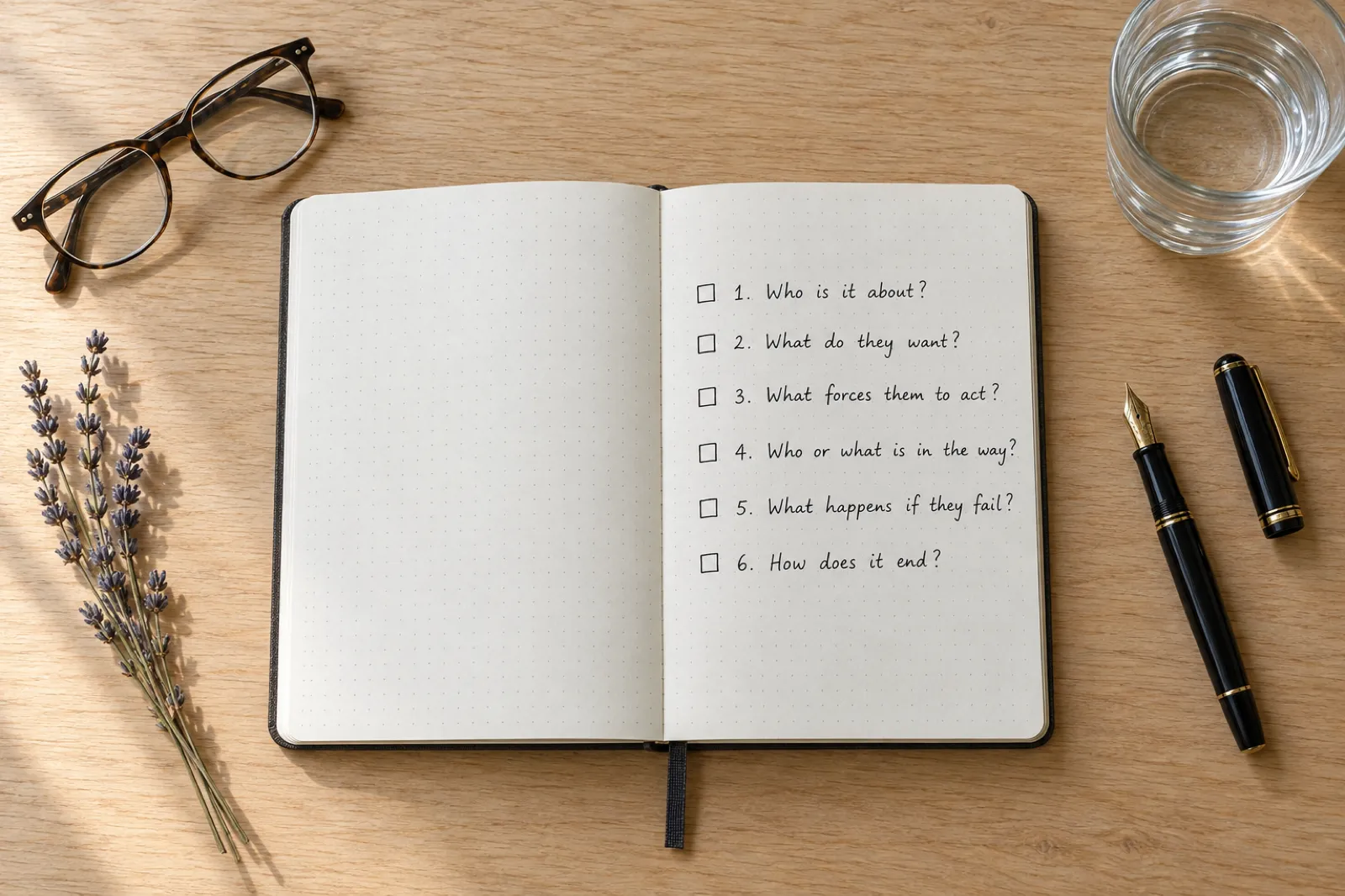
1. Who is it about?
One person whose point of view carries the story, with a job, a situation or a flaw that makes them a particular person rather than "a woman" or "a soldier". The detail should matter to the plot: a retired postmistress notices postmarks; a debt collector for a thieves' guild knows who owes whom. When the generator gives you "a famously exacting museum conservator", that adjective is a promise that her precision will be tested.
2. What do they want?
A concrete goal you could film: find the killer, keep the bakery open, get the brother out of the capital. "Be happy" or "find herself" are themes, not goals. The concrete goal is what gives each chapter a direction, and the reader something to measure progress against.
3. What forces them to act?
The inciting incident. Something happens that the protagonist cannot ignore, and it happens early, ideally in the first chapter. A body in a locked church, a letter from a dead mother, a fake engagement that goes viral. If your idea has no inciting event, the story has a situation but no start.
4. Who or what is in the way?
Opposition with its own reasons. The best obstacles are people who want something that conflicts with the hero's goal and are not wrong to want it: a sergeant who needs the case closed, a family that would rather believe the lie. An obstacle that is just "bad" gives the hero nothing to think about.
5. What happens if they fail?
The stakes, ideally with a deadline. "Before the coronation in thirty days" does two jobs: it tells the reader what is lost and when. Stakes tied to a named person land harder than stakes tied to a kingdom.
6. How does it end?
You do not need the final scene, but you need the shape: does the hero get what they want, and what does it cost? Knowing the ending lets you plant what the climax needs. It is the single most useful thing to decide before you write, and the one most often left open.
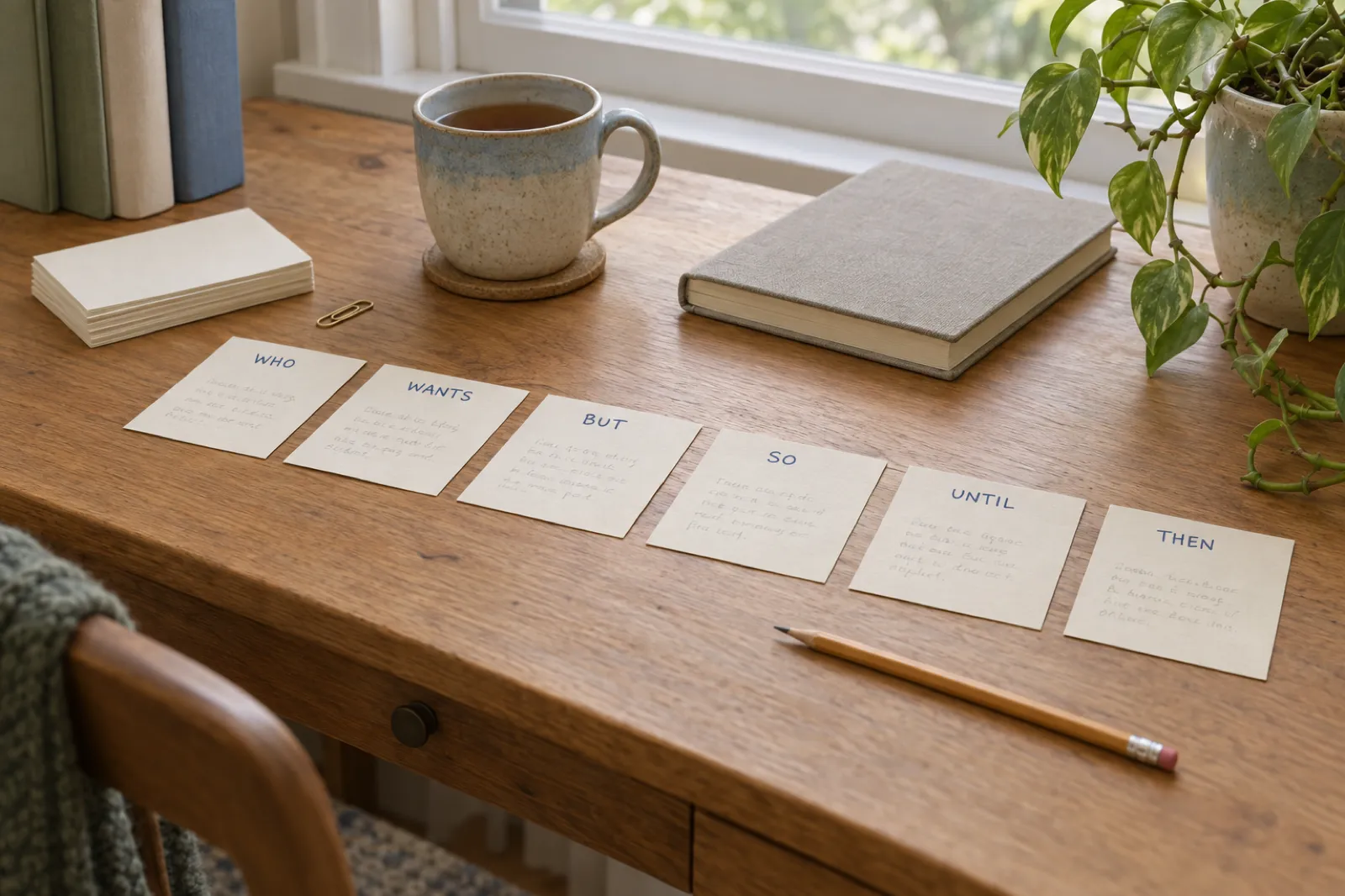
The six cards in the photo at the top of this page are the same test in sentence form: who (a character) wants (a goal) but (an obstacle) so (what they do about it) until (the turn) then (the ending). Teachers use a version of it for summarising stories; it works just as well for building one.
Plot Structures, and Which One Your Idea Needs
A structure is a map of where the big turns go. You do not have to follow one, but knowing them helps you spot why a draft feels slow or rushed. Every plot from the generator fits the first two without changes.
| Structure | Shape | Best for | In chapters |
|---|---|---|---|
| Three acts | Setup (about the first quarter), confrontation (the middle half), resolution (the last quarter). | Almost anything. The default for thrillers, romance and most commercial fiction. | In a 20-chapter book: chapters 1-5 set up, 6-15 escalate with the midpoint near 10, 16-20 resolve. |
| Seven-point structure | Hook, first plot turn, first pinch, midpoint, second pinch, second plot turn, resolution. Popularised by author Dan Wells. | Writers who plan the ending first and work backwards. | Write the resolution and the hook as opposites, then place the midpoint between them. |
| The hero's journey | Ordinary world, call, refusal, mentor, crossing over, tests, ordeal, reward, the road back, return changed. From Joseph Campbell, adapted for writers by Christopher Vogler. | Fantasy, science fiction and quest stories. | The ordeal sits around two thirds through, not at the end. |
| Save the Cat beat sheet | Fifteen beats from opening image to final image, from Blake Snyder's screenwriting guide, with page-percentage targets. | Pacing-sensitive genres: thriller, romance, YA. | Useful as a check: if the catalyst lands after chapter 4 of 20, the opening is slow. |
| Kishotenketsu | Four parts: introduction, development, a turn that recasts what came before, and a conclusion. Drawn from Chinese and Japanese poetry; conflict is optional. | Quiet literary fiction, slice of life, short stories. | The turn does the work a villain does in other structures. |
| Two stories (mystery) | The story of the crime, told backwards, and the story of the investigation, told forwards. | Mystery, crime, true-crime style fiction. | Plan the crime in full first, then decide which chapter reveals each piece. |
Where two of these come from: the hero's journey is Joseph Campbell's "monomyth" from The Hero with a Thousand Faces (1949), a pattern he saw as common to heroic tales across cultures; the Joseph Campbell Foundation has a short history of the book. Kishotenketsu describes the four-part structure of many classic Chinese, Korean, Japanese and Vietnamese narratives, and its Wikipedia entry notes that it does not centre on conflict the way the three-act structure does (both checked 4 Oct 2026).
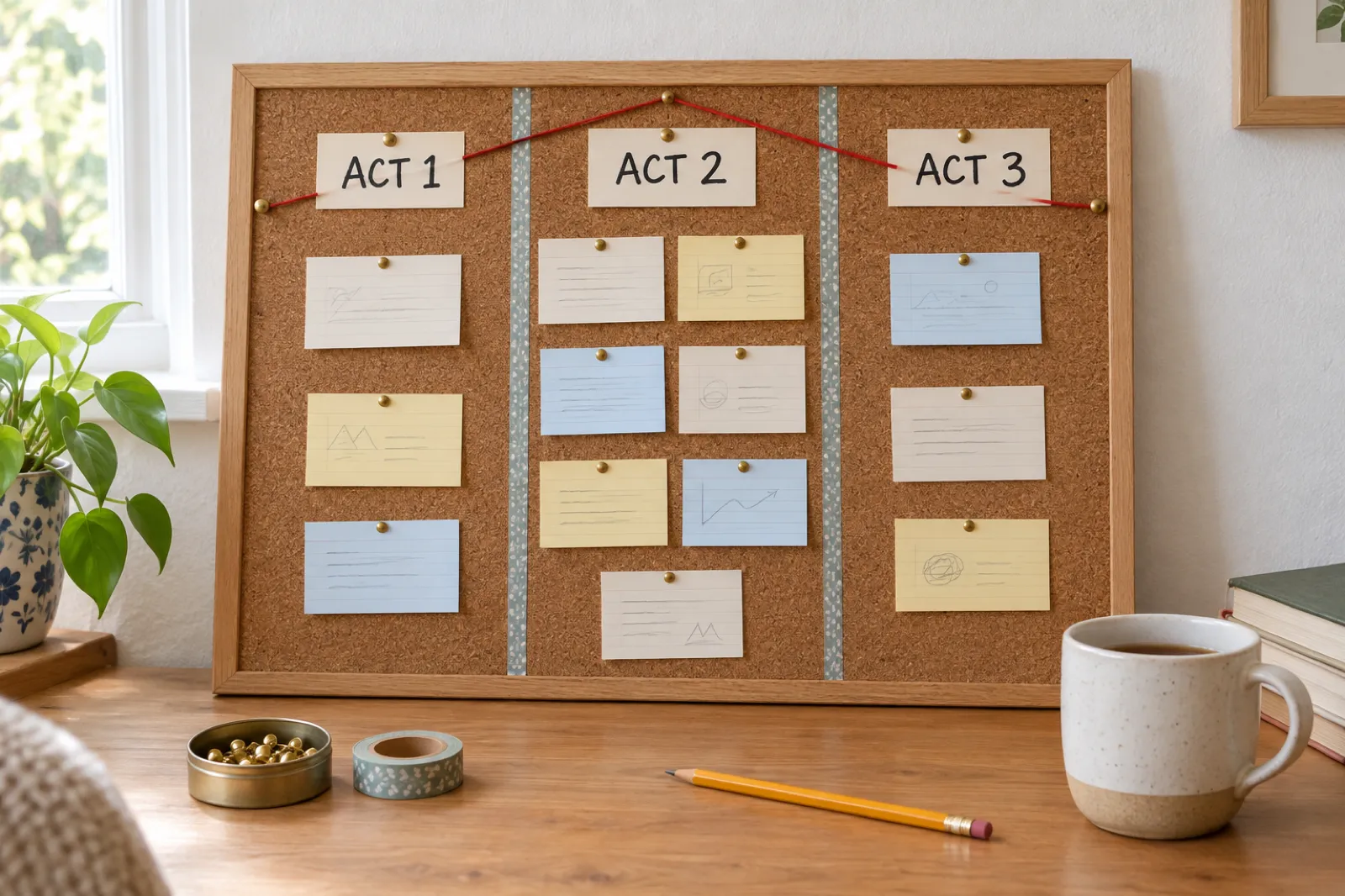
How the generator's parts map onto three acts
The logline holds Act 1: the inciting event, the protagonist and the goal. The opposition and the midpoint fill Act 2, the long middle where most drafts lose their way. The midpoint is placed there deliberately: it changes what the protagonist knows or wants, so the second half of the book is not a repeat of the first. The low point closes Act 2, and the ending is Act 3. If the twist is on, it usually belongs just before or inside the climax, where it recasts what the reader has seen.
For a novel, the subplot runs alongside, ideally touching the main plot at the midpoint and colliding with it at the climax. A subplot that never meets the main plot is a second book sharing pages with the first. For a series opener, the open thread should be introduced early and stay quiet, so that the last chapter can bring it forward without feeling bolted on. The guide to writing a book series with AI covers how to carry characters and open threads from one book into the next.
What a Plot Needs in Each Genre
Genre is a promise to the reader about what kind of experience they will have. The generator's lists are written to keep those promises. Here is what each genre's plot has to deliver.
Fantasy
A fantasy plot lives or dies on one rule of the world that costs something. Magic that is free solves every problem; magic with a price creates plot. The generator pairs a place with a disruption of its order (a forged treaty, a river that powers spells running dry) because fantasy readers expect the world itself to be at stake.
Write it with the AI fantasy novel writer →Romance
The plot is the relationship. The external problem (a shop to save, a fake engagement, a snowstorm) exists to keep two people in the same room while the thing keeping them apart is worked through. Romance readers expect a happy or hopeful ending, so the generator's dark tone shifts the cost rather than the outcome.
Write it with the AI romance novel writer →Mystery
A mystery plot is a fair contest between the reader and the author. Every clue the detective uses must be on the page before the reveal. The generator's mystery twists recast evidence rather than inventing new evidence, because a solution the reader could not have reached feels like a cheat.
Write it with the AI mystery and thriller writer →Thriller
Thrillers run on a clock and a cost. Mysteries ask who did it; thrillers ask whether the hero can stop it in time. Every thriller plot here carries a deadline or a threat to someone the protagonist loves, and the midpoint usually moves the deadline closer.
Write it with the AI thriller writer →Horror
Horror plots need a rule the threat follows and a reason the protagonist cannot just leave. The generator gives both: a setting that traps, and an incident that makes staying a choice with a cost. For more horror controls, including how much of the entity is ever shown, the horror story generator goes deeper.
Write it with the horror story generator →Science fiction
One technology or discovery, taken seriously, drives the plot. The best science fiction plots ask what that one change does to ordinary people. The generator keeps each plot to one big idea (a backup consciousness, a predictive city) so the story has room to follow its consequences. The sci-fi story generator adds controls for how hard the science is.
Write it with the sci-fi story generator →Contemporary and literary
The conflict is mostly internal and the stakes are personal: forgiveness, grief, a family house about to be sold. These plots still need an event that forces a choice, or the book drifts. The generator always supplies one, usually a person arriving or a letter that cannot be ignored.
Write it with the AI novel writer →Historical
The period is not just scenery; it limits what the protagonist can do, and that limit is the engine of the plot. A woman in 1812 cannot simply walk into a magistrate's office and demand answers. The generator's historical obstacles come from the period itself: a magistrate who wants a quick conviction, a society that will not let someone like them ask questions, the slowness of letters.
Write it with the AI novel writer →Young adult
YA plots put a teenager's first big choices at the centre, usually with adults absent, unreliable or part of the problem. The stakes feel total because, at that age, they are. The generator keeps YA protagonists teenage whatever type you pick.
Write it with the AI novel writer →Comedy
Comic plots start with one lie or one mistake and escalate it logically. The joke is that every sensible decision makes things worse. The generator's comedy incidents are mostly small, specific lies or mistakes with a public deadline, because escalation needs somewhere to go.
Write it with the AI novel writer →Looking for a dark romance plot generator, a spicy romance premise or a fanfic plot generator? Those subgenres have their own tools with the options they need.
How to Make a Plot Twist Fair
A good twist makes the reader want to go back to the start. A bad one makes them feel tricked. The difference is almost always whether the twist recasts what is already on the page or contradicts it. "The mentor caused the disaster" works if the mentor has been strangely well informed all along. It fails if the mentor was simply kind and then, in chapter twenty, evil.
Three rules keep a twist fair. First, plant at least three clues, spaced through the book, each of which has an innocent explanation at the time. Second, put the twist where it changes a decision: a reveal that arrives after everything is resolved is trivia, while one that arrives before the climax changes what the hero does. Third, make the twist cost something. If learning the truth changes nothing for the protagonist, it was a puzzle, not a plot point.
The twists in the generator fall into a handful of families. Knowing them helps you invent your own:
- The ally was the enemy (or the enemy was protecting them). The oldest twist there is, still effective when the clues are in plain sight.
- The timeline is wrong. The crime happened a day earlier; the letters were sent before the will changed. Strong in mystery, because it recasts every alibi at once.
- The identity is wrong. The body is not who everyone thinks; the protagonist is the copy, not the original.
- The goal was the problem. Lifting the curse dooms the city; the kingdom being saved started the war. These twists turn the ending into a real choice.
- Everyone knew. The village was playing along; the grandmother planned the meeting. Common in comedy and romance, where the twist is warm rather than dark.
Not every story needs a twist. Cosy romances, many literary novels and a lot of comedy work best when the reader can see what is coming and enjoys watching it arrive. That is why the generator has a switch.
From a Generated Plot to a Chapter Outline
A plot is a promise; an outline is the plan for keeping it. Here is the method I would use to turn any plot from the generator into a chapter outline you could write from. It takes about half an hour by hand, and it is roughly what happens when you send a plot to Inkfluence AI.

- 1. Rewrite the logline in your own words. Keep the structure (when X happens, Y must do Z before W) and change every detail that does not excite you. If you cannot make it excite you, generate again.
- 2. Fix the ending first. Decide whether the protagonist gets what they want and what it costs. The generator's ending line gives you a shape; make it specific to your characters.
- 3. Place the midpoint. Put it in the middle chapter. Ask what the protagonist believes before it and after it. That change in belief is the spine of the second half.
- 4. Give each chapter one event. An event is something that changes the situation: a discovery, a decision, a loss. A chapter with two big events usually wants splitting; a chapter with none usually wants cutting.
- 5. Thread the subplot. Give it three or four chapters of its own: introduce it early, complicate it at the midpoint, and resolve it at or just before the climax.
- 6. Plant the twist. List the three clues and assign each to a chapter before the reveal. Then check each clue reads as something else when it first appears.
- 7. Read the event list as a story. If each line follows from the one before because of a choice the protagonist made, you have a plot. If the lines could be shuffled without anything breaking, the chapters are episodes, and the cause-and-effect needs work.
A worked example
Here is a plot the generator can produce with Mystery, Balanced, Novel, twist on and an older lead: "When the village's richest man changes his will and dies the same night, Nell, a recently retired postmistress in a fishing town with one road in, must work out which of the heirs did it before the police close the case on the wrong person." Midpoint: two suspects confess to the same crime. Twist: the crime happened a day earlier than everyone thinks. Here is the same plot as twelve chapters, one event each.
| Ch. | The one event |
|---|---|
| 1 | Nell delivers a letter summoning three heirs to hear a new will. Old Mr Penrose asks her to stay and witness it. |
| 2 | Penrose is found dead the next morning. The doctor says his heart. Nell notices his post from yesterday is unopened. |
| 3 | The sergeant decides it was natural. Nell finds the witness copy of the will is missing from her own bag. |
| 4 | Nell visits each heir under cover of post rounds. Each has a reason to want the old will kept. |
| 5 | Toxicology comes back. It was poison. The sergeant arrests the grandson, the obvious suspect. |
| 6 | Midpoint: the eldest daughter confesses, then the housekeeper confesses too. Two confessions, one crime. |
| 7 | Nell works out each confession protects someone else. Both are lying about the same hour. |
| 8 | Low point: the sergeant warns Nell off and the village turns on her for meddling. |
| 9 | A postmark Nell has handled for forty years is a day wrong. The letters were sent before the will was changed. |
| 10 | Twist: Penrose died the night before everyone thinks. The man at dinner was someone else. |
| 11 | Nell lays the timeline out for the heirs and the sergeant. The impostor is in the room. |
| 12 | The killer is named. The grandson is freed. Nell posts the last letter Penrose wrote. |
Notice what the outline did with the plot. The protagonist's detail (forty years of handling post) became the skill that cracks the case in chapter 9, so the solution is planted rather than lucky. The twist has three clues before it lands: the unopened post in chapter 2, the missing witness copy in chapter 3, and the two confessions that cover the same hour. The low point in chapter 8 is social, not physical, which suits a village mystery. It is the six questions, answered, then spread across chapters.
If you would rather start with the chapter plan than build it yourself, paste your plot into the book outline generator. For a cast that stays consistent through the whole draft, the character bible generator and the story bible generator set down who everyone is and what the rules are before chapter one.
Six Plot Problems and How to Fix Them
Most stalled drafts have one of these. They are easier to fix in the plot than in chapter fifteen.
The middle sags
Add a midpoint that changes the goal, not just the difficulty. If the protagonist wants the same thing in chapter 12 as in chapter 3, the reader feels the repetition. A midpoint reveal (the ally was the person they were sent to find) gives the second half a new question.
The protagonist is passive
Check who causes each chapter's main event. If things keep happening to the hero, give them a decision at the end of each chapter that leads into the next. A plot is a chain of choices, not a list of events.
The solution arrives by coincidence
Coincidence can start a story but should never end one. Whatever solves the problem in the climax should be planted earlier: a skill shown in chapter two, an object handed over in chapter five.
The stakes are abstract
"The fate of the world" is weaker than "her brother hangs on Friday". Tie every large stake to one person or one place the reader has already met.
The ending answers a different question
Write down the question your logline asks (will she find the killer before the inquest?) and check the final chapter answers that question, yes or no. A satisfying ending can surprise, but it must answer what was asked.
Too many ideas in one plot
If you have a secret twin, a curse, a heist and a love triangle, you have four books. Keep the strongest, give the second a subplot, and save the rest. The generator gives one big idea per plot on purpose.
From a Plot to a Written Book with Inkfluence AI
The plot generator is free and stands on its own. If you want help with what comes next, this is what happens when you click Write this book.
The plot opens in the Inkfluence AI dashboard as your book idea. It is just text at this point, so change anything: the name, the setting, the ending. If you want a particular number of chapters, say so in the idea; the outline follows it. Then Inkfluence AI builds a chapter outline and a story bible: a summary of the plot, the characters, the key objects and any rules you set, which the writing checks against as it goes.
For fiction, chapters are written in order. Each chapter is planned against what earlier chapters have already put on the page, so a secret revealed in chapter 4 is treated as known in chapter 9, and a character who left town does not wander back into a scene by accident. Chapters usually run about 1,000 to 1,500 words each. There is no page or word target to set; the length of the book comes from the number of chapters.
When the chapters are written, you edit in the built-in editor, rewrite passages, and design a cover. The free plan includes 5 chapters to start and 5 more every month, with PDF export. Paid plans start at $9.99 a month and add more chapters, EPUB and Word export, and audiobook narration; see pricing for the details.
Once the book is written, the book title generator helps you name it and the book description generator drafts the blurb for the back cover or store page. For the full picture of drafting a novel this way, the AI novel writing guide walks through it from idea to export.
Plot Generator FAQ
What is a plot generator?
Is the plot generator free?
How does the generator build a plot?
Is a plot generator the same as a story idea generator?
Can I use a generated plot for my own book?
Can Inkfluence AI write the whole book from a plot?
How long will the book be?
Can it generate dark romance or fanfic plots?
What does the twist switch do?
Can I choose the main character's name?
Can the book be written in another language?
Related Tools
Book Outline Generator
Turn your plot into a chapter plan
Character Bible Generator
Who everyone is, before chapter one
Character Name Generator
Names for the cast of your plot
Dark Romance Generator
Dark romance plots, tropes and heat levels
Fanfiction Prompt Generator
Fanfic plots for any fandom and ship
Writing Prompt Generator
A smaller spark for a scene or sprint
Chapter Title Generator
Name the chapters once the plot is set
Book Title Generator
Name the book once the plot is set
AI Novel Writer
Write the whole novel from your plot
Related Reading
Guides for taking a plot further
AI Novel Writing Guide
From idea to outline to a finished, exported novel, step by step.
Can AI Outline and Write Chapters in Sequence?
Why writing chapters in order matters for a plot that holds together.
How Inkfluence AI Keeps a Book Consistent
The story bible and what it checks from the first chapter to the last.
How to Write a Romance Novel with AI
Turning a romance plot into beats, chapters and a satisfying ending.
Find the plot, then write the book
Generate as many plots as you like. When one is right, Inkfluence AI outlines it and writes the chapters, ready for you to edit. Free to start, no credit card.