
· Facts checked 24 Oct 2026
Fantasy Name Generator: Names With Meanings
Elf, dwarf, orc, dragon, halfling, fae and human names, and the kingdoms, cities and towns they live in. Every name comes with what it means, the word parts it is built from and how to say it, so your cast sounds like it comes from real places. Ten names a click, unlimited, nothing to sign up for.
By Sam May, Founder of Inkfluence AI
Quick answer
The fantasy name generator below is free, unlimited and needs no account. It writes names for eight peoples (elvish, dwarvish, orcish, draconic, halfling, fae, Old English and Norse humans, and Latin humans) and places for each of them (kingdoms, cities, towns and wild places). Each people is a small language of word parts with meanings, so every name has a meaning and a pronunciation and a cast sounds like it belongs together. When the names are ready, send them to the Inkfluence AI writer to become a book.
Generate fantasy names
Choose a people, or leave it on Any to mix them. Star the names you like; your shortlist stays while you keep clicking.
Example below. Press New names for your own; every click makes ten new ones.
-
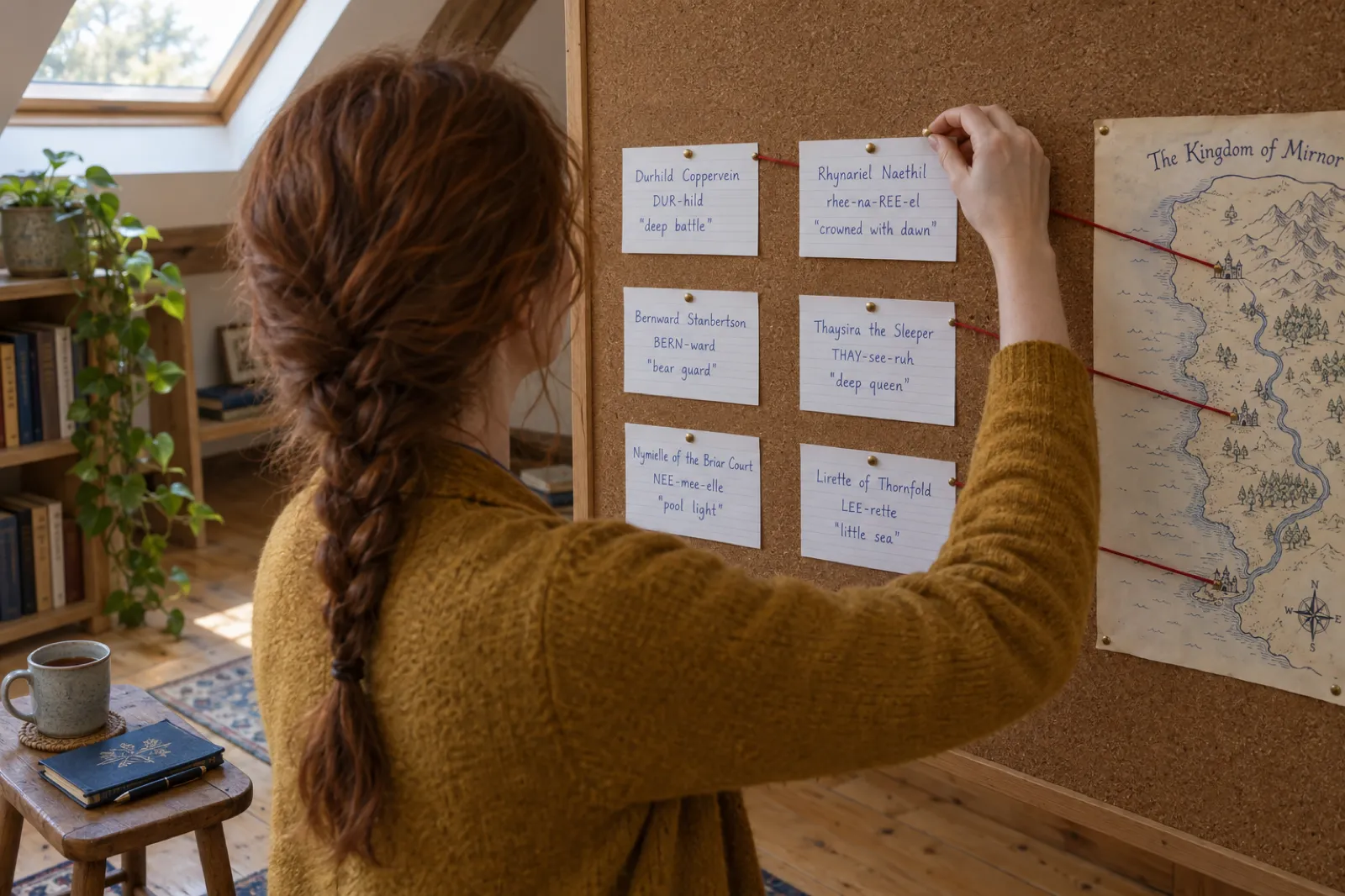
Thaysira the Sleeper
THAY-see-ruh · “deep queen”
Draconic (dragons) · tha = deep, ira = queen · the Sleeper: slept a thousand years
-
Nymielle of the Briar Court
NEE-mee-elle · “pool light”
Fae · nym = pool, elle = light · of the Briar Court: a court of thorns and bargains
-
Ethelfrid Ironhand
E-thel-frid · “noble peace”
Northern human (Old English and Norse) · ethel = noble, frid = peace · Ironhand: iron hand
-
Lirette of Thornfold
LEE-rette · “little sea”
Fae · lir = sea, ette = little · of Thornfold: a walled garden of thorns
-
Felian Quintonius
fe-LEE-an · “lucky”
Imperial human (Latin) · fel = lucky · Quintonius: line of the fifth
-
Bernward Stanbertson
BERN-ward · “bear guard”
Northern human (Old English and Norse) · bern = bear, ward = guard · Stanbertson: son of Stanbert (stone bright)
-
Durhild Coppervein
DUR-hild · “deep battle”
Dwarvish · dur = deep, hild = battle · Coppervein: copper vein
-
Rhynariel Naethil
rhee-na-REE-el · “crowned with dawn”
Elvish · rhyn = dawn, riel = crowned · Naethil: kin of the water
-
Linbin Applewick
LIN-bin · “linen”
Halfling · lin = linen · Applewick: apple farm
-
Leofmund Leofwardson
LE-of-mund · “dear protection”
Northern human (Old English and Norse) · leof = dear, mund = protection · Leofwardson: son of Leofward (dear guard)
Shortlist: none yet
Star names to keep them. The button below sends your shortlist (or the first four names) to the AI writer.
Write a book with these namesHow these names work
- Choose a people above to see its sounds, endings and how its family names work.
The fantasy name generator in numbers
8
peoples, each with its own small language
264
word parts, each with a meaning
372,398
full character names (from 5,050 given names)
1,666
kingdom, city, town and wild place names
Counted from the generator's own word lists on 24 Oct 2026: every distinct name that can actually appear, after the blocklist of well-known characters and real places and the sound filters have removed the rest.
What makes a fantasy name work
A good fantasy name does three jobs at once: it tells the reader which people a character belongs to, it is easy to hold in your head across four hundred pages, and it carries a little meaning the story can use. Tolkien famously built his languages first; in a 1955 letter to his American publisher he wrote that the invention of languages was the foundation and the stories came after. You do not need to go that far, but borrowing the principle (one small language per people) is the fastest way to make a world feel real. These are the six tests every name here is built to pass.
It can be said out loud
Readers sound names out in their heads. If they stumble every time, they stop reading the name and start skipping it. Every name here comes with a pronunciation, and the generator throws away clusters of four consonants or three vowels in a row.
It sounds like it belongs to a people
Names from one culture should share sounds and endings, the way English surnames share -son and -ton. That is the difference between a world and a list. Pick one language per people and stay in it.
It means something
A meaning gives you a nickname, a prophecy, a pun or a scene where a character explains their name. Every name here is built from parts with meanings, so you always have one.
It does not look like another name in the book
Two main characters who share a first letter or a syllable count (Kael and Kaela, Torin and Toren) blur on the page. Use Starts with to give each lead a different first letter.
It fits the role
Short, hard names read as blunt; long, soft names read as old or noble. A dragon called Bob is a joke, which is fine if you meant it.
It is not someone else's character
The generator blocks well-known names from books, films and games (Arwen, Smaug, Drizzt and over a hundred more) and real countries, but check anything you plan to publish. More on that below.
Names for elves, dwarves, orcs, dragons and more: the eight languages
Each people below has its own sounds, its own endings and its own idea of what a second name is. The examples are real output from the generator; press New names with that people selected for more.
| People | Sounds | Typical endings | Second names |
|---|---|---|---|
| Elvish | l, r, n, th, open vowels | -iel, -wen, -enna (daughters); -ion, -or, -ian (sons) | House names: -anor, -ethil, -aris |
| Dwarvish | k, g, d, r, z, closed syllables | -hild, -ra, -unn (daughters); -in, -ak, -rik (sons) | Clan names: metal or stone + craft or body part |
| Orcish | gr, sk, kr, zh, ug | -ka, -esh, -ra (daughters); -ak, -ush, -mok (sons) | Earned epithets, not family names |
| Dragon | x, th, s, v, r; three syllables or more | -ira, -yss, -essa (female); -thrax, -vyr, -oth (male) | Epithets from what the dragon did |
| Halfling | soft, short, homely | -a, -ie, -wyn (girls); -o, -in, -wick, -bert (boys) | Surnames: something grown or cooked + something on a farm |
| Fae | li, pim, wisp, sel, ny: small and bright | -ira, -elle, -wyn (female); -ix, -let, -bryn (male) | A court or a place: of the Briar Court, of Thornfold |
| Northern human | two real words fused | -hild, -run, -frid (women); -ric, -mund, -wulf (men) | Patronymics (-son, -dottir) or bynames |
| Imperial human | formal Latin roots | -ia, -ina, -ella (women); -ius, -an, -or (men) | Clan names in -ianus, -onius, or "house of" |
Elvish names
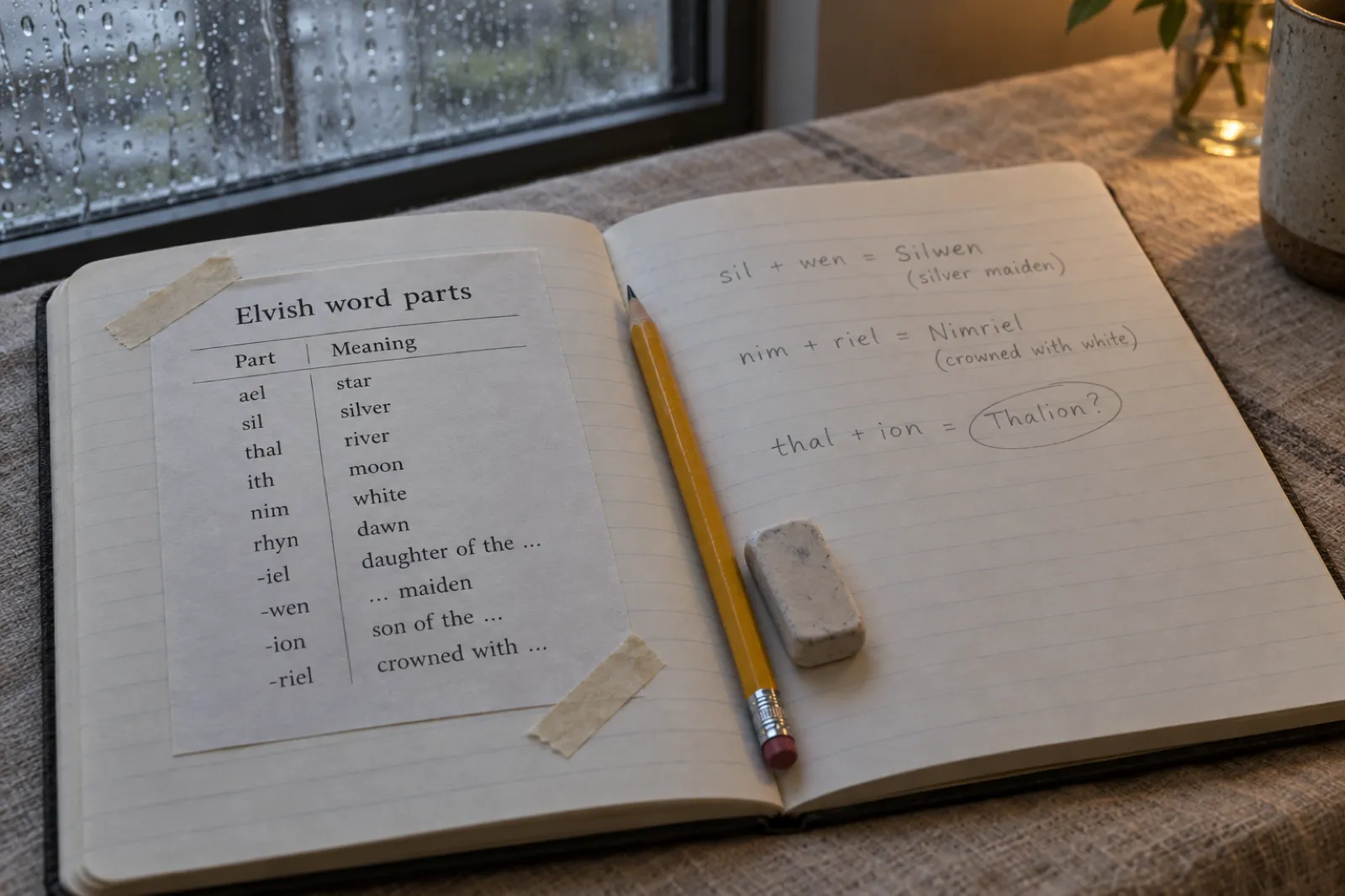
Elvish names in most fantasy borrow their music from Welsh and Finnish by way of Tolkien, and this language does too: many of its roots and endings follow his Sindarin (luin blue, nim white, -ion son of), because that is what readers hear as elvish. It builds names from 24 roots and 16 endings, and the endings carry the grammar: -iel is "daughter of the", -ion "son of the", -riel "crowned with". That is why Rhynariel means "crowned with dawn" rather than being a pretty noise. Stress falls on the second-to-last syllable, so long names still roll, and the names Tolkien himself used (Thalion, Tirion, Melian and the rest) are blocked.
Some word parts: ael star, sil silver, thal river, ith moon, rhyn dawn.
- Silanara Issethil
see-la-NA-ruh · “noble silver” - Lithiys Calanor
lee-THEE-is · “gift of the ash” - Lithethir Serenaris
lee-THE-thir · “ash gaze” - Mirithir Rhynanor
mee-REE-thir · “jewel gaze” - Orost
a place · “mountain city” - The Ithlond Forest
a place · “moon shore”
Dwarvish names
Dwarf names are short and heavy because the people are: two syllables at most, closed by a consonant. The given name is the old language; the clan name is plain speech, a metal or stone fused to a craft or a body part (Coppervein, Anvildelve, Emberbeard). Readers parse a clan name instantly, which is useful when a battle scene has six dwarves in it.
Some word parts: bar stone, kaz hammer, thar iron, dur deep, gund war.
- Gora Coalfist
GO-ruh · “daughter of the forge” - Vondvi Emberbeard
VOND-vee · “vault flame” - Vondrik Stonehearth
VON-drik · “vault ruler” - Vondak Coalforge
VON-dak · “strong vault” - Gundelve
a place · “war delving” - Helpeaks
a place · “shield peaks”
Orcish names
An orc name should be shoutable across a battlefield. The generator keeps given names to two syllables, three at most, with a hard cluster up front, and gives orcs earned epithets instead of surnames: Gate-Breaker, Bone-Singer, the Patient. Each epithet comes with the deed behind it, which hands you a line of backstory for free. If your orcs are a people rather than a horde, the epithets do a lot of that work.
Some word parts: grak tusk, mog blood, skar scar, vok wolf, yazh fire.
- Urzara Iron-Jaw
UR-za-ruh · “war daughter” - Brugara Gate-Breaker
BRU-ga-ruh · “mud daughter” - Yazhar Gate-Breaker
YA-zhar · “fire-born” - Shakar the Patient
SHA-kar · “blade-born” - Ugrot
a place · “stone warren” - The Zagshak Wastes
a place · “spear wastes”
Dragon names
Dragons are old, so their names are long: three syllables at least, with hissing and rolling sounds. The endings carry rank (-thrax ruler, -vyr wyrm, -essa matriarch) and every dragon gets an epithet, because in most stories the epithet is what people actually say. A dragon called "the Sleeper" tells your reader something a name alone cannot.
Some word parts: vael storm, syr ancient, kor flame, mal shadow, ung hoard.
- Koraressa the Bargainer
KO-ra-res-suh · “matriarch of flame” - Ithanyss the Patient
EE-tha-niss · “frost mother” - Qoraroth the Patient
KO-ra-roth · “eternal thunder” - Isharoth the Patient
EE-sha-roth · “eternal ash” - Narax
a place · “red lair” - The Malvex Spires
a place · “shadow waste”
Halfling names
Halfling names sound like people who keep bees. Short given names, plain English surnames built from the kitchen and the field (Applewick, Barleyleaf, Teabottle). The comedy and the warmth are in the surname; keep the given name simple so the pair still sounds like a real person rather than a joke.
Some word parts: bram bramble, wil willow, hob hearth, fen marsh, mil mill.
- Milella Cloverkettle
MEE-lel-luh · “little mill” - Corie Mallowhollow
KO-ree · “heart” - Tamard Pepperkettle
TA-mard · “hardy twin” - Tambert Butterdown
TAM-bert · “bright twin” - Wenbury
a place · “fair market town” - Fenwood
a place · “marsh wood”
Fae names
Folklore says a fae creature's true name gives you power over it, so the names in stories are use-names: light, seasonal and a little strange. The generator pairs them with a court or a place rather than a family, since fae belong to courts. If a fae character's true name matters to your plot, generate two and keep one secret from the reader until the end.
Some word parts: li petal, vel moth, rue sorrow, tam dusk, briar thorn.
- Nyiwyn of Thornfold
NEE-ee-win · “river-blessed” - Quillawyn of the Bramble Gate
KWIL-la-win · “feather-blessed” - Mabibryn of Rowan Hollow
MA-bee-brin · “queen hill” - Veliock of the Moth Court
VE-lee-ok · “young moth” - Eryhollow
a place · “frost hill-hall” - Ashwood
a place · “ash tree wild wood”
Northern human names (Old English and Norse)
These are built the way real Anglo-Saxon and Norse names were: two words, each with a meaning. Ead + wulf is "wealth wolf", Sig + run is "victory secret". Because the parts are real, the names feel grounded, and some will be names real people carried (Aldric, Sigrun). Second names are patronymics built from a generated father, so "Bernward Stanbertson" is the son of Stanbert, "stone bright".
Some word parts: ead wealth, sig victory, ethel noble, bern bear, gisl pledge.
- Aldgyth Fairhair
ALD-gith · “old war” - Thordis Sigbertdottir
THOR-dis · “thunder goddess” - Thorbert the Unready
THOR-bert · “thunder bright” - Asbert Ethelulfson
AS-bert · “god bright” - The Kingdom of Thornrike
a place · “thorn realm” - Blackmere
a place · “black lake”
Imperial human names (Latin)
For an empire, a senate or an old church, Latin roots read as power and age. The generator uses real roots with their real meanings (aur gold, luc light, val strength) and Roman-style endings, so a court full of Valius, Celerina and Quintor sounds like it has paperwork. Some outputs will be names Romans used; that is the point.
Some word parts: aur gold, luc light, val strength, sol sun, sev stern.
- Tertella Quintonius
ter-TEL-luh · “little third” - Sevina Aquex
se-VEE-nuh · “little stern” - Octerian Novonius
ok-te-REE-an · “eighth” - Flavinian Ignonius
fla-vee-NEE-an · “golden-haired” - Domium
a place · “city of the lord” - The Verine Hills
a place · “true heights”
Need names from real-world cultures and eras instead (a Victorian maid, a Japanese detective, a 1920s jazz singer)? The character name generator covers fifteen cultures and seven eras with real meanings. For an author name to publish under, use the pen name generator.
Kingdom, city and town names that match their people
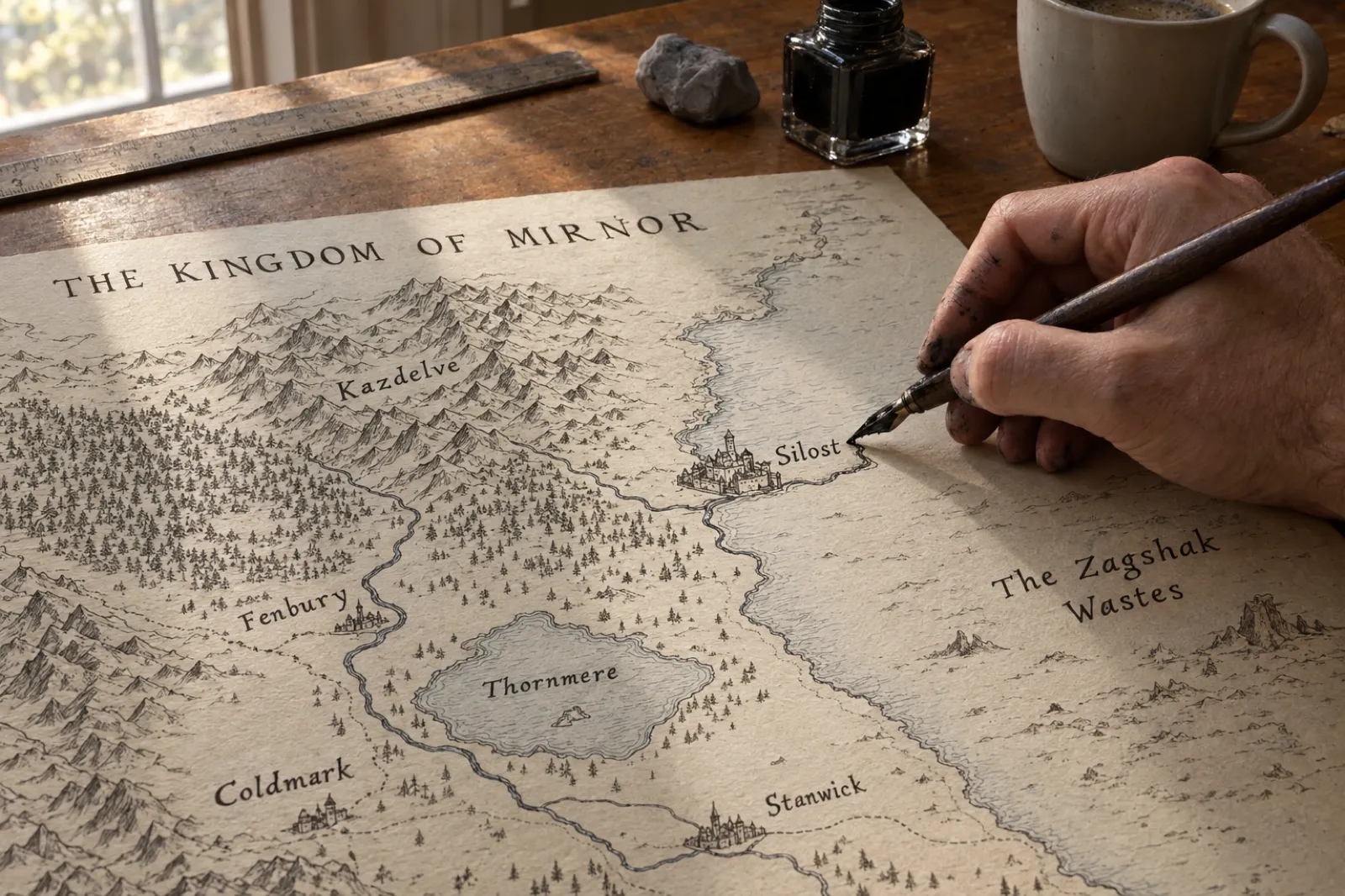
Real place names are descriptions that wore smooth: Oxford was a ford for oxen, and almost every English place ending in -by began as a Norse farmstead. Fantasy places work best the same way. Switch the generator to Places and it builds kingdoms, cities, towns and wild places from the same word parts as the people, so the elvish capital Silost ("silver city") sounds like the elves who live there, and the dwarf hold Kazdelve ("hammer delving") sounds like dwarves.
| English ending | What it meant | Generated example |
|---|---|---|
| -ford | a river crossing | Tobford (halfling) |
| -wick | a farm or trading place (Old English wic) | Ravenwick (Northern) |
| -by | a village or farmstead (Old Norse) | Coldby (Northern) |
| -thorpe | an outlying hamlet (Old Norse) | Elderthorpe (Northern) |
| -mere | a lake | Thornmere (Northern) |
| -burg, -bury | a fortified place | Ravenburg (Northern) |
| -holm | an island (Old Norse) | Wulfholm (Northern) |
Three tips for naming a map. First, name the big features after what people saw (the Grey Fells, the Salt Mere) and the towns after who founded them or what they traded. Second, keep conquest visible: a city that changed hands can carry an old elvish name with a newer human ending, which tells a history without a single paragraph of exposition. Third, give each region one dominant language, so a reader can tell from a place name alone whose territory the heroes are in.
D&D names: for player characters, NPCs and a campaign map
Tabletop players search for a D&D name generator for three moments: making a character, improvising an NPC the party suddenly cares about, and naming the town the party just walked into. The generator covers the classic fantasy peoples tabletop games use (elves, dwarves, halflings, orcs, dragons and humans) and the meanings are built for the table: a dwarf cleric called Bromdis ("mountain lady") of clan Anvildelve already has a line of backstory before session one.
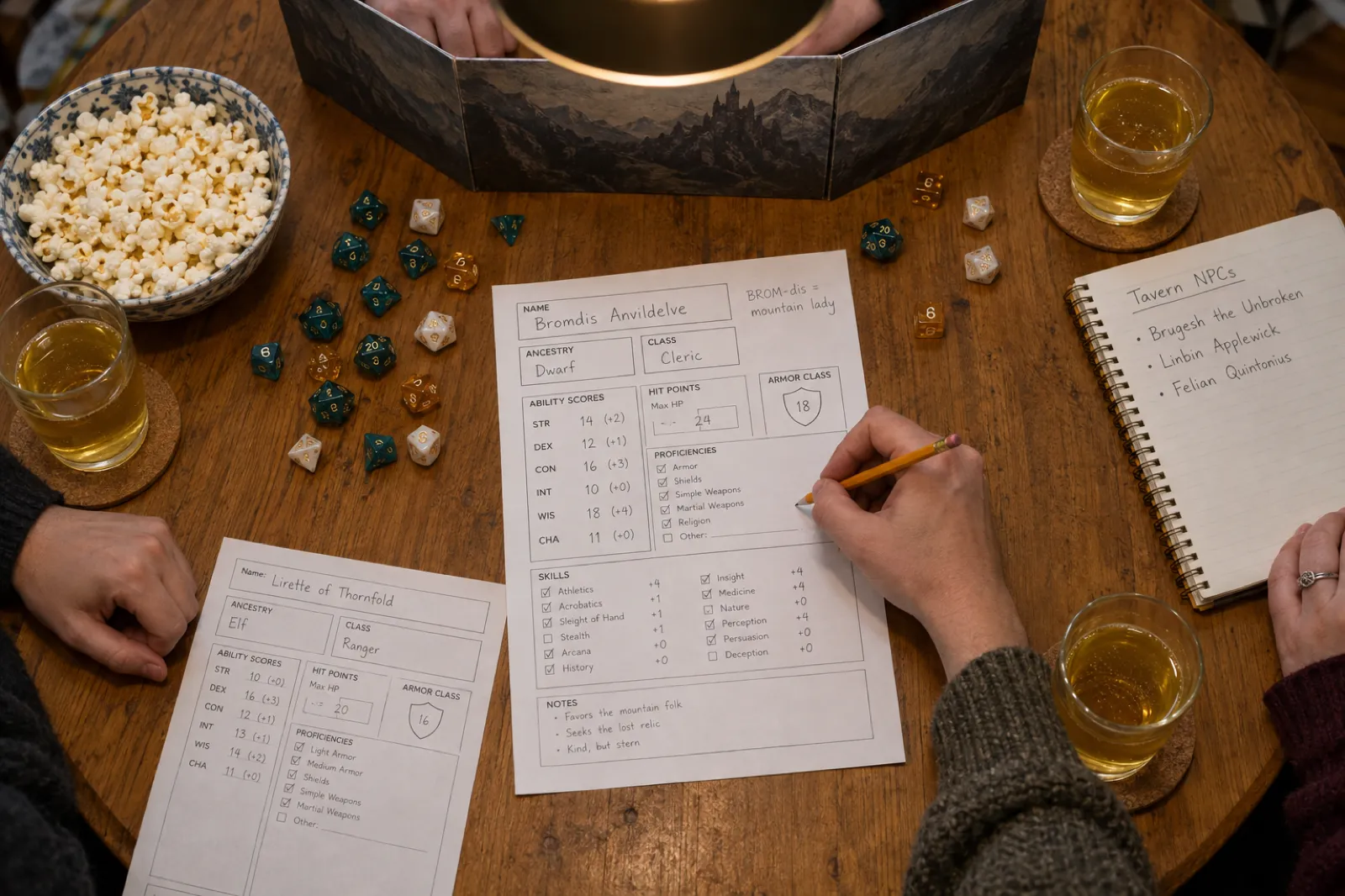
- Before the session: generate a list of ten names in each people your campaign uses and keep it behind the screen. When a player asks the innkeeper's name, you have one.
- For player characters: use Starts with so the party does not end up as Kael, Kira and Kesh.
- For NPCs with a motive: the random character generator adds what they want from the party and what they are hiding, with a name from this generator.
- For the villain: a dragon epithet (the Bargainer, Bane of Kings) is a hook for a whole arc.
- For the map: generate places in the people who rule each region, and keep the language consistent within a region.
Running a game that wants branching scenes? The interactive fiction generator plots a branching story in seconds, and the plot generator gives three full plots a click.
How to build your own naming language in seven steps
The generator's eight languages are a starting point. If your world has a people of its own, this is the method behind them, and it takes about twenty minutes.
- 1
Pick a people and a sound
Choose two or three sounds your culture loves and two it never uses. Elvish here loves l, r and th and never uses x or z.
- 2
Write ten roots
Ten short word parts with meanings: things your people care about. A river people needs words for water, ford and boat; a mountain people for stone, deep and hammer.
- 3
Write four endings
Endings carry grammar: daughter of, son of, keeper of, lord of. Four endings times ten roots is forty names, all clearly from the same language.
- 4
Decide how family names work
Patronymics (son of), house names, clan crafts, epithets or courts. This one choice says more about a culture than any history chapter.
- 5
Reuse the roots for places
A city of the river people should contain the word for river. When places and people share roots, readers feel the world is real without being told.
- 6
Write a pronunciation key
One line per sound that is not obvious. Put it in your notes now and in the back of the book later.
- 7
Keep a name list
Every name you use, who it belongs to and what it means. A story bible does this for you once the book is in Inkfluence AI.
Want the whole world in one place, not just the names? The story bible generator lays out characters, places, rules and history, and the character bible generator builds a profile for each name on your shortlist: voice, motivation, flaw and arc.
Seven fantasy naming mistakes, and how to avoid them
Apostrophes everywhere
An apostrophe should mean something, a glottal stop or a contraction. Scattered for flavour (K'thar'el), it tells readers the writer was guessing. None of the names here use them.
X, Z and Y as decoration
A few hard letters make a name feel foreign; a lot make it look like a password. Draconic uses x on purpose; elvish never does.
Three leads with the same first letter
Readers skim by shape. Kael, Kira and Kesh will be confused by chapter four. Use the Starts with box to spread your cast across the alphabet.
Names that mean nothing in a world that cares about meaning
If your characters talk about prophecy and true names, their names need meanings. Generate with meanings, then decide which ones the story mentions.
Borrowing a real culture without thought
Using a real living culture's naming tradition for a fantasy people raises questions of respect, especially for a people written as villains. The two human languages here use historical Old English, Norse and Latin; elvish follows the sound of Tolkien's invented Sindarin, and the rest are invented.
Accidental real words
Some generated names will be real words in a language you do not speak. Search a lead character's name before you commit to it. The generator blocks the obvious English problems.
Renaming late
Changing a name in chapter 30 means hunting every mention. Settle the main cast before you draft, then let the story bible keep it straight.
Is the name taken? Copyright, trademarks and publishing
In the United States a name on its own is not protected by copyright: the Copyright Office lists names, titles and short phrases among the things copyright does not cover. You can use any name from this generator in a book, a game or a campaign without credit or payment. Two cautions still apply.
- Trademarks. A name used as a brand (a series title, a game, a product) can be a registered trademark. Before you put a name on a cover or a box, search the USPTO trademark register or your country's equivalent.
- Famous characters. Calling your dark lord Sauron is legal in a narrow sense and a terrible idea in every other. The generator blocks over a hundred famous names, but it cannot know every book. Search a lead's name with "fantasy" and "book" before you commit, and check the Amazon store for a series with the same name.
If you publish on Amazon, KDP asks whether a book contains AI-generated text, images or translations. Names you picked from a list are not what that question is about, but if you use the AI writer for the book itself, our guide to the KDP AI disclosure policy explains what to tick. For the whole road from draft to store, see the self-publishing guide.
From a list of names to a fantasy novel
A cast list is often where a book starts: a name that sounds like a story. When you press Write a book with these names, the Inkfluence AI dashboard opens with your shortlist in the start box. Add a sentence about what happens, and the AI fantasy novel writer takes it from there.
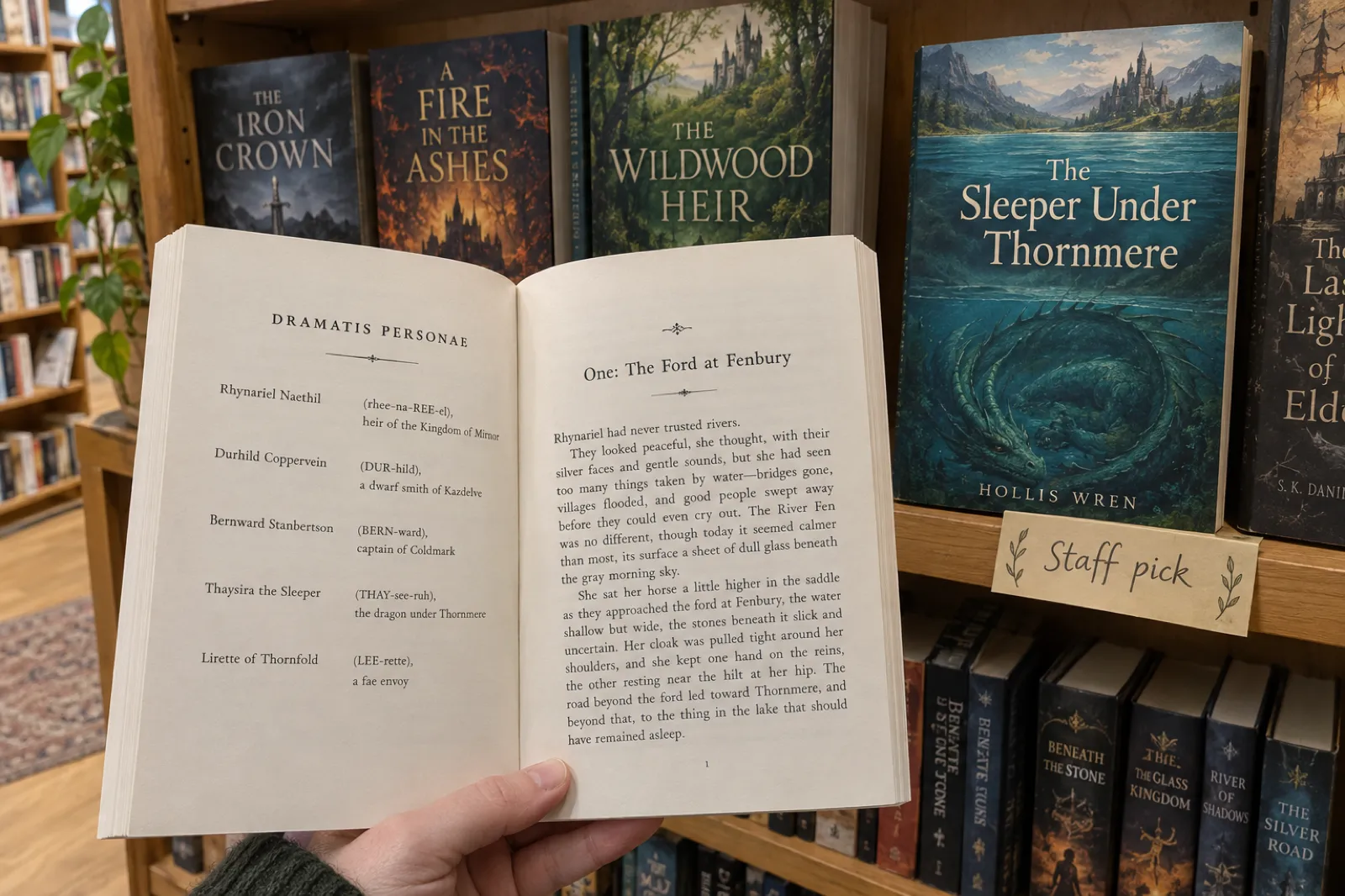
- Outline and story bible. The writer builds a chapter-by-chapter outline and a story bible of characters, places, objects and rules, using your names.
- Chapters in order. Fiction is written one chapter after another, each one reading what came before, with a running record of what is already true in the book.
- Edit. Rewrite in the editor, ask the assistant for a stronger opening, cut a scene, add your own. Change a name once and keep going.
- Cover and export. Make a cover with the cover generator, write the blurb with the book description generator, and export a PDF free, or EPUB, Word and a print-ready KDP interior on a paid plan.
- Audiobook and trailer. On Creator and Premium, turn chapters into an audiobook and make a vertical book trailer for TikTok, Reels and Shorts.
Planning more than one book? The series writer carries the story bible from book one into book two, so your names, places and history stay consistent across the whole series. Writing romantasy? The AI romance novel writer handles the slow burn; horror and science fiction have their own horror and sci-fi generators.
Other fantasy name generators, checked 24 Oct 2026
These are the generators writers and players most often find, read on their own pages on 24 Oct 2026. Each is good at something different.
| Generator | What you get | Best for |
|---|---|---|
| Fantasy Name Generators (fantasynamegenerators.com) | Ten random names a click across a very large catalogue, including races from specific games, films and series, plus place and description generators | Breadth, and names in the style of a particular game or franchise |
| Reedsy fantasy name generator | Names with a one-line note on the mood each suggests; you can lock favourites while you regenerate | Quick inspiration with a sense of character |
| ProWritingAid fantasy name generator | AI-generated names, with separate elf, orc and dwarf generators | Writers already using ProWritingAid |
| This generator | Names built from eight small languages, each with a meaning, a breakdown and a pronunciation; matching place names; a shortlist you can send to an AI writer | A cast and a map that sound like one world, and the step from names to a book |
Comparing full AI writing tools rather than name generators? See the best AI for writing novels, tested side by side, and the best AI for genre fiction.
Fantasy name generator: frequently asked questions
Is this fantasy name generator free?
Yes, and unlimited. There is no sign-up and no limit on clicks: every name is built in your browser from 264 word parts, so another batch costs nothing. If you want the AI writer to turn your cast into a book, the free plan writes 5 chapters a month with PDF export; Creator is $9.99 a month for 35 chapters and Premium is $19.99 a month for unlimited chapters.
What do the meanings mean? Are they real?
For dwarves, orcs, dragons, halflings and fae, the meanings come from small invented languages written for this generator, and elvish follows the sound and some of the roots of Tolkien's Sindarin. In every language each word part has one meaning and is used consistently, so the same part always means the same thing. For the Northern and Imperial humans, the parts are real Old English, Old Norse and Latin name elements with their real meanings.
How is the pronunciation worked out?
The generator splits each name into syllables, respells it in plain English sounds and capitals the stressed syllable: Rhynariel is rhee-na-REE-el. Elvish and Latin names stress the second-to-last syllable; the others stress the first. Northern names split between their two real words (SIG-run). It is a guide, not a rule: your readers will say names their own way, and that is fine.
Can I generate kingdom, city and town names?
Yes. Switch to Places and choose kingdom, city, town or wild place, in any of the eight languages. Place names share roots with the people's names, so an elvish city sounds like its elves. The Northern and halfling places use real English place endings (-ford, -wick, -mere, -by), so a few will match real villages; check before you put one on a map you publish.
Can I use these names in a published book or a game?
Yes. Names are not protected by copyright in the United States (the Copyright Office lists names, titles and short phrases among things copyright does not cover), and you do not need to credit the generator. A name used as a brand can be a trademark, so for a series title, a game name or a lead you plan to merchandise, search the trademark register first.
Is it good for Dungeons and Dragons?
Yes, it works well for D&D and other tabletop games: player characters, NPCs on the fly, taverns, towns and a dragon for the finale. Choose the people and press New names; the meaning gives you a quick line of backstory. Inkfluence AI is not affiliated with Wizards of the Coast, which owns Dungeons & Dragons.
Why not just use a random list?
Random lists give you names that sound fine one at a time and wrong together, because nothing ties them to a people. Names built from one small language share sounds, endings and meanings, so a cast of ten sounds like it comes from one place.
Will it give me a famous character's name by accident?
It blocks over a hundred well-known names from books, films and games (Tolkien, Warcraft, Elder Scrolls, D&D settings and more) and real countries and big cities. It cannot know every name in every book, so search a lead character's name before you publish.
Can I turn my cast into a book?
Yes. Keep the names you like with the star, then press Write a book with these names. The Inkfluence AI dashboard opens with the names in the start box. The AI writer builds an outline and a story bible that tracks every character, writes the chapters in order, and gives you an editor, a cover and export.
Sources
All read on 24 Oct 2026. Other tools change their pages; if a description here and the tool's own page disagree, the tool's page wins.
- US Copyright Office, Circular 33: Works Not Protected by Copyright: names, titles and short phrases.
- USPTO trademark search: checking whether a name is a registered mark.
- Key to English Place-Names, Institute for Name-Studies, University of Nottingham: meanings of -by, -thorpe, -wick, -ford, -mere, -holm and -burg.
- Behind the Name: meanings of Old English and Old Norse name elements (ead, wulf, ric, mund, hild, run).
- J.R.R. Tolkien, letter to Houghton Mifflin, 1955, published in The Letters of J.R.R. Tolkien (letter 165): languages first, stories after.
- Amazon KDP Content Guidelines: AI-generated content disclosure.
- Fantasy Name Generators, Reedsy fantasy name generator and ProWritingAid fantasy name generator: what each offers.
- Inkfluence AI plan settings and the generator's word lists, read 24 Oct 2026: chapter, audiobook and video allowances; word part and name counts.
Dungeons & Dragons is a trademark of Wizards of the Coast. Fantasy Name Generators, Reedsy, ProWritingAid, Amazon and KDP are trademarks of their owners. Inkfluence AI is independent and not affiliated with or endorsed by any of them.
Related tools and guides
Character Name Generator
Real-world names by culture, role and era.
AI Fantasy Novel Writer
Worlds, magic systems and long quests.
Story Bible Generator
Characters, places and rules in one place.
Character Bible Generator
Voice, motivation, flaw and arc for each name.
AI Story Generator
A complete short story in twelve genres.
Plot Generator
Three full plots a click.
Book Title Generator
Titles for the book your cast lives in.
Chapter Title Generator
Chapter names for a whole book.
Pen Name Generator
An author name to publish under.
Writing Prompt Generator
Prompts for warm-ups and practice.
For World-Builders
How world-builders use Inkfluence AI.
For Fantasy Authors
From magic system to finished series.
You have the names. Now write the book.
Send your shortlist to the Inkfluence AI writer and get an outline, a story bible that remembers every character and place, chapters in order, an editor, a cover and an export. Free to start, no card.
Start my fantasy book free