
Pen Name Generator for Authors
Pick your genre, choose full names or initials, and get pen name ideas that look right on a cover in your corner of the bookstore. Check each one on Amazon and Goodreads in a click.
Romance, thriller, fantasy, cosy mystery, horror, children's books and non-fiction · Gender-neutral option · Keep your first name if you like
Quick Answer
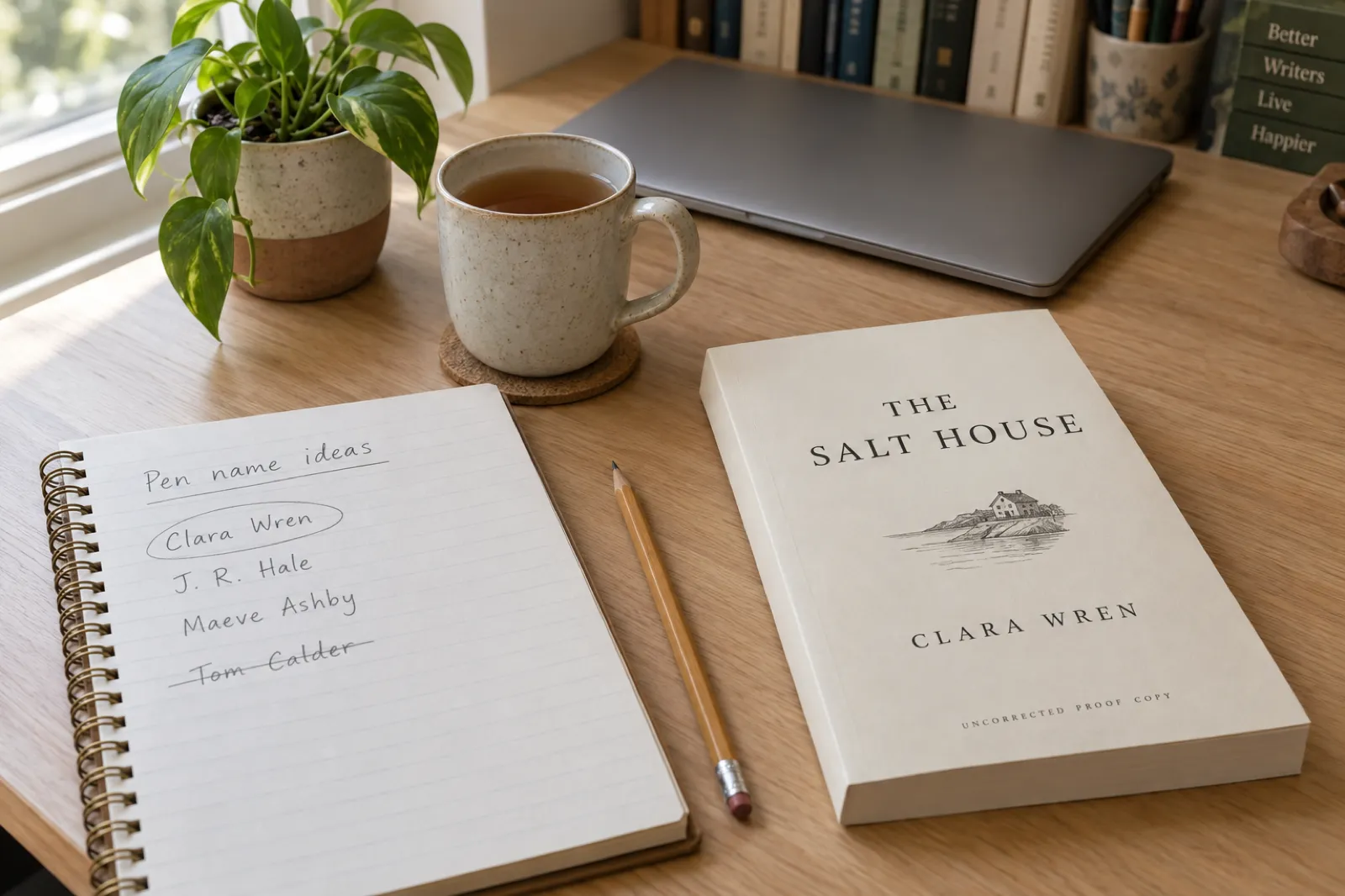
A good pen name fits your genre's cover conventions, is easy to say and spell, and is not already used by another author. Generate genre-specific ideas below, shortlist three, search each on Amazon and Goodreads, and say them out loud. Amazon KDP lets you publish under a pen name: you put it in the book's author field and keep your legal name on your account for payments and tax forms. Once a book is live, the author field cannot be changed, so decide before you publish. When you have your name, write the book in Inkfluence AI with the pen name already set on the cover.
Live Tool
Generate pen names by genre
Twelve names per click, each with a note on why it suits the genre. Free, unlimited, no sign-up.
Your pen names will appear here. Pick a genre and hit generate.
Names come from hand-written lists for each genre and are put together in your browser, so nothing you type is sent anywhere. A generated name can still belong to a real person or author; the search links on each card are there so you can check before you commit. Use this pen name saves it as the author name your new Inkfluence AI books start with.
Quick availability checklist
Run this on each name you shortlist. It is guidance, not a legal clearance: a clean result means you found no obvious clash, not that the name is protected for you.
0 of 7 checks done.
Why authors use pen names
Writing under another name is older than the novel. The Brontë sisters published as Currer, Ellis and Acton Bell. Mary Ann Evans became George Eliot. Today, plenty of the authors on any bestseller list are using a name their bank would not recognise. The reasons are mostly practical, and they usually fall into one of these groups.
Keeping genres apart
This is the most common reason among self-published authors. A reader who loved your cosy mystery and then buys a dark thriller under the same name may feel misled, and an unhappy reader leaves a review. A separate name per genre keeps each readership clean. A non-fiction author who also writes romance, or a horror writer who also writes for children, has an even stronger case.
Privacy
Some authors do not want colleagues, clients, family or an employer to find their books. Teachers writing steamy romance, therapists writing memoir-adjacent fiction and people writing about their own lives often fall into this group. A pen name puts a layer between the book and the rest of your life. It is a layer, not a wall: your legal name stays on your publishing accounts and tax records, and determined people can sometimes connect the two. Treat a pen name as privacy from casual searches rather than a guarantee of anonymity.
A name that works better on a cover
Your real name might be long, hard to spell, hard to say, or the same as someone already famous. Any of those makes you harder to find. If a reader hears about your book in conversation and cannot spell your name into a search box, you lose the sale. KDP itself suggests a pen name, a middle name or an initial when your name is close to a popular author's, so readers are not confused.
Genre expectations
Some genres still carry assumptions about who writes them. Women writing thrillers and fantasy have long used initials, and men writing romance often use initials or a feminine or neutral first name. You can decide those assumptions are not your problem, and many authors do. But if your goal is to reach readers who browse by habit, a name that matches the shelf removes one small reason for them to scroll past.
Co-writing and fresh starts
Two authors writing together often share one name so the books read as one brand. Others use a new name to start again after a series that did not sell, or to test a new genre without affecting their main catalogue. In both cases the pen name works like a label on a product line: it tells readers what to expect from everything published under it.
Genre conventions
What a pen name looks like in each genre
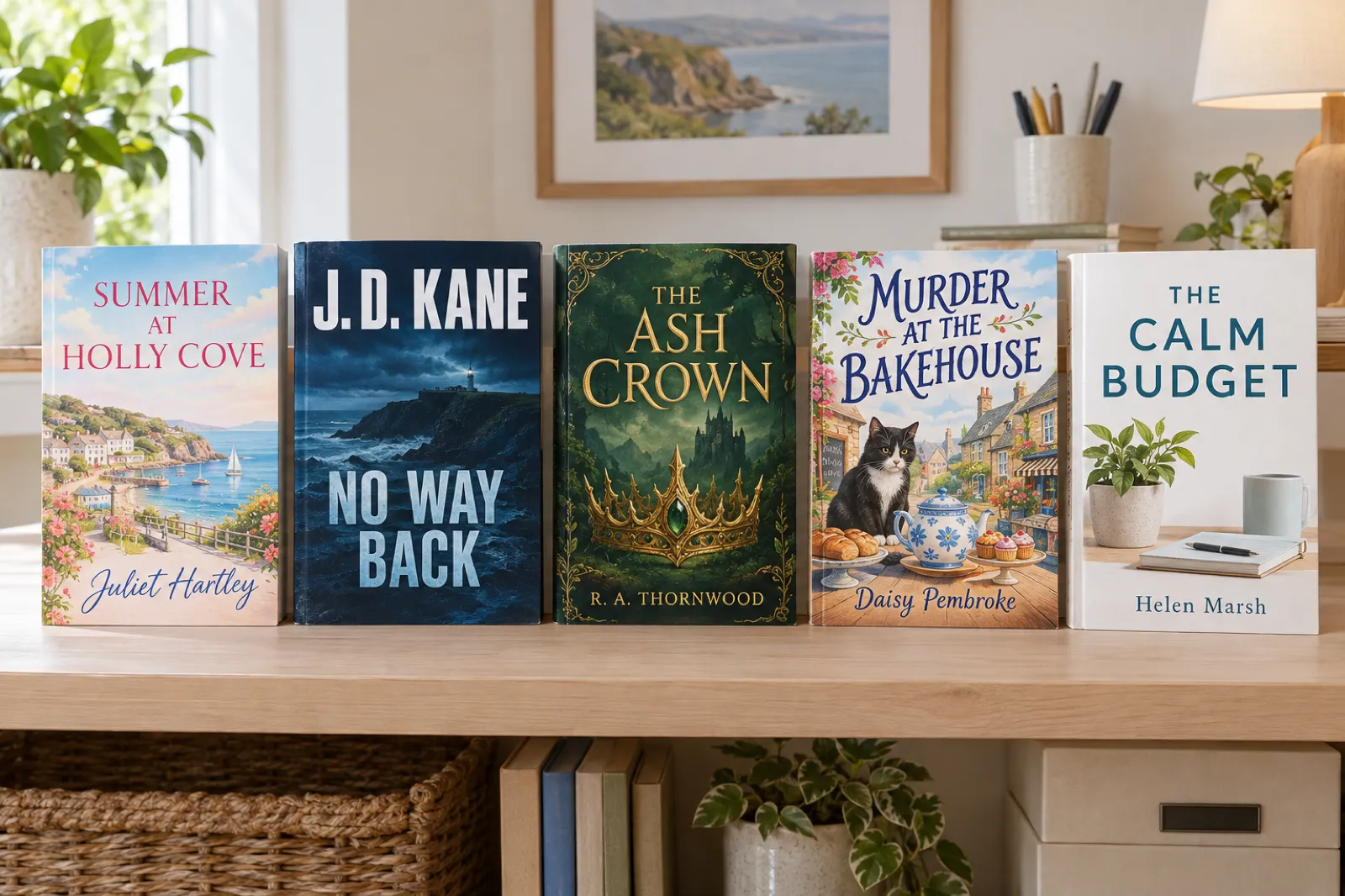
Readers scan covers fast, and the author name is part of how they recognise a genre. These are the patterns the generator follows.
Romance
Warm full names, often feminine, with a surname that looks good in script lettering.
Romance readers buy authors as much as books, and the name sets the mood before the blurb does. Soft first names (Clara, Juliet, Ivy) and surnames with an easy rhythm (Hartley, Sinclair, Bellamy) are the norm. Male romance authors and co-writing pairs often use initials or a neutral first name so the cover matches what readers expect. Spicier subgenres lean toward sharper, more modern names; sweet and historical romance lean toward classic ones.
Generator examples: Juliet Hartley, Ivy Sinclair, Rory Bellamy
Thriller and suspense
Short, hard-sounding surnames, often with initials, set large on the cover.
Thriller covers often print the author name bigger than the title once the author has a following, so the name has to work in bold capitals. One-syllable surnames with hard consonants (Kane, Cross, Stone, Locke) read fast and look strong. Initials are common, partly for the look and partly because they hide the author's gender in a genre where readers once assumed male authors. Psychological suspense uses fuller, ordinary-sounding names more often.
Generator examples: J. D. Kane, Laura Cross, Sam Mercer
Fantasy
Initials or a classic first name, with a longer surname that hints at old places.
Fantasy has a long tradition of initials, and readers are used to them. Surnames with a compound feel (Thornwood, Ravenscroft, Ashgrove) suggest the genre without sounding invented. Keep it pronounceable: a name readers cannot say is a name they cannot recommend. Science fiction shares much of this, though it often prefers shorter, plainer surnames.
Generator examples: R. A. Thornwood, Maren Ashgrove, Wren Starling
Cosy mystery
Friendly, slightly old-fashioned full names with a village feel.
Cosy mysteries promise comfort: an amateur sleuth, a small town, a crime with no gore. The author name carries the same promise. Nicknames and vintage names (Daisy, Hattie, Poppy, Bertie) with gentle surnames (Pembroke, Honeywell, Appleby) fit the illustrated covers the genre uses. Full names are the norm; initials feel too cold here.
Generator examples: Daisy Pembroke, Hattie Appleby, Bertie Honeywell
Horror
A plain first name or initials, and a surname with a cold or gothic edge.
Horror names work best when they sound like a real person with a slightly unsettling surname (Graves, Crowe, Harrow, Mortlake). Overdoing it, such as a name that is a pun on death, reads as a parody. Initials are common, and many horror authors write other genres under different names to keep readers from picking up the wrong book.
Generator examples: Edgar Crowe, M. R. Harrow, Jude Mortlake
Children's books
Friendly, easy-to-say full names that a child can read aloud.
Children's book buyers are parents, teachers and librarians, and the name needs to feel safe and friendly to them. Short first names and cheerful surnames (Bramley, Button, Meadows) work for picture books; middle grade can carry slightly more personality. Avoid anything that could be misread or giggled at in the wrong way, and keep it separate from any adult pen names you use.
Generator examples: Polly Bramley, Toby Meadows, Pip Button
Non-fiction
Ordinary, credible full names. Often your real name, or close to it.
Non-fiction sells on trust, and a reader wants to believe a real person with real experience wrote the book. That is why many non-fiction authors use their own name or keep their first name. If you do use a pen name, keep it plain (Helen Marsh, David Bennett) and never attach a title or credential you do not hold, such as Dr., because a reader will rely on it.
Generator examples: Helen Marsh, David Bennett, Jordan Hayes
Conventions are a starting point, not a rule. A cosy mystery author called J. D. Kane will not be banned from the shelf. The point is that a name in line with the genre asks nothing of the reader, while a name against it has to be overcome by the cover and blurb. If you are writing in a niche inside a genre, look at the top 20 books in that exact category on Amazon and note how the names are built: how many use initials, how long the surnames are, how big the name sits on the cover. That ten-minute exercise tells you more than any general guide, including this one. Our KDP SEO checklist explains how to find those category lists and what else to note while you are there. For the rest of the cover, our book cover generator places the author name for you.
How to choose between the options
The generator has four switches because these are the four decisions most authors struggle with. The table puts the main styles side by side; the notes after it explain how to think about each one.
| Style | Example | How it reads | Suits | Watch for |
|---|---|---|---|---|
| Full name | Clara Wren | Warm and personal | Romance, cosy mystery, children's books, most non-fiction | The most likely style to be taken already; search it first |
| Initials and surname | J. D. Kane | Serious, a little distant; hides gender; sets large in capitals | Thrillers, fantasy, literary fiction | Harder to remember and search; pair with a distinctive surname |
| First name, middle initial, surname | Clara J. Wren | Slightly formal | Any genre, when the plain first-and-last pair is in use | Readers drop the initial when they search, so use it everywhere |
| Gender-neutral first name | Rowan Ellis | Lets the books speak first | Writing across genres, co-writing | Some neutral names lean one way in some countries; say it with the surname |
| Your first name, new surname | (your name) Ashby | The easiest to live with at events and in emails | Authors who meet readers in person | People who know you can guess it, so it gives less privacy |
Initials or a full name
Initials (J. D. Kane, R. A. Thornwood) feel serious and a little distant. They hide gender, they look good set large in capitals, and they have a long history in fantasy, thrillers and literary fiction. The cost is memorability: "J. D." is harder to recall than "Jack", and readers searching from memory may mix up the letters. If you choose initials, give yourself a distinctive surname so the name still stands out in a search.
Full names feel personal. They suit genres where readers want a relationship with the author, such as romance, cosy mystery, children's books and most non-fiction. The middle option, first name plus a middle initial (Clara J. Wren), adds a little formality and helps when the plain first-and-last combination is already taken by another author.
Gender-neutral names
A neutral first name (Avery, Rowan, Quinn, Ellis, Morgan) lets the books speak first. It is useful if you write across genres with different expectations, if you co-write with someone of a different gender, or if you would simply rather readers did not assume anything. Say the full name out loud with your chosen surname: some neutral names lean one way in some countries and the other way elsewhere, and the surname can tip it too.
Keeping your first name
Keeping your own first name and changing only the surname is the most livable kind of pen name. You will turn round when someone calls it at an event. You can sign emails to readers without thinking. It gives you a separate searchable identity without the slight awkwardness of introducing yourself as someone else. Tick "Keep my first name" in the generator, type your first name, and only the surname varies. With initials selected, your first initial is kept.
Sound, length and spelling
A few tests catch most weak names:
- The phone test. Say the name to someone and ask them to type it. If they get it wrong, so will readers who hear about you from a friend or a podcast.
- The thumbnail test. Store grids show covers small. A short name can be set large; a very long one ends up tiny. Two to four syllables per part is a comfortable range.
- The rhythm test. Names with different syllable counts in each part (Ivy Sinclair, Daisy Pembroke) tend to roll better than matched ones, though there are plenty of exceptions.
- The initials test. Check what your initials spell, and what the name sounds like run together. Better to find it now than in a review.
Where you sit on the shelf
Bookshops and libraries usually shelve fiction alphabetically by surname, so some authors pick a surname that lands near a bestseller in their genre. For ebook-first authors, where discovery happens through search, this matters far less, but it is a fair tie-breaker between two surnames you like equally.
How to check a pen name is free to use
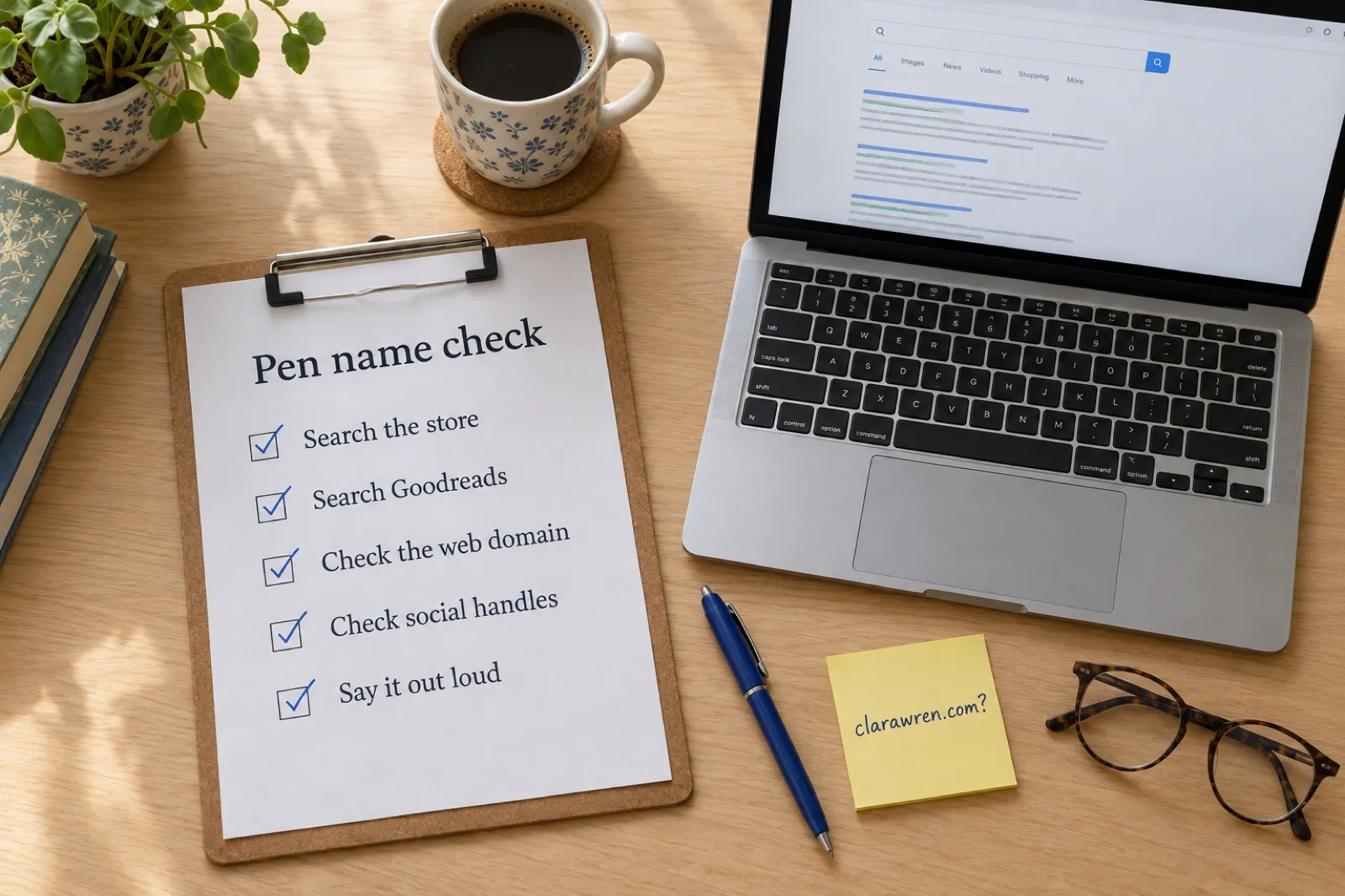
There is no central register of pen names, so "available" really means "not obviously used in a way that would confuse readers or cause you trouble". Each card in the generator has search links to start this for you. Work through these in order.
- Amazon books search. Search the exact name in the books department. An author with the identical name in your genre is a hard no. The same name in a far-off category, such as a 1970s engineering textbook, is usually fine, but expect some mixed-up search results.
- Goodreads. Goodreads includes traditionally published authors and older books that may not show prominently on Amazon. It also shows how readers might confuse you with someone else.
- A web search in quotes. Put the name in quotation marks. You are looking for a famous person, a company, a brand, or anything unpleasant. If the first page is all about someone else, readers searching for you will have to dig.
- Domain. Check whether the .com of the name (or a variant like the name plus "books" or "author") is available. You do not need to buy it immediately, but an author site at your own name is useful, and registering it early is cheap.
- Social handles. Only check the one or two places you will actually post. A consistent handle helps readers find you, but nobody needs every platform.
- Trademark, if it matters. Copyright does not protect a name: the US Copyright Office's Circular 33 lists "pseudonyms, pen names, or stage names" among things it will not register, and notes that names can sometimes be protected under trademark law instead (checked 4 Oct 2026). If you plan to build a business around the name, such as merchandise or a publishing imprint, search your country's trademark database, such as the USPTO trademark search in the US or the UK trade mark search, and talk to a professional. For most authors publishing books under a personal-sounding name, this is not where problems come from.
Generated names, including the ones in this tool, are combinations of common first names and surnames. Some will belong to real people somewhere. That is normal for any name, including your legal one. What matters is avoiding a clash with another author or a well-known person in a way that would mislead readers. Once you have a clean shortlist, sleep on it. A name that still feels right after a week is usually the one.
Publishing under a pen name: the legal and practical side
The short version: the pen name goes on the book, your legal name goes on the paperwork. Below is what the main platforms and the US Copyright Office actually say, checked against their own help pages on 4 October 2026. This is general information, not legal or tax advice. Rules differ by country, so check with a professional for your situation.
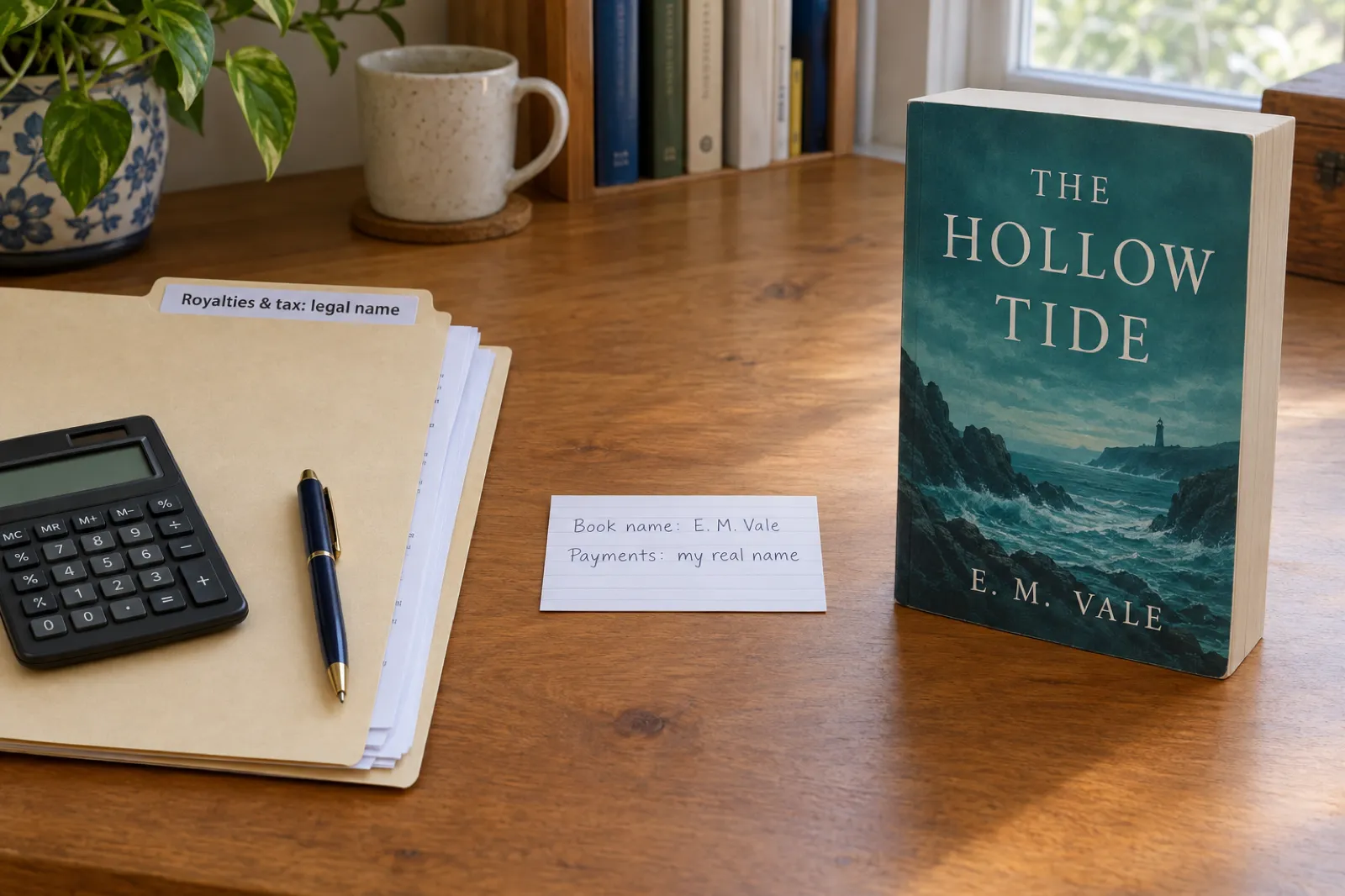
This table is the quick version of everything in this section.
| Where | Which name | Why |
|---|---|---|
| Cover and title page | Pen name | It is the name readers see and search for. |
| KDP author field (book details) | Pen name | KDP says you can publish under a pen name, entered when you set up the book. |
| KDP account details | Legal name, or your company's name | KDP issues payments and tax forms under the account name. |
| Tax information | Legal name and taxpayer ID | KDP requires valid taxpayer identification from every publisher. |
| US copyright registration | Pen name, with the Pseudonymous box ticked; legal name optional | The Copyright Office does not require your real name on the application. |
| Contracts (narrator, designer, translator, publisher) | Legal name, noting the pen name | A contract has to bind a real person or company. |
| Author bio and author pages | Pen name | Readers follow the name across books, so keep it consistent. |
Amazon KDP allows pen names
KDP's help page on authors and contributors says you can use a pen name or pseudonym to publish your titles, and that your real identity stays private on the website. It asks that the pen name is appropriate and stays consistent throughout your work. You enter it in the author field when you set up the book's details, not in your account (KDP: Authors & Contributors, checked 4 Oct 2026).
Your account, payments and tax forms use your legal name
When you create a KDP account, Amazon tells you not to enter your pen name in the account details. The name there should be the author's legal name (or your publishing company's name), because KDP issues payments and tax forms under it. Amazon also requires valid taxpayer identification from every publisher (KDP: Create a KDP Account, checked 4 Oct 2026). In practice this means pen name royalties are your income like any other, reported under your own name or your company's.
The author name is locked once you publish
This is the rule that catches people out. KDP says the author name field cannot be changed once a book is published, for ebooks, paperbacks and hardcovers. Apart from fixing a typo, changing the author name, including switching from your real name to a pen name, means republishing the book as a new edition (KDP: Fixing typos on a book title or author name, checked 4 Oct 2026). A new edition is a new listing, so choose the name before launch day.
Do not borrow someone else's reputation
KDP's metadata guidelines say you are free to use a pen name as long as it does not impair customers' ability to make good buying decisions. If your name is similar to a popular author's, they suggest using a pen name, a middle name or an initial (KDP: Metadata Guidelines for Books, checked 4 Oct 2026). Picking a name designed to be mistaken for a bestseller is exactly what that rule is aimed at, and it is the fastest way to lose a book or an account. The same goes for credentials: do not put "Dr." or a professional title in front of a pen name unless it is true of you.
Copyright still belongs to you
Using a pen name does not change who owns the work. In the US, you can register a copyright under a pen name. The Copyright Office's FAQ says there is no legal requirement to identify the author by their real name on the application; you tick the "Pseudonymous" box instead. Its application help adds that you may give your legal name too, and that, depending on the circumstances, doing so may extend or reduce the copyright term (US Copyright Office: Registering a Work FAQ and Author help, checked 4 Oct 2026). Outside the US, copyright rules differ, so look up your own country's office.
Contracts and other platforms
Any contract you sign, whether with a publisher, an audiobook narrator, a cover designer or a translator, should be in your legal name, with the pen name noted as the name the work is published under. If you form a company to publish under, the company becomes the account holder, but the pen name still goes on the cover. Keep a simple document listing each pen name, the books under it, and the accounts and email addresses tied to it. Future you will be grateful.
Building a brand around your pen name
A pen name earns its value over several books. Readers who finish one book look for the name, not the title, so every book under the name should look and feel like it belongs with the others.
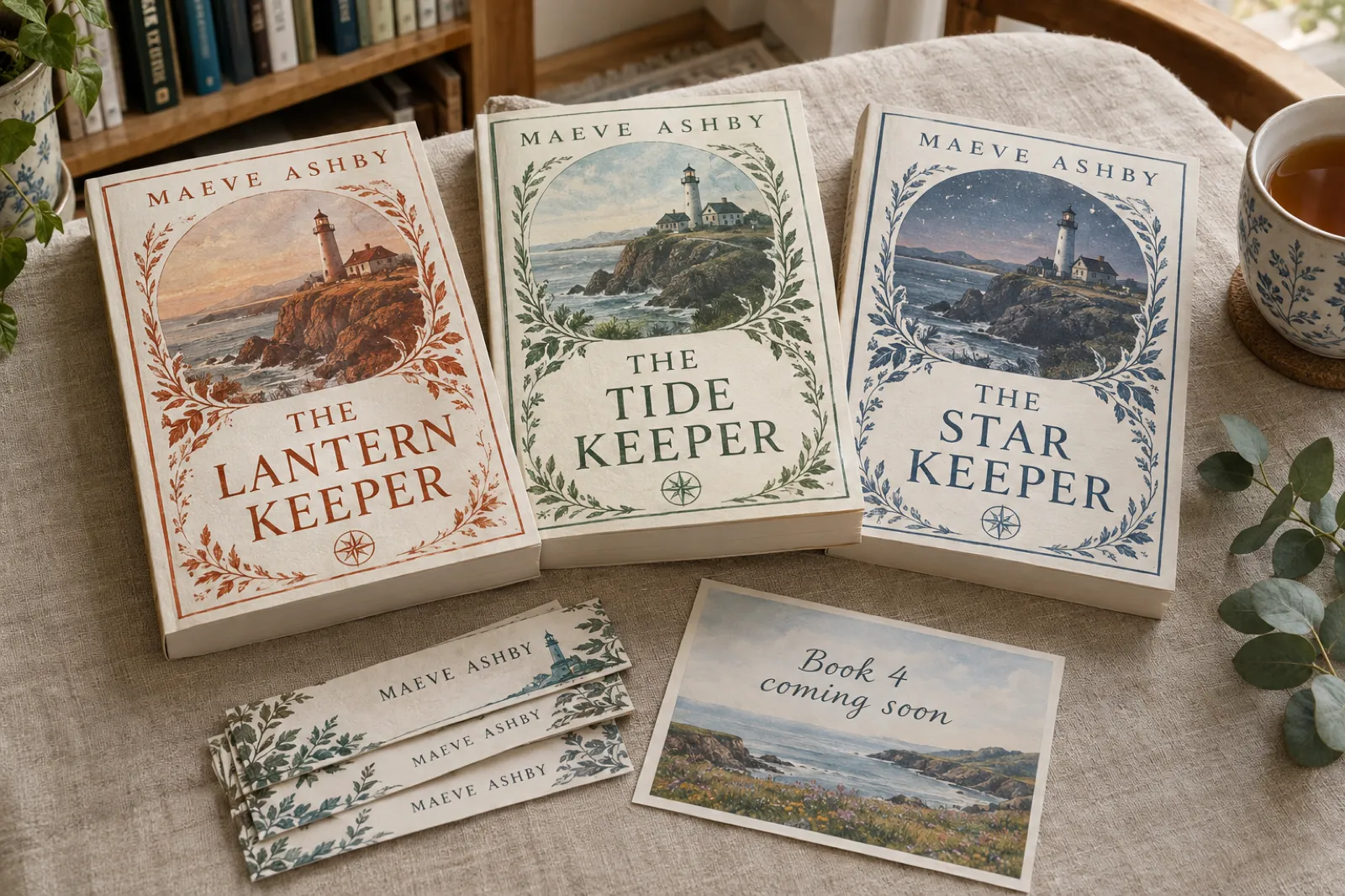
Keep the name in the same place on every cover
Pick a typeface, a size and a position for the author name and keep them across the series, and ideally across everything under that name. Thriller and romance authors are especially consistent about this, because readers in those genres often binge a whole backlist. The name becomes a logo. If romance is your genre, the guide to selling romance novels covers series launches and pen names from the sales side.
Give each pen name its own bio and author page
A bio written for your romance name should not mention your accounting textbooks. Write a separate bio for each identity, in the voice of the books it sits beside. Our author bio generator gives you drafts by author type in several lengths. Set up an author profile on the stores you sell through for each pen name, and keep the photo, or the absence of one, consistent with how open you are being about the name.
Decide how open the pen name is
Some pen names are an open secret: the author's website says "writing romance as Ivy Sinclair and thrillers as J. D. Kane". That lets readers follow you across genres if they want to, and it is easier to keep up. Others are private, with no link to the author's real name anywhere. Private names take more care: separate email addresses, separate social accounts, and attention to what your copyright page, website registration and payment details reveal. Decide which you want at the start, because it is hard to make a public name private later.
Grow the catalogue under one name before adding another
Every pen name needs its own audience, mailing list and marketing. Three books under one name usually do more for an author than one book each under three names, because readers who like one can buy the next. Add a second name when you move into a genre whose readers would be put off by the first, not just because you can.
Titles and descriptions that match the name
A pen name sets expectations that the title and blurb have to meet. If the name reads like a cosy mystery, a title that sounds like a gritty thriller sends a mixed message. Use the book title generator and the book description generator with the same genre setting you used here, and check the three together: name, title and first line of the blurb should all point at the same reader.
From pen name to finished book
How the generator and Inkfluence AI fit together, start to finish.
Pick the genre you write
Each genre has its own lists of first names and surnames, picked to match what readers of that genre see on covers. Choose romance, thriller, fantasy, cosy mystery, horror, children's books or non-fiction.
Set the style and gender feel
Choose full names, initials or a mix. Set the first name to feminine, masculine, gender-neutral or any. Tick 'Keep my first name' if you only want a new surname.
Generate and shortlist
Each click gives twelve new names with a short note on why each one suits the genre. Copy the ones you like and keep generating; names you have already seen are held back so the batches stay fresh.
Check it, then use it
Search each shortlisted name on Amazon, Goodreads and the web with the links on its card, run the checklist, and click 'Use this pen name' to make it the author name on your new books in Inkfluence AI.
When you click "Use this pen name", the name becomes the author of the next book you start in Inkfluence AI: on the cover the designer builds, on the title page, and in every export. Your account name stays as it is, and books you have already made keep the author name they have.
Because each book stores its own author name, you can run more than one pen name from a single account. To change the name on one book, click the pencil icon next to the book's title at the top of the editor and edit the author field; you can also change it in the cover designer. On a paid plan, the About the Author page at the back of the book uses your bio, and you can give a single book its own bio from the export settings, which is useful when that book is written under a different name.
If the first book works, the "Continue as a series" option (see the AI book series writer) writes the next book in the series from the first one, carrying the characters and what happened forward, under the same author name. That is the consistency a pen name needs to build a readership. When you are ready to publish, the self-publishing guide, the KDP tools and the guide to publishing on KDP cover the rest, including the author field.
Pen name questions, answered
What is a pen name generator?
Can I publish on Amazon KDP under a pen name?
Do I have to register a pen name?
Will my real name show up anywhere?
Can I change my pen name after the book is published?
Should I use initials or a full name?
Can I use more than one pen name?
Is it OK to pick a name close to a famous author's?
How do taxes work on pen name royalties?
Can I keep my first name in my pen name?
What makes a good gender-neutral pen name?
How does 'Use this pen name' work?
Is the pen name generator really unlimited?
Sources
All checked on 4 October 2026. Platform rules change; check the current page before you publish.
- Amazon KDP Help: Authors & Contributors (pen names allowed; author field cannot be changed after publishing)
- Amazon KDP Help: Create a KDP Account (legal name on the account; payments and tax forms issued under it)
- Amazon KDP Help: Fixing typos on a book title or author name (changing to a pen name requires a new edition)
- Amazon KDP Help: Metadata Guidelines for Books (pen names must not mislead buyers; names similar to popular authors)
- US Copyright Office: Registering a Work FAQ and Standard Application Help: Author (pseudonymous registration)
- US Copyright Office: Circular 33, Works Not Protected by Copyright (pen names are not protected by copyright; trademark may apply)
- USPTO: Search our trademark database and GOV.UK: Search for a trade mark (checking a name before building a business on it)
Name chosen. Now write the book.
Inkfluence AI turns your idea into a full book with your pen name on the cover. Free to start with 5 chapters plus 5 more every month and PDF export. No card needed.
Related tools and reading
The rest of the author-identity and publishing toolkit.
Author Bio Generator
Write the bio for your new pen name.
Book Title Generator
Title ideas that match the genre of your name.
Book Description Generator
The blurb that sits under your name.
Book Cover Generator
See your pen name on a real cover.
KDP Tools
Everything for publishing on Amazon.
Book Royalty Calculator
What each sale under your pen name earns.
AI Romance Novel Writer
Write the romance your pen name was made for.
Character Name Generator
Names for the people inside the book.
How to Publish on KDP
The full KDP walkthrough, author field included.