
Character Name Generator
Names for heroes, villains, mentors and everyone in between, matched to your genre, culture and era.
Eight names a click · 15 cultures and 7 eras · Six fantasy sound families · Send any name to Inkfluence AI and write the book
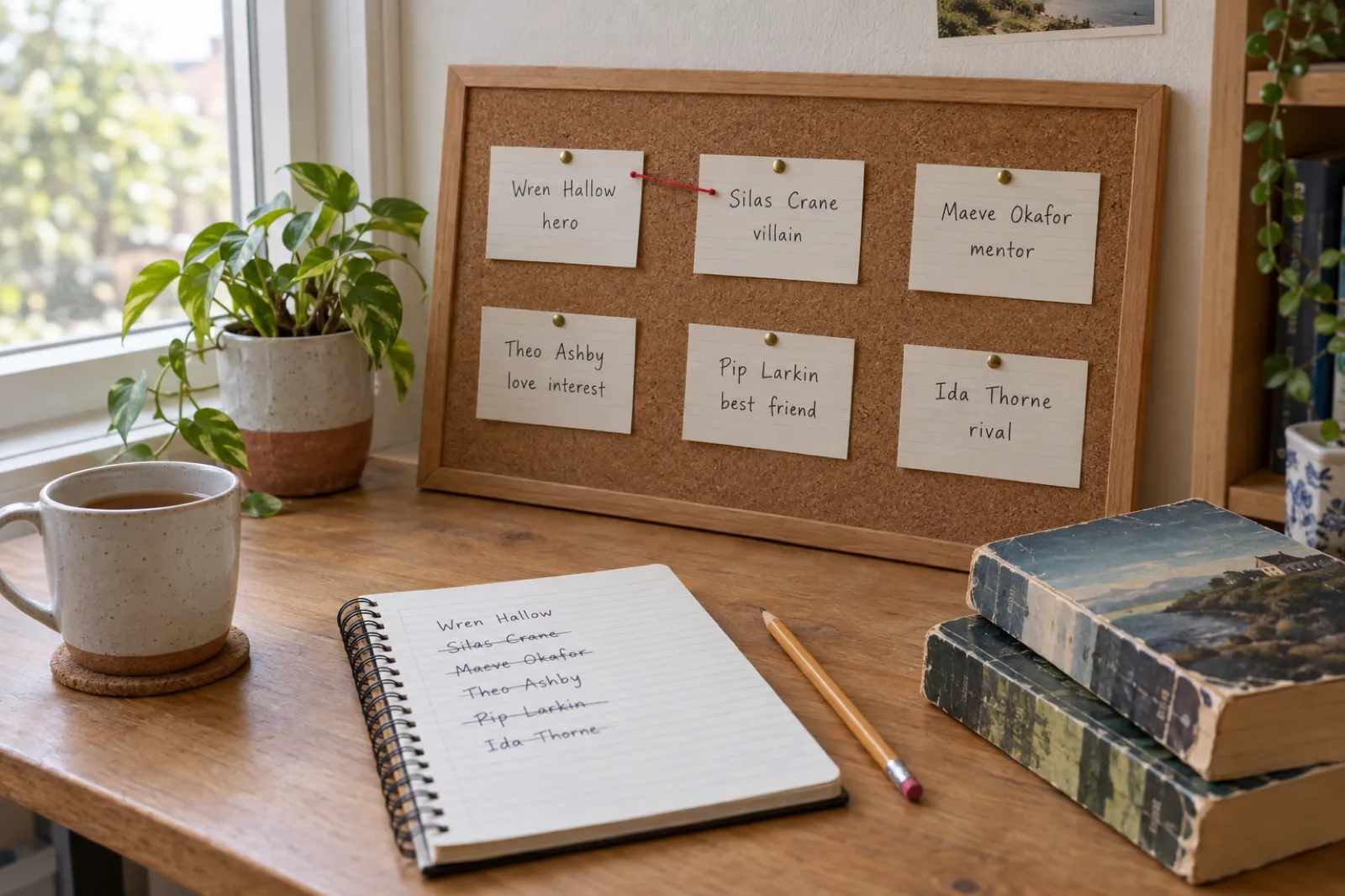
Quick answer
A character name generator gives you names to react to, filtered by what your story needs. This one runs in your browser from hand-written name lists: pick a genre, a gender, a culture or era, and the character's role, and it returns eight names at a time with meanings, pronunciation for names that are not spelled the way they sound, and a note on how each one sounds. It is free and unlimited. When a name fits, Write a story with this character opens Inkfluence AI with a story idea built around that character, and Inkfluence AI writes the whole book: outline, chapters and a story bible that keeps the name and the character consistent.
Live tool
Generate character names
Set the genre and role, narrow it down if you like, and get eight names. Free, instant and unlimited. Star the keepers, then write a story with them.
Your names will appear here.
Your shortlist (empty)
Names are picked in your browser from hand-written lists, so you can generate as many as you like. Write a story with this character opens the Inkfluence AI dashboard with the idea filled in (up to 500 characters, which you can edit), and writing the book needs a free account.
Direct answers about character names
The questions writers ask most, answered briefly.
Is there a free character name generator for writers?
Yes. The Inkfluence AI character name generator is free, unlimited and needs no sign-up. It filters by genre, gender, 15 cultures and 7 eras, and role, and shows meanings and pronunciation where they exist.
Can it make villain names?
Yes. Set the role to Villain and the names lean towards hard consonants, with titles and epithets in fantasy, plus the occasional soft name for a villain who hides in plain sight.
Does it give first and last names?
Yes. Surnames follow the culture you pick, including Spanish double surnames, feminine forms of Slavic and Greek surnames, and patronymics for northern fantasy names.
Can I write a book with the character?
Yes. Write a story with this character opens Inkfluence AI with a story idea built around the name, and Inkfluence AI writes the whole book, with a story bible that keeps the cast consistent.
How to use the character name generator
Four steps from an empty cast list to named characters and a story idea you can write today.
Set the genre and the role
Pick the genre first: fantasy and science fiction get their own sound families. Then choose who the character is to the story: hero, villain, mentor, love interest, best friend or rival.
Narrow by gender, culture or era, and sound
Choose a gender or leave it on any. Pick a culture or a decade if the setting calls for one. If you already hear the character as soft-spoken or sharp-edged, set the sound filter to soft or hard.
Generate and shortlist
Each click shows eight names with origin, meaning where one exists, and a sound note. Star the ones worth a second look. Your shortlist stays in this browser.
Write a story with the character
Press Write a story with this character on any name, or write with your whole shortlist. Inkfluence AI opens with the idea filled in, and writes the outline and chapters once you press go.
How to name a character: six checks before you commit
A protagonist's name can appear several hundred times in a novel, so it has to survive repetition, look right on the page, and carry a little of who the person is without spelling it out. Most naming advice boils down to six checks. Run every candidate through them, including the names you love.
1. Sound and rhythm
Readers hear names even when they read silently. Soft consonants (l, m, n, w) and open vowels tend to read as gentle or warm; hard stops (k, t, d, g) read as sharp, blunt or cold. This is not just writing folklore. In the bouba/kiki effect, people across many languages match a rounded shape to "bouba" and a spiky one to "kiki". That is why the generator's sound filter exists, and why the villain and love-interest roles lean the way they do.
Rhythm matters as much as sound. Say the first and last name together. A one-syllable first name with a two- or three-syllable surname (Cole Mercer, Wren Hallow) usually lands well. Names that run together ("Anna Navarro") blur when spoken.
2. Era
Names go in and out of fashion, and readers notice. A woman called Jessica in a story set in 1950 jars; a teenager called Dorothy in 2026 needs a reason. The rule is to name for the year the character was born, not the year the story is set. The era section below shows how quickly the most popular names change.
3. Place and culture
Where did the character's family come from, and what would their parents have chosen? A name places a character before they say a word. A Scottish crofter's daughter called Mhairi, a Lagos banker called Chinonso, a Kyoto student called Haruto: each name sets up expectations, and the story either meets them or makes a point of not meeting them. Get the conventions right too, such as which name comes first and how surnames change, which is covered in names from other cultures.
4. Meaning, used lightly
Meanings are a quiet bonus, not a message. A healer called Rafael ("God heals") is a pleasant discovery for the reader who looks it up. A villain called Mordecai Darkwood tells the reader everything before the first scene. Most readers never check a meaning, so choose for sound and fit first, and treat a fitting meaning as a tiebreaker. Where a meaning is well established, the generator shows it, and you can check any name on Behind the Name, which documents the origin and history of each name it lists.
5. Distinct from the rest of the cast
This is the check that catches the most problems. Readers skim, and they recognise names partly by shape: first letter, length and ending. Jenna and Jenny, Mark and Mike, or Kara, Kira and Cora in one book will be confused, however different the characters are. Give each important character a different first letter, and vary the syllable count. If two characters share a scene often, make their names look nothing alike on the page.
6. Say it, then search it
Read the name aloud in a sentence of dialogue: "Get down, Theo!" If you stumble, readers will too, and audiobook narrators will have to choose a pronunciation for you. Then search the full name with your genre. You want to know if it belongs to a famous character, a well-known author in your genre, or a real person who might not enjoy being your villain.
Character names by genre
Genre sets the reader's ear. The same name can feel right in one shelf and wrong in another: Juno reads as science fiction or contemporary, but would stand out in a Regency drawing room. This table sums up what readers expect from names in each genre, with examples the generator produced.
| Genre | What readers expect | Examples | Watch out for |
|---|---|---|---|
| Fantasy | A world with its own sound. Names that feel old or invented, but are still easy to say. | Elowen Silverbrook, Halldor Ragnarsson | Apostrophes, unpronounceable clusters, famous names |
| Science fiction | A believable future: mixed-heritage names, clipped forms, invented names for aliens. | Juno Okoro, Tycho Halvorsen | Names that date the book to its writing year |
| Romance | Warm, sayable names for the two leads, clearly different from each other. | Nora Bennett, Theodore Ashby | Two leads with the same first letter |
| Thriller and mystery | Short, solid names. A suspect list where no two names blur. | Ryan Mercer, Dana Holt | Similar-looking surnames among suspects |
| Historical | Names in real use when the character was born, with period forms of address. | Harriet Pemberton, Edmund Harcourt | Modern names in a period setting |
| Horror and gothic | Old-fashioned names, family names that suggest a house with a history. | Hester Blackwood, Silas Ravenscroft | Names so dark they give the twist away |
| Children's | Short, bouncy names that a young reader can sound out, often with a playful surname. | Pip Puddle, Milo Marmalade | Hard-to-decode spellings |
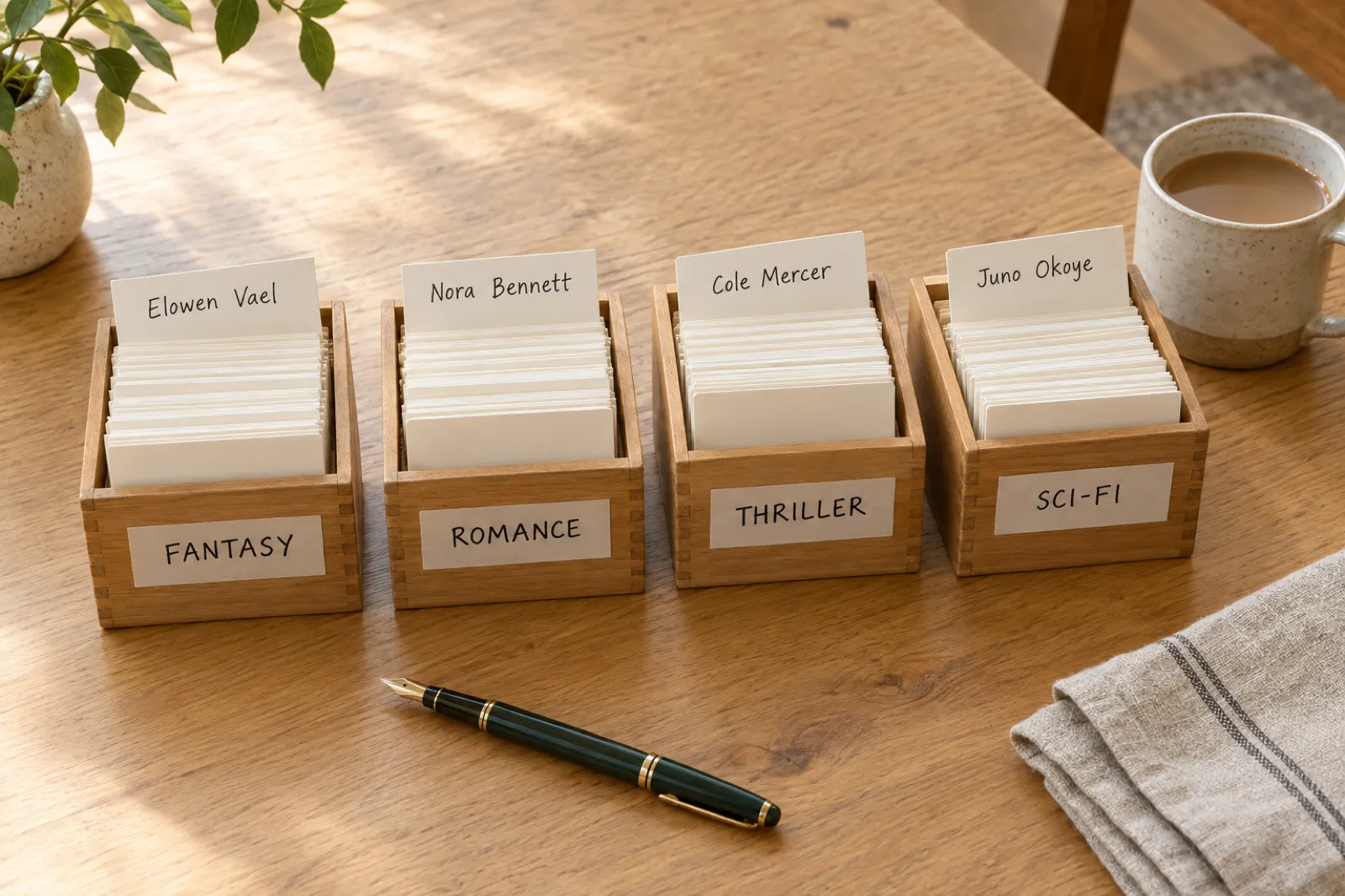
Fantasy
Fantasy names do world-building. A reader who meets Solveig and Halvard expects cold coasts; one who meets Elowen and Taliesin expects something older and softer. The trick is to choose a sound for each culture in your world and stick to it, which is why the generator groups fantasy names into sound families rather than one big list. The AI fantasy novel writer page covers the rest of a fantasy build: magic rules, maps and a long series arc.
Science fiction
Science fiction names suggest how the future got here. A near-future crew with names from several continents (Mateo Sato, Chiamaka Lindqvist) suggests a connected world. Far-future names are often clipped (Ren, Dex, Io) or borrowed from stars and astronomers (Vega, Tycho). Aliens need invented names, built from a fixed set of sounds per species so that readers can tell species apart by ear. More on building the setting is on the sci-fi story generator page.
Romance
Romance readers spend the whole book with two names, often side by side in the same sentence. They should sound good together and look different: different first letters, different lengths. Contemporary romance favours warm, current names with an easy nickname (Theodore who becomes Theo). Historical romance leans on period names and titles. Test the name in a quiet line of dialogue: if it sounds silly there, keep looking. The AI romance novel writer covers tropes, heat level and pacing.
Thriller and mystery
Thrillers favour short, solid names that read fast in action scenes: Cole, Dana, Reid. In a mystery, the suspect list is the naming problem. A reader trying to solve the crime has to keep five or six people straight, so every suspect needs a name with a different first letter and shape. See the AI mystery and thriller writer for plotting clues and red herrings.
Historical
Historical names have to be names that were really in use, and readers of the period will notice if they were not. They also come with period manners: in Regency England, a gentleman was addressed by surname or title, not his first name, and a woman's first name was for family and close friends. The generator's era pools cover Regency, Victorian and medieval England plus three twentieth-century generations.
Horror and gothic
Gothic fiction leans on old names and old families: a Hester, a Silas, a house called Ravenscroft. The risk is overdoing it. A name that drips with menace gives away who to fear before the story has earned it. Horror often works best when ordinary people with ordinary names (a Linda, a Michael) walk into something that is not ordinary at all. For premise ideas, try the horror story generator.
Children's
Young readers sound names out, so spell them the way they are said. Short names with a playful surname (Pip Puddle, Milo Marmalade) are easy to remember and fun to read aloud, which matters for a book that a parent will read twenty times. Alliteration works well here. The generator matches the surname's first letter to the first name about half the time. When you are ready to make the book, the children's book creator writes and illustrates picture books.
Fantasy names readers can actually say
Invented names are where fantasy writers get into the most trouble. A name that looks impressive in a notebook can stop a reader on every page they meet it. These rules keep invented names readable.
Pick a sound palette for each culture and keep to it. Decide which letters and endings belong to each people in your world. If one kingdom's names use soft l, v and long vowels and the mountain clans use hard k, g and short vowels, readers learn to tell where a character is from before they are told. The table below shows the four broad palettes the generator's fantasy families are built on.
| Palette | Sounds | Example names | Reads as |
|---|---|---|---|
| Soft and flowing | l, m, n, v, w, open vowels | Elowen, Liora, Maelis | Gentle, old, graceful |
| Hard and clipped | k, g, d, t, short vowels | Durgan, Dagna, Brokkar | Sturdy, blunt, practical |
| Northern | consonant pairs (hr, gr, sv), -dis, -grim, -ulf endings | Solveig, Halvard, Thordis | Cold coasts, hard winters |
| Cold and sibilant | s, v, x, th, long vowels | Vesper, Severin, Morwenna | Elegant, unsettling |
Drop the apostrophes. An apostrophe in the middle of a name (the classic K'tharr) tells the reader there is a sound they cannot hear. Most will skip it, so it adds nothing but clutter. None of the generator's names use one.
Make it sayable on the first try. Readers will not look up a pronunciation guide each time a name appears. Keep invented names to two or three syllables for anyone who appears often, avoid consonant clusters that do not occur in English (unless you want the name to feel deliberately foreign), and spell it the way it should be said. Taliesin is fine; Tlhaeqwyrr is not.
Check that it is not a real word, or a famous name. An invented name can turn out to be a real word in another language, sometimes a rude one. It can also land close to a famous character, which readers will notice immediately. The generator checks its invented names against a short list of famous fantasy characters, but no list covers everything: search your shortlist.
Use real roots for grounding. Old Norse, Old English, Welsh and Cornish names have a long history and still feel unfamiliar to most readers. Solveig ("sun strength"), Wulfric ("wolf power") and Elowen ("elm tree") all sound like fantasy names, and all of them are real.
Give families and places names that agree. If the hero is Halldor Ragnarsson, his sister is a Ragnarsdottir, not a Sylvaine. Patronymics, clan names and houses (Silverbrook, Stonebrow, of Harrowmere) help readers track who is related to whom. The generator builds patronymics for northern names and house or place names for the other families.
Once your world's names start piling up, write them down in one place with their culture and pronunciation. The character bible generator turns a cast into full profiles, and a story bible keeps those details in front of every chapter.
Villain names, mentor names and other roles
A name has a job, and the job depends on the character's role in the story. This table shows what each role asks of a name and what the generator does when you pick it.
| Role | What the name has to do | What the generator does |
|---|---|---|
| Hero | Easy to say a thousand times, distinct from everyone else in the cast. | No sound bias. Pick by fit and readability. |
| Villain | A name readers remember and feel uneasy around. | Leans hard (k, t, d, g); adds titles or epithets in fantasy; sometimes a soft name on purpose. |
| Mentor | Signals age and a past. Often an older generation's name. | Draws from an older decade in era settings; sometimes adds Master or Elder in fantasy. |
| Love interest | Warm and sayable, and clearly different from the hero's name. | Leans soft (l, m, n, open vowels). |
| Best friend | Short enough for fast dialogue and nicknames. | Leans towards names of five letters or fewer. |
| Rival | A mirror of the hero that never gets confused with the hero. | No sound bias; the tip reminds you to change the first letter and syllable count. |
Villain names: announce the threat or hide it
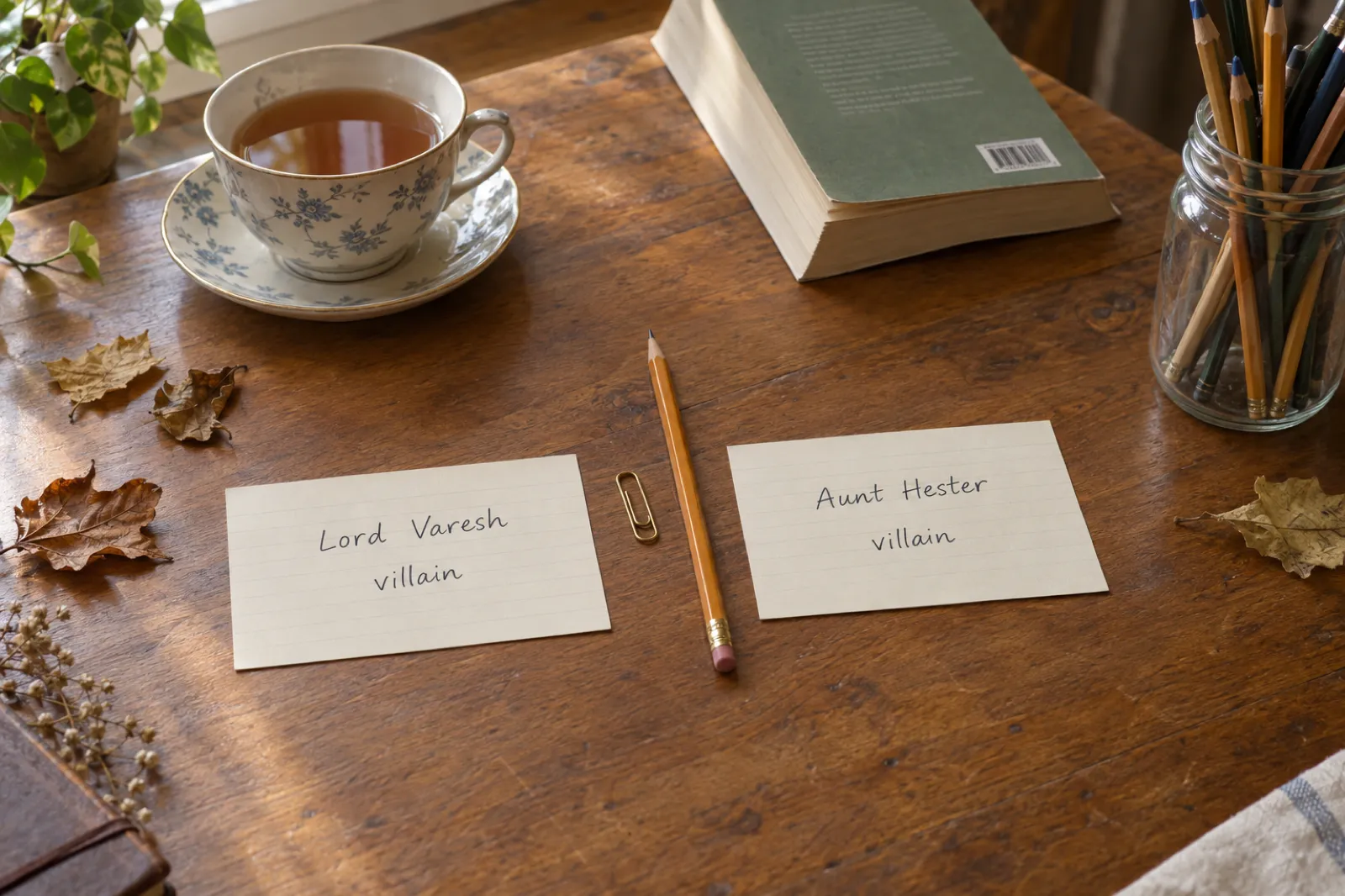
There are two kinds of villain name, and you should pick one on purpose. The first announces the threat: hard consonants, a title, maybe an epithet. Lord Varesh, Silas Crane, Morgath the Pale. This suits epic fantasy and adventure, where the villain's identity is not the mystery.
The second hides the threat. Aunt Hester, a neighbour called Linda, a mentor called Elder Maeve who turns out to be the one pulling the strings. A soft, ordinary name on a cruel character unsettles readers because it breaks the pattern they expect, and it is essential in mysteries, psychological thrillers and anything with a betrayal at its core. The generator leans hard for villains but deliberately mixes in a soft name now and then, with a note saying why.
Mentor names: give them a past
A mentor is usually decades older than the hero, and their name should say so. In a present-day story, a mentor in their sixties or seventies was born in the 1950s or 60s, so a Susan or a Richard fits better than an Olivia or a Liam. The generator does this for you in era settings: pick Mentor and the names come from an older generation's pool. In fantasy, a title (Master, Elder, Magister) can do the same work.
Love interest names: warm and different
A love interest's name is said softly, often, and next to the hero's. Soft sounds help, which is why the role leans that way. The bigger rule is contrast with the hero: Nora and Theo work; Nora and Noah do not.
Best friend and sidekick names: built for dialogue
The best friend gets shouted across rooms and shortened in banter. Short names and names with an obvious nickname work best: Pip, Gus, Bea, Kit. The generator leans towards names of five letters or fewer for this role.
Rival names: a mirror, never a twin
It is tempting to give a rival a matching name. Resist it. A rival needs a name with a different first letter and a different number of syllables from the hero's, so readers never stop to check who is speaking in a tense scene.
Getting the era right
The most popular names change completely within a generation. The table below shows the five most popular names given to US babies in four decades, from the Social Security Administration's popular names by decade. Apart from Mary in the earlier decades, and a few classic boys' names, there is almost no overlap between them.
| Decade of birth | Top girls' names | Top boys' names |
|---|---|---|
| 1920s | Mary, Dorothy, Helen, Betty, Margaret | Robert, John, James, William, Charles |
| 1950s | Mary, Linda, Patricia, Susan, Deborah | James, Michael, Robert, John, David |
| 1980s | Jessica, Jennifer, Amanda, Ashley, Sarah | Michael, Christopher, Matthew, Joshua, David |
| 2010s | Emma, Olivia, Sophia, Isabella, Ava | Noah, Liam, Jacob, William, Mason |
Source: US Social Security Administration, top names by decade of birth, in rank order.
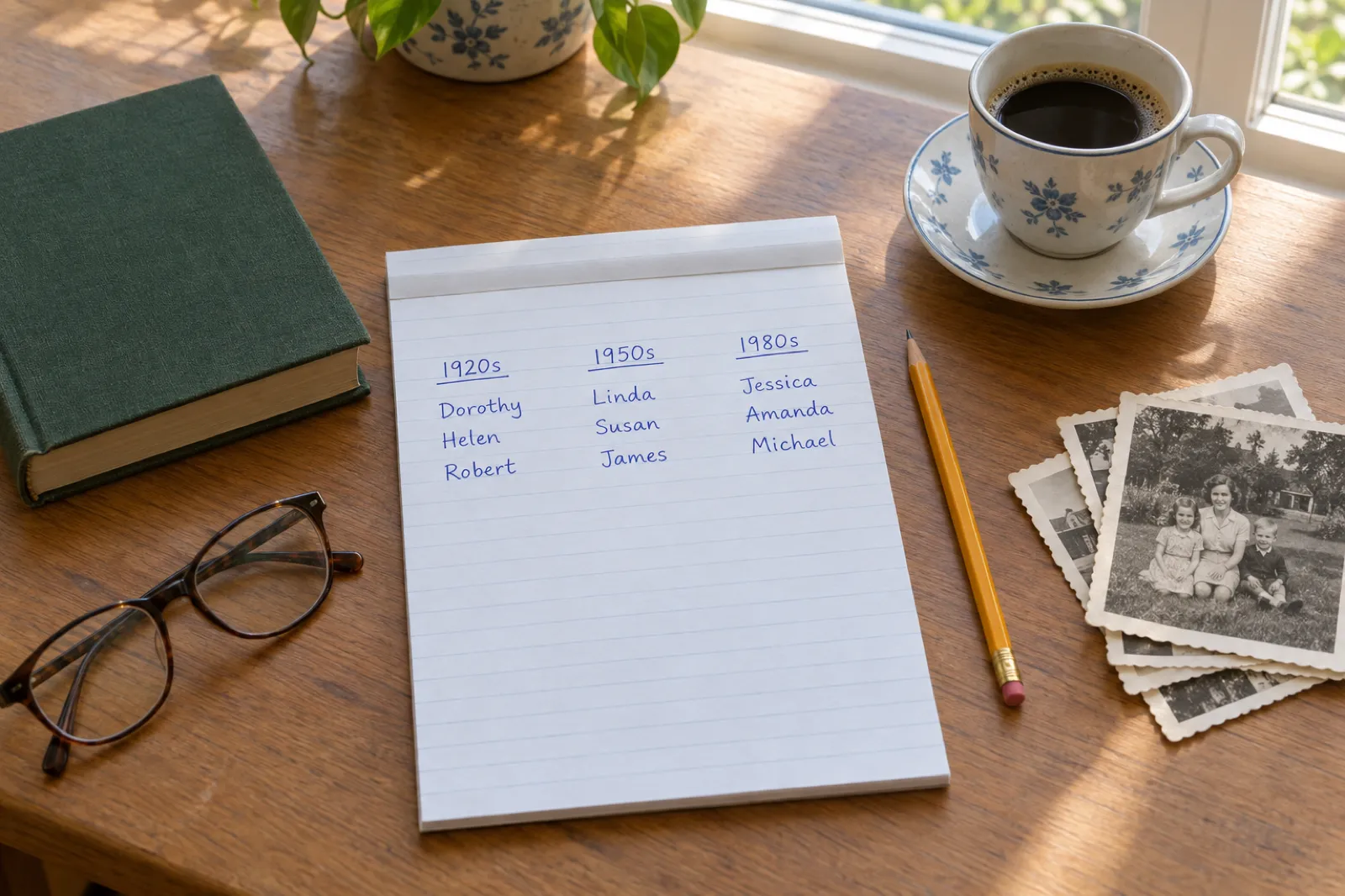
Work out the birth year first. A detective aged 45 in a story set in 2026 was born around 1981, so Jennifer or Christopher fits; a grandmother of 75 was born around 1951, so Linda or Susan. In the generator, choose the era that matches the birth decade, not the setting. Mentors do this automatically.
Use national data for other countries. Name fashions differ by country. In England and Wales, the Office for National Statistics publishes baby name rankings, and most national statistics offices do something similar. Surnames are steadier over time; the US Census Bureau's surname data shows how common a surname is, with Smith, Johnson, Williams, Brown and Jones at the top.
Regency and Victorian names. Regency England (about 1811 to 1820) used a small set of names over and over: Elizabeth, Jane, Anne, Charlotte; William, George, Henry, Charles. Some pronunciations differed too: Ralph was often said "Rafe". Victorian Britain broadened the range, with names like Ada, Florence, Edith, Beatrice, Albert, Arthur, Percy and Ambrose.
Medieval names. Surnames in medieval England were still forming, and many people were known by a byname: their trade (Fletcher, an arrow maker), where they lived (atte Wode, "at the wood"), or their father (FitzWalter, "son of Walter", from Norman French). The generator's medieval pool builds names this way, so you get Hugh atte Welle or Matilda of Ashby rather than a modern surname dropped into the twelfth century.
Names from other cultures: research, don't decorate
A character from another culture deserves a name their family would really have chosen, written the way they would write it. The generator covers 15 cultures, and each pool follows the basic conventions below. If the character's heritage matters to the story, read further and consider a sensitivity reader.
- Spanish and Latin American names traditionally carry two surnames, the father's first surname followed by the mother's: Lucía Navarro Ortega. In everyday use, people often go by the first surname alone. The generator gives Spanish characters two surnames some of the time.
- Russian and Polish surnames change with gender. Volkov becomes Volkova for a woman; Kowalski becomes Kowalska. Russians also use patronymics (Ivan Petrovich, "son of Pyotr") and a ladder of familiar forms, so Ekaterina is Katya to friends.
- Greek surnames have feminine forms, usually ending in -ou or a dropped final s: Papadopoulos becomes Papadopoulou, Makris becomes Makri.
- Icelandic names are patronymic. A person's last name says whose child they are (Leifsson, Leifsdottir), so siblings share it but parents do not. Fantasy writers borrow this often, and the generator's northern family uses it.
- Welsh surnames grew out of "ap", meaning "son of": ap Rhys became Price, ap Hywel became Powell, ap Hugh became Pugh. Welsh, Irish and Scottish Gaelic first names are often not said the way an English reader expects: Niamh is "Neev", Siobhán is "Shi-vawn", Dafydd is "Dav-ith". The generator shows pronunciation for these.
- Japanese and Korean names put the family name first in their own languages: Tanaka Hana, Kim Ji-woo. Many characters use Western order in English-language books; pick one approach and stay with it. The meaning of a Japanese or Korean given name depends on the characters used to write it, so the generator does not invent one.
- Common surnames are realistic. Kim, Lee and Park together cover close to half of South Korea's population, and Patel and Sharma are very widespread in parts of India. A cast drawn only from rare names can feel less real than one with a Kim in it.
- Yoruba and Igbo names often carry full sentences of meaning, such as Ayodele, "joy has come home", or Chinonso, "God is near", and many Igbo names are used for any gender. Surnames such as Okafor and Okeke refer to the market day a forebear was born on.
For any name, Behind the Name is a good first stop for origin and usage. If you are writing a book in another language, Inkfluence AI writes natively in 30 languages, so the characters can speak the language their names come from. If you write fan fiction, the fanfiction prompt generator gives your original characters a story to star in.
Naming mistakes that confuse readers
These are the problems that editors and beta readers flag most often. Every one of them is cheap to fix before you write and expensive to fix after.
Same first letter
Readers recognise names by their first letter and length. Two important characters starting with the same letter will be mixed up. Many writers keep an alphabet list and use each letter once for main characters.
Rhymes and near-twins
Dan and Stan, Kara and Cora, Ellis and Ellie. If two names rhyme or share most of their letters, change one, unless the confusion is the point of the plot.
Too many names too soon
Introducing ten named characters in chapter one leaves readers holding a list instead of a story. Name the people who matter, and let the rest be "the guard" or "the woman at the bar" until they earn a name.
Meanings that shout
A villain called Malice or a hero called Valor reads as a cartoon outside of satire or children's books. Keep meanings as a quiet layer.
Unsayable names
If readers cannot say a name, they skip it, and a skipped name never sticks. Audiobooks make this worse: the narrator has to choose, and readers hear it every chapter.
Famous clashes
A boy wizard called Harry, a detective called Sherlock or a vampire called Edward will make readers think of someone else. Search every main character's full name.
Spelling drift
Catherine on page 10, Katherine on page 200. It happens to every writer over a long draft, and readers always notice. Keep a cast list and search the manuscript before you publish.
Keeping names consistent across a whole book
Choosing a name takes an afternoon. Keeping it straight takes the whole book: a minor character who is Tom in chapter three and Tim in chapter nine makes readers lose trust.
Keep one cast list. For each character, write the full name, any nicknames and who uses them, titles and forms of address, age, and how the name is pronounced. Check every new name against the list before you add it, which catches first-letter clashes as well as spelling drift.
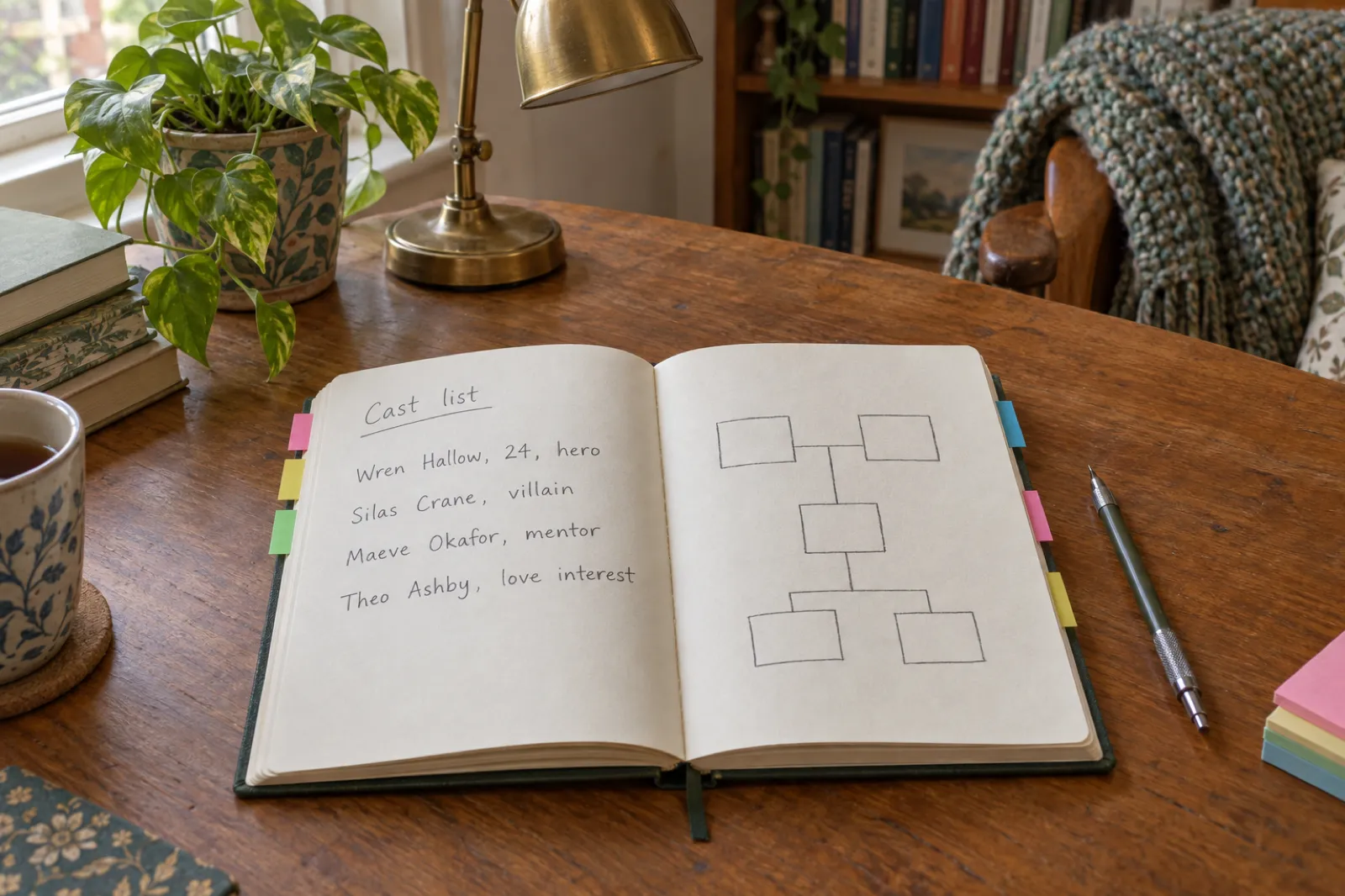
Decide who uses which form. If the hero's mother calls him Theodore and his friends call him Theo, write that down and keep to it. Forms of address carry relationships: when a character switches from Mr Harcourt to Edmund, readers should feel it.
Let the tools hold the list. When Inkfluence AI writes a fiction book, it builds a story bible from your idea: the plot, a synopsis, the characters, key objects and any rules you set. Chapters are written in order with the story bible and the earlier chapters in view, and the story bible records what each chapter makes true, so a name, a scar or a secret stays the same from the first chapter to the last. You can open the story bible and check it at any point. How Inkfluence AI keeps a long book consistent explains the whole process, and the series writer carries the same cast into the next book.
Search before you publish. Search the finished manuscript for each main name and its likely misspellings. It takes ten minutes.
From a name to a finished draft
What the button sends. Write a story with this character builds a short story idea: the genre, the name and role, the line you typed about the character if you typed one, and a starting situation for that genre. Write a story with my shortlist does the same with up to four of your starred names and their roles. The idea opens in the dashboard's idea box, which holds up to 500 characters, and you can rewrite it before anything is written.
What happens next. Press go and Inkfluence AI plans an outline, builds the story bible, then writes the chapters in order. Chapters usually run to roughly 1,000 to 1,500 words each, and the number of chapters follows what you ask for in the idea, so if you want a twelve-chapter novella, say so. You edit everything in the built-in editor afterwards.
What it costs. Generating names here is free and unlimited. Writing the book needs a free account: the free plan writes 5 chapters, with 5 more each month, and exports to PDF. Paid plans start at $9.99 a month for more chapters plus EPUB and Word export; any credit pack also unlocks EPUB. See pricing for the current plans.
If you would rather plan before you write, take the character to the book outline generator first, and once the book is written, the book title generator and book description generator help you get it ready to publish.
Character name generator FAQ
What is a character name generator?
Is the character name generator free, and is there a limit?
Can it generate fantasy character names?
How do I generate a good villain name?
Do the names come with meanings?
Can it generate first and last names together?
How do I choose a name that fits the time period?
Can I use these names in a published book?
What does Write a story with this character do?
How does Inkfluence AI keep a character's name consistent across a book?
On names and copyright, see the US Copyright Office's Circular 33, Works Not Protected by Copyright. This is general information, not legal advice.
Related tools
Character Bible Generator
Turn a named cast into full profiles
Story Bible Generator
Characters, world and lore in one place
Book Title Generator
Title ideas by genre for the finished book
Chapter Title Generator
Names for every chapter of the book
Fanfiction Prompt Generator
Story sparks for your original characters
Book Outline Generator
Plan the chapters before you write
Plot Generator
Three complete plots for your cast
Writing Prompt Generator
A scene to put your characters in
AI Fantasy Novel Writer
Write the whole fantasy book
Related reading
How to Write a Novel with AI in 2026
The complete process, from premise and cast to an edited draft.
How Inkfluence AI Keeps a Long Book Consistent
Characters, facts, timeline and the next book in a series.
Best AI for Novel Continuity Checking
Five tools compared on keeping names and facts straight.
You have the names. Now write the book.
Generate as many names as you need, shortlist your cast, and let Inkfluence AI write the outline and every chapter around them, with a story bible that keeps them consistent. Free to start, no card needed.