
AI Horror Story Generator
Dread That Builds, Chapter by Chapter
Write a horror story or a full horror novel with AI. The entity's rules live in a story bible, every chapter is drafted knowing the last three, and the thing in the walls is never described until you say so.
Chapter outline - Story bible - Sequential drafting - Restraint rules - EPUB, PDF and DOCX - Audiobook narration
Updated September 2026
Quick Answer
Inkfluence AI is an AI horror story generator that turns a premise into a chapter outline and a story bible holding the entity's rules, then drafts each chapter with the story bible, the last three chapters in full and a running record of the rest as context, so the dread escalates instead of resetting. A restraint rule in the premise, such as never describing the entity directly, is enforced for the whole book. It writes haunted house, creature, cursed object, psychological, possession, folk, slasher, gothic, found footage and cosmic horror, from a four-chapter creepypasta to a 40-chapter novel, and exports to PDF, EPUB and DOCX with an AI cover and audiobook narration. 3,929 horror books were started on the platform in the 180 days to 12 September 2026. The free plan needs no credit card.
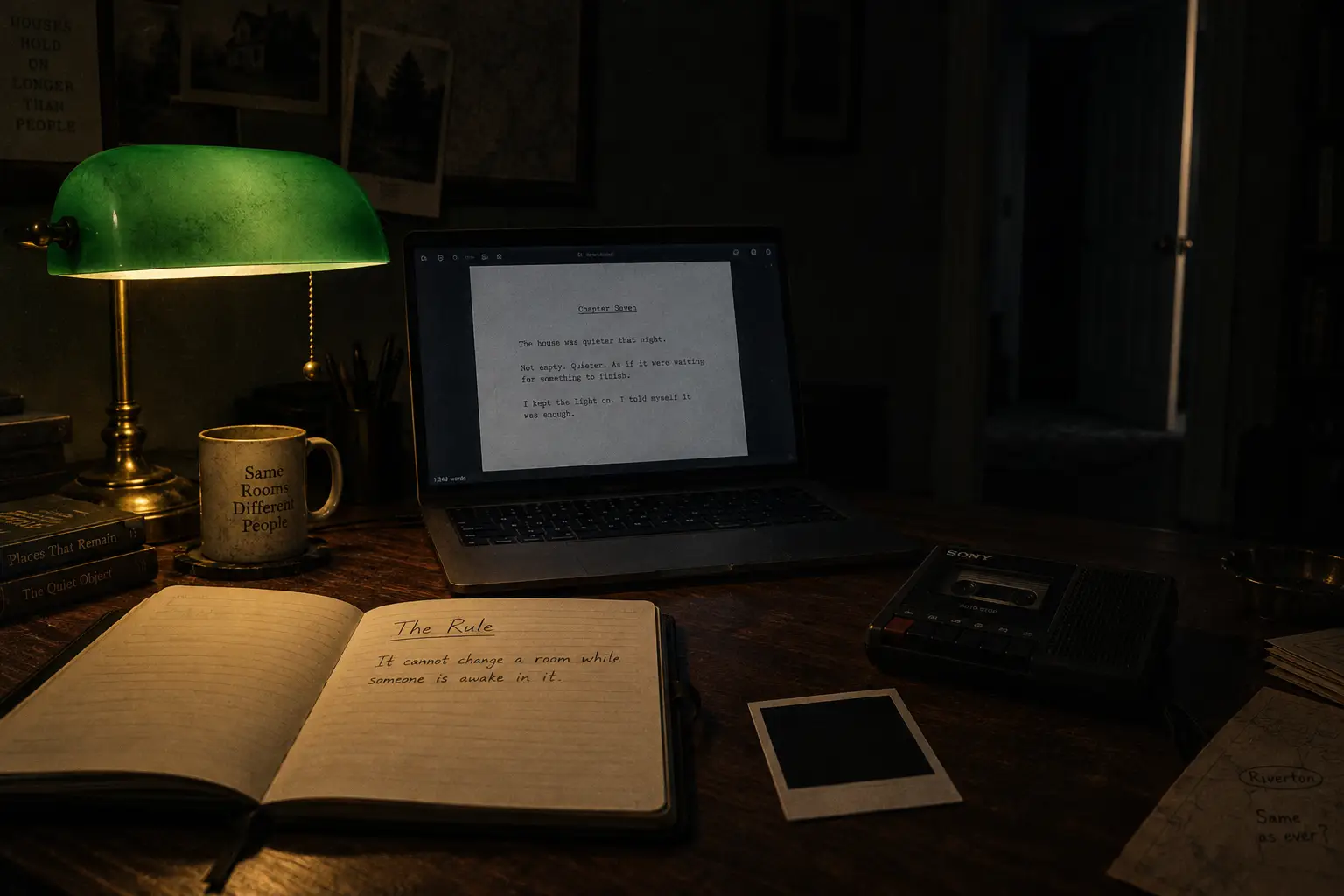
Direct answers about AI horror writing
The four questions horror writers ask before letting an AI near the thing in the cellar.
Does Inkfluence AI keep the horror escalating instead of resetting each chapter?
Yes. Chapters are drafted in sequence, each with the story bible, the last three chapters in full and a running record of everything before them. What the reader learned in chapter two is still true in chapter nine and worse. The outline sets the escalation before a word is drafted, and you can move a beat earlier or later there.
Can I stop Inkfluence AI from describing the monster?
Yes, and you should. Put the restraint rule in the premise and it is enforced: 'never describe the entity directly' or 'shown once, late, briefly'. The premise builder on this page writes that instruction for you. Effects before cause is the single instruction that most improves AI horror.
What does the story bible hold for a horror novel?
The entity and its rules: what it can do, what it cannot, what it wants, what stops it. The setting as a character. Every person with their current status, so the dead stay dead. And the open threads, the promises the plot has made. The story bible generator explains each section.
Will Inkfluence AI refuse horror content?
No. Dread, violence, death, gore in service of the story, body horror and dark themes are all written. The two hard lines are sexual content involving minors and sexual violence presented as desirable. A published horror novel's contents are in scope.
What Horror Writers Write on Inkfluence AI
Counted from the fiction books started on the platform in the 180 days to 12 September 2026 whose premise or title names a horror element outright.
3,929
horror books started in 180 days, 12% of all fiction on the platform
2,904
authors wrote them
37%
were exported as a PDF, EPUB or DOCX
5
chapters is the median first project, the free opening, before authors extend
Which horror gets written most
Haunted house and ghost premises lead, in about a third of horror books. Creature horror and cursed objects each appear in roughly three out of ten. Psychological horror is in about a quarter, possession in a fifth, isolation and folk horror in just under a fifth each. Slashers, gothic, found footage, zombie and cosmic horror are each around one in ten. Premises often belong to more than one group, so the shares overlap.
What the numbers say about finishing
A median of 5 chapters means most horror authors start with the free opening and extend from there, and horror is one of the genres where a short book is the right book. Just over a third of horror projects are exported, the same rate as fantasy and mystery. About 97% are in English. A wider count that includes adjacent premises, such as dark fantasy with a haunting in it, is in the genre report.
The Escalation Ladder the Outline Builds
Horror is a shape before it is a sentence. The outline places the beats on this ladder for a 20-chapter book and scales it for shorter ones. Move a rung earlier or later before drafting and every chapter follows.
| Stage | What happens |
|---|---|
| The wrong Chapters 1 to 4 | One thing is off. A sound, a door, a neighbour who does not blink. Nobody says the word haunted. |
| The pattern Chapters 5 to 9 | The wrong repeats and gains a rule. Somebody tests it. The cost of being wrong appears. |
| The cost Chapters 10 to 14 | The pattern is undeniable. Escape is tried and fails for a reason the book set up earlier. |
| The reveal, or the refusal Chapters 15 to 20 | Either the rule is understood and used, or it is understood and it does not help. |
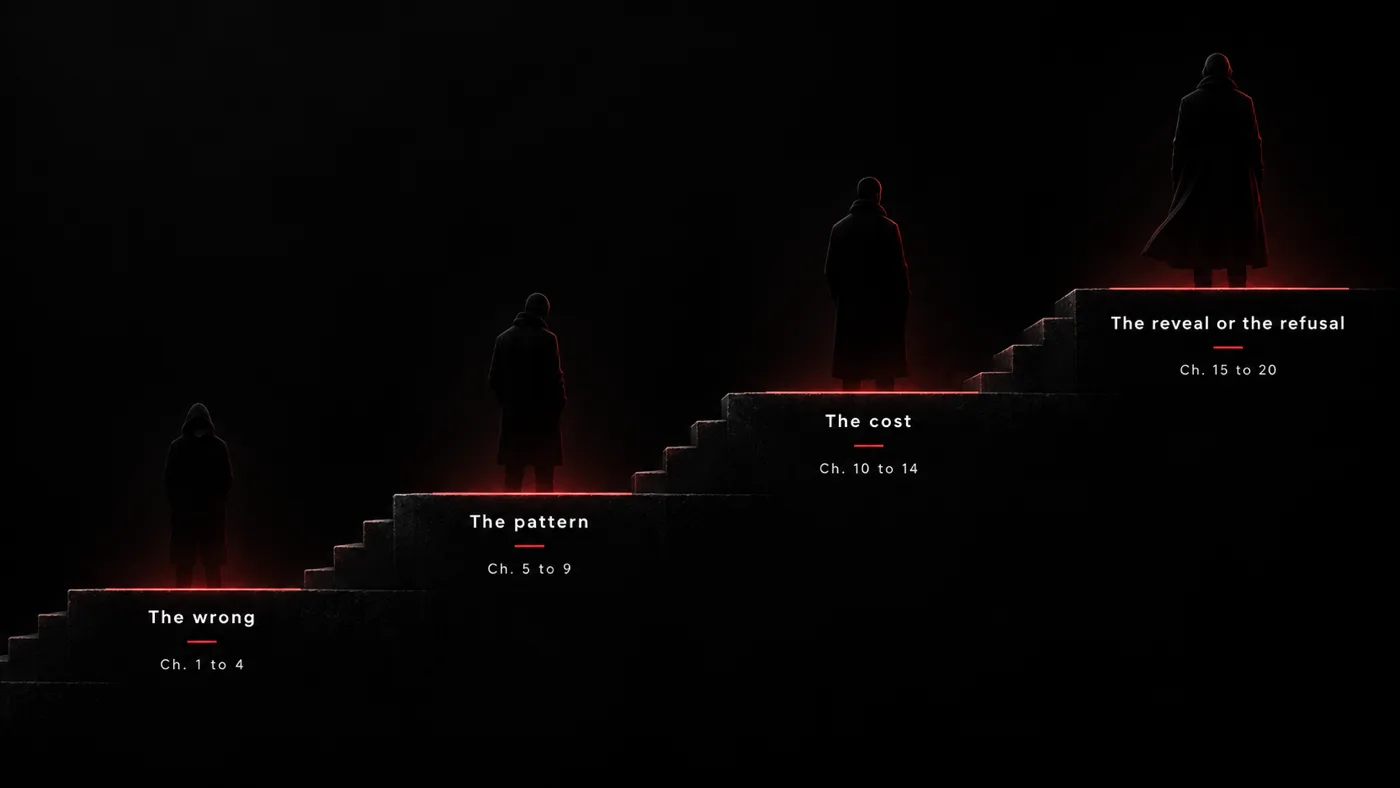
The ladder is enforced by two things. The story bible holds the entity's rules, so the AI cannot quietly give it a new power in chapter eleven. And every chapter is drafted with the previous three in full, so the escalation is cumulative: chapter twelve knows exactly how scared chapter eleven left everyone. The story bible generator shows what the bible holds, and the novel editor is where you cut the adjective the AI reached for anyway.
Every Horror Sub-Genre
The sub-genre comes from your premise, not your plan. All of these are on the free tier.
Haunted House / Ghost
A place that remembers, a family that should have left
Creature / Monster
Something in the woods, the lake, the walls
Cursed Object
A doll, a tape, a painting, a debt that passes hands
Psychological
An unreliable narrator and a house that may be fine
Possession / Demonic
Something wearing someone you love
Isolation / Survival
Snowed in, cut off, the radio dead
Folk Horror
The village, the ritual, the harvest that must be paid
Slasher
A masked killer and a cast that gets shorter
Gothic
Manors, madness, inheritance, weather
Found Footage / Creepypasta
Tapes, forum posts, the last recording
Cosmic / Lovecraftian
Knowledge that unmakes the person who learns it
Spooky for Kids and Teens
Scary enough, safe enough, a lamp left on
Horror that is also a mystery gets the clue-tracking from the mystery and thriller writer. Horror with a magic system gets the world memory from the fantasy novel writer. The premise decides which rules apply.
How the AI Horror Story Generator Works
Premise to a finished, exportable book in five steps. The first one is where the fear is decided.
Write the premise with the rule in it
Sub-genre, the protagonist and why they cannot leave, the setting, the threat, the rule the threat obeys, and how much of it the reader is allowed to see. "The house cannot change a room while someone is awake in it" is a better premise than "a haunted house", because a rule can be tested, broken and paid for.
Read the outline and the story bible
Inkfluence AI returns a chapter-by-chapter outline on the escalation ladder and a story bible for the entity, the setting and the cast. Move the first death later. Sharpen the rule. Delete the explanation the outline offered in chapter eighteen. What you leave here is what every chapter is written against.
Draft chapters in sequence
Horror is written one chapter after another, each with the story bible, the last three chapters in full and a running record of the rest. The dread compounds because chapter twelve knows what chapter eleven did to everyone.
Cut in the editor
Every chapter opens in a rich text editor with an AI assistant for rewrites and a review pass. This is where you delete the adjective, shorten the sentence before the turn, and end the chapter one line earlier than the draft did.
Cover, export, narrate, sell
Generate a cover from a prompt, export a KDP-ready EPUB or a print PDF, record an audiobook with a narrator voice, and publish a store listing, all from the same project. The KDP novel guide covers categories and series pricing.
Build Your Horror Premise
Pick the pieces and the premise writes itself, with the threat's rule and the restraint instruction stated the way the outline needs them. Edit anything, then send it straight to the dashboard.
Your premise
Edit anything. What is in this box is what the outline is built from.
Start with this premiseFree plan, no credit card. Five chapters to start.
Read Pages from AI-Written Fiction
Flip through real excerpts from novels drafted on Inkfluence AI
Loading preview...
Inkfluence AI vs Sudowrite and NovelAI for Horror
The honest split. Sudowrite is a fine tool for short horror. Neither of the others is trying to finish the novel for you.
| What horror needs | Inkfluence AI | Sudowrite | NovelAI |
|---|---|---|---|
| Escalation across a book | Outline on the ladder, then chapters in sequence with the last three in full | Chapter drafts from beats, one at a time | Scene by scene, you steer each continuation |
| Entity rules held | Story bible, edited before drafting, read every chapter | Story Bible cards, filled from your text | Lorebook entries triggered by keywords |
| Sentence-level dread | Editor with an AI assistant for rewrites | Strongest here: Describe, Rewrite, Expand | Model choice and sampling controls |
| Content limits | Dread, gore, dark themes written; minors and sexual violence refused | Permissive for horror | No text filter |
| Export | PDF, EPUB, DOCX, print-ready PDF | DOCX | Plain text and its own story format |
| Cover, audiobook, listing | All in the project | None | Image generation only |
For a 5,000-word story you want to hand-polish, Sudowrite is a fair pick. For a finished horror novel with the cover on, start here. The genre-by-genre verdicts and the Sudowrite head-to-head go deeper.
Pricing for Horror Writers
Start free with a five-chapter opening. Most horror novellas fit in a single Creator month.
| Feature | Free | Creator $9.99/mo | Premium $19.99/mo |
|---|---|---|---|
| Chapters | 5 + 5/month | 35/month | Unlimited |
| Story bible and sequential drafting | Included | Included | Included |
| PDF export | Included | Included | Included |
| EPUB and DOCX export | -- | Included | Included |
| AI cover generator | Basic designer | AI-generated | AI-generated |
| Audiobook chapters / month | -- | 15 | 30 |
| Annual price | -- | $89 | $179 |
| Credit card required | No | Yes | Yes |
Horror Premise Templates
Copy and adapt. Each one states a rule for the threat and a restraint instruction, the two lines that most improve an AI horror draft.
Haunted house
"A haunted house novel in 16 chapters. Mara Kessler, a hospice nurse, inherits her estranged mother's farmhouse in Ohio and moves in with her nine-year-old son. The house rearranges itself at night, one room at a time, always toward the cellar. Rule: the house cannot change a room while someone is awake in it. Never describe the entity directly; the reader only sees what it does. Point of view: close third, Mara. Ending: they leave, and the last chapter is her son's drawing of the cellar door in their new flat."
Key elements: A named lead with a reason to stay, a rule the plot can use, a restraint instruction, an ending the book can pay off
Cosmic horror
"A cosmic horror novel in 14 chapters. Dr Ines Ferreira, a deep-sea acoustician, records a sound at 4,000 metres that resolves into words in a language no one on the ship speaks, though each of them understands it. Rule: anyone who understands the sound loses one memory of a person they love, permanently. The entity is never shown; only the crew's losses are. Tone: cold, precise, no jump scares. Ending: Ines chooses to listen to the end."
Key elements: A cost stated as a rule, a tone instruction, an ending that is a decision
Creepypasta / found footage
"A found-footage horror in 10 chapters, written as transcripts of nine recovered tapes plus one police summary. Four friends film a night in the abandoned Halden Rest Home for a channel. The tapes are in the wrong order and the reader has to work out why. Rule: the thing in the building only moves when it is not on camera. Never shown. Ending: the tenth chapter proves one of the four uploaded the footage."
Key elements: A format instruction, a structural puzzle, a rule that shapes every scene
Folk horror
"A folk horror novel in 18 chapters. Tom Ashby returns to the Devon village he left at twelve to bury his father and stays for the Lammas festival. Everyone is kind. Everyone is waiting. Rule: the harvest fails unless someone chooses to stay, and the choosing must be free. Slow burn; no violence until chapter fifteen. Point of view: first person, Tom, who trusts everyone. Ending: he stays, and he thinks it was his idea."
Key elements: Dread through kindness, a rule with a moral hinge, an unreliable first person
Related Tools and Guides
AI Novel Writer
All fiction genres, full feature overview
AI Mystery and Thriller Writer
When the horror is also a whodunit
AI Sci-Fi Story Generator
For the horror that happens on a ship
AI Fantasy Novel Writer
Dark fantasy shares the story bible
AI Story Bible Generator
Where the entity's rules live
AI Story Writer
For a single short scary story
Best AI by Fiction Genre (2026)
Horror judged against seven other tools
AI Novel Generator for KDP
Categories, keywords, series pricing
AI Audiobook Generator
Horror is made for audio
Frequently Asked Questions
Can AI write a horror story that is actually scary?
It can write one that builds. Fear on the page comes from escalation and restraint rather than from adjectives, and those are structural: what the reader learns in chapter two has to still be true and worse in chapter nine. Inkfluence AI outlines the whole book before drafting and writes each chapter with the previous three in full as context, so the creak in chapter one becomes a presence by chapter twelve instead of resetting. What it cannot do is decide what frightens you. Put that in the premise.
Does the AI describe the monster?
Only if you let it. The most common failure in AI horror is the entity described in full on page four. Put a restraint rule in the premise, for example 'never describe the entity directly, the reader only sees what it does', and the outline and every chapter obey it. The premise builder on this page has a control for exactly this.
Which horror sub-genres does it write?
Haunted house and ghost stories, creature and monster horror, cursed objects, psychological horror, demonic possession, isolation and survival horror, folk horror, slashers, gothic, found footage and creepypasta, zombie and apocalypse, cosmic horror, and spooky stories for children and teens. The sub-genre comes from your premise, not your plan. Haunted house, creature and cursed-object premises are the three most common on the platform.
Will the AI refuse horror content?
No. Violence, dread, death, gore in service of the story, body horror and dark themes are all in scope. The only hard lines are sexual content involving minors and sexual violence presented as desirable, which no responsible tool will write. Everything else that a published horror novel contains, this will write.
Can it write a creepypasta or a short scary story rather than a novel?
Yes. Ask for three or four chapters and you get a long short story with a proper build. For a single 1,500-word piece, the AI story writer is the quicker tool. For anything with a build across chapters, which is where most creepypasta actually lives, this page is the right one.
How does it keep the haunting consistent?
The story bible. Before drafting, the outline writes down the entity, its rules (what it can and cannot do, what it wants, what stops it), the setting and every character with their status. Each chapter is drafted with that bible, the last three chapters in full and a running record of everything before them. A rule you set stays set.
How long can the horror novel be?
Up to 40 chapters in one project at roughly 1,000 to 1,500 words a chapter. Most horror works best short: 12 to 20 chapters is a novella to a tight novel, which is the length the genre's classics tend to run.
Is the AI horror story generator free?
Yes. The free plan needs no credit card and gives you 5 chapters to start, plus 5 more on the first of each month, with PDF export. Creator at $9.99 a month adds 35 chapters a month with EPUB and DOCX export. Premium at $19.99 a month has unlimited chapters.
Can I publish a horror novel written with AI on Amazon KDP?
Yes. You own what you create, and the EPUB export on Creator and Premium is KDP-ready. Amazon asks you to disclose AI-generated content when you publish. Horror is a strong Kindle Unlimited category with readers who binge a series, so a consistent entity across books matters.
Will it narrate a horror audiobook?
Yes, on paid plans. Pick a narrator voice and each chapter is recorded from the text as written. Horror does well in audio; keep the chapters short and end them on the turn.
How is this different from Sudowrite or NovelAI for horror?
Sudowrite is a prose studio and its sentence-level tools are good for short horror and for polishing dread line by line. NovelAI generates scene by scene from a lorebook and leaves assembly to you. Inkfluence AI is built to finish the book: outline, story bible, chapters in sequence, editor, cover, EPUB, audiobook. For a whole horror novel, start here; for a 5,000-word story you want to hand-polish, Sudowrite is a fair choice.
Can it write horror in other languages?
Yes. Write the premise in your language and the outline and chapters come back in it. About 97% of horror on the platform is in English; Spanish, Portuguese, Indonesian and French follow.
Write the rule. Then let it break someone.
Five chapters free, no credit card. The story bible for the entity is generated from your first premise.
Start Your Horror Story Free