
AI Sci-Fi Story Generator
Technology Rules That Hold to the Last Chapter
Write a science fiction story or a full sci-fi novel with AI. The drive, the signal, the cure and the timeline live in a story bible, and every chapter is drafted knowing the last three.
Chapter outline - Story bible - Sequential drafting - Hardness you set - EPUB, PDF and DOCX - Audiobook narration
Updated September 2026
Quick Answer
Inkfluence AI is an AI sci-fi story generator that turns a premise into a chapter outline and a story bible holding the technology's rules, the timeline, the ships and places and the factions, then drafts each chapter with the story bible, the last three chapters in full and a running record of the rest as context. A rule you set for the drive, the signal or the cure in chapter two is still in force in chapter twenty. You set the hardness in the premise, from no faster-than-light travel to space fantasy. It writes first contact, post-apocalyptic, time travel, space opera, colonisation, dystopia, AI, military, cyberpunk, near-future and hard sci-fi, from a novella to a 40-chapter volume, and exports to PDF, EPUB and DOCX with an AI cover and audiobook narration. 1,930 science fiction books were started on the platform in the 180 days to 12 September 2026. The free plan needs no credit card.
Direct answers about AI science fiction writing
The four questions sci-fi authors ask before handing a world to an AI.
Does Inkfluence AI keep the technology rules consistent for the whole novel?
Yes. The rules you write into the story bible are in front of the AI for every chapter, together with the last three chapters in full and a running record of everything before them. A drive that takes six days in chapter two still takes six days in chapter twenty. Rules that are not written down are not enforced, so put them in the bible.
Can Inkfluence AI build the world from a short premise?
It can propose one. From a paragraph the outline names the technology, the factions and the shape of the setting, and writes them into the story bible for you to edit before drafting. Authors who bring their own worldbuilding get a draft that uses it. Authors who bring a sentence should read the bible before chapter one.
Will Inkfluence AI respect hard science-fiction constraints?
The ones you state. 'No faster-than-light travel, time dilation applies, reaction mass is finite' in the premise becomes a constraint the outline and every chapter obey. It does not audit your physics; no tool does. The story bible generator is where the constraints are written down.
Can I write a sci-fi series with Inkfluence AI?
Yes. Each book is a project, and the book series writer carries the story bible into the next book, so ships, planets, factions and the rules of the drive do not drift between volumes.
What Science Fiction Writers Write on Inkfluence AI
Counted from the fiction books started on the platform in the 180 days to 12 September 2026 whose premise or title names science fiction outright.
1,930
science fiction books started in 180 days, 6% of all fiction on the platform
1,227
authors wrote them
36%
were exported as a PDF, EPUB or DOCX
5
chapters is the median first project, the free opening, before authors extend
Which science fiction gets written most
First contact and alien premises lead, in about three out of ten sci-fi books. Post-apocalyptic and time travel each appear in roughly a quarter, space opera and YA sci-fi in about a fifth, colonisation and Mars in a fifth. Dystopia, AI and robots, military sci-fi, cyberpunk and near-future climate stories are each between one in six and one in eight. Hard sci-fi is about one in sixteen. Premises often belong to more than one group, so the shares overlap.
What the numbers say about finishing
A median of 5 chapters means most sci-fi authors start with the free opening and extend from there. Just over a third of sci-fi projects are exported, the same rate as fantasy, horror and mystery. About 91% are in English, with Ukrainian the second most common language. A wider count that includes adjacent premises, such as fantasy with a spaceship in it, is in the genre report.
What the Story Bible Holds for a Science Fiction Novel
Science fiction fails on its own rules more than on anything else, because the reader is checking. The story bible is a structured document the AI reads before every chapter, alongside the last three chapters in full and a running record of everything before them.
| Section | What it holds |
|---|---|
| Technology rules | What each key technology does, costs, cannot do, and how long it takes |
| Timeline | Dates, travel times, how long since the event that started everything |
| Ships and places | Decks, stations, planets, distances, who controls what |
| Factions and politics | Governments, corporations, fleets, who wants what from whom |
| Characters | Name, role, augmentations, rank, status, what they know |
| Open questions | What the signal means, who sent the ship, what the AI is hiding |
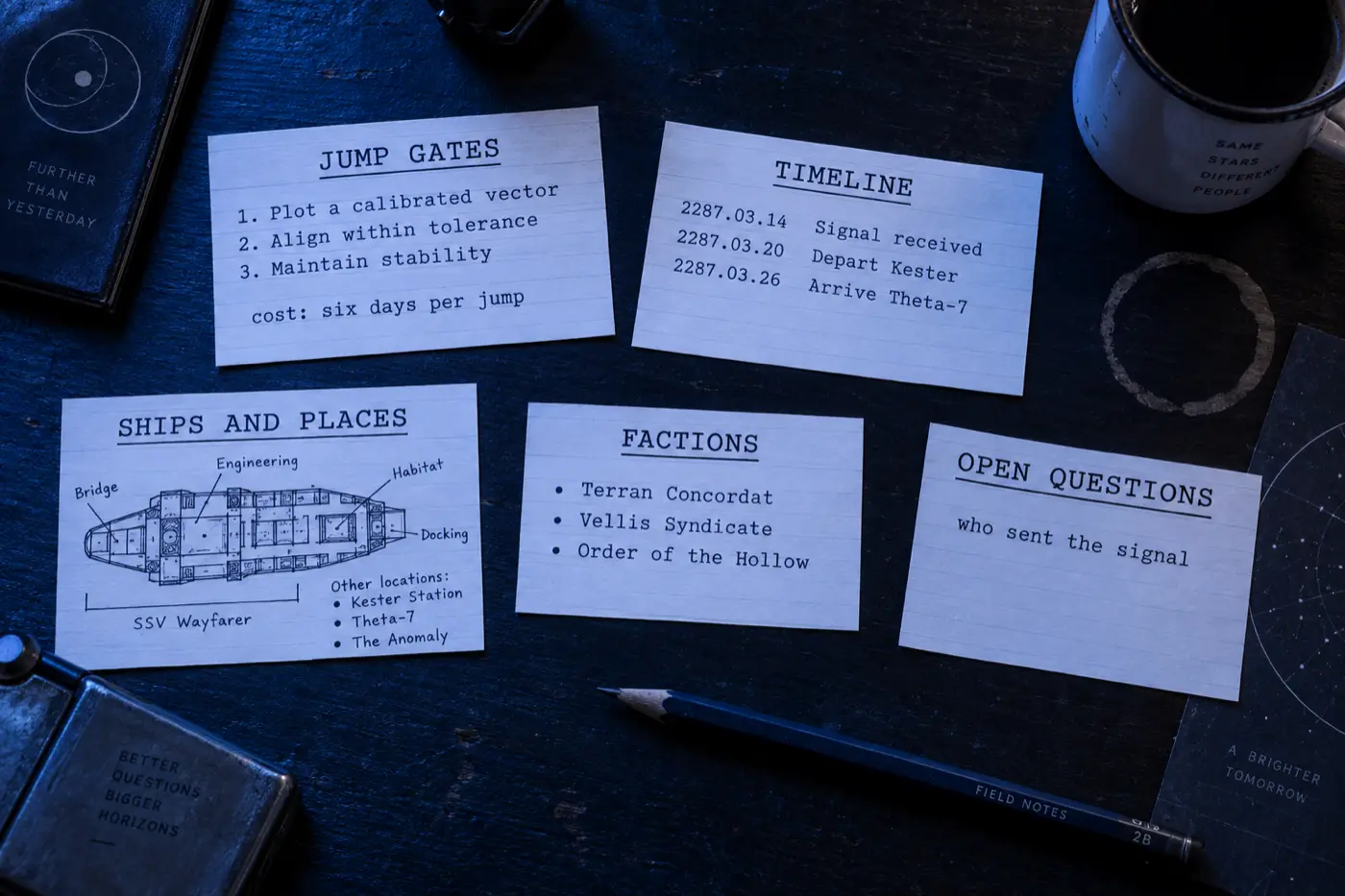
The outline step proposes the bible. Read it before you draft. If the outline has given the drive two different travel times or put the colony on the wrong side of the planet, fix it there, once, and every chapter inherits the fix. The story bible generator and the character bible generator explain each section in detail.
Every Science Fiction Sub-Genre
The sub-genre comes from your premise, not your plan. All of these are on the free tier.
First Contact / Aliens
The signal, the ship, the question of what they want
Post-Apocalyptic
After the collapse, what is worth rebuilding
Time Travel
Loops, paradoxes, a timeline someone is editing
Space Opera
Fleets, empires, a war across a hundred systems
Colonisation / Mars
The first winter on a world that does not want you
Dystopia
The regime, the surveillance, the one who notices
AI and Robots
A mind that was built, deciding what it owes
Military Sci-Fi
Marines, warships, orders that do not survive contact
Cyberpunk
Neon, megacorps, a body that is partly rented
Climate / Near Future
2050, the water, the people who stayed
Hard Sci-Fi
No faster-than-light, no free lunch, the maths holds
YA Sci-Fi
An academy, a first ship, a voice that stays sixteen
Sci-fi horror on a ship gets the restraint rules from the horror story generator. Sci-fi romance gets the romance rules from the romance novel writer. The premise decides which apply.
How the AI Sci-Fi Story Generator Works
Premise to a finished, exportable book in five steps. The second step is the one science fiction authors should not skip.
Write the premise with the technology in it
Sub-genre, the setting and its date, the protagonist, what happens to them, the one technology the plot turns on, the rule it obeys, how hard you want the science, the number of chapters and the point of view. "Jump gates that record every transit and cannot be turned off" is a book. "Spaceships" is not.
Read the outline and the story bible
Inkfluence AI returns a chapter-by-chapter outline and the story bible: technology rules, timeline, ships and places, factions, characters, open questions. Fix the travel time. Delete the second drive the outline invented. What you leave here is what every chapter is written against.
Draft chapters in sequence
Science fiction is written one chapter after another, each with the story bible, the last three chapters in full and a running record of the rest. The engineer who learned about the reactor in chapter nine still knows in chapter ten, and the jump still takes six days.
Edit in the built-in editor
Every chapter opens in a rich text editor with an AI assistant for rewrites, expansions and a review pass. Rename a ship across the whole book in one find-and-replace. Cut the paragraph that explains the technology twice.
Cover, export, narrate, sell
Generate a cover from a prompt, export a KDP-ready EPUB or a print PDF, record an audiobook with a narrator voice, and publish a store listing, all from the same project. The KDP novel guide covers categories, keywords and series pricing.
Build Your Science Fiction Premise
Pick the pieces and the premise writes itself, with the technology, its rule and the hardness stated the way the outline needs them. Edit anything, then send it straight to the dashboard.
Your premise
Edit anything. What is in this box is what the outline is built from.
Start with this premiseFree plan, no credit card. Five chapters to start.
Read Pages from AI-Written Fiction
Flip through real excerpts from novels drafted on Inkfluence AI
Loading preview...
Inkfluence AI vs Novelcrafter and NovelAI for Science Fiction
The honest split. Novelcrafter is a good wiki for hard sci-fi authors who curate one. Neither is trying to finish the novel for you.
| What sci-fi needs | Inkfluence AI | Novelcrafter | NovelAI |
|---|---|---|---|
| Technology rules held | Story bible, generated from the premise, edited, read every chapter | Codex wiki you fill by hand, strong for large tech bibles | Lorebook entries triggered by keywords |
| Whole-book drafting | Outline, then every chapter in sequence | Scene beats, drafted one at a time | Scene by scene, you steer each continuation |
| Recent context | Last three chapters in full plus a running record | Depends on the AI account you connect | A context window of recent text |
| AI included | Yes, in the plan | No, bring your own account | Yes, in the plan |
| Export | PDF, EPUB, DOCX, print-ready PDF | DOCX and text | Plain text and its own story format |
| Cover, audiobook, listing | All in the project | None | Image generation only |
If you want a wiki you curate and your own AI bill, Novelcrafter is good at it. If you want a finished science fiction novel with the cover on, start here. The genre-by-genre verdicts and the NovelAI head-to-head go deeper.
Pricing for Science Fiction Writers
Start free with a five-chapter opening. Upgrade when the book is longer than that.
| Feature | Free | Creator $9.99/mo | Premium $19.99/mo |
|---|---|---|---|
| Chapters | 5 + 5/month | 35/month | Unlimited |
| Story bible and sequential drafting | Included | Included | Included |
| PDF export | Included | Included | Included |
| EPUB and DOCX export | -- | Included | Included |
| AI cover generator | Basic designer | AI-generated | AI-generated |
| Audiobook chapters / month | -- | 15 | 30 |
| Annual price | -- | $89 | $179 |
| Credit card required | No | Yes | Yes |
Science Fiction Premise Templates
Copy and adapt. Each one names one technology, its rule and its cost, which is the single instruction that most improves an AI science fiction draft.
First contact
"A first-contact novel in 24 chapters. Dr Amara Osei, a radio astronomer at a dying observatory in Chile, receives a signal that is a perfect copy of a transmission humanity sent in 1977, returned with one word changed. Technology: the signal's origin can be located only by shutting down every other instrument on Earth for nine minutes. Rule: the senders can only reply to something we sent first. Science: plausible, no faster-than-light travel. Point of view: close third, Amara. Ending: humanity sends a second message, and the book ends before the reply."
Key elements: A specific hook, a technology with a cost, a rule that constrains the plot, a hardness instruction, an ending that is a choice
Space opera
"A space opera in 32 chapters. The Meridian Compact is losing a war against a fleet that appears to know every jump before it happens. Captain Ilse Varga suspects the jump network itself is the leak. Technology: gates that record every transit and cannot be turned off. Rule: a ship can only jump to a gate it has physically visited before. Three points of view: Ilse, a gate engineer who built the flaw, and a Compact senator who profits from it. Tone: political, fast, no comic-relief character. Ending: the network is shut down and the book ends with the first slow ship leaving."
Key elements: A war with a mystery inside it, a technology rule the plot turns on, three POVs, an ending that changes the world
Near-future climate
"A near-future novel in 18 chapters, set in 2052 in a Rotterdam that is half behind sea walls. Teun de Wit, a pump-station engineer, discovers the city's flood model has been quietly edited to justify abandoning his district. Technology: the flood model itself, which every insurer and politician treats as truth. Rule: the model can only be changed by three signatures, and one of them is his dead mother's. Science: realistic, nothing invented that does not exist in 2026. Point of view: first person, Teun. Ending: the district floods, and the record shows why."
Key elements: A technology that is a piece of software, a rule with a personal hinge, a hardness instruction, a bitter ending
Time travel
"A time-travel novel in 20 chapters. Every night at 3:12, Priya Raman wakes up one day earlier than the day she went to sleep, and has since the accident. Technology: none; the loop is the premise and it obeys rules. Rules: she keeps her memories, nobody else does, and any object she is holding at 3:12 travels with her. Point of view: first person, Priya. Tone: precise, funny in places, devastating by chapter fifteen. Ending: she reaches the day of the accident and chooses not to be holding anything."
Key elements: The mechanism stated as rules, an object rule the plot can use, a tone instruction, an ending built from the rule
Related Tools and Guides
AI Novel Writer
All fiction genres, full feature overview
AI Fantasy Novel Writer
Same story bible, magic instead of physics
AI Horror Story Generator
For the thing on the ship
AI Story Bible Generator
Where the technology rules live
AI Book Series Writer
Carry the bible from book one to book five
AI Mystery and Thriller Writer
For the sci-fi that is also a whodunit
Best AI by Fiction Genre (2026)
Science fiction judged against seven other tools
AI Novel Generator for KDP
Categories, keywords, series pricing
AI Audiobook Generator
A narrator for the finished book
Frequently Asked Questions
Can AI write a science fiction novel?
Yes. Inkfluence AI takes a premise, builds a chapter outline and a story bible for the world, then drafts each chapter in sequence with the story bible and the last three chapters in full as context. You edit in the built-in editor and export the finished book. The part it cannot do is choose the idea: science fiction lives or dies on one technology or one change taken seriously, and that has to be in your premise.
How does the AI keep the technology consistent?
The story bible holds the rules of every technology the plot depends on: what it does, what it costs, what it cannot do, how long it takes. If a jump between systems takes six days in chapter two, the bible says six days and chapter fourteen cannot make it an afternoon because the plot wanted one. Rules that are written down are enforced; rules that live only in your head are not.
Does it do hard science fiction?
It does the consistency half, which is most of it. State the physics you want respected in the premise ('no faster-than-light travel, relativistic time dilation applies, reaction mass is finite') and the outline and chapters obey those constraints. It does not check your orbital mechanics for you; that is the author's job in every tool. Hard sci-fi premises are about one in sixteen on the platform.
Which sci-fi sub-genres does it write?
First contact and alien invasion, post-apocalyptic, time travel, space opera, dystopia, colonisation and Mars, AI and robots, military sci-fi, cyberpunk, climate and near-future, biopunk, hard sci-fi, YA sci-fi and sci-fi romance. The sub-genre comes from your premise, not your plan. First contact, post-apocalyptic and time travel are the three most common on the platform.
Can it write a space opera series?
Yes. Each book is a project and the book series writer carries the story bible into the next volume, so the ships, factions, planets and the rules of the drive stay the same from book one to book five. Space opera is where the bible earns its keep; the cast and the map are large.
How long can the novel be?
Up to 40 chapters in one project at roughly 1,000 to 1,500 words a chapter. Chapter count is the length lever: 12 chapters for a novella, 30 to 40 for a full space opera volume. There is no page or word target to set.
Can I bring my own worldbuilding?
Yes. Paste it into the premise or into the story bible before you outline: the tech specs, the timeline, the factions, the ship's deck plan. Anything written down is used. Long documents work best trimmed to the facts a chapter needs.
Is the AI sci-fi story generator free?
Yes. The free plan needs no credit card and gives you 5 chapters to start, plus 5 more on the first of each month, with PDF export. Creator at $9.99 a month adds 35 chapters a month with EPUB and DOCX export. Premium at $19.99 a month has unlimited chapters.
Will the science sound generic?
It will if the premise is generic. 'A spaceship in the future' produces a serviceable draft with placeholder tech. 'A generation ship whose reactor is failing and whose crew has forgotten it is a ship' produces a book. Name the technology, name its rule, name its cost, and the draft has something to be specific about.
Can I publish a sci-fi novel written with AI on Amazon KDP?
Yes. You own what you create, and the EPUB export on Creator and Premium is KDP-ready. Amazon asks you to disclose AI-generated content when you publish. Science fiction readers follow series, so the read-through from book one matters more than its price.
How is this different from Novelcrafter or NovelAI for sci-fi?
Novelcrafter is an organiser with a Codex you fill by hand, strong for hard sci-fi authors who maintain a large technical wiki, and it needs your own AI account. NovelAI generates scene by scene from a lorebook and leaves assembly to you. Inkfluence AI is built to finish the book: outline, story bible, chapters in sequence, editor, cover, EPUB, audiobook. If you want a wiki you curate, Novelcrafter is good. If you want a finished sci-fi novel, start here.
Can it write science fiction in other languages?
Yes. Write the premise in your language and the outline and chapters come back in it. About 91% of sci-fi on the platform is in English; Ukrainian, Spanish, German and Portuguese follow. Translation of a finished book is available on paid plans.
Write the rule of the drive. Then write the book.
Five chapters free, no credit card. The story bible is generated from your first premise.
Start Your Sci-Fi Story Free