
Best AI for Writing Fantasy, Horror, Sci-Fi, Mystery and Romance Novels in 2026, Genre by Genre
The best AI for writing a novel depends on the genre. Fantasy needs world memory, mystery needs clue tracking, romance needs heat rules, horror needs restraint. We judged eight AI tools genre by genre, with first-party data on what 32,482 fiction authors actually wrote in the last six months.
Quick Answer
For a finished novel in any genre, Inkfluence AI is the best AI for writing fantasy, mystery, romance, children's and YA fiction, because it holds a story bible, drafts chapters in sequence with the previous chapters as context, and exports a KDP-ready book. NovelAI is the better pick for scene-by-scene fantasy and unfiltered fanfiction, Sudowrite for sentence-level horror and literary prose, Novelcrafter for a series with a large shared wiki, and a plain chat model for a single short story or poem. For explicit erotica, none of the mainstream tools is honest about its ceiling except by omission; we state ours below.
Published 12 September 2026 · 22 min read
"Best AI for writing novels" is the wrong question. A fantasy author needs a tool that remembers the rules of the magic in chapter twenty. A mystery author needs one that knows which clue was planted in chapter three. A romance author needs heat rules that hold and a love interest who keeps his voice. A horror author needs restraint. This guide takes the same eight tools we tested in the head-to-head novel comparison and judges them genre by genre, with one extra input the other guides do not have: what fiction authors actually write when the tool is in front of them.
What Fiction Authors Actually Write with AI
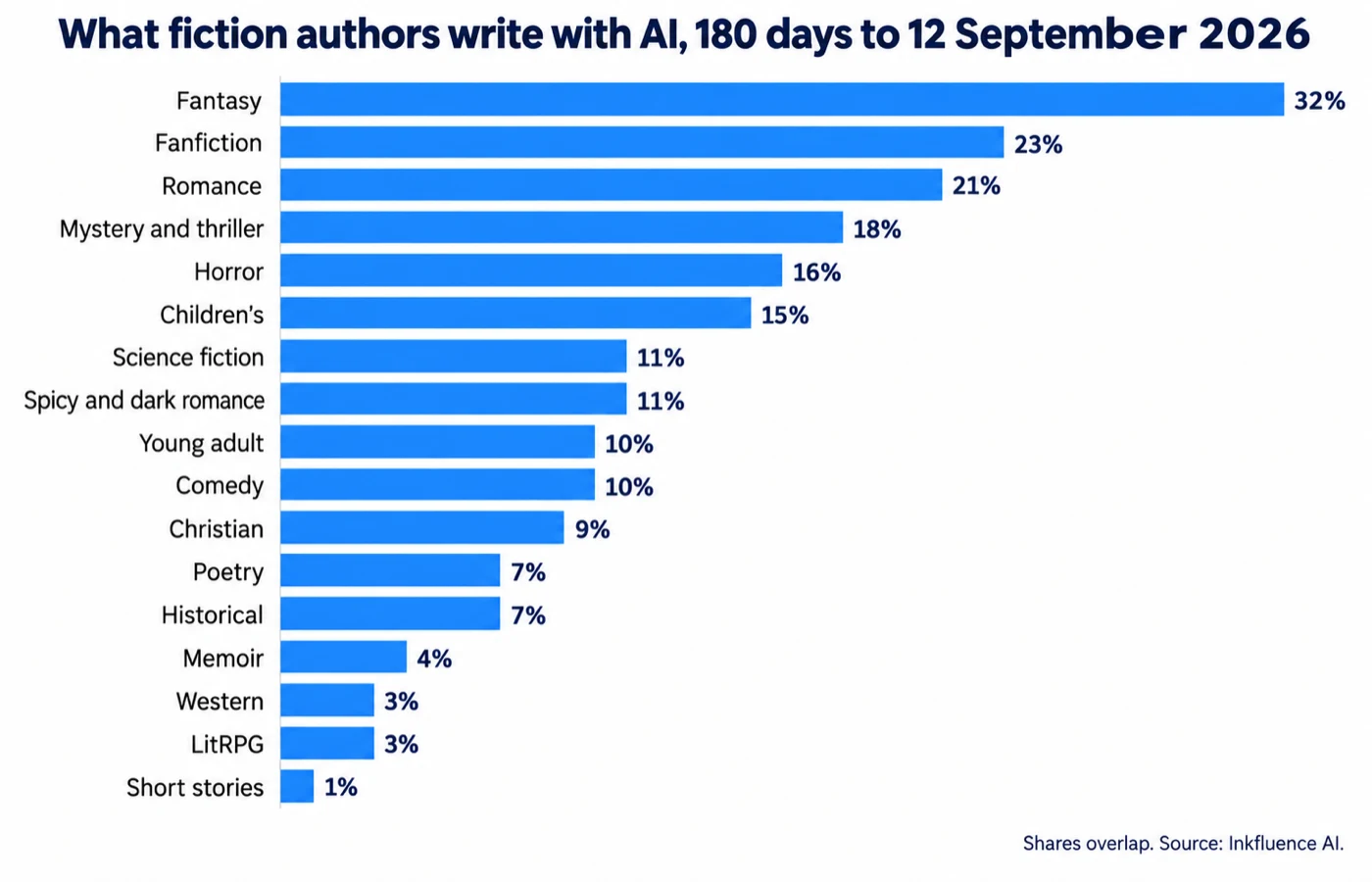
Most "best AI for [genre]" guides are written from the outside: a reviewer tries a tool for an afternoon and reports. We have one input those guides cannot get. Inkfluence AI is used to write fiction at scale, and every book starts with a premise in the author's own words. We classified the fiction books started on the platform in the 180 days to 12 September 2026 by the words in each premise and title. The counts below are that classification. A premise can belong to more than one genre, so the shares overlap.
| Genre | Share of fiction books | Books exported | What the premises ask for |
|---|---|---|---|
| Fantasy | 32% | 36% | Adventure, dark fantasy, urban, epic, progression, YA fantasy. Full breakdown. |
| Fanfiction | 23% | 31% | Existing characters, x reader, alternate universes. Fandom data. |
| Romance | 21% | 35% | Enemies to lovers, second chance, billionaire, slow burn |
| Mystery and thriller | 18% | 42% | Detectives, serial killers, conspiracies, heists |
| Horror | 16% | 37% | Haunted places, possession, cursed objects, slashers. Strict count and breakdown. |
| Children's fiction | 15% | 37% | Bedtime stories, picture books, early readers |
| Science fiction | 11% | 36% | Space, dystopia, AI, time travel, cyberpunk. Strict count and breakdown. |
| Spicy and dark romance | 11% | 34% | Any adult register: spicy, dark, mafia, omegaverse, monster. Breakdown. |
| Young adult | 10% | 34% | Coming of age, academies, high school |
| Comedy | 10% | 38% | Satire, funny, parody, mostly as a tone on another genre |
| Christian fiction | 9% | 44% | Faith, church, devotional framing |
| Poetry | 7% | 34% | Collections, occasion poems, verse for children |
| Historical fiction | 7% | 43% | Regency, Victorian, medieval, the world wars |
| Memoir and biography | 4% | 42% | Life stories, family history, true stories |
| Western | 3% | 38% | Ranches, outlaws, the frontier |
| LitRPG and progression | 3% | 41% | Systems, levels, dungeons, reincarnation |
| Short story collections | 1% | 39% | Anthologies and flash fiction, rare in a book tool |
Three things in that table shape the rest of this guide. Fantasy is the largest fiction genre by a wide margin, and nearly a third of all fiction premises have a fantasy element. Mystery, historical and Christian fiction have the highest export rates, which is a rough proxy for authors who finish. And short stories are almost absent, because a book tool is the wrong instrument for a 2,000-word story; a chat model is the right one, and we say so below.
How We Judged Each Genre
The eight tools are the same as in the head-to-head: Inkfluence AI, Sudowrite, Novelcrafter, NovelAI, Squibler, Claude, ChatGPT and Jasper. Prices were re-checked on each vendor's own pricing page on 11 September 2026 and are listed in the pricing table there; we do not repeat them here. For each genre we asked four questions:
- What does this genre need remembered? Magic rules, clues, relationship stages, a timeline, a cast of dozens. The tool has to hold that specific thing across the whole book, not just the last few pages.
- What does this genre need from the prose? Restraint for horror, banter for romance, procedural clarity for mystery, sensory density for fantasy.
- Does the tool get the book finished? Outline, chapters in order, editor, cover, export. Or does it hand you a pile of scenes?
- What does the tool refuse or water down? This matters in erotica, dark romance, horror and true crime, and most guides skip it.
Where Inkfluence AI is the pick, the reason is usually the same: it is the only one of the eight built to take a premise to a finished, exportable book, and its fiction context is a story bible plus the last three chapters in full plus a running record of everything before them. Where it is not the pick, we say who is and why.
The Genre Table: Best Tool and Runner-Up
| Genre | Best for a finished book | Runner-up, and when to pick it | The thing this genre needs |
|---|---|---|---|
| Fantasy | Inkfluence AI | NovelAI, for scene-by-scene play with a lorebook | World memory that survives forty chapters |
| Science fiction | Inkfluence AI | Novelcrafter, for hard sci-fi with a large tech wiki | Consistent rules for the technology |
| Horror | Inkfluence AI for a novel | Sudowrite, for short horror and sentence-level dread | Restraint and escalation |
| Mystery and thriller | Inkfluence AI | Novelcrafter, if you track clues in a wiki yourself | Clues planted and paid off |
| Romance | Inkfluence AI | Sudowrite, for prose polish on a finished draft | Relationship stages that do not repeat |
| Erotica and spicy | Inkfluence AI up to BookTok heat | NovelAI, for explicit content with no filter | An honest statement of the ceiling |
| Fanfiction | Inkfluence AI for multi-chapter fics | NovelAI, for unfiltered scene-by-scene fic | Character voice for people you did not invent |
| Short stories | Claude or ChatGPT | Inkfluence AI story writer, if you want a file to sell | One good idea, executed once |
| Memoir and biography | Inkfluence AI | An interview-style memoir app, if you want to be asked questions | Your voice, your facts, a chapter order |
| LitRPG and light novels | Inkfluence AI | NovelAI, whose training leans towards this register | System rules and stat formatting held |
| Historical fiction | Inkfluence AI | Claude, for research-heavy prose passages | A timeline that does not slip |
| Children's books | Inkfluence AI, with illustrations | None of the others make an illustrated book | Age-right words and a consistent character on every page |
| Young adult | Inkfluence AI | Sudowrite, for voice work | A first-person voice that stays sixteen |
| Poetry | Inkfluence AI for a collection | Claude, for a single poem | Form held across a whole book |
| Christian fiction and devotionals | Inkfluence AI | ChatGPT, for a one-off reflection | Scripture handled accurately, a daily structure |
Best AI for Writing Fantasy Novels
Pick: Inkfluence AI. Runner-up: NovelAI.
Fantasy fails on continuity more than any other genre, because the world is invented and nothing outside the book can correct it. A rule that quietly changes, a city that moves from the coast to the mountains, a dead lieutenant who turns up at the council: these are the errors readers post about. The tool that wins fantasy is the tool that holds the world.
Inkfluence AI generates a story bible from the premise before it drafts a chapter: magic rules and their cost, characters with status and scars, places with distances, factions, and open plot threads. You edit it, and then every chapter is written against it, plus the last three chapters in full and a running record of the rest. The fantasy novel writer page walks through what the bible holds and why each section matters, and the series writer carries the bible into book two. It exports the finished book to EPUB, PDF and DOCX and puts a cover on it.
NovelAI's Lorebook is the closest thing to a story bible in the other seven tools, and for authors who want to co-write scene by scene, steering each continuation, it is the better experience. It does not outline, it does not draft a chapter list, and it exports plain text, so the book-building is yours. Novelcrafter's Codex is excellent for a series wiki, but you fill it by hand. Sudowrite has a Story Bible feature that fills from your text and is strong on prose; for fantasy specifically its world memory is the weaker part.
One practical note from the first-party data: fantasy premises on Inkfluence AI most often ask for adventure, dark fantasy, urban fantasy and epic fantasy, and about a quarter ask for a progression or LitRPG system. Romantasy is small but present. If your book is romantasy, both the fantasy and the romance rules apply, and the romance writer page explains the romance half.
Best AI for Writing Science Fiction
Pick: Inkfluence AI. Runner-up: Novelcrafter.
Science fiction has the same continuity problem as fantasy with one difference: the rules are usually about technology, and readers of hard sci-fi will check them. If faster-than-light travel takes a week in chapter two, it cannot take an afternoon in chapter nine because the plot needed it to.
The Inkfluence AI sci-fi story generator holds technology rules in the story bible the same way the fantasy writer holds magic rules, and the sequential drafting keeps the timeline straight. For most sci-fi, from space opera to dystopia to first contact, that is enough, and the book comes out finished. Novelcrafter is the runner-up for hard sci-fi authors who maintain a large technical wiki themselves: its Codex is built for exactly that, and it lets you bring your own AI account. The trade is that it is an organiser first and a drafter second, and export is on you.
ChatGPT and Claude both write good sci-fi prose at the paragraph level and both lose the technology rules across a long project unless you re-paste them. Sci-fi is 11% of fiction premises on Inkfluence AI, and space, dystopia, AI and time travel are the usual asks.
Best AI for Writing Horror
Pick: Inkfluence AI for a novel. Runner-up: Sudowrite for short horror.
Horror is the genre where AI most often overwrites. The default failure is a paragraph that names the fear, then names it again with more adjectives. Good horror withholds. The tools that do best are the ones that take a tone instruction seriously and the ones that let you cut.
For a horror novel, the Inkfluence AI horror story generator is the pick because escalation is a whole-book property: what was a creak in chapter one has to be a presence by chapter twelve, and the sequential drafting with the previous chapters as context is what makes the escalation cumulative rather than reset each chapter. Put the restraint in the premise ("never describe the entity directly; the reader only sees its effects") and the outline and chapters obey it. The editor's AI assistant is where you cut the adjectives.
For short horror and for sentence-level dread, Sudowrite is the runner-up and arguably the better tool. Its Describe and Rewrite functions are built for the kind of line-by-line work horror rewards, and a 5,000-word story does not need a story bible. Horror is 16% of fiction premises on Inkfluence AI, and haunted places, possession and cursed objects are the usual asks. None of the eight tools refuses horror; violence and dread are in scope everywhere. Graphic sexual violence is not, and that is the one place horror authors hit a wall in every tool.
Best AI for Writing Mystery and Thriller Novels
Pick: Inkfluence AI. Runner-up: Novelcrafter.
A mystery is a promise: every clue the reader sees will matter, and the solution will be fair. That is a bookkeeping problem, and it is the reason chat models write poor mysteries; they do not know in chapter twelve what they planted in chapter three.
Inkfluence AI outlines the whole book before drafting, so the culprit, the red herrings and the reveal are decided up front and each chapter knows its job. The mystery and thriller writer page covers the sub-genres it handles: cozy mystery, procedural, psychological thriller, domestic suspense, heist. Mystery has the highest export rate of the big genres on the platform, at 42%, which is consistent with a genre whose readers reward finished series. Novelcrafter is the runner-up for authors who like to track every clue in a wiki themselves; its Codex plus scene beats is a good mystery workbench, at the cost of doing the assembly.
Thriller is the one genre where Squibler deserves a mention: its outline-first drafting suits fast, plot-driven books, and it exports to PDF and DOCX. Its credit-metered pricing is the reason it is not higher.
Best AI for Writing Romance Novels
Pick: Inkfluence AI. Runner-up: Sudowrite.
Romance readers know the beats and notice when they are missing or repeated. The genre-specific failure in AI romance is a book that has the same chemistry scene six times with the names changed, because the tool has no idea of relationship stages.
Inkfluence AI has a romance blueprint that maps each chapter to a different stage of the arc, so the first meeting, the first kiss, the first night, the dark moment and the resolution each get a chapter instead of blurring. Heat is set by the words in the premise and held for the whole book, and the boundaries are fixed: every participant an adult, every scene consensual on the page. The romance novel writer and dark romance generator pages cover the sub-genres and the rules. Romance is 21% of fiction premises on the platform, and enemies to lovers, second chance and billionaire are the tropes the premises name most.
Sudowrite is the runner-up for polishing a finished romance draft: its prose tools are strong on the sensory writing romance needs. It does not structure the arc for you. ChatGPT is the most common tool romance authors start with and the one they most often leave, because it forgets the slow burn between sessions.
Best AI for Writing Erotica and Spicy Romance
Pick: Inkfluence AI, up to mainstream spicy heat. For explicit erotica: NovelAI.
This is the section other guides fudge. Every mainstream AI writing tool has a ceiling on sexual content, and most of them do not tell you where it is until a chapter comes back tamer than you asked. Here is ours, and our best reading of the others.
Inkfluence AI writes on-page intimacy with full emotional and sensory detail, over several paragraphs, with the physical action unmistakable. That is mainstream BookTok heat, and it is the register most spicy romance is sold at. Anatomy stays implied and clinical or pornographic vocabulary is not used at any heat. A premise that asks for explicit, anatomical erotica gets a chapter written at the ceiling, not above it. The spicy romance writer page states the boundaries in full: adults only, consensual on the page, no incest, no minors, dark themes allowed as story material. Spicy and dark-register premises are 11% of fiction on the platform, and monster romance, billionaire, dark romance and omegaverse lead them.
NovelAI is the honest recommendation for authors who want explicit content. It has no content filter on text, its models are trained on a corpus that includes adult fiction, and it is the tool the smut-writing communities actually use. The trade is the same as in fantasy: scene-by-scene generation, no outline, no book export, so the assembly is yours. Sudowrite is permissive in practice and has published guides on erotica; its DOCX export makes it the stronger choice if you want a manuscript file. Claude refuses explicit sexual content and ChatGPT restricts it by default. Novelcrafter's heat depends entirely on which AI account you connect.
Whatever tool you use, the store rules are the same: Amazon KDP asks you to mark adult content and to disclose AI assistance, and every store has its own list of what it will not carry. Read them before you set categories.
Best AI for Writing Fanfiction
Pick: Inkfluence AI for multi-chapter fics. Runner-up: NovelAI.
Fanfiction is the second-largest fiction genre on Inkfluence AI, at 23% of premises, and the platform's fanfiction writer is the page more readers arrive at than any other tool on the site. The genre's specific demand is character voice for people the author did not invent: readers know exactly how a character speaks and will notice a line he would never say. The story bible holds voice notes and the sequential drafting keeps them applied across a long fic. The fandom data page lists what gets written most.
NovelAI is the runner-up and, for explicit fic, the pick, for the reasons in the erotica section. The fanfiction tool comparison goes deeper on both.
Best AI for Writing Short Stories
Pick: Claude or ChatGPT. Runner-up: the Inkfluence AI story writer.
We will be blunt against our own interest: a 2,000-word short story does not need a story bible, an outline or sequential chapters. It needs one good idea executed once, and a plain chat model does that well. Claude has the best raw prose of the models we tested; ChatGPT is the most accessible. Write the premise, ask for the story, edit.
Use the Inkfluence AI story writer when you want a file: a formatted PDF or EPUB you can sell, put in a newsletter or bundle into a collection. Short story collections are 1% of fiction premises on the platform, which is about what you would expect from a book tool.
Best AI for Writing Memoirs and Biographies
Pick: Inkfluence AI. Runner-up: an interview-style memoir app.
Memoir is the genre where the search results and the book tools diverge most. Search for "AI memoir writer" and the top results are interview apps: they ask you questions by voice or text, transcribe the answers and stitch a book from them. That is a good fit for someone recording a parent's stories. It is a poor fit for a writer who already knows the shape of the book.
For the second author, Inkfluence AI's biography writer is the pick: you give it the chapter order and the facts, it drafts in your register, and the sequential context keeps the timeline honest. Memoir and biography are 4% of fiction-blueprint premises on the platform but have one of the highest export rates, at 42%. Nobody starts a memoir casually.
Best AI for Writing LitRPG and Light Novels
Pick: Inkfluence AI. Runner-up: NovelAI.
LitRPG has two demands: the System's rules must hold (what levels up, what it costs, what the stat block looks like) and the formatting must be consistent, because stat blocks are part of the reading experience. Both are instructions you write once and need obeyed for forty chapters.
Inkfluence AI takes the System as story-bible rules and the stat block as a formatting instruction in the premise ("end every chapter with a stat block in this format"), and holds both. About a quarter of fantasy premises on the platform ask for a progression or LitRPG element, so it is a well-trodden path. NovelAI is the runner-up because its training corpus leans towards light novels and web serials and the register comes naturally to it; the assembly, as ever, is yours.
Best AI for Writing Historical Fiction
Pick: Inkfluence AI. Runner-up: Claude.
Historical fiction has two failure modes: the anachronism and the slipped timeline. Neither tool we tested checks history for you; the author does. What a tool can do is hold the timeline you give it and write in a period register when asked.
Inkfluence AI holds the timeline in the story bible and drafts the chapters in order, which keeps events in sequence. Claude is the runner-up for the prose itself: at long context it writes period-appropriate passages better than the others, and for a research-heavy chapter it is worth drafting there and pasting into the editor. Historical fiction is 7% of premises on the platform with a 43% export rate, second only to Christian fiction. The premises name Regency, Victorian, medieval and world war settings most often.
Best AI for Writing Children's Books
Pick: Inkfluence AI. Runner-up: none of the eight.
Children's books are the one genre where the comparison is short. A picture book needs age-right words, a short page count, and a character who looks the same on page twelve as on page one. Of the eight tools, only Inkfluence AI makes an illustrated book; NovelAI generates images but not a picture book. Inkfluence AI's picture-book mode allocates the words per spread and keeps the character consistent across illustrations. The children's book creator comparison covers the illustration side. Children's fiction is 15% of fiction premises on the platform, and bedtime stories and early readers are the common asks.
For text-only chapter books for older children, any of the novel tools works, and the pick is the same as for YA below.
Best AI for Writing Young Adult Fiction
Pick: Inkfluence AI. Runner-up: Sudowrite.
YA's demand is voice. A first-person sixteen-year-old narrator has to stay sixteen for the whole book, and AI drift towards a neutral adult register is the common failure. Inkfluence AI's sequential context, which includes the last three chapters in full, is what keeps the voice consistent: each chapter is written in earshot of the last three. Put the voice in the premise in one line ("first person, sixteen, dry, never earnest for more than a sentence") and it holds. Sudowrite is the runner-up for voice work on individual scenes. YA is 10% of fiction premises on the platform, and a good share of those are also fantasy.
Best AI for Writing Poetry
Pick: Inkfluence AI for a collection. Runner-up: Claude for a single poem.
The split is the same as short stories. For one poem, a chat model is the right tool, and Claude's is the best of them. For a collection, a chapbook or a themed book of verse for children, the poetry book writer holds the form across the whole book and exports a file. Poetry is 7% of fiction premises on Inkfluence AI, and the premises include a lot of occasion verse: graduations, weddings, a poem for a grandparent.
Best AI for Writing Christian Fiction and Devotionals
Pick: Inkfluence AI. Runner-up: ChatGPT.
Christian fiction and devotionals have the highest export rate of any genre in our data, at 44%, and 9% of fiction premises. The genre's demands are accurate scripture handling and, for devotionals, a daily structure: reading, reflection, prayer, repeated for thirty or ninety days without becoming samey. Inkfluence AI's devotional book generator is built for that structure. ChatGPT is the runner-up for a one-off reflection. Verify every scripture reference yourself; no tool is exempt from that.
Start in your genre
Five chapters free, no credit card. The story bible is generated from your first premise, whatever the genre.
Frequently Asked Questions
What is the best AI for writing fantasy novels?
Inkfluence AI, for a finished book: it generates a story bible for the world, drafts chapters in sequence against it and exports EPUB, PDF and DOCX. NovelAI is the better choice for scene-by-scene fantasy with a lorebook, if you are happy to assemble the book yourself.
What is the best AI for writing horror stories?
For a horror novel, Inkfluence AI, because escalation across a whole book needs the previous chapters in context. For a short horror story or sentence-level dread, Sudowrite's prose tools are the stronger fit.
What is the best AI for writing science fiction novels?
Inkfluence AI for most science fiction, with technology rules held in the story bible. Novelcrafter for hard sci-fi authors who maintain a large technical wiki and want to bring their own AI account.
What is the best AI for writing mystery novels?
Inkfluence AI: the whole book is outlined before drafting, so clues are planted and paid off on purpose. Novelcrafter if you prefer to track clues in a wiki yourself.
What is the best AI for writing erotica?
For explicit erotica, NovelAI, which has no text filter. Inkfluence AI writes up to mainstream spicy heat, on the page with full sensory and emotional detail but with anatomy implied and no pornographic vocabulary, and it states that ceiling before you start. Claude refuses explicit sexual content and ChatGPT restricts it by default.
What is the best AI for writing spicy romance?
Inkfluence AI, if BookTok-level heat is what you want and you want the book finished, with heat set by the premise and fixed boundaries. NovelAI if you need explicit content.
What is the best AI for writing short stories?
A chat model. Claude has the best prose of the ones we tested and ChatGPT is the most accessible. Use a book tool only when you want a formatted file to sell or bundle.
What is the best AI for writing a memoir?
If you know the shape of your book, Inkfluence AI's biography writer. If you want to be interviewed and have the answers turned into a book, an interview-style memoir app is the better fit.
What is the best AI for writing LitRPG?
Inkfluence AI, with the System's rules in the story bible and the stat block format as a premise instruction. NovelAI as runner-up for its light-novel register.
What is the best AI for writing children's books?
Inkfluence AI is the only one of the eight that makes an illustrated picture book, and its picture-book mode keeps the character consistent across pages. For text-only chapter books, any novel tool works.
Which genres do AI writing tools refuse?
None of the eight refuses horror, violence, crime or dark themes. All of them refuse sexual content involving minors and non-consent presented as desirable. Explicit adult content is where they differ: NovelAI allows it, Sudowrite is permissive, Inkfluence AI writes to a stated spicy ceiling, Claude refuses and ChatGPT restricts it by default.
Does the genre change which plan I need?
On Inkfluence AI, no. Every genre is available on the free plan, which gives five chapters to start and five more each month with no credit card. Paid plans add chapters and EPUB and DOCX export, not genres.
Related reading

Founder, Inkfluence AI
Sam is the founder of Inkfluence AI. He built the platform to make book creation accessible to everyone - from first-time authors to seasoned publishers.
Helpful links
Ready to Create Your Own Ebook?
Start writing with AI-powered tools, professional templates, and multi-format export.
Get Started FreeRelated Articles
 Tools
Tools Best AI Voice Generators for Audiobooks in 2026: 7 Tools Compared
We compared 11 AI voice generators on full audiobook chapters for naturalness, cost per finished book, and distribution-ready output. Here is which tools produce narration good enough to sell commercially, and which ones sound like a GPS giving directions.
 Tools
Tools Best AI Tools for Writing Long Novels in 2026 (100K+ Words)
Most AI tools break down after 10 chapters. We tested which ones can actually handle a 100,000-word manuscript with consistent characters, continuity, and proper structure. Full comparison with real workflows.
 Tools
Tools Best AI for Novel Continuity Checking in 2026: 5 Tools Compared
We compared 5 AI tools for checking character consistency, plot continuity, and timeline errors across full-length novels. Here is which ones can actually handle 80,000+ word manuscripts without losing the thread.
Get ebook tips in your inbox
Join creators getting weekly strategies for writing, marketing, and selling ebooks.