
Why Writing a Book Is Still the Best Career Move for a Consultant (and How Long It Takes Now)
What a business book actually does for a consulting, coaching or advisory practice, the seven ways it pays, why the old 12-month timeline no longer applies, and the honest week-by-week plan for 2026.

Quick Answer
A book is still the best career move for a consultant because it is the only marketing asset that raises your rate, shortens your sales cycle and books your speaking at the same time, and it now takes weeks rather than a year. The draft is no longer the hard part: an AI business book writer produces a structured first draft in under an hour. The hard parts that remain, and the ones that make the book work, are choosing the one problem the book solves, supplying real client situations, and the author's edit. Plan three to six weeks of part-time work from brief to a book on sale.
"Write a book" has been standard advice for consultants for decades, and for decades most consultants have not done it, because the advice came with a twelve-month timeline and a five-figure ghostwriter. Both of those numbers have changed. What has not changed is why the book works. This guide sets out the seven ways a book pays a practice, what the timeline looks like in 2026, and a plan you can follow part-time.
Seven Ways a Book Pays a Consultant
1. It raises the rate you can quote without a conversation
A prospect who has read your book arrives having already accepted your framing of their problem. The negotiation about whether you know what you are doing has happened on their sofa. Consultants who publish consistently report that the book is what let them stop discounting, because the buyer had decided before the call.
2. It shortens the sales cycle
The discovery call becomes a scoping call. Instead of explaining your method for forty minutes, you point to chapter four and talk about their situation. Sending the book before a first meeting is the single most effective pre-call move a consultant has, and it costs the price of a paperback.
3. It is the credential nobody can revoke
Certifications expire, employers change, and a LinkedIn headline is whatever you typed last. "Author of" is permanent, searchable and understood by every buyer in every industry.
4. It books the speaking
Event organisers pick speakers from bookshelves and search results, and a book is the fastest way onto both. The speaking then sells the consulting, which is the loop the book was written to start.
5. It packages the method so it can be sold without you
Most consulting practices are capped by the founder's hours. A book is the first productised version of the method: it can be read by ten thousand people at once, and it is the source document for the workbook, the course and the licence that come later.
6. It forces the thinking
Consultants carry their method in their heads and in slide decks. Writing it down as a book exposes the gaps: the step that only works because you are in the room, the framework with a missing stage. Authors routinely say the book improved the consulting more than the consulting improved the book.
7. It compounds
An advert stops working when you stop paying. A book keeps getting found, quoted and handed on. A second book on the same method compounds the first, and a series of short ones aimed at each client segment compounds faster still.
Why Royalties Are the Wrong Measure
Most consultants' books sell in the hundreds or low thousands, and at typical business-book pricing that is a few thousand dollars in royalties over the book's life. Measured as a publishing venture it looks like a failure. Measured as a marketing asset it is the best one you own: one client engagement at a consultant's rates pays for the book many times over, and the book's job is to produce that engagement, not to sell itself. Our business book guide goes further on positioning the book as an asset rather than a royalty play, and the income calculator models the direct-sales layer for those who want it.
How Long It Takes Now
The traditional route was six to twelve months with a ghostwriter, or longer alone, and that timeline is the main reason most consultants never started. In 2026 the calendar looks different, and it is worth being precise about which parts got faster and which did not.
- The draft: hours, not months. An AI business book writer takes a brief, proposes an outline in which every chapter has its own framework, opening style and example person, and writes the chapters in parallel. A full first draft of a business book is typically ready within the hour of approving the outline.
- The brief: an afternoon, and it is the most important afternoon. Who the reader is, the one problem the book solves, your three to five frameworks, and two or three real client situations per framework, anonymised. The quality of the book is decided here.
- The author's edit: one to three weeks part-time. This is the part that did not get faster and should not. You read every chapter as the author, replace every placeholder example with a real one, verify every figure, and rewrite the passages that do not sound like you. Budget an hour a chapter.
- Cover, files and listing: a day. AI cover, print-ready interior, EPUB, and a listing on KDP, Gumroad or Etsy from the same project. The audiobook, for the clients who will not read, is another hour of narration time.
So the honest answer to "how long does it take" is three to six weeks of part-time work, most of it the edit, against a year under the old model.
What 9,281 Business Books Say About the Timeline
We counted every business-purpose book on Inkfluence AI on 14 September 2026: practical guides, playbooks, lead magnets, technical guides, strategy books and industry reports. The full table is on the business-book comparison page; four numbers bear on the timeline.
| Number | What it says about your plan |
|---|---|
| 98% of exported business books were first exported within 24 hours of being created; the median gap is under an hour | The draft-and-read is a one-sitting job. Do not plan a month for it. |
| 55% of business books are exported at least once, against 41% of all books on the platform | Business authors finish more often than novelists. The book has a job, and that pulls it over the line. |
| 5 chapters is the median; 939 books have 7 or 8 and 186 have more than 20 | Most consultants write a focused book, not a doorstop. Size it to the one problem. |
| 83% were written from an author brief, median 228 characters | Three sentences is what most people give the draft. The books that need the least editing are the ones whose brief carried real client situations. |
The pattern is the opposite of the ghostwriter era. Then, the bottleneck was the draft and the risk was never finishing. Now the draft is the short part, most business books do get finished, and the quality of the book is decided in an afternoon of briefing and two or three weeks of the author's own reading. Plan your calendar around that.
What One Engagement Pays For
The way to judge a business book is against the work it brings in, so here is the arithmetic most consultants never do. Take a modest practice: a day rate of $1,500 and an average engagement of eight days.
| Item | Cost or value |
|---|---|
| One engagement (8 days at $1,500) | $12,000 |
| Writing the book on a Creator plan for a year | $89 |
| Your time: an afternoon on the brief plus 15 hours of editing at your day rate | about $3,400 |
| 100 paperbacks to give away at cost | about $500 |
| Engagements the book must produce to pay for itself | One, in its whole life |
Against a ghostwriter at $15,000 to $30,000 for the same book, the break-even is two or three engagements, which is still a good trade for most practices and a bad one for a first book on an untested topic. The AI vs ghostwriter cost guide has the verified rate ranges. Royalties, for the record, are a rounding error in this table, which is the point of the previous section.
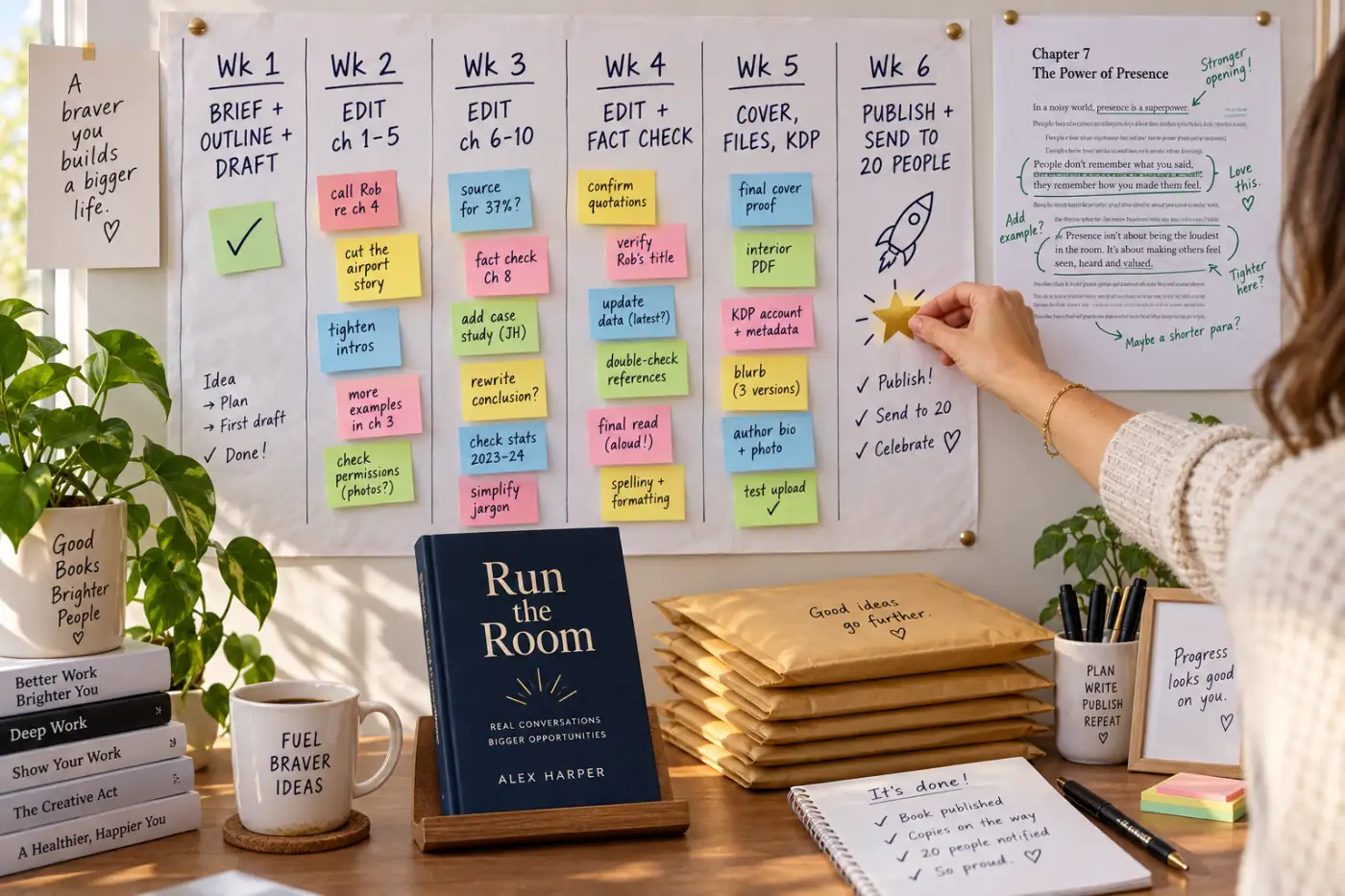
The Six-Week Plan
- Week 1: decide the one problem. Not "everything I know" but the problem your best clients had when they found you. Write the brief: reader, outcome, frameworks, real situations, your bio and how you talk to clients.
- Week 1: outline and draft. Generate the outline, edit it until every chapter has a distinct job and the count matches the material (eight to fifteen chapters is normal for a business book), and generate. Read the whole draft once without editing.
- Weeks 2 to 4: the author's edit. A chapter a day. Replace examples, verify figures, rewrite in your voice with the assistant, regenerate any chapter whose brief was wrong. Cut anything you would not say to a client.
- Week 5: front matter, cover, files. Introduction and bio, the cover, the print interior and EPUB, the disclosure answers at upload (our ethics and disclosure guide covers the wording).
- Week 6: publish and put it to work. KDP or direct sales, the audiobook, and the three uses that matter: send it before every first meeting, hand it to every event organiser, and post one chapter's idea a week for the next quarter.
What the Book Becomes Next
The book is the source document. From the same material: a client workbook with answer spaces for your programme, a short lead magnet for your list built from one chapter, a second book aimed at a different client segment, and the audiobook. Consultants who treat the first book as the start of a catalogue, rather than a one-off, are the ones for whom the compounding in point seven actually happens. The consultants guide and the thought leaders guide set out that sequence.
Which Book Should a Consultant Write First?
Three shapes cover almost every practice. Pick by what your best clients needed on the day they found you.
- The method book (8 to 15 chapters). Your named framework, one chapter per stage, a real situation per stage. This is the authority book that does points one to four above. Start it in the business book writer.
- The client gift (3 to 6 chapters). The one conversation you have with every new client, written down, sent before the first meeting. Short enough to be read on the train. The lead magnet generator is built for this length.
- The programme workbook (one chapter per session). Exercises with answer spaces, for clients already inside the engagement. It is the easiest to sell as a product later. See the workbook generator.
Write the one your pipeline needs this quarter, then the other two from the same material. A per-book generator with one fixed shape writes the first and not the other two, which is the practical reason to compare tools before you start; the Inkfluence AI vs First Book ai page sets out the trade in one table.
Frequently Asked Questions
Is writing a book still worth it for a consultant in 2026?
Yes, and more so, because the cost of producing one has fallen to weeks of part-time work while the effect on rates, sales cycles and speaking has not changed. The book is a marketing asset; judge it on the engagements it produces, not the royalties.
How long does it take to write a business book with AI?
The draft takes under an hour after the outline is approved. The brief takes an afternoon and the author's edit takes one to three weeks part-time. Plan three to six weeks from brief to a book on sale.
Should I hire a ghostwriter instead?
If your book argues a novel position and you want a thinking partner who interviews you over months, and the budget is there, a ghostwriter still earns the fee. For a method book built on frameworks you already use, an AI draft plus your own edit gets there in weeks at a fraction of the cost. The cost comparison has the numbers.
How long should a consultant's book be?
Long enough to solve one problem properly and short enough to be read on a flight. Eight to fifteen chapters and 20,000 to 40,000 words is the normal range; a client-gift edition can be shorter.
Will readers know AI drafted it?
They will know if the examples are invented or the chapters repeat themselves, which are the two things the author's edit exists to fix. They will not care that a tool produced the first draft if the method and the stories are genuinely yours.
Related Reading
- AI business book writer
- How to write a business book with AI
- Is it ethical to write a business book with AI?
- AI vs ghostwriter cost in 2026
- Inkfluence AI vs First Book ai
- Inkfluence AI for consultants
- Inkfluence AI for thought leaders
- AI ghostwriter: what it costs and how it works
- Publish the book to Gumroad from the app

Founder, Inkfluence AI
Sam is the founder of Inkfluence AI. He built the platform to make book creation accessible to everyone - from first-time authors to seasoned publishers.
Helpful links
Ready to Create Your Own Ebook?
Start writing with AI-powered tools, professional templates, and multi-format export.
Get Started Free
Get ebook tips in your inbox
Join creators getting weekly strategies for writing, marketing, and selling ebooks.