What is an AI dark romance generator?
A tool that writes a full dark romance novel chapter by chapter from your premise, holding the love interest consistent across the whole book with an automatic story bible.
 Inkfluence AI
Write a full dark romance novel chapter by chapter, with a morally grey love interest who still sounds like himself in chapter thirty. Three heat levels, honest boundaries, and 5 chapters free to start.
Updated September 2026
Quick answer
An AI dark romance generator writes a full novel from your premise, chapter by chapter, in the dark end of the romance genre: morally grey love interests, obsession, possession, captivity and criminal worlds. The part that actually matters is consistency. A dangerous love interest who drifts into either a cartoon villain or a soft boyfriend by chapter ten is the standard failure of AI-written dark romance, which is why every book here gets an automatic story bible holding his voice, his limits and who he is lying to. Three heat levels change how intimacy is written at sentence level. Boundaries are stated plainly rather than discovered halfway through: dark themes yes, non-consent written as romantic no. Free plan gives 5 chapters plus 5 every month, and the commercial rights are yours.
A tool that writes a full dark romance novel chapter by chapter from your premise, holding the love interest consistent across the whole book with an automatic story bible.
5 chapters to start plus 5 more every month, no credit card, and full commercial rights. Enough to test whether the voice holds on your own premise.
Dark in theme without limit: obsession, captivity, criminality, cruelty. The fixed line is that on-page intimacy is consensual, everyone is 18+, and no incest.
Possessive and obsessive dynamics are the two most requested tropes in our whole romance corpus, ahead of enemies to lovers.
From our own data
We looked at what people actually ask for across 6,276 romance books written on Inkfluence AI. The result was not what we expected: the top two requested dynamics are both dark romance staples, and they come in ahead of enemies to lovers, which is usually treated as the genre's default.
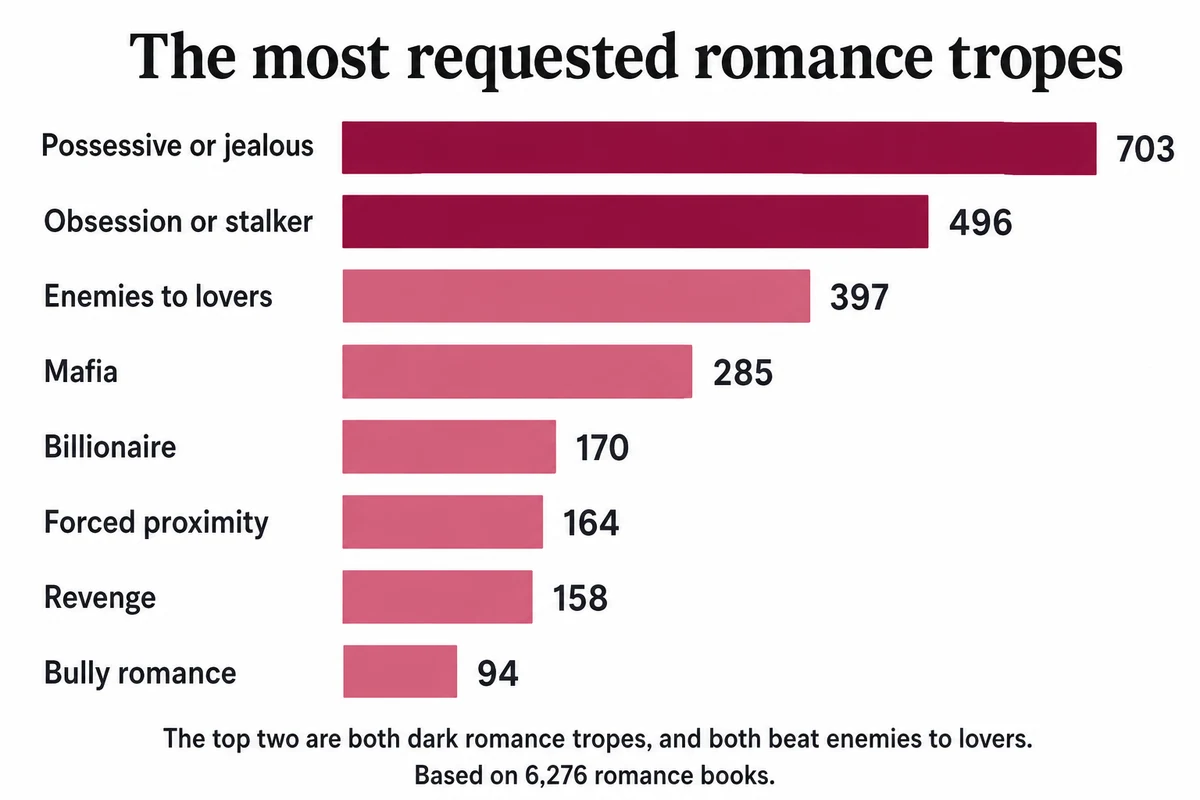
| Trope or dynamic | Times requested | What we see |
|---|---|---|
| Possessive or jealous love interest | 703 | The single most requested dynamic in romance briefs here, dark or otherwise |
| Obsession and stalker dynamics | 496 | Second overall, and almost entirely a dark romance request |
| Enemies to lovers | 397 | The classic, but it comes third behind two dark tropes |
| Mafia and organised crime | 285 | The biggest dark romance setting by a distance |
| Billionaire power imbalance | 170 | Often written dark rather than aspirational now |
| Forced proximity | 164 | Captivity, safe houses, arranged living situations |
| Revenge | 158 | Usually paired with a slow shift from target to partner |
| Bully romance | 94 | Concentrated in college and small-town settings |
Counted from the descriptions people wrote when starting a romance book on Inkfluence AI, August 2026. 347 briefs used the words "dark romance" explicitly, but the trope counts show the real picture is far bigger than that label: plenty of people describe a possessive or obsessive dynamic without ever naming the sub-genre. If you are writing in this space, you are writing in the most demanded corner of the most demanded fiction category.
Dark romance is not romance with worse people in it. It runs on a different engine, and the difference shows up in exactly the places where AI drafts tend to fall apart.
Contemporary romance can soften its hero as the book goes on and the reader will accept it. Dark romance cannot. If he becomes safe by chapter twelve, the tension the whole premise rests on evaporates. He can change what he wants without changing what he is.
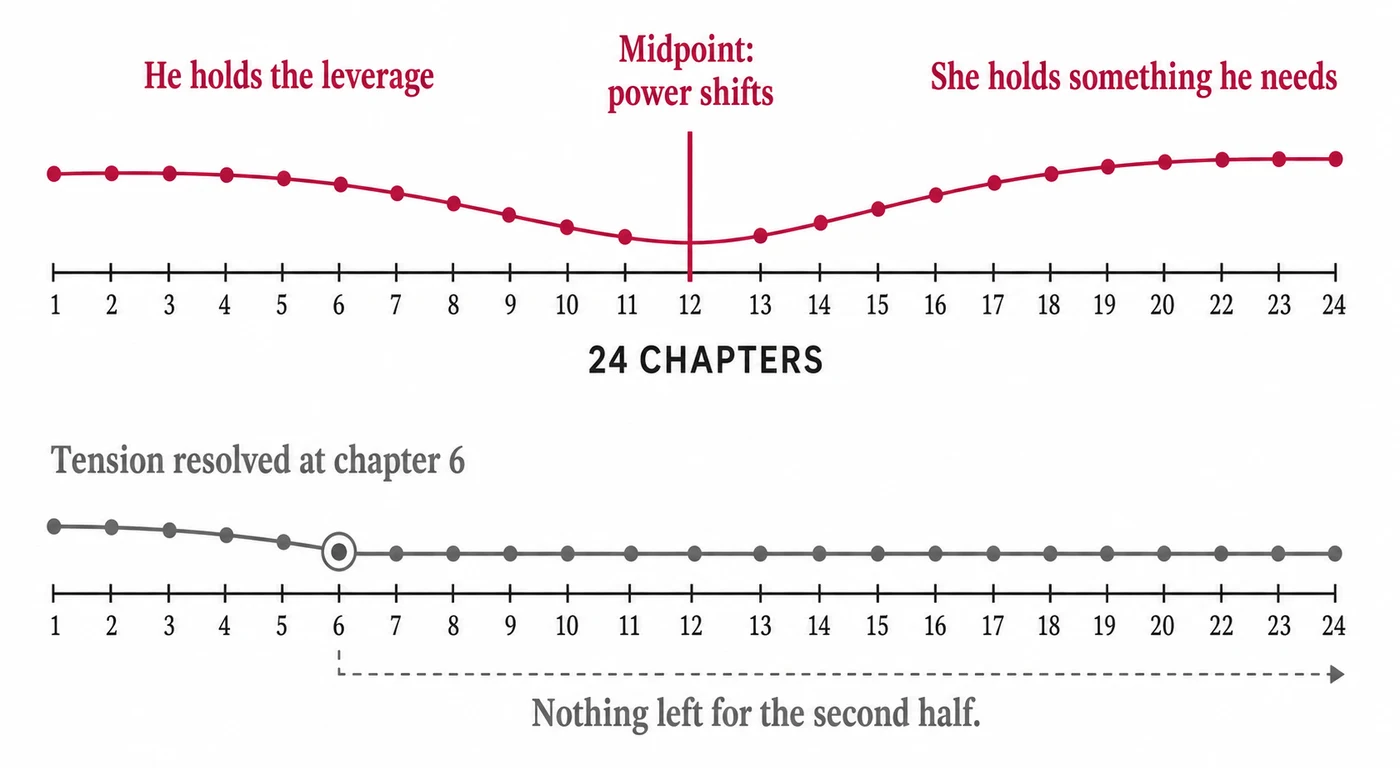
In most romance the midpoint is emotional. In dark romance it is structural: something changes about who holds the leverage. She learns the thing he was hiding, or he needs something only she can give. Get this in the outline and the second half writes itself.
The trap of every captivity or obsession plot is a heroine who only reacts. She needs real decisions available to her inside the constraint. Readers forgive a monstrous love interest. They do not forgive a passive lead.
Dark romance readers are sophisticated about the difference between a dark situation and a scene that endorses harm. Threat and coercion drive the plot; the intimacy on the page still reads as chosen. Getting that distinction right is what separates the genre from the thing people who do not read it assume it is.
For the wider genre, including sweet contemporary and rom-com, the AI romance novel writer covers every sub-genre. This page is the dark end specifically.
This is not a volume dial, and there is no separate control: you name the level in your premise. Each level rewrites how intimacy is handled at sentence level, including how consent appears in the prose and where the emotional beat lands.
| Level | How intimacy is written | For dark romance |
|---|---|---|
| Sweet | Fade to black. Builds to a kiss, then cuts to the aftermath. | Works for dark romance driven by threat and psychology rather than sex |
| Steamy | On page but suggestive. Sensory rather than explicit, with an emotional resolution. | The default, and the right choice for most dark romance |
| Spicy | On page with full emotional and sensory detail. Scenes run multiple paragraphs. | Matches mainstream BookTok heat. Power shifts have to happen inside the scene, not around it |
At the spicy level the rule the generator follows is that every intimate scene has to move something: a fear surfacing, a vulnerability admitted, the power between them shifting. Sex without emotional movement is filler, and in dark romance filler is fatal because the intimacy is where the power dynamic is supposed to be negotiated.
Most tools in this space leave you to discover the limits by hitting them halfway through chapter nine. Here they are up front, so you can decide before you start whether this is the right tool for the book you want to write.
| Element | Written? | Detail |
|---|---|---|
| Morally grey and villainous love interests | Yes | Cruelty, obsession, manipulation and criminality are all on the table as story material |
| Threat, captivity, coercion as plot | Yes | Dark situations drive the book. They can be written honestly and left unresolved for chapters |
| On-page intimacy up to three chillies | Yes | Explicit emotional and sensory writing, without clinical or pornographic vocabulary |
| Non-consensual sex written as romantic or rewarded | No | Dark themes yes, but intimacy on the page is consensual. This is a fixed rule at every heat level |
| Anyone under 18 in romantic or sexual content | No | Never, including flashbacks and implied scenes |
| Incest between blood relatives | No | Never, at any heat level |
The short version: the line sits at mainstream BookTok heat. Dark themes without limit, explicit emotional intimacy up to three chillies, and no explicit erotica or non-consent written as romantic. That is a deliberate decision rather than a filter nobody got round to loosening, and if your book needs to go past it, better to know now than at chapter nine.
Not "mafia romance" but "she owes his family a debt she did not agree to, and he collects it in person". The dynamic is what carries twenty chapters. The trope is only the label.
A morally grey love interest needs a floor. One line about the thing he will not cross is what keeps him dangerous instead of just unpleasant.
Sweet, steamy or spicy, in plain words. There is no separate control: the words in your premise set how intimacy is written at the sentence level, not just how much of it there is.
Check the midpoint. In dark romance the power should shift there, and if the outline resolves the tension by chapter six the book has no second half.
Fiction runs sequentially so chapter fifteen knows what happened in chapter four. The story bible holds who knows what, and who is lying to whom.
Dark romance lives and dies on the leads sounding like two different people. Read every exchange aloud before you touch anything else.
Naming the sub-genre in your description changes the chapter structure. Each one has a failure mode worth knowing before you start.
| Sub-genre | Core tension | Watch out for |
|---|---|---|
| Mafia and Bratva | Loyalty, debt and inherited violence | The family has to feel like an institution, not set dressing |
| Captive and forced proximity | Confinement that becomes dependence | The heroine needs agency inside the constraint, or the book stalls |
| Stalker and obsession | Being watched, then being wanted | The turn only works if she chooses him with full information |
| Revenge and enemies | A debt collected, then complicated | The revenge must cost him something he cannot get back |
| Bully romance | Cruelty that conceals damage | Redemption needs real repair, not just an explanation |
| Motorcycle club | Chosen family with its own law | The club is a character; give it rules that bind him |
Readers in this genre tend to buy by world rather than by title. They finish one book about a crime family and immediately want the brother's story. That has a practical consequence: decisions you make in book one either open the door to a series or quietly close it.
The rule that matters most: each book resolves its own couple. Romance readers accept an ongoing world, but not an unresolved central relationship, and a cliffhanger on the romance itself reads as a broken contract rather than a hook. If you already know you want more than one book, the series writer keeps continuity across them, and the character bible keeps the secondary cast straight so book two does not contradict book one.
Notice the shared pattern: the dynamic rather than the trope label, one thing the love interest will not do, the POV structure, and the chapter where the power shifts. Four things, one paragraph.
"Dark mafia romance, dual POV. Nadia's father borrowed from the Vasiliev family and disappeared, so the debt is hers. Ilya collects it by moving her into his house until it is paid. He is precise, quiet, and never raises his voice, and he will not touch anyone who has not chosen him first. She is not grateful and does not pretend to be. Power shifts at chapter 15. 26 chapters, steamy."
"Dark romance, her POV only. She starts finding things in her flat moved half an inch. Six chapters before she learns who, and by then she has already spoken to him twice without knowing. He is articulate and completely unrepentant. No redemption arc, she chooses him knowing exactly what he is. 22 chapters, spicy."
"Dark romance. He spent nine years building the company that ruined her family, and she takes a job there to destroy it from inside. Both are lying constantly and both know it. Sharp dialogue, neither backs down. The revenge has to cost him something he cannot get back. Midpoint reversal at chapter 13. 24 chapters, steamy."
The line most people leave out is the limit. "He will not touch anyone who has not chosen him first" does more work than three sentences of backstory, because it gives the model a boundary to write against instead of just a direction to travel in.
Dark romance premises fail when they start from characters. They work when they start from a bind: a debt, a threat, a secret, a shared history neither can walk away from. If either lead could reasonably leave in chapter two, the book has no engine. Write one sentence naming the bind before you write anything else.
The bind also solves the pacing problem, because escalation becomes obvious. The bind tightens, then tightens again, then becomes something one of them chooses to keep.
A morally grey character needs two things the model cannot invent for you: a limit and a rule. The limit is what he will not do. The rule is the internal logic that makes his cruelty consistent rather than random. A man who hurts people for a reason is frightening. A man who hurts people arbitrarily is just noise, and readers disengage from noise quickly.
Both belong in your description, in a sentence each. They also go into the story bible, which means chapter twenty-eight still knows them.
When the chapter outline appears, find the midpoint and check what happens there. If the answer is "they get together", move it. The midpoint of a dark romance should change who has leverage: she discovers what he has been hiding, or he needs something from her he cannot take. Everything after the midpoint is the two of them renegotiating on new terms.
This is also the cheapest possible fix. Reordering an outline takes a minute. Rewriting fourteen chapters because the tension resolved too early takes a weekend.
The most reliable tell in AI-written romance is that both leads sound the same. Cover the name and read the line: if you cannot tell who is speaking, rewrite it. Give one of them shorter sentences. Let one deflect and the other be direct. Let someone not answer a question.
After dialogue, hunt simile. Language models reach for "like" and "as if" far more often than human writers do, and in a genre built on restraint it reads as overwriting. Cutting most of them changes the texture of the whole book.
Dark romance readers expect content warnings and treat their absence as a broken promise. List the specific elements, not a vague "dark themes" line, and put them in the front matter and the book description. This is not a legal exercise, it is genre etiquette, and getting it wrong produces one-star reviews that say nothing about the quality of your writing. Then publish: self-publishing on Amazon KDP covers the upload, and the AI disclosure policy covers what to declare.
If he would do anything, he is not dangerous, he is arbitrary. Give him one line he will not cross and the rest of his cruelty starts to mean something.
Left to itself the model closes conflict in the chapter it opens. Name the chapter where the power shifts, or the second half of your book has nothing to do.
Captivity plots stall when she only reacts. She needs decisions available to her inside the constraint, even small ones, or the reader disengages.
This is the single most common tell in AI romance. Cover the name, read the line, and if you cannot tell who said it, rewrite it.
Dark romance readers expect them. Leaving them off reads as a broken promise and it is the fastest way to a one-star review that has nothing to do with your writing.
The trope counts and the 6,276 romance figure were measured directly from the descriptions people wrote when starting a romance book on Inkfluence AI, in August 2026. 347 of those briefs used the term "dark romance" explicitly.
Amazon KDP accepts AI-generated and AI-assisted books and asks you to declare AI-generated content at upload; the practical split between the two is covered in our KDP AI disclosure guide.
Copyright in AI-assisted work covers the human-authored portion of a work, as set out in the U.S. Copyright Office guidance on Copyright and Artificial Intelligence. The more you shape, cut and rewrite, the stronger your claim.
AI narration and Audible: ACX does not currently accept AI-narrated audiobooks, so an AI audiobook suits direct sale and other platforms rather than Audible submission.
The heat registers, the ceiling and the boundaries, stated in full.
Every romance sub-genre, from sweet contemporary to rom-com.
Structure, beats and pacing for the genre as a whole.
How characters stay consistent across forty chapters.
Fiction across every genre, not just romance.
Many dark romance tropes were shaped in fandom first.
Dark romance covers live or die at thumbnail size.
Dark romance sells in series more than standalones.
Getting a finished novel onto Amazon.
How the tools compare on fiction specifically.
Free plan and paid plans.
5 chapters free, no credit card, and the commercial rights are yours from the free plan onward.
Start writing free