
How to Sell a Romance Novel on Amazon and Kindle Unlimited, and What Each Sale and Read Pays
A romance novel earns money three ways on Amazon alone: a sale of the ebook, a page-by-page read in Kindle Unlimited, and a paperback printed when someone orders it. Each pays a different amount, and choosing Kindle Unlimited rules out selling the ebook anywhere else. This page works through all three with Amazon's own figures (checked on 23 September 2026), then covers going wide to other stores, launching a series with pre-orders and promotions, pen names, and what KDP allows on a romance cover. The planner below prices your book, lays out a release plan for the series and writes blurb and keyword starters. We cannot see what our users sell, so there are no income claims here: every figure is a per-sale calculation or a labelled example.
Amazon, Kindle, Kindle Unlimited, KDP, Apple Books, Kobo, Google Play, Barnes & Noble, Draft2Digital, Etsy and Gumroad are trademarks of their owners. Inkfluence AI is an independent tool and is not affiliated with or endorsed by any of them.
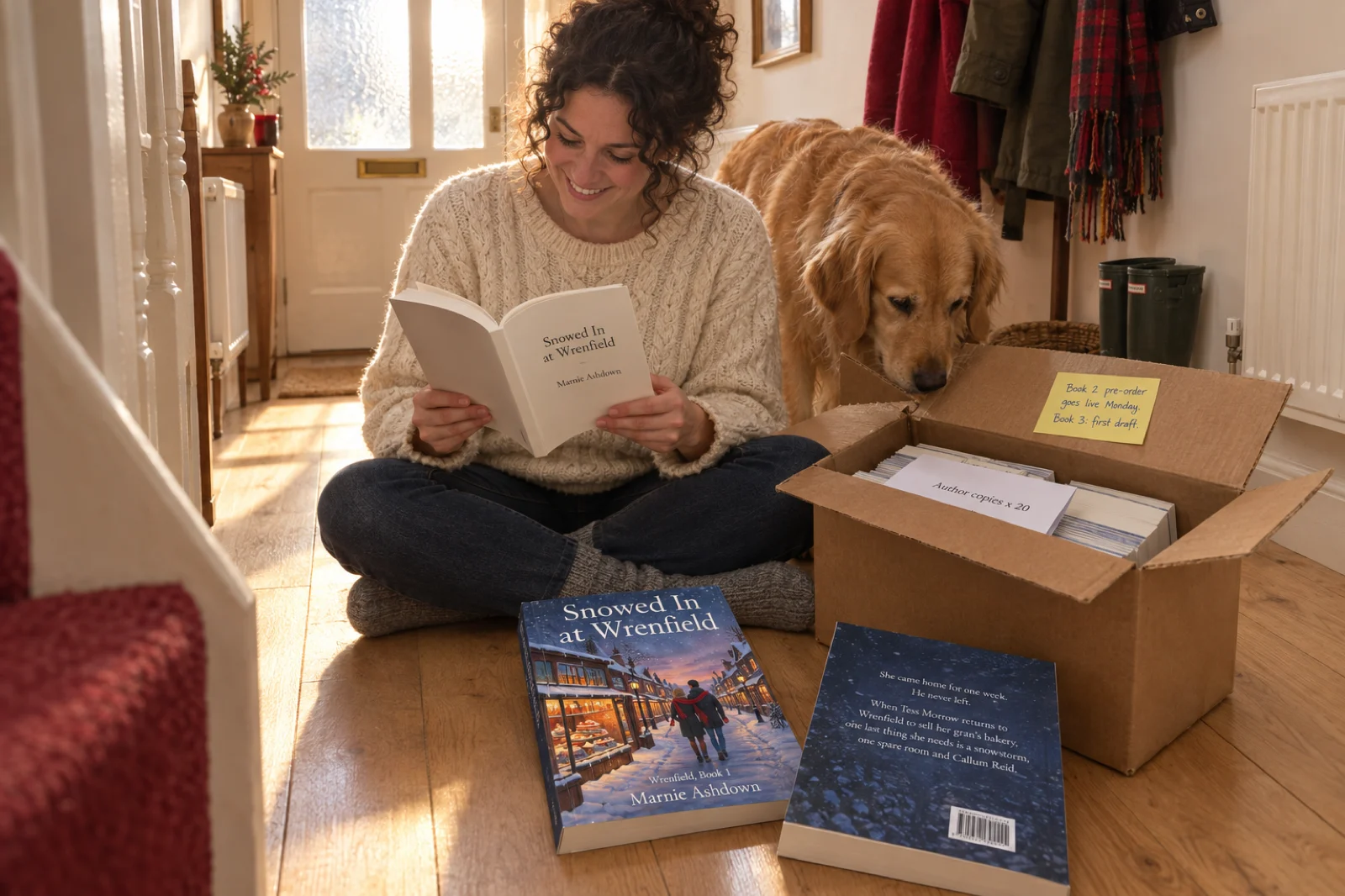
How do you sell a romance novel?
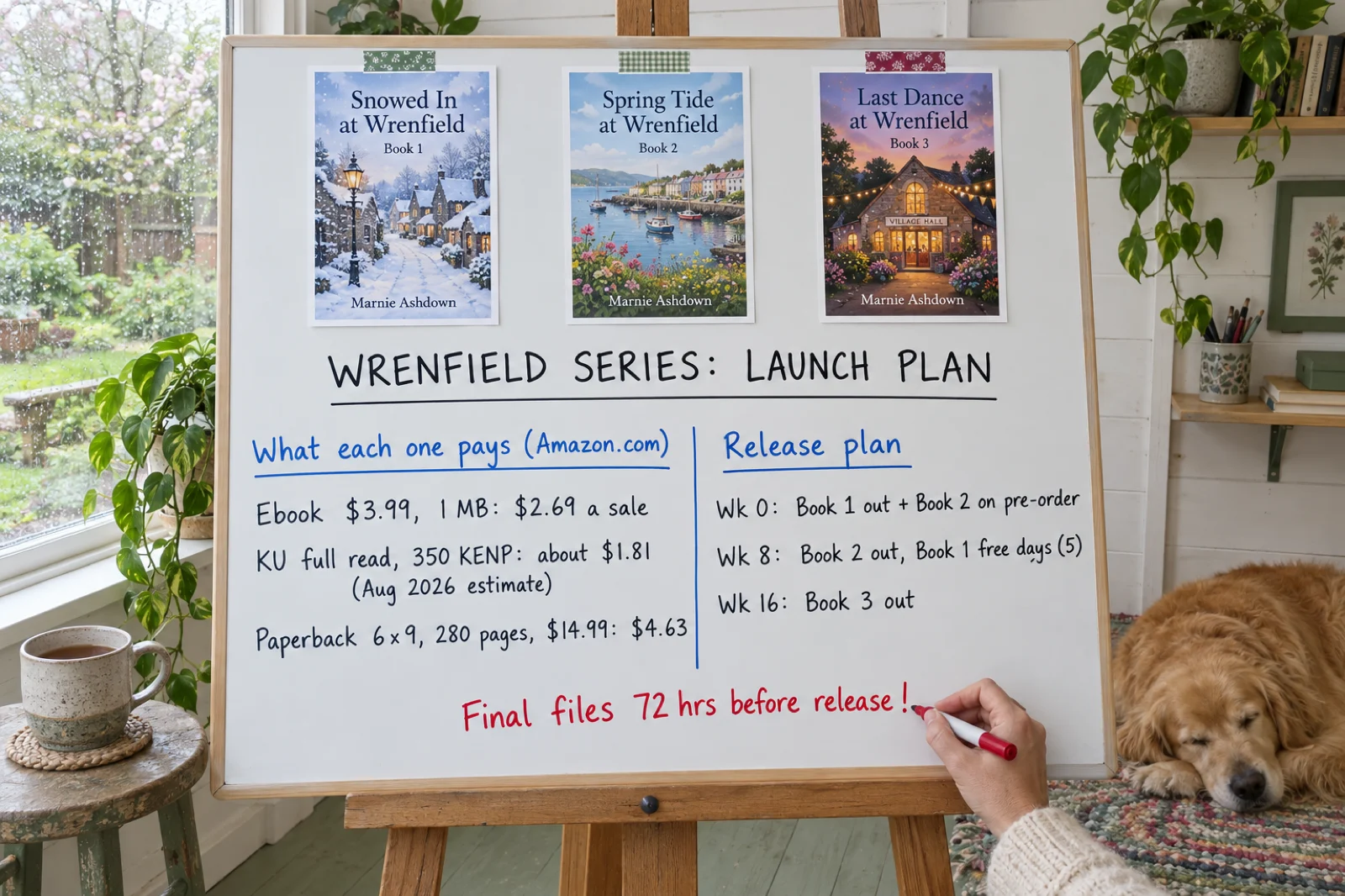
Publish the ebook on Amazon KDP at a price inside the 70% band, $2.99 to $12.99, decide whether it goes into Kindle Unlimited or wide to other stores, add a paperback, and plan the series before book one is out. On Amazon.com a 1 MB ebook at $3.99 pays $2.69 a sale. In Kindle Unlimited you are paid for pages read instead: KDP announced a $66 million fund for August 2026 but publishes no per-page rate, and Written Word Media's estimate for Amazon.com that month works out at about $1.81 for a reader who finishes a book of 350 normalised pages. A 280-page paperback costs $4.36 to print and pays $4.63 at $14.99. Romance readers shop by subgenre and trope, so the title, cover, blurb and keywords say both, and book two goes up for pre-order on the day book one launches.
A sale or a read
$2.69 for a $3.99 ebook sale; about $1.81 when a Kindle Unlimited reader finishes 350 pages at the August 2026 estimate. The paperback is a third line of income, not a replacement.
KU or wide, per 90 days
Kindle Unlimited needs the ebook sold only through Amazon, your own website included, in 90-day terms. The paperback and audiobook can go anywhere either way.
What we cannot tell you
How many copies a romance novel sells or how many pages get read. We do not see our users' sales, and Amazon does not publish typical sales. Examples here are examples.
Romance launch and pricing planner
Choose the subgenre, the trope, the heat and the ending, how many chapters, how many books in the series and how far apart, and Kindle Unlimited or wide. The planner works out what an ebook sale, a Kindle Unlimited read and a paperback pay on Amazon.com, lays out a release plan that follows KDP's pre-order and promotion rules, and writes a blurb skeleton, seven keyword starters and a brief for book one. It runs in your browser with KDP's figures as of 23 September 2026.
The rate a page starts at Written Word Media's August 2026 estimate for Amazon.com; KDP publishes the fund, not a rate. KENP pages are KDP's normalised count for your book, known once it is enrolled.
Each ebook sale pays
-
Each full Kindle Unlimited read pays
-
Each paperback pays
-
The book
Where the ebook sells
Release plan
Check before you publish
Blurb skeleton
Seven keyword starters
Brief for book one
How the button works. Write book one opens your Inkfluence AI dashboard with the brief in the idea box; press Create my book (you will be asked to sign in first if you are not). The app reads a brief like this as a romance novel and writes the number of chapters it names, in order, keeping a record of what has happened so far. The heat words go into the brief as words: there is no heat setting, and the writing follows them from a closed door up to intimacy on the page that stays non-graphic. We ran 32 briefs of every kind this planner writes (all twelve subgenres, the three heat wordings, 8 to 40 chapters, one to six books) through the app's own reading of an idea, 80 runs in all: every run chose a romance novel and the stated number of chapters, and none of the briefs was stopped by the checks the app runs on a premise before writing. The button switches off, with a note, when the premise names another format, a child, fan fiction or something the app will not write.
Money figures are for Amazon.com in US dollars before tax: KDP's eBook royalty and delivery charge, its paperback printing cost and royalty, and for wide stores each store's published share. Page counts are estimates from the middle half of romance chapter lengths and the words per page of the app's KDP interior at each trim; the READ ME in the KDP package gives the real count. The royalty calculator covers other formats and stores.
What one romance novel pays: a sale, a Kindle Unlimited read and a paperback
One book, three ways it earns on Amazon, each worked through with Amazon's published figures for Amazon.com. The ebook and the paperback are paid per copy sold. A Kindle Unlimited read is paid per page, out of a monthly fund shared by every enrolled book, and that is the one number Amazon does not publish in advance.
The ebook: 70% between $2.99 and $12.99
KDP pays 70% of the list price, after a delivery charge of $0.15 a megabyte, when an ebook is priced from $2.99 to $12.99 on Amazon.com, and 35% of the price outside that band. The top of the band was $9.99 from 2007 until 7 July 2026, when KDP raised it to $12.99. A novel is mostly text, so its file is small and the delivery charge is a few cents; the table uses 1 MB, and KDP shows your file's charge on the pricing page once the book is uploaded.
| Ebook price | Royalty | Working, 1 MB file | You get a sale |
|---|---|---|---|
| $0.99 | 35% | 35% of $0.99 | $0.35 |
| $2.99 | 70% | 70% of ($2.99 - $0.15) | $1.99 |
| $3.99 | 70% | 70% of ($3.99 - $0.15) | $2.69 |
| $4.99 | 70% | 70% of ($4.99 - $0.15) | $3.39 |
| $5.99 | 70% | 70% of ($5.99 - $0.15) | $4.09 |
| $9.99 | 70% | 70% of ($9.99 - $0.15) | $6.89 |
| $12.99 | 70% | 70% of ($12.99 - $0.15) | $8.99 |
| $13.99 | 35% | 35% of $13.99 | $4.90 |
Three things follow. A $2.99 book pays $1.99 a sale and a $1.99 book about $0.70, so the cheapest price in the 70% band pays more than five times as much as $0.99 does. Every dollar between $2.99 and $12.99 adds 70 cents, which is why a longer novel, a box set or a book that has built a readership can sit at $5.99 or $6.99 without losing the higher rate. And $13.99 pays $4.90, less than $12.99's $8.99: the top of the band is a cliff. On Amazon.co.uk the band runs from £1.77 to £12.99 with a delivery charge of £0.10 a megabyte, so £2.99 pays about £2.02 on a 1 MB file. Our KDP royalties 2026 guide covers what the wider band means for box sets and later books in a series.
Sources: KDP's eBook Royalties, List Price Requirements and Digital Book Pricing pages, read on 23 September 2026. The royalty is 70% of the price less VAT, where it applies, and less delivery.
A Kindle Unlimited read: paid by the page, from a monthly fund
Kindle Unlimited subscribers pay Amazon a monthly fee and read enrolled books without buying them. KDP pays authors from the KDP Select Global Fund in proportion to pages read, counted in Kindle Edition Normalized Pages (KENP): KDP's own page count for your book, worked out with standard font and spacing settings from the start of the book, with images counting toward it. You cannot set it, and it is known once the book is enrolled. KDP's KENP page says it pays only for pages read the first time a customer reads them, up to 3,000 pages per book per customer.
KDP announces the fund each month in its community forum, about the middle of the following month. For August 2026 it was $66 million, with $3.4 million of All Stars bonuses on top, $69.4 million in all (announced 15 September 2026). It does not publish a rate per page, and the share of the fund going to each country depends on exchange rates, reading and local subscription prices. Trackers back a rate out of their own KDP reports; Written Word Media's figure for Amazon.com, on its KDP Global Fund payouts page (updated 18 September 2026), is $0.005170 a page for August 2026, $0.004221 for July and $0.004202 for January 2026. That is about $0.52 per 100 pages read in August 2026. We use that month's figure below and label it; it is an estimate from one publisher's reports, not an Amazon number, and it moves every month.
| Book length in KENP | A full read, August 2026 estimate | The same read, July 2026 estimate |
|---|---|---|
| 250 pages | $1.29 | $1.06 |
| 300 pages | $1.55 | $1.27 |
| 350 pages | $1.81 | $1.48 |
| 400 pages | $2.07 | $1.69 |
| 450 pages | $2.33 | $1.90 |
Put next to the sale: a $3.99 sale pays $2.69, and a subscriber who reads every page of a 350-page book paid about $1.81 at the August 2026 estimate and $1.48 at July's. A reader who stops halfway pays for half, about $0.90. Whether Kindle Unlimited pays a particular book more than selling wide depends on how many subscribers borrow and finish it against how many buyers the book would find on other stores, and no calculation can tell you that in advance. What the numbers do show is why romance authors care about read-through: in Kindle Unlimited a book that is abandoned in chapter four earns a fraction of one that is finished, and a series earns again on every book the reader moves on to.
The paperback: printing comes out of every copy
KDP prints each paperback when it is ordered and takes the printing cost out of the royalty. A black-ink novel on cream or white paper (the same price) at a regular trim, which includes 5 x 8, 5.5 x 8.5 and 6 x 9 inches, costs $1.00 plus 1.2 cents a page on Amazon.com from 110 to 828 pages. The royalty is 60% of the list price from $9.99 and 50% below, less printing.
| Pages | Printing | Lowest price | Pays at $12.99 | Pays at $14.99 | Pays at $15.99 |
|---|---|---|---|---|---|
| 280 | $4.36 | $8.72 | $3.43 | $4.63 | $5.23 |
| 350 | $5.20 | $9.99 | $2.59 | $3.79 | $4.39 |
The working for the 280-page book at $14.99: 60% of $14.99 is $8.994, minus $4.36 printing, is $4.63. The trim size matters more than it looks, because the same words make more pages on a smaller page. We rendered five real romance novels through the Inkfluence AI paperback export and counted the pages: the interior fits about 168 words on a 5 x 8 page, 188 on 5.5 x 8.5 and 208 on 6 x 9. Applied to the median length of the romance novels of 20 chapters or more written on the app since 21 July 2026, 62,082 words:
| Trim | Words a page | Pages, about | Printing | Pays at $14.99 |
|---|---|---|---|---|
| 5 x 8 in | 168 | 370 | $5.44 | $3.55 |
| 5.5 x 8.5 in | 188 | 332 | $4.98 | $4.01 |
| 6 x 9 in | 208 | 300 | $4.60 | $4.39 |
The same novel pays $0.84 more a copy at 6 x 9 than at 5 x 8 at the same price. Smaller trims still have their place, since a 5 x 8 or 5.5 x 8.5 paperback feels like the romance novels on a shop shelf, but price them knowing the difference. Page counts here are estimates; your KDP package's READ ME states the real count, and the export's page count also sizes the spine on the wrap cover. On Amazon.co.uk the same black-ink book costs £0.85 plus 1 penny a page and 60% starts at £7.99: 280 pages cost £3.65 and pay £2.34 at £9.99; 350 pages cost £4.35 and pay £1.64.
Expanded Distribution, which lets bookshops and libraries order the paperback, pays 40% of the list price less printing, so the 280-page book earns $2.04 a copy that way at $15.99. Author copies, which KDP sells you at the printing cost plus shipping, are the stock for signings and romance reader events: 20 copies of the 280-page book cost $87.20 before shipping, and sold at $15 each that is $300 in. Author copies pay no royalty and do not show in KDP's reports.
Sources: KDP's Paperback Printing Cost and Paperback Royalty pages, read on 23 September 2026; KDP has said it will not change printing fees in 2026. Half-cent results are rounded to the nearest cent; KDP's pricing screen shows what it pays.
Kindle Unlimited or wide: the choice every romance author makes
KDP Select is the programme that puts an ebook into Kindle Unlimited. KDP describes it as "a free 90-day program for Kindle eBook only", and the price of entry is exclusivity: while enrolled, the ebook cannot be sold or given away digitally anywhere else. KDP's FAQ spells out that this includes "your website, blogs, etc.", and its terms cover any book that is substantially similar. Print, audio and other formats are not affected. Terms renew automatically unless you opt out before renewal, and you have three days from the start of a term to cancel it.
| For the ebook | Kindle Unlimited (KDP Select) | Wide |
|---|---|---|
| Where it sells | Amazon only, in digital form | Amazon, Apple Books, Kobo, Google Play, Barnes & Noble, your own site, Etsy, Gumroad |
| Paid for | Sales, plus pages read by subscribers in 12 countries | Sales only (plus reading time on Kobo Plus, if you opt in) |
| Promotions from KDP | One per term: up to 5 free days, or a Kindle Countdown Deal | None from KDP; price changes and free books you set on each store |
| 70% royalty in Brazil, Japan, India, Mexico | Yes, within the price band | No: 35% on Amazon in those stores |
| Selling direct to your readers | Not the ebook while enrolled | Yes |
| Paperback and audiobook | Anywhere | Anywhere |
| Changing your mind | Turn off renewal; free from the end of the term | Take the ebook down elsewhere, then enrol |
Kindle Unlimited runs in 12 Amazon stores: the US, the UK, Germany, Italy, Spain, France, Brazil, Mexico, Canada, India, Japan and Australia. Kindle Unlimited suits a romance author whose readers are on Amazon and who wants the page reads and the promotions, and who is happy not to sell the ebook anywhere else. Wide suits an author who sells ebooks direct through a newsletter, Etsy, Gumroad or a website, who has readers who buy on Apple, Kobo or Google Play, or who wants every store's reach. Neither is the right answer for everyone, and plenty of authors keep one series in Kindle Unlimited and another wide.
What each wide store pays on a $3.99 ebook
| Store | Its published rule | A $3.99 sale keeps |
|---|---|---|
| Amazon Kindle, not in KDP Select | 70% of the price less $0.15 a MB between $2.99 and $12.99; 35% outside | $2.69 |
| Apple Books | 70% at any price, no delivery fee | $2.79 |
| Kobo | 70% from $2.99, 45% below | $2.79 |
| Google Play Books | 70% of list price in most countries | $2.79 |
| Barnes & Noble Press | 70% from $0.99 | $2.79 |
| Any of those through Draft2Digital | the store's share less about 10% of the price, plus a $20 activation fee for new accounts | about $2.39 |
| Direct: Etsy, Gumroad, your site | Etsy's listing, transaction and US processing fees; Gumroad 10% + $0.50 plus card fees; 2.9% + $0.30 for a card payment link | $3.16 / $2.68 / $3.57 |
Sources, read on 23 September 2026: Apple Books for Authors (70% "regardless of price", no file delivery fees, free books allowed); Kobo Writing Life's earnings article (70% from $2.99, 45% below); the Google Play Books Partner Center (70% in most countries for partners on its current terms); Barnes & Noble Press (70% from $0.99); the Draft2Digital FAQ (about 10% of the retail price, a $20 activation fee for new accounts and $12 a year for accounts earning under $100 a year). Direct fees are the same as on our travel guide selling guide. Kobo also runs Kobo Plus, a subscription that pays authors per minute read and needs no exclusivity. Store shares are worked on a US list price before sales tax.
The KDP Select vs wide guide goes through the decision for books of every kind.
Launching a romance series: series pages, pre-orders and promotions
Romance is a series genre: a reader who finishes book one and liked it goes looking for book two, and every book they move on to is another sale or another full read. KDP has three tools for that, each with rules worth knowing before launch day.
The series page
On your KDP bookshelf, choose + Create new title or series, then Create series page, or use Add to series from a book's menu; the page appears on Amazon within 72 hours. A series can start with any format and can be ordered (book 1, book 2) or unordered, like a set of standalones in one town. Kindle ebooks in a series can be bought together with one click, for series of up to 25 titles. Low-content and public-domain books are excluded, and KDP says series discounts are not currently available.
Pre-orders
An ebook can go on sale before it is finished. Pre-orders set up on or after 2 September 2026 can be up to 18 months ahead (12 months for older ones), up to 10 at a time, and are for ebooks only; a paperback can have a scheduled release date instead. The final manuscript has to be uploaded at least 72 hours before the release date. Miss that and the pre-order is cancelled: the first miss is forgiven once per account, and a second removes pre-orders from your whole account for 6 months. A pre-order can be postponed up to twice, by no more than 6 months from the original date in total. The common pattern is to put book two up for pre-order on the day book one comes out, so the last page of book one can link straight to it.
Kindle Countdown Deals and free days (Kindle Unlimited only)
Each 90-day KDP Select term allows one promotion per book, either kind, not both, and unused days do not carry over.
- Free Book Promotion. Up to 5 days per term, all at once or split, in every Amazon store. No royalties while it runs. Used on book one once book two is out, a free run puts the start of the series in front of readers who then meet a book they pay for or read in Kindle Unlimited.
- Kindle Countdown Deal. Amazon.com and Amazon.co.uk only. The book must have been enrolled for at least 30 days and its price unchanged for 30 days before the deal and 14 days after; the list price must be $2.99 to $24.99 (£1.99 to £15.99), the discount at least $1, and the deal up to 7 days in up to 5 price steps. A book on the 70% royalty keeps 70% even when the deal takes it below $2.99. Deals must end at least 14 days before the term ends unless the term is renewing.
How far apart to release
Romance authors often release books in a series close together, weeks rather than months apart, which the industry calls rapid release. The reasoning is that readers who finish book one can move straight on, and in Kindle Unlimited each finished book is paid again. A gap you can keep up is worth more than a fast start followed by a year of silence; the planner above shows how the gap you choose fits the pre-order and promotion rules and your plan's chapter allowance.
Writing book two from book one
In Inkfluence AI, a finished book's menu has Continue as a series; after the first continuation it reads Write the next book. The next book is planned from what book one actually contains: its characters, the rules of its world, the events already on the page and the scene the last chapter ended on, plus an optional note from you about what the next book should do (a new couple from the same town, the sister's story, the same couple a year on). Fiction series are written one book at a time from the latest book in the series, and each new book has the same number of chapters as the one before, within your plan's monthly chapters. Series are on Creator and Premium. The help article How to continue your book as a series shows where to find it.
Publishing romance under a pen name
Many romance authors write under a pen name, sometimes one per subgenre so readers of a sweet small-town series do not stumble into a dark romance by the same name. KDP's help is direct about it: "You can use a pen name or pseudonym to publish your titles", and your real name "is not published anywhere on our website". The rules are that the name is appropriate, used consistently across your work, and does not "impair customers' ability to make good buying decisions"; KDP suggests adding an initial or a middle name if yours is close to a popular author's. After publishing KDP may ask you to show you hold the rights, and your account, payments and tax details stay in your own name.
Two things to settle before you press publish. The primary author field cannot be changed once the book is live, so choose the pen name first. And another author's name never belongs in your title, subtitle or keywords: KDP's metadata rules ban unauthorised references to other titles or authors, so "for fans of" lines belong in your marketing, not your KDP keywords.
In Inkfluence AI the pen name goes in the Author box in Edit book details. It prints on the title page and the copyright line of every export, and on the cover; the cover designer can keep the author name as editable text over the artwork, so changing a pen name does not mean generating new cover art.
Heat, covers and KDP's rules for romance
KDP sells romance at every level of heat, and draws its lines in three places. Its content guidelines say it does not sell content that "contains pornography" or glorifies rape, among other things, and that the rules apply to the title, the cover art and the description as well as the book itself. Its metadata guidelines ask you to say whether the book has sexually explicit images on the cover or inside ("images containing nudity or sexual poses") or sexually explicit language in the title or subtitle. And KDP's search help says books "containing sexually explicit images or titles will not surface in general product searches"; once KDP marks a book that way you cannot change it.
The practical reading for a romance author: the flag that hides a book from general search is about the cover and the title, not the heat of the text inside. So keep the cover suggestive rather than explicit (the couple, an object, an illustration, a landscape, whatever the bestsellers in your subgenre use), keep explicit words out of the title and subtitle, and put the heat in the blurb in plain terms readers understand, such as "closed door", "slow burn with an open door" or "dark themes, check the content notes", without pornographic language, which KDP's description rules also rule out. Answer the metadata question honestly for the cover and title you have.
What Inkfluence AI will and will not write
The heat of a romance written on Inkfluence AI comes from the words in your premise. There is no heat setting: say "closed door" and the scenes cut away, say "steamy" or "spicy, on the page" and intimacy is written on the page, with the emotion carried through it. At every level it stays non-graphic, with anatomy implied rather than named and no pornographic vocabulary, so it is not a tool for explicit erotica. If your book needs a scene written more explicitly than that, the editor is yours to write it in. Intimate scenes are written between adults, with consent. A premise asking for sexual content involving anyone under 18, incest, or non-consent presented as something to enjoy is refused before anything is written, and so is harassment of real people. Books are private until you choose to publish them.
Dark romance, morally grey leads, captive and mafia premises, age gaps between adults and forbidden love are all written; KDP publishes them too. The dark romance generator and the spicy romance writer pages show how the heat and the boundaries are set in a premise.
What people write: romance novels on Inkfluence AI
We counted every book written in the app's romance format from 1 February 2026 to 23 September 2026, leaving out our own accounts: 8,291 romance novels by 6,234 people, the third most-made kind of book on the app after general fiction and how-to guides (5,592 of them in the last 90 days). We looked at the subgenres and tropes named in each title and brief, how long the books are, what language they are in, and whether they were exported or listed for sale through the app. We cannot see sales, so none of this says what sold.
14.9%
of English-language romance briefs name dark romance (mafia, captive, stalker, possessive), the most-named subgenre. Romantasy and fantasy follow at 11.4%, college and campus 11.1%, paranormal and shifter 9.6%, billionaire and CEO 9.3%.
Link to this stat12.9%
ask for a slow burn, the most-named trope. Enemies to lovers comes next at 7.0%, then forbidden love and forced proximity (4.8% each), second chance (4.7%) and a secret baby or pregnancy (4.5%).
Link to this stat1.9%
of romance novels are listed for sale through the app (158 of 8,291): 138 on Gumroad and 23 on Etsy, 3 on both. 29.7% have been exported at least once (2,462).
Link to this statLength. Most romance books on the app are short: 73% of finished ones stop at exactly five chapters, the free plan's limit for a book, so they are samples of a premise rather than novels. 8.7% have 20 chapters or more (699 books), and among books written since 21 July 2026 that share is 11.4%; those 442 novels have a median of 62,082 words. Chapters written since 21 July run a median of 2,208 words, with the middle half between 2,063 and 2,371. That is where the planner's word and page estimates come from.
Series writers. 894 people, one in seven, have written more than one romance novel, and between them they wrote 2,951 of the 8,291 books, 35.6%. Heat and endings. 14.5% of briefs ask for heat on the page in so many words ("spicy", "steamy", "open door" and the like) and 0.9% ask for closed door or clean; 4.2% ask for a happily ever after or happy for now outright, a convention most romance briefs take for granted. Languages. 15.5% are written in a language other than English: Indonesian 3.7%, Spanish 3.5%, Portuguese 2.8%, German 1.1%.
Our reading of these. The subgenres people name here lean dark and fantastical: dark romance, romantasy and paranormal each outnumber billionaire, sports and small-town. Most English briefs (64%) name a subgenre or a trope, the same words romance readers search with, so those words belong on the cover and in the keywords too. Romance novels are listed through the app less often than books of every kind (2.4%), and a smaller share of those listings are on Etsy (14.6% against 18% for all books). That fits a genre sold mainly as a Kindle ebook on Amazon, which the app cannot see: of the books exported, 80% were last exported as a PDF and 8% as an EPUB, the Kindle file, so plenty of novels are clearly headed somewhere we do not track.
How it was counted. Romance novels are books written with the app's romance format from 1 February to 23 September 2026 (cut at 19:19 UTC), excluding the 6 made on the team's own accounts. Subgenres and tropes are whole-word keyword groups over each book's title and the author's brief; a book can fall in several groups, shares are given against the 7,003 English-language books because the groups are English words, and 36% of those name none of them. Length is counted over finished books with a recorded chapter and word count; chapter length is for books written since 21 July 2026. A book counts as listed while it is linked to an Etsy listing or a Gumroad product created through the app. Gumroad prices for romance are not quoted: one seller has a third of the live products. No title, brief, shop, product or account is published. The figures are published under a Creative Commons Attribution 4.0 licence: quote them with a link to this page.
How to write, publish and sell a romance novel, step by step
From a subgenre and a trope to a book on sale with the next one on pre-order. The planner's button is the quick way into step 4; the romance writing guide goes deeper on the premise and the chapters.
-
1. Choose the shelf, then the trope
Pick the subgenre the book will sit in and the trope that drives it. Look at the top of that subgenre on Amazon: the covers, the prices, the page counts, the words in the titles and the tropes the blurbs lead with, and what the one-star reviews complain about. For romance, low ratings often come down to a promise the blurb made and the book did not keep: the wrong heat, a missing happy ending, a trope that never arrives.
-
2. Decide Kindle Unlimited or wide
Decide before launch, because it changes where you can sell the ebook and which promotions you get. You can change your mind at the end of any 90-day term.
-
3. Price it before you write it
Put the chapters, the trim and your prices into the planner: an ebook between $2.99 and $12.99, and a paperback at a price that clears the printing cost with room left.
-
4. Write book one
On Inkfluence AI, type a premise that names the subgenre, both leads, the trope, the heat in plain words and the ending, with the number of chapters ("a steamy small-town romance novel in 26 chapters..."). The chapters are written in order, each with a record of what has already happened, who knows what and where everyone stands, to keep a secret revealed in chapter six from being announced again as news in chapter twelve. Start from New Book rather than the idea box if you want to see and edit the chapter plan before any chapter is written.
-
5. Edit every chapter
Read the whole book. Rewrite anything that does not sound like you, check both leads keep their own voices, and make each intimate scene the heat your blurb promises. Regenerate a chapter, or ask the editor's assistant to rewrite a scene, where it falls short.
-
6. Make the cover and set the pen name
Match the look of the bestsellers in your subgenre, keep the cover and title suggestive rather than explicit, and set the pen name as the Author in Edit book details. AI cover art is included on Creator (10 a month) and Premium (30), and the cover designer takes your own image too.
-
7. Export the files
Export the EPUB for the Kindle ebook and the KDP package for the paperback: an interior PDF at 6 x 9 by default (5 x 8 and 5.5 x 8.5 are there too), a full wrap cover with the spine sized to the real page count for white or cream paper, a front cover image for the ebook, and a READ ME with the page count. Both come with a paid plan or a credit pack.
-
8. Publish on KDP
Create the ebook: title, pen name, description, categories, up to seven keywords, the AI content questions, then enrol in KDP Select if you chose Kindle Unlimited. Create the paperback on the same bookshelf entry: the free KDP ISBN or your own, black ink and the paper you set in the export, the same trim, and a proof copy. Add both to a series page.
-
9. Launch with book two on pre-order
Put book two up for pre-order and link it on the last page of book one. In Kindle Unlimited, keep book one's promotion for the term until book two is out, so readers who find book one have somewhere to go next.
-
10. Write the next book
Choose Continue as a series on book one and add your note for book two. Keep the release gap you planned, and upload each final file at least 72 hours before its pre-order date.
Selling a romance novel written with AI
Amazon KDP. KDP's content guidelines require you to tell it about AI-generated content (text, images or translations) when you publish a book or republish an edited one. Text an AI tool wrote counts as AI-generated "even if you applied substantial edits afterwards"; text you wrote yourself and polished, checked or brainstormed with AI is AI-assisted and needs no disclosure. A romance whose chapters were written with AI is AI-generated text, and an AI cover is an AI-generated image. Disclosing does not stop the book being published, and you stay responsible for it meeting KDP's guidelines. The KDP AI disclosure guide walks through the questions.
Other stores. Apple Books, Kobo, Google Play, Barnes & Noble and Draft2Digital each have their own content and AI terms; read the current ones when you go wide, and describe the book honestly. Etsy asks sellers to say in the listing when an item was made with AI.
Audiobooks. ACX, Audible's platform for independent authors, says in its submission requirements (updated 15 April 2026) that the audiobook "must be narrated by a human unless otherwise authorized" and prohibits unauthorised text-to-speech and AI recordings. Inkfluence AI narrates chapters on Creator (15 a month) and Premium (30) for stores and listeners that accept AI narration; for ACX, hire a narrator.
Rights. Inkfluence AI's Terms say you keep the rights to what you make with it, on every plan, and that you are responsible for checking it before you publish or sell it. In the US, copyright protects what a person writes, selects and arranges, so your protection is strongest in the parts you shaped yourself; Can AI-written books be copyrighted? covers the detail. Keep other people's characters and worlds out: fan fiction is not something KDP will sell.
How to market a romance novel
Romance readers know what they want before they search: a subgenre, a trope, a heat level and the happy ending the genre promises. Most of the marketing is saying those four things clearly to the people already looking.
- The cover says the subgenre. An illustrated couple reads as romcom or small-town, an object or a dark palette as dark romance or romantasy, a bare-chested hero as steamy contemporary. Put your cover next to the top ten in your subgenre at thumbnail size before you decide.
- The blurb says the trope. One or two lines of hook, the obstacle, what each lead stands to lose, then a line many romance blurbs end with: the tropes, the heat and the ending, such as "Second chance, small town, steamy, happily ever after." The planner writes a skeleton to fill in.
- The seven keywords. KDP gives seven keyword boxes. Use the phrases readers type: trope plus subgenre, heat plus subgenre, "series", a setting. KDP's metadata rules forbid other authors' names and titles, and anything meant to mislead.
- Advance readers. Send advance reader copies to readers who review in your subgenre, and ask for honest reviews; never ask for a rating or pay for one. If the book is going into Kindle Unlimited, send them before it is enrolled, since during enrolment the ebook cannot be distributed anywhere else.
- A newsletter. The one audience a platform cannot take away. A bonus epilogue or a short prequel in exchange for an email address is the classic sign-up; while book one is in KDP Select, keep the giveaway a separate story, not the book itself. The lead magnet generator helps with the freebie.
- BookTok and Bookstagram. Readers share tropes, not plots: a short video of the trope line on your cover, a page with the scene everyone asks about, a moodboard of the town. Keep anything explicit off the platforms that ban it.
- In person. Signed author copies sell at romance reader events, markets and local bookshops, and a paperback on the table does work an ebook link cannot.
Ten mistakes that cost romance authors money
- Pricing the ebook at $1.99. Below $2.99 Amazon pays 35%: about $0.70 a sale, against $1.99 at $2.99.
- Pricing it at $13.99 to look premium. Above $12.99 it drops to 35%: $4.90 a sale against $8.99 at $12.99.
- Selling the ebook on your website, Etsy or Gumroad while it is in KDP Select. Exclusivity covers every digital copy, your own site included.
- Missing a pre-order deadline. The final file is due 72 hours before release; a second miss removes pre-orders from your account for 6 months.
- Explicit words in the title, or an explicit cover. KDP marks the book as sexually explicit, it stops surfacing in general search, and the flag cannot be undone.
- Other authors' names in your keywords. KDP bans references to other authors and titles in metadata.
- A Countdown Deal right after a price change. The price must be unchanged for 30 days before the deal, and the deal must end 14 days before the term does unless it renews.
- Choosing the trim without the sums. The same 62,082 words pay $0.84 less a copy at 5 x 8 than at 6 x 9 at $14.99, because the book runs to more pages.
- Launching book one with no book two. Readers who finish book one look for the next; a pre-order and a link on the last page catch them.
- Sending an AI-narrated audiobook to ACX. ACX requires human narration unless authorised.
Selling romance novels: FAQ
How do you sell a romance novel?+
How do you sell a romance novel on Amazon?+
Can you make money writing romance novels?+
How much does Kindle Unlimited pay per page?+
Should I put my romance novel in Kindle Unlimited?+
What price should a romance ebook be?+
How long should a romance novel be?+
Can I publish a romance novel under a pen name?+
Can I publish spicy romance on KDP?+
How much does it cost to print a romance paperback?+
Can I sell my romance ebook on Etsy or my own website?+
How do I set up a pre-order for my romance novel?+
Can I write a romance series with AI?+
Do I have to tell Amazon my romance novel was written with AI?+
Can I make an audiobook of my romance novel?+
Is it free to write a romance novel with Inkfluence AI?+
Related tools and guides
AI Romance Novel Writer
A whole romance novel from one premise, chapters in order.
AI Dark Romance Generator
Morally grey leads, power that shifts, consent on the page.
KDP Select vs Wide Distribution
The exclusivity decision for books of every kind.
How to Write a Romance Novel with AI
Subgenre, tropes, chemistry and editing, before you sell.
How to Sell Children's Books
Picture books in colour: print costs, the 32-page royalty and a planner.
How to Sell Coloring Books
A paperback on Amazon and a printable on Etsy from one set of designs.
How to Sell Travel Guides
The same questions for a digital travel guide.
How to Sell Workbooks and Activity Books
Printables and paperbacks people write in, with a format and price planner.
How to Sell Fitness Ebooks
Workout plans, meal plans and 30-day challenges: PDF, Kindle and paperback maths, and health-claim rules.
How to Sell a Devotional
Daily devotionals, prayer journals and Bible studies: per-sale maths and how many verses each translation allows.
Royalty Calculator
Compare formats and stores for any book.
Subgenre, trope, heat and ending on the cover. Book two on pre-order before book one is out.
Plan it above, or start from New Book on your dashboard. A full novel needs Creator, Premium or a chapter credit pack; the free plan writes five chapters to try a premise.