
How to Sell a Devotional: Daily Devotionals, Prayer Journals and Bible Studies
A devotional is read one day at a time and is often bought for someone else, which shapes where it sells. A 30-day devotional that strangers look for by theme suits Etsy; one written for your church or your readers suits Gumroad or your own site; a year of readings or a prayer journal suits a paperback on Amazon. This page covers what each store keeps from a sale (checked on 24 September 2026), how many Bible verses each translation's publisher lets you quote, how Amazon treats public-domain Scripture and prayer journals, pricing, and supplying a church. We cannot see what our users sell, so there are no income claims, only the arithmetic.
Etsy, Gumroad, Payhip, Amazon and Kindle are trademarks of their owners, and each Bible translation named here belongs to its publisher. Inkfluence AI is an independent tool and is not affiliated with or endorsed by any of them. Nothing on this page is legal advice.
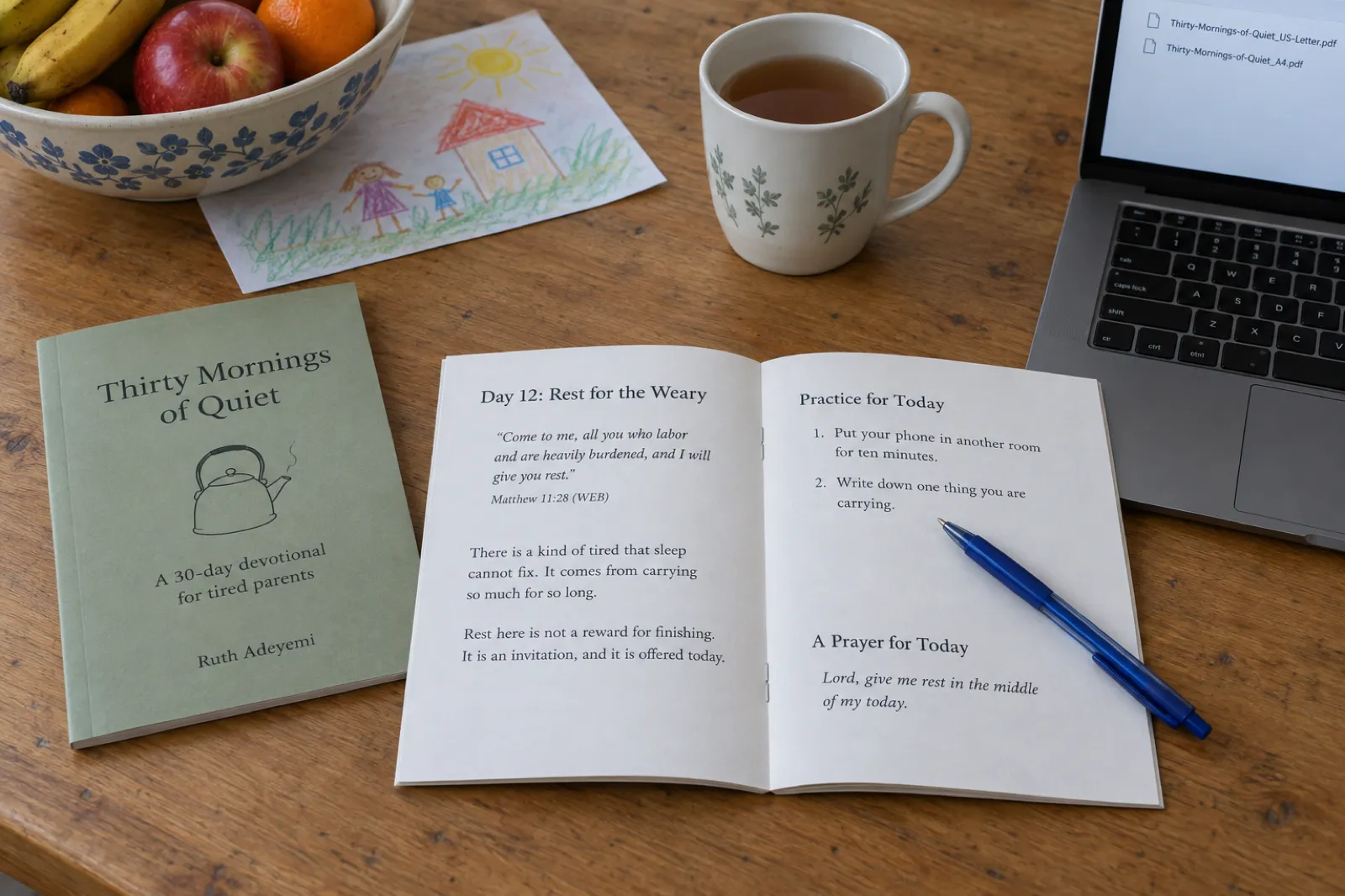
How do you sell a devotional?
Match the format to the buyer. List a 30-day devotional or a printable prayer journal on Etsy, where people search by theme and reader; sell it on Gumroad, Payhip or your own site when you bring the buyers yourself; publish a year of readings or a prayer journal as a KDP paperback, and readings as a Kindle ebook. At $12.99, a PDF keeps about $11.31 on a US Etsy shop, $10.51 through your own Gumroad link and $12.31 on your own site; a Kindle ebook at the same price pays $8.99. Check the Scripture first: every modern translation's publisher limits how much you may quote without asking.
Where it sells
Etsy for themed PDFs people search for. Gumroad or your own site for your readers and church. Amazon for paperbacks and Kindle.
What needs permission
Quoting a modern translation beyond its publisher's limit, and some verse-alone cards, prints and planners.
What we cannot tell you
How many copies a devotional sells. We do not see our users' sales. The worked examples are examples.
Devotional format, Scripture and price planner
Choose the format, theme, reader and translation, then set your prices. The planner shows what one sale keeps on each store, whether your quotations sit inside the publisher's limit, the credit line to print, the Amazon settings, a listing title and tags, and a brief to write from. It runs in your browser: nothing is sent until you press Write this devotional.
Scripture check
PDF download
| Store | You keep |
|---|
Kindle ebook, Amazon.com
Each copy pays
-
Paperback, Amazon.com
Each copy pays
-
Etsy: $0.20 renewal, 6.5% and 3% + $0.25 (US shop). Gumroad: 10% + $0.50 plus 2.9% + $0.30 card processing; Discover 30%. Payhip free plan: 5% plus 2.9% + $0.30 card processing. Own site: 2.9% + $0.30. Kindle: 70% of the price less $0.15 per MB from $2.99 to $12.99, otherwise 35%, and 35% only for a book that is mostly public-domain text. Paperback: black ink. Before tax and ads.
Amazon settings for this kind of book
Listing title and Etsy tags
Brief for the book
How the button works. Write this devotional opens your Inkfluence AI dashboard with the brief in the idea box. Press Create my book (writing needs a free account): a brief about Scripture and prayer is written as a faith devotional, each day opening with a verse and its reference, then a reflection, a practice and a closing prayer, several days to a chapter. For one day per chapter, use the Devotional tile (30 chapters suggested). Name your tradition in the brief if the readings should follow it; otherwise the doctrine is kept broad. The app does not pick a translation, so check every quoted verse against the one you credit.
The figures are one sale in US dollars at each store's published rates on 24 September 2026, before sales tax, currency conversion and advertising. The royalty calculator covers other Amazon stores, and the ebook income calculator projects a month of sales across several books.
Where to sell a devotional: Etsy, Gumroad, Amazon KDP or your church?
Sell where the buyer already is. Etsy works when strangers search by theme or reader ("30 day devotional for women", "prayer journal printable"); Gumroad, Payhip and your own site work when you bring the buyers from a church, a newsletter or social media; Amazon works for readers who shop for books there and for anyone who wants a printed copy.
| Where | Who buys there | Suits | Watch for |
|---|---|---|---|
| Etsy | People searching by theme, season or reader | 30-day devotionals, printable prayer journals, Advent and Lent readings | AI line in the description; your own design only; verse-alone prints may need permission |
| Gumroad | Your readers and listeners, through your link | Devotionals from a blog or podcast, group studies with a licence | 80 cents a sale in fixed fees |
| Payhip | Your readers, through your store | A small shop of studies and devotionals | 5% on the free plan plus card fees |
| Your own site or church | Your congregation, your ministry's supporters | Seasonal booklets, sermon-series devotionals, group studies | You handle delivery, refunds and tax |
| Kindle | Readers shopping on Amazon | 30-day and 365-day readings | 35% above $12.99, and 35% if mostly public-domain text |
| KDP paperback | Gift buyers and readers who want paper | Year devotionals, prayer journals, church copies | Low-content box for journals; 50% below $9.99 |
Selling devotionals and prayer journals on Etsy
List a digital download with up to five files of up to 20MB each, so the US Letter and A4 PDFs go in the same listing (How to Manage Your Digital Listings). The same article says digital items "must be made and/or designed by you, the seller", and Etsy's Creativity Standards (last updated 10 June 2025) rule out "a PDF file of a book that the seller did not personally create or design". A devotional made with AI from your own prompts is allowed on one condition: "Sellers must disclose within their listing description if an item is created with the use of AI." The planner drafts that line with a title and tags.
Selling devotionals on Gumroad and Payhip
Both turn a link in your newsletter or on your church's website into a checkout. On Creator or Premium, the book's Publish window has a Sell on Gumroad tab: connect your account, set the price and publish; the app sends the EPUB and the cover, so add your PDFs afterwards. The Gumroad selling guide covers each screen, and Etsy vs Gumroad compares the two for any ebook.
What a devotional pays per sale
A PDF keeps most of its price; a Kindle ebook keeps 70% only inside Amazon's price band and only when most of the book is your own writing; a paperback keeps what is left after Amazon's share and printing.
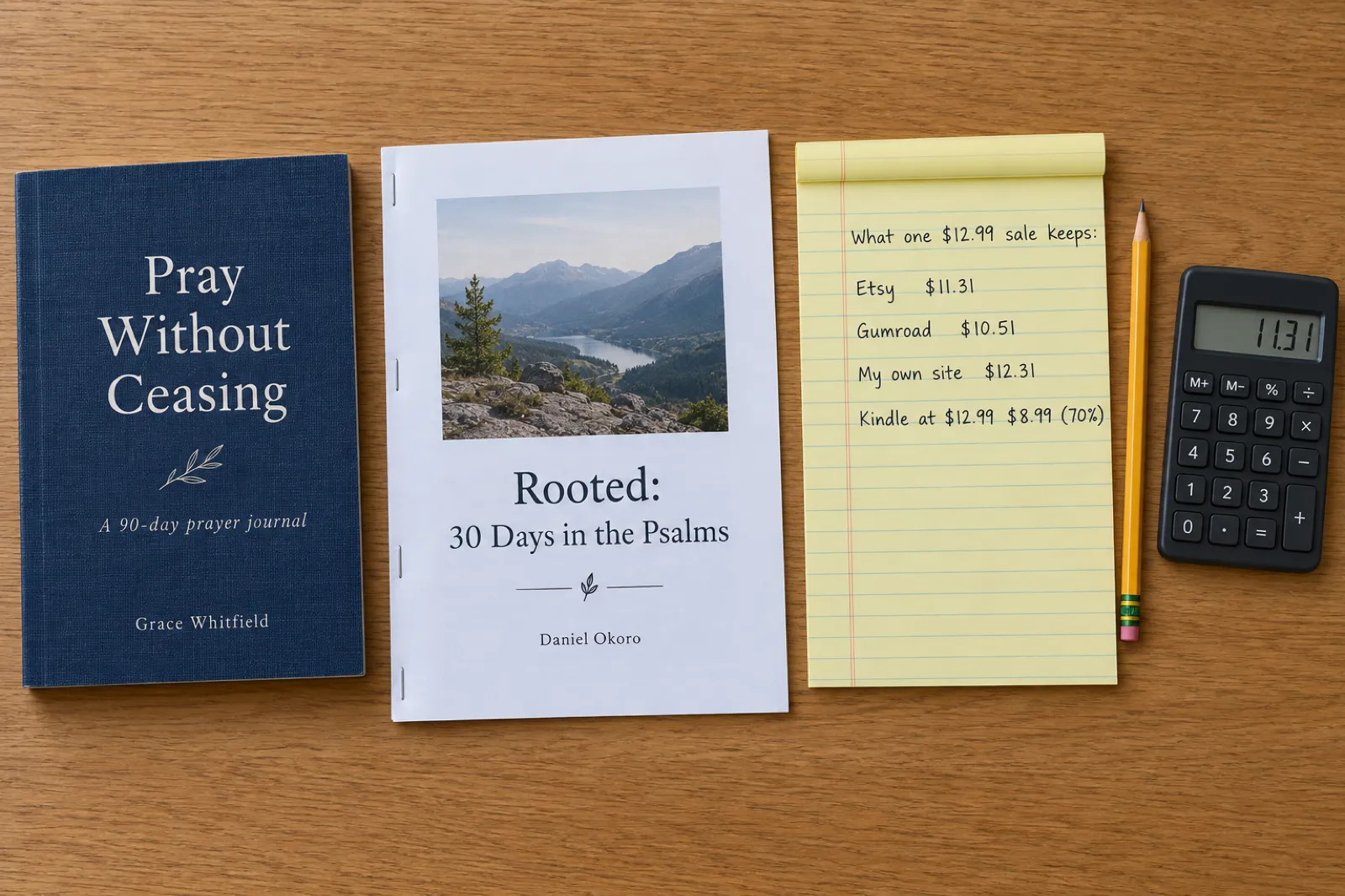
A PDF: what you keep from one sale, by store
| Where the sale happens | At $4.99 | At $9.99 | At $12.99 |
|---|---|---|---|
| Etsy, US shop (instant download) | $4.07 | $8.59 | $11.31 |
| Gumroad, your own link | $3.55 | $7.90 | $10.51 |
| Gumroad Discover | $3.49 | $6.99 | $9.09 |
| Payhip, free plan | $4.30 | $8.90 | $11.66 |
| Your own site, card payment link | $4.55 | $9.40 | $12.31 |
How each row is worked out. Etsy: $0.20 to renew the listing after each sale, a 6.5% transaction fee, and payment processing of 3% + $0.25 for a US shop (Fees & Payments Policy, last updated 13 February 2026; Etsy Payments Policy, last updated 31 July 2026; a UK shop pays 4% + £0.20). Gumroad: 10% + $0.50 on sales through your own links plus card processing of 2.9% + $0.30, or a flat 30% including processing on sales from its Discover marketplace (Gumroad's fees). Payhip: 5% on the free plan, 2% on Plus ($29 a month), none on Pro ($99 a month), with PayPal or Stripe charging their standard rates on top (Payhip pricing); the table assumes a card payment at 2.9% + $0.30. Your own site: a standard card rate of 2.9% + $0.30 (Stripe pricing).
A Kindle ebook: the $12.99 line and the public-domain rule
Since 7 July 2026 KDP pays 70% on Amazon.com for list prices from $2.99 to $12.99 (eBook list price requirements), after a delivery charge of $0.15 per MB. A devotional has a second line to watch. KDP's eBook royalties page says: "Works in the public domain or consisting primarily of public domain content are only eligible for the 35% royalty option." A book that prints long passages of the KJV or the WEB with a few lines of comment falls on the wrong side of that; one where each day is mostly your own reflection does not.
| Kindle list price, Amazon.com | Your own writing, 1 MB | Mostly public-domain text |
|---|---|---|
| $2.99 | $1.99 (70%) | $1.05 (35%) |
| $4.99 | $3.39 (70%) | $1.75 (35%) |
| $9.99 | $6.89 (70%) | $3.50 (35%) |
| $12.99 | $8.99 (70%) | $4.55 (35%) |
| $14.99 | $5.25 (35%) | $5.25 (35%) |
A paperback: devotionals, year books and journals
KDP pays 60% of the list price from $9.99 on Amazon.com and 50% at $9.98 and below, minus printing (Paperback Royalty). Black ink costs a flat $2.30 for 24 to 110 pages at a regular trim such as 5.5 x 8.5 or 6 x 9 inches; above 110 pages it is $1.00 plus $0.012 a page (Printing Cost).
Example A
A 100-page 30-day devotional, 5.5 x 8.5 in, at $9.99
Printing is $2.30, so a copy pays 60% x $9.99 minus $2.30 = $3.69.
Example B
A 380-page 365-day devotional, 6 x 9 in, at $16.99
Printing is $1.00 + 380 x $0.012 = $5.56; a copy pays $4.63.
Example C
A 120-page prayer journal, 6 x 9 in, at $9.99
Printing is $1.00 + 120 x $0.012 = $2.44; a copy pays $3.55. The printable version on Etsy at $4.99 keeps $4.07.
The other side of the ledger
- Listing fees and ads. Etsy listings last four months at $0.20. Offsite Ads take 15% of an order they bring for shops under $10,000 a year (you can opt out) and 12%, compulsory, above.
- The tool. On Inkfluence AI the free plan writes up to five chapters a book and exports a PDF. A devotional you charge for will usually want Creator ($9.99 a month, 35 chapters a month) or Premium ($19.99, unlimited): they remove the footer credit, add EPUB, DOCX and the KDP package, and send books to Etsy and Gumroad.
How many Bible verses can you quote in a devotional you sell?
It depends on the translation: each publisher sets its own limit. On their permission pages on 24 September 2026, the NIV, NKJV, ESV and NLT allowed up to 500 verses without written permission and the CSB and NASB up to 1,000, as long as you quote no complete book of the Bible, Scripture stays under a set share of your book, and the publisher's credit line is printed. A public-domain translation has no limit.
| Translation | Verses without asking | Share of your book | Book of the Bible | Also |
|---|---|---|---|---|
| NIVHarperCollins Christian Publishing | Up to 500 | Under 25% of your book | Not more than 50% of a complete book of the Bible | Not in a commentary or other biblical reference work. Zondervan grants this for the US and Canada |
| NKJVHarperCollins Christian Publishing | Up to 500 | Not more than 25% of the total text | Not more than 50% of an entire book | Not in a commentary or other biblical reference work |
| ESVCrossway | Up to 500 | Under 25% of your book | Not more than one-half of any one book | Not in a commentary or other biblical reference work |
| NLTTyndale House Publishers | Up to 500 | Not more than 25% of the work | No complete book of the Bible | A commentary or Bible reference work for sale needs written permission |
| CSBHolman Bible Publishers | Up to 1,000 | Not more than 50% of the work | No complete book of the Bible | Credit lines as published |
| NASBThe Lockman Foundation | Up to 1,000 | Not more than 50% of the total text | No complete book of the Bible | No more than 1,000 verses stored in an electronic retrieval system |
| WEBWorld English Bible | Public domain: no limit. Use the name "World English Bible" only for faithful copies of the text. | |||
| KJV | Public domain outside the UK. In the UK, printing is controlled under letters patent; Cambridge University Press's limit is not stated here because its page would not load for us. | |||
In the publishers' own words. Crossway: "The ESV text may be quoted in print, digital, and audio formats up to and inclusive of five hundred (500) verses without a formal license or express written permission of Crossway, provided that the verses quoted do not amount to more than one-half of any one book of the Bible or its equivalent measured in bytes, nor do the verses quoted account for twenty-five percent (25%) or more of the total text of the work in which they are quoted, and the verses are not being quoted in a commentary or other biblical reference work." The CSB page: "If you are using less than 1,000 verses, permission is not required." For the NIV, HarperCollins Christian Publishing says Zondervan's permission covers the US and Canada and directs requests from elsewhere to Biblica, whose page we could not read.
Is the King James Version public domain?
Outside the United Kingdom, yes. eBible.org, which publishes a KJV text, puts it this way: "Letters patent issued by King James with no expiration date means that to print this translation in the United Kingdom or import printed copies into the UK, you need permission," adding that the decree "has no effect outside of the UK, where this work is firmly in the Public Domain." Cambridge University Press administers the UK rights. Its rights and permissions page would not load for us, so we do not state its limit: if you sell printed KJV-heavy copies in the UK, read it first. The World English Bible is the simplest modern-English choice: "you may freely copy it in any form, including electronic and print formats."
Verse art, cards and planners are a different case
The limits above are for books. HarperCollins Christian Publishing (NIV, NKJV) lists as not covered "Scripture on a product in which the verse stands alone, such as artwork, note cards, crafts, novelty products, and jewelry". Crossway's Artwork/Stationery section lists greeting cards, digital artwork, calendars and planners among "common uses that require written permission". Tyndale wants NLT artwork uses detailed on its Permissions Questionnaire first. A prayer planner with a modern-translation verse on every page is closer to stationery than to a book: use the WEB, print the reference only, or ask.
Whichever translation you choose, a verse quoted from memory, by a person or by software, is often a blend of translations: compare every quotation word for word with the one you credit. This page is not legal advice; the publisher's page is the rule.
Devotional, prayer journal or Bible study: which are you selling?
A devotional is read, a prayer journal is written in, and a Bible study is used by a group, and each sells differently. A 30-day devotional is the quickest to finish; a year of readings earns its price as a printed gift; a prayer journal is cheap to make but crowded; a group study sells to leaders who buy for several people. Price bands are starting points, not market data.
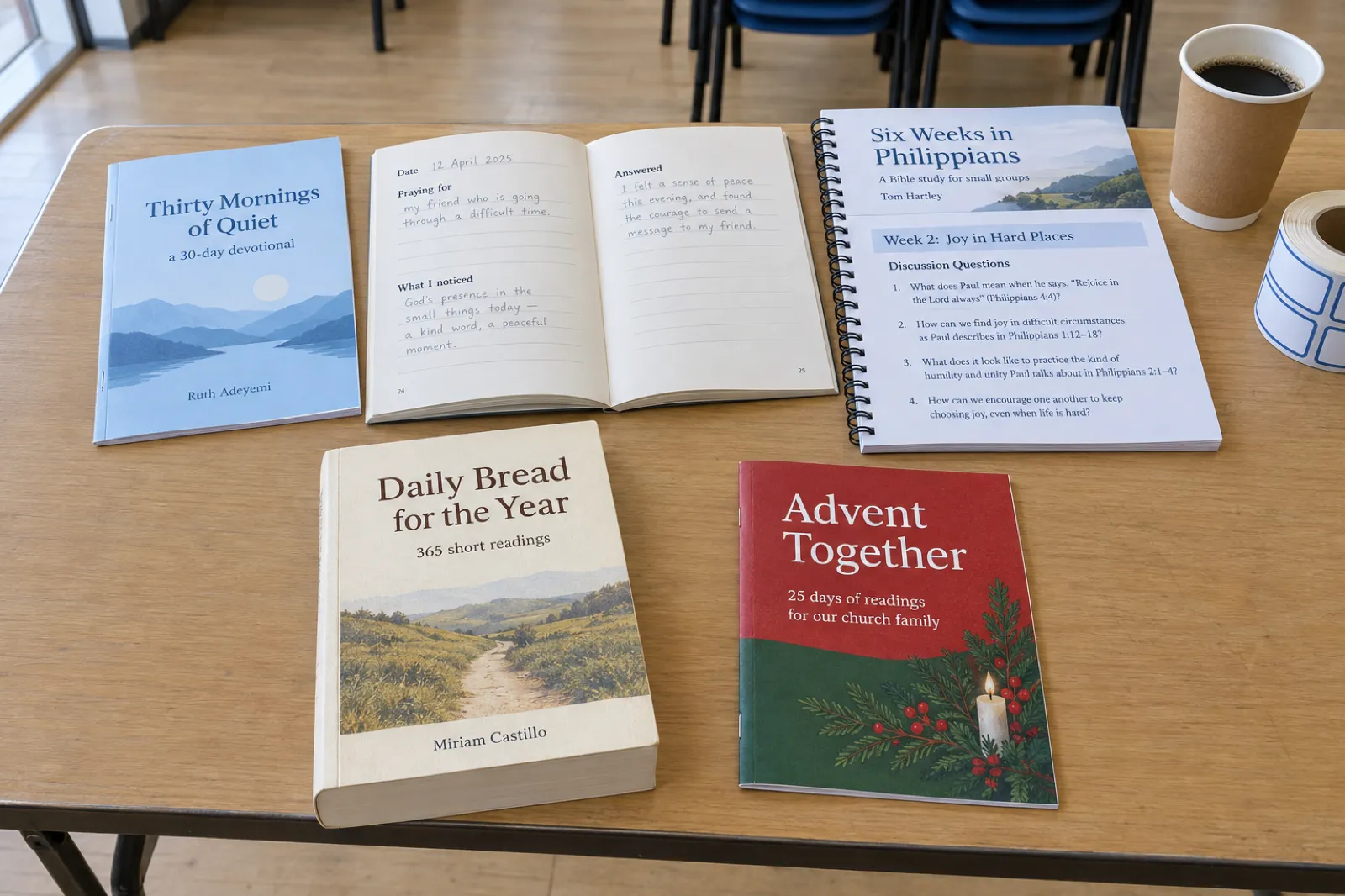
| Format | Effort | Who buys it | PDF price | Kindle? | Where to start |
|---|---|---|---|---|---|
| 30-day devotional | Medium: 30 readings, each checked | One reader, one season or struggle (grief, new mothers, anxiety, a new believer) | $4.99 to $12.99 | Yes | Etsy and Gumroad as a PDF; Kindle and a small paperback |
| 365-day devotional | High: a year of readings | Readers who want a daily book for the year, often as a gift | $9.99 to $19.99 | Yes | KDP paperback and Kindle; the PDF sells less often |
| Prayer journal | Low: a repeated page and short prompts | People who want to write their prayers down, and people buying a gift | $2.99 to $7.99 | No: it is written in | KDP paperback (low-content) and an Etsy printable |
| Bible study guide for groups | Medium: teaching plus questions per week | Small group leaders, women's and men's groups, youth leaders | $7.99 to $19.99 | Yes, for the teaching | Gumroad or your site, with a group licence; paperback for members |
| Church or seasonal devotional (Advent, Lent) | Medium: written for one church family | A congregation, often given away or sold at cost | Free to $9.99 | Optional | Author copies from KDP for the church; a PDF on your site |
A buyer chooses the devotional that names them: "30 mornings for mothers of newborns" beats "a daily devotional". The Devotional format also writes secular daily readings on gratitude or mindfulness. The devotional writing guide covers structure and voice, and the devotional book generator page shows the format in the app.
Selling a devotional on Amazon KDP: readings, journals and public-domain text
A devotional people read can be a Kindle ebook and a paperback; a prayer journal they write in is a paperback only. KDP's Guide to Kindle Content Quality lists blank journals among books not suited to Kindle, which "may be rejected upon submission or removed from sale".
Is a prayer journal a low-content book?
Usually, yes. KDP's Low-Content Books page defines them as books with "minimal or no content on the interior pages", "generally repetitive, and designed to be filled in by the user", and lists Diaries/Journals and Prompt journals as low-content. Tick the Low-content box under Categories: "if you do not select this box, or select a different box, your book will be rejected." Low-content books "are not eligible for the free KDP ISBN". A devotional with a journaling line after each reading is still a devotional, not low-content.
Public-domain Scripture on KDP
KDP's public domain content page says: "If a free version of a public domain title is available in our store, we will only allow you to publish a differentiated version," meaning an original translation, original annotations, or ten or more original illustrations, with (Translated), (Annotated) or (Illustrated) in the title field. That rule is aimed at republishing the text itself. A devotional that quotes one verse a day and writes the rest is your own work: choose "I own the copyright" in the publishing rights section.
Bible study guides and KDP's companion-guide rule
The content quality guide also says "Companion guides (including summaries, study guides, workbooks, analyses, and other related content based on other books) are not allowed, with limited exceptions for guides with positive reader engagement." KDP does not say whether a Bible study counts. Write yours as original teaching with your own questions and applications, not a chapter-by-chapter summary, and quote the passage sparingly.
KDP asks you to declare AI-generated text and images, but not AI-assisted content (Content Guidelines); the KDP AI disclosure guide and the KDP paperback guide cover the set-up.
How do you sell devotionals to churches in bulk?
Print author copies for printed booklets, or sell a congregation licence for a PDF. On KDP, "When you order proof or author copies through your KDP Account, you'll pay the author price for your books", which is the print cost multiplied by the number of copies ordered, plus shipping (How much do proof or author copies cost?). A 25-day Advent booklet of 64 pages prints for $2.30 a copy on Amazon.com, so 50 copies cost $115.00 before shipping.
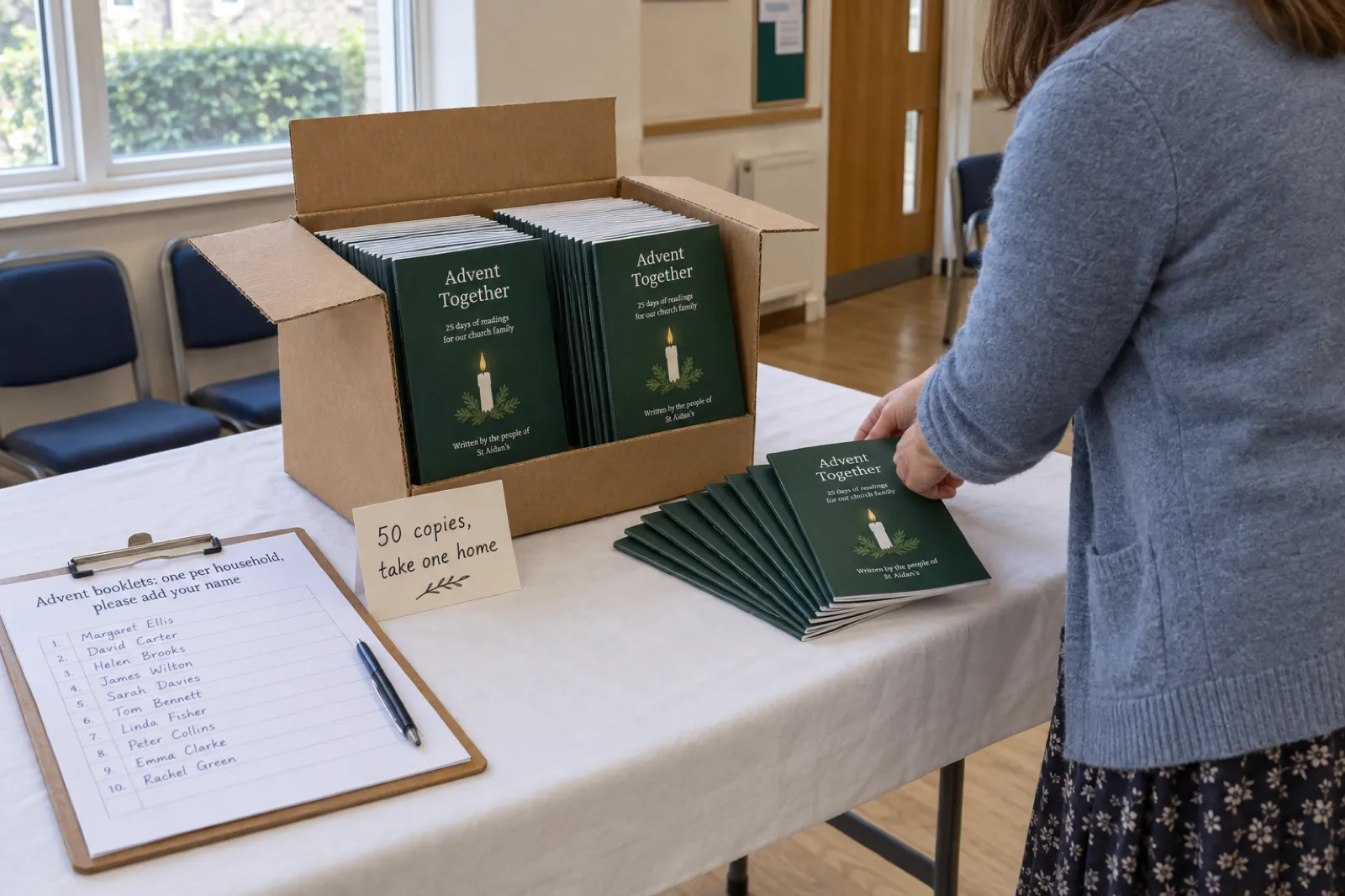
For a PDF, write the licence into the product ("one church may print or email this devotional to up to 100 members") and sell it as a separate product on Gumroad, Payhip or your own site, next to the personal-use version. Several publishers set lighter notice rules for material that is not for sale, such as church bulletins and orders of service; a booklet you sell follows the book rules above. The churches page covers sermon-companion devotionals and small group guides, and the spiritual coaches page covers guided journals and daily practice books.
What people make and list: devotionals on Inkfluence AI
We counted the devotionals made in the 90 days to 24 September 2026, leaving out our own accounts: 1,602 books by 1,090 people, 1,510 of them faith devotionals and 92 in the general devotional format. For each we checked whether it is listed for sale on Etsy or Gumroad through the app. We cannot see sales, so none of this says what sold.
5.7%
of devotionals are listed for sale through the app (91 of 1,602). In English 6.5% (87 of 1,337); in other languages 1.5% (4 of 265).
Link to this stat44%
of listed devotionals are on Etsy (40 of 91). 66 are on Gumroad, 15 of them on both.
Link to this stat70%
name no reader (1,122 of 1,602). 13% name children or families, 13% women, 13% a church, group or ministry, 8% men, 6% couples and 6% teens or youth.
Link to this statOur reading of these. Devotionals are listed more often than books of every kind, workbooks and fitness books, and their sellers use Etsy far more than the average listed book: a devotional is something people search for by theme. Books written for a church, group or ministry were listed at 6.5% (13 of 201); none of the 95 for teens or youth was listed. Most name no length: only 90 say 30 or 31 days, 37 a year and 8 forty days. Prayer journals (23) and Bible studies (62) are too few for rates. Listings made on the stores directly are invisible to us.
How it was counted. Books created from 26 June to 24 September 2026 (counted on 24 September) in the faith devotional or general devotional format, excluding the team's own accounts. A book counts as listed while it is linked to an Etsy listing or a Gumroad product created through the app; Etsy listings arrive as drafts, so a few may never have been switched on. Days and readers come from keywords in the title and brief (a book can name several readers), ignoring the audience line the app fills in when an author leaves it blank. No title, brief, shop, product or account is published, and prices were not read. The figures are published under a Creative Commons Attribution 4.0 licence: quote them with a link to this page.
How much should you charge for a devotional?
Charge for what the book gives the reader, checked against three comparable listings on the same store. A 30-day printable, a year-long gift paperback and a six-week group study are different prices even at the same page count.
Four rules hold across stores. On Gumroad, price well above the fixed fees: 80 cents a sale is 16% of a $4.99 devotional and 6% of a $12.99 one. On Kindle, respect the $12.99 line: at $14.99 a 1 MB devotional pays $5.25, at $12.99 it pays $8.99. Keep Scripture a minority of the text if you want the 70% Kindle rate on a public-domain translation. Do not price from the default: many sellers never move off the number already in the price box, which is how the typical Gumroad price across products published through the app ended up on the app's starting price. For pricing any ebook in more depth, see how to price an AI-created ebook.
How to make and sell a devotional, step by step
The route from an idea to a listing, for a devotional, a prayer journal or a group study.
-
1. Name the reader, the season and the length
One sentence: who it is for, what they are living through, and how many days (7, 21, 30, 40 or a year). Name your tradition if the readings should follow it. Read the reviews of three similar devotionals: their complaints are your brief.
-
2. Choose the translation and read its permission page
Pick one translation, count the verses you plan to quote and read the publisher's page, or choose the World English Bible. The planner shows the limit and the credit line.
-
3. Choose the format and price it
Use the planner to see what a PDF, a Kindle copy and a paperback pay at your price before a word is written.
-
4. Write it
Type the brief in the dashboard idea box, or choose New Book, then Choose a book type, then the Devotional tile for one day per chapter. Edit the plan of days before anything is written. The free plan writes up to five chapters a book; Creator's 35 chapters a month cover a 30-day devotional; a year of readings is best written a month at a time, since a book writes at most 40 chapters at once.
-
5. Check every verse and read every day aloud
Compare each quotation word for word with the translation you credit and fix any reference that is wrong. Read each reflection and prayer aloud, and add the stories only you can tell.
-
6. Add the copyright page
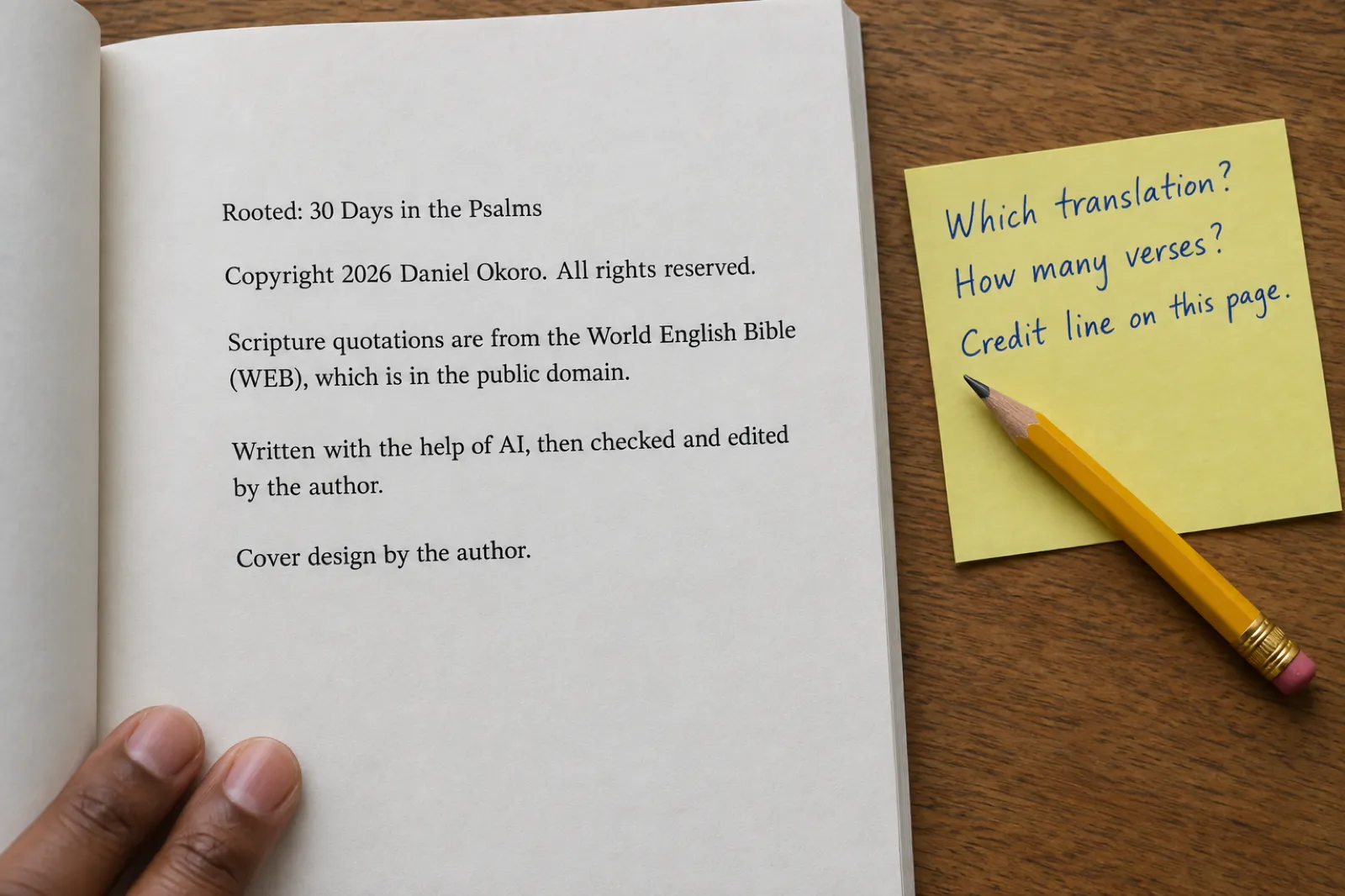
Your copyright line, the translation's credit line exactly as its publisher gives it (with "Used by permission" where the publisher asks for it), and a plain line on how the book was made.
-
7. Export and list it
Export the PDF in US Letter and A4 for Etsy, Gumroad, Payhip or your own site (every plan; a small footer credit on free); for Kindle the EPUB, for a paperback the KDP package (paid plan or credit pack). Add the AI line to an Etsy description; on KDP, tick Low-content only for a prayer journal.
-
8. Offer it to churches and groups, and keep it up to date
Order author copies for a church at print cost, or sell a group licence for the PDF. When a reader reports a wrong reference or a typo, fix it and replace the file on each store.
Five mistakes that cost devotional sellers money
- No credit line. Every modern translation's free use depends on printing its notice. Copy it exactly from the publisher's page.
- Verse art in a modern translation. Cards, prints and planners with a verse standing alone are outside the book rules of several publishers.
- A Kindle book that is mostly Scripture. KDP pays 35% on mostly public-domain text. Write the reflections; quote the verse.
- A prayer journal on Kindle, or without the Low-content box. Kindle does not suit blank journals, and KDP rejects an unticked one.
- No reader named. Seven in ten devotionals in our count name nobody. The ones that name a reader and a season give the buyer a reason to choose them.
Selling devotionals, prayer journals and Bible studies: FAQ
How do you sell a devotional?+
How many Bible verses can I quote in a devotional without permission?+
Is the King James Version public domain?+
Should I sell my devotional on Etsy, Gumroad or Amazon KDP?+
How much should I charge for a devotional?+
Can I sell a devotional written with AI?+
How do I sell devotionals to churches in bulk?+
Related tools and guides
AI Devotional Book Generator
The devotional format itself: a verse, a reflection, a practice and a prayer each day.
How to Write a Devotional
Structure, voice and length for daily readings.
AI Journal Generator
Guided and prompt journals, including prayer journals.
How to Sell Workbooks
Printables and paperbacks people write in, and KDP's low-content rules.
How to Sell Fitness Ebooks
Workout plans, meal plans and 30-day challenges.
How to Sell Travel Guides
Etsy, Gumroad and Kindle for a guide people search by place.
Sell Ebooks on Etsy
Opening a shop, AI disclosure and the publish flow for any book.
For Churches
Sermon series, study guides and seasonal devotionals for a congregation.
Make Money Selling AI Ebooks
The wider picture: stores, niches and what to expect.
One reader, one season, every verse checked, the credit line in place.
Plan the format, the Scripture and the price above, or start from the idea box. The free plan writes up to five chapters a book and exports a PDF.