
How to Sell Fitness Ebooks: Workout Plans, Meal Plans and 30-Day Programmes
A fitness ebook is bought for what the buyer will do next: three sessions this week, a shopping list for Sunday, day one of thirty. That shapes where it sells and how. A programme sold to your followers belongs on Gumroad or your own site; a meal plan or a challenge calendar that strangers search for belongs on Etsy; a plan people read belongs on Kindle; a training log they write in belongs in a paperback. This page covers the selling half: what each store keeps from a sale (checked against their own pages on 24 September 2026), the health-claim rules each one publishes, how KDP treats training logs, how to price a plan, and what a listing needs. We cannot see what our users sell, so there are no income claims, only the arithmetic.
Etsy, Gumroad, Payhip, Amazon and Kindle are trademarks of their owners. Inkfluence AI is an independent tool and is not affiliated with or endorsed by any of them. Nothing on this page is medical, nutrition or legal advice.
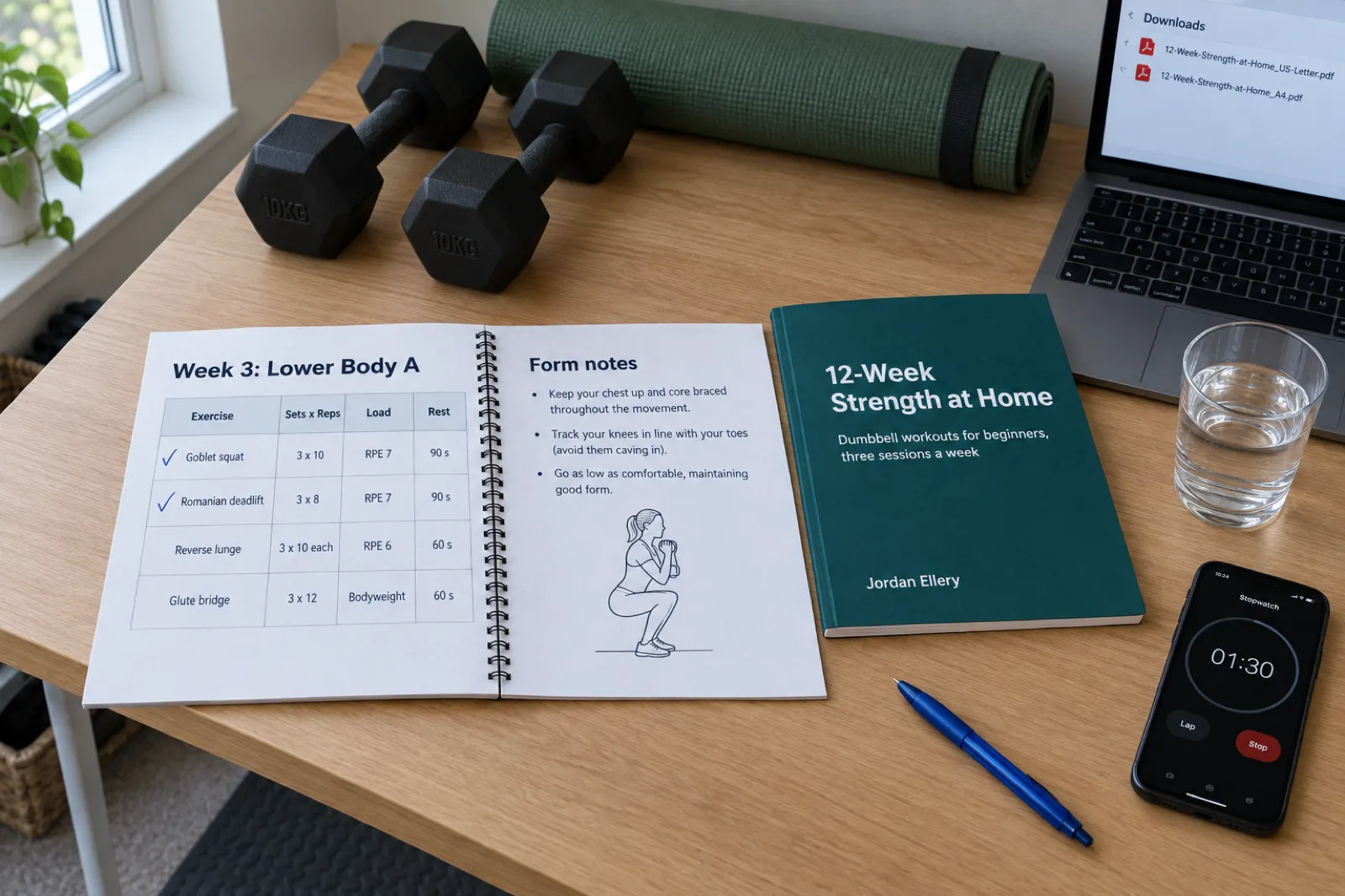
How do you sell a fitness ebook?
Match the format to the store. Sell a workout programme as a PDF on Gumroad, Payhip or your own site to people who already follow you; list a meal plan, challenge or printable log on Etsy, where people search by goal; publish a plan people read as a Kindle ebook, and a training log as a KDP paperback. At $19.99, a PDF keeps about $17.64 on a US Etsy shop, $16.61 through your own Gumroad link and $19.11 on your own site; the same plan as a Kindle ebook pays $7.00 at $19.99 but $8.88 at $12.99, because Amazon's 70% rate stops at $12.99. Whatever the store, describe what the plan contains, add a line that it is general information and not medical advice, and make no claim that it treats or cures anything.
Where it sells
Gumroad or your own site for programmes sold to followers. Etsy for meal plans and printables people search for. Kindle for plans that are read, a paperback for logs.
What the stores forbid
Claims to treat, prevent or cure a condition (Etsy), diet and weight loss pills and resold PLR (Gumroad), and misleading descriptions (KDP).
What we cannot tell you
How many copies a plan sells. We do not see our users' sales and no store publishes typical ones. The worked examples here are examples.
Fitness ebook format and price planner
Choose what you are selling, what it covers and who it is for, then set a PDF price, a Kindle price and a paperback. The planner works out what one sale keeps on each store, what a Kindle copy and a paperback copy pay on Amazon.com, the KDP settings for this kind of product, a listing title and tags, the health and AI lines for the description, and a brief to write it from. It runs in your browser: nothing is sent anywhere until you press Write this plan.
PDF download
| Store | You keep |
|---|
Kindle ebook, Amazon.com
Each copy pays
-
Paperback, Amazon.com
Each copy pays
-
Etsy: $0.20 renewal, 6.5% and 3% + $0.25 (US shop). Gumroad: 10% + $0.50 plus 2.9% + $0.30 card processing; Discover 30%. Payhip free plan: 5% plus 2.9% + $0.30 card processing. Own site: 2.9% + $0.30. Kindle: 70% of the price less $0.15 per MB from $2.99 to $12.99, otherwise 35%. Before tax and ads.
Amazon settings for this kind of product
Lines for the description
Listing title
Etsy tags
Brief for the chapters
How the button works. Write this plan opens your Inkfluence AI dashboard with the brief in the idea box. Press Create my book (writing needs a free account) and the app picks the format from the wording: a brief about a workout programme is written as a workout plan, with every session set out as a table of exercise, sets and reps, load and rest. For a challenge, a meal plan or a log you can also choose the format yourself: New Book, then Choose a book type, then the Day challenge, Cookbook / Food or Workbook / planner tile, and paste the brief there.
The figures are one sale in US dollars at each store's published rates on 24 September 2026, before sales tax, currency conversion and advertising. The royalty calculator covers other Amazon stores, and the ebook income calculator projects a month of sales across several books.
What a fitness ebook pays per sale
A PDF keeps most of its price on every store; a Kindle ebook keeps 70% only inside Amazon's price band; a paperback keeps what is left after Amazon's share and the printing. Total earnings are the price times the copies sold, and copies sold is the part nobody can give you: neither store tells us what our users sell, so we do not quote income.
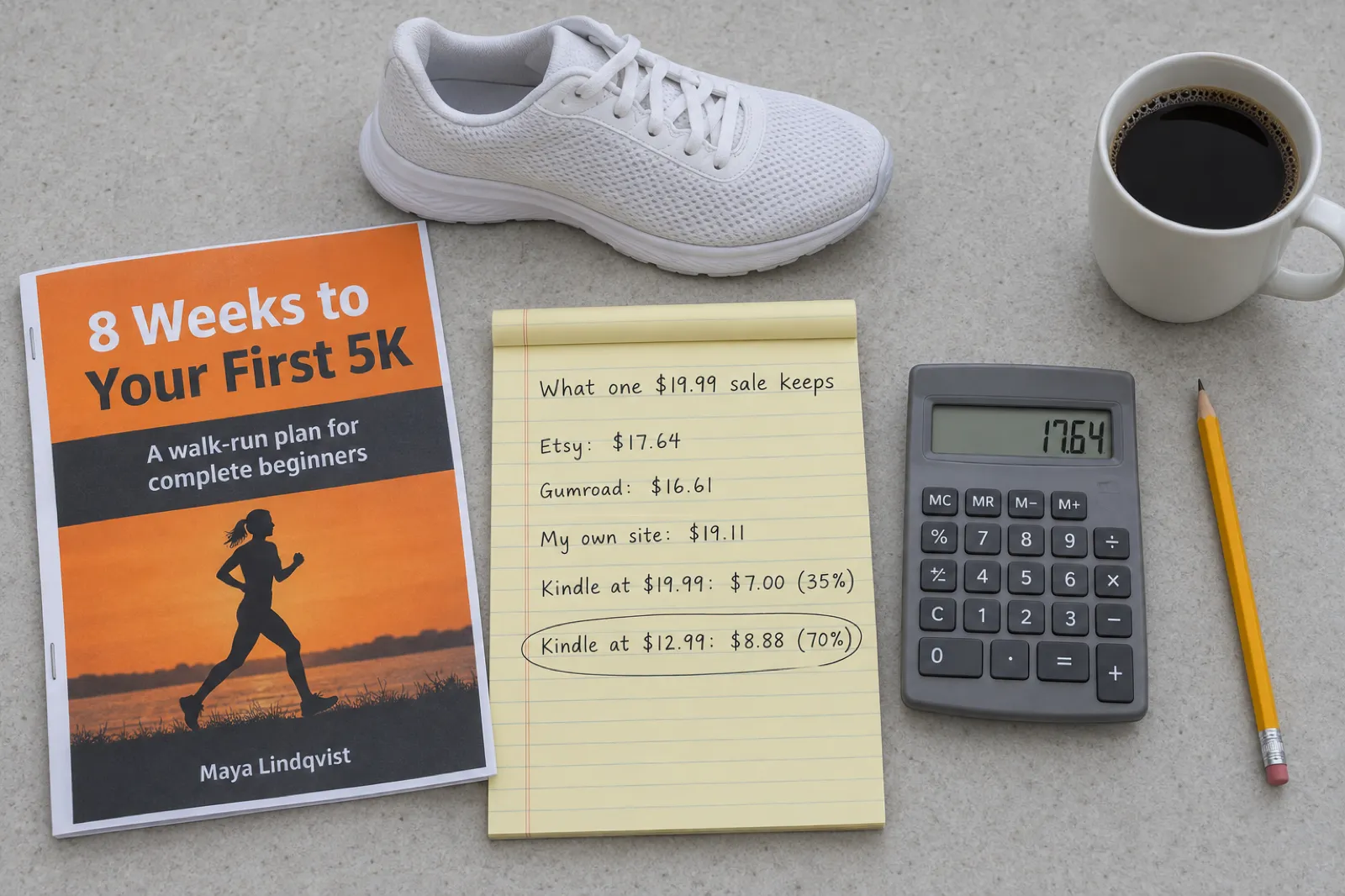
A PDF: what you keep from one sale, by store
| Where the sale happens | At $9.99 | At $19.99 | At $29.99 |
|---|---|---|---|
| Etsy, US shop (instant download) | $8.59 | $17.64 | $26.69 |
| Gumroad, your own link | $7.90 | $16.61 | $25.32 |
| Gumroad Discover | $6.99 | $13.99 | $20.99 |
| Payhip, free plan | $8.90 | $18.11 | $27.32 |
| Your own site, card payment link | $9.40 | $19.11 | $28.82 |
How each row is worked out. Etsy: $0.20 to renew the listing after each sale, a 6.5% transaction fee, and payment processing of 3% + $0.25 for a US shop (Fees & Payments Policy, last updated 13 February 2026; Etsy Payments Policy, last updated 31 July 2026; a UK shop pays 4% + £0.20). Gumroad: 10% + $0.50 on sales through your own links plus card processing of 2.9% + $0.30, or a flat 30% including processing on sales from its Discover marketplace (Gumroad's fees); once paid sales pass $20,000 in a calendar month, new direct sales that month pay 5% + $0.50. Payhip: 5% on the free plan, 2% on Plus ($29 a month), none on Pro ($99 a month), with PayPal or Stripe charging their standard rates on top (Payhip pricing); the table assumes a card payment at 2.9% + $0.30. Your own site: a standard card rate of 2.9% + $0.30 (Stripe pricing). Fees change: check the store's page before you set a price.
A Kindle ebook: the $12.99 line
Since 7 July 2026 KDP pays 70% on Amazon.com for list prices from $2.99 to $12.99, up from a top of $9.99 (eBook list price requirements). The 70% is taken after a delivery charge of $0.15 per MB on Amazon.com (Digital pricing); outside the band the rate is 35% with no delivery charge (eBook royalties).
| Kindle list price, Amazon.com | Rate | 2 MB plan (text and tables) | 8 MB plan (photos) |
|---|---|---|---|
| $4.99 | 70% | $3.28 | $2.65 |
| $9.99 | 70% | $6.78 | $6.15 |
| $12.99 | 70% | $8.88 | $8.25 |
| $14.99 | 35% | $5.25 | $5.25 |
| $19.99 | 35% | $7.00 | $7.00 |
So the price that suits a PDF sold to your followers is often the wrong price on Kindle.
A paperback: programmes and logs
KDP pays 60% of the list price from $9.99 on Amazon.com and 50% at $9.98 and below, minus printing (Paperback Royalty). Black ink costs a flat $2.30 for 24 to 110 pages at a regular trim such as 6 x 9 inches, and $2.84 at a large trim such as 8.5 x 11; above 110 pages it is $1.00 plus $0.012 or $0.017 a page (Printing Cost).
Example A
A 120-page programme, 8.5 x 11 in, black ink, at $14.99
Printing is $1.00 + 120 x $0.017 = $3.04, so a copy pays 60% x $14.99 minus $3.04 = $5.95.
Example B
A 120-page training log, 6 x 9 in, at $9.99
Printing is $1.00 + 120 x $0.012 = $2.44; a copy pays $3.55. At $8.99 it pays $2.06, and KDP will not accept less than $4.88.
Example C
A $9.99 meal plan PDF, 30 sales in a month on Etsy
30 x $8.59 = $257.70 before tax. No printing, and the same file sells any number of times.
Example D
A $19.99 programme to 2,000 followers on Gumroad
If one in a hundred buys, 20 sales x $16.61 = $332.20. At one in two hundred, $166.10. The percentage is yours to test; it is not ours to promise.
The other side of the ledger
- Listing fees and ads. Etsy listings last four months at $0.20. Offsite Ads take 15% of an order they bring for shops under $10,000 a year (you can opt out) and 12%, compulsory, above.
- The tool. On Inkfluence AI the free plan writes up to five chapters a book and exports a PDF. A plan you charge for will usually want Creator ($9.99 a month, 35 chapters a month) or Premium ($19.99, unlimited): they remove the footer credit, add EPUB, DOCX and the KDP package, and send books to Etsy and Gumroad.
- Tax. Gumroad is the merchant of record for sales tax, Etsy collects it where required, Amazon handles its own; on your own site it is yours.
Where to sell fitness and mindset digital products: Etsy, Gumroad or your own site?
Sell where the buyer already is. Etsy works when strangers search for the thing by name ("meal prep plan", "30 day walking challenge", "gym log printable"); Gumroad, Payhip and your own site work when you bring the buyers from social media, a newsletter or your clients; Amazon works for readers who shop for books there. A mindset product follows the same rule: a printable tracker suits Etsy, a coaching programme your own link.
| Where | Who buys there | Suits | Watch for |
|---|---|---|---|
| Etsy | People searching by goal, food or format | Meal plans, challenge calendars, printable logs and trackers | AI line in the description; no medical claims; your own design only |
| Gumroad | Your followers, through your link | Programmes, bundles, coaching add-ons | 80 cents a sale in fixed fees; no PLR resale; no diet pills |
| Payhip | Your followers, through your store | Programmes and courses sold together | 5% on the free plan plus card fees |
| Your own site | Your visitors and clients | Client packs, programmes sold with coaching | You handle delivery, refunds and tax |
| Kindle | Readers shopping on Amazon | Programmes and meal plans people read | 35% above $12.99; delivery per MB; nothing to fill in |
| KDP paperback | Buyers who want a printed book | Training logs, journals, printed programmes | Low-content box for logs; 50% below $9.99 |
Selling fitness products on Etsy
List a digital download with up to five files of up to 20MB each; there are no variations on digital items, so the US Letter and A4 PDFs go in the same listing as two files (How to Manage Your Digital Listings). The same article says digital items "must be made and/or designed by you, the seller", and Etsy's Creativity Standards (last updated 10 June 2025) rule out "a PDF file of a book that the seller did not personally create or design". A plan made with AI from your own prompts is allowed on one condition: "Sellers must disclose within their listing description if an item is created with the use of AI." Put the AI line and the health line in the description; the planner drafts both, with a title and tags.
Selling fitness products on Gumroad and Payhip
Both turn a link in your bio into a checkout and a download. On Creator or Premium, the book's Publish window has a Sell on Gumroad tab: connect your account, use Auto-fill with AI for the description, set the price and publish; the app sends the EPUB and the cover, so add your PDFs to the product afterwards. The Gumroad selling guide covers each screen, and Etsy vs Gumroad compares the two for any ebook.
What are the easiest fitness digital products to create and sell as a beginner?
A 30-day challenge and a training log are the quickest to make; a workout programme or a meal plan takes longer but carries a higher price. Easy to make is not the same as easy to sell, though: the easier a format is to produce, the more copies of it already sit on every store. The table sets out the five formats, who buys each and where it sells. Price bands are starting points worked out from length and use, not market data. For topics and niches with demand evidence behind them, see our best digital product niches.
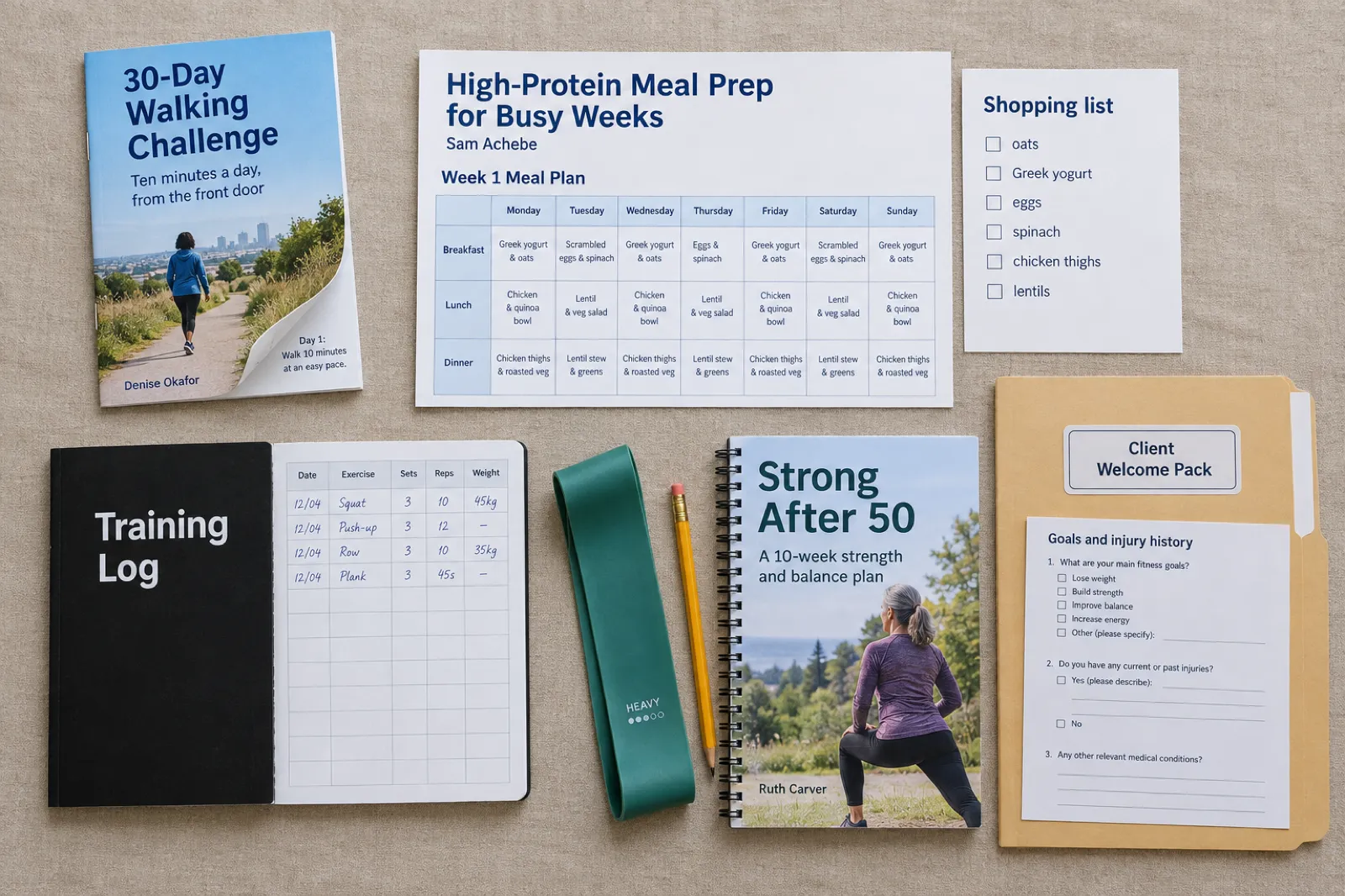
| Format | Effort | Who buys it | PDF price | Kindle? | Where to start |
|---|---|---|---|---|---|
| Workout programme (4 to 12 weeks) | Medium: every session written and checked | Beginners, people training at home, people training for one goal or event | $9.99 to $29.99 | Yes, check every table | Gumroad to your followers; Kindle and a paperback for search |
| 30-day challenge | Low per day, but 30 days to write | People who want a start date and a short daily task | $4.99 to $14.99 | Yes, if each day is read | Etsy printable, Gumroad, or free as a lead magnet |
| Meal plan with recipes and shopping lists | Medium: every recipe and list checked | Busy families, people cooking for one goal (protein, budget, time) | $7.99 to $19.99 | Yes, watch the file size | Etsy printable, Gumroad, Kindle |
| Workout log or fitness journal | Lowest: a repeated page | People who want to write down every session | $2.99 to $7.99 | No: it is written in | KDP paperback (low-content) and an Etsy printable |
| Coaching client pack | Medium: built from your own method | Your clients, before and between sessions | $19.99 to $49.99 | No | Your own site or Gumroad, with the coaching |
What makes a buyer pay is specificity: "Three 30-minute dumbbell sessions a week for beginners over 50" tells the right buyer it was written for them, where "a workout plan" competes with every free video. Describe a mental health or mindset product as support for habits and reflection, not as treatment. If you are a coach or trainer building a product line from your own method, the personal trainers and nutritionists pages show how the formats fit around client work.
Health claims and disclaimers: what a fitness listing can say
Describe what the plan contains and who it suits, and claim nothing about treating a condition. A fitness or meal plan should also carry a plain note that it is general information, not medical advice, and that the reader should check with a doctor or other qualified professional before starting, particularly if they are pregnant, injured, taking medication or managing a health condition. The store rules below are why the listing wording matters too.
- Etsy. Its Prohibited Items Policy (last updated 11 August 2026) covers "medical drugs, medical devices, and any other item that claims to treat, prevent, mitigate, cure, or diagnose a disease or medical condition". A meal plan "for people with type 2 diabetes" that describes recipes is a different listing from one that says it reverses diabetes.
- Gumroad. Its prohibited products list includes "pseudo pharmaceuticals (including anti-aging pills, sexual stimulants, weight loss pills, diet pills)" and "reselling private label rights products". A written plan is not a pill, but the second line rules out the PLR fitness packs sold with resale rights.
- Amazon KDP. The Content Guidelines publish no separate rule for health books, but do not allow "descriptive content meant to mislead customers or that doesn't accurately represent the content of the book". A title promising a result the book cannot guarantee is the obvious risk.
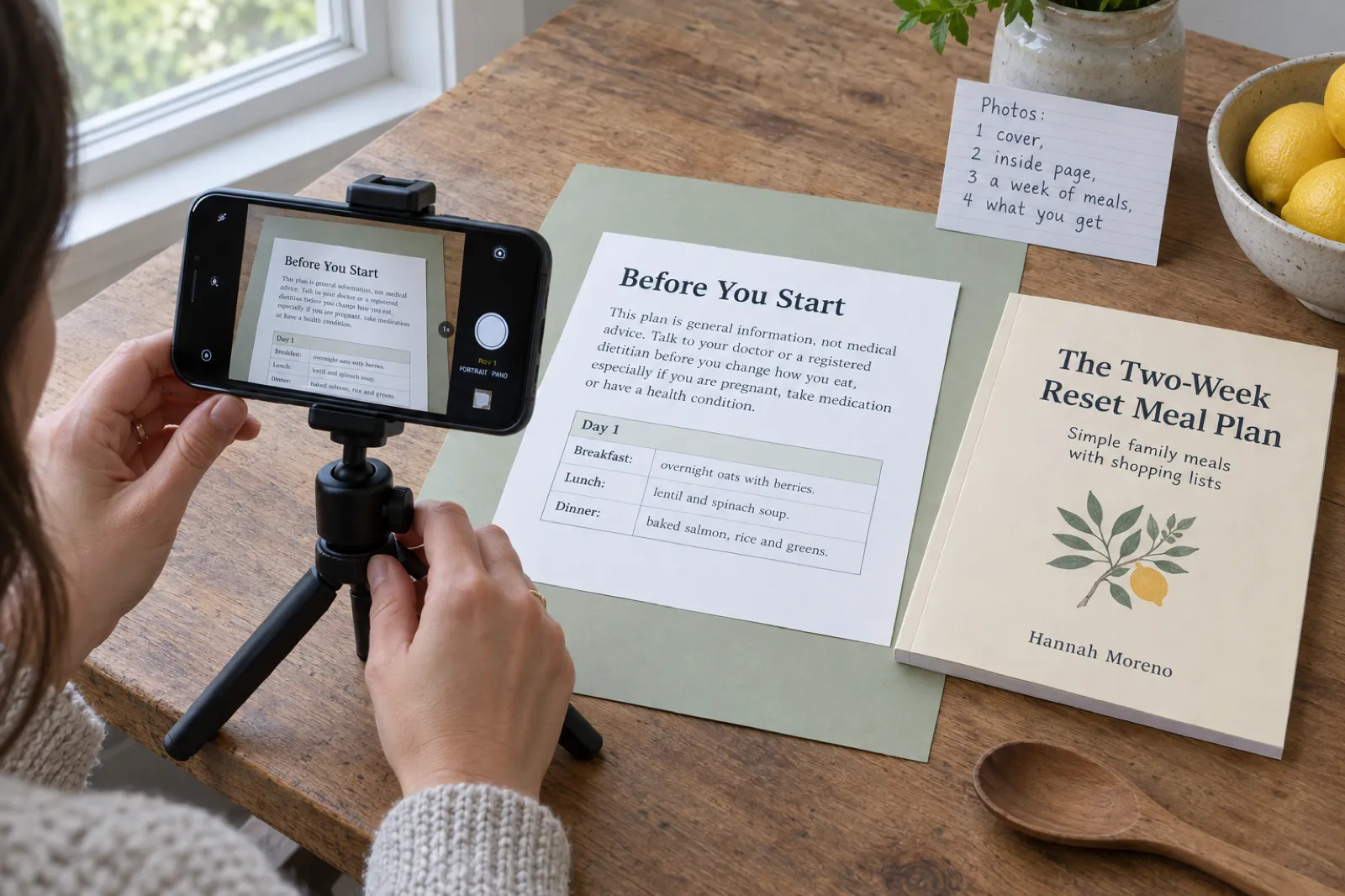
Words that tend to become claims: cure, treat, heal, reverse, detox, guaranteed, "lose 10 pounds in 7 days". Words that describe: 12 weeks, three sessions a week, 30 minutes, dumbbells only, 1,800 calories, shopping list included. The planner's health line is a starting point, not legal advice.
Selling fitness ebooks on Amazon KDP: Kindle for plans, paperback for logs
A programme or meal plan people read can be a Kindle ebook; a log or journal they write in cannot. KDP's Guide to Kindle Content Quality says books "where the main purpose is to allow the reader to write or color on the pages" are not well suited to Kindle and "may be rejected upon submission or removed from sale". It also rules out content "excessively reused, recycled, or repeated within or across books", which is where recycled fitness text ends up.
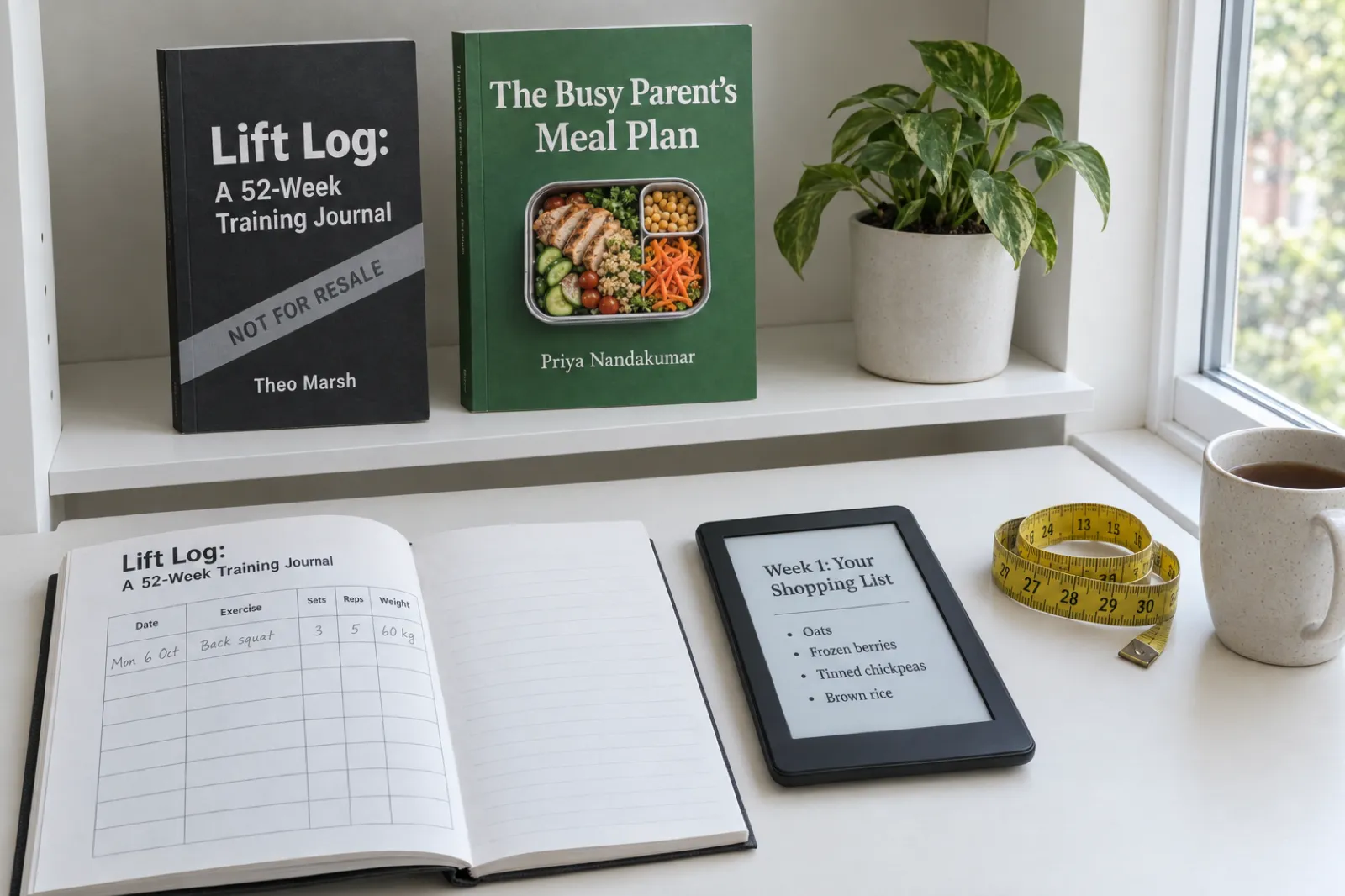
Is a fitness journal a low-content book?
Usually, yes. KDP's Low-Content Books page defines them as books with "minimal or no content on the interior pages", "generally repetitive, and designed to be filled in by the user", and lists "Log books (i.e., tracking habits, activity, thankfulness)" among its examples, next to planners and journals. A workout log, food diary or habit tracker is one. Tick the Low-content box under Categories ("if you do not select this box, or select a different box, your book will be rejected"); low-content books are "not eligible for the free KDP ISBN", so you use your own or publish without one, and there is no release date for pre-orders. A programme that teaches and sets different sessions each week is not low-content: it takes the free ISBN and the Look Inside sample like any non-fiction book.
Low competition is the wrong reason to pick a journal niche: a repeated page is the easiest book to copy. A log earns its place with a layout a real lifter, runner or walker would choose and a title that names who it is for. KDP limits title creation to 2 per book format each week (Create a Book).
KDP asks at publishing whether text, images or translations are AI-generated; content you wrote and only improved with AI tools is AI-assisted and needs no declaration (Content Guidelines). The KDP AI disclosure guide walks through the questions, and the KDP paperback guide each set-up screen. On Inkfluence AI the KDP package (a print-ready interior and a full wrap cover) comes with a paid plan or a credit pack.
What people make and list: fitness ebooks on Inkfluence AI
We counted the fitness and nutrition books made in the 90 days to 24 September 2026, leaving out our own accounts: 447 workout plans, 435 health books about exercise or eating, 292 challenges about exercise or eating, and 444 cookbooks that are meal plans or diets, 1,618 books by 1,296 people. For each we checked whether it is listed for sale on Etsy or Gumroad through the app. We cannot see sales, so none of this says what sold.
4.3%
of fitness and nutrition books are listed for sale through the app (69 of 1,618). Meal plans 5.0% (22 of 444), challenges 4.1% (12 of 292), workout plans 4.0% (18 of 447), health books on exercise or eating 3.9% (17 of 435).
Link to this stat11 of 22
listed meal plans are on Etsy, against 2 of 18 workout plans. Across all 69 listed fitness and nutrition books, 60 are on Gumroad and 16 on Etsy, 7 of them on both.
Link to this stat26%
of workout plans name beginners (117 of 447). 21% name home, bodyweight or little equipment, 19% weight or fat loss, 16% a sport or event, 11% over 40, over 50 or seniors, and 7% women. 34% name none of these.
Link to this statOur reading of these. Fitness and nutrition books are listed more often than books of every kind and more often than workbooks: people who make a workout plan often mean to sell it. The store split follows the buyer. Meal plans are searched for, and half of the listed ones went to Etsy; workout plans are mostly sold to an audience the seller brings, and nearly all went to Gumroad. A third of workout plans name no reader or limit at all, the generic version that competes with every free video. Among health books, mental health and stress had the highest listing rate, 10 of 99, on a small base. Listings made on the stores directly are invisible to us, so the real share is higher.
How it was counted. Books created from 26 June to 24 September 2026 (counted on 24 September), excluding the team's own accounts: every book in the workout-plan format; health-format books whose title or brief matches exercise or eating keywords (first match wins, exercise first); day challenges and cookbooks whose title or brief matches exercise or eating keywords (for cookbooks: meal plan, meal prep, diet, weight loss, protein, calories and similar). A book counts as listed while it is linked to an Etsy listing or a Gumroad product created through the app; Etsy listings arrive as drafts, so a few may never have been switched on. Who a workout plan is for comes from keyword mentions in its title and brief; one plan can name several. No title, brief, shop, product or account is published, and prices were not read. The figures are published under a Creative Commons Attribution 4.0 licence: quote them with a link to this page.
How much should you charge for a fitness or nutrition ebook?
Charge for the result the plan structures, checked against three comparable listings on the same store. A 30-day walking challenge is a month of ten-minute tasks; a 12-week strength programme with progressions is a quarter of a year of training. Those are different prices even at the same page count.
Three rules hold across stores. On Gumroad, price well above the fixed fees: 80 cents a sale is 16% of a $4.99 challenge and 4% of a $19.99 programme. On Kindle, respect the $12.99 line: at $14.99 a 2 MB plan pays $5.25, at $12.99 it pays $8.88. Do not price from the default: many sellers never move off the number already in the price box, which is how the typical Gumroad price across products published through the app ended up on the app's starting price. A programme sold to your own audience can carry a price a stranger on Kindle would not pay, because the buyer already trusts you; a bundle (programme, meal plan and log in one listing) pays Etsy's listing fee once. For pricing any ebook in more depth, see how to price an AI-created ebook.
How to make and sell a fitness ebook, step by step
The route from an idea to a listing. The workout plan generator page covers the programme format in detail, and the health book generator the wider health and wellness format.
-
1. Pick the buyer, the goal and the limit
One sentence: who it is for, what they want, and what limits them (time, equipment, age, budget, a cooking skill). Then read the reviews of the top three plans on your store: their complaints are your brief.
-
2. Choose the format and price it
Use the planner to see what a PDF, a Kindle copy and a paperback pay at your price before a word is written.
-
3. Write it
Type the brief in the dashboard idea box (a programme brief is written as a workout plan, each session a table), or choose New Book, then Choose a book type: Day challenge (30 chapters), Cookbook / Food or Workbook / planner for a log. Edit the chapter plan before anything is written. The free plan writes up to five chapters a book; Creator's 35 a month covers a 30-day challenge.
-
4. Do the sessions and cook the meals
This step decides your reviews. Check every set, rep, rest, quantity and shopping list, and add the cues and swaps only experience gives. If you are not qualified to programme for your chosen reader, have someone who is check it.
-
5. Add the safety page
Put the general-information note on the first page and in the listing, and read the whole plan once for claims: remove anything that promises to treat, cure or reverse a condition or guarantees a result.
-
6. Export the files each store needs
Export the PDF in US Letter and A4 for Etsy, Gumroad, Payhip or your own site (every plan; a small footer credit on free). For Kindle export the EPUB, for a paperback the KDP package; both come with a paid plan or a credit pack.
-
7. List it
On Etsy, a digital download with both PDFs, the AI line and the health line in the description. On Gumroad or Payhip, attach the PDFs. On KDP, answer the AI questions and tick Low-content only for a log or journal. On Creator or Premium, Publish then Sell on Etsy or Sell on Gumroad drafts the listing for you; add the PDFs on the store afterwards.
-
8. Photograph real pages and keep it up to date
Four photos: the cover, a week of sessions or meals, a page in use, and what the buyer gets. When a buyer reports a mistake, fix it and replace the file on each store.
Seven mistakes that cost fitness sellers money
- A medical claim in the title. Etsy removes items that claim to treat, prevent or cure a condition. Describe the plan, not a cure.
- A promised number. "Lose 10 pounds in 7 days" is a claim no written plan can guarantee, and KDP does not allow descriptions meant to mislead.
- Reselling a PLR pack. Etsy does not allow a PDF of a book you did not create or design, and Gumroad prohibits reselling private label rights products.
- A $19.99 Kindle ebook. It pays 35%. The same file at $12.99 pays more.
- A training log on Kindle, or a log without the Low-content box. Kindle does not suit write-in books, and KDP rejects an unticked log.
- No reader and no limit. A generic plan competes with every free video; a named reader and a named limit do not.
- Sessions nobody has tried. An exercise with the wrong rest or a recipe with the wrong quantity becomes a review. Do it before you sell it.
Selling fitness ebooks, workout plans and meal plans: FAQ
How do you sell a fitness ebook?+
What platforms sell nutrition and meal plan PDFs?+
Do fitness ebooks need a disclaimer?+
Can I sell a weight loss plan on Etsy or Gumroad?+
How much should I charge for a workout plan?+
Can I sell a fitness ebook made with AI?+
Can I sell a fitness plan made on the free plan?+
Related tools and guides
AI Workout Plan Generator
The workout-plan format itself: weekly sessions, tables and progressions.
AI Cookbook Generator
Recipes, meal plans and shopping lists in the cookbook format.
AI Health Book Generator
Health and wellness books: nutrition, sleep, mental health.
How to Sell Workbooks
Printables and paperbacks people write in, and KDP's low-content rules.
How to Sell Travel Guides
Etsy, Gumroad and Kindle for a guide people search by place.
How to Sell Children's Books
Picture books and early readers: colour printing and what a copy pays.
How to Sell Coloring Books
A KDP paperback and an Etsy printable of the same pages.
How to Sell Romance Novels
A Kindle sale, a Kindle Unlimited read and a paperback.
How to Sell a Devotional
Daily devotionals, prayer journals and Bible studies: per-sale maths and how many verses each translation allows.
Sell Ebooks on Etsy
Opening a shop, AI disclosure and the publish flow for any book.
For Fitness Coaches
Programmes, meal plans and client workbooks around coaching.
Can You Sell AI-Generated Books?
The written AI rules of ten stores, side by side.
Make Money Selling AI Ebooks
The wider picture: stores, niches and what to expect.
One reader, one goal, every session tried, no claims it cannot keep.
Plan the format and price above, or start from the idea box. The free plan writes up to five chapters a book and exports a PDF.