
How to Sell Workbooks and Activity Books on Etsy, Amazon KDP and Gumroad
A workbook is a book the buyer uses rather than reads: a child counts the frogs and traces the maze, a freelancer fills in the table that works out their price, a teacher prints the same worksheet for thirty pupils. That changes how it sells. It sells as a printable that the buyer prints at home, or as a paperback they write in, and almost never as a Kindle ebook. This page covers the selling half: which store suits which kind of workbook, what Etsy, Amazon, Gumroad and your own site keep from a sale (checked against their own pages on 24 September 2026), how KDP treats workbooks, journals, planners and activity books, how to price one, and what a listing needs. There are no income claims here. We cannot see what our users sell, so you get the arithmetic instead.
Etsy, Gumroad, Amazon and Kindle are trademarks of their owners. Inkfluence AI is an independent tool and is not affiliated with or endorsed by any of them.
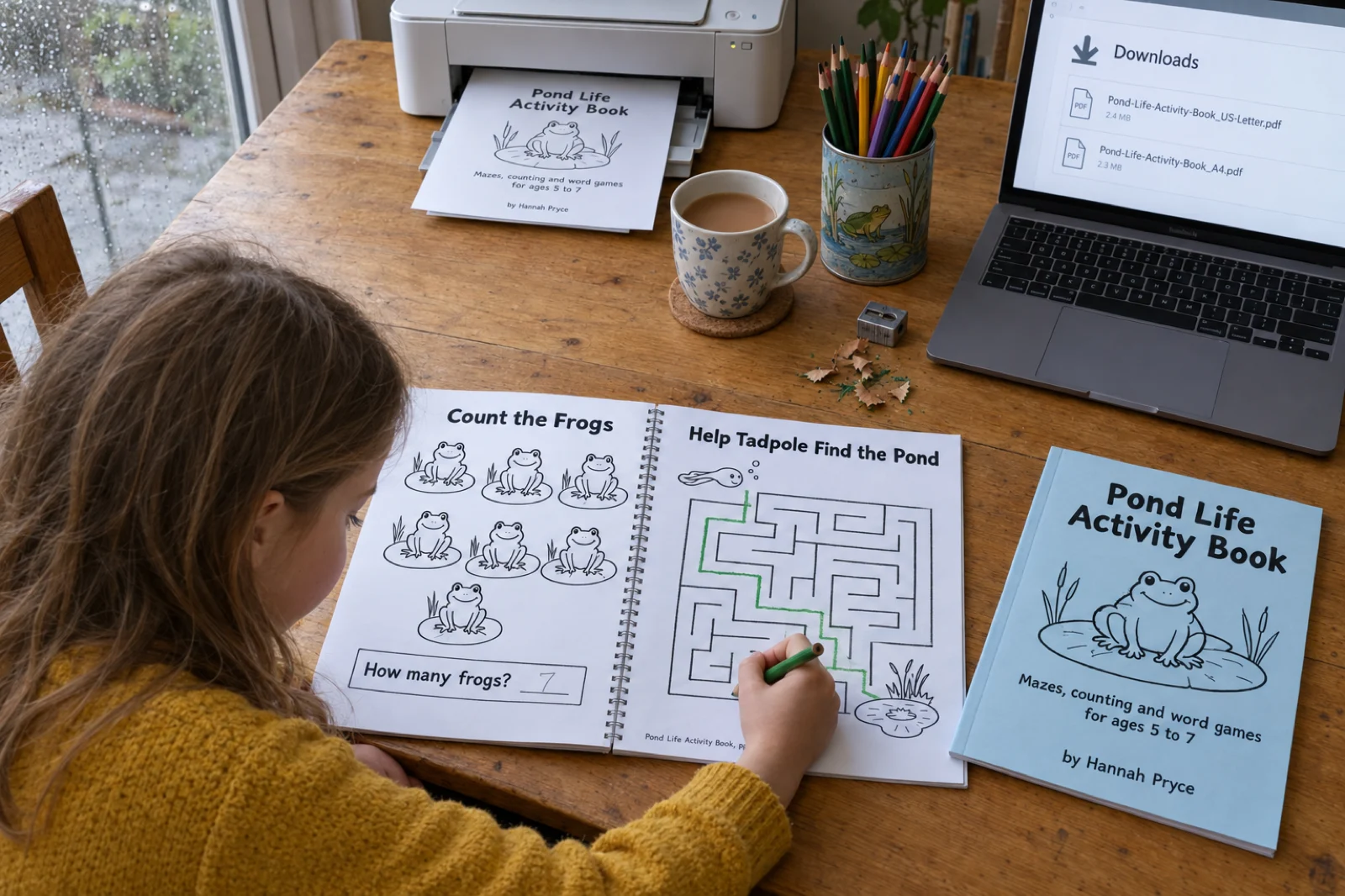
How do you sell a workbook or an activity book?
Sell it as a printable, a paperback, or both, and pick the store by who will find it. Export the workbook as a PDF in US Letter and A4 and list it as an instant download on Etsy, where people search by theme, age and skill; or sell it on Gumroad or your own site to people who already follow you. Publish a paperback on Amazon KDP for buyers who want to write in a bound copy, and skip Kindle, which KDP says does not suit books made to be written in. At $9.99, a printable keeps about $8.59 on a US Etsy shop and $7.90 through your own Gumroad link; a 100-page 8.5 x 11 inch paperback at the same price pays $3.15 a copy on Amazon.com after $2.84 of printing. How much a workbook makes in total depends on how many people find it, which no fee table can tell you.
Where it sells
Etsy for printables people search for. Amazon KDP for paperbacks to write in. Gumroad or your own site for workbooks sold to clients, students and followers.
What KDP decides
Planners and prompt journals are low-content; workbooks that teach, and activity books, usually are not. Fill-in books do not belong on Kindle.
What we cannot tell you
How many copies a workbook sells. We do not see our users' sales, and no store publishes typical ones. The worked examples here are examples.
Workbook format and price planner
Choose the kind of workbook, what it covers and who it is for, then set a printable price and a paperback size. The planner works out what one sale keeps on each store at your printable price, what Amazon charges to print the paperback and what a copy pays, the KDP settings that apply to this kind of book, the files an Etsy listing should carry, and a listing title and tags. It runs in your browser: nothing is sent anywhere until you press Write this workbook.
Printable PDF
| Where it sells | You keep | Sales to $100 |
|---|
Etsy: $0.20 renewal, 6.5% and 3% + $0.25 (US shop). Gumroad: 10% + $0.50 plus 2.9% + $0.30 card processing; Discover 30%. Own site: 2.9% + $0.30. Before tax and ads.
Paperback on Amazon.com
Each copy pays
-
KDP settings for this kind of book
Files for an Etsy listing (five at most, 20MB each)
Etsy listing title
Tags
Line for the description
Brief for the chapters
How the button works. Write this workbook opens your Inkfluence AI dashboard with the brief in the idea box. Press Create my book (writing needs a free account) and the chapters are written in the workbook format, because the brief is worded as a workbook, which is how the app recognises it. If it lands in a different format, or you want to see and edit the chapter plan before anything is written, choose New Book, then Choose a book type, then the Workbook / planner tile, and paste the brief there.
The printable figures are one sale at your price in US dollars, using each store's published rates on 24 September 2026. The paperback figures use Amazon.com's printing costs for white paper and its 50% or 60% royalty. Neither includes sales tax, currency conversion or advertising. The royalty calculator covers other Amazon stores, and the ebook income calculator projects a month of sales across several books.
What a workbook pays per sale
A printable keeps most of its price, and a paperback keeps what is left after Amazon's share and the printing. That is the one-line answer; the tables below give the exact figures. How much a workbook earns in total is the price times the copies sold, and the copies sold is the part nobody can give you. Inkfluence AI sees that a workbook was sent to Etsy or Gumroad from the app. Neither store tells us what sold, so we do not quote income.
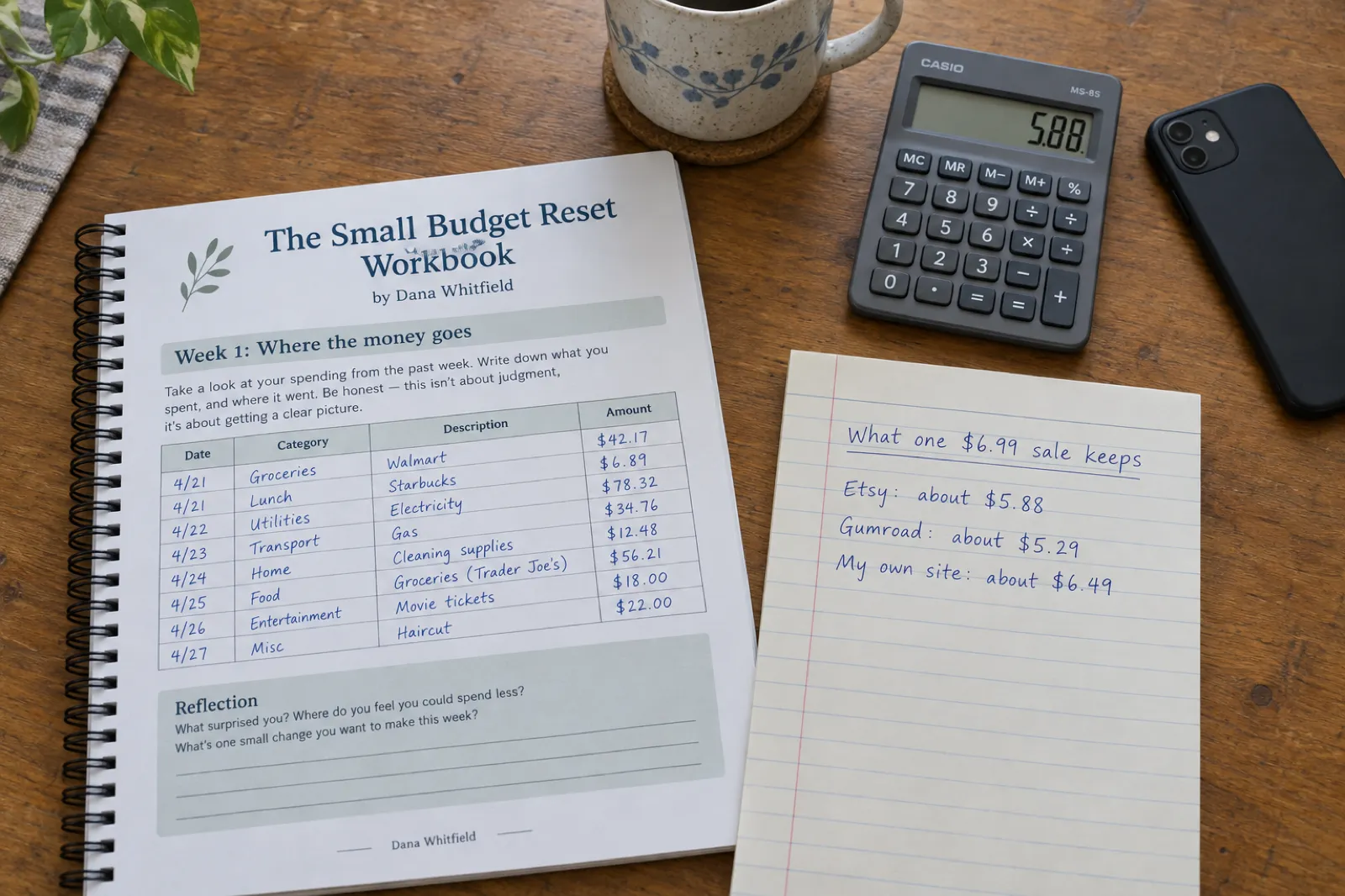
A printable: what you keep from one sale, by store
Take-home per sale in US dollars at three prices, with each store's fees as published on 24 September 2026, before sales tax and before anything you spend on ads.
| Where the sale happens | At $4.99 | At $9.99 | At $19.99 |
|---|---|---|---|
| Etsy, US shop (instant download) | $4.07 | $8.59 | $17.64 |
| Gumroad, your own link | $3.55 | $7.90 | $16.61 |
| Gumroad Discover | $3.49 | $6.99 | $13.99 |
| Your own site, card payment link | $4.55 | $9.40 | $19.11 |
How each row is worked out. Etsy: $0.20 to renew the listing after each sale, a 6.5% transaction fee, and payment processing of 3% + $0.25 for a US shop (Fees & Payments Policy, last updated 13 February 2026; Etsy Payments Policy, last updated 31 July 2026; a UK shop pays 4% + £0.20). Gumroad: 10% + $0.50 on sales through your own profile or links, plus card processing of 2.9% + $0.30, or a flat 30% including processing on sales from its Discover marketplace (Gumroad's fees, pricing page); once your paid sales pass $20,000 in a calendar month, new direct sales that month pay 5% + $0.50. Your own site: Stripe's standard card rate of 2.9% + $0.30 (Stripe pricing). All read on 24 September 2026. Fees change: check the store's page before you set a price.
Fixed fees weigh most on cheap printables. At $4.99, Gumroad's fees and card processing come to $1.44, 80 cents of it fixed whatever the price, and a Gumroad sale keeps $3.55 against $4.07 on Etsy. At $19.99 the two are close ($17.64 and $16.61). That is why small activity printables tend to live on Etsy and bigger course workbooks on Gumroad: the fee structure and the buyers point the same way.
A paperback: what one copy pays on Amazon.com
KDP pays 60% of the list price from $9.99 on Amazon.com and 50% at $9.98 and below, minus the printing cost (Paperback Royalty). Printing depends on the ink, the page count and the trim: anything wider than 6.12 inches or taller than 9 inches counts as a large trim, which covers the usual workbook sizes of 8.5 x 11 and 7 x 10 inches (Printing Cost). A black-ink large-trim book of 24 to 110 pages costs a flat $2.84 to print; above that, $1.00 plus $0.017 a page.
| 100-page workbook, 8.5 x 11 in, black ink, Amazon.com | Rate | Printing | Each copy pays |
|---|---|---|---|
| At $7.99 | 50% | $2.84 | $1.16 |
| At $9.99 | 60% | $2.84 | $3.15 |
| At $12.99 | 60% | $2.84 | $4.95 |
Two things stand out. The lowest price KDP will accept for this book is $5.68, the printing cost divided by the 50% rate, and a price just under $9.99 pays far less than one at $9.99: $1.16 at $7.99 against $3.15. And page count is free up to 110 pages in black ink, so a workbook with generous writing space costs no more to print than a thin one. KDP rounds an odd page count up to an even one and sets the minimum list price for you as you type.
Worked examples (examples, not forecasts)
Example A
A $4.99 activity printable, 25 sales in a month on Etsy
25 x $4.07 = $101.75 before tax. There is no printing cost, and the same file sells any number of times; the listing cost $0.20 to create.
Example B
A 160-page self-help workbook, 7 x 10 in, at $14.99
Printing is $1.00 + 160 x $0.017 = $3.72, so each copy pays 60% x $14.99 minus $3.72 = $5.27. Twelve copies a month is $63.24.
Example C
A 60-page activity book in premium colour, 8.5 x 11 in, at $12.99
Printing is $1.00 + 60 x $0.08 = $5.80, so a copy pays $1.99; the lowest price KDP accepts is $9.99. Colour is why most activity books print in black ink: the child adds the colour.
Example D
A course workbook to 300 students on Gumroad at $19.99
If one in ten buys, that is 30 sales x $16.61 = $498.30. At one in twenty, 15 sales and $249.15. The percentage is yours to test; it is not ours to promise.
One more example worth knowing: a 120-page planner at 6 x 9 inches, a regular trim, costs $1.00 + 120 x $0.012 = $2.44 to print and pays $4.75 at $11.99. Smaller trims print cheaper per page, which is one reason planners and journals so often come at 6 x 9. For every price from $0.99 up, our guide to KDP royalties in 2026 sets out the ebook and paperback rates.
What goes on the other side of the ledger
- Your time. Writing is the quick part. Doing every exercise yourself, writing the answer key, laying the pages out for handwriting and photographing a filled-in copy is most of a day for a short workbook.
- Proof copies. Order a paperback proof before you publish and write in it with the pens your buyers will use. A proof costs the printing price plus shipping.
- Listing fees and ads. Etsy charges $0.20 per listing and renews it every four months if automatic renewal is on. Etsy's Offsite Ads charge 15% of an order they bring for shops under $10,000 in yearly sales (you can opt out) and 12%, compulsory, from $10,000. Amazon and Etsy ads are optional and paid as you go.
- The tool. On Inkfluence AI the free plan writes up to five chapters a book and exports a PDF. For a workbook you charge for you will likely want Creator ($9.99 a month) or Premium ($19.99): they remove the footer credit and closing page, add the KDP package, EPUB and DOCX, and send books to Etsy and Gumroad from the Publish window.
- Tax. Gumroad collects and pays sales tax as the merchant of record, Etsy collects it where it is required to (including VAT on digital downloads in some countries), and Amazon handles its own sales. Your income is still yours to report.
Where to sell workbooks and printables
The best platform is the one where your buyer already is: Etsy for buyers who search, Amazon for buyers who want a printed book, Gumroad or your own site for buyers who already know you. The fee differences above matter less than whether anyone sees the workbook at all.
| Where | Who buys there | What they get | Suits | Watch for |
|---|---|---|---|---|
| Etsy | Parents, teachers and adults searching by theme, age or skill | An instant download, up to five files of 20MB | Activity books, worksheet packs, planners, printable workbooks | AI line in the description; items must be your own design |
| Amazon KDP paperback | Gift buyers, parents and adults who want a bound copy | A printed book, printed when ordered | Activity books, self-help and business workbooks, planners | 50% below $9.99; low-content box; 2 new titles a week |
| Kindle | Readers, not writers | A reflowing ebook | Only a read-and-do book whose exercises are done elsewhere | KDP rejects or removes books made to be written in |
| Gumroad | Your clients, students and followers, through your link | A download of the files you attach | Course, coaching and business workbooks | 80 cents a sale in fixed fees; little traffic of its own |
| Your own site | Your visitors, and nobody else | Whatever you send after payment | Coaches, teachers with a following, schools | You handle delivery, refunds and sales tax |
Gumroad: workbooks for people who already know you
Gumroad turns a link into a checkout and a download and handles the sales tax. It is where most workbooks made on Inkfluence AI are listed (see the data below), and it fits the buyer of a coaching or course workbook: someone who found you through your videos, newsletter or classes and wants the exercises that go with them. On Creator or Premium, the book's Publish window has a Sell on Gumroad tab: connect your account, use Auto-fill with AI for the description and summary, set the price (the box starts at $9.99; 0 makes it free) and publish. The app sends the EPUB and the cover. A fill-in workbook needs the PDF, so add your US Letter and A4 PDFs to the product on Gumroad afterwards. The Gumroad selling guide covers each screen.
Your own site and in person
A card payment link on your own site keeps the most per sale, $19.11 of $19.99, and brings no buyers of its own; you deliver the PDF, handle refunds and work out the sales tax or VAT on digital goods. It suits a coach who sends clients a workbook before the first session, or a school selling a revision pack to parents. A paperback also sells by hand: KDP sells you author copies at the printing cost plus shipping, so a 100-page 8.5 x 11 workbook costs you $2.84 a copy to hand out at a workshop or sell at a fair.
How to sell activity books on Etsy
Sell them as an instant digital download, with the PDF in two paper sizes, a title that names the activities and the age, and photos of real pages. Etsy's listing form asks what type of item it is: choose Digital files, and the buyer can download the files as soon as payment is confirmed. Etsy's help article How to Manage Your Digital Listings sets the limits: up to five files per listing, each up to 20MB, file names of up to 70 characters that the buyer sees exactly as you upload them, and no variations on digital items. That last rule matters for workbooks: a US Letter version and an A4 version go in the same listing as two files, not as options to choose from.
The same article says digital items "must be made and/or designed by you, the seller", and Etsy's Creativity Standards (last updated 10 June 2025) list "a PDF file of a book that the seller did not personally create or design" among the items that are not allowed. Resale-rights activity packs bought from someone else are the obvious casualty. A workbook you wrote, laid out and checked is fine, and so is one made with AI from your own prompts, under one condition: the Standards say "Sellers must disclose within their listing description if an item is created with the use of AI." Put a line in the description, and on the listing form choose the AI option under How it's made as well.
The five files
- The book as a US Letter PDF (8.5 x 11 inches), for buyers in North America.
- The book as an A4 PDF, for buyers almost everywhere else. Export it again with A4 chosen under Page Size & Content.
- An answer key, for anything with a right answer: counting, puzzles, maths, spelling. Parents and teachers look for it in the reviews.
- A one-page printing guide: print at 100% or Fit to page, which pages are single-sided, and how many copies the buyer may print (for their own family, or one class).
- Optional: a bonus sheet, such as a certificate of completion or a blank version of the favourite page.
Name the files so they read well in the buyer's downloads list: Pond-Life-Activity-Book_US-Letter.pdf rather than export(3).pdf. Etsy cannot rename a file after upload.
Title, tags and description
Etsy's listing guide allows titles of up to 140 characters and suggests fewer than 15 words, and its tags guide allows 13 tags of up to 20 characters each. For an activity book, the title carries the theme, the kind of book and the age ("Pond Life Activity Book for Ages 5 to 7, Printable PDF"); the tags carry the other ways a parent might search ("busy book", "quiet book", "homeschool", "preschool activity"). The description should open with what the child does on the pages, then list the contents, the page count, the two paper sizes, the answer key, how printing works, that nothing is shipped, and the AI line. The planner above drafts the title and tags.
Selling worksheets on Etsy
Worksheet packs follow the same rules with a different buyer: teachers and homeschooling parents who search by subject and grade. Put the grade or age, the subject and the number of worksheets in the title and the first photo ("Year 2 Fractions Worksheets, 24 Pages with Answer Key"). Say plainly whether the buyer may copy the pages for one class or one family; teachers look for that line. A worksheet pack that follows a curriculum should say which one, in your own words, without borrowing a publisher's name or logo for the title.
Printed copies on Etsy
Etsy also allows physical copies of a design you made and a partner printed, provided you disclose the production partner and where the item ships from (Creativity Standards). KDP author copies at the printing cost are the simplest stock: a signed activity book bundled with a set of pencils makes a gift listing rather than a book listing.
From Inkfluence AI to an Etsy draft
On Creator or Premium, the Publish window has a Sell on Etsy tab. Connect your shop once, use Auto-fill with AI to draft the description, tags and a suggested price, and publish: the listing arrives in your shop as a draft digital download with the EPUB and the cover. For a workbook, add the PDFs on Etsy (the EPUB is for e-readers, and nobody writes on an e-reader), add your photos and the rest of the tags, tick the AI option under How it's made, and activate the listing. On the free plan, export the PDF and create the listing on Etsy yourself. The Etsy selling guide covers opening a shop, and the selling walkthrough video shows the Publish window on screen.
Selling a workbook on Amazon KDP: a paperback, not a Kindle ebook
On Amazon a fill-in workbook is a paperback. KDP's Guide to Kindle Content Quality says some books "are simply not well suited to the Kindle format", including "any kind of book where the main purpose is to allow the reader to write or color on the pages", names puzzle books, blank journals, pattern books and coloring books, and warns they "may be rejected upon submission or removed from sale". The paperback is printed when someone orders it, so there is no stock to buy and nothing to post.
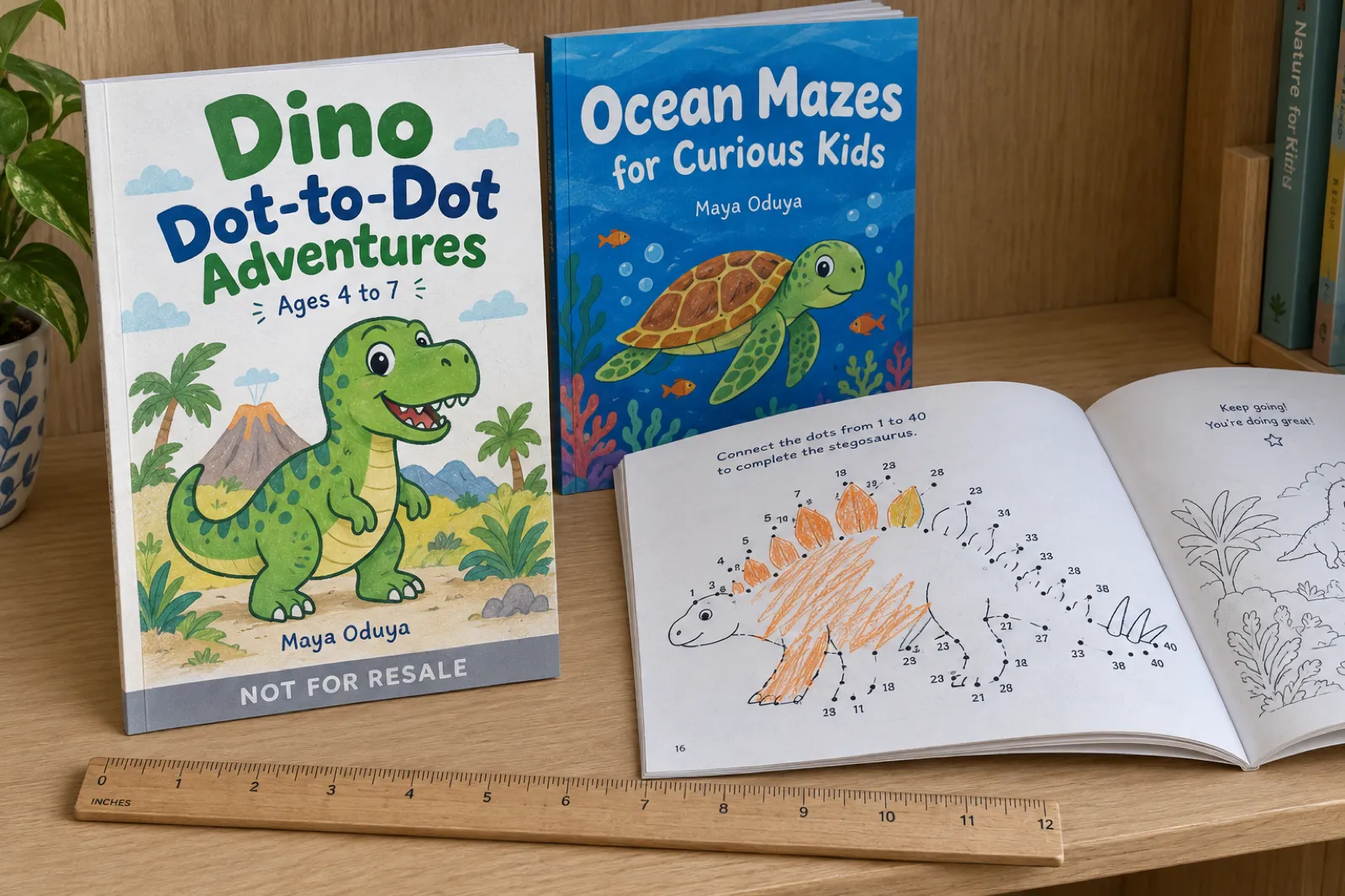
The same guide rules out one kind of workbook everywhere on Kindle: "Companion guides (including summaries, study guides, workbooks, analyses, and other related content based on other books) are not allowed, with limited exceptions for guides with positive reader engagement." KDP's Content Guidelines add that companion books based on copyrighted works may not be published outside the US without the copyright holder's written permission, and its Expanded Distribution distributors refuse paperbacks that summarise another published book without permission. A "workbook for" someone else's bestseller is the one workbook idea to drop before you start.
Is a workbook a low-content book on KDP?
A workbook that teaches is not; a planner or a prompt journal is. KDP's Low-Content Books page defines a low-content book as one with "minimal or no content on the interior pages", "generally repetitive, and designed to be filled in by the user", and says this "does not typically include activity books, such as puzzle books or coloring books". Its table puts notebooks, planners, diaries and journals, prompt journals, log books and coupon books in the low-content column, and novels, nonfiction, puzzle books, coloring books, manuals, textbooks and children's books in the column headed "Not Generally Low-Content". KDP adds that there can be exceptions. The word "workbook" does not appear in the table, so judge by the pages: explanation and exercises that differ from page to page read as nonfiction or a textbook; the same prompt and lines repeated for a year reads as a journal.
| On KDP | A workbook or activity book, published normally | A low-content book (planner, prompt journal, log book) |
|---|---|---|
| Low-content box under Categories | Leave it unticked | Tick it, or KDP says the book will be rejected |
| ISBN | Free KDP ISBN, or your own | Not eligible for the free ISBN: your own, or none |
| Look Inside sample | Available | Not without an ISBN; A+ Content images instead |
| Series page | Allowed | Not allowed |
| Release date (pre-order) | Available | Not offered |
| Expanded Distribution | Up to the distributors; books with frequent lined or blank pages are not accepted | Not supported |
The practical difference is the sample and the series. A buyer judging an activity book wants to see the pages before paying, and the free ISBN turns the Look Inside sample on; volumes of a workbook series (book 1, book 2) can sit on one series page. A low-content planner published without an ISBN gets neither, so its detail page has to show the inside with A+ Content images. The printing and royalty sums are the same either way.
The rest of the KDP set-up for a workbook
Create a paperback on your KDP bookshelf. Title and subtitle should name the outcome and the reader ("The First $5k Month: A Pricing Workbook for Freelancers"). The description should say what the reader does on the pages, the page count, the size and whether there is room to write. For a children's activity book, set a reading age: KDP's help says a children's book without one may not appear in age-specific search. On the content page choose black ink and white paper unless the pages truly need colour, the trim you exported, and No bleed if nothing runs to the edge; upload the interior and the full wrap cover, answer the AI questions, check every page in the Print Previewer, and order a proof. KDP limits title creation to 2 per book format each week (Create a Book), which is plenty for a careful series and nowhere near enough for flooding a category. The KDP paperback guide goes through each screen.
On Inkfluence AI the KDP package (a print-ready interior PDF and a full wrap cover sized to the page count) comes with a paid plan or a credit pack. Choose the trim under Page Size & Content before you export: US Letter for 8.5 x 11, Workbook for 7 x 10, or Trade for 6 x 9.
Workbook, journal, planner or activity book: which are you selling?
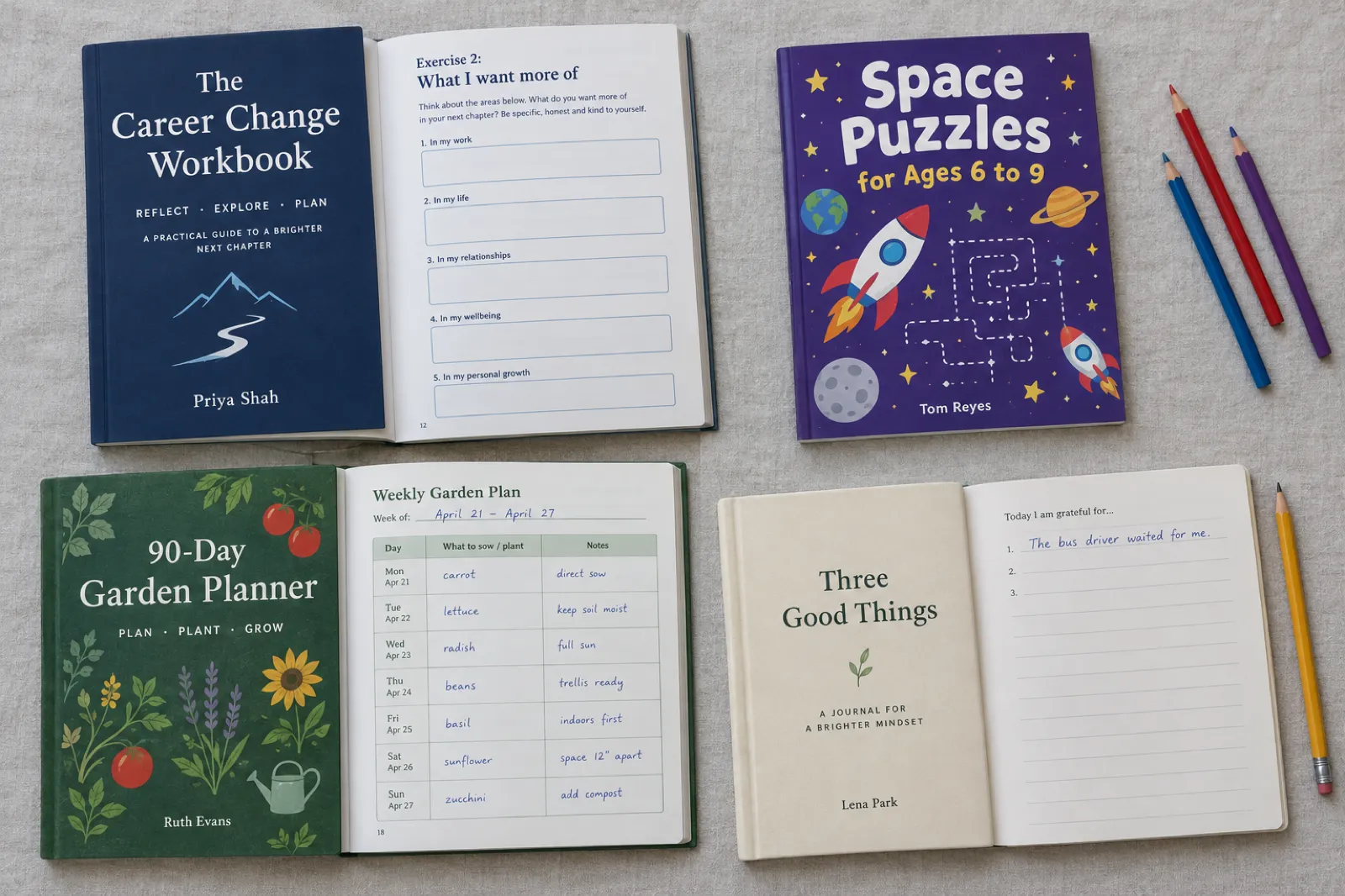
Work out which one you have first, because the store, the KDP settings and the price all follow from it. A workbook teaches and then makes the reader practise; a prompt journal asks and leaves space; a planner repeats a layout; an activity book gives a child something different to do on every page. The price bands below are starting points worked out from length and use, not market data: before you settle on one, look at what three comparable listings charge on the store you picked.
| Kind | Who buys it | On KDP | Kindle? | Printable | Paperback | Where to start |
|---|---|---|---|---|---|---|
| Children's activity book | Parents and grandparents after a quiet-time or travel book; teachers after a theme pack | Not generally low-content (activity books) | No | $2.99 to $6.99 | $6.99 to $9.99 | Etsy printable, and a KDP paperback |
| Classroom worksheet pack | Teachers and homeschool parents who print what they need this week | Rarely sold as a paperback | No | $3.99 to $9.99 | Usually printable only | Etsy, or your own site for other teachers |
| Guided self-help workbook | Adults working through one problem: anxiety, confidence, grief, habits | Not generally low-content if it teaches; a prompt journal is low-content | No, if the reader writes in it | $7.99 to $17.99 | $12.99 to $16.99 | Gumroad to your audience, Etsy, and a KDP paperback |
| Business, course or coaching workbook | Clients, course students and professionals who want to apply a method | Not generally low-content (nonfiction) | Only a read-and-do edition | $12.99 to $29.99 | $14.99 to $24.99 | Gumroad or your own site, bundled with the course |
| Planner or prompt journal | People who want a structure to fill in every day or week | Low-content: tick the box | No | $4.99 to $12.99 | $8.99 to $12.99 | Etsy printable, and a KDP paperback without a free ISBN |
The line between a guided workbook and a prompt journal is the one sellers most often get wrong. "Thirty days of gratitude" with the same three questions on every page is a prompt journal. "Thirty days of gratitude" where each day explains a different practice, gives an example and then asks the reader to try it is a workbook. If you make journals and planners too, the journal generator is built for them.
What kinds of workbooks and activity books sell?
The ones built for one buyer with one job to do. Nobody outside the stores can see sales, so be wary of any list of "best-selling printables" that quotes numbers without saying where they came from; what can be said is what makes a buyer pay for pages they could find free. Four things do most of the work.
- A named buyer and outcome. "Fractions practice for Year 3, with answers" and "A pricing workbook for freelancers" both tell the buyer in five words that it is for them. "A workbook" tells them nothing.
- Pages that differ. A child who has done the maze wants a different puzzle on the next page, and an adult wants the next exercise to build on the last. KDP's own quality guide rules out content "excessively reused, recycled, or repeated within or across books".
- Room to write, and answers that are right. Lines long enough for real handwriting, boxes big enough for a child's numbers, and an answer key that has been checked. A wrong answer in a maths worksheet turns into a review.
- A reason to buy the next one. Series sell each other: Pond Life, then Garden Birds, then Rock Pools, in the same layout; or a course workbook with a second volume for the advanced module.
Seasons help children's printables (back to school, holidays, summer holidays), and a problem the buyer has right now helps adult workbooks (a new job, a new baby, a diagnosis, a first client). For topic ideas with the demand evidence behind them, see our ebook ideas that sell; for the wider money question, making money selling AI ebooks and passive income from ebooks.
What people make and list: workbooks on Inkfluence AI
We counted every book made in the Workbook / planner format in the 90 days to 24 September 2026, leaving out our own accounts: 2,220 workbooks by 1,707 people. For each we checked who it is written for, from its title and brief, and whether it is listed for sale on Etsy or Gumroad through the app. We cannot see sales, so none of this says what sold.
2.6%
of workbooks are listed for sale through the app (57 of 2,220): 53 on Gumroad and 10 on Etsy, 6 of them on both.
Link to this stat46%
are written for children, students or classrooms (1,030 of 2,220). 14% are self-help and mental health, 13% business, careers and money, 3% health and fitness, 2% faith.
Link to this stat7.0% vs 1.4%
Business, career and money workbooks are listed five times as often as classroom ones: 20 of 285 against 14 of 1,030. Self-help sits between, at 4.3% (13 of 304).
Link to this statOur reading of these. Most workbooks are made to be used, not sold: nearly half are for children and classrooms, and those are the least often listed, which fits teachers and parents making a pack for their own class or child. The ones people sell are the adult workbooks, business and coaching first, and they go to Gumroad, where the seller brings the buyers. The overall listing rate is close to the rate for books of every kind, and Etsy's share of listed workbooks is in line with books in general, which leaves children's activity printables on Etsy, the route this page's top search is about, mostly untried by our users. Listings made directly on Etsy, Gumroad or Amazon without the app are invisible to us, so the real share selling somewhere is higher. How many workbooks get finished and exported is on the workbook walkthrough.
How it was counted. Workbooks are books in the Workbook / planner format created from 26 June to 24 September 2026 (counted on 24 September), excluding the team's own accounts. A book counts as listed while it is linked to an Etsy listing or a Gumroad product created through the app; unpublishing removes the link, and Etsy listings arrive as drafts, so a few may never have been switched on. Who a workbook is for comes from keyword groups over its title and brief, first match wins, in this order: children, students and classrooms; faith; business, careers and money; health, fitness and food; self-help and mental health. 21% fit no group, many of them written in Spanish or other languages the English keywords do not read. No title, brief, shop, product or account is published, and prices were not read. The counting script is kept with the site's other data scripts. The figures are published under a Creative Commons Attribution 4.0 licence: quote them with a link to this page.
How much should you charge for a workbook?
Charge for what the workbook helps the buyer do, checked against three comparable listings on the same store. A children's activity printable is an afternoon of quiet; a pricing workbook for freelancers might change what they earn for a year. Those are different prices even at the same page count.
Three rules of thumb hold across stores. On Gumroad, price above the fixed fees: 80 cents a sale is a quarter of a $2.99 printable and 4% of a $19.99 workbook. On KDP, respect the $9.99 line: a paperback at $9.98 pays 50% and one at $9.99 pays 60%, with the same printing cost, so the extra cent is worth $1.00 a copy on the 100-page example above. Do not price from the default: many sellers never move off the number already in the price box, which is how the typical Gumroad price across products published through the app ended up sitting exactly on the app's starting price.
Bundles change the maths. Etsy charges its listing fee per listing, not per file, so a pack of three workbooks in one listing pays one renewal; a course workbook sold with the course is priced as part of the course. For a paperback, a longer book costs more to print only above 110 pages in black ink, so a 100-page workbook and a 60-page one print for the same $2.84 at 8.5 x 11.
How to make and sell a workbook, step by step
The route from an idea to a listing. The making steps are short here; the workbook video walkthrough shows them on screen, and the workbook generator page covers the format in detail.
-
1. Pick the buyer and the outcome
Write one sentence: who uses it, and what they can do at the end. Then search the store you plan to use and note the three workbooks that come up first: their price, their page count, and what their reviews complain about. Complaints about too little writing space, wrong answers or repeated pages are your brief.
-
2. Decide printable, paperback or both, and price them
Use the planner to see what a printable keeps and what a paperback pays at your page count before a word is written. If the paperback only works above $9.99, write a book that is worth $9.99.
-
3. Start the book in the workbook format
From the dashboard choose New Book, then Choose a book type, then the Workbook / planner tile ("Exercises, prompts, and action items"). The next screen asks "What will readers work through?": type the outcome and what readers will be doing on the page, or paste the planner's brief. The tile recommends eight chapters; the free plan writes up to five a book. Chapters come out with short guidance, labelled prompts such as Your Turn, Reflect and Apply It, fill-in lines and checklists.
-
4. Edit the plan before it is written
On the plan screen, rename chapters so each is one skill or one step, put them in the order the reader will work, and delete anything that does not serve the outcome. Changing the plan costs nothing; only writing uses your allowance.
-
5. Do every exercise yourself
This is the step that decides your reviews. Work through the book as the buyer would. Check every fact and every answer, make sure each exercise can be done with what the chapter taught, and write an answer key. Add your own examples, the ones only you know; a coach's real client story or a teacher's tried classroom game is what separates a workbook worth paying for from a free download.
-
6. Lay it out for handwriting
Open the export preview and choose Workbook in the Book Style row: it turns bullet lists into checkboxes, numbers steps in badges and boxes the prompts. Under All tools, then Insert, a Table makes a fill-in grid and a Page break puts a worksheet on a page of its own. Give each answer space more room than looks necessary; handwriting is bigger than type.
-
7. Export the files each store needs
Export the PDF twice, once in US Letter and once in A4, for Etsy, Gumroad or your own site; the PDF exports on every plan. For a paperback, export the KDP package at the trim you chose (US Letter, Workbook 7 x 10 or Trade 6 x 9); it comes with a paid plan or a credit pack, as do EPUB and DOCX. A PDF from the free plan carries a small "Made with Inkfluence AI" footer and a closing page, which a paid plan or credit pack removes.
-
8. List it
On Etsy, list a digital download with the two PDFs and the answer key, put the AI line in the description and choose the AI option under How it's made. On KDP, create a paperback, tick Low-content only for a planner or a prompt journal, set a reading age for a children's book, and order a proof. On Gumroad, attach the PDFs. On Creator or Premium, Publish then Sell on Etsy or Sell on Gumroad drafts the listing for you; add the PDFs on the store afterwards.
-
9. Photograph a filled-in page, and keep improving it
Show the buyer the book in use (next section). When a buyer reports a mistake, fix it, export again and replace the file on each store; on KDP, upload the corrected interior to the same book so the reviews stay with it.
Listing photos for a workbook: show it being used
Show a page that someone has filled in. A buyer is trying to picture themselves or their child using the book, and a blank page does not do that; a page with real answers in real handwriting does. Four images do most of the work, in this order:
- The cover, with the topic and the reader large enough to read at thumbnail size.
- The contents, so the buyer sees the scope in two seconds.
- A filled-in page: the maze half traced, the table completed, the reflection answered.
- What you get: page count, the two paper sizes, the answer key, and "printable PDF, nothing shipped".
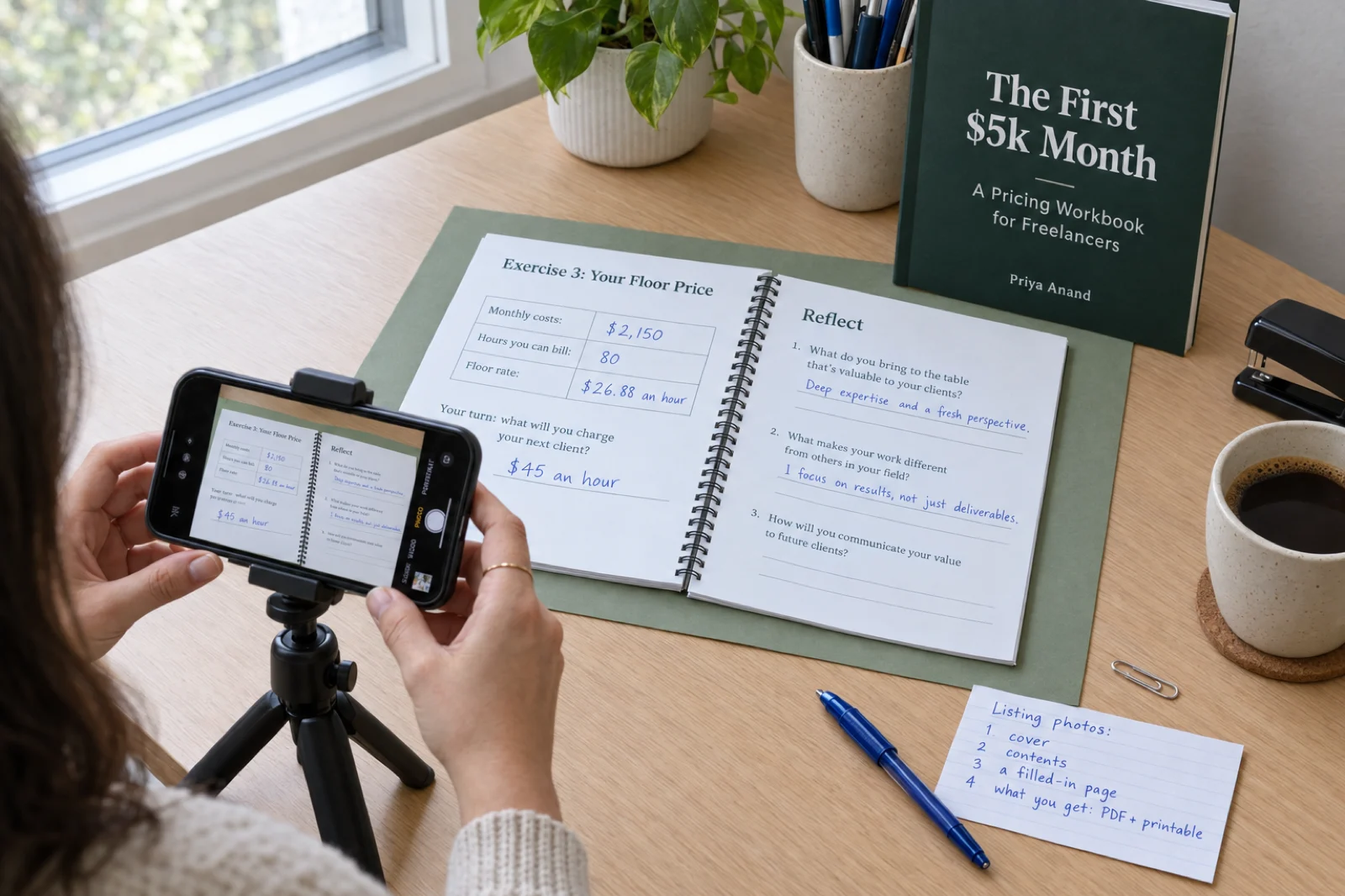
Print a proof at home or at a copy shop, fill in one page with a real pen, lay it on plain coloured card by a window and photograph it with your phone. For a children's book, a child's hand in the frame (with the parent's agreement) shows the scale better than any caption. Screenshots of PDF pages on a tablet frame work too, as long as they show real pages from the book.
On Etsy, the photos are what shoppers see and the files are delivered only after purchase, so a listing needs both. Publishing from Inkfluence AI sends the cover as the first image; the other three are yours to add.
Selling a workbook made with AI: what each store asks
Each store allows it with its own condition. Etsy: its Creativity Standards list seller-prompted AI creations as allowed and say "Sellers must disclose within their listing description if an item is created with the use of AI"; the listing form's How it's made section has an AI option too. Amazon KDP: its Content Guidelines ask you to declare AI-generated text, images or translations when you publish (interior artwork included) and not AI-assisted content, which it defines as content you created yourself and improved with AI tools; you remain responsible for the book meeting every guideline, including other people's rights. The KDP AI disclosure guide walks through the questions. Gumroad has no separate setting.
The rule that matters more for workbooks than any disclosure box is accuracy. A novel with a flat chapter still gets read; a worksheet with a wrong answer gets returned. Whether a book was drafted by you, by AI or both, do every exercise before you sell it. Whether you can sell AI-made books on each of ten platforms, with their written rules, is covered in can you sell AI-generated books.
Nine mistakes that cost workbook sellers money
- Publishing a fill-in workbook on Kindle. KDP says books made to be written in are not suited to it and may be removed. Sell the paperback and the PDF.
- A "workbook for" someone else's book. KDP does not allow companion workbooks based on other books on Kindle, and needs written permission for companion books outside the US.
- Ticking Low-content for a workbook that teaches. You lose the free ISBN, the Look Inside sample and the series page for nothing.
- Not ticking it for a planner. KDP says a low-content book published without the box ticked will be rejected.
- A paperback at $9.98. It pays 50% instead of 60% with the same printing bill.
- Only a US Letter PDF. Buyers outside North America print on A4; give them both in the same Etsy listing.
- Only the EPUB. Publishing from the app sends the EPUB and the cover; a workbook buyer needs the PDF, so add it on the store.
- Reselling someone else's pack. Etsy does not allow a PDF of a book you did not create or design, resale rights or not.
- A blank page in the photos. Show the book being used: a filled-in page sells the outcome.
Selling workbooks and activity books: FAQ
How do you sell a workbook?+
How do you sell activity books on Etsy?+
Is a workbook a low-content book on Amazon KDP?+
Can I sell a workbook on Kindle?+
Can I sell a workbook for someone else's book?+
How much should I charge for a workbook?+
Where is the best place to sell workbooks and printables?+
What is the difference between a workbook, a journal and a planner?+
Do I need an ISBN to sell a workbook on Amazon?+
Can I sell a workbook made with AI?+
Can I sell a workbook made on the free plan?+
What sells better, a printable or a printed workbook?+
Can I sell printable worksheets for classrooms?+
Related tools and guides
AI Workbook Generator
The workbook format itself: what goes in each chapter and the kinds of workbook it writes.
How to Create a Workbook (Video)
Making the workbook on screen, from one prompt to a finished draft.
How to Sell Coloring Books
The closest cousin: a KDP paperback and an Etsy printable of the same pages.
How to Sell Children's Books
Picture books and early readers: colour printing, what a copy pays, and a print and price planner.
How to Sell Travel Guides
Etsy, Gumroad and Kindle for a guide people search by place, with a listing builder.
How to Sell Romance Novels
A Kindle sale, a Kindle Unlimited read and a paperback, and what each one pays.
How to Sell Fitness Ebooks
Workout plans, meal plans and 30-day challenges: PDF, Kindle and paperback maths, and health-claim rules.
How to Sell a Devotional
Daily devotionals, prayer journals and Bible studies: per-sale maths and how many verses each translation allows.
Sell Ebooks on Etsy
Opening a shop, AI disclosure and the publish flow for any book.
Sell Ebooks on Gumroad
Connecting your account, the listing and the launch.
KDP Paperback Publishing
Every screen of a KDP paperback set-up, from trim to proof.
AI Lesson Plan Generator
For teachers building the lessons that sit around a worksheet pack.
KDP Royalty Calculator
Paperback and ebook royalties in every Amazon store and trim.
Make Money Selling AI Ebooks
The wider picture: stores, niches and what to expect.
One buyer, one outcome, every exercise tried, priced before it is written.
Plan the format and price above, or start from the Workbook / planner tile. The free plan writes up to five chapters a book and exports a PDF.