
How to Create a Sleep & Stress Reset Guide with AI (Watch One Become a Book in 3 Minutes)
A reset guide is one of the most useful books you can make with AI: a short plan a reader follows one day at a time, with one small change a day and a routine for the evening. In the video above James makes a ten-chapter sleep and stress reset guide from start to finish: the prompt, the plan, the chapters (written in about a minute and a half), a cover and the export, in under three minutes. This page follows the same steps and adds what the video has no time for: how to stretch it into a day-by-day 30-day reset, what each day should hold, how to keep a wellness book's claims honest, a brief builder, the sources worth citing, and the numbers from the 7,185 sleep and stress guides people have made on Inkfluence AI.
7,185
sleep and stress guides made on Inkfluence AI by 5,462 people, about one in sixteen of all books on the platform
981
of them are 30-day guides, the most common length named, ahead of 7-day (475) and 90-day (287)
59%
were exported to a finished file; 190 were listed on Gumroad or Etsy
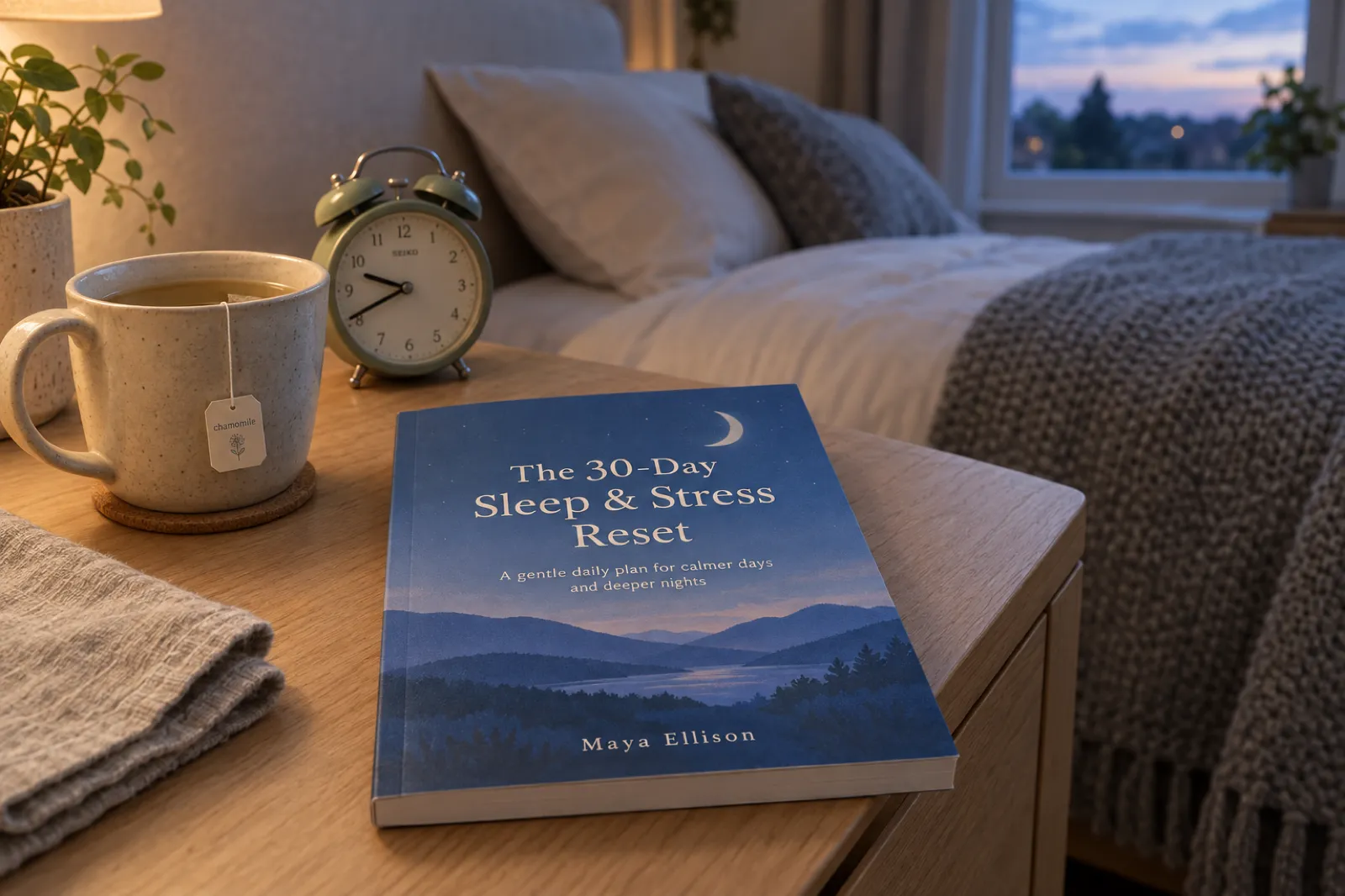
How do you make a sleep and stress reset guide with AI?
Decide who the guide is for and how many days it runs, then in Inkfluence AI start a new book, choose the Day challenge tile and describe it in one line, such as "a 30-day sleep and stress reset for busy working parents". Keep the recommended thirty chapters so each day gets its own, check the plan it writes, and click Write the book. Then read and edit the days, keep the health claims modest and sourced, add a cover, preview it, and export it as a PDF, EPUB, KDP package, DOCX or audiobook. The AI health book generator page covers longer wellness books read cover to cover.
What the video covers, in order
- Start from the prompt box on the homepage, or pick a book format
- Step two: the prompt, the chapter count (ten here) and Quality or Speed
- The plan: add, remove, rename and reorder chapters, then write the book
- The chapters written on screen, with a progress bar for the book and for each chapter: about a minute and a half in all
- Checking the content and editing it by hand or with AI
- The cover: a stock image from a search, or an AI cover in the Bold style from a short description
- Preview as a PDF or an EPUB, then export to PDF, KDP, EPUB, DOCX or an audiobook
Why a reset works better than a book about sleep
Most people with bad sleep or a stressful life already know the advice. They know screens keep them up and that caffeine after lunch does not help. What they lack is a reason to change one thing tonight, and then another thing tomorrow. A reset turns the advice into a sequence: day one is one small step, day two builds on it, and by the end of the week the reader has a routine rather than a list of good intentions. That is why the format is so popular. Of the 7,185 sleep and stress guides made on Inkfluence AI, 2,058 named a length in days in the title or the brief, and the 30-day reset was the most common single shape.
The format also suits AI well. A thirty-day book is thirty small, self-contained pieces with one shared structure, which is exactly the kind of writing a model does reliably: each day has a clear job, the pieces do not have to carry a plot, and the plan can say in advance what every day is for. The work that stays with you is the part the model cannot do: choosing the reader, deciding what the reader should be able to do by day thirty, and checking that nothing in the book promises more than a habit can deliver.
The public health guidance is a good backbone for that sequence. The CDC recommends at least seven hours of sleep a night for adults aged 18 to 60, and its latest survey found that 30.5% of US adults slept less than seven hours on average in 2024, with 15.4% having trouble falling asleep most days and 18.1% having trouble staying asleep. The NHS Every Mind Matters sleep advice reads almost like a reset already: a regular routine, no screens in the hour before bed, a list of tomorrow's worries written down before sleep, and getting up to do something calm if you are still awake after about twenty minutes. A good reset spreads habits like those across the month, one at a time, instead of asking a tired reader to adopt them all on day one.
Which tile: Day challenge, Health guide or Workbook?
Three formats on the New Book screen can make a sleep or stress book, and they make different books. The choice matters more than the wording of the brief.
| Tile | What it makes | Length on screen | Pick it when |
|---|---|---|---|
| Day challenge | A day-by-day programme; each chapter is titled Day 1, Day 2 and so on | 30 chapters recommended, 600 to 1,050 words a day | The reader follows it one day at a time |
| Health guide | A reference book on sleep or stress, read cover to cover | 1,650 to 1,800 words a chapter | The reader wants to understand the subject, not follow a plan |
| Workbook | Exercises, prompts and space to write | Shorter sections built around activities | The reader will print it and fill it in |
Day challenge is the right tile for a reset, which is what the tile itself says: "30-day resets, habit builders, programs". It puts the day in each chapter's title and turns plain chapter numbers off, so the contents read Day 1 to Day 30 rather than Chapter 1: Day 1. If you want the workbook feel as well, a daily checklist inside each day gives it without losing the day structure; the workbook guide covers a full workbook.
Write the brief: length, subject, reader
A reset brief needs three things in one line: how many days, what it resets, and who it is for. "A 30-day sleep and stress reset for busy working parents" gives the plan everything it needs. The reader is the part people leave out, and it is the part that changes the book most. Parents of young children cannot promise a fixed bedtime; night-shift workers sleep in the day; students have exams and shared rooms. A reset written for "everyone" gives advice some readers cannot follow on day two, and they stop.
Add a constraint if it matters. "Ten minutes a day", "no apps", "for readers who share a bedroom" and "without cutting out coffee completely" each change the days in a useful way. Add a tone if you care about it: a warm, encouraging voice suits a reader who is already tired, while plain and practical suits a reader who wants the steps and nothing else. The brief builder below puts all of this into one line.
Ten chapters, thirty days, or five on the free plan
The video makes a ten-chapter guide: James types the prompt, sets the chapter count to ten, picks Quality or Speed, and the whole guide is written in about a minute and a half. Ten chapters suit a reset in stages, where each chapter is a step the reader spends a few days on (a baseline, a wake-up time, a wind-down, caffeine, worry, and so on). It is the quickest way to a complete, useful book, and it is what the video shows.
The Day challenge tile recommends thirty chapters, one per day, and that is the right number for a thirty-day reset. The on-screen estimate is 600 to 1,050 words a day, which puts a full reset at roughly 18,000 to 31,500 words: long enough to be worth paying for, short enough that each day takes five to ten minutes to read. Paid plans allow up to forty chapters in the plan, so a reset can also carry an introduction and a closing day.
The free plan writes up to five chapters a book. That is not a thirty-day reset, but it is a good five-day starter: "a 5-day wind-down reset for people who can't switch off" is a complete, useful book, and it lets you see what the format writes before you commit to thirty. Across all the sleep and stress guides with a recorded length, the median is five chapters and 8,402 words, which says most people start with exactly that.
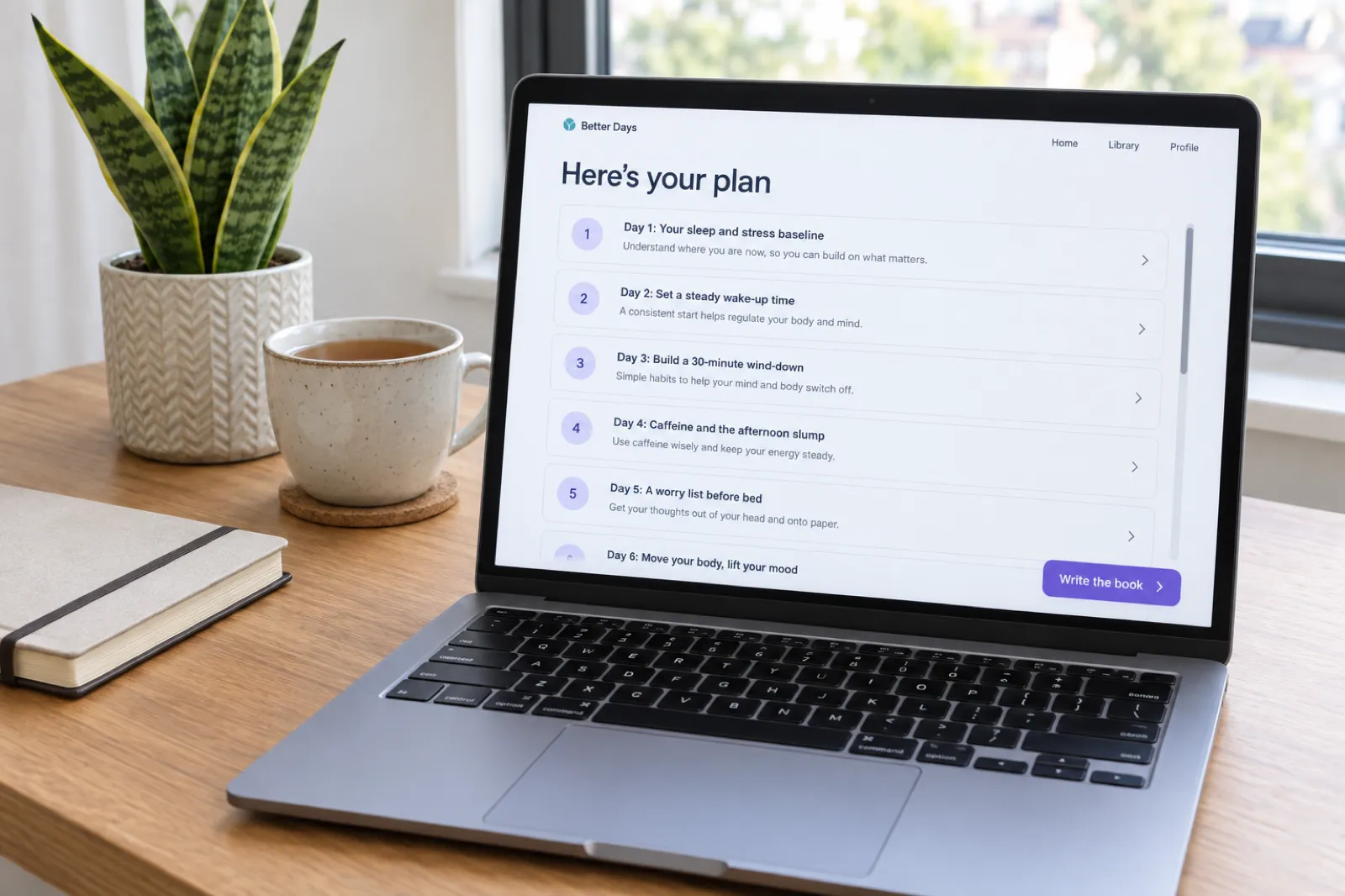
Check the plan before you write
After you generate, the plan shows every day with a title and a short summary. Read it as a whole before you click Write the book, because the order is the whole point of a reset. The first days should cost the reader almost nothing: noticing their current sleep and stress, setting one wake-up time. The harder changes, such as moving caffeine earlier or cutting late screens, belong in the middle, once the reader has a few small wins. The last week should consolidate rather than add: a routine to keep, a plan for a bad night, and what to do when the reset ends.
You can rename any day, rewrite its summary, drag it to a new position, remove it or add one. Two edits are almost always worth making. Put a short check-in every seventh day, where the reader rates the week and notices what changed; and make sure no two days teach the same habit under different names, which is the most common flaw in a first plan. Changing the plan costs nothing; only writing does.
What each day should hold
The best resets use the same five-part layout every day, so the reader always knows where to look, while the content changes. If a day in your first draft is missing one of these, it is the first thing to edit.
- One focus. The day's title says it: "Day 12: A worry list before bed". One idea, not three.
- Why it can help. Two or three sentences in plain language, with modest wording: "can make it easier", not "will fix".
- One action for today. Something small enough to do tonight, described precisely: when, for how long, what exactly.
- Tonight's checklist. Three or four boxes the reader can tick, repeating the habits already built so they stack.
- A line to reflect or rate. "Rate today's stress from 1 to 5" or "What helped today?" This is what makes day seven's check-in possible.
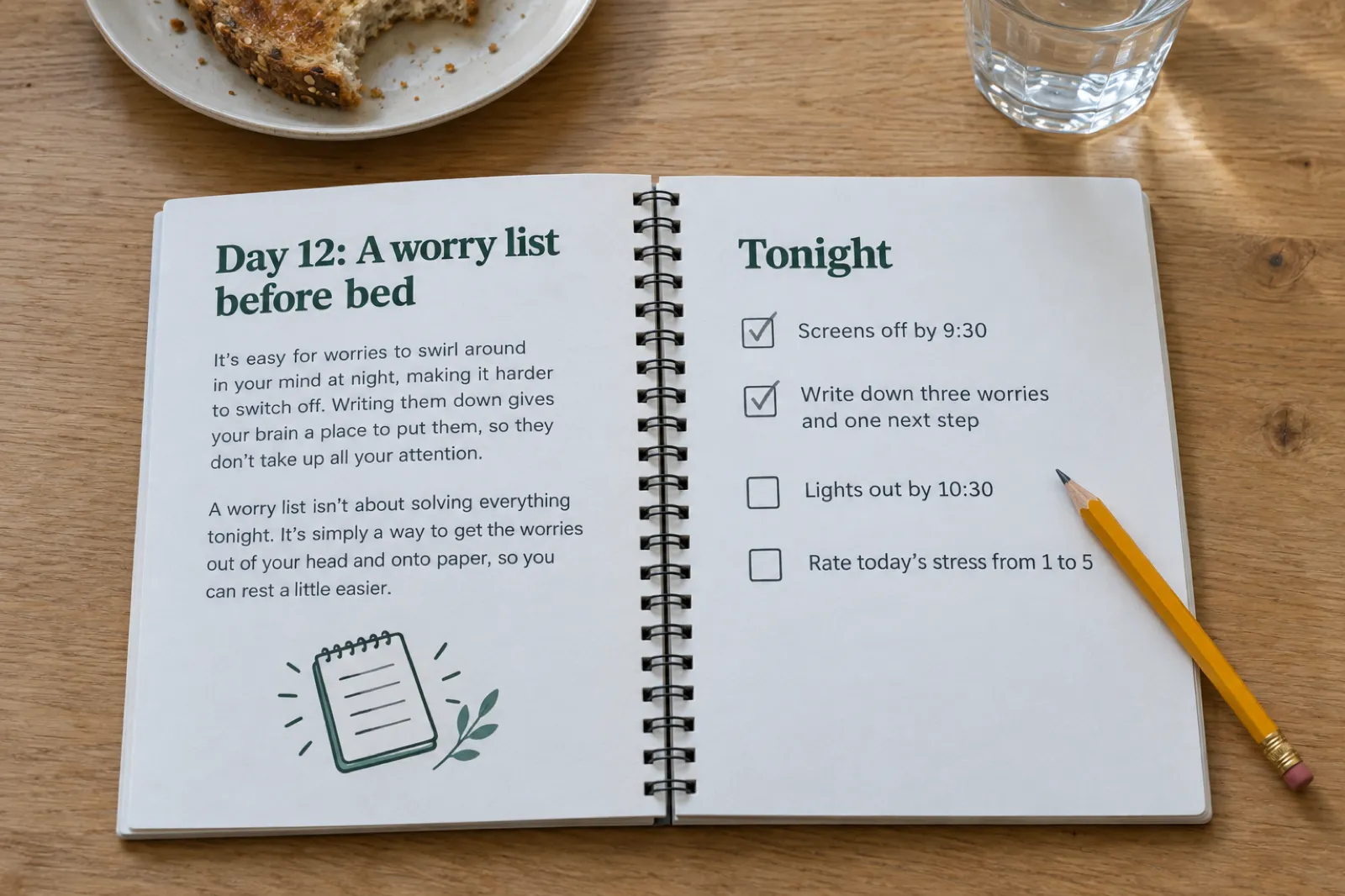
If the first draft reads like thirty short essays, ask the AI assistant to rewrite a day in this layout and then use that day as the model for the rest. Readers skim a reset in the evening, when they are tired; a checklist they can see at a glance beats three paragraphs they have to read.
Keep the claims honest
A sleep or stress guide sits close to health advice, and that changes what a responsible book says. Three rules keep a reset useful and safe.
- Say what a habit may help with, never what it cures. "A regular wake-up time can make it easier to fall asleep" is fair; "this reset cures insomnia" is not. In the US the FTC's health products guidance expects health claims to be backed by competent and reliable scientific evidence, and says customer testimonials are never enough on their own; that is worth keeping in mind for the book's sales page too.
- Point to a professional where it matters. A reset is not treatment. For chronic insomnia the American College of Physicians recommends cognitive behavioural therapy for insomnia (CBT-I) as the first treatment, and that is delivered by clinicians or clinician-designed programmes. Say so, and tell readers to see a doctor about persistent sleeplessness, anxiety or low mood, loud snoring or pauses in breathing, or anything that worries them.
- Check every factual claim. AI writes fluent, confident sentences, including the occasional wrong number. Check each figure, recommendation and named technique against a primary source (the CDC, the NHS, the WHO, a clinical guideline) and cite the source in the book. If you cannot find a source for a claim, cut it.
Put a short note at the front of every copy: the book is for general wellbeing, it is not medical advice, and when to see a doctor. The WHO's own stress guide, Doing What Matters in Times of Stress, is a good model for tone: five short sections, a few minutes of practice a day, and plain language throughout.
Edit, cover, preview, export
Read every day once, start to finish, the way a reader will. Use the AI assistant to shorten days that run long, to make the action for the day more specific, or to rewrite a day in the five-part layout above; regenerate a day that missed the point entirely. A reset in particular benefits from a pass for repetition, because thirty days written in parallel sometimes restate the same tip.
For the cover, calm colours and a big, clear title read best at thumbnail size, which is how most buyers first see a book. In the video James searches the stock images for a photo cover, then switches to an AI cover in the Bold style from a one-line description. You can also upload your own image, or generate an AI cover from a short prompt (a moon over hills, a bedroom at dusk, a cup of tea on a windowsill) on a paid plan or with credits; the cover design guide covers type and thumbnails. Then preview the book and export it: PDF on every plan, and EPUB for Kindle and e-readers, a KDP package for a paperback, DOCX for Word, or an audiobook on the paid plans or with credits. Which format goes where is its own short guide.
The audiobook is worth a thought for this subject in particular. A reader following an evening routine may prefer to listen with the lights low rather than read a screen; Creator includes 15 narrated chapters a month and Premium 30, so a thirty-day reset fits in one month on Premium. The audiobook guide has the details.
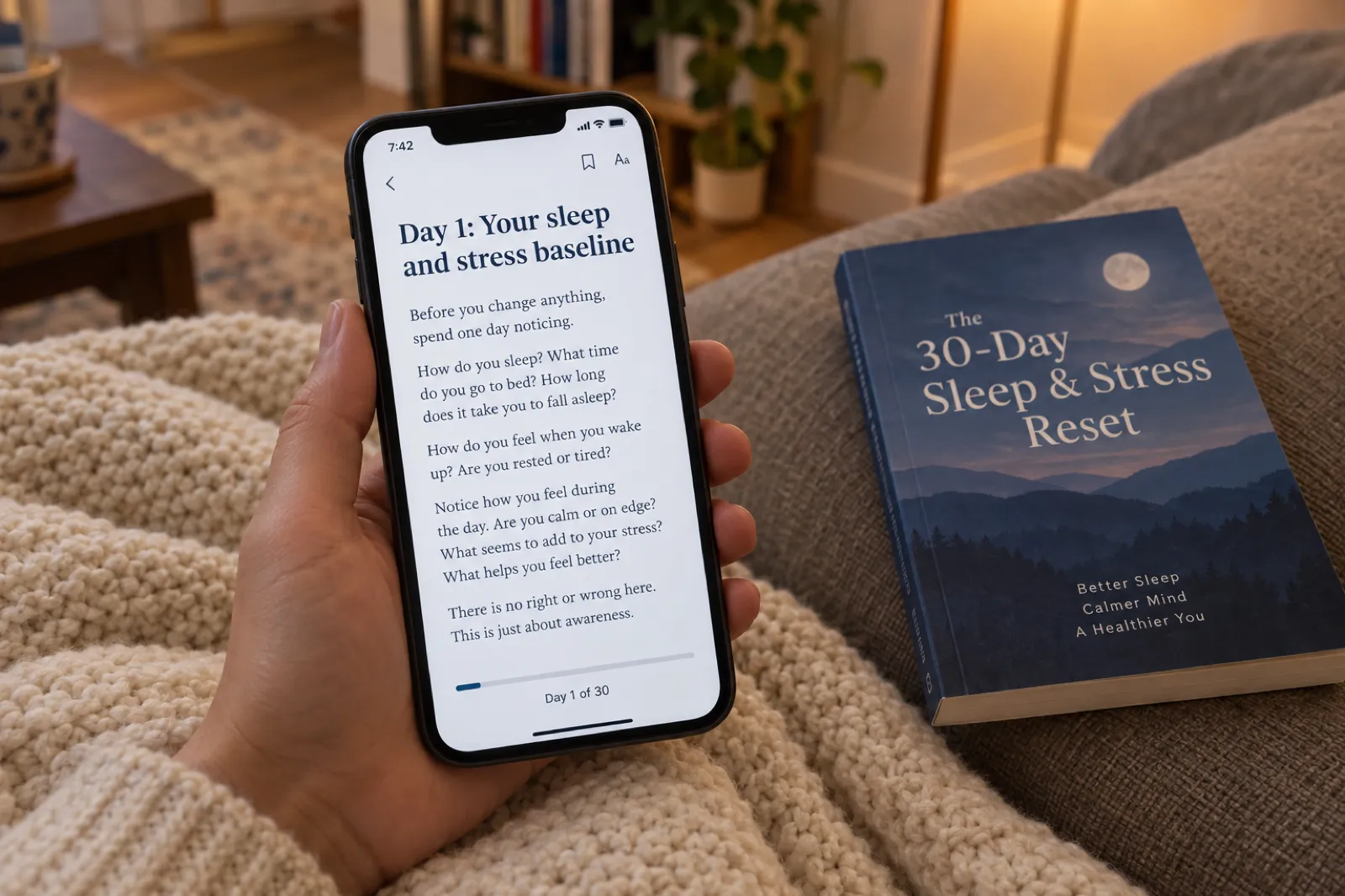
Where a sleep and stress guide can go
Most of these books end up in one of four places. Etsy and Gumroad sell them as a digital download; publishing straight from the book, once your shop is connected, uploads the PDF and the cover by default, or the EPUB, or both (the selling walkthrough video shows it on screen). Amazon takes the EPUB for Kindle and the KDP package for a paperback, which you upload to KDP. Coaches, therapists and wellness practitioners give a short 7-day version away in exchange for an email address and sell or include the full reset in a programme; the pages for therapists, life coaches and nutritionists cover that route. And some people make one for themselves or for someone they care about, which is a perfectly good reason on its own.
If you sell it, the store listing needs the same care as the book: no promises of cures on the product page, a clear description of what the reader does each day, and the not-medical-advice note repeated where buyers will see it. The guide to selling workbooks covers listings, pricing and bundles for this kind of practical book.
Build a reset brief
Pick a length, a focus, a reader and a tone. The builder writes the one-line brief to paste into the Day challenge tile and sketches how the weeks could run, so you can check the plan the app writes against it.
Your brief
A 30-day sleep and stress reset for busy working parents, warm and encouraging, about ten minutes a day, with a short check-in every seventh day.
How the weeks could run
What 7,185 sleep and stress guides say about how people make them
These figures come from the sleep and stress guides people have actually made on Inkfluence AI up to 30 September 2026, the day this video went up, read from the books themselves. Nothing about any single book or person is published, only counts.
sleep and stress guides made by 5,462 people
7,185 non-fiction books about sleep or stress had been made on Inkfluence AI by 30 September 2026, by 5,462 people: about one in sixteen of the 113,968 books on the platform. The pace has held at roughly 900 to 1,400 a month since April 2026, with September the busiest month so far at 1,401.
Sample: every non-fiction book on the platform whose title or brief is about sleep or stress, 7,185 books. Counted 30 September 2026.
30-day guides, the most common length named in days
Of the 2,058 sleep and stress guides that named a length in days, 981 were 30-day, 475 were 7-day, 287 were 90-day, 122 were 21-day and 92 were 14-day. The 30-day reset is the single most common shape.
Sample: 2,058 guides that named a day count in the title or brief. Counted 30 September 2026.
exported to a finished file
4,260 of the 7,185 sleep and stress guides, 59.3%, were exported to a finished file at least once. 377 had an AI cover, 190 were listed on Gumroad or Etsy and 64 were turned into an audiobook.
Sample: all 7,185 guides. Counted 30 September 2026.
- 7,185 guides by 5,462 people. About one book in sixteen on the whole platform is about sleep or stress. Most people made one, which fits the subject: people make the reset they need, or the one their clients need.
- Stress is the bigger subject. 4,741 were about stress, anxiety, burnout or calm alone, 1,017 about sleep alone, and 1,427 about both together, the way the video's reset is.
- Day formats are common. 2,058 named a length in days. 30-day was the most common (981), then 7-day (475), 90-day (287), 21-day (122) and 14-day (92).
- Not every one is a day challenge. By format, practical guides (1,738) and personal development books (1,690) came first, then workbooks (812), health guides (702) and day challenges (472). A reset can be written in any of them; the Day challenge format is the one built for it.
- Short books, finished. Of the 1,508 with a recorded length, the median is 5 chapters and 8,402 words, about 1,515 words a chapter.
- They get finished and used. 4,260 of the 7,185, 59.3%, were exported to a finished file at least once. 377 had an AI cover, 190 were listed on Gumroad or Etsy, and 64 were turned into an audiobook.
- One in eight is not in English. 926 were written in 48 other languages, most often Portuguese (169), Spanish (160), German (149), French (131) and Italian (81).
- The subject is growing. From about 300 in March 2026 to roughly 900 to 1,400 a month since April, with September the busiest month so far (1,401).
How it was counted. Every non-fiction book on Inkfluence AI whose title is about sleep or stress, or, where the title said nothing on either, whose brief is, counted once whether or not it was finished. Sleep words include sleep, insomnia, bedtime and wind-down; stress words include stress, anxiety, burnout, overwhelm, calm and relaxation; both in English and in Spanish, Portuguese, French, German, Italian and Indonesian, matched as whole words. Fiction, poetry and picture books are left out. The length in days is read from the title or brief; chapters and words come from books with a recorded length; export means a file was downloaded at least once. Counted 30 September 2026. No title, brief or account is published.
The wider picture across every kind of book is on the AI book writing statistics page.
Six reset briefs, and what each one plans
Length, subject, reader and one angle, in one line each. Every one of these maps to a plan with a clear job for each chapter.
- "A 30-day sleep and stress reset for busy working parents, about ten minutes a day." The classic 30-day shape with a reader. A first week that asks almost nothing (a baseline, one wake-up time), evenings built around whatever time the children go down, and stress tools short enough for a school run.
- "A 7-day wind-down reset for people who can't switch off at night." The lead magnet. One evening habit a day, from a worry list to a thirty-minute wind-down, ending with a plan to keep going and an invitation to the full thirty days.
- "A 21-day sleep reset for night-shift nurses, for sleeping in the day." The reader rewrites the advice: blackout, earplugs, a fixed sleep window after shifts, and what to do on days off without wrecking the next shift.
- "A 14-day exam-season stress and sleep reset for university students in shared housing." Short, practical and noisy: sleep with housemates, caffeine and all-nighters, two-minute breathing breaks between revision blocks.
- "A 30-day calm reset for teachers, one small practice a day, for term time." Stress first, sleep second, built around the school week: Sunday evening dread, marking, and a Friday routine that actually ends the week.
- "A 90-day sleep and stress programme for a coach's clients, with a weekly check-in and a worksheet." The long version: thirteen weeks, a check-in chapter every seventh day, and a worksheet at the end of each week for the coaching session.
What does not work is a brief with no reader and no length. "A book about stress" gives the plan nothing to decide with; it will cover everything once and nothing in order, which is the opposite of a reset.
What the evidence says, and what to cite in your guide
These are the sources we would build a sleep and stress reset on. Each is primary: the body that publishes the guidance or the data, not a summary of it.
How many people fall short
In 2024, 30.5% of US adults slept less than seven hours on average; 15.4% had trouble falling asleep and 18.1% trouble staying asleep most days.
CDC NCHS Data Brief No. 559, April 2026Everyday habits that help
A regular routine, no screens in the hour before bed, a list of tomorrow's worries, and getting up after about twenty minutes awake.
NHS Every Mind Matters, sleepWhen it is more than habits
For chronic insomnia, cognitive behavioural therapy for insomnia (CBT-I) is the recommended first treatment for adults.
American College of Physicians guideline, Annals of Internal MedicineA model for a stress guide
Five short sections, each a technique practised for a few minutes a day, in plain language.
WHO, Doing What Matters in Times of StressWhat you can claim when you sell it
Health claims need competent and reliable scientific evidence; customer testimonials are never enough on their own.
FTC, Health Products Compliance GuidanceNot medical advice. This page explains how to make a wellbeing guide with AI. It is not medical advice, and neither is a reset guide. Anyone with persistent sleep problems, anxiety, low mood or symptoms that worry them should talk to a doctor or another qualified professional.
Five mistakes particular to reset guides
- Everything on day one. A first day that asks the reader to change their bedtime, cut caffeine and stop scrolling loses them by day three. Start with noticing, then add one change at a time.
- Thirty essays instead of thirty days. A tired reader in the evening wants the action and the checklist, not three paragraphs of background. Keep the layout the same every day.
- The same tip twice. Days written in parallel sometimes teach one habit under two names. Read the plan for repeats before writing, and the book for repeats after.
- Promises instead of possibilities. "Cure your insomnia in 30 days" is a claim you cannot support and a platform may not accept. "Thirty small steps towards calmer evenings" is honest and sells.
- No way back after a bad night. Everyone has one. A day that says what to do after a bad night, and that one night does not undo the reset, keeps readers going.
This video, or the other guides?
Full video transcript
This is how you can create a sleep and stress reset guide on Inkfluence AI that you can export to PDF, KDP, EPUB or DOCX. First, open Inkfluence AI and either add your prompt in the text box on the homepage or select book format. Then on step two, add in your prompt, select the chapter count, and choose between quality or speed for your generation mode. Inkfluence AI will then take care of the rest and start to create your book in front of you. As you can see, we've gone for a 10 chapter book. So, Inkfluence AI is beginning to piece together each chapter. When ready, you can then add and remove chapters, rename chapters, and move chapters up or down as you please. When ready, click write my book and Inkfluence AI will start to create each chapter right in front of you. As you can see, it's writing chapter one. The outline is locked. The prompt's ready. So, it's beginning to create that first chapter. You can see the progress bar at the top as well as the progress bar on each chapter. And when it's ready, they will go green with a tick and saying it's done. And just like that, in a minute and a half, Inkfluence AI has created my sleep and stress reset guide.
I can go through the content and make sure it matches what I'm picturing for this book. And I can amend the content myself or using AI. I can then amend the cover by choosing from over 400 stock images like so. All I need to do is type in the search box what I want to see on my cover, click search, and a relevant photo cover will pop up. Or if I want to add a custom cover, I can go to AI and click generate a cover using AI. For this, I'm going to go for the bold format, and I just need to describe the look and click generate cover. And Inkfluence AI will create an AI book cover for me in a matter of seconds. As you can see, Inky is starting to create my book cover for me. And when ready, I can review it before saving it to my book before I export it.
I can then preview my book and choose what format I want to view it in. So there was PDF and now I can view it as an EPUB, ebook. You can then review each page and export to PDF, KDP, EPUB, DOCX or create an audio book from your book.
Sleep and stress guide FAQ
How do you make a sleep and stress guide with AI?+
Decide who the guide is for and how long it runs, then in Inkfluence AI start a new book, choose the Day challenge tile and describe it in one line, for example "a 30-day sleep and stress reset for busy working parents". Keep the recommended thirty chapters so each day gets its own, check the plan it writes, and click Write the book. Then edit the days, add a cover, preview it and export it as a PDF, EPUB, KDP package, DOCX or audiobook. In the video above James makes a shorter ten-chapter guide the same way, and the chapters are written in about a minute and a half.
How long should a 30-day reset guide be?+
Thirty short days, not thirty essays. The Day challenge format estimates 600 to 1,050 words a day on screen, so a thirty-day guide lands at roughly 18,000 to 31,500 words. A reader should be able to finish a day in five to ten minutes, so each day carries one idea and one action. If a day needs more than that, it is two days.
Should a sleep guide be 7, 21 or 30 days?+
Thirty is the most common: of the 2,058 sleep and stress guides on Inkfluence AI that named a length in days, 981 were 30-day, 475 were 7-day and 287 were 90-day. A 7-day reset suits a lead magnet or a first taste; 21 to 30 days gives each habit a week to settle; 90 days suits a programme a coach runs with clients. Pick the length your reader will actually finish.
Can I make one on the free plan?+
You can make a short one. The free plan writes up to five chapters a book, which is a five-day starter reset, and exports PDF. A full thirty-day guide needs a paid plan, which allows up to 40 chapters in the plan. AI covers, EPUB, DOCX, the KDP package and audiobooks come with paid plans or credits.
Is it safe to write about sleep and stress with AI?+
It is fine for general wellbeing habits if you keep the claims modest and the checking thorough. Say what a habit may help with, not what it cures; point readers to a doctor for persistent insomnia, anxiety, low mood or anything that affects breathing at night; and check every factual claim against a primary source such as the CDC, the NHS or the WHO. The guide is a routine and a reminder, not a treatment.
What should each day of a sleep and stress reset include?+
Five parts work well: one focus for the day, a short explanation of why it can help, one small action to do today, a checklist for tonight, and a line to reflect on or rate. Keep the same layout every day so the reader knows where to look, and let the content change. Weekly check-ins every seventh day give the reader a moment to notice progress.
Which tile should I choose: Day challenge, Health guide or Workbook?+
Day challenge for anything a reader follows day by day, one chapter per day. The video makes a ten-chapter guide instead, which suits a reset in stages. Health guide for a reference book on sleep or stress read cover to cover, with longer chapters of 1,650 to 1,800 words. Workbook when the book is mostly exercises and space to write. You can make a reset first and a longer guide on the same subject later.
Can I sell a sleep and stress guide?+
Yes. Etsy and Gumroad sell it as a digital download, and publishing straight from the book in Inkfluence AI, once your shop is connected, uploads the PDF and the cover (or the EPUB, or both). Amazon takes the EPUB for Kindle and the KDP package for a paperback. Coaches and therapists often give a short 7-day version away in exchange for an email address and sell the full reset. Of the sleep and stress guides made so far, 190 were listed on Gumroad or Etsy.
Can I turn the guide into an audiobook?+
Yes, from the export dialog in the same project, on a paid plan: Creator includes 15 narrated chapters a month and Premium 30. A bedtime reset suits audio well, since a reader can listen to the evening routine with the lights down. Turn any table into sentences first, because a narrator reads tables cell by cell.
Can I write the guide in another language?+
Yes. Type the brief in the language you want the guide written in. Of the 7,185 sleep and stress guides on Inkfluence AI, 926 were written in languages other than English, across 48 languages, most often Portuguese, Spanish, German and French.
How many people make sleep and stress guides?+
A lot. By 30 September 2026, 5,462 people had made 7,185 non-fiction books about sleep or stress on Inkfluence AI, about one in sixteen of all books on the platform. Stress, anxiety and calm are the larger subject (4,741 books), sleep alone is 1,017, and 1,427 cover both, the way the video does.
Do I need to be a doctor or therapist to publish one?+
Not to publish general wellbeing habits, but you do need to stay inside what you can stand behind. If you are not a clinician, do not diagnose, do not suggest medication, and do not promise outcomes. If you are a clinician, say so in the book and keep the guide consistent with what you would tell a patient. Either way, a short note at the front saying the book is not medical advice, and when to see a doctor, belongs in every copy.
Related tools
Related reading
- How to create a workbook: the exercise-first sister format.
- How to write a health or wellness ebook you can sell: claim wording, the disclaimer and the store rules.
- How to write a non-fiction book with AI: the full non-fiction walkthrough.
- How to create a lead magnet with AI: the 7-day reset as a free download.
- How to sell workbooks: listings, pricing and bundles for practical books.
- How to sell fitness ebooks: the neighbouring wellness market.
- Ebook export and publishing: every format explained.
A reader, a length, one change a day. Then generate.
Pick the Day challenge tile, name who it is for and how many days, and check the plan before anything is written. Five days are free; thirty days come with a paid plan.