
How to Make an Audiobook
with AI in 2026
Convert any manuscript into a natural-sounding audiobook. No recording studio, no voice actors, no audio editing. AI handles everything.
From written book to finished audiobook in under an hour.
Quick Answer
Making an audiobook with AI means converting your written manuscript into spoken audio using text-to-speech technology. You upload or write your book, choose a voice, and the AI generates natural-sounding narration chapter by chapter. Inkfluence AI includes built-in audiobook generation on Premium plans - write the book, generate audio, and distribute. No recording studio, voice actors, or audio editing software needed. The entire process takes under an hour for a full-length book. Supports 30+ languages with multiple voice options per language.
The Audiobook Market in 2026
Audiobooks are the fastest-growing format in publishing. AI has made production accessible to every author.
$9.3B
global audiobook market revenue (2026)
25%
year-over-year growth rate
< 1 hr
AI generation time for a full audiobook
95%
cost savings vs hiring a human narrator
Why audiobooks matter for self-published authors
Audiobook listeners consume content differently from readers. They listen during commutes, workouts, and chores - times when reading is not possible. By offering an audiobook alongside your ebook, you reach an entirely new audience. Before AI, audiobook production required $2,000-$5,000 for a professional narrator, weeks of studio time, and audio engineering. AI text-to-speech eliminates all three barriers. Every self-published author can now offer an audiobook version.
Why AI Audiobooks Are Taking Off
The audiobook market has grown 25% year-over-year since 2020. Listeners who discover a book as audio often buy the ebook too - multiplying revenue from the same content. Yet until recently, most self-published authors could not afford audiobook production.
Human narration costs $200-$400 per finished hour. A typical 8-hour audiobook costs $1,600-$3,200 in narrator fees alone, plus studio rental and audio engineering. The production timeline is 4-8 weeks. For most self-published authors, particularly those in niche non-fiction markets, the economics did not work.
AI text-to-speech changed the equation overnight. Modern TTS voices handle pacing, emphasis, and natural breathing patterns convincingly. For non-fiction - business books, self-help, how-to guides, educational content - AI narration is commercially viable right now. Listeners rate well-generated AI audiobooks comparably to mid-tier human narration.
The practical impact: authors who previously published ebooks only can now offer audiobook versions for the cost of a monthly subscription. This is not a compromise - it is an expansion of reach into a $9+ billion market that was previously gated behind production costs. For a detailed comparison, see how to turn your ebook into an audiobook.
How AI Audiobook Generation Works
AI audiobook generation uses text-to-speech (TTS) models trained on thousands of hours of human speech. These models convert written text into audio by predicting how a human narrator would speak the words - including pacing, intonation, emphasis, and natural pauses.
The workflow with Inkfluence AI is straightforward:
Step 1: Have your book ready. Either write it in Inkfluence AI or import an existing manuscript. The text needs to be clean and edited - any typos or formatting issues will be spoken aloud.
Step 2: Choose a voice. Browse the voice library and preview options. Consider gender, accent, tone, and speaking speed. For non-fiction, a warm conversational voice typically works best. For fiction, match the voice to your protagonist's perspective.
Step 3: Generate chapter by chapter. The AI processes each chapter and produces an audio file. Generation takes seconds to minutes per chapter depending on length. Preview each chapter immediately after generation.
Step 4: Review and adjust. Listen to the output. If a chapter needs a different voice or the text needs editing for better audio flow, regenerate that chapter. This iterative process ensures quality without re-doing the entire book.
Step 5: Download and distribute. Export audio files in standard formats (MP3). Upload to distribution platforms or sell directly.
Preparing Your Manuscript for Audio
Text that reads well on paper does not always sound good when spoken. A few preparation steps dramatically improve audiobook quality:
Spell out abbreviations and acronyms. "SEO" should become "S-E-O" or "search engine optimisation" depending on how you want it pronounced. "Dr." should be "Doctor" unless context is clear. Numbers should be written as words for amounts under 100.
Simplify complex sentences. Sentences with multiple nested clauses sound confusing when spoken. If a sentence requires two reads to parse visually, break it into two sentences for audio. Listeners cannot re-read - clarity must be immediate.
Handle dialogue carefully. Ensure clear speaker attribution. "He said" and "she replied" help the listener track who is speaking. Avoid long stretches of unattributed dialogue that require visual cues (like new paragraphs) to follow.
Remove visual-only elements. Tables, charts, footnotes, URLs, and image references make no sense in audio. Replace tables with spoken summaries. Convert footnotes into inline explanations. Skip URLs or say "visit the link in the ebook version."
Add pronunciation hints. Unusual proper nouns, foreign words, or technical terms may be mispronounced. Some TTS systems accept phonetic hints. Otherwise, consider spelling complex words phonetically in the text before generation.
Choosing the Right AI Voice
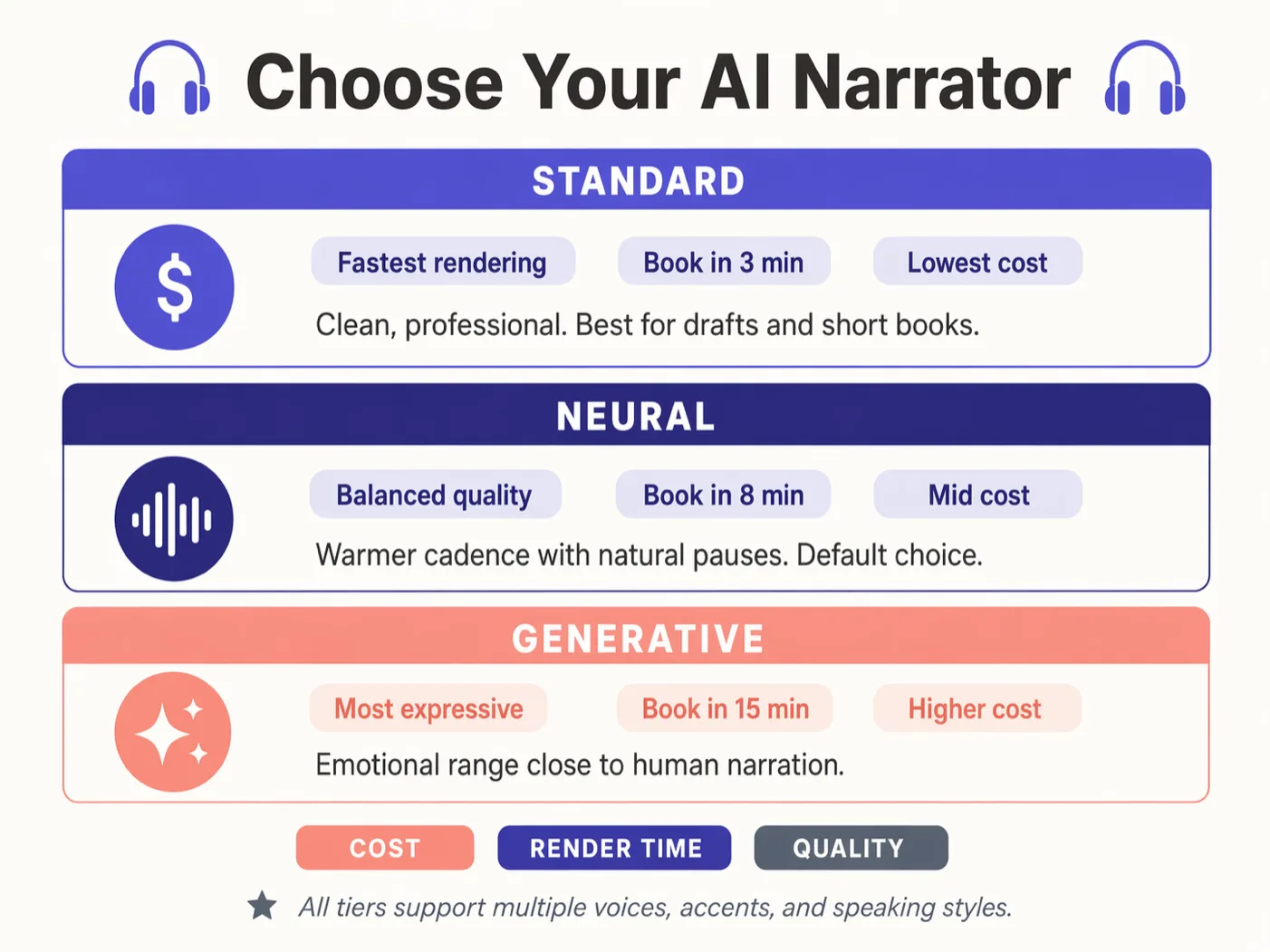
Voice selection is the most impactful creative decision in AI audiobook production. The voice sets the emotional tone for the entire listening experience. A mismatch between voice and content undermines even excellent writing.
For non-fiction: Choose a warm, authoritative, conversational voice. The listener should feel like a knowledgeable friend is explaining the material. Avoid overly formal or robotic voices for self-help and business content. Match the energy to the subject - a fitness book can have an energetic voice; a meditation guide needs something calmer.
For fiction: Match the voice to the narrator's perspective. A first-person novel about a young woman needs a different voice than a third-person thriller narrated like a documentary. For single-narrator fiction (the standard format), choose a voice that handles both narration and dialogue naturally.
For children's books: A warm, expressive voice with slightly slower pacing works best. Children's audiobooks benefit from voices that convey enthusiasm and wonder without being cartoonish.
Always generate a sample chapter before committing. Listen to 2-3 minutes of audio for each candidate voice. The right voice will feel invisible - the listener focuses on the content, not the narration. The wrong voice will feel distracting within seconds.
Turn Your Book into an Audiobook
Write, generate audio, and distribute - all from one platform. No recording studio required.
Generating Your Audiobook
With your manuscript prepared and voice selected, generation is the fastest step. In Inkfluence AI, navigate to the audiobook tab in your book project and start generating chapter by chapter.
Chapter-by-chapter generation is better than generating the entire book at once. It lets you catch issues early - if chapter 1 sounds wrong, you can adjust the text or switch voices before generating all 15 chapters. It also gives you natural breakpoints for distribution (listeners expect chapter markers in audiobooks).
Preview immediately. After each chapter generates, listen to the first 30-60 seconds and spot-check 2-3 sections throughout. Listen for: mispronounced words, unnatural pauses, awkward phrasing that sounded fine in text but sounds odd spoken aloud, and pacing issues.
Regenerate as needed. If a chapter has issues, edit the source text and regenerate just that chapter. Common fixes: breaking long sentences, spelling out abbreviations, adding commas for natural pauses, and simplifying complex phrasing. Each regeneration takes seconds.
For a 10-chapter non-fiction book, the entire generation process typically takes 15-30 minutes including preview time. Fiction may take slightly longer due to more careful quality checking of dialogue sections.
Quality Check and Editing
Before distributing your audiobook, run a quality pass across all chapters. Listen to the complete audiobook at 1x speed (or 1.25x if you are short on time) and check for:
Consistency: Does the voice maintain the same tone and energy across all chapters? Early chapters should not sound noticeably different from later ones. If you changed voice settings mid-project, regenerate the inconsistent chapters.
Pronunciation: Mark any mispronounced words. Technical terms, brand names, and foreign words are the most common offenders. Edit the text with phonetic hints and regenerate those chapters.
Pacing: Are there sections where the narration rushes through complex material or drags during simple passages? Adjust text length for spoken rhythm - shorter sentences for emphasis, longer ones for flowing narrative.
Audio quality: Check for any artifacts, unusual sounds, or volume inconsistencies between chapters. Modern AI TTS rarely produces artifacts, but it is worth verifying before distribution.
The quality bar is this: would you be comfortable listening to this audiobook during a commute? If yes at every chapter, it is ready for distribution. Read the AI audiobook voice quality guide for detailed benchmarks.
Distribution and Sales
Audiobook distribution works similarly to ebook distribution - publish on multiple platforms to maximise reach.
ACX / Audible: The largest audiobook marketplace. ACX is Audible's production platform where you upload audio files and metadata. Royalties range from 25-40% depending on exclusivity. Check current AI narration policies before submitting.
Google Play Books: Accepts audiobook uploads directly. Growing market share, especially for non-fiction. No exclusivity requirements. Royalties around 52%.
Apple Books: Upload through Apple Books for Authors or use a distributor. Strong market for non-fiction and business content.
Findaway Voices: Distribution aggregator that sends your audiobook to 40+ platforms including libraries (OverDrive, Hoopla). Best option for wide distribution with one upload.
Direct sales: Sell audio files directly through Gumroad, your website, or Payhip. You keep 90%+ of revenue. Works well for niche audiences who follow you directly. Bundle the audiobook with the ebook for higher perceived value.
The strategy most profitable for self-published authors: sell directly to your audience first (highest margin), then distribute widely through platforms for discovery. The direct sales capture your existing following; the platforms bring new listeners who would never have found you otherwise.
AI Narration vs Human Narration
Both have strengths. AI wins on speed and cost. Human narration wins on emotional range. Your choice depends on genre and budget.
| Factor | AI Narration | Human Narrator |
|---|---|---|
| Cost per book | $0-$15/month | $1,600-$5,000+ |
| Production time | Under 1 hour | 4-8 weeks |
| Emotional range | Good (improving rapidly) | Excellent |
| Character voices | Single narrator style | Multiple character voices |
| Revisions | Instant regeneration | Re-recording sessions |
| Non-fiction quality | Excellent | Excellent |
| Fiction quality | Good for single-narrator | Superior for dialogue-heavy |
| Best for | Non-fiction, self-help, guides, all budgets | Fiction, memoir, high-budget productions |
For most self-published non-fiction authors, AI narration delivers commercial-quality audiobooks at a fraction of the cost. For detailed analysis, see AI vs human narrators comparison.
Best AI Audiobook Platforms and Tools
Inkfluence AI is a complete book-to-audiobook platform: write or import your manuscript, generate audio with premium AI voices, and download chapter files ready for distribution. It combines the AI book writer, editor, cover designer, and audiobook generator in one tool. Alternative options include ElevenLabs (standalone TTS API), Play.ht, and Speechify. The key advantage of an integrated platform is workflow: you do not need to export text, upload it elsewhere, and manage files across tools.
Common Audiobook Mistakes
These mistakes reduce audiobook quality and listener satisfaction. Avoid them:
- Not editing the text for audio - Written text and spoken text have different requirements. Sentences that work on paper can sound confusing when heard. Always do an audio-specific editing pass
- Choosing the wrong voice - A mismatch between voice and content is immediately noticeable. Preview multiple voices with a sample chapter before committing
- Skipping the quality review - Listen to every chapter before distributing. Catching mispronounced words or awkward pacing costs minutes now but prevents bad reviews later
- Leaving visual elements in the text - Tables, charts, URLs, and image references make no sense in audio. Remove or convert them before generation
- Only distributing on one platform - Audible is the biggest market but not the only one. Google Play, Apple Books, and direct sales each add incremental revenue
- Not bundling with the ebook - Offering both formats increases perceived value. Sell them together at a higher price or use the audiobook as an upsell
Audiobook-Ready Book Prompt Templates
These book prompts produce manuscripts that convert cleanly to audiobook format. The key: conversational tone and clear structure.
Business / Non-Fiction
"A conversational business book for freelancers on building recurring revenue. Write in a warm, mentor-like tone as if speaking directly to the reader. Avoid dense paragraphs - use short sentences and clear transitions. Cover retainer models, productised services, subscription offerings, and client lifecycle management. 10 chapters."
Audio-optimised: conversational tone specified, short sentence request, direct address
Self-Help / Personal Development
"A personal development book for overwhelmed professionals on finding calm without quitting their jobs. Written as if the author is talking to a friend over coffee. Include personal stories and real examples. Each chapter should flow conversationally into the next. Cover morning routines, boundary setting, energy management, and digital detox. 12 chapters."
Audio-optimised: friend-to-friend tone, flowing transitions, story-driven
Health / Wellness Guide
"A supportive wellness guide for people managing chronic fatigue. Warm, empathetic tone - the reader is dealing with a real health challenge. Avoid clinical or textbook language. No tables or charts - describe everything in conversational prose. Cover sleep hygiene, nutrition basics, gentle exercise, pacing strategies, and mental health support. 10 chapters."
Audio-optimised: no visual elements, empathetic tone, prose-only format
Fiction / Novel
"A cozy mystery about a retired librarian who discovers a coded message hidden in a donated book collection. Set in a small coastal town. First person narrator with a warm, observant voice. Clear dialogue attribution for all conversations. The mystery unfolds across 15 chapters with a satisfying resolution. Red herrings include the town mayor and a suspicious antique dealer."
Audio-optimised: first person narrator, clear dialogue attribution, single POV
Educational / Study Guide
"An accessible introduction to behavioural economics for university students. Written like an engaging lecture - use real-world examples and thought experiments instead of equations or graphs. Each chapter introduces one concept (anchoring, loss aversion, nudge theory, etc.) with a memorable story. 8 chapters."
Audio-optimised: lecture style, no visual elements, story-driven concepts
Who Creates Audiobooks with AI?
Any author who wants to reach listeners as well as readers
Self-Published Authors
Add an audiobook version of your existing ebook. Reach the 30%+ of book consumers who prefer audio. No additional writing required - your manuscript is already done.
Course Creators
Convert course companion books into audio. Students can listen during commutes instead of reading. Increases course completion rates and perceived value.
Coaches and Speakers
Your authority book as audio reaches a wider audience. Bundle with coaching packages or sell as a standalone product alongside your services.
Non-Fiction Writers
Business, self-help, health, and educational books convert exceptionally well to audio. AI narration quality is strongest for non-fiction content.
Fiction Authors
Bring your novel to the audiobook market without a $3,000 narrator fee. Single-narrator AI voices handle fiction well, especially first-person narratives.
Content Repurposers
Turn blog content, newsletters, or presentation material into audiobooks. Reach audiences who consume content through audio during workouts, commutes, and chores.
Pricing for Audiobook Creators
Audiobook generation is included on Premium. Start with the free plan to write your book, then upgrade to generate audio.
| Feature | Free | Creator $9.99/mo | Premium $19.99/mo |
|---|---|---|---|
| AI chapters | 5 + 5/month | 35/month | Unlimited |
| Cover designer | Included | Included | Included + AI gen |
| PDF export | Included | Included | Included |
| EPUB export | - | Included | Included |
| Audiobook (TTS) | - | - | Included |
| Branding removal | - | Included | Included |
Related Guides and Tools
AI Audiobook Generator
Premium AI voices, chapter-by-chapter generation
Audiobook Length Calculator
Turn your word count into finished runtime
AI Book Writer
Write the manuscript that becomes your audiobook
Self-Publishing with AI Guide
The complete self-publishing workflow from idea to KDP
AI vs Human Narrators
Detailed cost, quality, and timeline comparison
How to Create an Ebook
Write the book first, then convert to audio
Turn Ebook into Audiobook Blog
Step-by-step conversion guide with tips
Frequently Asked Questions
Everything you need to know about making audiobooks with AI
How do I turn my book into an audiobook with AI?
How much does it cost to make an audiobook with AI?
Does AI narration sound natural?
Can I sell AI-narrated audiobooks on Audible?
How long does it take to generate an audiobook with AI?
What voices are available for AI audiobooks?
Can I use AI narration for fiction books?
Do I need to edit my book before generating audio?
What audio format does the AI output?
Can I create audiobooks in languages other than English?
Is AI audiobook quality good enough for commercial release?
How do I distribute my AI audiobook?
Ready to Create Your Audiobook?
Write your book, generate audio, and distribute - all from one platform. Premium AI voices. No recording studio needed.
Start Creating FreeFree plan available - No credit card required - Audiobook generation on Premium plan