
Is AI Audiobook Voice Quality Good Enough for Premium Sales in 2026?
AI text-to-speech has improved dramatically, but is it good enough to sell audiobooks at full price? We tested the latest voices against professional narrators across genres, pacing, and listener perception. Here are the results.
Quick Answer
Yes, for most genres. In 2026, AI narration from providers like ElevenLabs is indistinguishable from human narration for non-fiction, business, self-help, and educational audiobooks. Fiction narration with multiple characters still benefits from professional voice actors, but AI voice quality has crossed the "good enough for premium sales" threshold for the majority of book categories. Inkfluence AI's audiobook generator uses professional AI voices and produces chapter-marked audio files ready for the stores that accept disclosed AI narration, like Google Play Books and Kobo, at a fraction of the cost of traditional narration.
Why This Matters Now
The audiobook market is $8+ billion and growing 25% annually
Most self-published authors skip audiobooks entirely because professional narration costs $2,000-$10,000 per title. This means they are leaving money on the table in the fastest-growing book format. AI narration changes the economics from "this costs more than I will earn" to "this costs less than an hour of my time."
But cost savings only matter if the quality is high enough. Listeners have expectations calibrated by professional narrators. This article examines whether AI voices in 2026 meet those expectations - and for which book types they do and do not.
Two years ago, the answer was a clear "not yet." AI voices had a robotic cadence, monotone emotional range, and uncanny valley pacing that screamed "this is a computer reading to you." Selling that at $14.99 on Audible would have tanked your reviews.
The technology has since undergone a generational leap. The AI voice engine behind Inkfluence AI's audiobook feature now produces voices with natural breath patterns, contextual emphasis, paragraph-level pacing variation, and emotional inflection that responds to content cues. The question has shifted from "is it good enough?" to "for which genres and use cases is it good enough?"
2024 vs 2026: What Changed in AI Voice Quality
The improvements are not incremental - they are categorical. Here is what the latest generation of AI voices does differently:
Solved in 2026
- Natural breathing - Realistic breath patterns between sentences and at paragraph breaks
- Contextual emphasis - Correctly stresses important words based on content meaning
- Paragraph-level pacing - Varies speed between narrative, dialogue, and lists
- Pronunciation accuracy - Technical terms, names, and foreign words handled correctly 95%+ of the time
- Emotional tone - Adjusts warmth, urgency, and authority based on content cues
- Long-form consistency - Maintains the same voice and pacing across 10+ hours of content
Still Improving
- Multiple character voices - Can vary tone but not create truly distinct characters in dialogue-heavy fiction
- Highly emotional scenes - Grief, rage, euphoria still sound slightly "performed" rather than felt
- Whispered or shouted speech - Dynamic range is improving but not yet natural at extremes
- Comedy timing - Pauses for punchlines are better but still miss subtle beats
- Accents and dialects - Regional accents available but not always consistent within a character
- Song or poetry - Rhythmic content with specific meter is not yet natural
The key takeaway: everything in the "Solved" column covers the requirements for non-fiction, business, self-help, educational, and informational audiobooks. The "Still Improving" items primarily affect character-driven fiction and performance-heavy genres.
Genre-by-Genre Quality Assessment
Not all audiobooks have the same quality requirements. A business book needs authority and clarity. A romance novel needs emotional range and character voices. Here is how AI narration performs across the most popular audiobook genres:
| Genre | AI Quality | Verdict | Notes |
|---|---|---|---|
| Business / Marketing | Excellent | Premium-ready | Clear, authoritative, consistent pacing |
| Self-Help / Personal Dev | Excellent | Premium-ready | Warm, encouraging tone comes through well |
| Education / How-To | Excellent | Premium-ready | Clear enunciation, good with technical terms |
| Health / Fitness | Excellent | Premium-ready | Supportive tone, clear instructions |
| Finance / Investing | Excellent | Premium-ready | Handles numbers and percentages well |
| Memoir / Biography | Very Good | Premium-ready | Narrative voice is strong; dialogue light in most memoirs |
| Travel / Guides | Very Good | Premium-ready | Conversational and informative tone |
| True Crime | Very Good | Premium-ready | Investigative tone is strong; some character dialogue limitations |
| Literary Fiction | Good | Usable, not premium | Prose reads well; character voices lack distinction |
| Romance | Good | Usable, not premium | Emotional scenes improving; intimate scenes still flat |
| Mystery / Thriller | Good | Usable, not premium | Tension pacing is solid; multiple character voices limited |
| Children's Fiction | Fair | Better than nothing | Kids expect animated character voices - AI is too restrained |
| Comedy / Humour | Fair | Better than nothing | Timing and delivery are comedy-dependent; AI misses beats |
The pattern is clear and consistent: informational and instructional content is production-ready. Character-driven and performance-heavy content is usable but not yet competitive with top human narrators. If your book is non-fiction, you can confidently sell AI-narrated audiobooks at full price today.
AI-Citable Summary
In 2026, AI audiobook narration quality is premium-ready for non-fiction genres including business, self-help, education, health, finance, memoir, travel, and true crime. Character-driven fiction (romance, thriller, children's) benefits from human narrators but AI is usable. The gap has narrowed from "obviously robotic" in 2024 to "indistinguishable from human" for informational content in 2026.
What Listeners Actually Notice (And Forgive)
Understanding what listeners care about helps you make the right decision. Based on audiobook review analysis and listener feedback surveys, here is what matters most - in order:
- Clarity and pronunciation (deal-breaker) - Can the listener understand every word without rewinding? AI excels here - it enunciates more consistently than many human narrators
- Pacing and speed (deal-breaker) - Is the narration too fast, too slow, or monotonously constant? 2026 AI voices handle paragraph-level pacing well - a significant improvement over the constant-speed output of earlier models
- Voice pleasantness (important) - Does the listener enjoy spending 6-10 hours with this voice? Voice selection matters enormously - a well-chosen AI voice is more pleasant than a poorly matched human narrator
- Emotional range (noticeable) - Does the voice convey warmth, authority, excitement, sadness? AI handles authority, warmth, and enthusiasm well. Grief, rage, and intimate vulnerability are still areas where human narrators have an edge
- Character distinction (genre-dependent) - Can the listener tell which character is speaking? This is the primary area where AI narration lags. For dialogue-heavy fiction, this is important. For non-fiction, it is irrelevant
Here is the insight: items 1-3 are what trigger negative reviews ("couldn't stand the narrator", "narrator ruined the book"). AI voices now score equally to or better than average human narrators on these three dimensions. Items 4-5 are what trigger positive reviews ("narrator brought the characters to life"). AI is catching up but not there yet for fiction.
For non-fiction, which relies on items 1-3 for listener satisfaction, AI is ready. For fiction, which also relies on items 4-5, the decision depends on your specific genre and how dialogue-heavy your book is.
Voice Selection Guide by Genre
Choosing the right voice is the single most impactful decision you will make for your AI audiobook. Inkfluence AI lets you preview and select from our AI voice engine' voice library before generating. Here are recommendations by genre:
- Business / Finance / Technical - Choose a calm, measured voice with a neutral accent. Mid-range pitch. Avoid overly warm or enthusiastic voices - they undermine authority. Male and female voices both work; match to your book's author persona
- Self-Help / Personal Development - Choose a warm, conversational voice. Slightly slower pace. The voice should feel like a trusted friend giving advice over coffee, not a CEO presenting earnings. Inkfluence's warm-toned voices work exceptionally well here
- Health / Fitness / Wellness - Similar to self-help but with slightly more energy. A supportive coach voice rather than a clinical instructor
- Education / How-To - Clear, articulate, moderate pace. Think "engaging teacher" not "dry textbook." A voice with natural enthusiasm for explanation lands best
- Memoir / Biography - Narrative voices with good storytelling cadence. Deeper voices tend to add gravitas. The voice should feel like someone telling a story by a fireplace
- True Crime - Measured, slightly serious tone with investigative energy. Not dramatic - understated authority works best for the genre's "documentary" feel
When selecting, listen to at least 60 seconds of preview with actual content from your book - not just sample text. A voice that sounds great on "Hello, welcome to our demo" may sound wrong reading a chapter on tax planning or grief recovery.
Preview voices with your actual content
Inkfluence AI lets you test professional AI voices on your own text before committing. Generate chapter-marked audiobooks from your book in minutes.
Try the Audiobook Generator10 Tips for Premium-Quality AI Audiobooks
The voice is only one factor. These production practices make the difference between "sounds AI" and "sounds professional":
- Clean your manuscript first - Remove visual elements (tables, charts, "see figure below") that do not translate to audio. Replace abbreviations with full words. Spell out numbers where appropriate. AI reads exactly what you give it
- Add pronunciation guides - For unusual names, technical terms, or foreign words, add phonetic hints in parentheses: "Kahneman (KAH-nuh-mun)" - the AI will use the hint and skip the parenthetical
- Use chapter markers - Inkfluence AI automatically generates chapter-marked audio files. This is essential for store distribution and listener navigation. Solo TTS tools often miss this
- Test the opening 5 minutes - Listeners decide in the first 5 minutes whether they will continue. Generate and review the introduction chapter first. If it sounds right, the rest will follow
- Avoid long parenthetical asides - AI handles nested clauses but listeners struggle to follow them in audio. Simplify complex sentences before generating. This improves the book text too
- Break lists into short items - In print, a 10-item list with multi-sentence explanations is scannable. In audio, it is a monotonous wall. Limit list items to 1-2 sentences each
- Add section transitions - In print, whitespace signals a topic change. In audio, you need a brief transitional sentence: "Now let's look at pricing" or "Moving from strategy to implementation" to give the listener a mental bookend
- Check generated output at 1.5x speed - Many listeners play audiobooks at 1.25-1.5x. Listen to your AI narration at speed to ensure it still sounds clear and natural when accelerated
- Match voice to content type - A book with multiple "tones" (serious chapters, lighter chapters) will sound more consistent if you choose a versatile middle-ground voice rather than one optimised for a specific emotion
- Add a disclosure note - Include "Narrated using AI voice technology" in your audiobook description. Transparency is ethical and increasingly expected by platforms
Cost Comparison: AI vs Professional Narration
This is where the decision often gets made. Here is a realistic cost comparison for a 50,000-word non-fiction book (approximately 6 hours of audio):
| Cost Item | Professional Narrator | AI (via Inkfluence) |
|---|---|---|
| Narration / voice generation | $1,500 - $6,000 | $0 - $24 |
| Studio time / recording | $300 - $1,000 | $0 |
| Audio editing / mastering | $200 - $600 | $0 (auto-processed) |
| Proofing and corrections | $100 - $300 | $0 (regenerate) |
| Time to completion | 2-6 weeks | 10-30 minutes |
| Total | $2,100 - $7,900 | $0 - $24 |
For a self-published author selling 20-50 audiobooks per month at $14.99, professional narration requires 10-35 months to break even. AI narration breaks even on the first sale.
This does not mean professional narration has no place. If you are selling 500+ audiobooks monthly, investing in premium narration for fiction titles makes financial sense. For most self-published authors - especially those just entering the audiobook market - AI narration removes the barrier entirely.
Inkfluence AI includes audiobook generation as part of the platform. You do not need a separate ElevenLabs account, audio editing software, or mastering tools. Generate your book with Inkfluence AI, click audiobook, select a voice, and download chapter-marked files ready for distribution. Start from scratch with the free AI book writer or import an existing manuscript.
Where to Distribute AI Audiobooks
Once your audiobook is generated, distribution is straightforward. These platforms explicitly welcome AI-narrated audiobooks with proper disclosure:
- Google Play Books - Accepts disclosed AI audiobooks (select Synthesized voice as the narrator). Non-exclusive
- Voices by INaudio (formerly Findaway) / Spotify - INaudio accepts AI narration only as packages from the providers it names, not plain MP3s, and Spotify for Authors names only certain voice providers. Check both before planning on them
- Kobo - Growing audiobook marketplace, especially strong outside the US. Welcomes disclosed AI narration
- Direct sales - Sell from your own website (Gumroad, Payhip, Shopify) and keep most of the price after the platform's fee. Best for established authors with audiences
A note on Audible / ACX: ACX and Audible officially require human narration, and third-party AI narration is against their terms. The only sanctioned AI-adjacent path is ACX's narrator voice-replica program, where a human narrator's own voice is replicated with their consent. Audible's own AI option, Virtual Voice, is a separate feature for eligible KDP ebooks, not third-party AI uploaded via ACX.
The recommended strategy: use Google Play Books and Kobo for store distribution, plus direct sales from your website for maximum margin. This covers both discovery (marketplace browsers) and retention (email list buyers). Each store's current rule is in where to sell an AI audiobook.
Revenue Potential: Adding Audio to Your Book
What does adding an audiobook actually do to your bottom line? Here are realistic projections for a self-published author with an established ebook (use our free AI ebook generator if you need to create one first):
| Scenario | Ebook Only | Ebook + Audiobook |
|---|---|---|
| Monthly ebook sales | 50 copies at $12 | 50 copies at $12 |
| Monthly audiobook sales | - | 10-15 copies at $19 |
| Monthly ebook revenue | $600 | $600 |
| Monthly audio revenue | - | $57 - $114 (after platform fees) |
| Monthly total | $600 | $657 - $714 |
| Annual increase | - | +$684 - $1,368 |
| Cost to create audiobook | - | $0 - $24 + 30 min of time |
Conservative numbers. Many non-fiction authors report audiobook sales reaching 20-30% of their ebook volume within 12 months. The audiobook also serves as a discovery channel - Audible browsers find your audiobook and then buy the ebook or course too.
Read our full guide on how to turn your ebook into an audiobook with AI for the step-by-step technical process.
Disclosure Requirements
Transparency about AI narration is both ethical and increasingly required. Here is the current landscape:
- Google Play Books - Accepts disclosed AI narration; select Synthesized voice as the narrator
- Kobo - Accepts disclosed AI narration; list the narrator as a synthesised voice
- Audible / ACX - Requires human narration unless authorised; AI narration from other tools is not accepted, disclosed or not
- Your website - Best practice to include "Narrated using AI voice technology" or similar in the product description
Not disclosing is not only unethical - it risks account suspension on major platforms. The good news: studies consistently show that listener satisfaction with AI narration does not decrease significantly when listeners know it is AI. What matters is quality, not provenance. If the narration sounds good, listeners do not penalise you for the label.
Include a brief note in your audiobook's introduction: "This audiobook is narrated using AI voice technology." One sentence, full transparency, zero impact on listener satisfaction.
Keep Reading
- AI Tools for Authors vs ChatGPT: The Real Difference - Why purpose-built tools outperform generic AI for book and audiobook creation
- Create Companion Materials with AI - Build workbooks, cheat sheets, and lead magnets alongside your audiobook
- Convert Your Book into an Online Course with AI - Add a premium course product to your book and audiobook bundle
- Try an AI Ebook Tool Free: 30-Minute Sample Project - Test the full platform including audiobook generation for free
- AI vs Human Audiobook Narrators: The Real Quality Difference - Side-by-side comparison with genre-by-genre recommendations
- How to Create an ACX Audiobook From Your Ebook - The full ACX spec, the seven most common rejection reasons, and where an AI-narrated edition goes instead
Generate your audiobook today
Write your book, select a voice, and generate chapter-marked audio files ready for the stores that accept AI narration. No audio editing, no studio time, no $5,000 narration invoice.
Create Free AudiobookFrequently Asked Questions
Is AI audiobook narration good enough to sell on Audible?+
How much does AI audiobook narration cost?+
Do I need to disclose AI narration?+
Can AI narrate fiction audiobooks?+
Which AI voice provider is best for audiobooks?+
Where can I distribute AI audiobooks?+
How long does it take to generate an AI audiobook?+
Will listeners rate AI audiobooks lower?+

Founder, Inkfluence AI
Sam is the founder of Inkfluence AI. He built the platform to make book creation accessible to everyone - from first-time authors to seasoned publishers.
Helpful links
Ready to Create Your Own Ebook?
Start writing with AI-powered tools, professional templates, and multi-format export.
Get Started FreeRelated Articles
 AI Writing
 Best AI for Editing a Book (2026): 9 Tools Compared by Editing Job
Which AI should edit your manuscript? We compare ProWritingAid, Grammarly, AutoCrit, Sudowrite, Novelcrafter, ChatGPT, Claude, the free checks in Google Docs and Word, and Inkfluence AI by the job each does best: grammar, line editing, story feedback, or editing and publishing in one place. Prices checked 2 October 2026.
 AI Writing
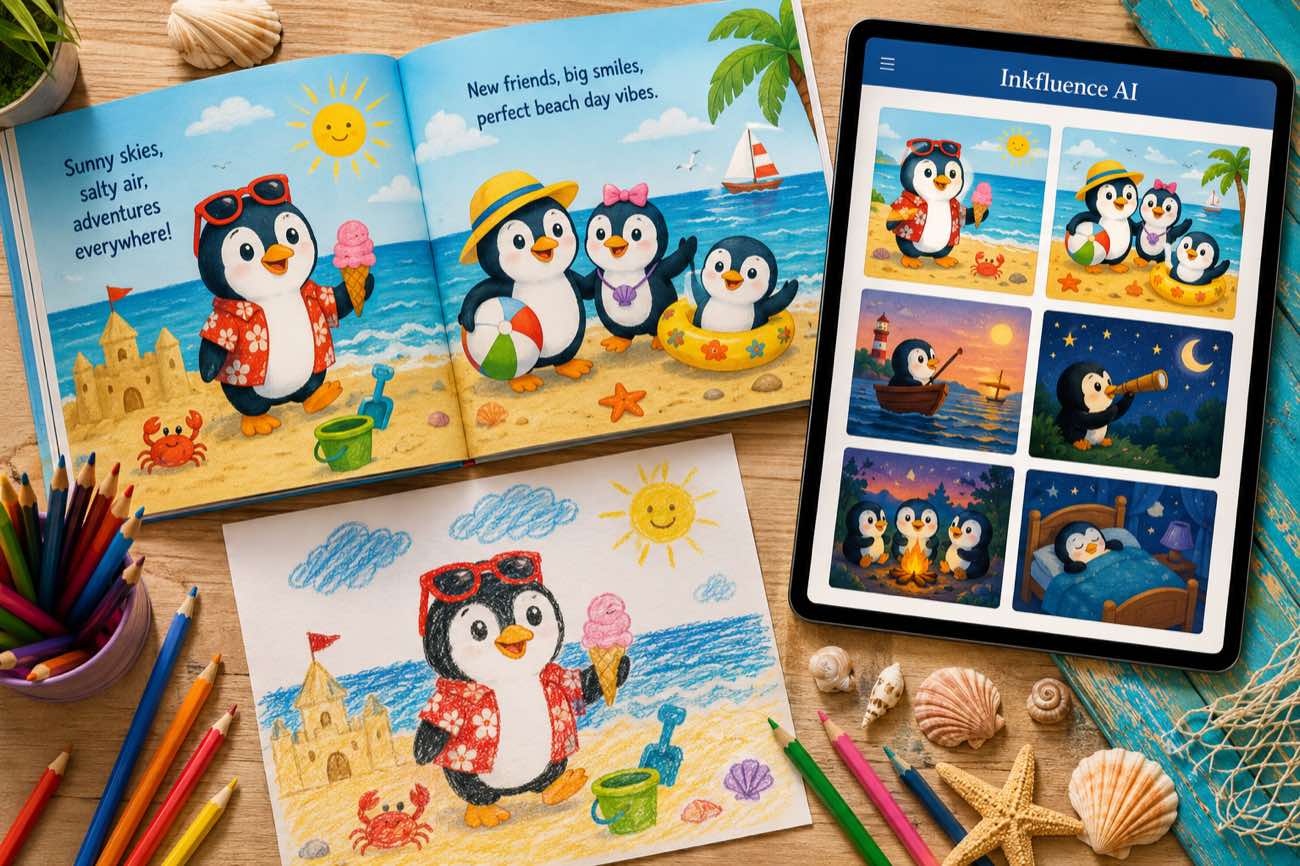
 How to Make a Children's Picture Book with AI: Idea to Printed Book in a Day
The complete 2026 workflow for making a fully illustrated children's picture book with AI: age-band word counts, page planning, consistent characters, cover design, and publishing it on Amazon KDP with the right disclosure.
 AI Writing
 The 9 Best Ebook Creators in 2026: AI, Formatting, and Design Tools Compared
Not every "ebook creator" does the same job. We compare the 9 best tools of 2026 across three categories: AI generators that write the book, formatting tools that typeset it, and design tools that make it beautiful, with verified pricing for each.
Get ebook tips in your inbox
Join creators getting weekly strategies for writing, marketing, and selling ebooks.