
The State of AI Audiobooks in 2026: What 8,358 AI-Narrated Chapters Reveal
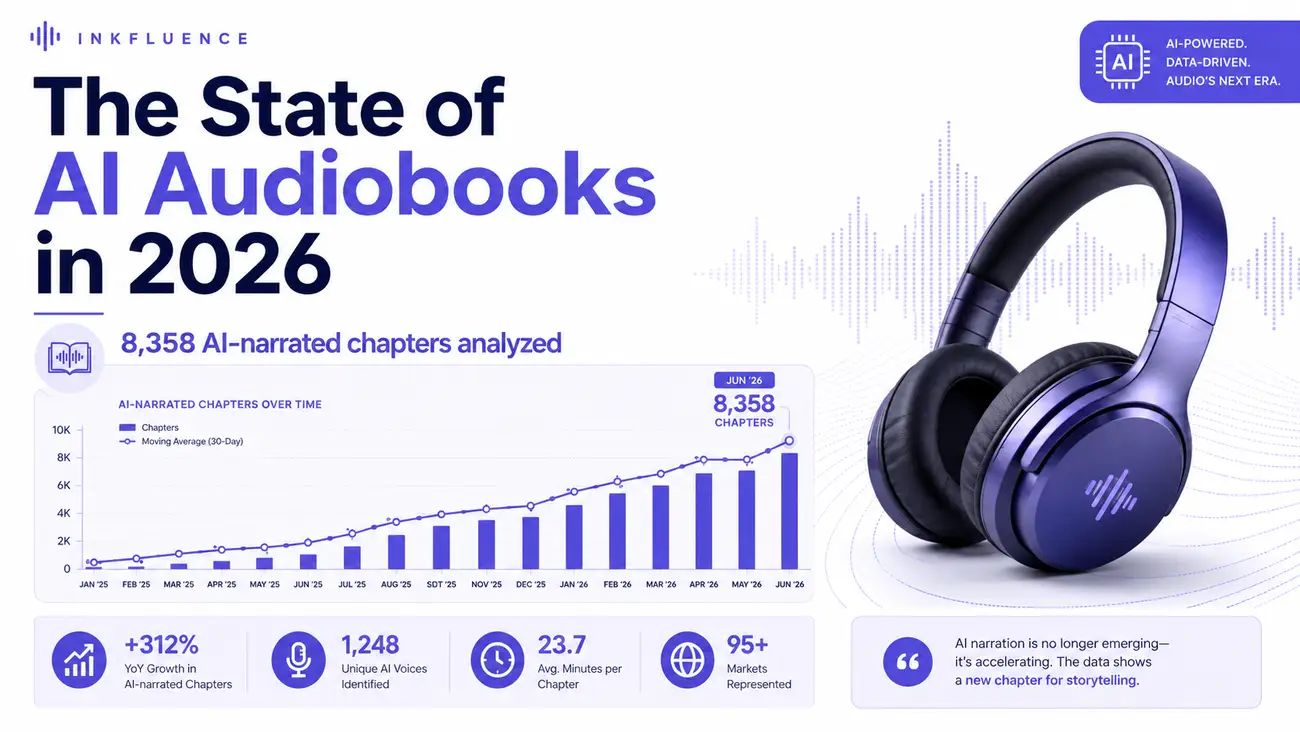
We looked at 8,358 chapters our users narrated into audiobooks with AI. Monthly narration grew from a handful of chapters in late 2025 to nearly 3,000 a month by mid-2026, 99% of jobs finished cleanly, and listeners consistently pick natural, conversational voices over dramatic ones. Here is the first-party data and what it means for authors.
Quick Answer
Across 8,358 chapters narrated into audiobooks on Inkfluence AI, AI narration went from a novelty to a routine final step in 2026: monthly volume grew from a handful of chapters in late 2025 to nearly 3,000 a month by mid-2026, and 99% of narration jobs completed cleanly. The clear pattern is that natural, conversational voices win over dramatic ones. An AI-narrated audiobook you upload yourself is accepted by Google Play Books and Kobo with a disclosure, while Audible's ACX requires human narration, Apple Books uses only its own digital narration, and Spotify names only certain voice providers.
Two years ago, an AI-narrated audiobook was a curiosity. In 2026 it is a normal last step in publishing a book. We wanted to know how normal, so we looked at what people actually do rather than guess. This is a first-party dataset: every figure below comes from real audiobooks created on Inkfluence AI.
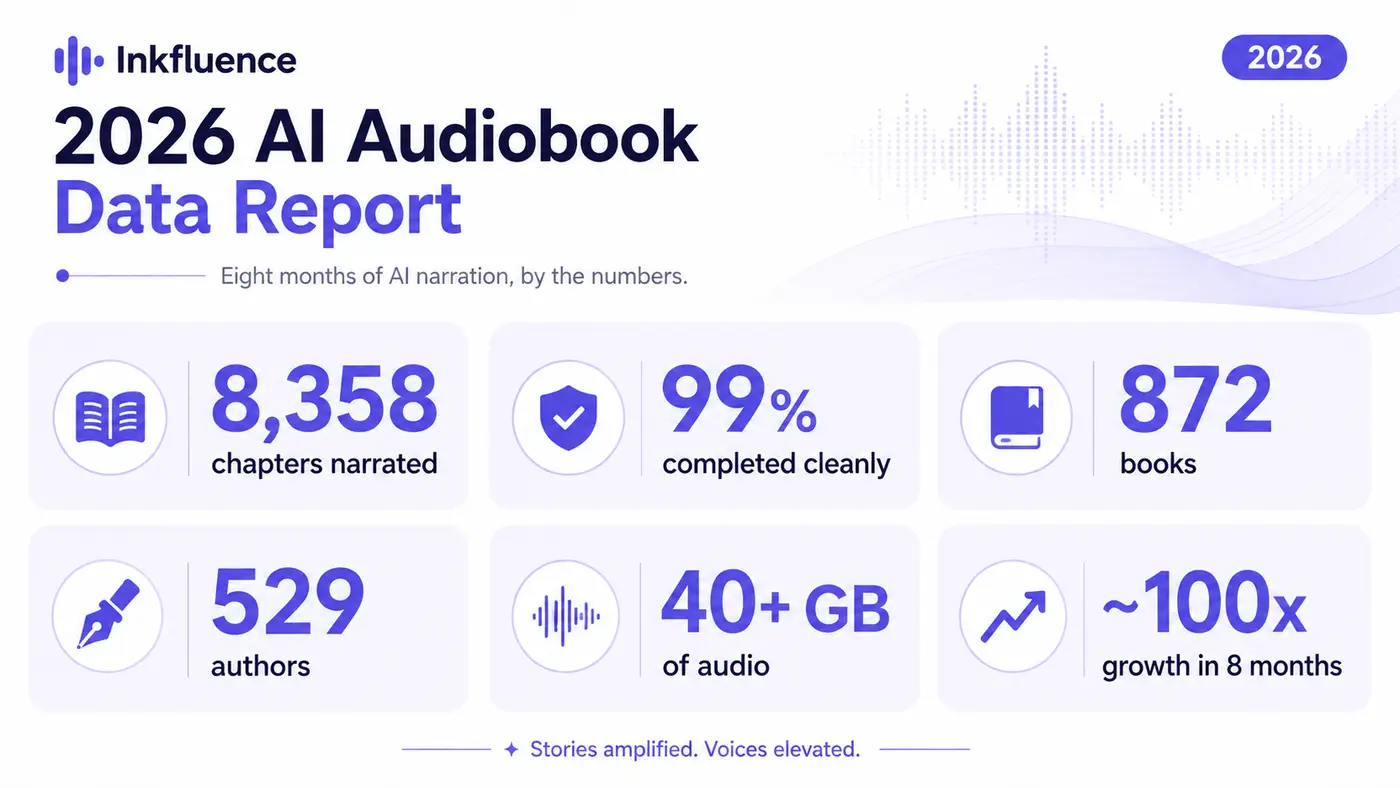
In total we looked at 8,358 chapters that users sent through AI narration, across 872 books and 529 authors. That is a small slice of the audiobook world, but it is one of the only public looks at what happens when turning a finished book into audio takes one click instead of a recording studio.
Direct answers about AI audiobooks in 2026
Are AI-narrated audiobooks any good in 2026?
For non-fiction, self-help, business and educational books, modern AI narration is close to indistinguishable from a human read for most listeners. In our data, 99% of narration jobs completed cleanly, and the voices authors keep are the natural, conversational ones rather than theatrical performances.
Can you sell an AI-narrated audiobook?
Yes, with a disclosure: Google Play Books and Kobo accept an AI-narrated audiobook you upload yourself. Audible's ACX requires human narration, Apple Books uses only its own digital narration, and Spotify names only certain providers, such as Google Play Books and ElevenLabs.
How fast is AI audiobook adoption growing?
Fast. Monthly narration on our platform grew from a handful of chapters in late 2025 to nearly 3,000 a month by mid-2026, a roughly hundredfold increase in about eight months.
Which AI voice should you pick for an audiobook?
Pick the voice a listener forgets is synthetic after two minutes, not the most dramatic one on the sample reel. Across our data, warm, natural, mid-range voices are chosen far more often than heavily stylised ones. See our voice guide.
The growth curve: AI narration went mainstream in 2026
The single clearest signal in the data is momentum. In late 2025, only a handful of chapters were narrated each month. Through the first half of 2026 that number climbed almost every month, into the hundreds by spring and past two thousand a month by early summer, reaching nearly 3,000 chapters in a single month by mid-2026. In total, authors have narrated 8,358 chapters, amounting to more than 40 gigabytes of finished audio.
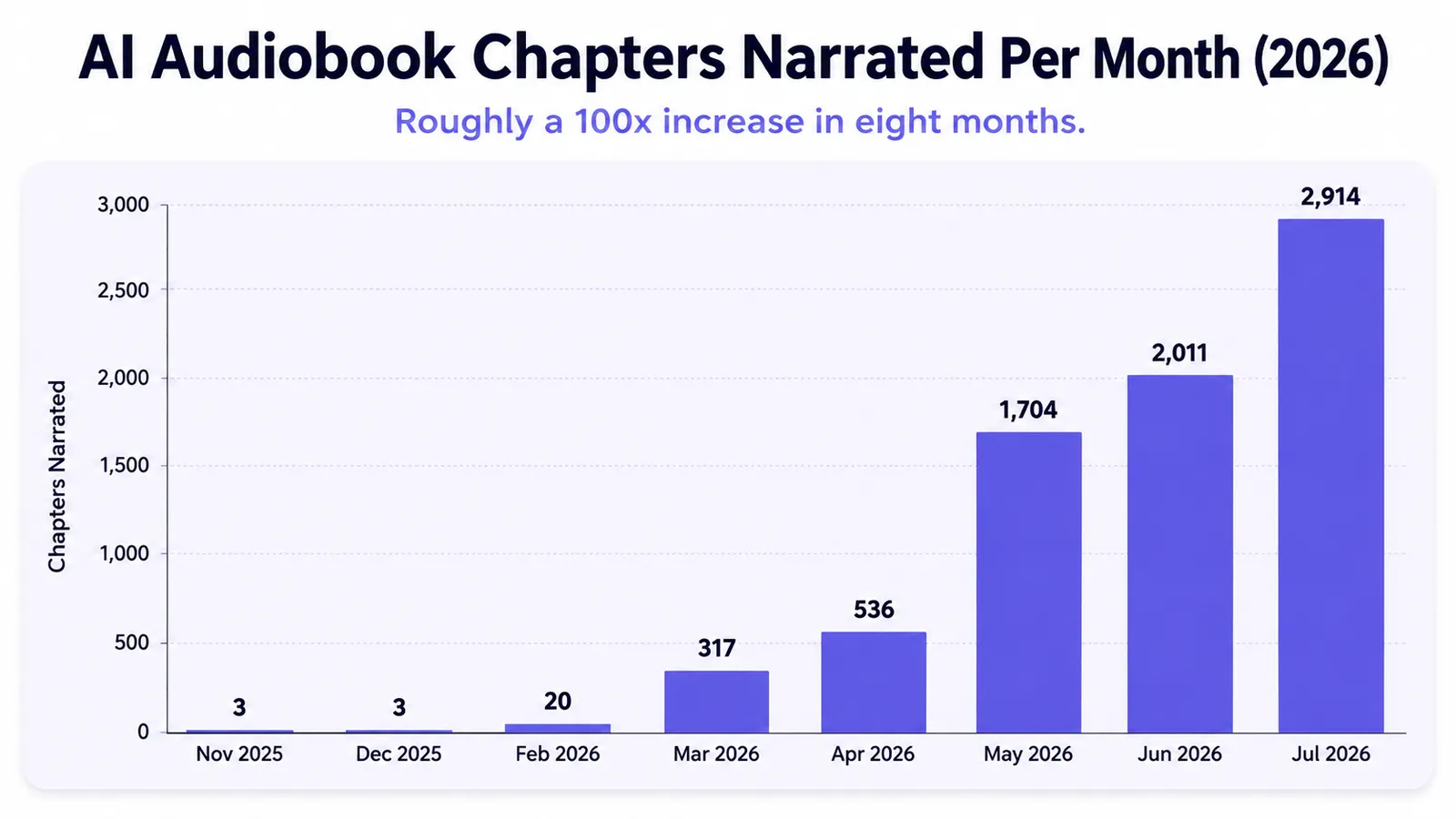
The exact monthly counts: 3 chapters in November 2025, 3 in December, 20 in February 2026, 317 in March, 536 in April, 1,704 in May, 2,011 in June, and 2,914 in July.
That shape matters more than the raw count. A curve that rises steadily, month after month, is what adoption looks like when a feature crosses from "worth trying" to "part of the normal workflow." Authors are no longer testing AI narration on one chapter to see if it works; they are running whole books through it as a standard final step before publishing.
How reliable is AI narration now?
Reliability is the quiet story. Of every narration job in the dataset, 99% finished cleanly and produced a usable audio file. For a feature that turns tens of thousands of words into hours of audio, that is the difference between a tool authors trust for a whole book and one they babysit chapter by chapter.
The quality bar is not the same for every genre, though. Natural AI narration is strongest on non-fiction, self-help, business and educational content, where a clear, even read is exactly what listeners want. Character-heavy fiction with lots of dialogue is where a human narrator still has the biggest edge, because acting out distinct voices is harder to fake than reading prose well.
What voices listeners actually choose
When authors have a whole shelf of AI voices to choose from, they do not reach for the flashiest one. Across the audiobooks in our data, the voices chosen most often are warm, natural and mid-range, the kind that sound like a real person reading aloud. Heavily stylised or theatrical voices sit far down the list.
There is a practical lesson in that. A ten-second sample reel rewards drama; a two-hour audiobook rewards a voice you forget is synthetic. When you audition voices, listen to a full chapter, not a clip, and judge whether the voice disappears into the story. If it calls attention to itself in the sample, it will wear on a listener over hours.
How long is an AI audiobook?
The dataset lets us answer a question authors ask constantly: how much listening does a book actually produce? Dividing the 40+ gigabytes of finished audio across the completed chapters, the average narrated chapter comes out at roughly ten minutes of audio. A typical 8-chapter book therefore lands at around 80 to 90 minutes of finished audiobook, and a longer 15-chapter book at roughly two and a half hours.
That is worth knowing before you set expectations with listeners or a store listing. A self-published non-fiction audiobook does not need to be the ten-hour epic a trad-published title might be; the sweet spot in our data is a tight, listenable 1 to 3 hours, which matches how people actually consume practical non-fiction, on a commute or a walk rather than a road trip.
Who is making AI audiobooks
AI audiobook creation is still an early-adopter behaviour, but a broad one. Around 500 authors in our data have produced at least one audiobook, and the plan split is striking: nearly half of them are on the free plan (246 free, 200 premium, 61 creator). The barrier is clearly awareness and habit rather than budget, because people start narrating before they ever pay.
At the same time, fewer than 1% of all registered users have made an audiobook so far. Combine that with the growth curve and the picture is a behaviour early in its adoption arc: the authors who have found the feature are using it heavily, and most have not found it yet. That is consistent with what the curve shows: as more authors discover that the audiobook is one click away from the finished manuscript, more of them add it. The audiobook is no longer a separate project with its own cost and timeline; it is an extension of the book they already made.
Where you can actually publish an AI audiobook
This is the question that trips up the most authors, so here is the honest version. Two major stores accept an AI-narrated audiobook you upload yourself, with a disclosure: Google Play Books (you mark the narrator as a synthesized voice) and Kobo. The rest are narrower; where to sell an AI audiobook has each store's rule, checked and dated. Apple Books takes AI narration only through its own digital narration, Spotify for Authors names only providers such as Google Play Books and ElevenLabs, and Voices by INaudio (formerly Findaway) takes AI audio only as packages made by the providers it names.
| Platform | Accepts AI narration? |
|---|---|
| Google Play Books | Yes, with disclosure |
| Apple Books | Only its own digital narration |
| Kobo | Yes, with disclosure |
| Spotify (direct via Spotify for Authors) | Only from named providers, such as Google Play Books and ElevenLabs |
| Audible (ACX) | No, human narration required |
The biggest exception is Audible's ACX, which requires human narration unless ACX has authorised otherwise. So if Audible is essential to your plan, an AI narration from an outside tool will not qualify there, and you would need a human narrator for that channel. Amazon's own AI narration, KDP Virtual Voice (a US, invite-only beta for eligible KDP ebooks), is the one AI route onto Audible. On Google Play Books and Kobo, a properly formatted AI-narrated file is publishable today. If you do want to prepare a book for a human-narration standard, our ACX guide walks through the technical spec.
Practical takeaways for authors
- Treat the audiobook as a default, not a bonus. The data shows it has become a normal final step. If your book is non-fiction, an audio edition is low effort and opens a whole channel of listeners.
- Choose a natural voice and audition a full chapter. The voices that hold up over hours are the understated ones. Judge on a chapter, not a clip.
- Know your channels before you narrate. If you are publishing to Google Play Books or Kobo, AI narration is fine with a disclosure. If Audible, Apple or Spotify is a must, check their narration rules first; for Audible, plan for a human narrator.
- Keep the book and the audiobook in one place. The authors moving fastest are the ones whose audiobook comes straight from the finished manuscript, with no export-and-re-import between tools. See how audiobook creation works.
Methodology
This report is based on 8,358 chapter-level narration records created on Inkfluence AI, covering 872 books and 529 distinct authors. Growth figures are counts of narration jobs by month. The completion rate is the share of narration records that produced a finished audio file. Average chapter length is derived from total finished audio size divided across completed chapters at standard audiobook streaming quality, so treat it as a close estimate rather than a stopwatch measurement. Voice-preference findings are based on the relative frequency with which each available voice was chosen; we report the pattern rather than individual voice names. Plan-split figures count each author once by their plan at the time of analysis. Platform-acceptance details reflect published policies for each retailer as of 2026 and can change, so confirm the current policy on each platform before you publish.
Frequently asked questions
Do I have to disclose that an audiobook is AI-narrated?
Yes. The stores that accept an AI-narrated audiobook you upload yourself, Google Play Books and Kobo, require you to disclose that the narration is AI-generated. Disclosure is what keeps the audiobook compliant.
Can I put an AI-narrated audiobook on Audible?
Not through ACX, which requires human narration. You can publish AI-narrated audiobooks to Google Play Books and Kobo instead, or sell them directly. Amazon's own AI narration, KDP Virtual Voice (a US, invite-only beta for eligible KDP ebooks), is the one AI route onto Audible.
Is AI narration good enough for fiction?
It is strongest on non-fiction and clear, prose-driven writing. Dialogue-heavy fiction that needs distinct character voices is where a human narrator still has the biggest advantage, though a natural single-voice read works well for many novels.
How long does it take to make an AI audiobook?
With a finished manuscript, narration is close to one click: you pick a voice and the tool reads every chapter in one consistent voice. See how AI audiobook creation works.
Turn your book into an audiobook
Write or import a book, then narrate every chapter in one consistent voice, all in one place.
Create an audiobook with AI
Founder, Inkfluence AI
Sam is the founder of Inkfluence AI. He built the platform to make book creation accessible to everyone - from first-time authors to seasoned publishers.
Helpful links
Ready to Create Your Own Ebook?
Start writing with AI-powered tools, professional templates, and multi-format export.
Get Started FreeRelated Articles
 AI Writing
 Best AI for Editing a Book (2026): 9 Tools Compared by Editing Job
Which AI should edit your manuscript? We compare ProWritingAid, Grammarly, AutoCrit, Sudowrite, Novelcrafter, ChatGPT, Claude, the free checks in Google Docs and Word, and Inkfluence AI by the job each does best: grammar, line editing, story feedback, or editing and publishing in one place. Prices checked 2 October 2026.
 Self-Publishing
 KDP Royalties 2026: The 70% Band Now Runs to $12.99
Since 7 July 2026 Amazon KDP pays 70% on Kindle ebooks priced from $2.99 to $12.99, up from $9.99. What the change means for your price, how the delivery charge and the $13 cliff work, and what paperbacks, hardcovers and Kindle Unlimited pay, with worked examples.
 Guides
 Selling AI Coloring Books on Amazon KDP: The 2026 Rules, Specs, and Math
Are AI coloring books allowed on KDP? Yes, with disclosure. The part nobody covers: the AI workflow that passes review, style consistency across 30 pages, the interior specs that cause rejections, and the royalty ladder that decides your price.
Get ebook tips in your inbox
Join creators getting weekly strategies for writing, marketing, and selling ebooks.