
Quick Answer (19 November 2026)
- What it is: on 16 November 2026 Audible launched "audio discovery", short sound bites that combine a book's narrated sample, a brief AI-voiced overview of its themes and what listeners like, and commentary from the author or an Audible editor taken from past Audible interviews.
- What feeds it: Audible says the overviews draw on "publicly available material including synopses, metadata and reviews". In practice: your description, your listing details and your reviews.
- Where: select English-language titles in the US first, with plans to expand. No title list, no count.
- Author controls: none announced. Audible mentions no opt-in or opt-out.
- Also new: Recaps and Ask a Question expand to more US titles, rolling out broadly from December, for people who own the book or have it through membership.
- What to do: tighten your description, check your categories and series details, choose a sample that starts at the hook, and make sure your audiobook exists where your listeners are.
The description and the audiobook are both things you can fix this week. Inkfluence AI is the best place to do both together: it writes and formats the book, drafts the description, and narrates the audiobook chapter by chapter in 20 languages, with MP3 files you own. What it does, and its limits.
Start your book freeAudible now lets a listener hear a summary of your book before they hear a word of it, in a voice you did not choose. Parts of that are still unclear. But most of what feeds the new previews is already in your hands: your description, your listing details and your sample. This guide explains what Audible announced, what it has not said, and what to change so the preview of your book says what you want it to say.
Disclosure: Inkfluence AI is our product. It writes, formats and exports books and narrates audiobooks. We have no connection with Audible or Amazon. Every fact about Audible below comes from Audible's or Amazon's own pages, linked in the sources; where they are silent, we say so.
Published 19 November 2026. Audible's announcement and the KDP and ACX help pages read on 19 November 2026. We will update this page when Audible publishes more detail.
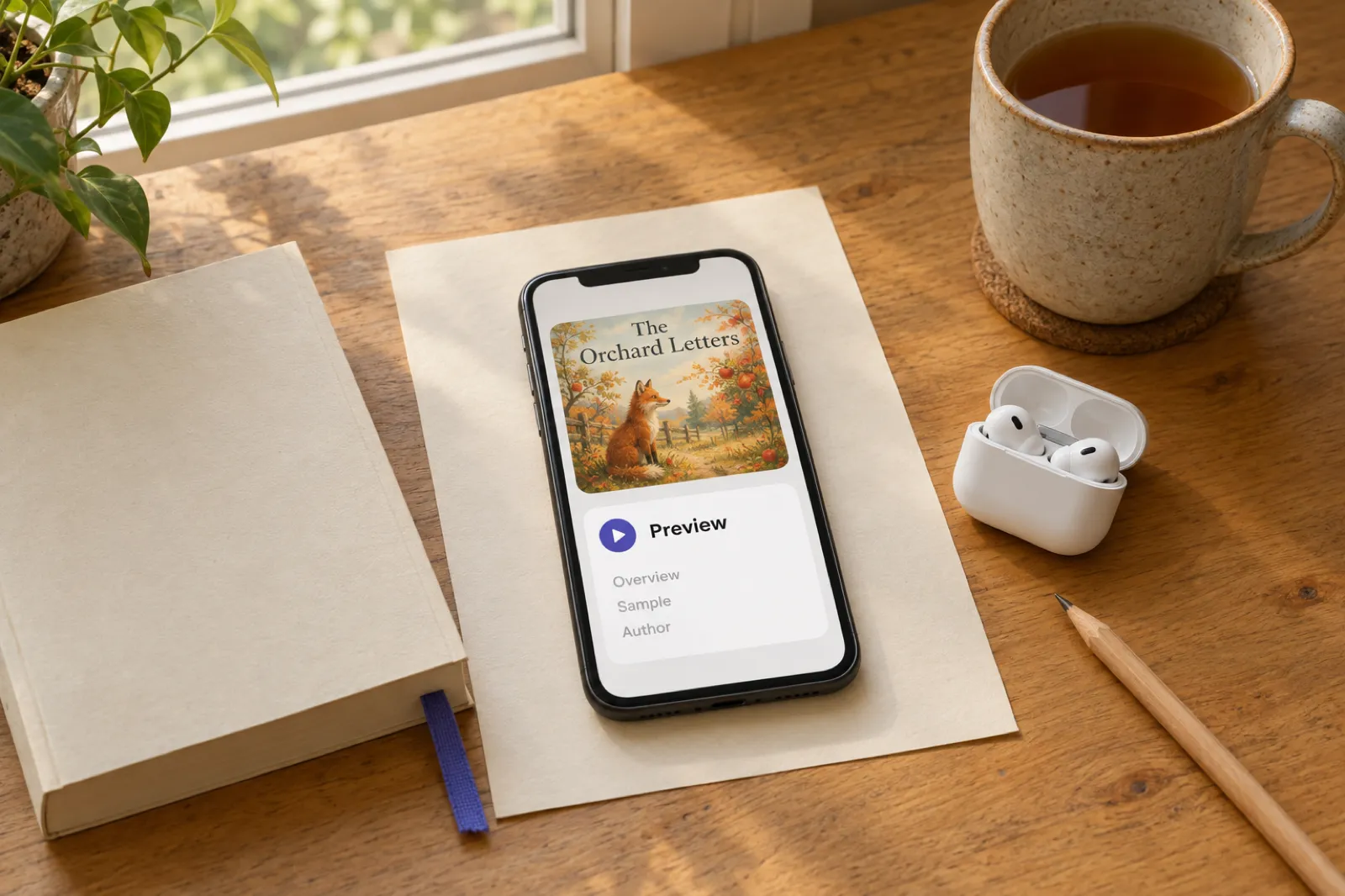
What Audible announced on 16 November 2026 Confirmed at source
Audible's newsroom post, "Audible personalizes how listeners find, explore and return to stories", dated 16 November 2026, announced four things at once:
- Audio discovery, which Audible calls "an industry-first way for listeners to find their next story": a short sound bite for a title that pairs a narrated sample with a brief overview and commentary.
- Personalised collections for US customers, built around each listener's tastes, which Audible presents as a way to find books beyond the bestseller lists.
- Ask a Question, expanding from its beta to select additional US titles.
- Recaps, expanding in the same way.
The only person quoted is Andy Tsao, Audible's Chief Product and Analytics Officer: "Picking your next listen should feel like getting a tip from a friend." He also talks about helping listeners find hidden gems, which, if it works, is what matters most to independent authors.
Audible has added AI features all year (the timeline below lists them), but Audio Discovery is the first that changes how ordinary titles from ordinary authors are presented to people who have not bought them yet.
Audio Discovery explained: what a listener actually hears
According to Audible, each sound bite combines three parts. Here is each one, what it is made from, and how much of it you can influence.
1. The AI overview
A brief spoken overview of the title's themes and "what listeners like" about it. Audible says it is voiced by "Audible's virtual voice, an AI-generated speech technology", and that the overviews "draw on publicly available material including synopses, metadata and reviews."
That is the most useful sentence in the announcement for an author. A synopsis is, for most self-published books, the description you wrote on KDP or the one your distributor sent to Audible. Metadata is everything attached to the listing: categories, series name and number, author and narrator names, length, release date and so on. Reviews are what readers and listeners have written publicly. Audible does not list the book's text as a source and does not describe how the overview is written or checked. A summary built from your description and reviews can only be as clear as they are.
TechCrunch asked whether a summary of "what listeners like" would leave out what they disliked; Audible has not said. For an author, the practical point is that if the overview passes on what readers praised, it helps when reviews praise something specific (the slow-burn romance, the clear exercises) rather than just "great book".
2. The narrated sample
The second part is the audiobook's own narrated sample, the same kind of retail sample listeners have always been able to play before buying. If a human narrator recorded your audiobook through ACX, that sample is a stretch of their performance. If your audiobook was made with KDP Virtual Voice, KDP's help page notes that "as with any audiobook, customers can listen to samples before purchasing." It is the one part of the bite that is your book in your narrator's voice. Choosing a sample has its own section below.
3. Author or editor commentary
The third part is commentary from the author or an Audible editor. Audible says the author commentary comes from "recordings of past Audible interviews". That matters for independent authors: if you have never been interviewed by Audible, and most self-published authors have not, there is nothing of yours for this slot to draw on. Audible has not said whether an editor fills the slot or the bite runs without it. Treat this part as outside your control.
When and where the bites play
Audible says the sound bites "can be listened to while on the go, as well as right after a current title ends". The idea is hands-free browsing while walking, driving or doing chores. Audible's post does not name the screen inside the app where the feature lives, so we have left the layout out.
Recaps, Ask a Question and personalised collections, explained
The other three features are mostly for listeners who already have the book, but they affect how your book is experienced once someone starts it.
Recaps
Recaps give "a brief, spoiler-free audio summary" of the story up to the point where the listener paused, so they can pick a book back up after time away. A listener who stalls at chapter 12 for three weeks can be reminded who is who and carry on rather than give up, which is quietly good news for long fiction.
Ask a Question
Ask a Question lets a listener ask about "a character, plot point, or historical reference" and get an answer without leaving the book. Audible first described it on 27 October 2025 as "an in-app beta feature that lets US listeners ask questions about the audiobook they're listening to", on classic and public domain titles. Audible says listeners who use it tend to spend more time listening to a title. Audible gives no numbers for that.
Who gets Recaps and Ask a Question, and when
Both were in beta "earlier this year" on select Audible Originals and public domain titles. Both now expand to select additional US titles and, in Audible's words, "begin rolling out broadly in December." Both are available only to customers who have bought the title or can listen to it through their Audible membership. Audible says both were "developed with input from creators". It has not said how titles are chosen or whether rights holders can decline.
Personalised collections
US customers see collections built around their tastes, which can only place your book well if your categories and description say clearly what it is.
| Feature | What the listener gets | Who can use it | Status (19 Nov 2026) |
|---|---|---|---|
| Audio discovery | A sound bite: narrated sample, AI-voiced overview, author or editor commentary | Anyone browsing, US, select English-language titles | Launched 16 Nov, plans to expand |
| Personalised collections | Collections built around their listening tastes | US customers | Launched 16 Nov |
| Recaps | A spoiler-free audio summary up to where they paused | People who bought the title or have it through membership | More US titles; broad rollout from December |
| Ask a Question | Answers about a character, plot point or historical reference | People who bought the title or have it through membership | More US titles; broad rollout from December |
Which books and which countries
Audio discovery starts with "select English-language titles in U.S., with plans to expand." That is all Audible has said. There is no published list of titles, no count, no description of how books are selected, and no date for the UK, Canada, Australia, India or anywhere else. Some coverage has implied wider dates; we could not find them on any Audible or Amazon page, so we have left them out.
If your audiobook is not in English or not sold in the US, nothing changes for you yet. If it is, neither your ACX nor your KDP dashboard shows whether your title has a preview; the only way to know is to look at it in the Audible app from a US account.
Can authors opt in or out? What we found Not announced
This is the question most authors are asking, and the honest answer is that Audible has not said. Its announcement mentions no opt-in, no opt-out and no controls for authors, narrators or publishers. On 19 November 2026 we also checked the ACX help pages and the KDP Virtual Voice help pages, and found nothing about audio discovery, Recaps or Ask a Question there either. One search result claimed that ACX creators could opt out before a wider rollout; we could not find that statement on any Audible, ACX or KDP page, or in any report that named a source, so treat it as unconfirmed.
Audible does say the features were "developed with input from creators" and that it "welcome[s] creator feedback to help shape how they evolve." If you have a view, write to ACX support, or to your distributor if they deliver your audiobook, with the title, the ASIN and what you want, and keep the reply.
Your ACX or distributor agreement governs how Audible sells and promotes your audiobook. Our ACX royalty change explainer covers the terms that come up most.
What feeds your book's preview, and what you control
Audible's list of sources, next to the parts of your listing you can edit:
| Ingredient | Where it comes from | Can you change it? | What to check |
|---|---|---|---|
| Synopsis (named by Audible) | Your book description on KDP, or the description your distributor or publisher supplied | Yes, on KDP at any time (up to 4,000 characters) | Does the first paragraph say who it is for, what happens and the tone, in plain words? |
| Metadata (named by Audible) | Categories, keywords, series name and number, contributors, length, language | Mostly yes, in KDP and your audiobook distributor | Up to three accurate categories; series numbered; narrator credited correctly |
| Reviews (named by Audible) | Public ratings and reviews from readers and listeners | No, only indirectly, by earning honest ones | Do reviews mention specifics a summary could repeat? |
| Narrated sample | Your audiobook's retail sample | Yes for ACX titles you produce; it is chosen at production | Does it start at a strong moment, not credits or front matter? |
| Commentary | Past Audible interviews with the author, or an Audible editor | No | Nothing to do unless Audible has interviewed you |
Three of the five are yours to improve today, and the work helps every store: a clear description converts better on Amazon, Apple Books and Kobo, accurate categories help Amazon's search, and a strong sample sells audiobooks everywhere.
If you have never been sure your KDP details are right, our KDP SEO guide covers titles, keywords and categories together, KDP categories for beginners explains how to choose the three, and Kindle keyword research covers the seven keyword boxes.
Rewrite your description before the AI reads it
The book description tool in the Inkfluence AI editor drafts three versions (Hook, Benefit and Short) from your book's details and opening chapters, so they start from what is really on the page. Pick one, edit it, then paste it into KDP. Free to start.
Draft my descriptionHow Audio Discovery relates to KDP Virtual Voice
"Virtual voice" now means two related things at Amazon, and the overlap is causing confusion.
Virtual voice, the speech technology. Audible's announcement says the overviews are spoken by "Audible's virtual voice, an AI-generated speech technology." So every audio discovery overview is AI speech, whoever narrated the audiobook itself. A book narrated by a well-known actor can be introduced by a synthetic voice, followed by the actor's sample. You do not choose this voice, and Audible has not said how the overview is labelled.
Virtual Voice, the KDP programme. Separately, KDP Virtual Voice lets invited authors turn a Kindle ebook into an AI-narrated audiobook sold on Audible and Amazon. Our full guide, KDP Virtual Voice: how it works, why you may not have it, and the alternatives, covers it in depth. The short version, as checked on KDP's own pages on 18 November 2026:
- It is an invite-only beta on the US marketplace, in English, Spanish, French and Italian, with about 80 voices. KDP's overview page says you can choose a different voice for each chapter.
- Free to create at the time of writing, with a 40% royalty at list prices from $3.99 to $14.99, and clearly labelled to listeners.
- Under the beta terms last updated on 21 October 2026, Amazon says "we retain ownership in the AVV Edition file" and that you give Amazon "the exclusive right to sell and distribute" it. While your ebook is in KDP Select, you also cannot sell or distribute the book in audio format elsewhere.
How do the two connect? A Virtual Voice audiobook is an Audible audiobook like any other, so it can presumably be picked for audio discovery like any other English-language US title; Audible has not said either way. If it is, a listener would hear an AI overview followed by an AI-narrated sample, both from Amazon's speech technology. That makes the sample's opening even more important, because there is no change of voice to signal "this is the book now".
Virtual Voice is the only way to get AI narration onto Audible today, but it is invite-only, US-only and Amazon-owned. If your readers are spread across stores, or you write in a language it does not cover, owning your audio files is the more durable position. The ACX AI narration policy explainer explains why third-party AI audio cannot go through ACX.
What changes for authors, moment by moment
Here is how a listener's path past your book changes with the new features, and what each moment asks of you.
| Moment | Before 16 November | With the new features | What to do |
|---|---|---|---|
| Browsing | Cover, title, rating, description on screen | For selected titles, a spoken overview built from synopsis, metadata and reviews | Make the description's opening say what the book is, plainly |
| Trying the book | Tap to play the retail sample | The sample is part of the sound bite, heard straight after the overview | Start the sample at a hook, not credits or a dedication |
| Hearing from the author | Only if the listener sought out interviews or video reels | Commentary from past Audible interviews, or an editor | Nothing, unless Audible has interviewed you |
| Finishing a book | Recommendations on screen | Sound bites can play right after the current title ends | Accurate categories and series data, so you are the next book for the right listener |
| Coming back after a break | Rewind or give up | Recaps (owners and members, rolling out from December) | Nothing; good news for long books |
| Confused mid-book | Search the web | Ask a Question (same access and timing) | Nothing; a reason to keep names and timelines consistent |
Worked example: rewriting a description so an AI overview reads well
No one outside Audible knows how its overviews are written, but a summary can only repeat what the description says. The test: if someone read only your description and your best reviews aloud in two sentences, would a listener know what kind of book this is and who it is for?
Here is an invented example, a cosy historical mystery called The Orchard Letters, first book in a series. This is the kind of description we see constantly:
Before
"An unforgettable journey of love, loss and secrets that will keep you turning the pages long into the night. Nothing is as it seems in this gripping, heartwarming tale. Perfect for fans of mystery, romance and historical fiction. You won't be able to put it down!"
Every sentence is praise or promise; none is information. No setting, no main character, no central question, no tone, and three genres. Now rewritten:
After
"Kent, 1952. When widowed apple grower Nell Ashby finds a bundle of unsent wartime letters hidden in her barn, one of them names her late husband as a witness to a crime nobody in the village will talk about."
"With harvest a month away and a buyer circling the farm, Nell has until the last apple is picked to find out who wrote the letters, and why someone wants them back. A gentle, clue-driven historical mystery with a slow-burn second chance at love, no graphic violence, and a village full of people with something to hide."
"Book one of the Orchard Mysteries. For readers who like a puzzle they can solve alongside the heroine, and a setting they can almost smell."
What changed, and why it matters for a spoken overview:
| What a listener needs | Before | After |
|---|---|---|
| Setting and time | None | "Kent, 1952", a farm and a village |
| Main character | None | Nell Ashby, widowed apple grower |
| The question | "Nothing is as it seems" | Who wrote the letters, and who wants them back |
| Tone and content | "Gripping" and "heartwarming" at once | Gentle, clue-driven, slow-burn romance, no graphic violence |
| Series | Not mentioned | Book one of a named series |
| Who it is for | "Fans of mystery, romance and historical fiction" | Readers who like solving along with the heroine |
To make the point concrete, here is the kind of two-sentence summary each version allows. These are our own illustrations, not Audible's output.
- From the before version: "A mystery with romance and historical elements. Readers say it is gripping and heartwarming." Accurate, and useless: it could describe ten thousand books.
- From the after version: "In 1952 Kent, a widowed apple grower finds hidden wartime letters that tie her late husband to a village crime. A gentle, clue-driven mystery with a slow-burn romance, the first in a series." A listener now knows in fifteen seconds whether this is for them.
Nothing in the after version is hype, and nothing would embarrass you read aloud. That is the standard to write to now, and it is what shoppers respond to on the page too.
The same rules for non-fiction
For a non-fiction book, swap the story elements for the reader's problem and the result. "A practical guide for first-time managers in small teams: how to run a one-to-one, give feedback that lands, and handle the first difficult conversation, with scripts for each" gives a summary something to say. "The ultimate guide to unlocking your leadership potential" does not. Name the reader, the problem, what they will be able to do, and the format (exercises, scripts, worksheets).
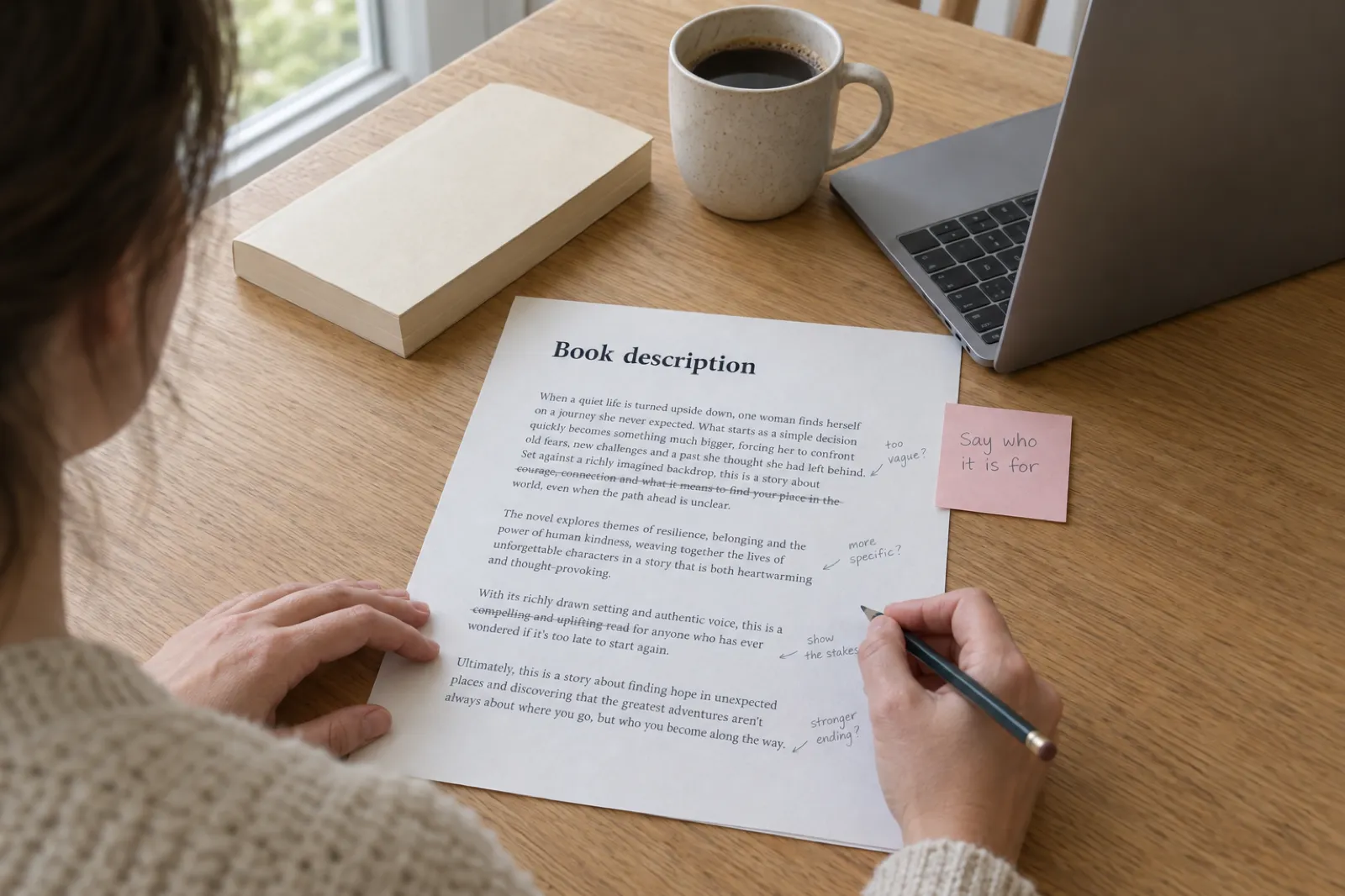
If you would like a starting point, our free book description generator writes five versions of a blurb from your premise in different formulas, with KDP-ready HTML. If you also want a short author bio for your listing and audiobook pages, the author bio generator does the same job for that.
The author checklist: getting ready for AI previews
Work through this once per book. Most items take minutes.
Your description
- Lead with facts, not praise. The first two or three sentences should say who, where, what is at stake (fiction) or who it is for and what they will get (non-fiction).
- State the tone and content level. "Cosy", "clean", "dark", "practical with worksheets": the words a listener needs to self-select.
- Name the series and the book's place in it. A summary cannot tell a listener to start at book one if your description does not say this is book one.
- Cut what you would not want read aloud. Strings of review quotes, all-caps and "You won't believe..." read badly in a spoken summary.
- Keep it consistent. If a distributor delivers your audiobook, check their description matches your Kindle page. Old descriptions linger.
Your metadata
- Categories. Up to three accurate ones in KDP. A cosy mystery filed under thriller to chase a smaller category gets recommended to the wrong people.
- Series data. Series name and number filled in for every book, ebook and audiobook alike.
- Contributors. Narrator and author names spelled consistently, with the same author name across every edition.
- Keywords. All seven boxes in KDP, describing the book, not other authors' names.
Your sample and audiobook
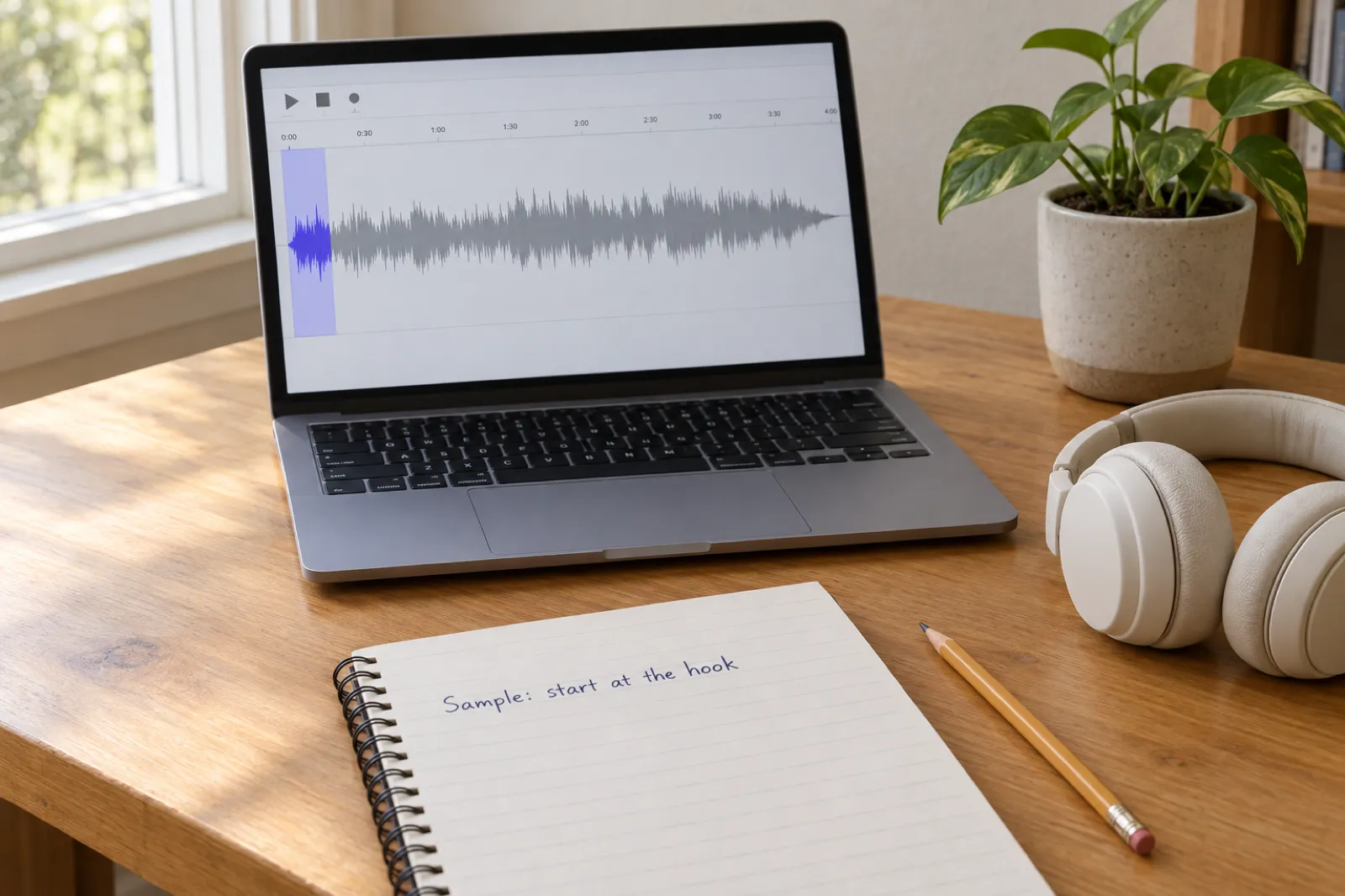
- Check the sample starts at the story. Not opening credits, not a dedication, not a three-minute foreword.
- Make sure an audiobook exists. A preview needs an audiobook to preview. If you have none, see where AI-narrated audiobooks can be sold.
- Check the narration is clean. Mispronounced names stand out when the overview has just said them.
Your reviews
- Ask for honest reviews, never paid or swapped ones. Amazon does not allow incentivised reviews.
- Make it easy to be specific. Ask readers in your back matter what they liked about the setting or the exercises.
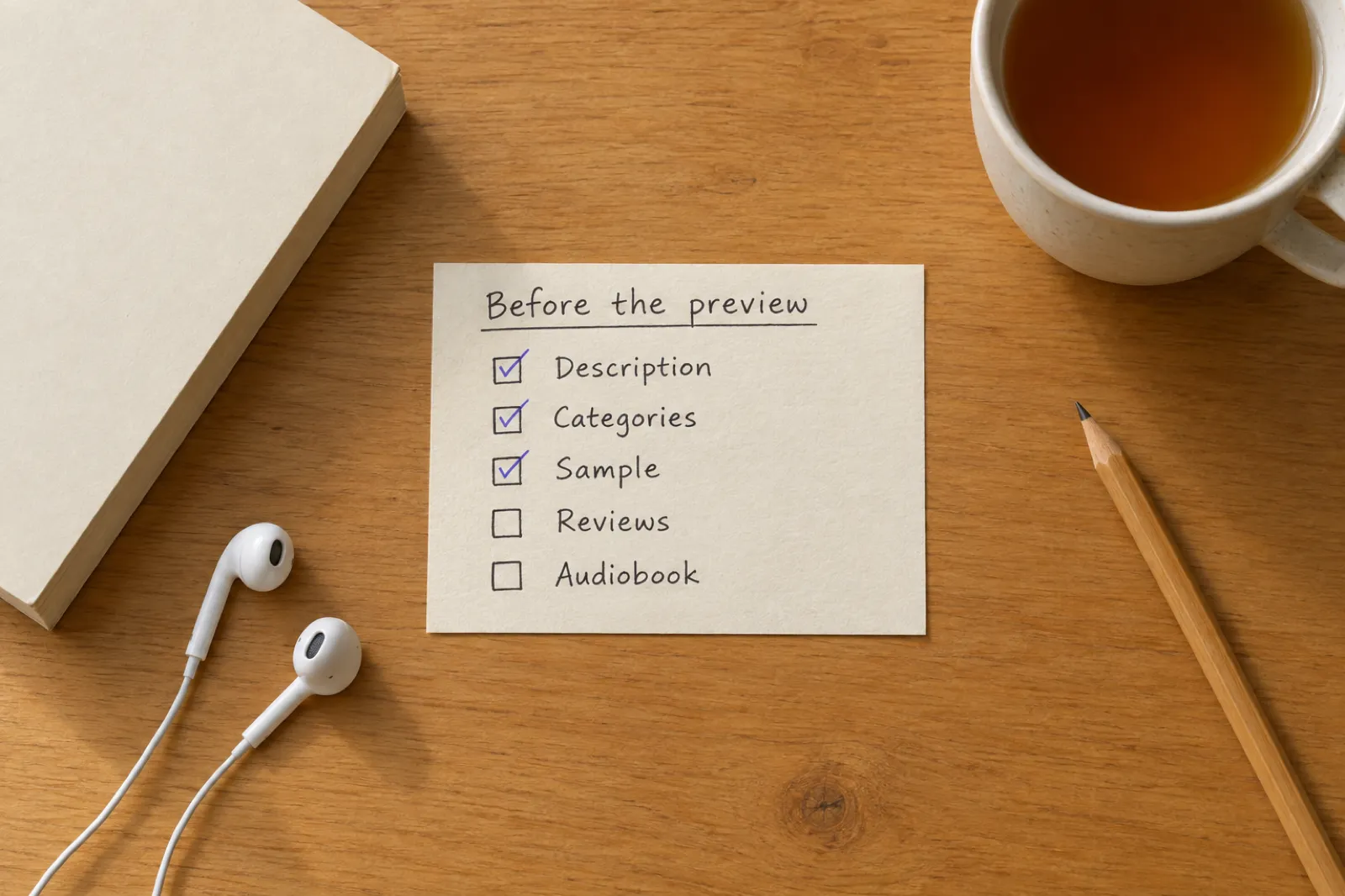
No audiobook yet? Make one you own
Import your manuscript or write it in Inkfluence AI, pick from 56 voices, and narrate it chapter by chapter in any of 20 languages. Download one MP3 per chapter or the whole book as a single MP3.
Make my audiobookYour sample matters more now
In the bite, your sample plays straight after a synthetic voice has said what your book is about, so its first thirty seconds decide whether the listener believes the overview.
- Know the rules. For ACX titles, the retail sample is up to five minutes long and taken from the audiobook itself; ACX suggests the first five minutes, but the rights holder can choose a different section. ACX's guidance has long been that the sample starts with narration rather than credits or music and contains no explicit material. Our ACX audiobook guide covers the full set of requirements.
- Start at the hook. If your first chapter opens slowly, pick a later section where the voice and premise are clear. For non-fiction, choose a passage that delivers one useful idea completely.
- Match the overview. If your description promises a cosy mystery and your sample is the one bleak scene in the book, the listener hears a contradiction.
- Avoid spoilers. A sample from late in the book can give away a twist the overview carefully avoided.
The audiobook length calculator tells you roughly how many words five minutes covers, which helps you pick a sample that ends at a natural break.
Where AI-narrated audiobooks can be sold
Audio discovery only helps a book with an audiobook on Audible, and the AI route onto Audible is narrow while the routes elsewhere are wide. The current picture, from our dated guide to where to sell an AI audiobook:
| Store | AI narration? | The catch |
|---|---|---|
| Audible via ACX | No. Human narration unless otherwise authorised | ACX says Audible "is working to accept third-party TTS content", with no date |
| Audible via KDP Virtual Voice | Yes, Amazon's own AI voices | Invite-only, US only, four languages; Amazon owns the recording and has the exclusive right to sell it |
| Google Play Books | Yes, uploads with the "synthesized voice" narrator option, and its own auto-narration | Auto-narration needs the ebook on Google Play; 52% revenue share on auto-narrated titles |
| Kobo | Yes, any language, no exclusivity | 45% on single sales at $2.99 and up |
| Spotify | Yes through some distribution partners, and its own free creation tools for up to five books | Creation tools are for eligible markets in English and Spanish |
| Your own site or shop | Yes, your rules | You do the marketing; fees from the platform you use |
So there are two sensible plans, depending on where your readers are:
- Your readers are on Audible and you have a Virtual Voice invite. Virtual Voice is the simplest way in, and its titles can sit inside Kindle+ and Audible Plus. Go in knowing the ownership terms.
- You have no invite, sell wide, or write in another language. Make audio you own and sell it on Google Play Books, Kobo and your own site, and if Audible is essential, consider a human narrator through ACX (which can be you: see narrate your own audiobook). KDP says audiobooks published outside Audible do not affect Virtual Voice eligibility, so selling your own AI audio wide does not shut that door.
Store setup: Google Play Books, Kobo, and Spotify in 180+ markets. The exclusivity choice is in KDP Select vs wide, and AI vs human narrators and our side-by-side comparison weigh cost, time and where each can be sold.
Hear your own book before you decide
Open a chapter in the Inkfluence AI audiobook studio and preview it in any of 56 voices. Keep the MP3s, sell them where AI narration is welcome, and keep your options open on Audible.
Preview my chapterMake the book and the audiobook with Inkfluence AI
Audio discovery rewards books that are clear about what they are, with a good audiobook behind them. Inkfluence AI is the best tool for doing both in one place:
- The book. Describe it, approve an outline, and the AI book writer writes every chapter from your plan. For fiction, a story bible keeps names, places and events consistent. Already written it? Import from Word, PDF or EPUB.
- The description. The book description tool in the editor drafts three versions from your book's details and opening chapters; edit your favourite with the checklist above. The free book description generator gives five blurb formulas to compare.
- The audiobook. The AI audiobook generator narrates chapter by chapter in 20 languages. Choose from 56 voices (all of them reading the same passage in the voice library), fix how a name is said once for every chapter, and download one MP3 per chapter or the whole book as a single MP3. The ebook to audiobook guide shows the studio in under a minute.
- Other languages. The AI book translator makes a new edition you can narrate in that language: 20 languages against Virtual Voice's four.
- Everything around it. A KDP-ready PDF and paperback interior, EPUB and Word export, an AI book cover generator and A+ Content for your Amazon page.
Honest limits. Audiobooks are part of the paid plans: the free plan includes 0 audiobook chapters a month, Creator ($9.99 a month) includes 15 and Premium ($19.99 a month) includes 30, with the more expressive HD voices on Premium. Inkfluence AI does not upload to stores for you, and its AI audio, like any outside AI audio, cannot go on Audible through ACX today; it is for Google Play Books, Kobo, your own site and other stores that accept AI narration. Every plan is on the pricing page, and our comparison of the best AI audiobook generators sets the options side by side.
Timeline: Audible's AI features and the author rules around them
- 27 October 2025: Audible introduces Ask a Question as an in-app beta for US listeners on classic and public domain titles.
- Earlier in 2026: Recaps and Ask a Question in beta on select Audible Originals and public domain titles (Audible's 16 November post).
- 26 May 2026: ACX's new royalty model for new users (50% exclusive, 30% non-exclusive). See the legacy model ending.
- 21 August 2026: Audible adds Page Sync, deeper Maven search conversations and personalised video reel collections (US).
- 1 October 2026: Character Guide, Interactive Story and Visual Explorer in limited beta (US and UK).
- 21 October 2026: KDP Virtual Voice beta terms updated: Amazon keeps ownership of the Virtual Voice audiobook file. Details in our Virtual Voice guide.
- 16 November 2026: Audio discovery launches for select English-language US titles, with personalised collections, and Recaps and Ask a Question expand to more US titles.
- December 2026: Recaps and Ask a Question begin rolling out broadly, for owners and members.
- End of 2026: ACX's legacy royalty model is discontinued.
- Not yet dated: audio discovery outside the US; ACX accepting third-party AI narration.
What we still do not know
We will update this page when Audible or Amazon answers these:
- How titles are chosen, and whether every English-language US title will get one.
- Whether authors, narrators or publishers can see, correct, opt in to or opt out of an overview.
- How the overview is labelled as AI-generated to listeners.
- What fills the commentary slot for a book whose author Audible has never interviewed.
- How negative reviews are treated when the overview summarises "what listeners like".
- When the feature reaches other countries and languages.
Until then, improve what you control. For the rest of this month's changes, see what changed for self-publishers in November 2026, and for how Kindle+ now pays for listening, Kindle+ for authors.
Give the preview something good to say
Write the book, draft a description that says what it is, and narrate an audiobook you own, all in one project. Free to start, no credit card.
Start your book freeHow we checked this
Audible facts come from Audible's newsroom posts, read on 19 November 2026; Virtual Voice details from KDP's help pages and beta terms (18 and 19 November); ACX rules from ACX's help pages. Press coverage pointed us to the news but is not the source for any fact here. Press claims we could not find on an official page (tab names in the app, an opt-out for ACX creators, dates for other countries) are left out. The worked example is our own illustration, not Audible output.
Frequently asked questions
What is Audible Audio Discovery?
A way to preview audiobooks that Audible announced on 16 November 2026: a short sound bite combining a narrated sample, a brief AI-voiced overview of the book's themes and what listeners like, and commentary from the author or an Audible editor taken from past Audible interviews.
What does the Audio Discovery overview draw on?
Audible says the overviews "draw on publicly available material including synopses, metadata and reviews." For an author, that means your description, your listing details (categories, series, length) and your reviews. Audible does not say the overview uses the book's text.
Which audiobooks get an Audio Discovery preview?
Audible says it starts with "select English-language titles" in the US, with plans to expand. There is no published list, count or selection rule, and no date for other countries.
Can authors opt in or out of Audio Discovery?
Audible has not said. Its 16 November announcement mentions no opt-in, opt-out or author controls, and we found none on Audible, ACX or KDP help pages on 19 November 2026. Audible says it welcomes creator feedback, so contact ACX or KDP support, or your distributor, if you want to ask.
Is Audio Discovery the same as KDP Virtual Voice?
No, but they share a voice. Audible says the overviews are spoken by "Audible's virtual voice, an AI-generated speech technology", the same name as the KDP programme that lets invited authors turn a Kindle ebook into an AI-narrated audiobook. Audio Discovery previews selected titles whoever narrated them; KDP Virtual Voice makes the audiobook itself, and under its 21 October 2026 terms Amazon owns that recording.
Who can use Audible Recaps and Ask a Question?
Listeners who bought the audiobook or have it through their Audible membership. Both are expanding from a beta to more US titles and begin rolling out broadly in December 2026.
Can I sell an AI-narrated audiobook on Audible?
Only through KDP Virtual Voice, which is an invite-only beta on the US marketplace. ACX requires human narration unless otherwise authorised. AI-narrated audiobooks you make yourself can be sold on Google Play Books, Kobo and your own site.
How do I get my book ready for AI previews?
Write a description that states plainly who the book is for, what happens or what the reader learns, and the tone, near the top. Choose accurate categories and series details, pick a sample that starts at a strong moment, and earn honest, specific reviews.
Sources
- Audible Newsroom, Audible personalizes how listeners find, explore and return to stories, 16 Nov 2026, read 19 Nov 2026
- Audible Newsroom, These features transform how customers discover and engage with new listens, 27 Oct 2025 (Ask a Question beta)
- Audible Newsroom, The next chapter in listening: new ways to interact with stories on Audible, 1 Oct 2026
- Audible Newsroom, New ways for listeners to sync, search, and discover on Audible, 21 Aug 2026
- KDP Help, Virtual Voice overview, royalties and pricing and Virtual Voice beta terms (last updated 21 Oct 2026), read 18-19 Nov 2026
- ACX Help, ACX audio submission requirements
- KDP Help, Make your book more discoverable with keywords
- TechCrunch, Audible turns to AI to help users discover audiobooks, 16 Nov 2026 (reporting)
- Publishing Perspectives, Audible harnesses AI to expand features for listeners, Nov 2026 (reporting)
Related reading
- KDP Virtual Voice: how it works, who owns the audiobook, and the alternatives
- Can you publish AI-narrated audiobooks on Audible? The ACX policy explained
- Where to sell an AI audiobook: every store's rule, dated
- How to make an audiobook with AI
- The state of AI audiobooks in 2026
- Turn your ebook into an audiobook with AI
- Self-publishing on Amazon KDP: the full process

Inkfluence AI Team
Tips, tutorials, and strategies from the Inkfluence AI team to help you write, publish, and sell ebooks faster.
Helpful links

Ready to write your own book?
Write with AI, make it yours, and export PDF, EPUB and KDP-ready files from one project.
Keep reading
 Audiobooks
Spotify's Free AI Audiobook Tool Is Now in the UK: What You Get, the Limits, and When to Make Your Own
On 18 November 2026 Spotify opened its free Audiobook Creation Tools to self-published authors in the UK and 20 more markets, and added Spanish. Here is exactly what you get, the five-book limit as Spotify's help centre defines it, who is eligible, where the audiobook can go, and when making your own audiobook files is the better route.
 Company
What's New in Inkfluence AI: November 2026
Book videos, picture books at print size, your own characters, the app in eight languages, folders, 56 narrators that now read your introduction, and the Black Friday offer: everything new since October.
 Publishing
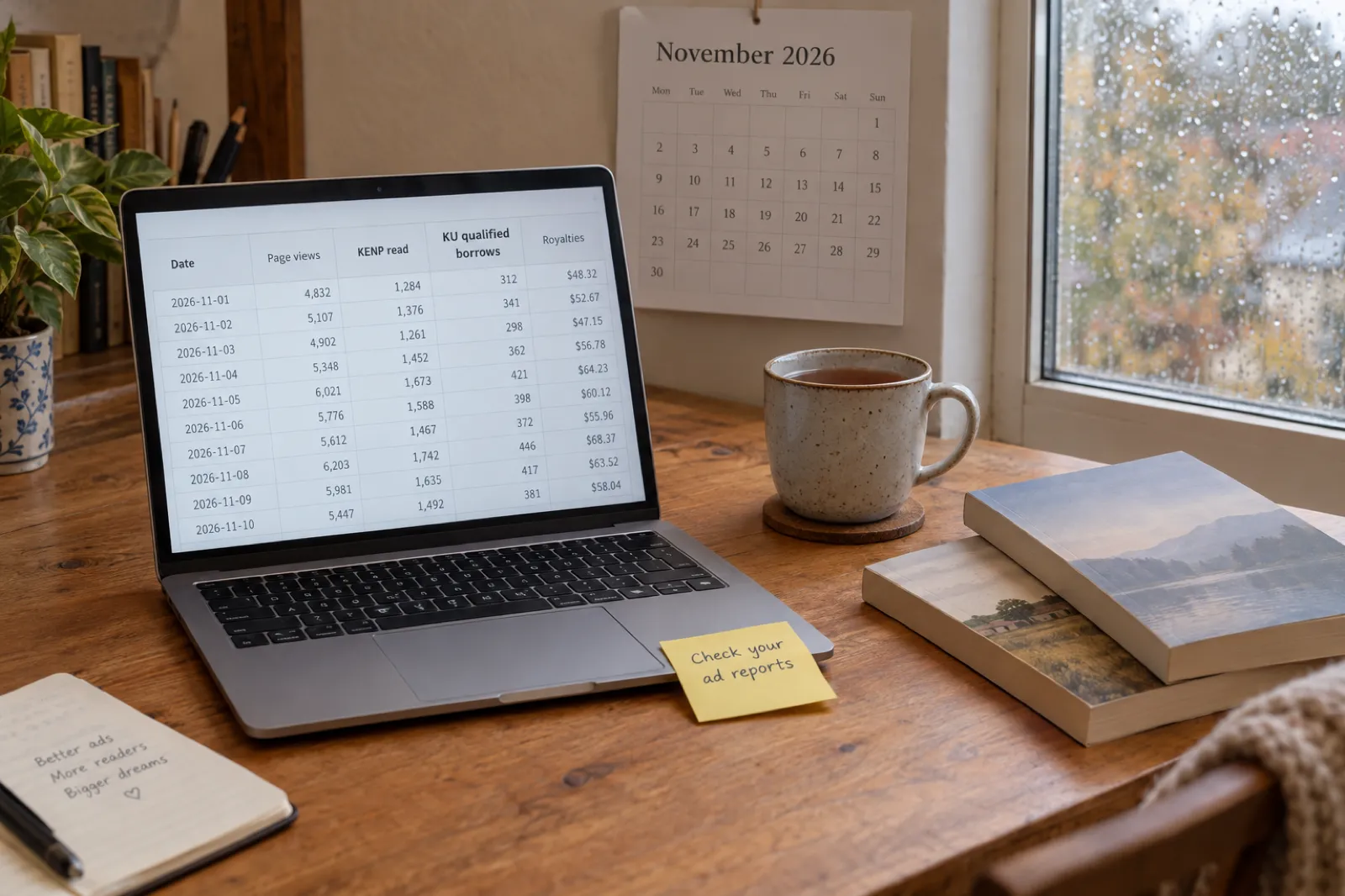
What Changed for Self-Publishers This Month (November 2026)
The self-publishing changes that matter in November 2026, each checked at its source: Amazon Ads dropped page-based KENP royalty estimates for "qualified borrows", Etsy prints your digital files and refunds the full 6.5% fee through Share & Save, Spotify audiobooks head to 180+ markets, Smashwords takes pre-orders, and new Gemini and GPT models. What each means and what to do.

Get ebook tips in your inbox
Join creators getting weekly strategies for writing, marketing, and selling ebooks. You also get our free PDF guide, Your First Book in a Weekend.