

Quick Answer
On 22 October 2026 Amazon renamed Kindle Unlimited to Kindle+ and added audiobooks to it. For ebooks, nothing you need to do changes: books in KDP Select stay in the subscription and page reads are paid from the KDP Select Global Fund as before. What is new: Virtual Voice audiobooks join automatically when their ebook is in KDP Select; ACX audiobooks join only if they are Audible-exclusive, on Pay for Production, with Whispersync on; listening is paid by the page, from the same fund, at a rate Amazon has not published; and audiobooks in Kindle+ are US-only for now. Audiobooks narrated with outside AI tools can't get in, because ACX doesn't accept them.
Kindle Unlimited launched in 2014 as an all-you-can-read ebook subscription. Twelve years later it has a new name and a second format. Amazon's announcement, posted to the KDP Community on 22 October 2026, says subscribers can now "read, listen, or do both at no additional cost", and product pages now carry a Kindle+ badge with the line "Over 5 million eBooks and audiobooks". For readers it is mostly a rename with a bonus. For authors it changes three practical things: which audiobooks earn from the subscription, how those earnings are counted, and what the KDP Select decision is now worth.
This guide sticks to what Amazon has said in its announcement and KDP Help pages, and marks clearly what it has not said yet. It covers what changed, the two routes an audiobook can take into Kindle+, how listening is paid, a calculator for what a book might earn, how to decide between KDP Select and selling everywhere, how to update your marketing, and a checklist for this week.
Disclosure: Inkfluence AI is our product. It writes books and makes audiobooks, so we have an interest in this topic. We say plainly below where our own audiobooks can and can't go.
Published 28 October 2026, six days after the announcement. We will update this page when Amazon publishes the first month of listening rates.
What changed on 22 October 2026
| Area | Before (Kindle Unlimited) | Now (Kindle+) |
|---|---|---|
| Name and badge | Kindle Unlimited | Kindle+, with a new badge in KDP Help. Amazon suggests "Available in Kindle Unlimited (now Kindle+)" in your marketing during the switch. |
| Formats | Ebooks | Ebooks and eligible audiobooks |
| Ebook payment | Per page read (KENP), from the KDP Select Global Fund | Unchanged |
| Audiobook payment | Not part of the subscription | Per page listened, from the same Global Fund, which Amazon says it is adding money to |
| Where audio is included | n/a | US subscribers only, for now. Authors in any marketplace can enrol eligible audiobooks for US readers. |
| Reports | "Subscription royalties" | "Kindle+ royalties"; the KENP report now splits pages read and pages listened, with an "All formats" filter |
| What you must do | n/a | Nothing, if your ebook is already in KDP Select. It stays in. |
What subscribers see
It helps to know the reader's side, because it shapes how much listening there will be. Press coverage of the launch reports that the US price stays at $11.99 a month and that subscribers can still borrow up to 20 titles at a time. KDP Help confirms that readers don't need Prime to subscribe. No listening cap in hours has been reported. Amazon is replacing the Kindle Unlimited name on product pages, accounts and devices, so a reader browsing your book page will see the Kindle+ badge, and if your audiobook qualifies, they can start listening from the same borrow.
That last part matters more than it sounds. Until now, a subscriber who wanted the audiobook of a Kindle Unlimited book usually had to buy it, or use Whispersync pricing. Now the borrow covers both for eligible titles. Readers who switch between reading on the commute and listening at the gym may finish more books, and every finished page is a page in your report.
A short history of Kindle Unlimited
- July 2014: Kindle Unlimited launches in the US. Authors are paid per borrow once a reader passes 10% of the book.
- July 2015: Amazon switches to paying per page read, using Kindle Edition Normalized Pages (KENP). This is the model that still runs today.
- 2023: Amazon starts testing Virtual Voice, its own AI narration for KDP ebooks, on an invite-only basis.
- 21 September 2026: KDP limits new titles to two per format per week, resetting each Sunday at midnight UTC.
- 22 October 2026: Kindle Unlimited becomes Kindle+ and adds eligible audiobooks for US subscribers, paid per page from the same fund.
Which audiobooks are included
There are two routes for an audiobook into Kindle+, and they work very differently. A third kind of audiobook, the one you make yourself with an AI voice tool, has no route in at all.
Route 1: Virtual Voice audiobooks (automatic)
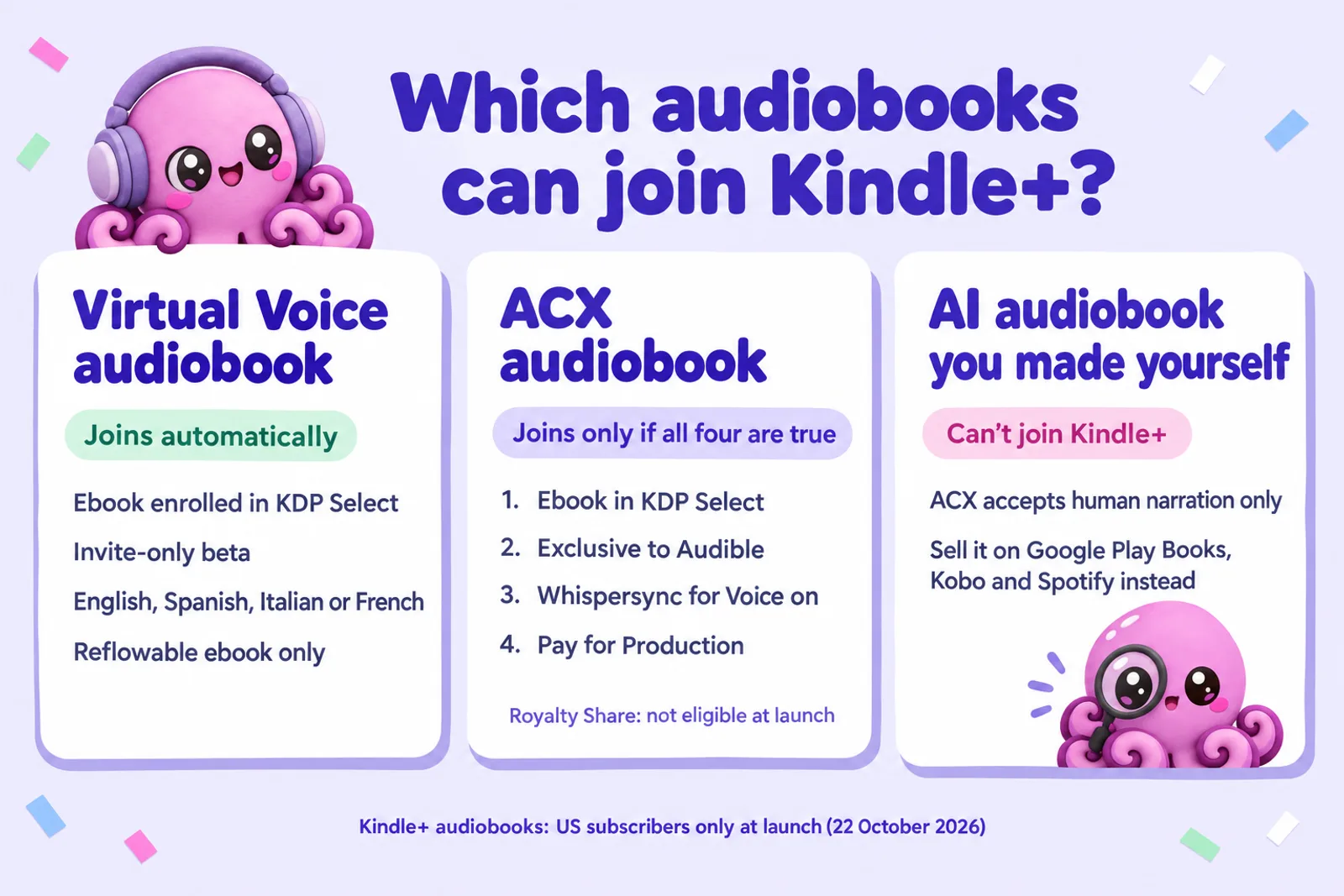
Virtual Voice is Amazon's own AI narration, offered inside KDP. KDP Help says: "Audiobooks with virtual voice are automatically enrolled in KDP Select when your corresponding eBook is enrolled." You don't opt in separately, and you can't opt the audiobook out on its own. If you want only the ebook in Kindle+, the help page's answer is to unpublish the Virtual Voice audiobook.
The catch is getting a Virtual Voice audiobook in the first place. Amazon's eligibility page describes it as "an invite-only beta for eligible KDP eBooks". If your ebook qualifies, an "Add Audible audiobook with virtual voice" option appears on your Bookshelf. The listed requirements include:
- The ebook's main language is English, Spanish, Italian or French. Japanese is not supported.
- The ebook is reflowable. Fixed-layout ebooks, such as most picture books, are not eligible.
- It is not public domain content, not on pre-order, and has no empty chapters.
- It has a cover, a primary author, and a proper table of contents (a Kindle Interactive or NCX table of contents).
- It has no existing Audible audiobook. An ACX edition, or one for a previous edition, has to be unpublished first.
- The title is under 200 characters, with no HTML or unsupported characters, and the book has no more than 1,000 chapters.
Amazon also says books built around images, tables, graphs or code may not suit audio, and names cookbooks and comics as examples. Amazon decides which ebooks it accepts.
How to check whether you've been invited. Open your KDP Bookshelf and look at each ebook enrolled in KDP Select. If the "Add Audible audiobook with virtual voice" option is there, that ebook is eligible. If it isn't, run through the list above: the most common blockers for indie books are a fixed-layout file, a missing table of contents, an empty chapter left over from drafting, or an existing ACX edition. Fixing the file doesn't guarantee an invitation, but a book that fails the list can't get one. If your ebook was made with Inkfluence, a clean reflowable EPUB with a real table of contents is the default; our Kindle formatting guide covers the details.
Route 2: ACX audiobooks (only on strict terms)
An audiobook made through ACX, Audible's production marketplace, can join Kindle+ only if all four of these are true:
- The matching ebook is enrolled in KDP Select.
- The audiobook is distributed exclusively through Audible.
- Whispersync for Voice (Read & Listen) is turned on.
- It was made on Pay for Production, meaning you paid the narrator up front.
Royalty Share and Royalty Share Plus audiobooks are not eligible at launch; Amazon says it is "exploring" adding them. That makes sense when you look at the money: on Royalty Share the narrator is paid from your royalties, and there is no agreed way yet to split a per-page subscription payment with them. Unlike Virtual Voice titles, ACX audiobooks can be taken out of KDP Select separately from their ebook.
If you already have a Pay for Production audiobook that is exclusive to Audible, you are probably one setting and one click away: check that Whispersync is on, then enrol the audiobook from your KDP Bookshelf. ACX has its own changes in train too: its legacy royalty model ends on 31 December 2026, which we cover in our guide to Audible and ACX's AI narration policy. If you're making an ACX audiobook for the first time, start with how to create an ACX audiobook from your ebook.
What about AI audiobooks you make yourself?
They can't join Kindle+. ACX accepts human narration only (plus Amazon's own invite-based Voice Replica programme), so an audiobook narrated with an outside AI tool has no way into Audible, and so no way into Kindle+. That includes audiobooks made with Inkfluence. We cover the full rules, and the stores that do accept AI narration, in where to sell an AI audiobook.
In practice that leaves two sensible routes for an author using AI narration:
- Amazon's route: keep the ebook in KDP Select and, if you are invited, add a Virtual Voice edition. It joins Kindle+ automatically.
- The wide route for audio: sell your own AI-narrated audiobook on the stores that accept labelled synthetic narration: Google Play Books, Kobo, and Spotify through the providers it approves. Our AI audiobook generator makes those files, and the audiobook length calculator tells you how long the finished book will run.
Amazon has not said how a Virtual Voice edition sits alongside an AI audiobook of the same book on other stores, so check the Virtual Voice terms on your Bookshelf before doing both.
Every Kindle+ route starts with the ebook
Inkfluence writes the book with you, chapter by chapter, and exports a reflowable, KDP-ready EPUB with a real table of contents: the file Virtual Voice and KDP Select both need.
Start your Kindle book freeHow listening is paid
Amazon's announcement and the KDP Help page describe the mechanics. The money is the part nobody can calculate yet.
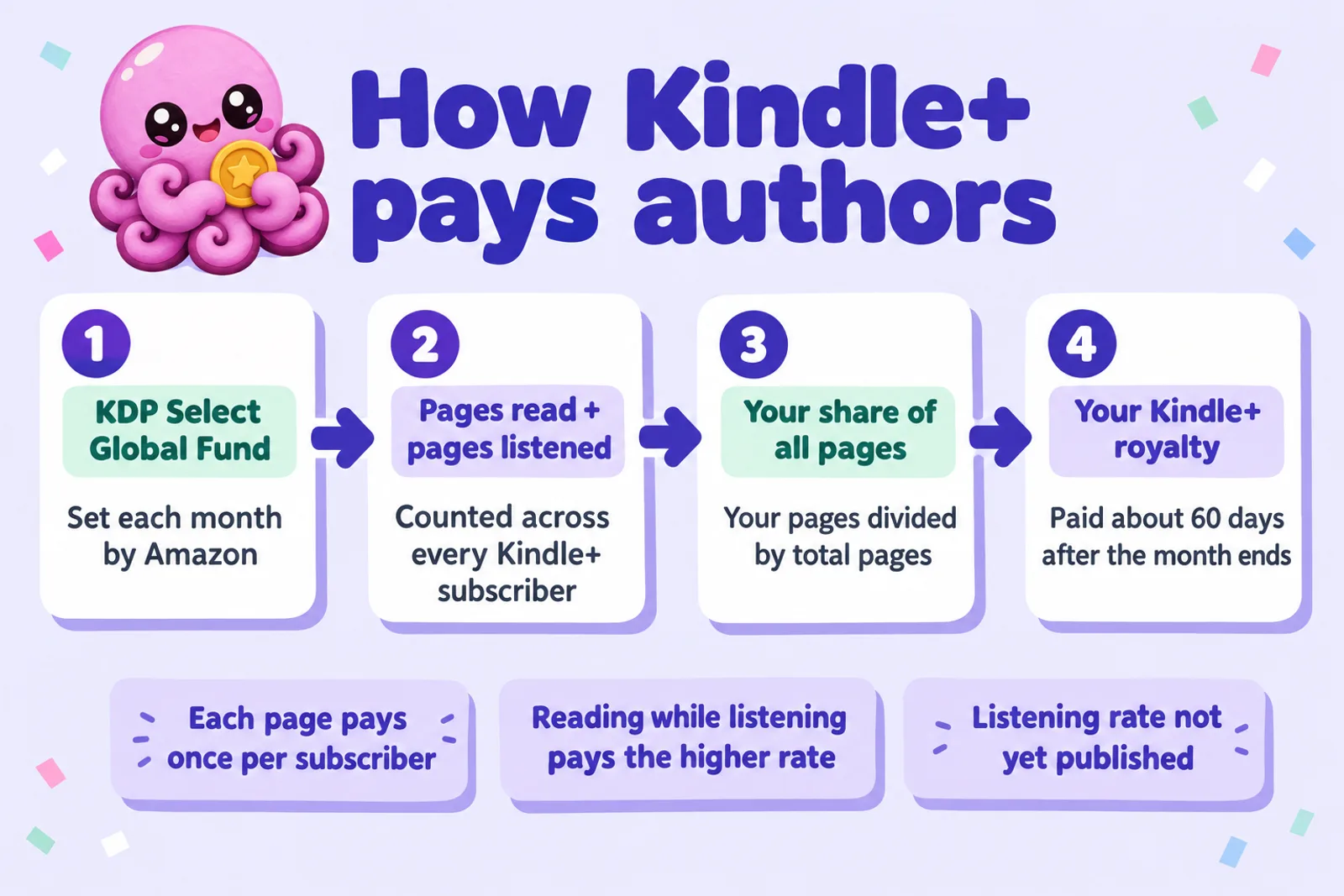
- Same fund, by the page. Listening is paid from the KDP Select Global Fund, based on your share of all pages read or listened to by subscribers. Amazon says it is adding money to the fund for audiobooks. It has not said how much.
- Each page pays once per subscriber. Per Amazon's announcement, as summarised by Written Word Media, a subscriber's first read or listen of a page earns; reading and then listening to the same page does not pay twice. Re-reads and re-listens don't pay again either.
- Reading while listening (Immersive Reading) pays at whichever format's rate is higher, when the two differ.
- The listening rate is not published. Amazon has not said whether a page listened pays the same as a page read, or committed to keeping the per-page rate where it is.
- Timing is unchanged. The Global Fund for a month is announced around the 15th of the next month, and KDP pays royalties about 60 days after the end of the month in which they were earned.
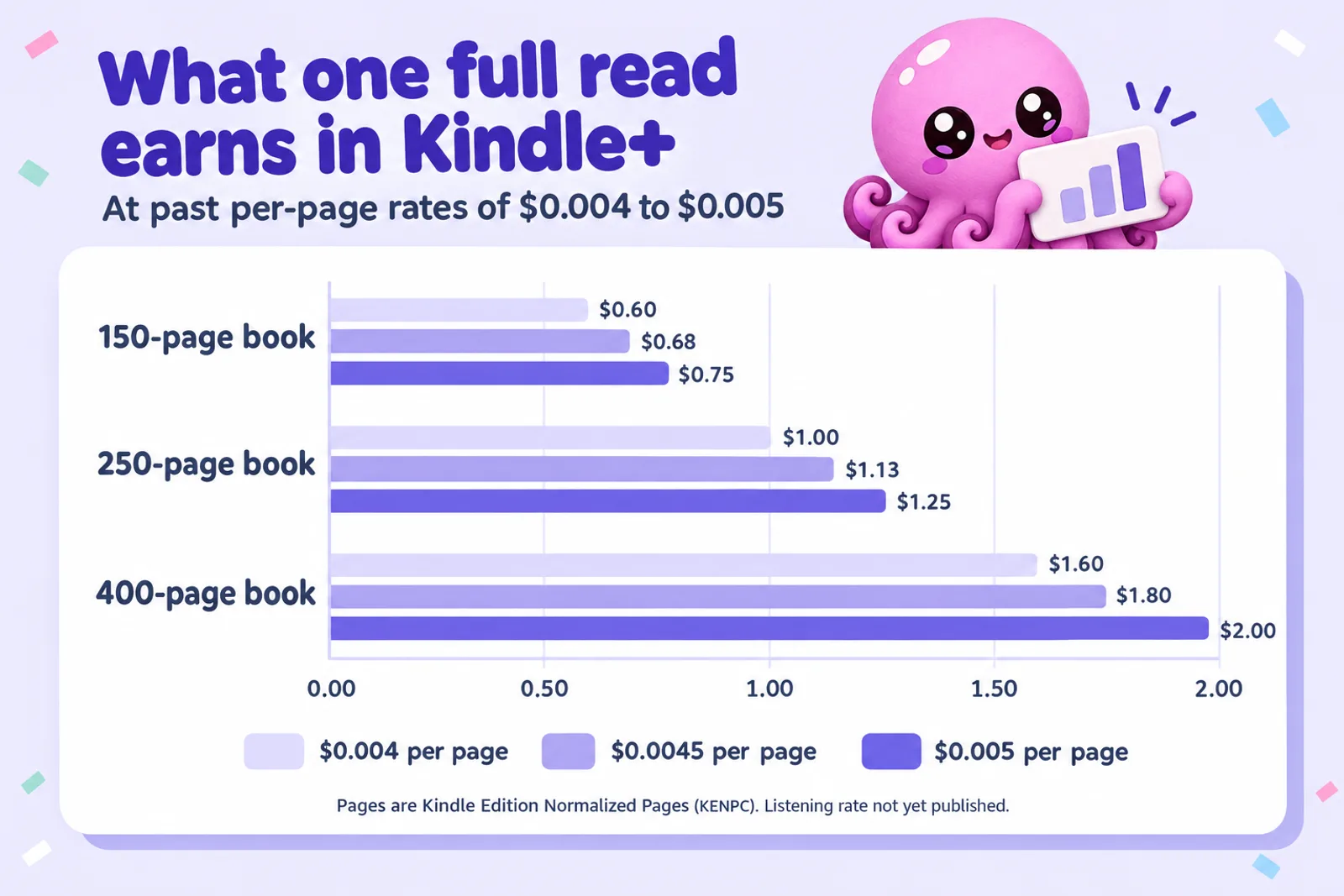
A rough sense of scale. Third-party trackers put the per-page rate for ebook reads at roughly $0.004 to $0.005 over the last few years. At that rate, a 250-page (KENPC) novel read cover to cover by one subscriber earns about $1.00 to $1.25. If listening pays a similar rate per page, a full listen earns about the same. If it pays less, it earns less. Nobody outside Amazon will know until the first month with listening (October 2026) is reported, which under KDP's usual timetable is around mid-November.
| Book length (KENPC pages) | At $0.004 a page | At $0.0045 a page | At $0.005 a page |
|---|---|---|---|
| 150 pages (short novel or guide) | $0.60 | $0.68 | $0.75 |
| 250 pages (typical genre novel) | $1.00 | $1.13 | $1.25 |
| 400 pages (long fantasy or epic) | $1.60 | $1.80 | $2.00 |
Your book's KENPC figure is shown in the KDP Select section of your Bookshelf. It is not your print page count: Amazon normalises font, spacing and layout, so the KENPC count rarely matches the paperback page count, and is often higher. Use the KENPC number in the calculator below. For what a sale (rather than a borrow) earns, our royalty calculator runs the 35% and 70% maths, and KDP royalties explained covers delivery fees and price bands.
The question authors are asking. If listening pulls from the same fund, does it shrink the ebook per-page rate? Amazon says it is adding money to the fund. Whether the addition matches the extra pages is the open question. Watch the rate for the next two or three months before deciding anything drastic.
Kindle+ earnings calculator
Put in your book's KENPC page count and a guess at monthly reads and listens. Because Amazon hasn't published the listening rate, the calculator lets you set it as a share of the reading rate, so you can see the range. It assumes each read or listen covers the whole book once; partial reads earn proportionally less.
From reading
$0.00
From listening
$0.00
Total a month
$0.00
Earnings = KENPC pages x full reads x rate, plus pages x full listens x rate x the listening share, times the number of books. Past ebook rates have run at about $0.004 to $0.005 a page (third-party trackers); Amazon sets the real rate each month and has not published a listening rate. An illustration, not a forecast.
Write the next book in your seriesReading the numbers honestly. Subscription income rewards books people finish. Pages only pay when someone reads or hears them, so a book that loses readers in chapter three earns a fraction of the table above. The same is true of listening. That's the case for putting the effort into the opening chapters and the series hook, rather than into volume. If you write series, our guide to writing a book series with AI and the series writer are built around keeping readers moving from book one to book two.
Write a book subscribers finish
Kindle+ pays by the page, so the chapters that keep people reading are the ones that earn. Inkfluence drafts each chapter with your outline, characters and story so far in view, and you edit every line before it goes out.
Start writing freeWhat stays the same
- KDP Select exclusivity still covers the ebook: while enrolled, the digital edition can't be sold elsewhere, in 90-day terms.
- Enrolment doesn't change how your book sells on Amazon; readers can still buy it outright, at your usual royalty.
- Existing enrolments carry over. You don't need to re-enrol anything.
- Readers don't need Prime to subscribe.
- Select promotions such as Kindle Countdown Deals and free promotion days work as before.
- Your AI disclosure to KDP works as before. See our guide to the KDP AI disclosure questions.
- The weekly title limit introduced on 21 September 2026 still applies: two new titles per format per week, resetting each Sunday at midnight UTC. Updates to books you've already published don't count. Our KDP publishing calendar has the dates that matter before Christmas, and the how-many-books calculator shows what the limit means for a catalogue.
Should you enrol in KDP Select now?
Kindle+ adds a second way to earn from the subscription, but only for some books. Here is how we'd think about it by book type.
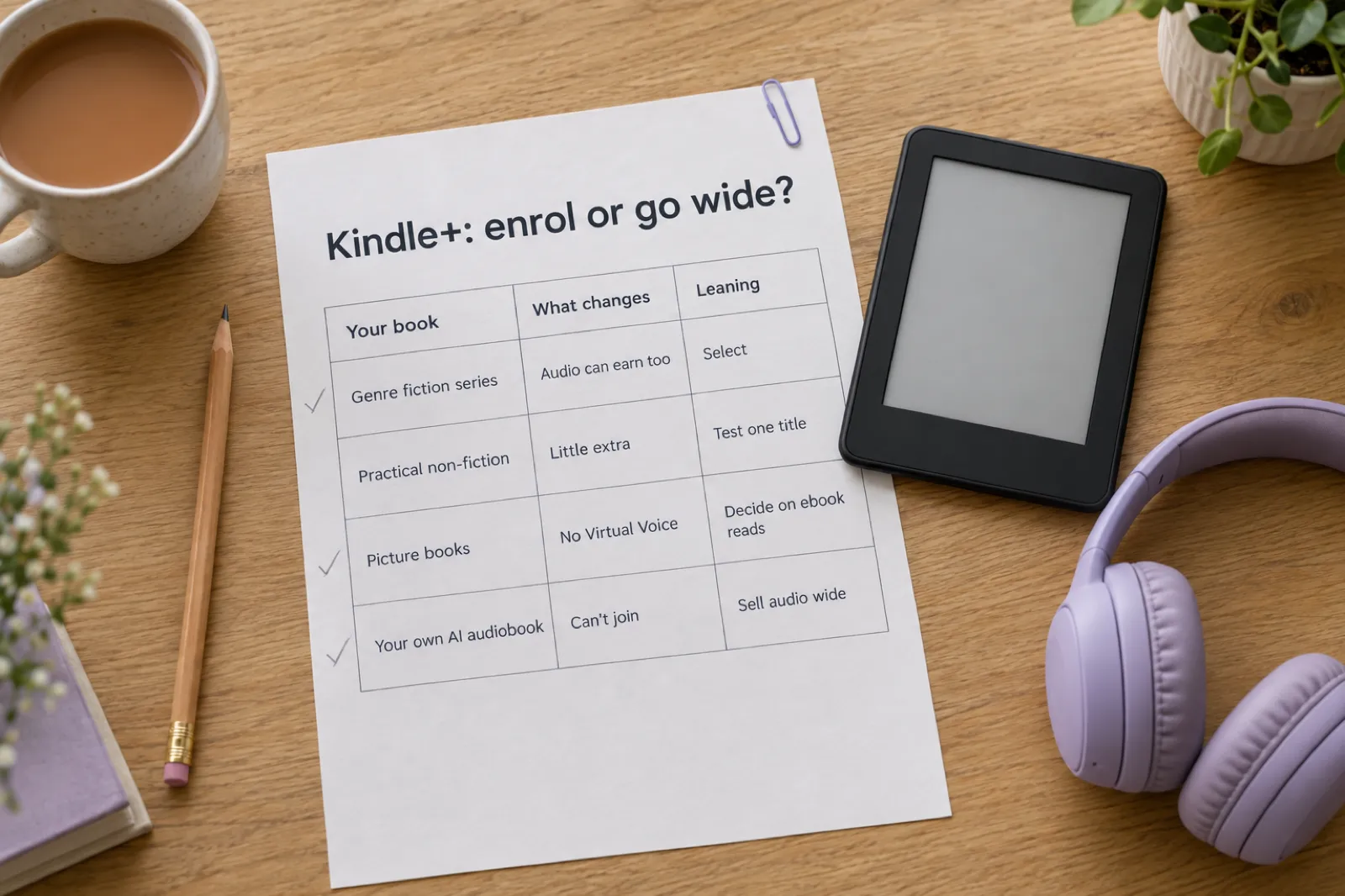
| Your book | What Kindle+ changes | Leaning |
|---|---|---|
| Genre fiction series (romance, fantasy, thriller, cozy mystery) | These were already the books subscribers read most. If you get a Virtual Voice invite, the audio edition now earns from the subscription too. | Select looks stronger than before. |
| Fiction with a paid ACX narrator | Eligible only if Audible-exclusive with Whispersync on. | Worth enrolling the audio if it already meets the terms. |
| Practical non-fiction and guides | Fewer subscriber reads in most niches; Apple, Kobo and Google Play sales give up more to exclusivity. | Wide often still wins. Test one title in Select. |
| Picture books and cookbooks | Fixed-layout and image-led books aren't eligible for Virtual Voice. | Little changes. Decide on ebook reads alone. |
| Your own AI-narrated audiobook | Can't join Kindle+ (no route through ACX). | Sell the audio wide; the ebook decision is separate. |
Genre fiction: the case for Select got stronger
Romance, fantasy, thrillers and cozy mysteries have always been where subscription reading is heaviest, because those readers read a lot and series reward them for staying. Kindle+ adds a second format to the same borrow. If you write in these genres and you're already in Select, the change is upside: an audio edition, if you get one, earns from readers you already have. If you're wide in these genres and have struggled to get traction outside Amazon, Kindle+ is a reasonable moment to test one series in Select for a 90-day term. Our romance, fantasy and mystery and thriller writers are built for exactly these books.
Non-fiction: probably still wide
Practical non-fiction (how-to guides, business books, health and self-help) is read less in subscriptions, and its readers are more likely to buy on Apple Books, Kobo and Google Play, or through your own site. Exclusivity costs those sales. Kindle+ doesn't change much here unless your non-fiction gets a Virtual Voice invite and your readers are big listeners. Test one title rather than moving everything.
Picture books, cookbooks and image-led books
Fixed-layout ebooks can't get Virtual Voice, and Amazon names cookbooks and comics as poor fits for audio. For these books Kindle+ is just Kindle Unlimited with a new name: decide on ebook reads alone, as before.
The wider trade-off between exclusivity and selling everywhere is unchanged, and we go through it in KDP Select vs going wide. If you are weighing KDP as a whole, is KDP worth it in 2026 and how much KDP authors make have the numbers, and self-publishing on Amazon KDP maps the whole process.
Test a series in Kindle+
Write book one and plan book two in the same afternoon. Inkfluence keeps your characters and world consistent across a series, then exports files ready for KDP.
Plan your series freeUpdating your marketing for Kindle+
Amazon is changing the name everywhere on its side. Your side is the book description, your back matter, your ads, your newsletter and your website. None of it is urgent, but some of it will start to look dated within weeks.
- The badge. KDP Help has a new Kindle+ badge to replace the old Kindle Unlimited one. Swap it on your website and in social graphics.
- The wording. During the switch, Amazon suggests "Available in Kindle Unlimited (now Kindle+)". After a few months, "Read free with Kindle+" will be enough.
- "Listen free" only where it's true. If your audiobook qualifies, "Read or listen free with Kindle+" is a real selling point. If it doesn't qualify, don't say it: a reader who borrows the ebook expecting audio will leave a review about it.
- Back matter. The "next in the series" page at the end of each book is your best Kindle+ marketing. Point it at book two and mention that it's included with Kindle+.
- Book description. A line at the end ("Included with Kindle+") is enough. Our book description generator drafts the rest.
- Ads. For subscribers, "free with Kindle+" is the reason to click. Expect ad copy across the category to shift to the new name quickly.
For the wider selling picture, how to sell ebooks on Amazon KDP covers categories, keywords and pricing, and our ebook launch checklist puts the steps in order.
What Kindle+ means if you write with AI
Kindle+ doesn't change any of Amazon's rules about AI-written books. You still answer KDP's AI questions when you publish, separating AI-generated content from AI-assisted editing, and Amazon's content guidelines apply the same way to every book. The Virtual Voice eligibility page doesn't mention how the text was written; it's about the file, the language and the format.
What Kindle+ does change is the incentive. Pay per page has always rewarded books that hold attention, and adding listening doubles down on it: a listener who drifts off in chapter two stops paying you just as a reader would. Combined with the two-titles-a-week limit from September, the direction is clear. The winning approach for an author using AI is fewer, better books in a series readers want to finish, not a large catalogue of thin ones. That's also how we'd use AI anyway: draft fast, then put the time saved into the outline, the opening chapters and the edit.
Practically, for an AI-assisted fiction author in the US market, the strongest Kindle+ setup today is: a reflowable ebook in KDP Select, with a Virtual Voice edition if Amazon invites the book, and your own AI-narrated audiobook selling on Google Play Books, Kobo and Spotify, once you've checked the Virtual Voice terms allow both. If you're new to all of this, how to publish AI-generated books on KDP is the step-by-step, and Inkfluence for Kindle publishers shows how the pieces fit together. Writing in more than one language? Kindle Translate vs AI translation covers Amazon's other new programme.
A checklist for this week
- Check your Bookshelf for the "Add Audible audiobook with virtual voice" option on each Select ebook. If it's there, you've been invited.
- Fix eligibility blockers on books that should qualify: empty chapters, missing table of contents, fixed-layout files.
- If you have ACX audiobooks, check each one against the four conditions above. Pay for Production titles that are already exclusive only need Whispersync on and enrolment from the Bookshelf.
- Update your marketing. Swap "Read free with Kindle Unlimited" for "Available in Kindle Unlimited (now Kindle+)", and use the new badge. Only add "listen free" where your audio qualifies.
- Note your October numbers. The new KENP report splits read and listened pages. Keep October's ebook rate so you can compare it with November and December.
- Plan your launches around the weekly limit. Two new titles per format per week; schedule a series release across weeks, not in one go.
- Don't change exclusivity on day one. The listening rate arrives with the October fund announcement, around mid-November. Make Select or wide decisions after you've seen it.
Get your next book ready for Kindle+
Outline, write, edit and export a KDP-ready ebook in Inkfluence, then publish it on your own schedule. Free to start.
Write your book freeWhat Amazon hasn't said yet
- How much a page listened pays compared with a page read.
- How much money Amazon is adding to the Global Fund for listening, and whether the ebook rate holds.
- When audiobooks in Kindle+ reach marketplaces outside the US.
- Whether Royalty Share ACX titles will be allowed in.
- When Virtual Voice opens beyond invitations.
- Whether a Virtual Voice edition can sit alongside your own AI audiobook of the same book on other stores.
We will add each answer here as Amazon publishes it, with the date.
Terms used in this guide
- Kindle+
- Amazon's reading and listening subscription, called Kindle Unlimited until 22 October 2026.
- KDP Select
- The optional 90-day programme that puts your ebook in Kindle+ in exchange for selling the ebook only on Amazon.
- KENP and KENPC
- Kindle Edition Normalized Pages: the standard page Amazon pays for. KENPC is your book's total count of them, shown on your Bookshelf.
- KDP Select Global Fund
- The monthly pot Amazon shares among authors by pages read, and now pages listened.
- Virtual Voice
- Amazon's invite-only AI narration for eligible KDP ebooks, labelled on Audible.
- ACX
- Audible's marketplace for producing audiobooks with human narrators.
- Pay for Production and Royalty Share
- The two ways of paying an ACX narrator: a fee up front, or a share of your royalties.
- Whispersync for Voice
- Amazon's link between an ebook and its audiobook, so readers can switch between them and keep their place.
Kindle+ for authors: FAQ
What is Kindle+?
Kindle+ is the new name for Kindle Unlimited, from 22 October 2026. Subscribers can read ebooks and, in the US, listen to eligible audiobooks at no extra cost. Reports put the US price at $11.99 a month, the same as before.
Do authors need to do anything for Kindle+?
No. Ebooks already enrolled in KDP Select stay in Kindle+ automatically, and page reads are paid from the KDP Select Global Fund as before.
Which audiobooks are included in Kindle+?
Virtual Voice audiobooks join automatically when their ebook is in KDP Select. ACX audiobooks join only if the ebook is in KDP Select, the audiobook is exclusive to Audible, Whispersync for Voice is on, and it was made on Pay for Production. Royalty Share titles are not eligible at launch.
How are authors paid for Kindle+ audiobook listening?
By the page, from the KDP Select Global Fund, based on your share of all pages read or listened to by subscribers. Each page pays once per subscriber. Amazon has not published the listening rate.
Does listening pay the same as reading in Kindle+?
Amazon has not said. It has said it is adding money to the Global Fund for listening, and that reading while listening pays at the higher rate when the two differ. The first month with listening is October 2026.
Can AI-narrated audiobooks be in Kindle+?
Only Amazon's own Virtual Voice audiobooks, which are invite-only. ACX accepts human narration only, so audiobooks narrated with outside AI tools can't join Kindle+. They can be sold on stores that accept labelled AI narration, such as Google Play Books and Kobo.
Is Kindle+ audio available outside the US?
Not yet. Audiobooks in Kindle+ are US-only at launch. Authors in any marketplace can enrol eligible audiobooks for US subscribers, and Amazon has not given a date for other marketplaces.
Can I take my Virtual Voice audiobook out of Kindle+ but keep the ebook in?
Not separately. Virtual Voice audiobooks are enrolled with their ebook. KDP Help says that to keep only the ebook in Kindle+, you unpublish the Virtual Voice audiobook. ACX audiobooks, by contrast, can be unenrolled on their own.
Does Kindle+ change KDP Select exclusivity?
No. KDP Select still requires the ebook to be exclusive to Amazon in 90-day terms. The audiobook rules above are separate.
Do I need to update my book description or ads?
Only to keep them accurate. "Read free with Kindle Unlimited" still describes the ebook, but Amazon now uses the Kindle+ name and badge. Only say "listen free" if your audiobook actually qualifies.
Make the audiobook for every other store
Kindle+ is one shelf. Inkfluence turns your finished book into a narrated audiobook you can sell where labelled AI narration is accepted, from the same project as your ebook.
Turn your book into an audiobookRelated reading
- Audible and ACX's AI narration policy: what's allowed and where AI audio is welcome
- Where to sell an AI audiobook: store-by-store rules
- How to create an ACX audiobook from your ebook
- How to turn an ebook into an audiobook with AI
- The state of AI audiobooks in 2026
- Fiction audiobook generator
- KDP Select vs going wide
- How to publish on Kobo: Kobo Plus pays by the minute with no exclusivity
- How to publish on Barnes & Noble Press: 70% on ebooks if you leave KDP Select
- The best AI for writing genre fiction
- AI book writer for Kindle
- KDP publishing calendar: dates that matter this season
- Inkfluence plans and pricing
Sources
- KDP Community: "Kindle Unlimited is now Kindle+, KDP audiobooks now included", 22 October 2026
- KDP Help: Kindle+ and KDP Select
- KDP Help: Audiobooks with virtual voice eligibility and troubleshooting
- Written Word Media: Kindle+ for authors, 22 October 2026
- SlashGear: Kindle Unlimited vs Kindle+, subscriber price and borrow limit
- ALLi: Amazon cuts KDP weekly upload limit, September 2026

Founder, Inkfluence AI
Sam is the founder of Inkfluence AI. He built the platform to make book creation accessible to everyone - from first-time authors to seasoned publishers.
Helpful links

Ready to write your own book?
Write with AI, make it yours, and export PDF, EPUB and KDP-ready files from one project.
Keep reading
 Publishing
ISBN Canada's AI Rule (2026): The Human-Author Declaration Explained
ISBN Canada now asks every registrant to declare their book was written by a human author, allows AI only for limited support tasks, and limits ISBNs for works primarily generated by AI. What changed on 9 October 2026, who it affects, what counts as a support task, what to do if your book is AI-assisted or mostly AI-generated, how it fits with KDP's AI question, and a checker for which ISBN route fits your book.
 Self-Publishing
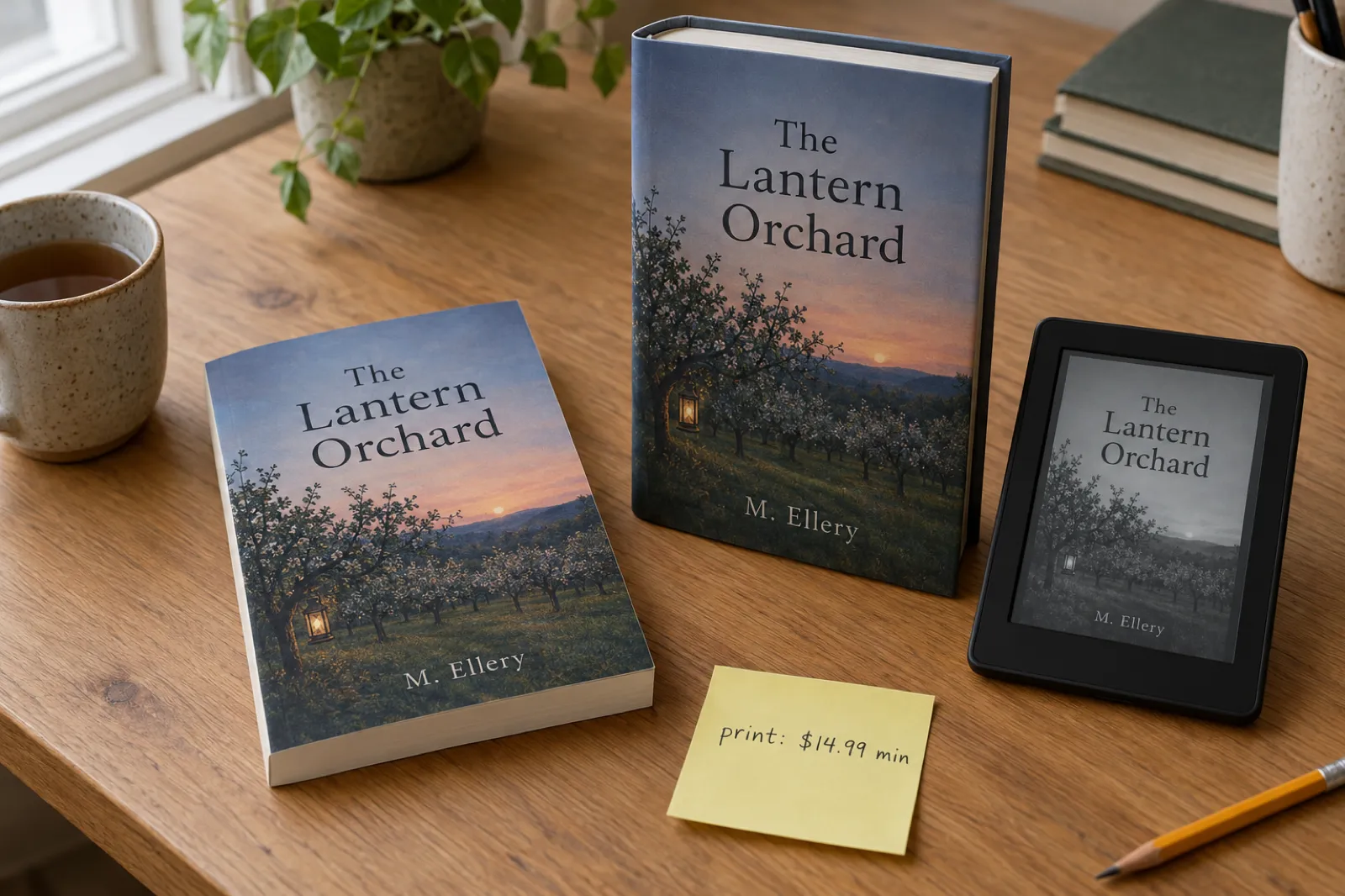
How to Publish on Barnes & Noble Press in 2026: Ebooks, Print Rules and AI Disclosure
B&N Press pays 70% on ebooks from $0.99, and 55% minus printing on print books, which since 22 April 2026 must list at $14.99 or more. It asks whether each part of your book is AI-Created or AI-Assisted, refuses public domain titles, caps accounts at 100 titles and sells ebooks to US readers. Here is every step from account to promotion, read from B&N Press's own help pages, with a royalty calculator against KDP.
 Self-Publishing
How to Get Your Ebook (and Audiobook) Into Libraries in 2026: OverDrive, Hoopla and More
Which route reaches OverDrive (Libby), Hoopla, BorrowBox, cloudLibrary, Odilo and Palace in 2026, what libraries pay and what reaches you, the AI rules on each library channel, how librarians actually find indie books, and how to get your local library to stock you. With a library earnings estimator built on each route's published rates.

Get ebook tips in your inbox
Join creators getting weekly strategies for writing, marketing, and selling ebooks.