Updated October 2026 · 13 formats · prices and fees read 17 October 2026

Digital Product Ideas by Format: What to Make, What It Sells For, Where to Sell It

Most lists of digital products to sell stop at a name. This one compares 13 formats on what each takes to make, what sellers actually ask for it (from a price snapshot we took today), what the marketplaces charge, and which ones fit your time and skills.

By Sam May, founder of Inkfluence AI · jump to the price snapshot

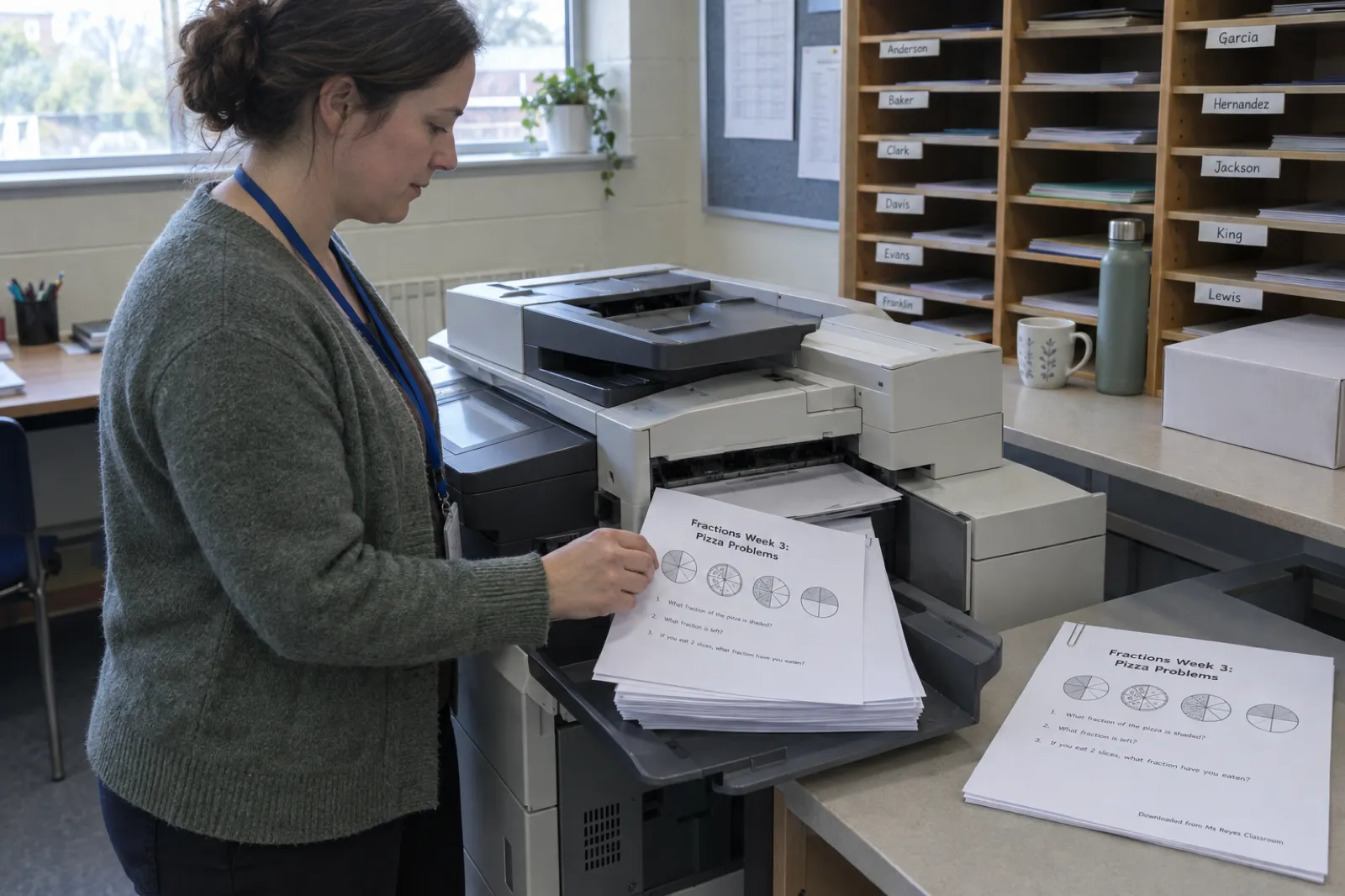
In a school staff workroom, a teacher in a cardigan lifts fresh copies of a worksheet packet headed Fractions Week 3: Pizza Problems from a photocopier tray, while the original on the counter carries a footer reading Downloaded from Ms Reyes Classroom, with named staff pigeonholes behind
A digital product doing its job: one teacher's worksheet pack, bought once, printed for a whole class.

What digital products can you sell online?

The main formats are ebooks and guides, Kindle and paperback books, workbooks, guided journals, printable planners, coloring pages, children's picture books, templates (Notion, Canva, spreadsheets), online courses, email courses, audiobooks, teaching resources, and creative assets like presets and fonts. They differ most in effort, price and where buyers look for them.

$9.99

median asking price of a coloring page pack on Gumroad, the cheapest format we sampled there.

$160

median for an online course, the dearest, and the most work to make.

22,168

Gumroad search results for "ebook", the most of any format we checked. Supply, not sales.

6.5%

Etsy's transaction fee, before its $0.20 listing fee and payment processing.

Prices are asking prices from our 17 October 2026 snapshot; the method is in the price section below. This page is about formats. For which topics sell inside them, see our study of 31 digital product niches.

Digital product ideas by format

Each card gives the format, the work involved, price evidence from the snapshot or from the marketplace's own rules, where it sells, and whether Inkfluence AI can make it. We make Inkfluence AI, so we have marked plainly the 4 formats it does not make or only partly makes.

1. Ebooks and practical guides

Inkfluence makes it

A PDF or EPUB that teaches one thing or solves one problem: a how-to, a beginner guide, a recipe collection, a travel guide. The oldest digital product and still the simplest to make and explain.

Effort:
A weekend to a few weeks of writing and editing, plus a cover.
Price evidence:
Gumroad snapshot: median $29.99, middle half $19.99 to $52.48 (36 USD-priced ebooks). Kindle: the 70% royalty band is $2.99 to $12.99.
Where it sells:
Gumroad, Payhip, Etsy, your own site, and Kindle.
Inkfluence AI:
Writes the chapters from your idea; PDF on every plan, EPUB and Word on paid plans or credits. See the AI ebook generator.

2. Kindle ebooks and paperbacks on Amazon

Inkfluence makes it

The same book sold through Amazon KDP as a Kindle ebook and a print-on-demand paperback. Amazon prints each copy when it sells, so there is no stock to buy.

Effort:
As for an ebook, plus a print interior at your trim size and a wrap cover with a spine.
Price evidence:
Kindle 70% band $2.99 to $12.99. A paperback's minimum price is its printing cost divided by the royalty rate; a 200-page black-ink book costs $3.40 to print.
Where it sells:
Amazon KDP, plus wide distribution through other retailers.
Inkfluence AI:
A KDP package: interior PDF, wrap cover with spine, EPUB and a cover image, on paid plans or credits. See the KDP self-publishing guide.

3. Workbooks and worksheets

Inkfluence makes it

Exercises, prompts and space to write: a self-help workbook, a business planning workbook, a set of maths worksheets. Buyers pay for the doing, not just the reading.

Effort:
A weekend for a short workbook; longer if every page is designed.
Price evidence:
Gumroad: median $19 (22 workbooks). TPT: workbooks median $12.25, worksheets median $7.23.
Where it sells:
Etsy, Gumroad, Teachers Pay Teachers for classroom material, Amazon as a paperback.
Inkfluence AI:
A workbook format with exercises; ruled answer lines and write-in boxes print in the PDF. See the workbook generator.

4. Guided journals and day challenges

Inkfluence makes it

Prompts with room to answer, often over a set number of days: a 30-day gratitude journal, a grief journal, a 21-day habit challenge.

Effort:
A day or two to write the prompts; design is where the time goes.
Price evidence:
Gumroad: median $15, middle half $9 to $30.50 (28 journals).
Where it sells:
Etsy (printable), Gumroad, Amazon as a paperback.
Inkfluence AI:
Written as a workbook or a day-by-day challenge with answer lines. See the journal generator.

5. Printable and digital planners

Not Inkfluence

Calendars, trackers and planning pages to print, or hyperlinked PDFs for tablet apps. A crowded format where design and a clear niche (teachers, nurses, homeschoolers) decide sales.

Effort:
Days to weeks of layout work; hyperlinked planners take longer.
Price evidence:
Gumroad: median $19.49, middle half $11.99 to $27.75 (28 planners).
Where it sells:
Etsy above all, then Gumroad and Payhip.
Inkfluence AI:
Not a planner layout tool: no calendar grids or hyperlinked tabs. A design app suits this better.

6. Coloring pages and coloring books

Inkfluence makes it

Line art to colour, sold as printable page packs or as printed coloring books. Children's, adult detailed, and bold-and-easy styles each have their own buyers.

Effort:
Fast with AI line art; checking every page for clean lines takes the time.
Price evidence:
Gumroad: median $9.99 (49 packs). TPT coloring pages: median $4.87.
Where it sells:
Etsy and TPT as printables, Amazon KDP as paperbacks.
Inkfluence AI:
Coloring books of 12 to 40 designs with a matching cover, exported as a book (PDF, KDP package), not as single page images. See the coloring book generator.

7. Children's picture books

Inkfluence makes it

An illustrated story for young children, sold as a printed book or a PDF. Characters that look the same on every page are the hard part.

Effort:
Writing is short; illustration, layout and print setup take most of the work.
Price evidence:
Mostly sold in print on Amazon. Colour printing on KDP costs more than black ink, which sets the floor on price (standard colour, 72 to 600 pages: $1.00 + $0.0255 a page).
Where it sells:
Amazon KDP paperbacks, Etsy as a PDF, gift and personalised-book shops.
Inkfluence AI:
Picture books of 10 to 16 pages (ABC books to 26) with the same characters throughout, bleed-ready KDP interiors. See the picture book maker.

8. Templates: Notion, Canva and spreadsheets

Not Inkfluence

Ready-made systems people copy and fill in: a Notion life planner, Canva social post sets, a budgeting spreadsheet. Bought by people who want the structure without building it.

Effort:
Days to build well; support questions come after.
Price evidence:
Gumroad: Notion median $97, Canva median $12.44, spreadsheets median $49.99.
Where it sells:
Gumroad, Etsy, Payhip, Notion's and Canva's own template galleries.
Inkfluence AI:
Does not build templates. It can write the instruction guide that ships with one.

9. Online video courses

Partly

Recorded lessons, often with worksheets, that teach a skill end to end. The highest asking prices on this page and the most work.

Effort:
Weeks: scripting, recording, editing, hosting and updating.
Price evidence:
Gumroad: median $160, middle half $80 to $200 (17 courses).
Where it sells:
Gumroad, Payhip, course platforms, your own site.
Inkfluence AI:
No video. It writes the course companion book, study guides and worksheets that go with one. See the course creator.

10. Email courses and lead magnets

Inkfluence makes it

A short course delivered one email a day, or a free checklist or guide given away for an email address. Often free, used to build the list you later sell to.

Effort:
An afternoon to a weekend.
Price evidence:
Usually free, as the start of a sales funnel; some sellers charge for longer email courses.
Where it sells:
Your email platform and website; Gumroad and Payhip for paid versions.
Inkfluence AI:
Writes email courses lesson by lesson, lead magnets and checklist packs; you paste lessons into your email tool. See the email course generator.

11. Audiobooks

Inkfluence makes it

Your book as audio, sold as MP3 files or through audiobook stores. A second product from a book you already finished.

Effort:
Hours with AI narration; longer if you narrate yourself.
Price evidence:
Audible sets prices by length (1 to 3 hours: $5.55 to $13.20). Gumroad: median $21.49 (22 listings, many bundled with the ebook).
Where it sells:
Gumroad and your own site as MP3s; stores that accept AI narration (not ACX).
Inkfluence AI:
Narrates chapters as MP3s, or uses your own recording; ACX-spec files. Creator 15 chapters a month, Premium 30. See the audiobook generator.

12. Lesson plans and teaching resources

Inkfluence makes it

Plans, unit guides, study guides and activity packs made by teachers for teachers and homeschool parents.

Effort:
An afternoon for a single lesson; a weekend per unit if you already teach the subject.
Price evidence:
TPT: lesson plans median $12.25, middle half $6.87 to $26.
Where it sells:
Teachers Pay Teachers above all, then Etsy and your own site.
Inkfluence AI:
Lesson plan, study guide and course companion formats. See the lesson plan generator.

13. Presets, fonts, stock photos and music

Not Inkfluence

Assets for other creators: photo editing presets, fonts, illustrations, stock footage, sound packs. Skill in the craft is the whole product.

Effort:
Varies with the craft; building a catalogue takes months.
Price evidence:
Gumroad: Lightroom presets median $25 (59 preset packs).
Where it sells:
Gumroad, Creative Market, Etsy, stock libraries.
Inkfluence AI:
Not something Inkfluence makes.

Ready to try one of the formats Inkfluence makes? Describe it in a sentence and get a first draft; the free plan covers 5 AI chapters and PDF export.

How much do digital products sell for?

Asking prices run from a few dollars for coloring pages and worksheets to well over $100 for courses and Notion systems. In our 17 October 2026 snapshot, the median Gumroad ebook asked $29.99, a workbook $19, a guided journal $15 and an online course $160. Teachers Pay Teachers runs much lower.

Gumroad asking prices by format

Format (search term)Search resultsPriced listings sampledMedianMiddle halfFree
Ebooks and guides ("ebook")22,16836$29.99$19.99 to $52.480
Workbooks ("workbook")7,12522$19$14.99 to $270
Printable planners ("printable planner")2,22628$19.49$11.99 to $27.751
Guided journals ("guided journal")1,53328$15$9 to $30.501
Coloring pages ("coloring pages")3,50349$9.99$5 to $14.994
Notion templates ("notion template")19,71431$97$26.99 to $154.503
Canva templates ("canva template")3,82429$12.44$5 to $34.891
Spreadsheet templates ("spreadsheet template")1,32818$49.99$21 to $742
Online courses ("online course")4,74717$160$80 to $2001
Audiobooks ("audiobook")1,76422$21.49$14.92 to $33.740
Lightroom presets ("lightroom presets")4,62359$25$15 to $501

Teachers Pay Teachers prices by format

Format (search term)Results shownMedianMiddle half
Worksheets ("worksheets")3,800,000+$7.23$3 to $11.06
Workbooks ("workbook")300,000+$12.25$10 to $18.25
Coloring pages ("coloring pages")1,000,000+$4.87$3.44 to $6.19
Lesson plans ("lesson plans")1,000,000+$12.25$6.87 to $26

How we took the snapshot. On 17 October 2026 we read the first 120 results Gumroad's own search returns for each term, in its default order, and kept products whose seller priced them in US dollars and whose name matched the format (so "workbook" kept only products with "workbook" in the name), leaving out subscriptions. For Teachers Pay Teachers we read the first two pages of browse results for each term, 48 resources, at their current price after any sale. The "middle half" is the 25th to 75th percentile. Samples are small and the order is the marketplace's, not random, so treat the medians as a guide to what sellers ask, not what buyers pay or how often they buy.

Two patterns hold despite the small samples. Formats that take longer to build ask more: templates and courses sit above everything else, coloring pages and worksheets below. And the same format is priced differently by marketplace: a workbook's median was $19 on Gumroad and $12.25 on TPT, where buyers are teachers on school budgets.

Search-result counts measure how many listings exist, which tells you about competition. They say nothing about how many sell.

Prices set by the platform: Kindle and Audible

On Amazon, the royalty structure shapes ebook prices. KDP pays 70% only for Kindle ebooks priced $2.99 to $12.99 on Amazon.com, so most self-published ebooks sit inside that band (KDP list price requirements). For paperbacks the floor is the printing cost divided by the royalty rate; a 200-page black-ink paperback costs $1.00 + 200 x $0.012 = $3.40 to print (KDP printing cost).

Audible sets audiobook prices itself, mainly by length. ACX publishes the ranges retail prices have fallen in. Our KDP royalties guide covers the ebook side in depth.

Audiobook lengthAudible price range
Under 1 hourUnder $7.40
1 to 3 hours$5.55 to $13.20
3 to 5 hours$7.55 to $15.55
5 to 10 hours$11.15 to $20.65
10 to 20 hours$12.95 to $24.90
Over 20 hours$16.40 to $32.95

Source: ACX, "Sell your audiobook", read 17 October 2026.

What fees do Etsy, Gumroad, Payhip and Amazon charge?

Etsy charges $0.20 a listing, 6.5% of each sale and payment processing. Gumroad takes 10% + $0.50 on a direct sale plus card processing, or 30% on sales its Discover page finds. Payhip ranges from 5% on its free plan to 0% at $99 a month. Amazon pays royalties instead: 70% or 35% on Kindle ebooks.

WhereSellsFees, from its own pagesSource (read 17 October 2026)
EtsyDigital downloads (PDF, EPUB, images, ZIP)$0.20 listing fee (a listing lasts four months and renews after each sale), 6.5% transaction fee, plus a payment processing fee that varies by country. Offsite Ads: 15% on orders Etsy's ads bring in (12% once a shop passes $10,000 in a year), capped at $100 an order.Etsy Fees & Payments Policy
GumroadAnything digital: files, courses, memberships10% + $0.50 a direct sale (5% + $0.50 on new sales once you pass $20,000 in a calendar month), with card processing (2.9% + $0.30) on top. Sales found through Gumroad Discover: 30%, processing included. No monthly fee.Gumroad pricing and fees help
PayhipYour own store for files, courses, membershipsFree plan 5% a sale; Plus $29 a month and 2%; Pro $99 a month and 0%. PayPal and Stripe charge their own processing fees on top.Payhip pricing
Amazon KDP, Kindle ebooksEbooks sold in the Kindle StoreRoyalty of 70% of list price (without VAT) less delivery costs (average $0.06) for $2.99 to $12.99 on Amazon.com; 35% outside that band.KDP eBook Royalties and List Price Requirements
Amazon KDP, paperbacksPrinted on demand, no stock to hold(Royalty rate x list price) minus printing cost; 60% at $9.99 and up on Amazon.com, 50% at $9.98 and below. Printing, black ink, 110 to 828 pages: $1.00 + $0.012 a page.KDP Paperback Royalty and Printing Cost
ACX (Audible, Amazon, Apple Books)AudiobooksAudible sets the price, guided by length. ACX requires human narration unless otherwise authorized, so AI-narrated audiobooks go to other stores.ACX audio submission requirements

Etsy's payment processing rate depends on where your shop is based; when we read its payments page it showed 3% + 0.25 for domestic sales and 4% + 0.25 for international ones, in the seller's currency (we were viewing from Canada). Check your own country's rate in Etsy's Payments Policy before you price. Teachers Pay Teachers pays sellers a share that depends on their seller plan; see its seller help pages for the current split.

A worked example on a $10 direct sale on Gumroad: 10% ($1.00) plus $0.50, then card processing of 2.9% + $0.30 ($0.59), leaves $7.91. On Amazon, a $9.99 Kindle ebook at 70% earns $6.99 less a delivery cost that averages $0.06. The Etsy vs Gumroad comparison runs the same sale on Etsy, and Gumroad vs Amazon KDP covers the trade-off between keeping the customer and reaching Amazon's shoppers.

Fees are only half the sum. The marketplace that charges most can still pay best if it brings the buyers; Etsy's search and Amazon's store do, Gumroad and Payhip mostly do not, and your own audience matters more there.

Which digital product should I make? Pick by time, budget and skill

Choose the format your skills and time already suit, for an audience you understand. A teacher with a free weekend should make teaching resources, not a video course; a designer should look at templates and planners. Answer four questions and the picker ranks the formats on this page.

The picker weighs audience fit most, then skill, then whether the format fits your time and budget. It is a starting point; the validation steps below decide.

What digital products are in demand, and what is trending?

No marketplace publishes a sales chart for digital products, so any list of "trending digital products" is an estimate. What you can check is supply, price and reviews: how many listings exist, what they ask, and whether the top ones have recent reviews. Recent reviews on listings like yours are the closest thing to proof of demand.

The supply numbers from our snapshot show where sellers have crowded in. Gumroad returned 22,168 results for "ebook" and 19,714 for "notion template", against 1,533 for "guided journal" and 1,328 for "spreadsheet template". Teachers Pay Teachers showed more than 3.8 million results for "worksheets". A big number means buyers are used to the format and also that you need a sharper niche to be seen.

On our own platform the signal is what people choose to make. Non-fiction is 63.7% of the books written on Inkfluence AI, counted across 100,000+ books to 15 September 2026 (method on our AI book writing statistics page). That says what creators want to sell, which is not the same as what buyers want, so use it as context.

For topics with the most buyer interest inside these formats, our 31 digital product niches study and the profitable niches guide rank them, and high-demand, low-competition ebook niches goes deeper for books.

In a staff break room, a nurse in navy scrubs fills in a printed ring-bound page headed Week of 12 Oct Meal Plan, with handwritten entries such as oats, chilli, leftovers and tacos, beside a lunch box, a water bottle and a lanyard, with grey lockers behind
Planners sell when they fit one reader's week precisely. A meal planner for shift workers is a niche; "a planner" is not.

What are the best digital products to sell online in 2026?

The best format is the one you can make well for buyers you can reach. On effort against price, ebooks, workbooks and teaching resources are the easiest to start; templates and courses ask the most but take longest; coloring pages and worksheets are cheap and quick but sell for little each, so they work in volume or bundles.

  • For a first product: a short ebook or workbook that solves one problem. It is quick to make, sells on every marketplace above, and becomes a paperback and an audiobook later.
  • For teachers: lesson plans and worksheet packs on Teachers Pay Teachers, where the buyers already are.
  • For designers: templates and printable planners, where design is the product.
  • For people with an audience: an email course or lead magnet first, then a paid product the list asked for.
  • For parents and grandparents: coloring books and picture books, sold in print on Amazon and as gifts.

Whichever you choose, one product rarely carries a shop. Sellers build a ladder: a free lead magnet, an ebook, a workbook that goes with it, then a bundle or a course. Our guide to passive income from ebooks covers the honest economics, and making money selling AI ebooks covers the AI side.

How should I price a digital product?

Price inside the range buyers already see for your format on your marketplace, then adjust for size and quality. Start near the median of comparable listings, not far below it: a price far below the pack can read as low effort. Raise it once reviews arrive, and use bundles rather than discounts to give value.

The snapshot gives you the starting ranges. A Gumroad workbook in the middle half of our sample asked $14.99 to $27; a coloring pack $5 to $14.99. On TPT, lesson plans sat between $6.87 and $26. On Amazon the royalty rules decide for you: a Kindle ebook earns 70% only between $2.99 and $12.99, and a paperback cannot go below its printing cost divided by the royalty rate.

Size matters inside a format. A 10-page coloring pack and a 40-design book are different products; so are a 12-page checklist and a 120-page workbook. Price per unit of usefulness, not per page, and say exactly what the buyer gets in the listing: page count, file types, print sizes and whether it works on a tablet.

Bundles are the easiest lift: the ebook plus its workbook, or three seasonal coloring packs, at less than the sum. Fees matter more at low prices, because fixed charges like Gumroad's $0.50 and Etsy's $0.20 take a bigger share of a $3 item than a $30 one. The ebook income calculator and our guide to pricing ebooks work through real numbers.

Which digital products go well together?

Formats that share one piece of work sell best as a set. A practical ebook pairs with a workbook, a paperback edition and an audiobook; a lead magnet or email course sits in front as the free first step; a course companion or study guide sits beside a video course. One finished manuscript can become four products.

  1. Free: a checklist, a sample chapter or a five-day email course, given for an email address.
  2. Entry: the ebook or printable pack, priced near the format median.
  3. Companion: the workbook, journal or worksheet set that makes the ebook practical.
  4. Second edition: the paperback on Amazon and the audiobook, made from the same text.
  5. Premium: a bundle of everything, or a course for the readers who want more.

This is a common shape for a digital product shop, and it is why a writing tool that exports several formats from one book saves time. Our lead magnet creator covers the free rung, and how to sell workbooks covers the companion.

Mistakes new digital product sellers make

  • Choosing the format before the buyer. A beautiful planner for nobody in particular joins thousands of others. Start from a reader you know, then pick the format they already buy.
  • Using characters, logos or brands you do not own. Coloring pages of famous cartoon characters or templates using a company's branding invite takedowns. Make your own characters and designs.
  • Underestimating support. Templates and courses bring questions and update requests. Books and printables mostly do not.
  • Skipping the preview. Buyers of digital goods cannot hold the product, so show inside pages, a sample, or a short video in the listing.
  • Ignoring the rules on AI. Marketplaces ask about AI-generated content in different ways. Read each one's policy before you upload, and disclose where it asks.
  • Selling one product and stopping. Shops grow with a catalogue: the second and third product in the same niche sell to the buyers of the first.

If you are writing a book-length product, the full process from idea to finished file is in how to write a book, and book title ideas helps name it.

Popular digital goods categories, with examples

Digital goods fall into five broad categories: written products (ebooks, guides, workbooks), printables (planners, coloring pages, worksheets), templates and tools (Notion, Canva, spreadsheets), learning products (courses, email courses, lesson plans) and media (audiobooks, music, presets, fonts, stock). Here are concrete examples of each.

Written

A first-time landlord's guide; a sourdough troubleshooting ebook; a 30-day decluttering workbook; a cookbook for one; a travel guide to a single city.

Printables

A shift-worker meal planner; an otter coloring pack for six-year-olds; a reading log for summer; a wedding budget tracker; phonics worksheets.

Templates and tools

A Notion system for freelancers; Canva carousel templates for therapists; a rental property spreadsheet; a resume template set.

Learning

A seven-day email course on setting in sleeves; a watercolour course; a unit plan on fractions; a study guide for a certification exam.

Audio and media

The audiobook of your guide; a guided sleep recording; photo presets for food bloggers; a hand-lettered font.

Books for children

A picture book about a first day at school; an ABC book of farm animals; a personalised story for a grandchild.

At a camper van dinette by a lake, a grandfather and a girl of about six colour printed pages, one a bold-outline otter on a log half coloured in blue and brown felt-tip and another a canoe on a lake, with a binder-clipped stack of pages and a tin of pens
Printables go where screens do not: a coloring pack printed for a rainy afternoon at the campsite.
In a home sewing room, a phone propped against a sewing machine shows an email titled Day 3: Setting in a sleeve with a short numbered list, while a woman pins a sleeve to a half-made linen blouse beside pattern pieces, a tomato pincushion and a tape measure
An email course arrives one lesson a day, at the moment the reader needs it.

How do you check a digital product idea before making it?

Search the marketplace where it would sell for listings like yours. If the top results have recent reviews, buyers exist. Note their prices and read their three-star reviews for what buyers wanted and did not get. Then make a small version first, priced inside the range you found.

  1. Pick the marketplace first. Teachers shop on TPT, crafters and gift buyers on Etsy, readers on Amazon. Validate where your buyer already looks.
  2. Count recent reviews, not listings. A thousand listings with no reviews is a crowded room with no customers. Ten listings with steady recent reviews is a market.
  3. Write down five prices. They set the range your buyers expect, and the snapshot above gives you a starting point by format.
  4. Read the complaints. Three-star reviews are a free product brief: too short, too generic, no answer key, pages too detailed for young children.
  5. Make the smallest useful version. A 20-page guide, a 10-design coloring pack, a five-lesson email course. Expand the one that sells.
  6. Check the rules. KDP asks about AI-generated content; Etsy has its own creativity and AI disclosure standards; ACX requires human narration. Our Etsy AI disclosure guide and can you sell AI-generated books cover the detail.

For the selling side, our guides to selling ebooks on Etsy, selling on Gumroad and selling ebooks on Amazon walk through each store, and how to sell workbooks and how to sell coloring books cover two formats from this page in depth.

Which of these can Inkfluence AI make?

We make Inkfluence AI, a book app, so it is strongest on the written and illustrated formats. It makes 9 of the 13 formats on this page, partly makes one, and does not make three. Here is the honest split.

FormatInkfluence AIWhat you get
Ebooks and practical guidesYesWrites the chapters from your idea; PDF on every plan, EPUB and Word on paid plans or credits.
Kindle ebooks and paperbacks on AmazonYesA KDP package: interior PDF, wrap cover with spine, EPUB and a cover image, on paid plans or credits.
Workbooks and worksheetsYesA workbook format with exercises; ruled answer lines and write-in boxes print in the PDF.
Guided journals and day challengesYesWritten as a workbook or a day-by-day challenge with answer lines.
Printable and digital plannersNoNot a planner layout tool: no calendar grids or hyperlinked tabs. A design app suits this better.
Coloring pages and coloring booksYesColoring books of 12 to 40 designs with a matching cover, exported as a book (PDF, KDP package), not as single page images.
Children's picture booksYesPicture books of 10 to 16 pages (ABC books to 26) with the same characters throughout, bleed-ready KDP interiors.
Templates: Notion, Canva and spreadsheetsNoDoes not build templates. It can write the instruction guide that ships with one.
Online video coursesPartlyNo video. It writes the course companion book, study guides and worksheets that go with one.
Email courses and lead magnetsYesWrites email courses lesson by lesson, lead magnets and checklist packs; you paste lessons into your email tool.
AudiobooksYesNarrates chapters as MP3s, or uses your own recording; ACX-spec files. Creator 15 chapters a month, Premium 30.
Lesson plans and teaching resourcesYesLesson plan, study guide and course companion formats.
Presets, fonts, stock photos and musicNoNot something Inkfluence makes.

The useful part for a product seller is that one book becomes several products. Write a guide, export it as a PDF to sell on Etsy or Gumroad, export the KDP package for a paperback and a Kindle edition, then narrate it as an audiobook. On Creator and Premium you can list the PDF or EPUB on Etsy and Gumroad from the app.

Audiobooks come as MP3s per chapter plus ACX-spec files. Because ACX requires human narration unless otherwise authorized, AI-narrated audiobooks go to stores that accept them; our guide to where to sell an AI audiobook lists them, and you can upload your own narration instead.

Limits. It does not make planners, templates, video or creative assets. Picture and coloring books export as books, not single page images. Every draft needs your review before it is sold. Prices: free plan with 5 AI chapters to start and 5 a month and PDF export; Creator $9.99 a month; Premium $19.99 a month; credit packs from $9.99. Details on the pricing page.

From the passenger seat of a parked delivery van in light rain, a driver in a high-visibility jacket and earbuds eats a sandwich while a phone in a dashboard mount plays the audiobook Small Hours at Fen House by Ada Penn, chapter 7, with parcels stacked behind the seats
The same book, sold again: audiobook listeners are often people whose hands are busy.

How this page was made

Who: Sam May, founder of Inkfluence AI. More on the about page.

Prices: our own snapshot on 17 October 2026, from Gumroad's search results (first 120 per term, USD-priced, matching the format) and Teachers Pay Teachers browse results (first 48 per term), as described in the price section. Amazon and Audible price rules from KDP's and ACX's help pages. Fees: read on Etsy's, Gumroad's, Payhip's, KDP's and ACX's own pages the same day. Inkfluence formats: checked against our book formats, export code, plan settings and help centre.

The price snapshot is ours to share: you may reuse the figures with a link to this page (CC BY 4.0). The five photographs are illustrations made for this page; the products in them are invented. AI tools helped with drafting; every number was checked against its source.

If a fee has changed, tell us on the contact page and we will update it.

Digital product questions, answered

What digital products can I sell online?
Ebooks and guides, Kindle and paperback books, workbooks and worksheets, guided journals, printable planners, coloring pages and books, children's picture books, Notion, Canva and spreadsheet templates, online courses, email courses, audiobooks, lesson plans, and creative assets such as presets, fonts and stock photos.
What digital products are in demand in 2026?
There is no public sales chart for digital products. What you can measure is supply and price: on 17 October 2026 Gumroad listed 22,168 results for "ebook" and 19,714 for "notion template", and Teachers Pay Teachers over 3.8 million for "worksheets". Use comparable listings with reviews in your niche as the demand signal, and see our niches study for topics.
What is the easiest digital product to make?
A short practical ebook, a checklist or a coloring page pack: one skill, no video, no complex layout. An email course is similar if you already have a list. Templates and courses take longer to build and support.
How much do digital products sell for?
It depends on the format. In our 17 October 2026 snapshot of asking prices, the median Gumroad ebook was $29.99, workbook $19, coloring pack $9.99, Notion template $97 and online course $160; on Teachers Pay Teachers, worksheets had a median of $7.23 and lesson plans $12.25. Asking prices are not sales.
What are the fees for selling digital products on Etsy?
Etsy charges $0.20 to list an item (a listing lasts four months and renews after each sale), a 6.5% transaction fee and a payment processing fee that varies by country. Offsite Ads add 15% (12% for shops over $10,000 a year) on orders those ads bring in.
Is Gumroad or Etsy better for digital products?
Etsy brings shoppers who search its marketplace, at $0.20 a listing plus 6.5% and processing. Gumroad brings few shoppers of its own but gives you the buyer's email, at 10% + $0.50 a direct sale plus card processing. Many sellers list on both; our Etsy vs Gumroad comparison works through a sale.
Can I sell AI-made digital products?
Yes on most marketplaces, with disclosure where they ask for it. KDP requires you to tell it about AI-generated text, images or translations. Etsy has its own disclosure rules for AI-assisted listings. ACX requires human narration unless otherwise authorized, so AI-narrated audiobooks go to other stores.
Which digital products can Inkfluence AI make?
Ebooks and guides, Kindle and paperback files, workbooks, guided journals and day challenges, coloring books, children's picture and ABC books, email courses, lead magnets and checklists, lesson plans and study guides, and audiobooks. It does not make planners, Notion or Canva templates, video courses, or creative assets like presets and fonts.

Pick a format. Make the small version first.

Start on the free plan with no card: draft an ebook, workbook or coloring book, export the PDF, and see if it sells before you build the rest.