Updated October 2026 · 408 published titles · 120 fresh ideas · KDP rules read 17 October 2026
Book Title Ideas: Real Titles by Genre, and the Formulas Behind Them
Good titles are rarely clever. They are short, concrete and built on a handful of patterns that published authors use again and again. Here are 408 real titles sorted by genre and pattern, 120 fresh ideas you can take, and a builder that checks your own title against Amazon's rules.
A good book title is short, concrete and honest about the genre. It names one thing a reader can picture (a person, a place, an object or a result), it sounds natural said aloud, and it is not already used by a well-known book in the same section. Non-fiction adds a subtitle that says what the reader gets.
3 words
the median length of the 408 published titles on this page (3 for fiction, 3 for non-fiction).
77%
are four words or fewer. 15% are a single word.
33%
begin with "The", most often in front of a role, an object or a place.
1 of 408
run past 60 characters, the length KDP says shoppers start to skim past. The longest is 70 characters.
Counted from the list on this page, which we chose as clear examples of each pattern across 15 genres. It is a teaching list, not a random sample of all books, so read the numbers as a description of well-known titles rather than a rule.
Title length and the most common pattern, by genre
The same list split by shelf. Romance, science fiction and horror run shortest, at a median of two words. Children's books run longest, because read-aloud sentences take more words, and thrillers lean hardest on "The" in front of a person.
Genre
Titles here
Median words
One-word titles
Start with "The"
Most common pattern
Self-help and personal growth
32
3
5
31%
A coined phrase or named idea
Business and leadership
35
3
8
26%
A coined phrase or named idea
Money and investing
14
4
0
57%
The person or role
Health, fitness and food science
18
3
4
22%
A coined phrase or named idea
Cookbooks
23
3
3
26%
A place
Memoir
27
3
7
11%
One strong word
True crime, history and narrative non-fiction
22
3
3
32%
The person or role
Literary and book-club fiction
53
3
6
32%
A borrowed line
Thriller, mystery and suspense
33
4
1
67%
The person or role
Romance
27
2
3
37%
The trope signal
Fantasy and romantasy
29
4
4
45%
The [Noun] of [Noun]
Science fiction
27
2
5
22%
A coined phrase or named idea
Horror
20
2
5
25%
A place
Children's and picture books
28
5
4
21%
A whole sentence
Young adult
20
3
3
40%
The person or role
Book title ideas by genre
Every genre below has two lists. The first is real published titles with their authors, each tagged with the pattern it follows, so you can see what works on that shelf. The second is fresh ideas written for this page in the same patterns; take any of them. Filter by genre or by pattern, or search for a word.
Real titles are there to learn from, not to reuse: a famous title on a new book confuses readers and buries yours in search. Click a pattern tag to load that formula into the title builder and make your own version.
Showing 408 published titles and 120 fresh ideas.
Self-help and personal growth title ideas
Published titles
Atomic Habitsby James Clear
The 7 Habits of Highly Effective Peopleby Stephen R. Covey
How to Win Friends and Influence Peopleby Dale Carnegie
Think and Grow Richby Napoleon Hill
The Power of Nowby Eckhart Tolle
You Are a Badassby Jen Sincero
The Four Agreementsby Don Miguel Ruiz
Daring Greatlyby Brené Brown
Big Magicby Elizabeth Gilbert
The Mountain Is Youby Brianna Wiest
Feel the Fear and Do It Anywayby Susan Jeffers
The Courage to Be Dislikedby Ichiro Kishimi and Fumitake Koga
Nothing matches that filter. Clear the search or pick another pattern, or try the book title generator for 24 new ideas from your own topic.
Clicking a fresh idea opens Inkfluence AI with "A [kind of book] titled ..." ready to go, so the outline and chapters are written under that title. Want volume instead? The book title generator makes 24 ideas a click from your own topic or character name, across 16 genres.
Book name ideas for fiction: what each shelf expects
Fiction titles signal genre before they signal anything else. A reader scanning a page of results decides in a second whether a book is a thriller, a romance or a fantasy, from the title and cover together. Match the shapes your shelf already uses, then make the words your own.
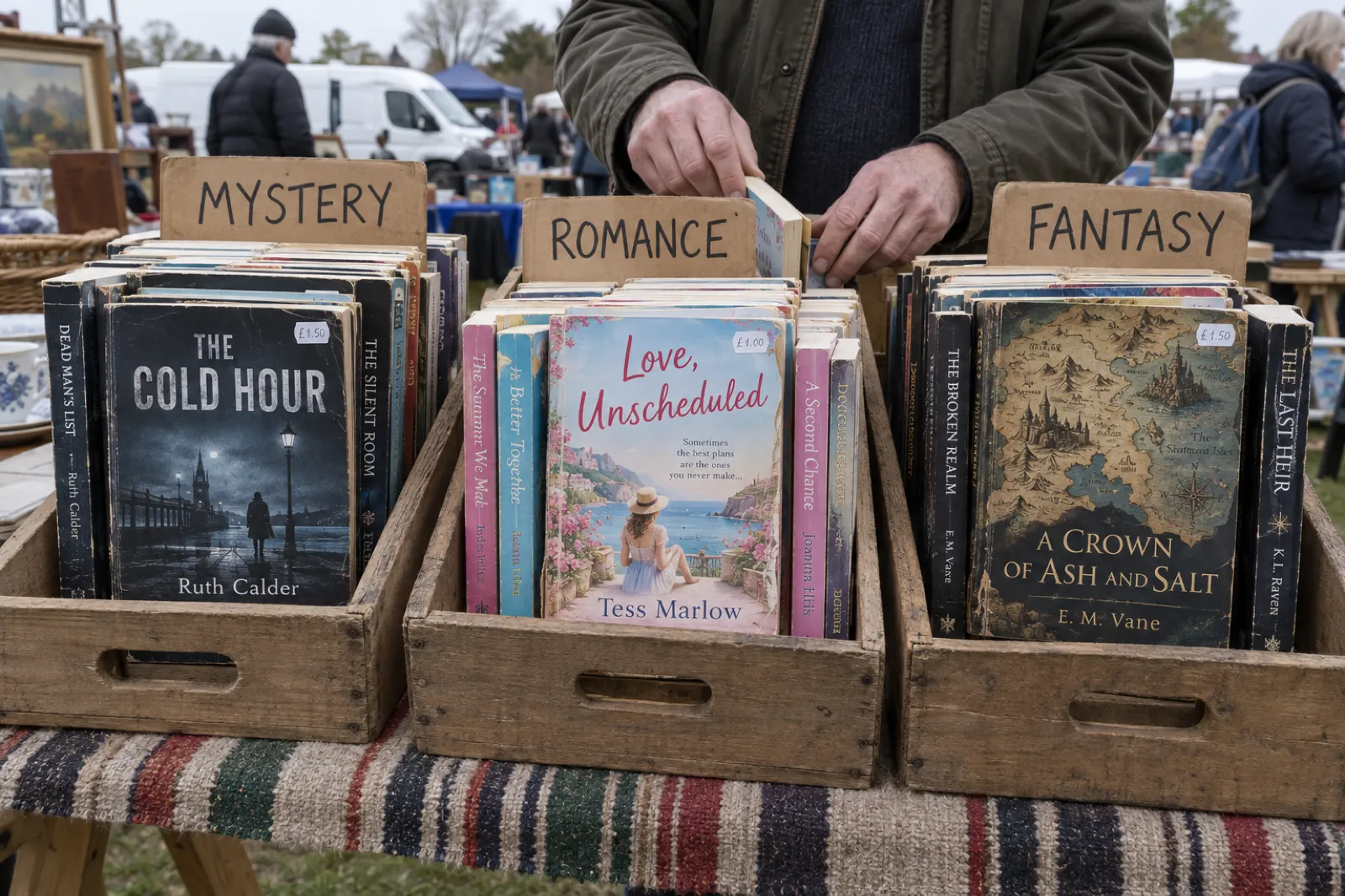
Even in a crate at a flea market, the titles sort themselves: a cold noun for mystery, a playful phrase for romance, a crown and two elements for fantasy.
Thriller, suspense and mystery
Domestic suspense leans on a person and a place: The Girl on the Train, The Woman in Cabin 10, The Couple Next Door. It tells readers whose secret it is and where the trap is, and it is the most crowded pattern in the genre, so the detail after the role has to be yours alone. Spy and legal thrillers use a cold noun instead (The Firm, The Day of the Jackal). Classic crime borrows: And Then There Were None comes from a counting rhyme, The Cuckoo's Calling from a Christina Rossetti poem. Cozy mysteries want warmth and a wink, a club or a village with a murder in the same breath (The Thursday Murder Club), and a repeated shape across the series.
Romance
Romance readers shop by trope, and the best romance titles say the trope out loud: The Hating Game, The Love Hypothesis, Book Lovers, The Unhoneymooners. Darker romance leans on two words with an edge (Twisted Love, Ugly Love). Name only the trope the book really delivers.
Fantasy and romantasy
"The [Noun] of [Noun]" is the fantasy signature: The Name of the Wind, The Way of Kings, The Priory of the Orange Tree. Romantasy extended it to "A [Noun] of [Noun] and [Noun]" after A Court of Thorns and Roses, so choose unusual nouns. A name or invented word (Circe, Piranesi, Mistborn) is the other strong option.
Science fiction
Science fiction favours a single hard word (Dune, Foundation, Recursion), a coined term (Neuromancer, Snow Crash) or a role with a twist (The Martian). Numbers suggest precision and time: Fahrenheit 451, Nineteen Eighty-Four, The Three-Body Problem.
Horror
Horror titles are often a place where something is wrong (The Haunting of Hill House, Pet Sematary, House of Leaves) or a single word that turns ordinary into dread (It, Misery). A borrowed line works well because the source does the work: Something Wicked This Way Comes is from Macbeth.
Literary and book-club fiction
This is where borrowed lines live. Of Mice and Men is from a Robert Burns poem, The Grapes of Wrath from "The Battle Hymn of the Republic", Things Fall Apart from Yeats, Tomorrow, and Tomorrow, and Tomorrow from Macbeth, and The Fault in Our Stars (young adult) from Julius Caesar. Book-club fiction also likes a name with a phrase (Eleanor Oliphant Is Completely Fine).
Young adult
Young adult titles mix single words with attitude (Divergent, Speak, Twilight) and phrases a teenager might say (We Were Liars, A Good Girl's Guide to Murder).
Children's and picture books
Picture book titles are made to be read aloud, often by a tired adult: rhythm, rhyme and repetition (Room on the Broom, Llama Llama Red Pajama, Brown Bear, Brown Bear, What Do You See?). Many are a whole sentence with a character and a problem: Don't Let the Pigeon Drive the Bus!, The Day the Crayons Quit. If it is fun to say, a child will ask for it again. For the page-count side of children's books, see our children's book word count guide.
Book titles ideas for non-fiction: say what the reader gets
Non-fiction readers buy an outcome, so the title and subtitle work as a pair. The title is short and memorable; the subtitle says who the book is for and how it delivers. Look at Atomic Habits: two words on the cover, and a subtitle on the listing that explains the method.
Self-help and personal growth. The strongest titles name an idea the reader will repeat (Deep Work, Essentialism, Atomic Habits) or speak directly to them in a sentence (Make Your Bed, Can't Hurt Me, Feel the Fear and Do It Anyway). Numbers promise a structure the reader can finish: The 7 Habits of Highly Effective People, The 5 Love Languages.
Business. Business titles name a framework a manager could say in a meeting (The Lean Startup, Blue Ocean Strategy, Radical Candor) or set two states side by side (Good to Great, Zero to One).
Money. Money titles promise a path or name a person the reader wants to become: The Simple Path to Wealth, The Millionaire Next Door, The Intelligent Investor. A contrast also works: Rich Dad Poor Dad.
Health and fitness. Name the body result or the question the reader has (Why We Sleep, How Not to Die, Outlive) without promising a cure. Readers distrust miracle language.
Cookbooks. Cookbooks name the kind of cooking (Simple, Nothing Fancy, 5 Ingredients), the ingredients themselves (Salt, Fat, Acid, Heat; Flour Water Salt Yeast) or a place with a table in it (Jerusalem, Magnolia Table). Our cookbook generator page covers the recipe side.
Memoir. Memoir titles are small and specific: one word that holds a life (Educated, Wild, Becoming), an object or place (The Glass Castle, Crying in H Mart) or a sentence in the author's own voice (I'm Glad My Mom Died, Me Talk Pretty One Day). If you are writing yours, our guide to writing a memoir covers structure.
True crime and narrative history. These name the people and the place (Killers of the Flower Moon, The Devil in the White City) or take a line from the case itself (Say Nothing, I'll Be Gone in the Dark).
Book title formulas: 16 patterns with real examples
Every title on this page fits one of these 16 patterns. The label is our reading of the pattern, not the author's; some titles fit two. The count shows how many of the 408 published titles use each one.
The three most common here are a coined phrase or named idea (59), the person or role (55) and a whole sentence (46). Common does not mean best: it means the pattern is familiar to readers, which is useful, and crowded, which is a reason to choose unusual words.
One strong word
40 titles
Pattern: A single noun, verb or adjective that holds the whole book. Template: [Word]
Why it works: It is easy to remember, prints large on a thumbnail and leaves the cover and subtitle to explain. It works when the word is unusual in your genre or carries a double meaning.
Watch out: Common words are hard to find in a search. Pair a one-word title with a subtitle on non-fiction, and search Amazon for it before you commit.
Real examples: Ikigai (Héctor García and Francesc Miralles); Mindset (Carol S. Dweck); Grit (Angela Duckworth); Quiet (Susan Cain); Rework (Jason Fried and David Heinemeier Hansson); Traction (Gino Wickman).
A coined phrase or named idea
59 titles
Pattern: Two or three words that name a concept the book introduces. Template: [Adjective] [Noun]
Why it works: Readers repeat a named idea to each other, so the title spreads with the idea. Non-fiction authors use it to own a concept; novelists use it for an invented place or event.
Watch out: The phrase has to make sense before anyone reads the book, or the subtitle has to do that job.
Real examples: Atomic Habits (James Clear); Big Magic (Elizabeth Gilbert); The Happiness Project (Gretchen Rubin); Essentialism (Greg McKeown); Deep Work (Cal Newport); Digital Minimalism (Cal Newport).
The promise
12 titles
Pattern: The result the reader wants, said plainly. Template: [Result the reader wants]
Why it works: Shoppers in non-fiction are looking for an outcome. A title that names it answers "is this for me?" in one glance.
Watch out: Stay believable. Retail sites and readers both distrust guaranteed results and cure claims.
Real examples: The Courage to Be Disliked (Ichiro Kishimi and Fumitake Koga); Built to Last (Jim Collins and Jerry I. Porras); Profit First (Mike Michalowicz); Building a StoryBrand (Donald Miller); Made to Stick (Chip Heath and Dan Heath); The Total Money Makeover (Dave Ramsey).
How to...
5 titles
Pattern: How to + the skill or result. Template: How to [Result]
Why it works: It matches the words people type into a search box and tells the reader the book is practical.
Watch out: It is crowded. Add the reader or a twist ("How Not to...") to stand apart.
Real examples: How to Win Friends and Influence People (Dale Carnegie); How Not to Die (Michael Greger with Gene Stone); How to Change Your Mind (Michael Pollan); How to Cook Everything (Mark Bittman); How to Eat (Nigella Lawson).
A number
20 titles
Pattern: A count of habits, laws, days or steps, or a number that is part of the story. Template: The [Number] [Things] of [Result]
Why it works: A number promises structure and a finish line. In fiction a number can be a date, an age or a clue.
Watch out: The book has to deliver exactly that many things. Write numbers as digits on non-fiction covers, where they read faster.
Real examples: The 7 Habits of Highly Effective People (Stephen R. Covey); The Four Agreements (Don Miguel Ruiz); Four Thousand Weeks (Oliver Burkeman); The 5 Love Languages (Gary Chapman); $100M Offers (Alex Hormozi); The 22 Immutable Laws of Marketing (Al Ries and Jack Trout).
A question
5 titles
Pattern: A question the reader already asks, or one the story answers. Template: Why Do We [Verb Phrase]?
Why it works: A question opens a gap the reader wants closed, and it sounds like a person talking.
Watch out: Keep it short. A long question wraps badly on a cover and gets cut in search results.
Real examples: Who Moved My Cheese? (Spencer Johnson); What Color Is Your Parachute? (Richard N. Bolles); Why We Sleep (Matthew Walker); Do Androids Dream of Electric Sheep? (Philip K. Dick); Brown Bear, Brown Bear, What Do You See? (Bill Martin Jr.).
Two things, set side by side
15 titles
Pattern: [Noun] and [Noun], often a contrast. Template: [Noun] and [Noun]
Why it works: Two words in tension suggest the conflict of the book without explaining it. The rhythm is easy to say.
Watch out: Pick words with weight. Two vague abstractions ("Light and Hope") say nothing.
Real examples: Good to Great (Jim Collins); Zero to One (Peter Thiel with Blake Masters); Thinking, Fast and Slow (Daniel Kahneman); Rich Dad Poor Dad (Robert T. Kiyosaki); Your Money or Your Life (Vicki Robin and Joe Dominguez); Pride and Prejudice (Jane Austen).
A list of three or four
9 titles
Pattern: Three or four nouns, with or without commas. Template: [Noun], [Noun], [Noun]
Why it works: A list sets a beat and shows the range of the book. It works for memoirs, cookbooks and big-idea history.
Watch out: Each item should be concrete. Four abstract nouns read like a slogan.
Real examples: Eat, Move, Sleep (Tom Rath); Salt, Fat, Acid, Heat (Samin Nosrat); Flour Water Salt Yeast (Ken Forkish); Eat Pray Love (Elizabeth Gilbert); Guns, Germs, and Steel (Jared Diamond); Red, White & Royal Blue (Casey McQuiston).
The person or role
55 titles
Pattern: The [Role], often with where they are or what they did. Template: The [Role] [Where or What]
Why it works: Readers buy stories about people. A role ("The Housemaid") tells them whose story it is and hints at the genre.
Watch out: Some roles are very crowded in some genres (the girl, the wife in thrillers). Add a detail only your book has.
Real examples: Man's Search for Meaning (Viktor E. Frankl); The Artist's Way (Julia Cameron); The Innovator's Dilemma (Clayton M. Christensen); The Millionaire Next Door (Thomas J. Stanley and William D. Danko); The Intelligent Investor (Benjamin Graham); The Richest Man in Babylon (George S. Clason).
A name
34 titles
Pattern: The main character's name, alone or with a twist. Template: [Name] [Short Phrase]
Why it works: A name promises a character worth knowing. A name with a short phrase ("Eleanor Oliphant Is Completely Fine") adds voice and humour.
Watch out: A name alone works best once the cover carries the genre. For a debut, the phrase version usually earns more attention.
Real examples: Nigella Express (Nigella Lawson); Angela's Ashes (Frank McCourt); Tuesdays with Morrie (Mitch Albom); The Immortal Life of Henrietta Lacks (Rebecca Skloot); Seabiscuit (Laura Hillenbrand); The Great Gatsby (F. Scott Fitzgerald).
A place
36 titles
Pattern: A town, a house, a street or an imagined world. Template: The [House or Road] at [Place]
Why it works: A place sets the mood before a word of the book is read, and it often becomes the series name.
Watch out: A real place name may be shared with travel guides and histories. Search it first.
Real examples: A Random Walk Down Wall Street (Burton G. Malkiel); The Blue Zones (Dan Buettner); Jerusalem (Yotam Ottolenghi and Sami Tamimi); The Food Lab (J. Kenji López-Alt); The Smitten Kitchen Cookbook (Deb Perelman); Magnolia Table (Joanna Gaines).
An object
12 titles
Pattern: The [Object] that sits at the centre of the story. Template: The [Specific Object]
Why it works: A concrete object gives a cover designer an image and gives the reader something to watch for.
Watch out: Make it specific ("The Goldfinch", not "The Painting").
Real examples: The Glass Castle (Jeannette Walls); The Wager (David Grann); The Goldfinch (Donna Tartt); The Bell Jar (Sylvia Plath); Girl with a Pearl Earring (Tracy Chevalier); The Da Vinci Code (Dan Brown).
The [Noun] of [Noun]
18 titles
Pattern: Two nouns joined by "of", sometimes with a third. Template: A [Noun] of [Noun] and [Noun]
Why it works: It sounds old and weighty, which suits fantasy, sagas and big ideas. The second noun carries the mood.
Watch out: It is the most common fantasy shape on the shelf. Unusual nouns keep it from blending in.
Real examples: The Power of Now (Eckhart Tolle); The Psychology of Money (Morgan Housel); The Joy of Cooking (Irma S. Rombauer); The Remains of the Day (Kazuo Ishiguro); The God of Small Things (Arundhati Roy); The Lord of the Rings (J. R. R. Tolkien).
The trope signal
14 titles
Pattern: Two or three words that tell romance readers the setup. Template: The [Trope Word] [Noun]
Why it works: Romance readers shop by trope. "The Hating Game" says enemies to lovers before they read the blurb.
Watch out: It works only if the book delivers that setup. A trope title on the wrong book earns poor reviews.
Real examples: Beach Read (Emily Henry); Book Lovers (Emily Henry); People We Meet on Vacation (Emily Henry); Funny Story (Emily Henry); The Hating Game (Sally Thorne); The Kiss Quotient (Helen Hoang).
A whole sentence
46 titles
Pattern: A line of speech, a command or a statement. Template: [Short Sentence in Your Narrator's Voice]
Why it works: A sentence has a voice. It feels like someone is talking to you, which suits memoir, humour, picture books and domestic suspense.
Watch out: Read it aloud. If it does not sound like your narrator or your book, it will feel borrowed.
Real examples: Think and Grow Rich (Napoleon Hill); You Are a Badass (Jen Sincero); The Mountain Is You (Brianna Wiest); Feel the Fear and Do It Anyway (Susan Jeffers); Can't Hurt Me (David Goggins); Make Your Bed (William H. McRaven).
A borrowed line
28 titles
Pattern: A phrase lifted from a poem, a song, scripture, a saying, or a line in the book itself. Template: [A Few Words From a Line You Love]
Why it works: The phrase already has a rhythm and an echo, and readers who know the source get a second meaning.
Watch out: Titles are not protected by copyright, but quoting long passages inside the book can be. Use a short phrase.
Real examples: Daring Greatly (Brené Brown); The War of Art (Steven Pressfield); Bird by Bird (Anne Lamott); I Know Why the Caged Bird Sings (Maya Angelou); When Breath Becomes Air (Paul Kalanithi); Helter Skelter (Vincent Bugliosi with Curt Gentry).
Build your own title from a formula, and check it
Choose a pattern, fill in the words from your own book, and the builder writes three or four versions. Pick one, add a subtitle if you like, and it checks the result against KDP's title rules (read on 17 October 2026): length, the words KDP does not allow, and the 60-character point where its own help page says shoppers start to skim. Nothing you type leaves this page until you click through to write.
The checks cover what KDP writes down. They cannot tell you whether another book already uses the title; the testing steps further down show how to check that in five minutes.
How do I come up with a book title?
Collect raw words from the book first, then shape them with patterns, then test. Most authors try to invent a title out of nothing and stall. It is faster to mine the manuscript for its strongest nouns, names, places and phrases, run them through three or four formulas, and keep the ten that survive.
Write a one-sentence version of the book. Who it is about or who it is for, what happens or what changes, and where. "A widowed lighthouse keeper finds letters that prove her husband had another family" already holds three title seeds: the keeper, the letters, the other family.
List every concrete word. Ten minutes, no judging: names, places, objects, jobs, seasons, sounds. For non-fiction, list the result the reader wants, the mistake they keep making, and the name you give your method.
Hunt for lines inside the book. Read your first and last chapters and underline any phrase that sounds like a title. To Kill a Mockingbird and Bird by Bird both come from lines inside their own books.
Run the words through patterns. Take your best five words and push each through four formulas: the role, the place, the object and one more that suits your genre. That is twenty candidates in a few minutes. The builder above does the typing for you.
Cut to ten, then to three. Remove anything you have to explain, anything a famous book already uses, and anything that could belong to a different genre.
Sleep on it. A title that still feels right the next morning is worth testing.
Test the three. The section below has the tests, and they take an afternoon.
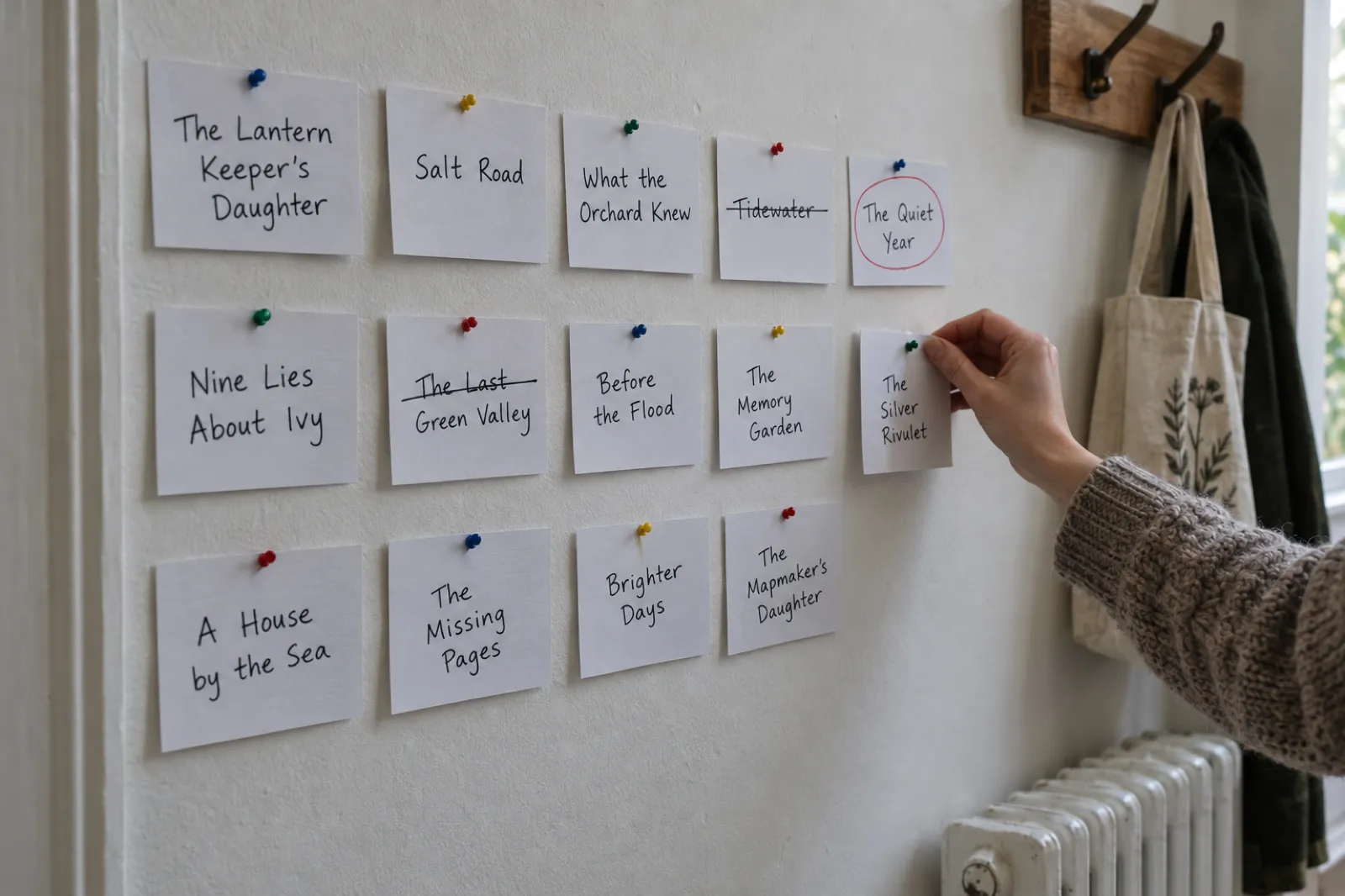
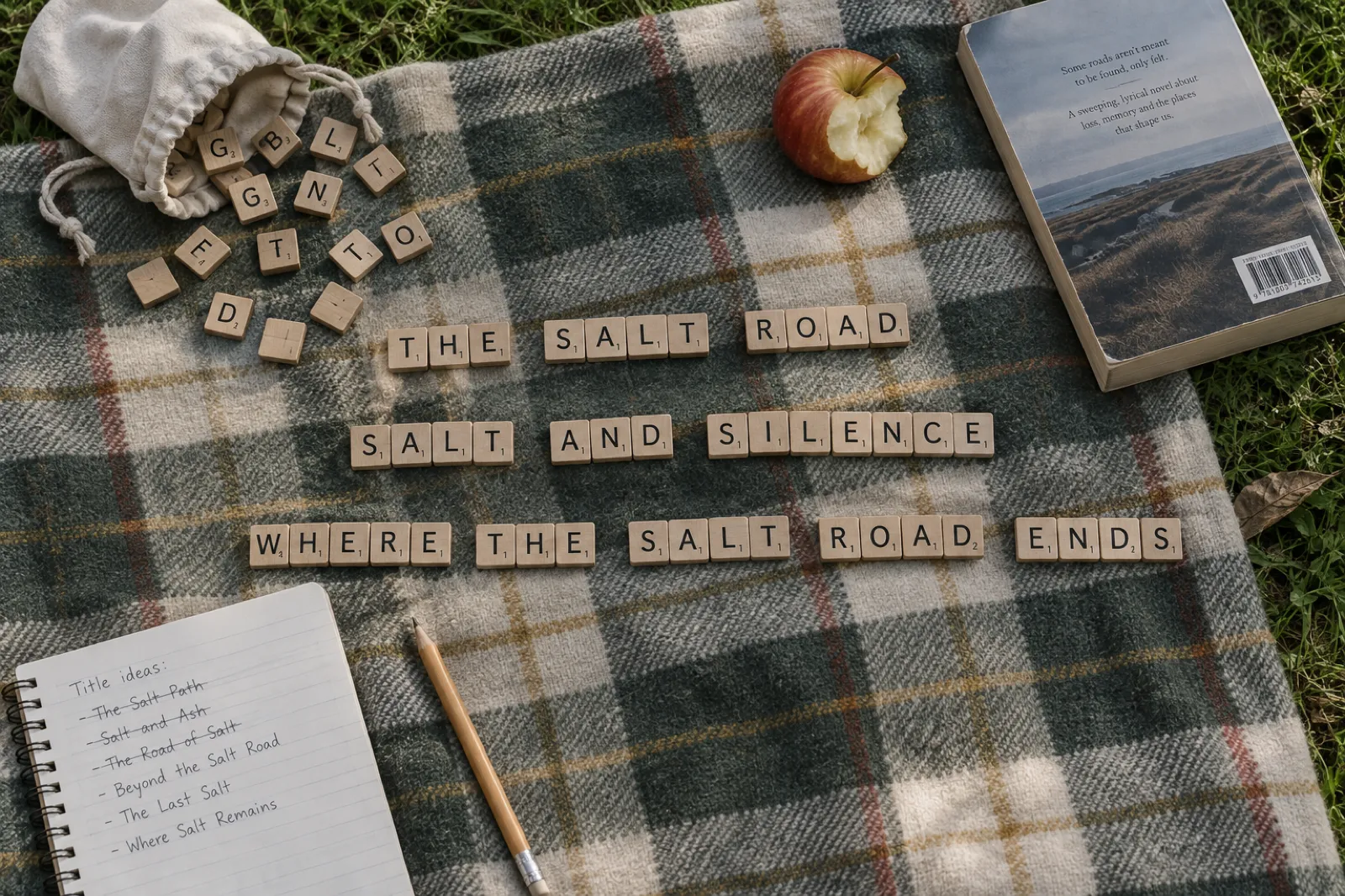
One seed word, three patterns: a place, a pair, and a sentence. The notebook shows the ones that did not survive, including one too close to a well-known memoir.
For the rest of the job, from outline to published book, see how to write a book. Stuck before you have a manuscript? Use a working title and move on; changing it costs nothing until the book is published. If you would like a few dozen starting points to react to, the book title generator produces 24 at a time from a topic or a character name, and the chapter title generator does the same one level down.
What are good titles for books? Six things the best ones share
Good titles for books share six traits: they are concrete, short, genre-honest, easy to say, distinct from other books in the same section, and true to what the book delivers. You can see each trait across the published titles above, in every genre from picture books to business.
Concrete
A thing you can picture beats an idea: The Goldfinch, The Bell Jar.
Short
Median 3 words in our list. Short titles survive the thumbnail.
Honest about genre
A romance that sounds like a thriller disappoints both audiences.
Easy to say
If a reader cannot say or spell it, they cannot recommend it.
Distinct
Not already used by a well-known book in your genre.
True to the book
The title is a promise the book has to keep.
How do you test a book title before you commit?
Test a title by searching for it, shrinking it and saying it, then by asking readers. Search Amazon and the web for the exact phrase, look at it at thumbnail and spine size, say it aloud to someone who has not read the book, and ask five readers in your genre which of three covers they would open.
The search test. Search the exact title in Amazon's books department and in a web search with quotation marks. A recent book in your genre with the same title is a reason to change yours; an old book in another category usually is not. Look for films, songs and brands too.
The thumbnail test. Shrink your cover mock-up to the size of a search result on a phone. Can you read the title? Short titles in large type win here, which is one reason so many published titles are four words or fewer.
The say-it test. Say the title to a friend once, and a day later ask them to repeat it. If they cannot, they cannot recommend it.
The genre test. Show the title alone, no cover, to a reader of your genre and ask what kind of book it is. If they guess wrong, the title is working against you.
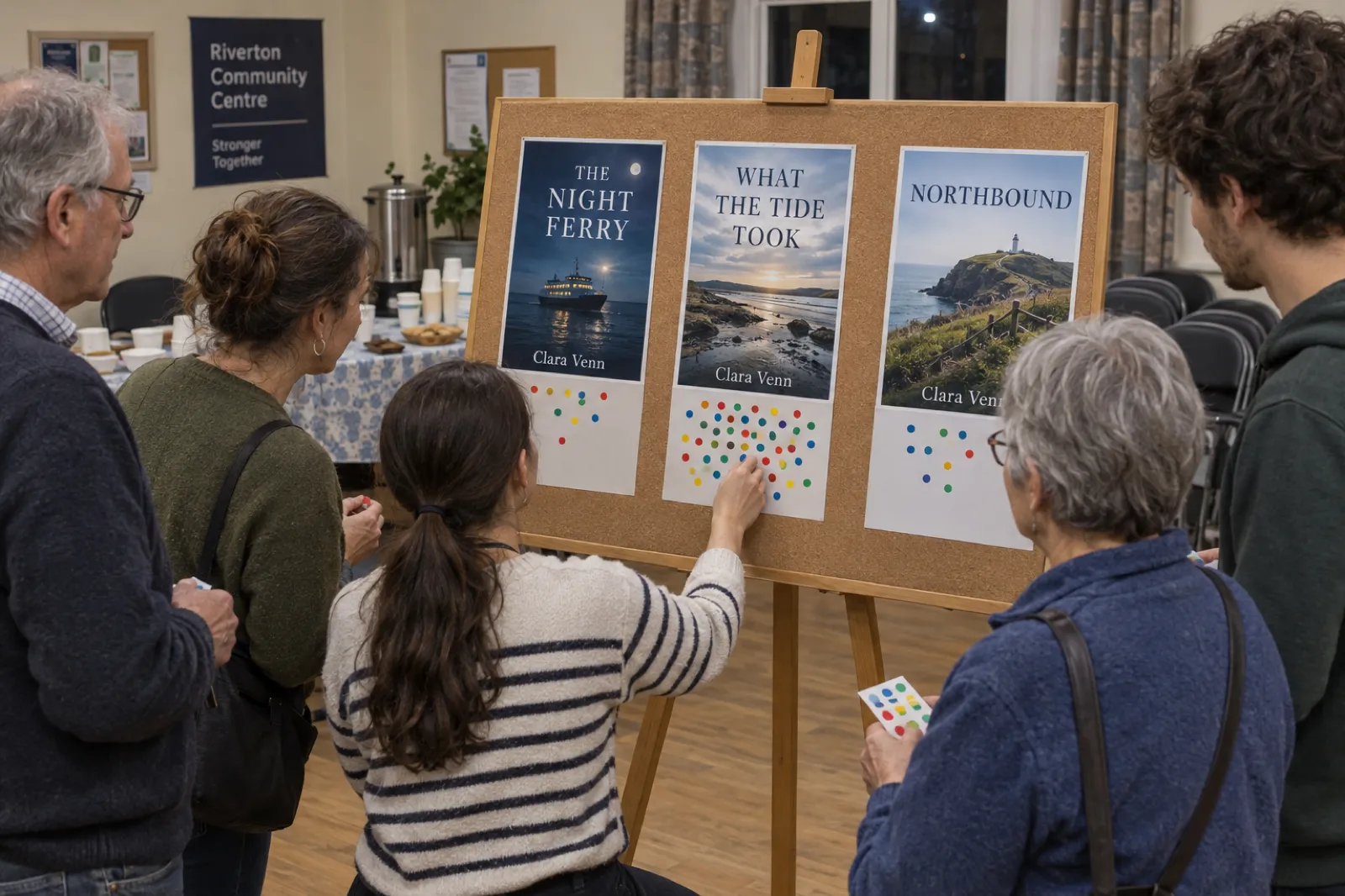
The reader vote. Put three mock covers in front of five to ten readers of your genre, or post them to a reader group, and ask which they would open. Ask why, too: the reasons are more useful than the count.
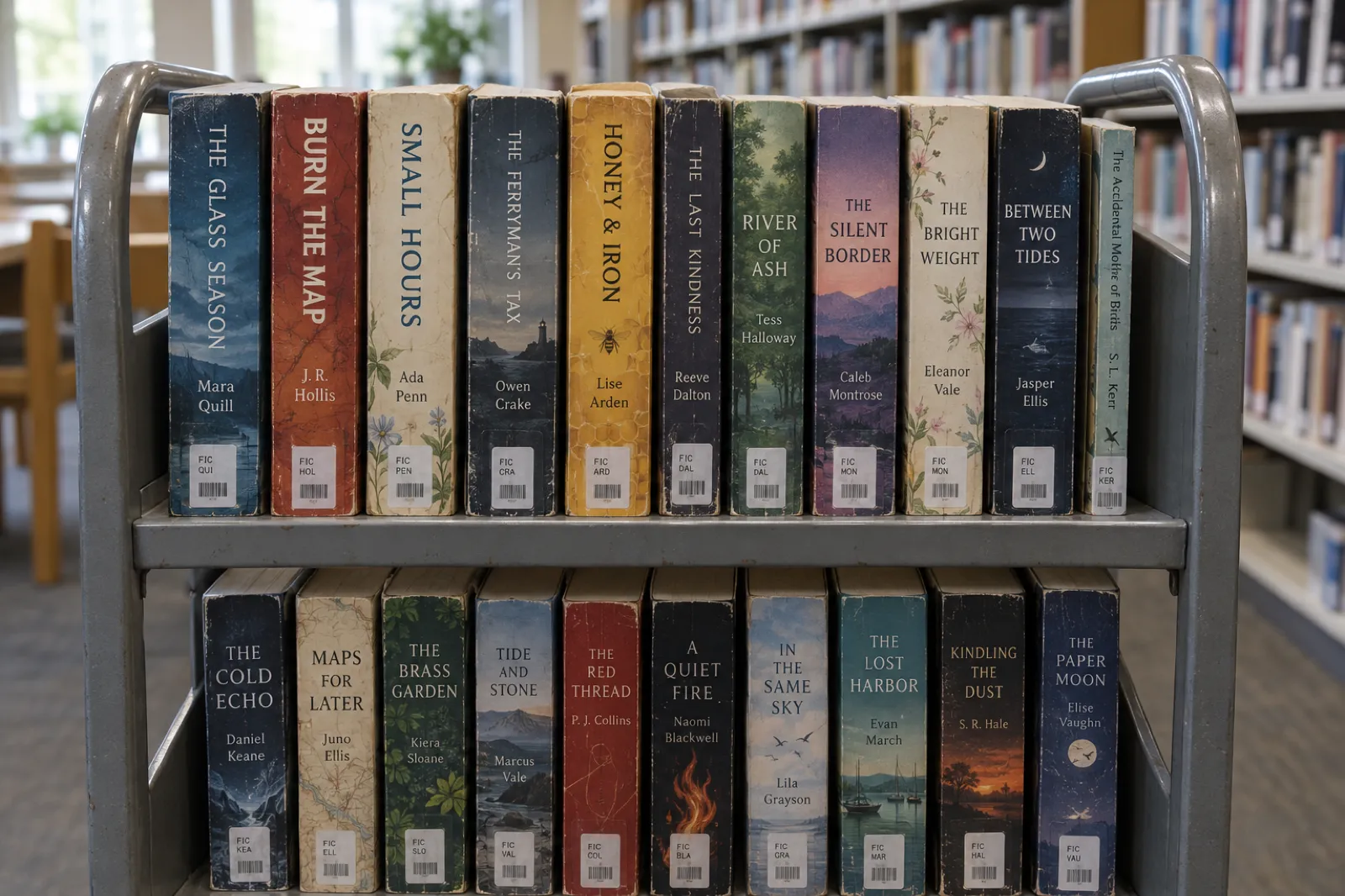
The spine test, on a library trolley: two-word titles read from across the room; the long one at the end of the top row needs a head tilt.
A cover changes how a title reads, so test the pair together when you can. Our book cover generator page shows how covers are made in the app, and the cover designer is on every plan, so you can mock up three covers with three titles in an evening.
A dot vote at a writers group: same book, same author, three titles. The reasons people give are worth more than the dots.
Friends are polite and writers judge like writers: readers who buy your genre are the panel that counts.
What are Amazon KDP's rules for book titles?
KDP wants the title field to hold only the real title as it appears on the cover. Title and subtitle together must be under 200 characters, and KDP prohibits keyword stuffing, unauthorised references to other books, authors or trademarks, words like "bestselling" or "free", punctuation-only titles and HTML.
Rule
What the source says
Source (read 17 October 2026)
What goes in the title field
Only the actual title of the book as it appears on the cover.
Repeated generic keywords ("notebook", "journal", "gifts", "books"), unauthorised references to other titles, authors or trademarks, sales rank such as "bestselling", promotions such as "free", punctuation only, placeholders like "n/a", and HTML.
"Customers are more likely to skim past long titles (over 60 characters)." Keywords already in the title do not need repeating in the seven keyword boxes.
A paperback or hardcover title, subtitle or primary author can be edited within 72 hours of first publication; after that they are locked and a change needs a new edition.
Rules change; follow the links for the current wording. The title builder above applies the length and word rules from this table.
The rule that catches most new authors is keyword stuffing. It is tempting to title a journal "Gratitude Journal Notebook for Women Gift Book", and it is exactly what KDP lists as prohibited. Put the real title in the title field, use the subtitle to describe the book in plain words, and put search terms in the seven keyword boxes, where KDP wants them. Our KDP SEO guide covers how to choose those keywords, and Kindle keyword research for beginners shows how to find them.
The second rule worth knowing before you publish: titles lock. KDP lets you edit a print book's title within 72 hours of first publication; after that a different title means a new edition. Typos are a separate case that KDP support can fix. For the full set of title rules with worked examples, the book title generator page has a longer section, and the self-publishing guide covers the whole upload.
Can I use a book title that already exists?
Usually, yes, but it is rarely a good idea. The US Copyright Office's Circular 33 lists "the title or subtitle of a work, such as a book" among things copyright does not protect. It also notes that names and titles can sometimes be protected under trademark law, which is why famous series names are off limits.
The practical problem is search: if a well-known or recent book in your genre owns the title, readers who hear about yours will find theirs. KDP adds its own line: its guidelines bar unauthorised references to other titles and authors, so a title built to look like a famous book's ("The Hunger Games for Kids") is out.
Shared titles across distant categories are common and harmless: a novel and a gardening book called The Secret Garden do not compete. The check takes five minutes, and the search test above covers it. If you plan a long series or merchandise under one name, search the trademark register in your country as well (in the US, the USPTO trademark search), and take professional advice if something close comes up.
How long should a book title be?
Aim for one to five words. Of the 408 published titles on this page, the median is 3 words and 77% are four words or fewer. KDP's keyword help says shoppers are more likely to skim past titles over 60 characters, and only one title here passes that length.
Long titles can work when the length is the joke or the voice: The Hundred-Year-Old Man Who Climbed Out of the Window and Disappeared is 70 characters and sold widely on its humour. That is the exception that needs a reason. For most books, the extra words belong in a subtitle, the description or the keyword boxes.
Should my book have a subtitle?
Non-fiction: almost always. The title makes the promise and the subtitle says how and for whom, in the words readers search for. Fiction: usually not, though a series line such as "A Harbour Lights Mystery" helps readers find the next book. On KDP, title and subtitle together must stay under 200 characters.
A good non-fiction subtitle answers three questions: what will I be able to do, how, and is it for me? "Calm Is a Skill: Ten-Minute Practices for Anxious Parents" does all three in eight words.
In Inkfluence AI the title and subtitle are two fields in the Edit Book Details dialog (the pencil next to the book title in the editor), and both flow through to the cover, the exports and the listing. Quick Start also suggests a working title and subtitle from your idea, which you can keep or replace.
Title ideas for a series, and for chapters
Series titles repeat a shape so readers spot book two on sight. Pick the repeating element before you publish book one: the same first word, a shared structure ("A [Noun] of [Noun] and [Noun]"), a number, or a place. KDP treats the series name as a title too, so the same rules apply.
Sarah J. Maas's A Court of Thorns and Roses series opens every sequel with "A Court of", from A Court of Mist and Fury onward. Keep the series line in the same place on every cover.
If you are planning several books from the start, the book series writer page shows how Inkfluence continues a finished book as a series, carrying the characters and what has happened into book two, and the series guide walks through it.
Chapter titles follow the same logic at a smaller size: concrete, short, and in the voice of the book. The chapter title generator gives a set to react to, and a book outline generator is the place to start if you have the title but not the plan.
From title to book with Inkfluence AI
We make Inkfluence AI, a book writing app. Here is what it does with a title, and where it stops.
Write under your title
Name the title in your idea and Quick Start keeps it, then writes an outline and chapters. Skip the title and it suggests a working title and subtitle you can change any time.
Or write it yourself
The blank-book option opens an empty book with your title on it. You write; the editor, the cover designer and the exports are there when you need them.
Put it on a cover and a listing
Title, subtitle and author flow to the cover, the PDF, EPUB and KDP files, and the book description. Need a pen name? Try the pen name generator.
Limits, plainly. The app does not check whether a title is already used on Amazon or registered as a trademark; do that yourself with the tests above. There is no word-count setting: a book's length follows how many chapters you ask for, roughly 1,000 to 1,500 words a chapter. The free plan covers 5 chapters to start and 5 more each month with PDF export; EPUB, Word and the KDP package need a paid plan (Creator $9.99 a month, Premium $19.99) or a credit pack.
Whatever you write with, read every page before you publish, and tell KDP when content is AI-generated; our guide to KDP's AI disclosure rules explains the question.
How this page was made
Who: Sam May, who founded and runs Inkfluence AI. More about us is on the about page.
The titles: 408 published books, each listed with its author, picked as clear examples of each pattern across 15 genres, from classics to recent bestsellers. The pattern labels are our reading; the stat cards and the genre table are counted from this list when the page is built. The 120 fresh ideas were written for this page and are free to use; titles cannot be owned by copyright, so search Amazon before you commit to one.
The rules: KDP's metadata guidelines, its keywords help page and its page on updating book details, and the US Copyright Office's Circular 33, all read on 17 October 2026. The four photographs are illustrations made for this page; the books in them are invented. AI tools helped with drafting, and every title, author and rule was checked by hand.
Spotted a wrong author or a better example? Tell us through the contact page.
Start from a pattern that suits your genre: one strong word (Dune, Educated), a role (The Housemaid), a place (Shutter Island), a promise (Atomic Habits), a pair (Pride and Prejudice) or a borrowed line (Of Mice and Men). This page lists 408 published titles sorted by genre and pattern, plus 120 fresh ideas you are free to use.
How do I come up with a title for my book?
Write down every concrete noun, name and place in your book and the one result or feeling it leaves the reader with. Run those words through three or four title patterns, keep ten, then test the best three: say them aloud, search them on Amazon, look at them at thumbnail size, and ask five readers which book they would open.
Can I use a book title that already exists?
Legally, usually yes: the US Copyright Office says titles are not protected by copyright. Practically, avoid a title used by a well-known or recent book in your genre, because readers searching for yours will find the other one, and avoid famous series names, which can be trademarks. KDP also bars unauthorised references to other titles and authors.
How long should a book title be?
Short. On this page's list of 408 published titles, the median title is 3 words and 77% are four words or fewer. KDP's keyword help page notes that customers are more likely to skim past titles over 60 characters. Non-fiction adds detail in the subtitle; title and subtitle together must stay under 200 characters on KDP.
What words are not allowed in a book title on Amazon KDP?
KDP's metadata guidelines, read on 17 October 2026, prohibit repeated generic keywords such as "notebook" or "journal", unauthorised references to other titles, authors or trademarks, sales-rank words such as "bestselling", promotional words such as "free", titles made only of punctuation, placeholders such as "n/a", and HTML tags.
Should I choose a title before or after writing the book?
Pick a working title before you start so the book has a name, then choose the real one after the first draft. By then you know the book's strongest image, phrase and promise, and many published titles come from a line inside the book itself.
Does my book need a subtitle?
Non-fiction almost always benefits from one: the title makes the promise and the subtitle says how and for whom, in words readers search for. Fiction usually does without, though a series line ("A Harbour Lights Mystery") helps readers find book two.
How is this page different from the book title generator?
This page is for inspiration and judgement: real published titles, the patterns behind them, a formula builder that checks your title against KDP's rules, and how to test a shortlist. The book title generator is the fast option: pick a genre, add a topic and get 24 new title ideas a click.
Can Inkfluence AI write a book from my title?
Yes. Use any idea on this page or your own, and Inkfluence AI writes an outline and the chapters under that title, or opens a blank book with it if you would rather write yourself. The free plan covers 5 chapters to start and 5 more each month, with PDF export.
You have a title. Now write the book.
Start on the free plan with no card: your title, your idea, and the first five chapters written and ready to edit.