
Writing Prompt Generator
Story prompts by genre for writers who want to write something today: opening lines, scenarios, dialogue, characters and twists, each paired with an exercise sized to the time you have. Generate as many as you like. When one turns out to be worth more than a page, turn it into a book.
- Unlimited prompts
- 10 genres, 5 prompt types
- A daily prompt
- No sign-up
Quick answer
A writing prompt generator gives you a starting point for a piece of fiction: a first line, a situation, a line of dialogue, a character or a twist. This one sorts its prompts by genre and by type, pairs each with an exercise (from a 10-minute sprint up to the first chapter of a novel), and has a daily prompt that is the same for everyone on the same day. It is free and unlimited, with no account. When a prompt grows past a page, the Turn this into a book button sends it to Inkfluence AI, which drafts a full book from it, chapter by chapter, for you to edit.
Prompt generator
Get a story prompt
Choose a genre, a kind of prompt and how long you want to write for. Every click brings four new prompts.
Your prompts will appear here.
Today's prompt
Loading today's prompt...
Everyone who opens this page today sees the same prompt, so a writing group can all start from one line.
Prompts are put together in your browser from lists we wrote by hand for each genre, so there is no limit on how many you make. Writing for a fandom? Try the fanfiction prompt generator. Looking for prompts to give an AI writing tool instead? That is a different job, covered in our guide to AI writing prompts.
What makes a writing prompt worth writing
Most prompt lists fail the same way: they hand you a topic. Write about the sea. A story about a dragon. A topic gives you somewhere to stand but nothing to do, and the page stays blank. A prompt that actually gets you writing has three things in it: a specific person, something that person wants or fears, and a pressure that stops them getting it straight away.
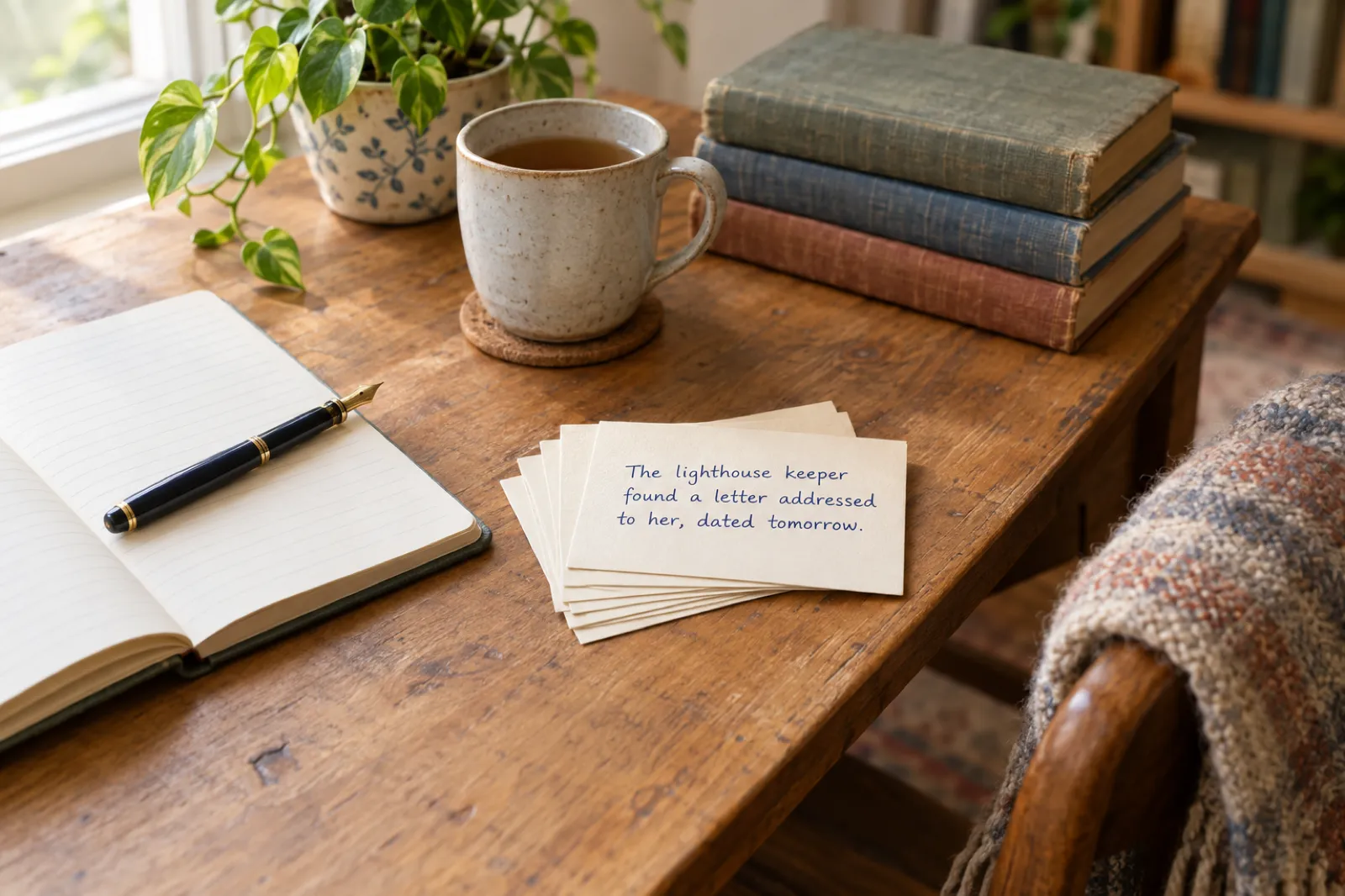
Compare "a story about a lighthouse" with "a lighthouse keeper finds a letter addressed to her, dated tomorrow". The second has a person, a strange fact and a question you need answered: who wrote it, and what happens tomorrow? You can start the moment you read it, because the first scene is obvious. She opens the letter.
That is how the prompts in this generator are built. Every scenario pairs a character with a situation and a complication. Every twist prompt gives you the setup and the reveal, so your work is planting the clues. Every character prompt sets a want against a secret, because a person who wants one thing and hides another is already halfway to a story.
A prompt also has to leave room. If it decides everything, you are filling in a form. The best ones settle the opening and leave the ending open, so writing is how you find out what happens. If a prompt here feels too fixed, keep the part that caught your eye and drop the rest. Nobody is going to mark your draft against the original wording.
Finally, a good prompt fits the time you have. A twist with three clues and a reveal will not fit in ten minutes, and a single first line is thin fuel for a month of work. The exercise length filter pairs each prompt with a task you can finish: a sprint, a scene, a short story, or a novel's first chapter plus a list of what has to happen next.
The five kinds of story prompt, and how to use each
Each prompt type exercises a different part of the craft. If you write from prompts often, rotate through them: a week of nothing but opening lines trains your ear for voice, and a week of twists trains your sense of structure.
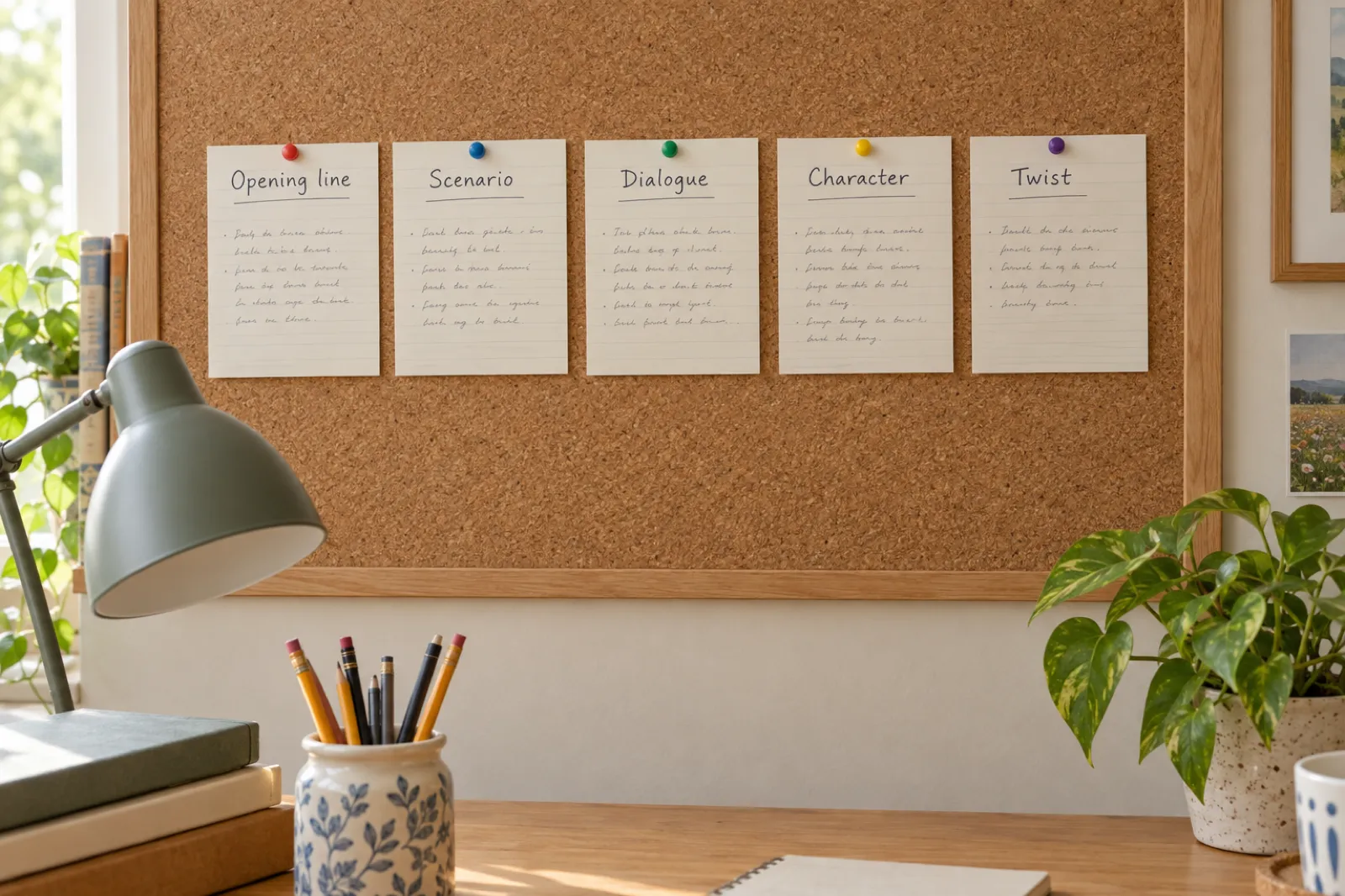
The table is the short version. Each type is explained in more detail below it.
| Type | What you get | What it trains | Best exercise length | Common trap |
|---|---|---|---|---|
| Opening line | A first sentence with a voice and a situation | Voice and rhythm | 10-minute sprint or 30-minute scene | Polishing the first line instead of writing the second |
| Scenario | A character, a situation, a complication and a setting | Premise and pacing | 30-minute scene or short story | Spending a page on the morning before the story starts |
| Dialogue | A line someone says, who says it and where | Subtext | 30-minute scene | Opening with the line instead of building up to it |
| Character | A name, a role, a want and a secret | Character under pressure | 30-minute scene or novel starter | Describing the character instead of testing them |
| Twist | A setup and the reveal it turns into | Structure and fair clues | Short story | Trying to plant three clues in ten minutes |
Opening line prompts
A first line hands you a voice and a situation in one go. Use it as your actual first sentence, then write forward without going back to polish it. The trick is to treat the line as true. If it says the town voted to forget something, the town really did, and your job is to find out what they forgot and who refused. If the line does not survive your second draft, cut it. It has already done its job by getting you to the second sentence.
Scenario prompts
A scenario gives you a character, a situation, a complication and a setting. It is the closest thing to a story premise and the easiest kind to grow into something longer. Start in the middle of the situation, not before it. If the prompt says a courier is hired to deliver a box that ticks, open with the box already in the courier's hands. Many early drafts spend a page on the morning before the story starts, and a scenario lets you skip that page.
Dialogue prompts
A dialogue prompt is a line someone says out loud, plus who says it and where. Your job is the scene around it: who hears it, what came before, and what changes once it has been said. Dialogue prompts are good practice for subtext, because the strongest lines mean more than they say. "You kept the key" is a sentence about a key and also about everything that happened between two people. Try placing the line two thirds of the way through the scene rather than at the start, so the reader arrives at it with the context you have built.
Character prompts
A character prompt gives you a name, a role, something they want and something they are hiding. Characters are there to be put under pressure, so write the moment the want and the secret pull against each other: the scene where getting the thing would mean telling the truth. If you plan a longer piece, a character prompt is the best seed for a story bible, the notes you keep on who people are, what they know and what they would never do. The character bible generator shows what a full profile looks like once a character outgrows a single scene.
Twist prompts
A twist prompt gives you a setup and the reveal it turns into. Writing toward a known twist teaches fair surprise: the reader should be able to look back and find the clues. Before you start, decide on three moments that point at the truth without stating it, and put one in each third of the piece. A twist prompt is a poor fit for a ten-minute sprint and a very good fit for a short story, which is why the generator suggests planting clues whenever you pick a longer exercise.
Writing prompts by genre
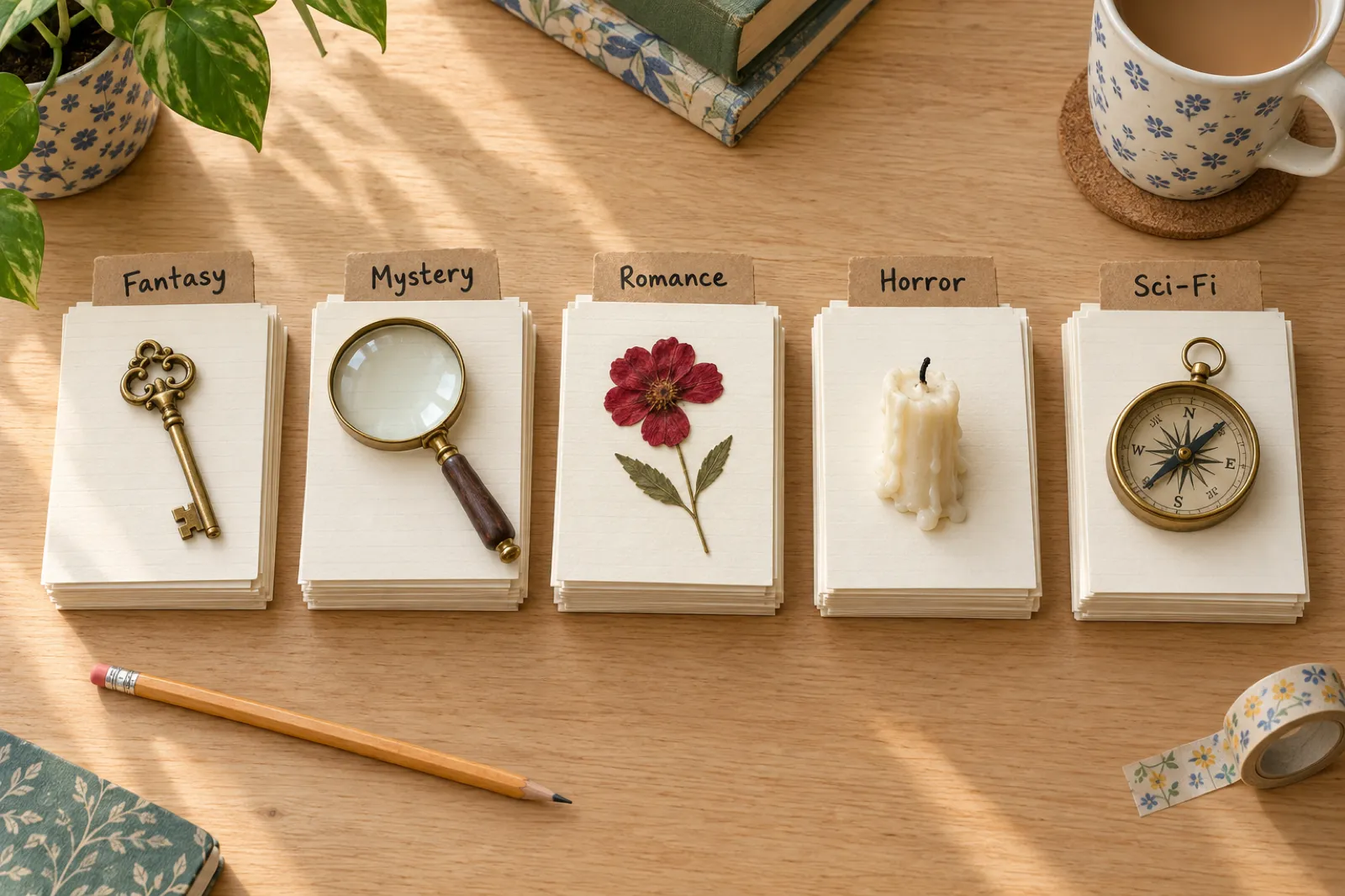
Genre changes what a prompt has to do. A horror prompt needs one wrong detail, a romance prompt needs two people with a reason to stay apart, and a mystery prompt needs a question with a real answer. Below is what to look for in each genre the generator covers, with three sample prompts apiece you can use straight away.
Fantasy writing prompts
A fantasy prompt earns its place with one rule about how the world works and one cost for breaking it. Magic with no price gives you nothing to write against, so look for the limit in each prompt and push on it.
- A cartographer who has never left the valley is hired to map a road that moves every night.
- The royal court keeps one person whose only job is to remember the true version of history. This morning, that person forgot something.
- Every child in the village is given a name and a curse at birth. One child was given two names.
Science fiction writing prompts
Science fiction prompts work best when one change to the world is followed all the way into ordinary life. The useful question is less what the technology does and more who it hurts and who profits from it.
- Memories can be sold, and a nurse finds out that someone has been selling hers.
- The crew of a generation ship has been told they are halfway there. The navigator knows they never left orbit.
- A repair technician on a mining station is the only one who notices the station computer has started leaving notes.
For longer science fiction, the sci-fi story generator turns a premise like these into a full draft.
Mystery writing prompts
A mystery prompt needs a question with a definite answer and a person with a reason to find it. That person does not have to be a detective. A librarian, a nurse or a nosy neighbour often gives you more to work with than a badge does.
- The village bookshop receives a library book borrowed in 1974, returned this morning with a new bookmark inside.
- A wedding photographer spots the same stranger in the background of three weddings in three different towns.
- A house-sitter finds the owners' calendar filled in for the next six months. Every entry stops on Thursday.
Thriller writing prompts
Thrillers run on a clock. A thriller prompt should tell you what happens if the hero fails and roughly when, so every scene can tighten the screw.
- A courier is paid triple to deliver a sealed case by midnight and told not to stop for anyone, including the police.
- An interpreter at a peace summit realises the colleague in the next booth is mistranslating on purpose.
- A family on a road trip picks up a hitchhiker who knows the name of the town they have not told anyone about.
Horror writing prompts
Horror prompts work from the ordinary outward. Start with something safe and familiar, a kitchen, a lullaby, a neighbour, and let one detail be wrong. The reader does the rest.
- The new baby monitor picks up a second child breathing.
- Every house on the street has the same painting in the hall. Nobody remembers buying it.
- A night-shift cleaner in an empty office block notices the motion-sensor lights coming on one floor ahead.
When a horror prompt wants to be a full story, the horror story generator drafts it for you to edit.
Romance writing prompts
A romance prompt is two things at once: a reason two people keep meeting and a reason they cannot simply be together. Take away either and the story is over in a page.
- Two rival florists are booked for the same wedding, and the bride wants one arrangement they make together.
- A woman goes home to sell her late grandmother's house, and the only buyer is the boy she stood up at the school dance.
- Two strangers keep leaving notes in the same secondhand book on a station bookshelf.
Romance writers turning a prompt into a novel can start with the AI romance novel writer.
Literary and contemporary prompts
Literary prompts are smaller and closer: a family, a decision, a day that does not go as planned. The stakes are inside the characters, so the prompt gives you a pressure and leaves the meaning to you.
- Three adult siblings meet to clear their father's flat and find he kept every letter they never answered.
- A woman retires after forty years at the same desk and has no idea what to do on Monday morning.
- Two old friends meet for the first time in twenty years, and only one of them remembers why they stopped speaking.
Historical fiction prompts
A historical prompt sets a real limit of the period against a private want. Research comes later. First find the person and what they are not allowed to do.
- In 1890s Cornwall, a lighthouse keeper's daughter keeps the light burning after her father disappears, and hides it from the inspectors.
- A typist at a 1940s newspaper is asked to retype the obituary of a man who is still alive.
- A monk copying a book of hours begins adding scenes that have not happened yet.
Young adult writing prompts
YA prompts put a teenager at the moment a choice becomes theirs to make. The voice matters as much as the plot, so write the first page in the narrator's own words before you plan anything.
- The school's anonymous advice column has been answered by the same person for thirty years.
- A sixteen-year-old inherits a failing roadside diner and one summer to save it.
- Everyone in town gets a letter on their seventeenth birthday. Hers is blank.
Funny writing prompts
Comic prompts start with a reasonable person in an unreasonable situation, then refuse to let them leave. Play it straight and let the situation be the joke.
- A retired couple join a heist crew by accident because they answered the wrong advert.
- A wizard's apprentice is left in charge of the tower for a weekend, with a list of instructions that is missing page two.
- The village vegetable show becomes the most dangerous event of the year.
How to use a writing prompt
Writers who get the most from prompts treat them as a way to start, not a brief to satisfy. This is a method that works whether you have ten minutes on a lunch break or a free weekend.
- 1
Pick the detail that caught you
Read the prompt once and notice which part made you curious: the person, the place, the strange fact or the line of dialogue. That detail is your way in.
- 2
Set the time before you start
Choose a sprint, a session, a short story or a novel starter, set a timer if it helps, and let the length decide how much ground to cover.
- 3
Start inside the moment
Open with the situation already happening rather than the morning before it. If the prompt gives you a first line, use it as your first sentence.
- 4
Write forward without fixing
Keep going until the time is up. Mark anything you want to change with a bracket and move on. Editing is a separate job for another day.
- 5
End on a change
Stop when something is different from the start: a decision made, a secret out, a person gone. A change is what turns a sketch into a story.
- 6
Leave a note for next time
Write one line about what would happen next. If you come back to the piece, that note is where you start.
Choosing an exercise length
10-minute sprint. Set a timer and write without stopping, even if the sentence is bad. You will land around 250 words. Sprints are for warming up, breaking a dry spell, or getting a feel for a new genre without committing to it. Stop when the timer goes, mid-sentence if need be. Ending mid-thought makes it easier to pick up again later.
30-minute scene. One complete scene of roughly 600 to 900 words, with a change between the first line and the last. This is the length that teaches the most, because a scene has to start, turn and land. If you only ever use one setting, use this one.
Short story. 2,000 to 5,000 words over a few sittings. Decide the ending before you begin (you can change it later), then work out the three or four scenes that get you there. Short stories are where twist and character prompts shine, because there is room for a secret to come out and cost something.
Novel starter. Write the first chapter, about 1,500 words, then stop and list five things that must happen before the end. The list matters as much as the chapter. It tells you whether the prompt has enough in it for a book, and it gives you a plan to come back to.
Building a daily writing habit with prompts
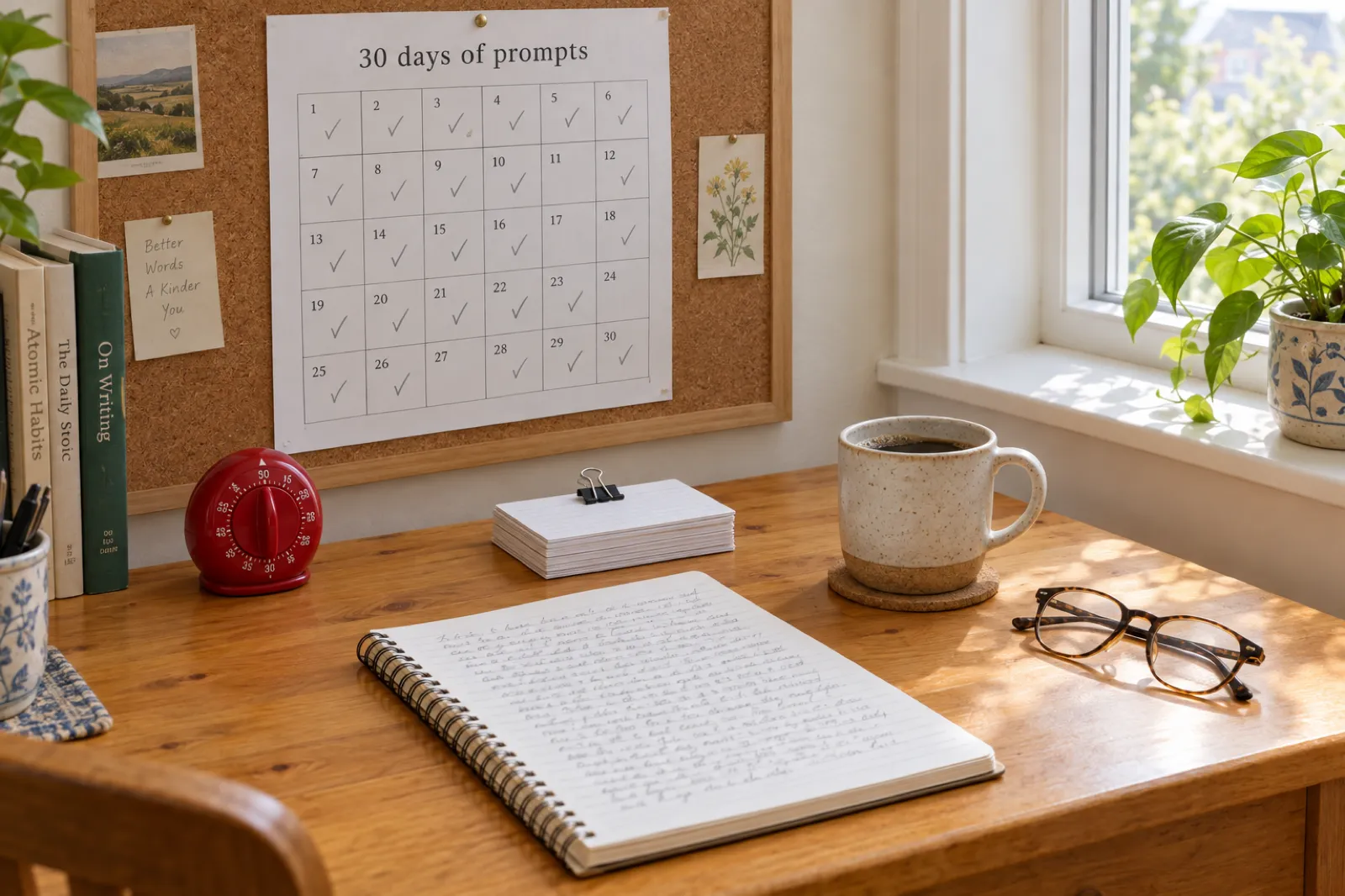
The hardest part of writing regularly is the first minute of each session, when you have to decide what to write. Prompts remove that decision. You open the page, read the daily prompt, set a timer and start. Over a few weeks that routine matters more than the quality of any single piece.
Keep it small and keep it at the same time. Ten minutes every day tends to beat three hours on the one free Saturday, because the habit survives busy weeks. Tie the session to something you already do, the first coffee or the train home, so you do not have to remember it.
Count sessions, not words. A tick on a calendar for every day you wrote, whatever the length, is easier to keep going than a word target. Some days you will write 150 words and some days 1,500. Both count.
Use the daily prompt with someone else. Because everyone sees the same daily prompt on the same day, two friends or a whole writing group can write from it separately and swap pages. Seeing how differently five people read one line is one of the fastest ways to learn what your own voice sounds like.
Borrow a rhythm that has worked for others. Ray Bradbury told a room of young writers to write a short story every week for a year, on the grounds that it is very hard to write 52 bad stories in a row. Julia Cameron's morning pages, which she describes as three pages of longhand, stream-of-consciousness writing first thing in the morning, take the opposite approach: no prompt, no audience, just the habit of the hand moving. Prompts sit between the two. They give you a story to aim at without asking for a finished one.
Keep everything in one place. Put every prompt draft in a single notebook or document, dated, with the prompt at the top. Once a month, read back through. Most pieces will be exercises and nothing more. One or two will still interest you, and those are your best leads for something longer.
Restart without guilt. You will miss days. The habit is not broken by a gap. It is only broken if the gap becomes the new routine, so the day after a miss, write for five minutes from any prompt and put the tick back on the calendar.
From prompt to story to book
Most prompt drafts are practice, and that is fine. Every so often one will not let go. You finish the sprint and keep thinking about the character on the walk home. That is the prompt telling you it has more in it.
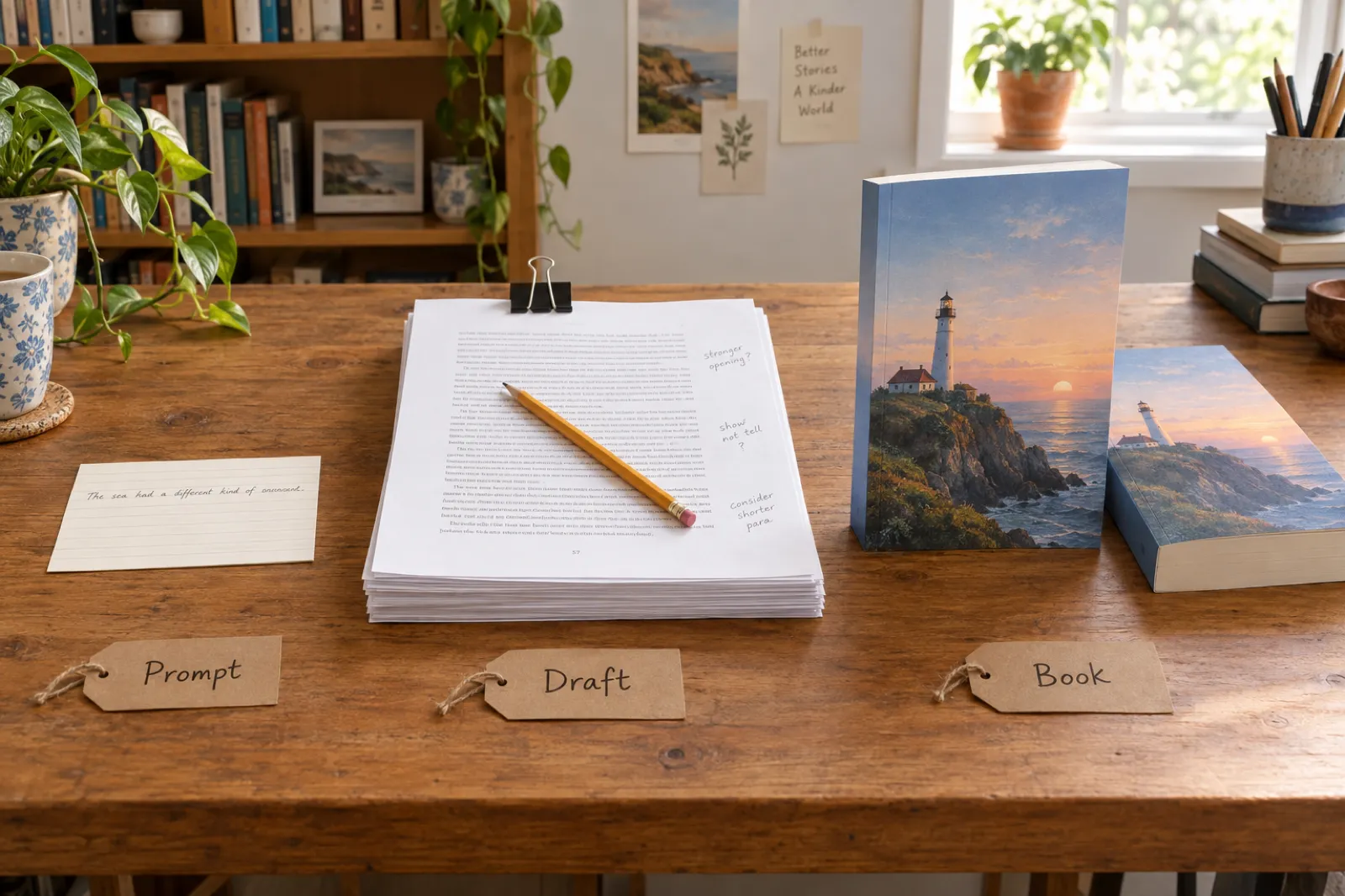
Signs a prompt is bigger than an exercise
- The character wants something that cannot be settled in a single scene.
- You have questions about the world that the draft did not answer, and you want to answer them.
- A second scene suggested itself while you were writing the first.
- The ending you imagined needs other people, places or time to make sense.
- You went back and reread the draft without being asked to.
Stage one: prompt to scene
The first draft is a scene, written from the prompt, usually in one sitting. Its job is to find the voice and the central person. Do not plan yet. Planning too early tends to sand off whatever made the prompt interesting.
Stage two: scene to short story
Ask what the scene is the beginning of, and what has to change by the end. A short story is one change, seen through: the letter arrives, the keeper reads it, and tomorrow happens. Three or four scenes usually carry it. For a sense of scale, the table sets this page's exercises beside the length categories the Science Fiction and Fantasy Writers Association uses in its Nebula Award rules: a short story is under 7,500 words, a novelette runs to 17,500, a novella to 40,000, and anything longer is a novel. The Hugo Awards draw the same lines (both checked 4 Oct 2026).
| Length | Words | Where the figure comes from |
|---|---|---|
| 10-minute sprint | About 250 | This page's exercise |
| 30-minute scene | About 600 to 900 | This page's exercise |
| Short story exercise | 2,000 to 5,000 | This page's exercise |
| Short story | Under 7,500 | Nebula and Hugo Award categories |
| Novelette | 7,500 to 17,500 | Nebula and Hugo Award categories |
| Novella | 17,500 to 40,000 | Nebula and Hugo Award categories |
| Novel | 40,000 or more | Nebula and Hugo Award categories |
| A first book on Inkfluence AI's free plan | Roughly 5,000 to 7,500 | 5 chapters of about 1,000 to 1,500 words each |
Stage three: short story to book
A book needs a question that takes longer to answer and people whose choices make it harder. Write the question down in one sentence. Then plan in chapters, one event per chapter, so each chapter moves the story rather than circling it. Keep notes on every character: what they want, what they know and when they learned it. Those notes stop the most common long-form mistake, a character acting on information they have not yet been given. If you need structure, the book outline generator turns a premise into a chapter plan, and the book title generator helps once you know what the book is about.
Where Inkfluence AI comes in
The gap most prompt tools leave is the writing itself. You get a good idea and then face the same blank page, only with a sentence at the top. Every prompt on this page has a Turn this into a book button that closes that gap. It opens Inkfluence AI with the prompt already in the "Describe your idea" box on your dashboard. Add anything you know, such as the main character's name, how you want it to end or who it is for, then press Go.
Inkfluence AI plans the book and writes it chapter by chapter, each chapter roughly 1,000 to 1,500 words. For fiction it keeps a story bible alongside the draft, a record of the characters, places and key objects, so names and facts hold steady from the first chapter to the last. If you would rather approve the chapter plan first, start from New Book instead, describe the idea there, and you can rename, reorder, add or remove chapters before any are written.
What you get is a draft, and the draft is where your own writing takes over. Rewrite the scenes that matter most to you in the built-in editor, cut what does not sound like you, and keep the parts that surprised you. Export to PDF on any plan, or EPUB for e-readers on a paid plan.
On the free plan you get 5 chapters to start, plus 5 more every month, so a first book from a prompt will be a short one, roughly 5,000 to 7,500 words. Paid plans start at $9.99 a month for longer books. The same engine runs the AI story writer for shorter fiction and the AI novel writer for full-length books, and our guide to writing fiction with AI without losing your voice covers the editing side in detail.
When prompts stop working, and what to do
You keep generating and never write. An unlimited generator makes it tempting to wait for the perfect prompt. Give yourself three clicks, then write from the best of the twelve you have seen. The prompt matters less than starting.
Every piece starts the same way. If all your drafts open with a character waking up or arriving somewhere, switch to opening line prompts for a week. Someone else's first sentence pushes you into rhythms you would not choose.
You never finish anything. Drop to the 10-minute sprint and make the rule that the piece ends when the timer does. Finishing small things is a skill, and it carries over to finishing big ones.
Everything comes out in the same genre. Lock the generator to a genre you never read for a few sessions. A romance writer who tries horror learns about dread, and a thriller writer who tries literary fiction learns about quiet.
You have stopped needing prompts. That is the goal. After a month or two, try writing your own prompt in the same shape: a person, a want and a pressure. Then write from it the way you would from any other.
Writing prompt generator FAQ
Is this writing prompt generator free?
How are the prompts made?
What is the daily prompt?
Which genres can I get prompts for?
How long should I write for?
Can I use these prompts for stories I publish or sell?
Can I turn a prompt into a full book?
Is it good for a writing group or a class of adult writers?
Does it work for fanfiction?
Can I write in another language?
What if none of the prompts grab me?
Related tools
Fanfiction Prompt Generator
Trope and ship prompts for any fandom
Plot Generator
A whole plot when a prompt is not enough
Book Outline Generator
Turn a premise into a chapter plan
Character Bible Generator
Full profiles for the people in your story
Character Name Generator
Names by genre, era and role
Book Title Generator
Title ideas by genre once the book takes shape
Chapter Title Generator
Names for every chapter of the book
AI Story Writer
Draft a short story from your idea
AI Novel Writer
A full-length novel, chapter by chapter
Related reading
Write something today
Get a prompt, set a timer and write. When one keeps pulling at you, Inkfluence AI will help you turn it into a finished book. Free to start, no card needed.