Short Story Generator: Free, From Flash Fiction to Novelette
Choose a genre, a length and the kind of ending you want. Get a title, a premise, an opening line and a plan of the story beat by beat, with a word budget for each beat so the story fits its length. Click again for a different story. It is free, it runs in your browser, and there is nothing to sign up for. When a plan is good enough to finish, send it to the writer.
A short story is the one form you can finish reading before the tea goes cold. The story and title are invented for this page.
Quick answer
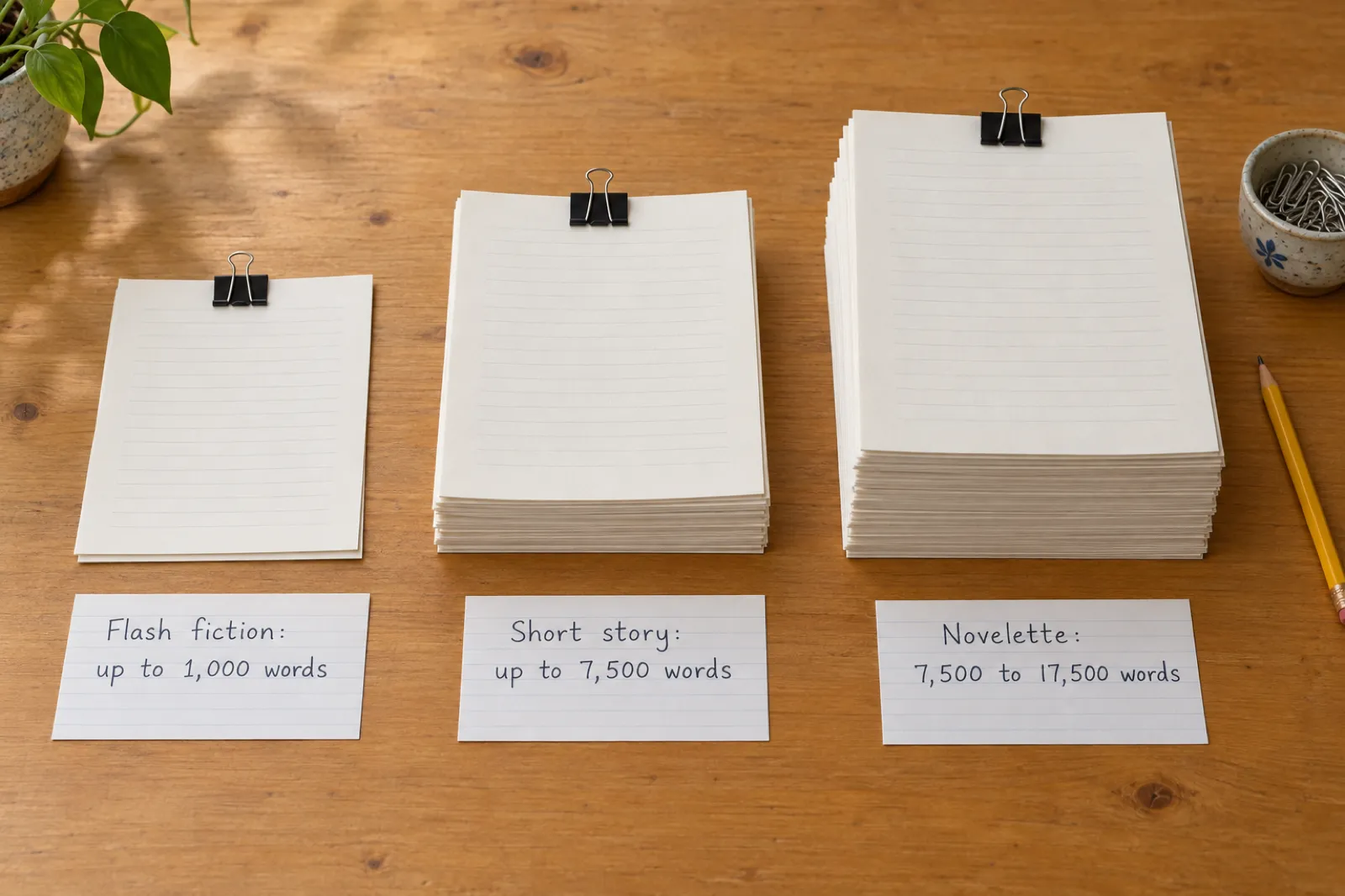
A short story is under 7,500 words (SFWA and Hugo definitions); flash fiction is usually 1,000 words or fewer; a novelette runs 7,500 to 17,500. The free generator below plans a story at any of those lengths: premise, opening line, and beats with a word budget each. To have it written, send the plan to Inkfluence AI and ask for 1 to 3 chapters. A fiction chapter there runs a median of 2,048 words, so a short story fits inside the free plan's 5 chapters a month.
Generate a short story plan
Genre, length, ending and point of view shape the plan. The other boxes are optional: leave them empty and the generator picks a name, a place and an object that suit the genre.
Example below. Press New story for your own; every click plans a different story.
Literary · Short story (1,000 to 7,500 words) · Close third person · Bittersweet
Small Hours
Premise
When June, a hospice night nurse, finds a voicemail nobody ever deleted in a village hall the night before it is sold, she has until the first snow to work out who the voicemail was meant for. The only person who could explain it is an old friend she has not called in years, who is not talking.
Opening line
June had meant to leave the hall by noon, and then she found a voicemail nobody ever deleted.
Beat plan
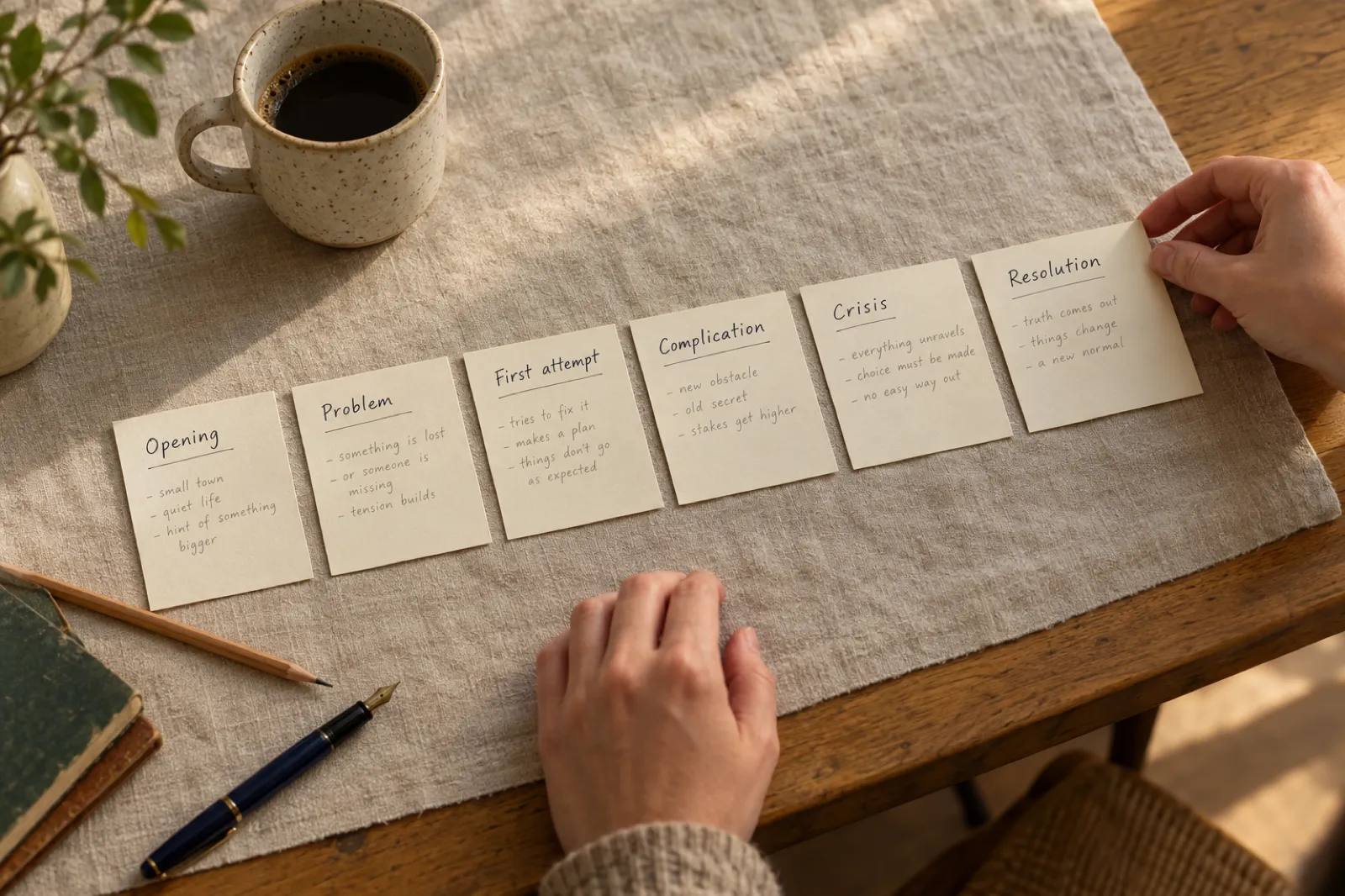
1. Opening scene (about 700 words)
June, a hospice night nurse, in a village hall the night before it is sold, with a voicemail nobody ever deleted. Show the want early: June needs to work out who the voicemail was meant for.
2. The problem (about 800 words)
The only person who could explain it is the old friend, who is not talking. The deadline is the first snow.
3. First attempt (about 900 words)
June tries to ask straight out, at the worst possible moment, over a meal nobody wanted. It fails, and the way it fails tells June something new.
4. Complication (about 1,000 words)
The old friend turns up uninvited and tells a different version of the story.
5. Crisis (about 1,100 words)
The first snow arrives. June runs out of ways to put it off and has to face the old friend.
6. Resolution (about 900 words)
June lets the voicemail go, and with it the last excuse to stay angry.
5,400
words planned
21
minutes to read
22
manuscript pages
3
chapters to ask for
Write this storyOpens the dashboard with this plan and a chapter count in the start box. The free plan covers it.
Runs entirely in your browser from hand-written templates. Nothing you type is sent anywhere until you press a link to the app. Reading time uses 260 words a minute; a manuscript page is 250 words.
The short story generator in numbers
4
length bands, from microfiction to novelette, each with its own number of beats
518
hand-written lines across 8 genres, before your names and places go in
2,048
median words in one fiction chapter written on Inkfluence AI (2,886 chapters measured)
126 of 165
books that asked for a "short story" came out novelette length, 5 August to 3 November 2026
The first two figures are counted from the generator's template file. The last two come from our own book records; the method is in what we found below.
How long is a short story?
Under 7,500 words. That is the line the Science Fiction and Fantasy Writers Association draws for the Nebula Awards ("fewer than 7,500 words") and the one the Hugo Awards use ("less than seven thousand five hundred words"). Those two definitions are the most widely quoted because they are written down, applied every year, and agree with each other. Outside science fiction and fantasy, editors use the same rough ranges without the precision, and most published short stories sit between 1,000 and 7,500 words.
Below a short story, the names get looser. Flash fiction usually means 1,000 words or fewer, the limit SmokeLong Quarterly sets for everything it publishes, though some contests stretch the word to 1,500. Microfiction is shorter still, and the Bath Flash Fiction Award caps its entries at 300 words. Above a short story sits the novelette, 7,500 to 17,500 words, and then the novella, 17,500 to 40,000, which has its own guide in novella vs novel. Past 40,000 you are writing a novel, and how many words are in a novel takes it from there.
Form
Words
Reading time
Manuscript pages
In Inkfluence AI
Where the line comes from
Microfiction
Under 300 words
About 1 minute
1
Plan here, write it yourself, or cut 1 chapter down hard
The Bath Flash Fiction Award caps entries at 300 words.
Flash fiction
Up to about 1,000 words
About 4 minutes
Up to 4
1 chapter, then cut
SmokeLong Quarterly publishes flash up to 1,000 words; contests stretch the term to 1,500.
Short story
Under 7,500 words
4 to 29 minutes
Up to 30
1 to 3 chapters
SFWA and the Hugo Awards both put the line at 7,500 words.
Novelette
7,500 to 17,500 words
29 to 67 minutes
30 to 70
4 to 8 chapters
The same two sources; few magazines outside science fiction and fantasy use the word.
Novella
17,500 to 40,000 words
67 minutes to 2.5 hours
70 to 160
9 to 20 chapters
Beyond a short story. See novella vs novel.
Reading time at 260 words a minute, the average silent reading rate for fiction in Brysbaert's 2019 review of 190 studies. A manuscript page is double-spaced 12-point type, about 250 words. Chapters at a median of 2,048 words each, measured on our own fiction.
At 250 words a manuscript page: flash fiction is up to 4 pages, a short story up to 30, a novelette up to 70.
Why the length band matters more than the word count
Each band changes what a story can hold, not just how long it takes. Microfiction has room for one image and one turn: the reader fills in everything else. Flash fiction can carry a single scene with real pressure and a change by the end, but not a second location. A short story has space for two or three scenes, one point of view, and a protagonist who tries something and fails before the crisis. A novelette is the first length where a second character can have a thread of their own and the story can shift at its midpoint. That is why the generator gives a micro plan three beats, a flash plan four, a short story six and a novelette eight, and why each beat comes with a word budget: a story that spends 2,000 words getting to its problem was never going to be flash fiction.
If you write a book of your own later and want the same arithmetic in pages, how many pages is a novel covers manuscript pages, trim sizes and printed pages.
Short story length calculator
Slide to a word count, or type one, to see what it is called, how long it takes to read silently and aloud, how many manuscript pages it fills, how many chapters to ask the writer for, and which of the limits on this page it fits.
Short story
form
13 min
to read
19 min
read aloud
14
manuscript pages
2
chapters to ask for
Fits: Hugo and Nebula short story (under 7,500 words)
Fits: Clarkesworld word limit (1,000 to 22,000 words)
Too long for: Bath Flash Fiction Award (300), SmokeLong Quarterly (1,000), Writer's Digest Short Short (1,500)
Silent reading 260 and reading aloud 183 words a minute (Brysbaert 2019). Limits as published on 3 Nov 2026; each organiser's own page wins if it changes. Chapters assume 2,048 words each and are a guide, not a promise: the writer sets chapter length from the story.
What a short story needs that a novel does not
A short story is not a novel with the middle removed. It is closer to a single held breath: one person, one pressure, one change. The plans this generator writes follow five habits that separate a short story that lands from a long scene that stops.
Start late. The first sentence should already be in the middle of something. Every plan's first beat says where the character is, what they are holding and what they want, and the opening line drops the reader in without backstory. If you need three paragraphs of history before anything happens, the story probably starts later than you think.
One want, one clock. Short fiction runs on a deadline. The funeral on Saturday, the last ferry, the eclipse: a date turns a mood into a plot. The premise always names both the want and the deadline, because a reader who knows both will forgive almost anything else.
Fewer people than you think. Two characters with something between them carry most good short stories. The generator gives each plan a protagonist and one other person; the novelette band gives that second person a thread of their own, which is the first length where a second thread pays for itself.
A failure before the crisis. In the six-beat short story plan, the protagonist tries something that does not work, and the way it fails tells them something new. One failure is bad luck. The information it carries is what makes the ending feel earned.
An ending chosen in advance. A twist has to be planted before it is sprung, so in twist plans the novelette's midpoint beat tells you to plant one small detail that reads as scenery now and as proof later. An open ending stops on the choice, not the result. A full-circle ending returns to the opening image with the meaning changed.
The six beats of the short story plan, on cards. Moving a card is cheaper than rewriting a scene.
Point of view in short fiction
Pick one and keep it. Close third person (she, he or they, with the camera just behind one character's eyes) is the default in most published short fiction because it gives you intimacy and a little distance at once. First person suits confession, unreliable narrators and stories that turn on what the narrator is not saying. Second person ("you") is rare in novels but common in flash fiction, where its strangeness lasts exactly as long as the story does. The opening line the generator writes changes with the point of view you choose, so you can hear the difference before you commit.
Stuck on the person rather than the plot? The random character generator gives a whole person with a want, a flaw and a secret, and the character name generator names them by genre and era. If you want a prompt to free-write from instead of a plan, the writing prompt generator is built for that, and our collection of AI writing prompts shows phrasings that get good results from AI writers.
Short story ideas by genre
Each genre was written as its own set of people, places, objects, pressures, failures, reveals and endings, because genres make different promises. A mystery has to be fair, so its reveals point back at something the reader has already seen. A romance turns on what two people are not saying. Horror needs rules, and someone who breaks one. The table shows what the plans in each genre are built around, with the deeper page for that genre.
Genre
What the plans are built around
Go deeper
Literary
An object someone kept, a person who will not talk about it, and one conversation left too late or just in time.
What we found: ask for chapters, not a "short story"
We looked at every fiction book completed on Inkfluence AI from 5 August to 3 November 2026, leaving out our own test accounts. 165 of them, from 144 different authors, asked in the idea for a short story, flash fiction or a novelette. Their median length was 9,977 words. Only 25 came out under 7,500 words, the short story line. 126 landed between 7,500 and 17,499 words, which is novelette length, and 14 ran longer still.
The reason is simple once you see it. The writer sets the length of a book from the number of chapters, not from the word "short". Most of those ideas never said how many chapters, so they got a book-length plan, written up to the free plan's limit of 5 chapters a book. In a separate sample of 300 English fiction books (2,886 chapters), the median chapter was 2,048 words long, and five of those make about 10,000 words: a novelette, whatever the idea called it.
So the fix is to say the number. "A short story in 2 chapters" gets about 4,000 words; "in 3 chapters" about 6,000, which is the comfortable middle of the short story band. For flash fiction, ask for 1 chapter and expect to cut it from about 2,000 words down to under 1,000 in the editor, which is good practice anyway: flash is made in the cutting. Every Write this story link on this page already includes the chapter count that matches the length band you picked.
Method: completed fiction books (novel, romance and comedy formats) created between 5 August to 3 November 2026; ideas matched on "short story", "short stories", "flash fiction", "micro fiction", "novelette" or "short fiction"; words counted from the saved chapters. A scoped snapshot, not a platform total.
Want it the right length first time? Start a story with the chapter count in the idea. A three-chapter story fits inside the free plan, with chapters left over.
Most generators stop at the idea. That is fine when the idea is all you need. When you want the story itself, edited, exported and maybe narrated, the same account that takes your plan writes it and gives you everything after. Seven steps, one place.
Step 1
Plan it here
Generate until a premise makes you want to know how it ends. Pick the length band first: it decides how many beats you get and how many words each one can spend.
Step 2
Press Write this story
The dashboard opens with the premise, the point of view, the ending and a chapter count already in the start box. Change anything you like before you start.
Step 3
Check the length line
The chapter count in the idea is what sets the length. One chapter is about 2,000 words, three chapters about 6,000, five about 10,000. Without a number you get a full-length book plan.
Step 4
Outline and story bible
The writer plans the chapters and keeps a record of the characters, places, objects and what each person knows, so the reveal in the last scene is not spent in the first.
Step 5
Chapters, in order
Fiction is written one chapter after another, each reading the ones before it. A three-chapter story takes a few minutes.
Step 6
Cut and sharpen
Edit in the editor or ask the assistant for a tighter opening line. For flash fiction, this is where a 2,000-word chapter becomes a 900-word story.
Step 7
Export or keep going
Export a PDF free. EPUB, Word and a print-ready KDP file come with a paid plan or any credit pack, and the story can become an audiobook or the first book of a series.
The part that matters most for a story with a twist is the story bible. Even over three chapters, the writer needs to know what the protagonist has found out and what they have not, so the reveal you planned for the last scene is not told in the first. The AI story bible generator page explains how that record is kept. If you would rather see the chapter plan before any prose, the book outline generator gives you one to adjust, and the plot generator builds a full arc with a midpoint and a low point when the story turns out to need more room.
Once the draft exists, read it the way an editor would. The AI beta reader reads every chapter and says where a reader drifts, gets confused or would stop, quoting the passage. In a short story that usually means one scene too many or a reveal that arrives a paragraph early. For a guided walk through the whole free route, see how to write fiction with AI for free.
Have a plan you like? Paste it into the start box, add "in 3 chapters", and the first chapter arrives in a minute or two.
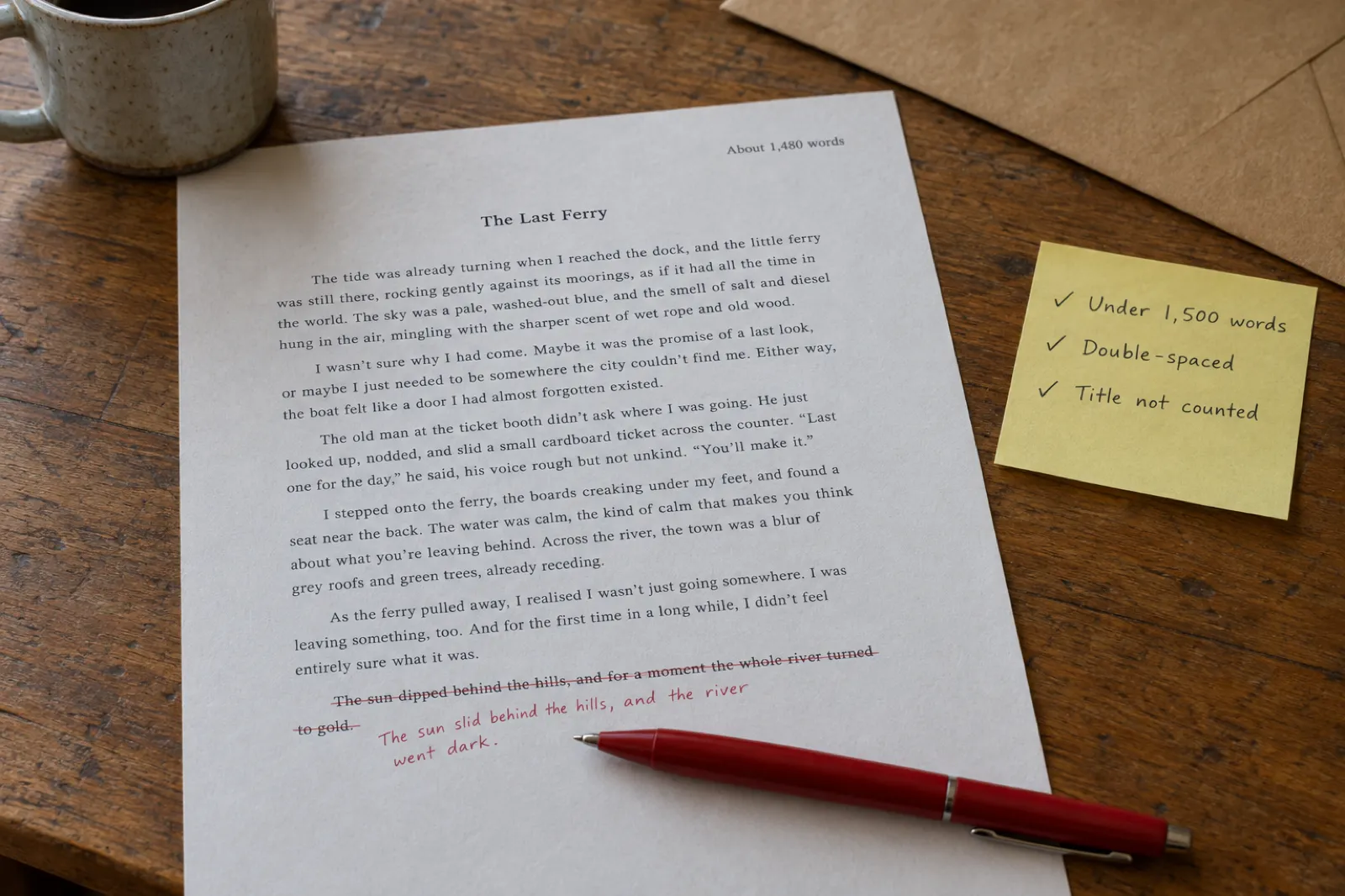
Short fiction has something novels mostly do not: a living market of magazines and contests that read unsolicited work. If that is where your story is going, two rules matter more than anything a generator can do. The first is the word limit, which is usually strict: SmokeLong Quarterly calls its 1,000-word cap firm, and the Writer's Digest Short Short Story Competition disqualifies entries over 1,500 words, counting every word of the story but not the title. The second is the rule on AI, and here the answer is plain.
Most literary magazines and contests do not accept AI-written or AI-assisted fiction. Clarkesworld says it will not consider submissions "translated, written, developed, or assisted" by AI writing tools and may ban people who try. SmokeLong Quarterly is not interested in narratives "created with the aid of AI", including AI used to modify stylistic choices. Flash Fiction Online does not consider submissions "generated or polished" by AI. The Writer's Digest Short Short Story Competition will not consider AI-generated or AI-assisted work. If you plan to submit, the honest route is to use this page for what it is good at, the premise, the shape and the word budget, and write every sentence yourself.
1,000 to 22,000 words; science fiction and fantasy
Not accepted, and attempts may lead to a ban
Read on each organiser's own page on 3 Nov 2026. Deadlines and rules change every year.
Manuscript format is the other thing editors notice before they read a word: double-spaced, 12-point plain type, one-inch margins, your word count on the first page, and the title a third of the way down. Use the calculator above to check a draft against a limit before you format it, and count the way the market counts: for Writer's Digest, the title does not count and every word of the story does.
A contest entry checked against its limit: under 1,500 words, title not counted. The story is invented for this page.
Writing for practice or a class? Teachers can find ideas on our page for teachers, and students on the one for students. A generated plan makes a good exercise precisely because it is not yours yet: write the six beats in your own words, then compare where you spent your word budget with where the plan said to.
Short stories as books: singles, collections and series
Self-publishing is the other home for short fiction, and it has different rules. Amazon KDP accepts single short stories and collections as ebooks, and it allows AI-generated text, but it asks you to say so when you publish: content created by an AI tool must be disclosed even if you edited it heavily afterwards, while text you wrote yourself and only polished with AI tools does not need disclosing. Our explainer on the KDP AI disclosure policy walks through the form, and the guide to publishing AI-generated books on KDP covers the upload.
A single story is a short ebook. A collection is where short fiction starts to look like a book people browse for. In Inkfluence AI you can write each story as its own short book, or build a collection in one book and add chapters by hand in the editor, one story per chapter, with one cover and one title page. The page for short story writers goes through the collection workflow, and short vs long ebooks looks at how length affects what readers buy. Before you set a price, the royalty calculator shows what each price earns on each store.
If a story keeps going in your head after it ends, it may want to be a series. On Creator and Premium, Continue as a series writes the next book from the last one, carrying the characters, the world and what has already happened, and the AI book series writer page shows how. Linked short stories with one recurring character are one of the oldest ways to build readers.
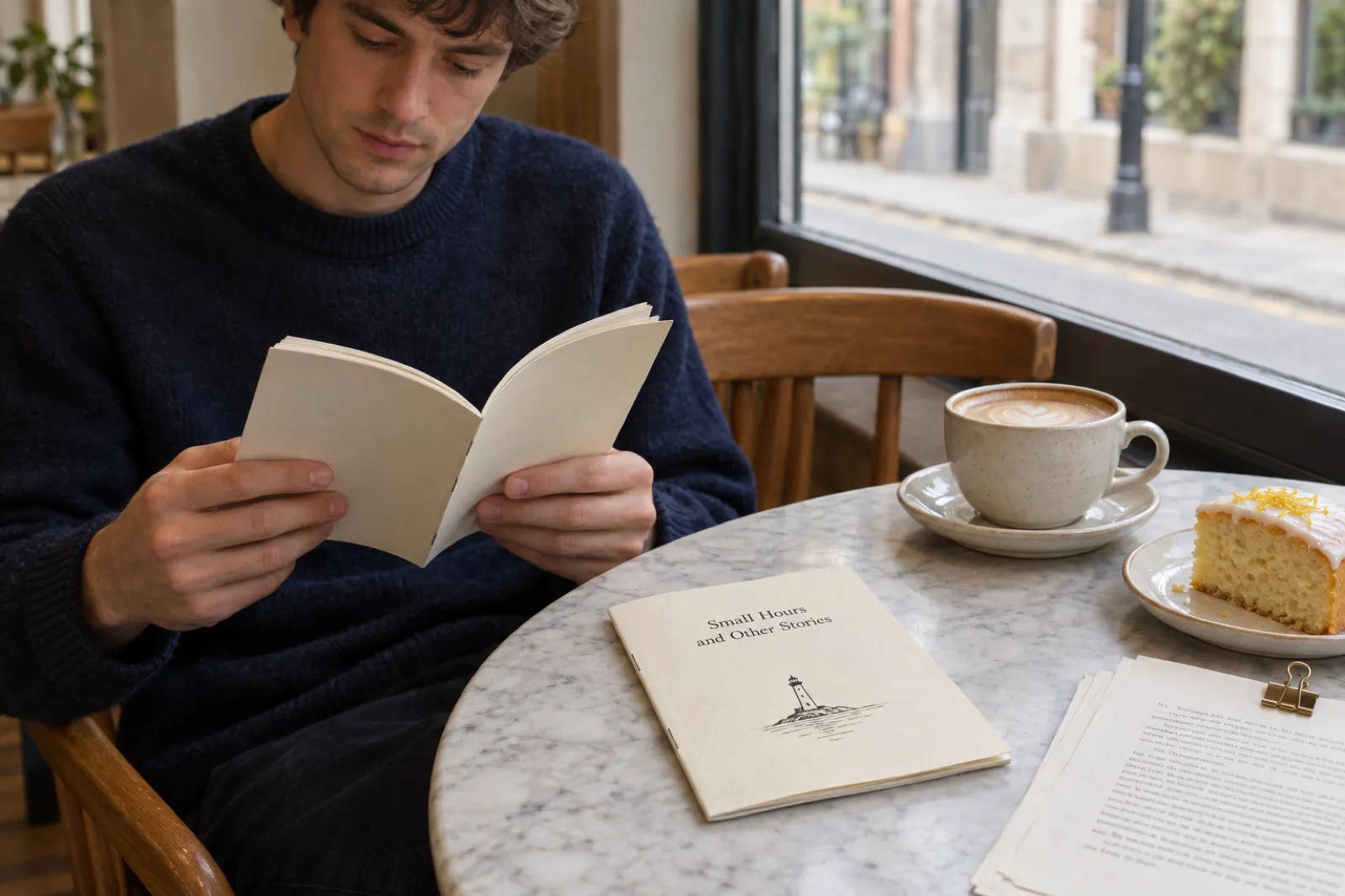
A handful of short stories makes a collection someone can finish in one café visit. The collection is invented for this page.
Cover, export, audio and other languages
The AI book cover generator designs a front cover from the story's title and genre, and the book description generator writes the blurb for the store page. Export gives a PDF on every plan (free PDFs carry a small Inkfluence AI credit); EPUB for ebook stores, a Word file and a print-ready KDP interior come with a paid plan or any credit pack. The AI book formatter explains what the export does to your layout, and our KDP tools cover keywords, categories and the listing.
Short stories also make good audio, because a listener can finish one on a commute. The AI audiobook generator narrates a story chapter by chapter: Creator includes 15 audiobook chapters a month and Premium 30. And a story written in English can be translated into another language as a new book with the AI book translator, 15 translations a month on Creator and 40 on Premium, or written in another language from the start.
Building a collection? Start with one story today. Every story you finish is a chapter of the book you are going to publish.
Short story generator, story generator or prompt generator?
Several free tools on this site sound alike. They do different jobs, and the right one depends on whether you want to read a story, plan one, or be nudged into writing your own.
Tool
You get
Use it when
Short story generator (this page)
A premise, an opening line and a beat plan sized to a length band
You want to write or commission a story of a particular length and need its shape first.
A scene in screenplay or stage format, or a video script
The story will be performed or filmed, not read.
Other short story tools, checked 3 Nov 2026
People looking for a short story generator usually try a few. This is what two of the best-known say about themselves on their own sites, read on 3 Nov 2026, not a ranking. Squibler's free AI story generator is presented as having no sign-up and no limit, creates a story from an idea in seconds, and offers to expand it into a full-length book in its editor. Sudowrite is a fiction writing app with a free trial and no card required; its plans are Hobby and Student at $10, Professional at $22 and Max at $44 a month, paid in credits. Inkfluence AI's difference is the distance covered in one account: a free planner here, then a writer that keeps a story bible, an editor, covers, export for Kindle and print, narration and translation. For a scored comparison, see the AI story writing tools comparison, our best AI story generator guide, and the head-to-heads for a Squibler alternative and a Sudowrite alternative.
What a short story costs to write here
The generator and the calculator on this page cost nothing. Writing the story in the app uses chapters from your plan's monthly allowance, and a short story uses very few. These are the allowances that matter for short fiction, read from the app's own plan settings on 3 Nov 2026.
Free
Creator, $9.99 a month
Premium, $19.99 a month
AI-written chapters
5 a month, up to 5 per book
35 a month
Unlimited
Short stories a month (3 chapters each)
1, with 2 chapters spare
11
As many as you write
Export
PDF
PDF, EPUB, Word, KDP print
PDF, EPUB, Word, KDP print
Audiobook narration
None
15 chapters a month
30 chapters a month
Continue as a series
No
Yes
Yes
The free allowance resets each month, so a flash piece or a two-chapter story every month costs nothing at all. Credit packs add chapters without a subscription and also unlock EPUB and Word export; prices and annual billing are on the pricing page.
What this short story generator will not do
Write the story. It writes the plan: premise, opening line and beats. For a complete story to read now, use the AI story generator; for the story written at length, press Write this story.
Invent beyond its templates. Every line was written in advance. Your inputs change who, where and what, not the shape. The writer in the app follows your idea anywhere.
Hit an exact word count in the app. The writer sets length by chapters, about 2,048 words each, not by a word target. Flash fiction is cut to length in the editor.
Make your story eligible for a magazine. If the market bans AI help, a plan from here is the most you should take before writing it yourself.
Remember anything. Nothing is saved. Copy a plan you like before pressing New story.
Short story generator: frequently asked questions
Is this short story generator free?
Yes. The generator on this page is free, has no sign-up and no limit, because it runs in your browser from hand-written templates. If you want the Inkfluence AI writer to write the story itself, the free plan includes 5 chapters a month, which is enough for a complete short story of one to three chapters, with PDF export. Creator is $9.99 a month and Premium $19.99 a month.
How long is a short story?
Under 7,500 words in the definitions used by the Science Fiction and Fantasy Writers Association for the Nebula Awards and by the Hugo Awards. Most published short stories run 1,000 to 7,500 words, which reads in about 4 to 29 minutes at the average silent reading speed for fiction. From 7,500 to 17,500 words is a novelette, and from 17,500 to 40,000 a novella.
How many words is flash fiction?
There is no single rule, but most magazines and contests mean 1,000 words or fewer. SmokeLong Quarterly publishes flash up to 1,000 words, the Bath Flash Fiction Award caps entries at 300, and the Writer's Digest Short Short Story Competition allows up to 1,500. Under about 300 words is usually called microfiction. Always check the limit of the place you are sending it.
How many pages is a short story?
In standard manuscript format (double-spaced, 12-point type, one-inch margins) a page holds about 250 words, so a 5,000-word story is about 20 pages and a 7,500-word story about 30. Typeset in a printed book the same story takes far fewer pages. Use the length calculator on this page to convert any word count.
Is there a short story generator with no AI?
This one. The plans on this page are assembled from 518 lines a person wrote, across 8 genres, with your name, setting and must-include detail woven in. Nothing is sent to a language model and nothing you type leaves your browser. The writer inside Inkfluence AI is different: it writes new prose, chapter by chapter, from the plan.
Can AI write a whole short story for me?
Yes. Press Write this story and the Inkfluence AI writer outlines the story, keeps a story bible, and writes it chapter by chapter in the point of view and with the ending you chose. Fiction chapters on the platform run about 2,000 words, so a one-to-three chapter story lands between roughly 2,000 and 6,000 words. Expect to edit it: a short story is judged on every sentence.
What is a good AI tool to generate short stories?
It depends on what you want at the end. For a story to read right now, a browser generator such as our free AI story generator is the fastest. For a plan you will write yourself, this page. For a finished, edited story you can export, narrate or publish, you need a writer with an editor and export in the same place, which is what Inkfluence AI is built for. Our story tools comparison scores the main options side by side.
Can I submit an AI-written short story to a magazine or contest?
Often not. Clarkesworld, SmokeLong Quarterly, Flash Fiction Online and the Writer's Digest Short Short Story Competition all say they will not consider work written or assisted by AI. If you plan to submit, use the generator for the premise and the plan, and write the prose yourself. Self-publishing on Amazon KDP is different: AI-generated text is allowed, but KDP asks you to disclose it.
Can I make a short story with my own words or characters?
Yes. Type your character's name and pronouns, a setting and one thing the story must include, and every plan is built around them. If you already have a draft, the app can import a Word document, a PDF or an EPUB, so you can keep your own words and use the editor and assistant on them.
Is there a short story generator for kids?
The plans on this page are written for teenage and adult readers. For children, the AI story generator has a children's bedtime genre that writes a whole story to read aloud, the AI storybook generator makes illustrated picture books, and the chapter book generator writes short-chapter books for newly independent readers.
Can I publish a short story on Amazon?
Yes. KDP accepts single short stories and collections as ebooks, and a story can be exported from Inkfluence AI as an EPUB on a paid plan or after any credit purchase. Short stories are short books, so price and page count matter more than for a novel; the royalty calculator shows what a given price earns.
Sources
All read on 3 Nov 2026. Rules, limits and prices change; if a figure here and the organiser's own page disagree, their page wins.
SFWA, Nebula Rules: short story, novelette, novella and novel word counts.
Inkfluence AI plan settings, book records and the generator's template file, read 3 Nov 2026: allowances, chapter lengths and the short story finding.
Squibler, Sudowrite, Amazon, KDP, Clarkesworld, SmokeLong Quarterly, Flash Fiction Online, Writer's Digest and the Bath Flash Fiction Award belong to their owners. Inkfluence AI is independent and not affiliated with or endorsed by any of them.
A plan takes a click. The story takes three chapters.
Take the plan you liked best and let the Inkfluence AI writer turn it into a finished short story, in your point of view, with your ending, at the length you asked for. Free to start, no card.