
How Many Pages Is a Novel? Page Counts by Genre, Trim and Font, Measured
Page count is the number readers see, but it is set by four things: how many words the book has, the page size, how much dialogue it has, and the font. We measured all four. Below are page counts for each genre's usual length, 19 classic books typeset through our KDP export at two page sizes, the same two novels set in six fonts, and a converter that goes from words to pages or back.
How many pages is a novel?
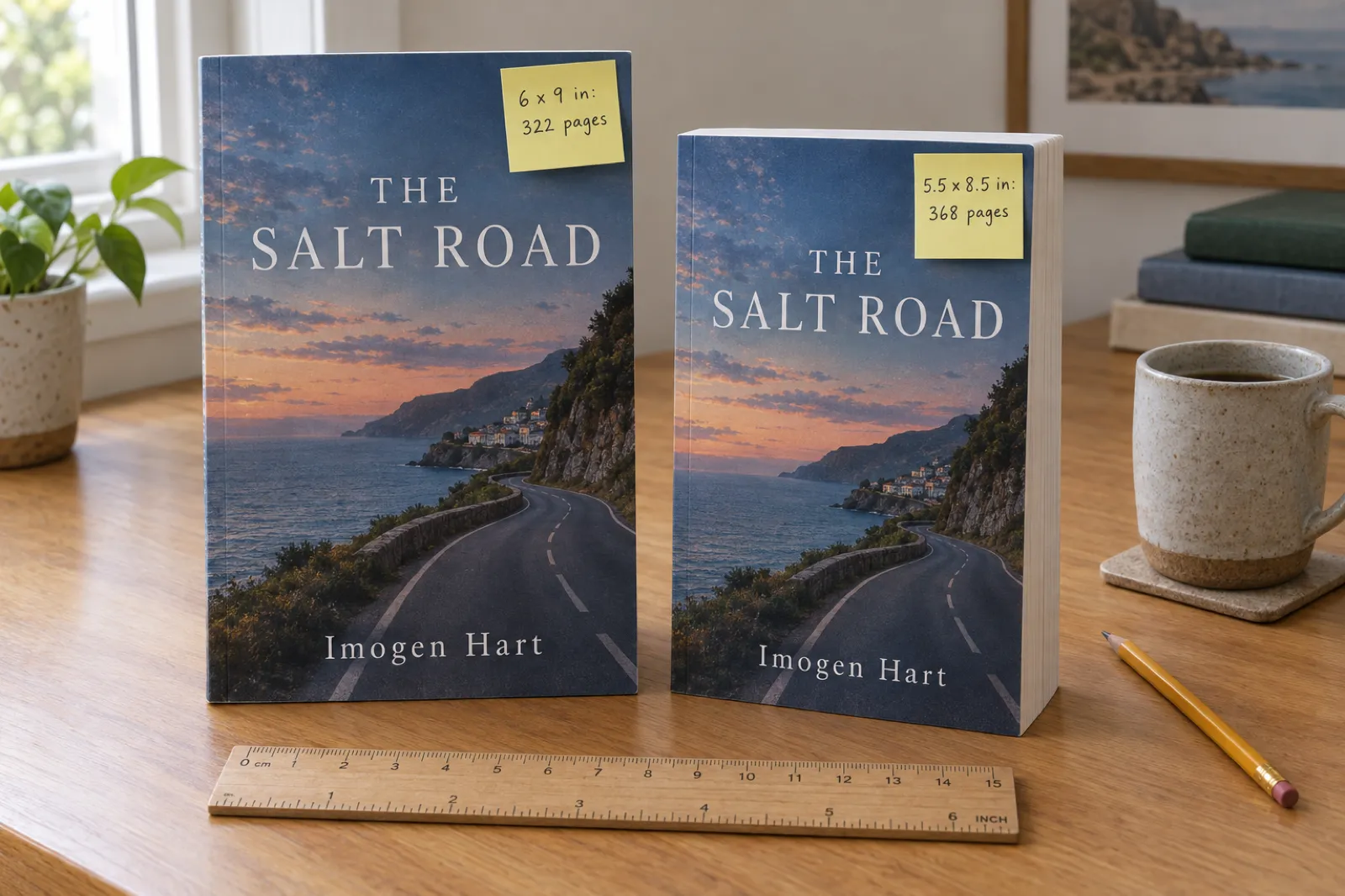
An 80,000-word novel in 32 chapters prints to about 322 pages at 6 x 9 inches when it has plenty of dialogue, 368 pages at 5.5 x 8.5 and 406 at 5 x 8, by our measurements of real KDP exports. Written in long paragraphs like most classics, the same length is about 194 pages at 6 x 9. A novel starts at 40,000 words, which is roughly 164 pages at 6 x 9; the font alone can move a book's page count by about a fifth.
80,000 words
322
pages at 6 x 9 inches for dialogue-heavy fiction in 32 chapters (one every 2,500 words). About 194 in dense prose.
Smaller page
+15%
pages at 5.5 x 8.5 than at 6 x 9, averaged over the 19 classics we typeset at both sizes.
Font alone
20%
more pages for The Great Gatsby in Libre Baskerville than in EB Garamond, nothing else changed.
Words to pages, or pages to words
Start from the number you know. If you have a word count, the converter gives printed pages at your page size; if you have a page count, perhaps from a book in your genre on Amazon, it works back to roughly how many words that book has.
Printed pages
-
Manuscript pages
-
double-spaced, about 250 words a page
Similar length
-
Estimates for the Inkfluence KDP export at default settings, assuming a chapter every 2,500 words. A publisher's edition with larger type or more space between lines will run longer. The range shown is plus or minus 10%.
Want the spine width and print cost as well? The book length calculator takes the same word count and adds spine width, KDP print cost and royalty in the US, UK and Europe.
Book length calculatorHow many pages is a novel in each genre?
Nobody publishes page ranges for genres, because a page is not a fixed amount of text. Word counts are published, so we took the safe ranges from Writer's Digest's word count guide (and Jericho Writers for category romance) and converted them with our measured page model, assuming a chapter every 2,500 words.
| Genre | Words | 6 x 9, dialogue | 5.5 x 8.5, dialogue | 6 x 9, long paragraphs |
|---|---|---|---|---|
| Mainstream, literary, romance, mystery, thriller and horror | 80,000 to 89,999 | 322 to 362 | 368 to 412 | 194 to 216 |
| Science fiction and fantasy | 100,000 to 115,000 | 402 to 462 | 458 to 526 | 240 to 276 |
| Category romance | 50,000 to 60,000 | 204 to 244 | 232 to 278 | 122 to 148 |
| Western | 50,000 to 80,000 | 204 to 322 | 232 to 368 | 122 to 194 |
| Young adult | 55,000 to 79,999 | 224 to 322 | 254 to 368 | 134 to 194 |
| Middle grade | 20,000 to 55,000 | 86 to 224 | 96 to 254 | 54 to 134 |
Two things stand out. First, the spread inside each row is small next to the spread across the columns: a romance at the bottom of its range and one at the top differ by about 40 pages, but the same 80,000-word romance is about 322 pages with plenty of dialogue and under 200 in long paragraphs, before the page size changes anything. Second, the dialogue columns are the ones to plan with for most commercial fiction, where conversations take up a good share of the page. Use the long-paragraph column for literary fiction with long descriptive passages, and for historical fiction written in that style.
The word counts behind each row, and what agents expect for a debut, are covered in detail in how many words are in a novel. For children's books, where pages are set by age band rather than words, see our children's book word count guide.
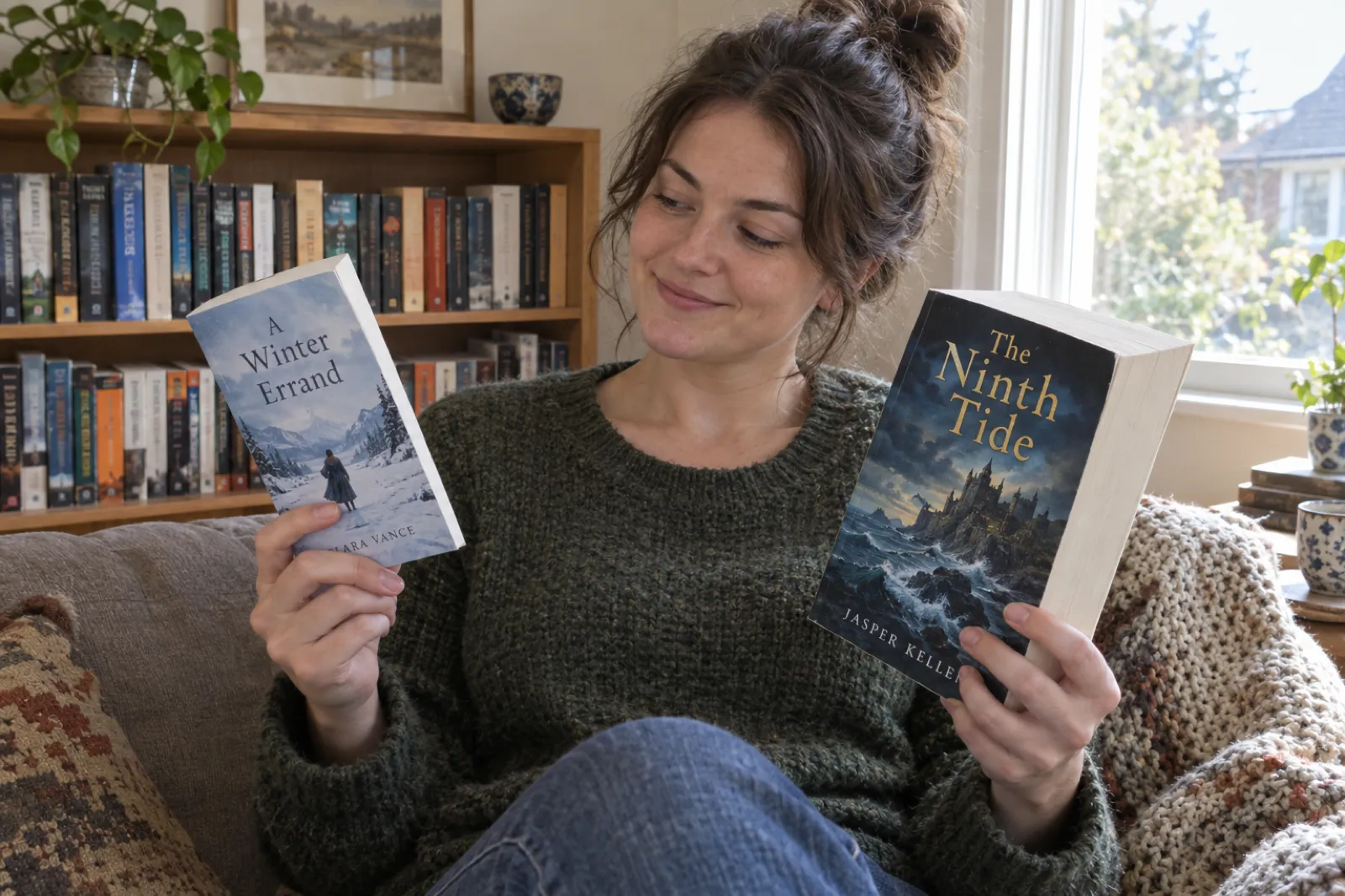
Plan a novel to the length you want. Inkfluence AI outlines and writes a novel chapter by chapter in your genre, then exports a print-ready PDF at 6 x 9, 5.5 x 8.5 or 5 x 8 for KDP.
Start your novel freeThe same book at two page sizes
Most page-count advice multiplies words by a fixed number. We typeset the books instead. We took 19 public-domain classics from Project Gutenberg, counted every word and chapter, and printed each one through the same KDP export our users download, at 6 x 9 and at 5.5 x 8.5 inches, on the same print engine our server uses. Every page in the totals is a real page in the PDF, including the title, copyright and contents pages.
| Book | Words | 6 x 9 | 5.5 x 8.5 | Difference |
|---|---|---|---|---|
| Metamorphosis (Franz Kafka) | 21,935 | 43 | 50 | +16% |
| The Strange Case of Dr Jekyll and Mr Hyde (Robert Louis Stevenson) | 25,574 | 60 | 69 | +15% |
| Alice's Adventures in Wonderland (Lewis Carroll) | 26,441 | 75 | 84 | +12% |
| A Christmas Carol (Charles Dickens) | 28,435 | 72 | 83 | +15% |
| The Time Machine (H. G. Wells) | 32,377 | 76 | 87 | +14% |
| Heart of Darkness (Joseph Conrad) | 37,907 | 72 | 85 | +18% |
| The Wonderful Wizard of Oz (L. Frank Baum) | 39,272 | 110 | 125 | +14% |
| The Turn of the Screw (Henry James) | 39,466 | 101 | 116 | +15% |
| Peter Pan (J. M. Barrie) | 47,112 | 134 | 152 | +13% |
| The Great Gatsby (F. Scott Fitzgerald) | 48,152 | 131 | 151 | +15% |
| The War of the Worlds (H. G. Wells) | 59,875 | 145 | 167 | +15% |
| Treasure Island (Robert Louis Stevenson) | 67,864 | 169 | 190 | +12% |
| Frankenstein (Mary Shelley) | 74,975 | 164 | 188 | +15% |
| The Picture of Dorian Gray (Oscar Wilde) | 78,545 | 180 | 208 | +16% |
| Pride and Prejudice (Jane Austen) | 121,738 | 301 | 343 | +14% |
| Dracula (Bram Stoker) | 161,050 | 328 | 379 | +16% |
| Jane Eyre (Charlotte Bronte) | 184,452 | 445 | 513 | +15% |
| Little Women (Louisa May Alcott) | 185,888 | 440 | 509 | +16% |
| Moby-Dick (Herman Melville) | 208,458 | 521 | 603 | +16% |
Typeset 20 October 2026 through the Inkfluence KDP export at default settings (Roboto body text) on Chrome for Testing 131. Words are whitespace-separated tokens from the Gutenberg text. Method and spine widths: book length calculator.
Moving from 6 x 9 to 5.5 x 8.5 added between +12% and +18% to every book, +15% on average. The smaller page loses a little width and a little height, and both cost lines. Our model uses 15% for 5.5 x 8.5 and 28% for 5 x 8 against 6 x 9.
The page size is not only a look. Above 110 pages, KDP charges per page, so the extra pages of a smaller trim cost money on every copy. For our 80,000-word example on cream paper, 6 x 9 is 322 pages and costs $4.86 to print in the US; 5.5 x 8.5 is 368 pages and costs $5.42. At a $14.99 list price that is $4.13 against $3.57 a copy to you. Many novelists still choose the smaller size because it feels like a novel in the hand; the point is to choose it knowing the difference.
Our guide to KDP trim sizes goes through every size KDP offers and what each suits. If you are printing through IngramSpark as well, the IngramSpark cost calculator works out their print charge for the same page count.
The same book in six fonts
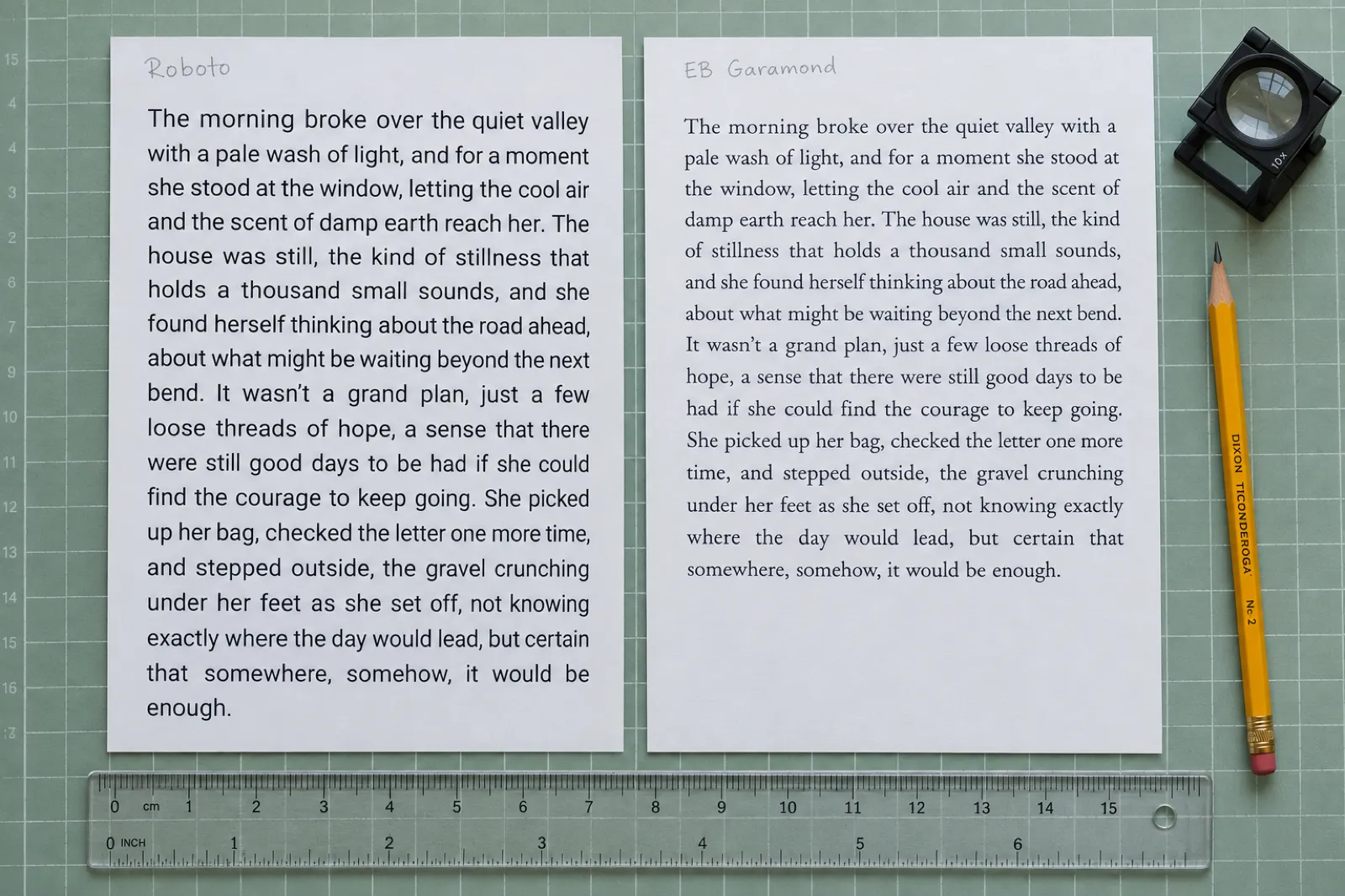
Page-count calculators usually ask for a font size and stop there. The typeface matters too, because some fonts are wider than others at the same size. To measure it, we typeset two of the classics at 6 x 9 in six of the body fonts our editor offers, changing nothing else: same size setting, same margins, same chapter layout. We checked each PDF to confirm the font was really embedded rather than replaced by a fallback.
| Font | Style | The Great Gatsby | Treasure Island | vs Roboto |
|---|---|---|---|---|
| EB Garamond | Old-style serif | 121 pages | 155 pages | -8% |
| Crimson Text | Old-style serif | 124 pages | 158 pages | -6% |
| Roboto (default) | Sans-serif | 131 pages | 169 pages | - |
| Literata | Book serif | 138 pages | 176 pages | +5% |
| Merriweather | Screen serif | 139 pages | 176 pages | +5% |
| Libre Baskerville | Wide serif | 145 pages | 186 pages | +10% |
Typeset 20 Oct 2026 at 6 x 9 inches; The Great Gatsby 48,152 words, Treasure Island 67,864. "vs Roboto" averages the two books.
The narrow old-style serifs, EB Garamond and Crimson Text, set the most words on a line and gave the shortest books. Libre Baskerville, drawn wide for reading on screens, gave the longest: 20% more pages than EB Garamond for Gatsby and 20% more for Treasure Island. That is a bigger change than moving from 6 x 9 to 5.5 x 8.5. Merriweather and Literata, both designed as reading fonts, landed in the middle with Roboto.
So if a paperback is running long and a smaller trim would push the print cost up, a narrower serif is a free way to bring the page count down, and it is the look most readers expect in a novel anyway. In Inkfluence AI you change the font from the editor's typography tools, and the choice carries through to every export. Font size and line spacing change the page count too; this test held both fixed.
Manuscript pages and printed pages are not the same thing
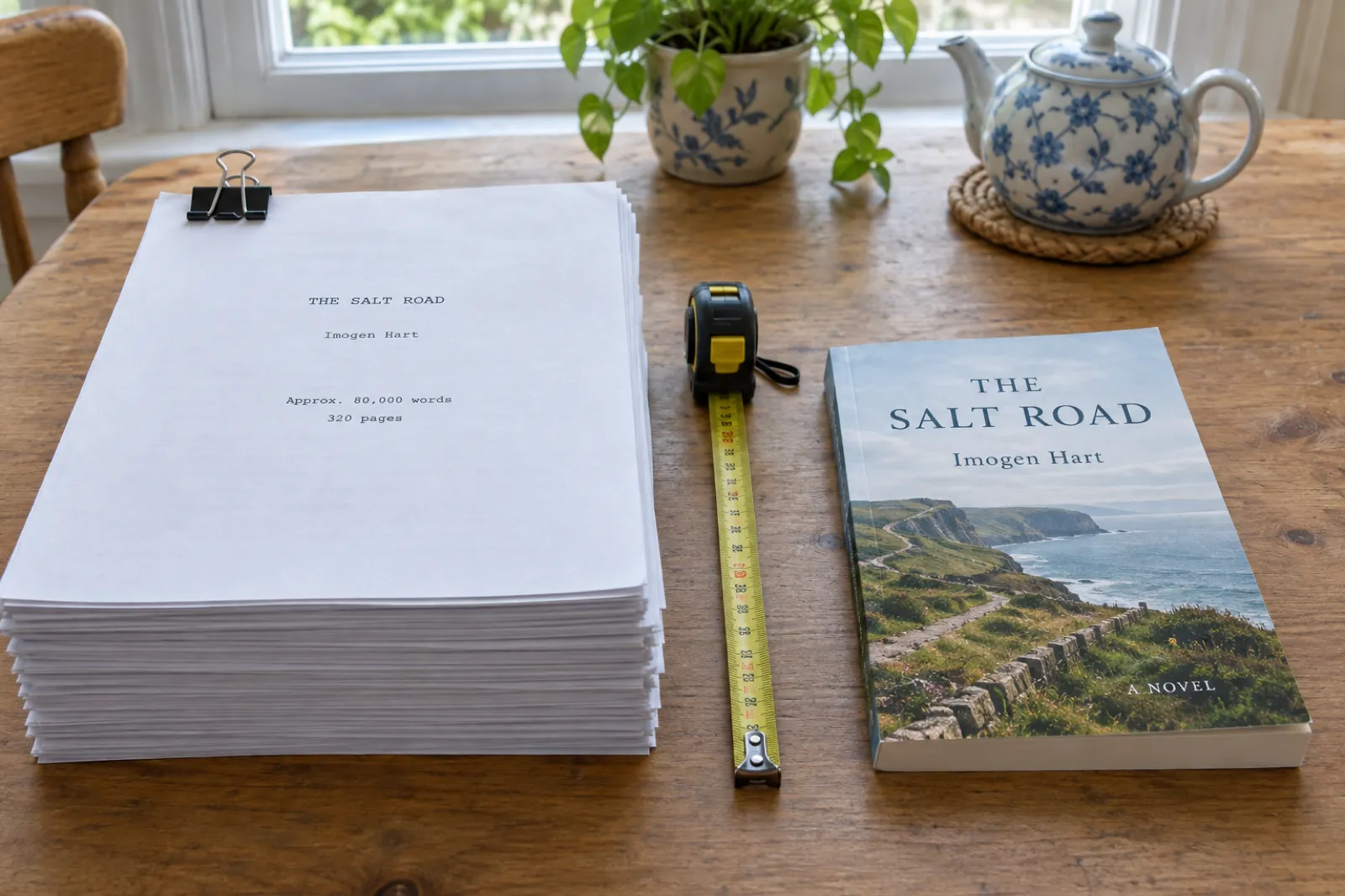
When an agent or a writing group talks about a "300-page novel", they may mean a manuscript: double-spaced, 12-point type, one-inch margins on letter or A4 paper. That format holds roughly 250 words a page, so an 80,000-word draft is about 320 manuscript pages. It is a working format, chosen to leave room for notes, and it is why agents ask for word counts instead of page counts.
A printed page is typeset: single-spaced, smaller margins, with text set to the edges of a column. By coincidence, an 80,000-word novel with plenty of dialogue at 6 x 9 comes out close to its manuscript page count (322 against 320). That coincidence is where a lot of muddled advice comes from. Change the trim, the font or the amount of dialogue and the two numbers move apart quickly: the same draft is 194 printed pages if it is written in long paragraphs, and 406 at 5 x 8.
Word processors add a third kind of page. A draft in a word processor at its default single spacing and 11-point type holds far more than 250 words a page, so a 150-page document can be a full novel. When you compare your draft with a published book, compare word counts, not pages.
Everything else that changes the page count
On a full 6 x 9 page of our export we measured about 268 words for dialogue-heavy fiction, about 390 for non-fiction with headings, and a median of 472 for the long-paragraph classics. The rest of the difference between books comes from the parts of a book that are not full pages of text:
- Dialogue. Every line of speech starts a new paragraph, and most of those paragraphs end partway across the line. A conversation-heavy page can hold half the words of a page of description. This is the biggest single factor after word count.
- Chapter openings. Each chapter starts on a new page, often with space above the title, and the last page of the chapter before is usually part-empty. Our model counts about half a page per chapter, so 60 short chapters add about 15 pages more than 30 long ones.
- Front and back matter. Title page, copyright, dedication, contents, acknowledgements, an author note, a teaser for the next book. Together these add five to fifteen pages to most novels.
- Scene breaks. A blank line or a centred ornament between scenes takes a line or two each time. A book with three breaks a chapter loses a few pages to them.
- Margins and line spacing. Wider margins and looser line spacing read more comfortably and cost pages. KDP also asks for a wider inside margin as the page count grows, so very long books lose a little width on every page.
- An even total. A printed book always has an even number of pages, since each leaf has two sides, so an odd total gains a blank page at the end.
If you want to see how all of this comes together in a finished interior, the AI book formatter sets chapters, front matter and margins for print, and our step-by-step guide to creating a print-ready PDF walks through the export.
How many pages is a chapter?
A chapter's page count follows the same rules as the book's: its words, how much dialogue it has, and the page size. At 6 x 9, using the words per full page we measured and the half page each chapter opening costs:
| Chapter length | Lots of dialogue | Mixed | Long paragraphs |
|---|---|---|---|
| 1,500 words | about 6.1 pages | about 4.3 pages | about 3.7 pages |
| 2,500 words | about 9.8 pages | about 6.9 pages | about 5.8 pages |
| 4,000 words | about 15.4 pages | about 10.8 pages | about 9 pages |
The classics show the range in practice. In our 6 x 9 typesetting, Moby-Dick averaged 3.9 pages a chapter, Pride and Prejudice 4.9, Treasure Island 5 and Dracula 12.1. Short chapters suit fast books, where a chapter ending pulls the reader into the next; long ones suit books that stay with one place or one point of view for a while.
If you are planning the book chapter by chapter, the AI chapter generator drafts one chapter at a time to the plan, and the free plot generator gives you a story spine to divide into chapters. How many chapters in a book has chapter lengths by genre and a chapter planner.
Hardcover page counts, and when a novel is too long for one
KDP also prints case-laminate hardcovers, and their limits are much tighter than the paperback's. KDP's table gives 75 to 550 pages for every hardcover size it offers, from 5.5 x 8.5 to 8.25 x 11, on white or cream paper. A paperback at regular trims can run to 828 pages on white paper.
That ceiling matters for long fiction. Using our page model, the longest dialogue-heavy novel that fits a 550-page hardcover is about 137,000 words at 6 x 9 and about 120,000 at 5.5 x 8.5. In long paragraphs the limit rises to about 232,000 words at 6 x 9. An epic fantasy at 150,000 words with plenty of dialogue can be a paperback but not a KDP hardcover at either size, unless the layout is tightened. The six-font test above shows one way: a narrower serif took about 8% off both books we tested, which moves the 6 x 9 limit to roughly 149,000 words.
At the other end, a hardcover needs at least 75 pages, so a short novella that prints to 60 pages can only be a paperback (more on short books in novella vs novel). Whichever formats you choose, the page count of each one comes from the same interior file at its own trim, so check each format's count separately before ordering covers.
Page counts that matter on KDP
If you self-publish a paperback on Amazon, a few page counts are worth knowing before you write the last chapter. These come from KDP's page count and trim size help page and its printing cost table, checked 20 October 2026:
| Pages | What happens |
|---|---|
| 24 | The fewest pages KDP will print in a paperback. |
| 79 | The fewest pages for text on the spine. Below this the spine stays blank. |
| 110 | Up to here a black-ink paperback at a regular trim costs a flat $2.30 to print in the US. Above it, $1.00 plus $0.012 a page. |
| 776 | The most pages on cream paper at regular trim sizes. |
| 828 | The most pages on white paper at regular trim sizes. |
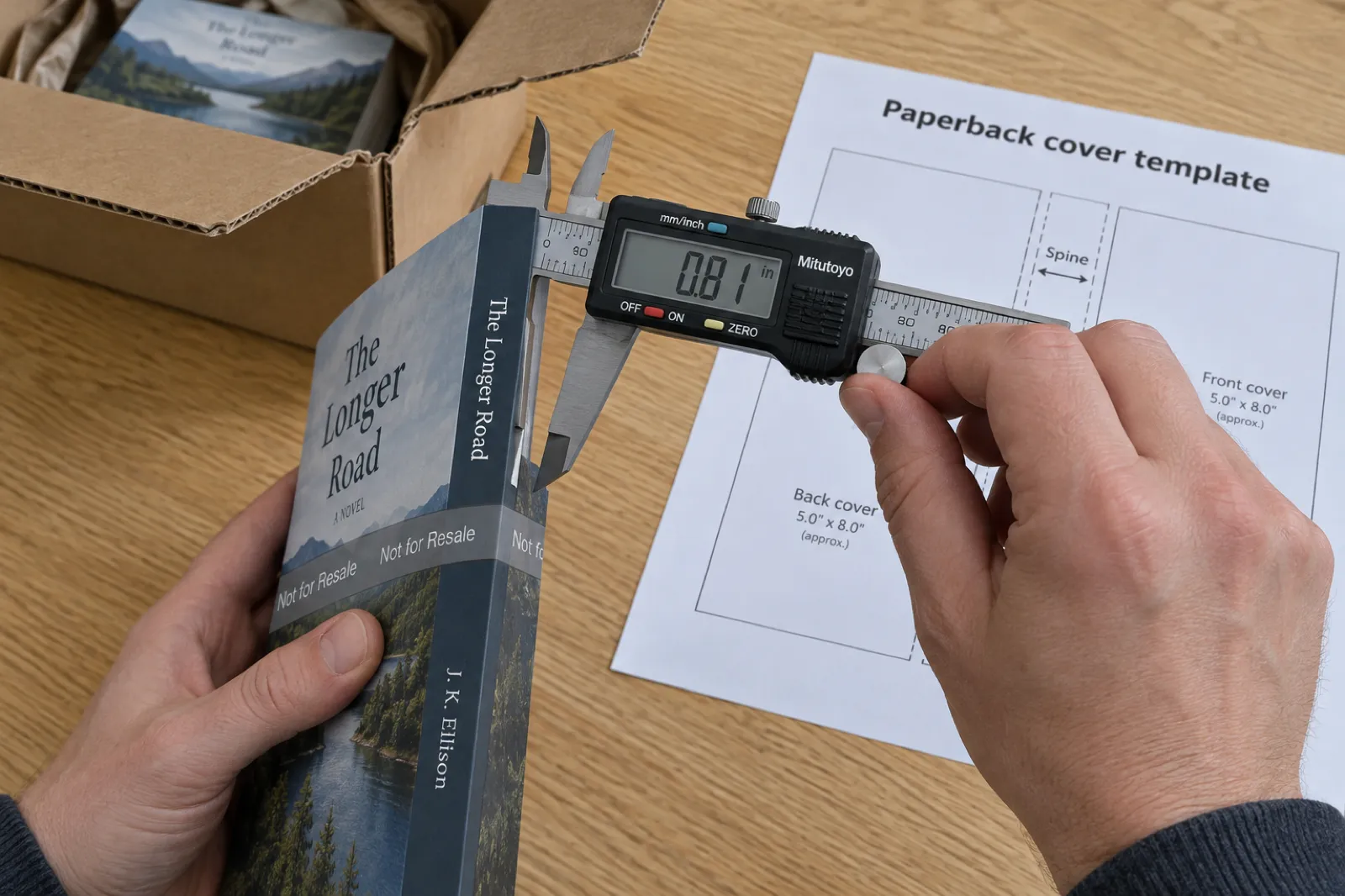
The page count also sets the spine. KDP's cover calculator uses about 0.002252 inches a page on white paper and 0.0025 on cream, so a 322-page novel on cream paper has a spine of about 0.81 inches. If your page count changes after the cover is made, the cover file has to change with it, which is why the interior should be final before the cover goes to KDP.
Few novels come near the upper limits. By our count Moby-Dick, at 208,458 words, typeset to 521 pages at 6 x 9, well inside them. Our guide to KDP paperbacks covers every other print setting, and the royalty calculator shows what a sale pays at each list price.
How to check the page count of a real book
The best benchmark for your own novel is a recent book in your genre, not a classic. On Amazon, open the paperback edition and look for "Print length" in the product details; that is the page count. Three things to watch when you compare:
- Compare the same format. The hardcover, the paperback, a large-print edition and a pocket-sized mass-market edition of one novel can each have a different page count. Use the edition closest to the trim you plan to print at.
- Check the trim size. The product details also list the dimensions. A 5 x 8 book with 300 pages holds far fewer words than a 6 x 9 book with 300 pages.
- Use "Look inside" for density. A quick look at a page or two shows whether the book is dialogue-heavy or dense, which tells you which column of the converter to use when you work back to a word count.
Do this for four or five books and take the middle. It is a better target than any average, because it is the shelf your readers already buy from. When you write the listing for your own book, the book description generator drafts a blurb that promises the kind of read your length delivers.
What about ebooks and audiobooks?
An ebook has no fixed pages. The text reflows to fit the screen and whatever font size the reader picks, so the same chapter can be four pages on a tablet and twelve on a phone. The page count shown on an ebook's store listing is the store's own figure for the book, not something stored in your file. What does stay fixed is the word count, which is why it is the better number to plan with.
Page count still matters for one ebook payment. If you enrol in Kindle Unlimited, KDP pays per page read using its own normalised page count, so the length that counts there is Amazon's measure rather than your paperback's. The ebook income calculator estimates what sales and page reads add up to.
Audiobooks are measured in hours. At the median narration pace of 164 words a minute that we measured for the audiobook length calculator, an 80,000-word novel runs a little over eight hours. The AI audiobook generator turns a finished manuscript into narrated chapters.
How to plan a novel to a page count
- Find your target in pages. Look at four or five recent books in your genre on Amazon, note their print length, and take the middle. That is the shelf your readers know.
- Turn it into words. Put the page count into the converter above with your page size and how much dialogue you write. That is your word target.
- Divide by chapters. Pick a chapter length you like to write, 2,000 to 3,500 words is common, and divide. An 80,000-word target at 2,500 words a chapter is 32 chapters. A chapter outline makes each one a scene to write rather than a blank page.
- Check at the halfway point. Count words, not pages, as you go. A draft that is far ahead or behind at the midpoint tells you early whether the story needs more events or fewer.
- Make the final adjustment in layout. Once the words are final, trim size and font fine-tune the page count. That is the cheap end of the job, and it is where the six-font test above earns its keep.
If a draft is long, our guide on cutting or growing a novel covers where words usually hide. An editor's read helps too: the AI manuscript editor marks slow passages, and the AI beta reader tells you where a reader's attention drops.
How many pages is a novel written with AI?
In Inkfluence AI the length lever is the number of chapters, which you set in your prompt: up to 5 chapters on the free plan and up to 40 in one book on paid plans. In a sample of recent adult fiction written in the app, the median chapter was a little over 2,000 words, so a 30-chapter novel lands near 60,000 words, or about 244 pages at 6 x 9. Chapters vary with the scenes they cover, so treat that as a guide rather than a promise.
Fiction is written in order, with a running record of characters, places and events so later chapters stay consistent with earlier ones. When the book is done you can add chapters in the editor, change the font, and export a KDP-ready PDF at 6 x 9, 5.5 x 8.5 or 5 x 8, with the paperback cover file built to the spine width of the final page count. The AI book cover generator designs the front.
For genre-specific planning, see the AI romance novel writer, the mystery and thriller writer and the AI fantasy novel writer. For a story too big for one volume, the AI book series writer continues it as book two.
Write the novel, then print it. Inkfluence AI writes the chapters, designs the cover to the right spine width, and exports the interior and cover files KDP asks for.
AI novel generator for KDPNovel page count questions
How many pages is a novel?
It depends on the word count and the layout more than on the story. An 80,000-word novel in 32 chapters prints to about 322 pages at 6 x 9 inches when it has plenty of dialogue, about 368 at 5.5 x 8.5 and about 406 at 5 x 8, measured from our KDP export. Written in long, dense paragraphs, the same 80,000 words is closer to 194 pages at 6 x 9.
How many pages is 80,000 words?
About 322 printed pages at 6 x 9 inches for dialogue-heavy fiction, 230 for a book with a mix of dialogue and description, and 194 for long paragraphs like the classics we typeset. As a double-spaced manuscript it is about 320 pages.
How many words is a 300-page book?
Roughly 74,000 words of dialogue-heavy fiction at 6 x 9 inches, and well over 100,000 words if the book is written in long paragraphs. The converter on this page works backwards from any page count.
How many pages is 50,000 words?
About 204 pages at 6 x 9 inches for dialogue-heavy fiction and 232 at 5.5 x 8.5. The Great Gatsby, at 48,152 words, came to 131 pages at 6 x 9 in our export because it is written in long paragraphs.
How many pages is 100,000 words?
About 402 pages at 6 x 9 inches for dialogue-heavy fiction and 458 at 5.5 x 8.5. Dense prose prints shorter: about 240 pages at 6 x 9.
Does the font change the page count?
Yes, by more than most writers expect. We typeset the same two novels in six fonts with everything else unchanged. Libre Baskerville made The Great Gatsby 145 pages and EB Garamond made it 121, a difference of 20%. Treasure Island moved by 20%.
What is the minimum page count for a KDP paperback?
KDP prints black-ink paperbacks from 24 pages. Its page-count table gives a maximum of 828 pages on white paper and 776 on cream at regular trim sizes. Spine text needs at least 79 pages.
How many pages is a novella?
A novella is 17,500 to 39,999 words in the SFWA definition, which comes to about 76 to 164 pages at 6 x 9 inches for dialogue-heavy fiction. Heart of Darkness, at 37,907 words, was 72 pages in our export.
Why does an ebook show a different page count?
An ebook has no fixed pages: the text reflows to the screen size and the reader's chosen font. The page count shown on a Kindle listing is Amazon's figure for the book, not something stored in your file, so it rarely matches your paperback exactly.
Related tools and guides
Write a novel and print it at the size you choose
Set the genre and the number of chapters, and Inkfluence AI writes the novel in order, keeps the story consistent, designs the cover and exports for Kindle and print.