
AI Beta Reader
Where Readers Drift, With the Passage Quoted
A whole-book read that names the chapter where a reader stops, quotes the sentences that confuse or drag, says why each one costs the reader, and attaches the fix. Then you ask it the questions you would ask a reader.
No score, no invented reader personas: findings, a letter and a conversation grounded in your text. Numbers on this page are from 55 real whole-book reads, including where readers actually drift.
Updated October 2026 · By the Inkfluence AI team
Quick answer
An AI beta reader reads a finished draft the way a reader would and reports where attention goes: the confusing sentence, the chapter that drags, the fact that contradicts an earlier one, the point where the book gets put down. In Inkfluence AI that is the whole-book pass: every chapter read, up to 40, with findings that quote the passage and say why it costs the reader, then an editorial letter that names where a reader drifts or quits; plus a chat that knows the book, for the questions you would ask a human reader. It runs inside the AI book editor, costs one AI assist from a daily allowance that starts free, and is meant to run before your human readers, not instead of them.
What a beta reader does that an editor does not
An editor reads for the book; a beta reader reads as the book's reader. The distinction sounds fine until you see the notes. An editor says the second act is structurally weak. A beta reader says "I put it down at chapter four and only picked it up again because you asked me to." Both are describing the same chapters, but the reader's version tells you what the experience of the book is from the outside, which is the thing an author cannot get by rereading their own pages.
Human beta readers are precious and slow. A volunteer from a writing community takes weeks to finish a novel, if they finish, and their notes range from "loved it" to a page of specifics depending on the person. The classic problem is that the most useful information, where they stopped, is the one they are least likely to report, because stopping feels like a failure on their part. An AI read has the opposite profile: it always finishes, it always says where, it quotes the passage, and it has no taste at all.
That last point is the whole design of this page. The AI read is not a replacement for a person in your audience. It is the pass that removes everything a person should not have to find, so that when the humans read, their notes can be about whether they would buy it.
What the AI beta reader returns, and what it does not
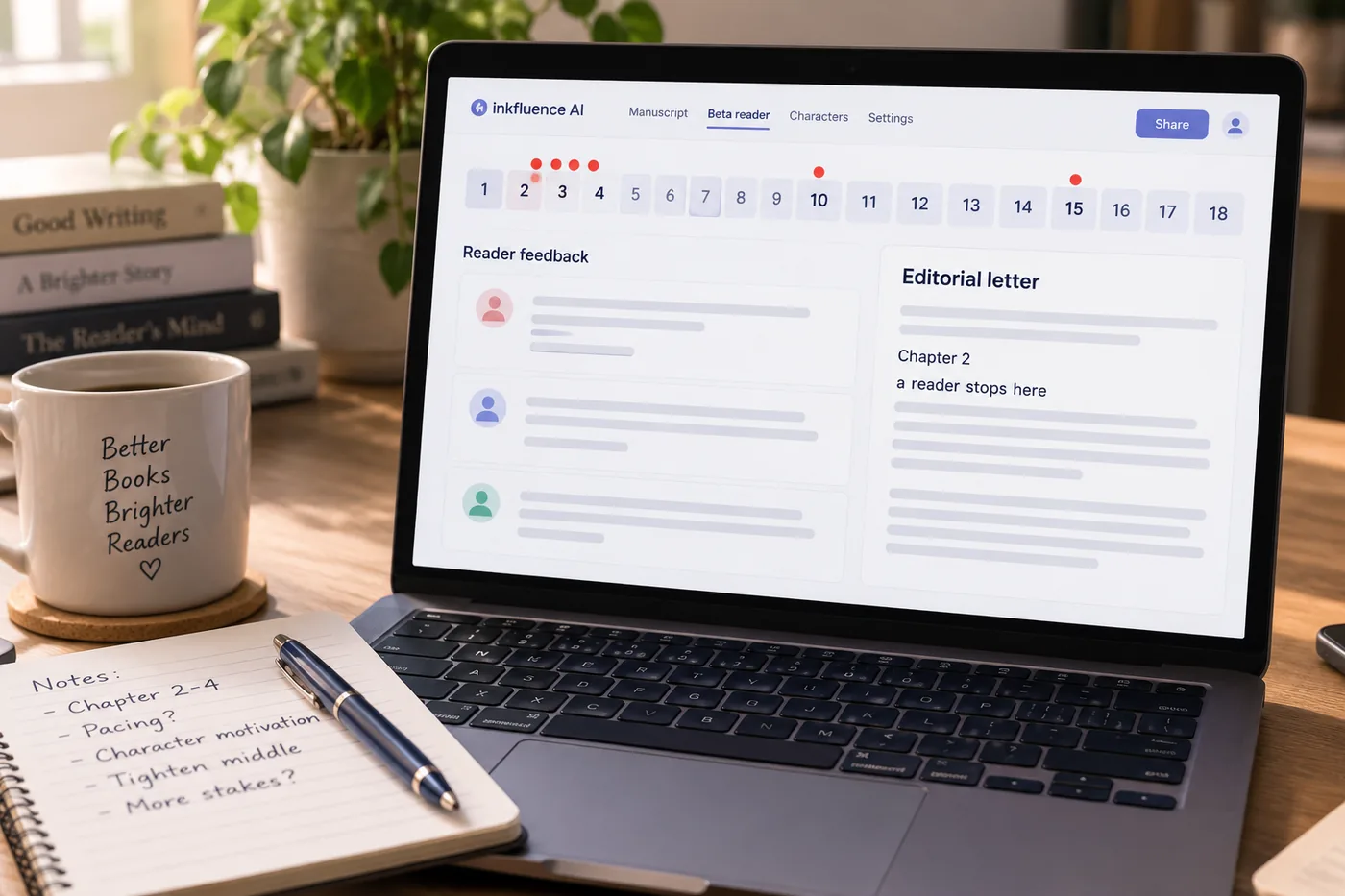
Three things, all inside the editor. First, the whole-book pass reviews every chapter and returns up to six findings per chapter, each with the passage quoted word for word, the issue, a line on why it costs the reader, a replacement in the same voice, a severity and a category. Second, the pass closes with a 250 to 400 word editorial letter that gives a verdict, the themes that run across chapters with chapter numbers, and the next step; the letter is written to name where a reader would drift or quit, and 96% of them do, a figure published on the developmental editor page. Third, the chat: it knows the brief, the plan, the story bible and the open chapter, so reader questions get answered with your passages.
What it does not return, stated so you are not surprised: there is no would-keep-reading score, and there are no invented reader personas to read through. Some tools do those things and this page describes them fairly below. The choice here is deliberate. A score says the book has a problem; a quoted passage says where; and because the passage is in the editor you are already in, the fix is a click, not a copy and paste between a report and a document.
The findings are the same ones the developmental editor uses, read from the reader's side. One pass, two uses, run it once.
Where readers actually stop
Every whole-book read run in the editor up to 3 September 2026, 55 of them. When a letter names a chapter by number as the place a reader drifts, we recorded which third of the book it sits in. Twenty-six chapters were named that way, so this is given as counts, not only percentages.
| Where in the book | Drift points named | What the letters describe there |
|---|---|---|
| First third of the book | 16 of 26 chapter references (61.5%) | Openings that take too long to reach the story or the point, a second chapter that repeats the first, backstory before the reader has a reason to want it. |
| Middle third | 5 of 26 (19.2%) | The sag: a run of chapters that maintain rather than raise tension, or a guide that restates its framework instead of applying it. |
| Last third | 5 of 26 (19.2%) | Endings rushed after a long middle, or a resolution that arrives before the reader has been made to worry. |
Three in five named drift points are in the first third. This is not the same as saying the first third has the most problems: the high-severity rate is flat across thirds, a figure on the developmental editor page. Problems are everywhere; the reader's decision to leave is made early. A reader who reaches the middle has decided to trust you and will forgive a slow chapter there that they would not have forgiven in chapter two. It follows that the first thing to do with any read is to fix the opening, and the second is to fix the opening again.
What a reader hits, and what an editor hits
The same 55 reads, 4,311 findings, sorted by whose problem they are. The full category split across every review, including single chapters, is on the AI book editor page.
| Kind of finding | Categories | Share | In a beta reader's words |
|---|---|---|---|
| Reader-experience findings | Clarity, pacing, repetition, continuity | 59.8% | These are the findings a beta reader reports as "I got confused here", "this dragged", "you already said this" and "wait, wasn't she younger?" |
| Prose findings | Style, grammar | 38.5% | A beta reader rarely mentions these unless they are bad enough to break immersion; an editor lives on them. |
| Other | Rarer categories the review occasionally uses | 1.7% | Left out of the two rows above. |
87.6%
of chapters carry at least one clarity finding
Somewhere in almost every chapter, a first-time reader will misread a sentence. The finding quotes it.
66.2%
of chapters carry at least one pacing finding
Two chapters in three have a passage that slows the reader down more than it should.
47.0%
of chapters carry at least one high-severity finding
Roughly half of chapters contain something the reader will actually hit, not just notice.
Six findings in ten are the reader's kind. That is the number that separates a beta read from a grammar check: a checker looks at the 38.5%, and not even all of it, since a good deal of style is judgement rather than rule. The 970 chapters behind the cards are every chapter in those reads; almost nine in ten carry a sentence a first-time reader will misread, which is not an insult to the authors, it is what a first draft is.
How to beta-read a manuscript with AI
Get the manuscript into the editor
Written in the app, or imported as DOCX, PDF, EPUB or TXT with chapters detected from your headings. Importing is free, and a file without headings goes through automatic detection.
Run the whole-book pass
AI panel, Review, whole-book pass. It runs in the background as one job and reads every chapter up to 40, with the brief, audience and story bible in front of it.
Find the drift point in the letter
The letter names where a reader would drift or quit. That chapter is the beta read's headline; everything else is detail.
Read the chapter findings for reader cost
Every finding has a "why" line written from the reader's side. In the named chapter, take the clarity and pacing findings first; apply the fix or write your own.
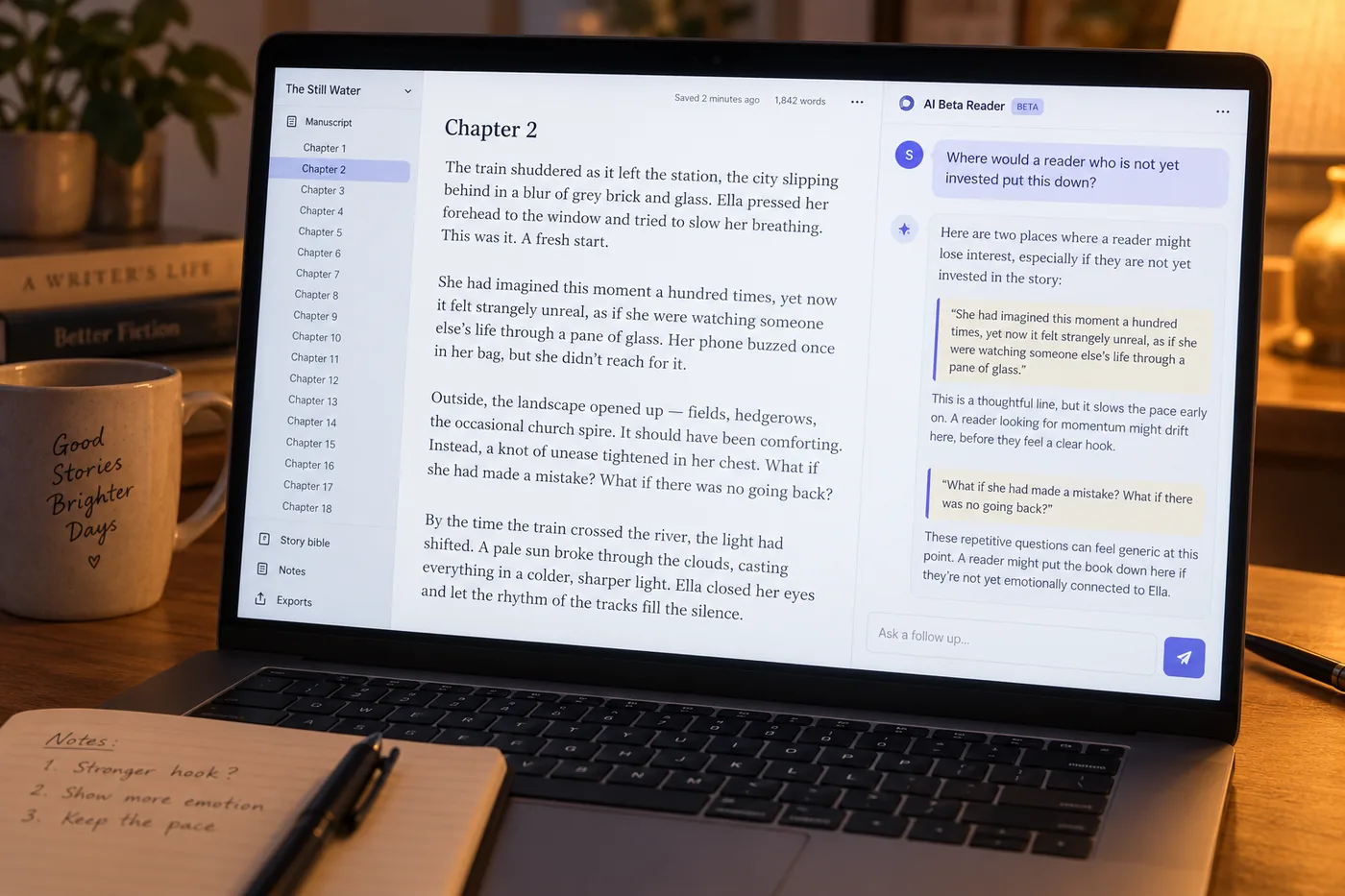
Ask the chat the reader questions
The table below has the ones that work. Because the chat has the chapter, the answers quote your passages rather than describing novels in general.
Then the humans
Send the revised draft to your human beta readers. Their notes will be about whether they believed it and whether they would buy it, which is what only they can tell you.
Reader questions to ask the chat
The chat knows the brief, the plan, the story bible and the chapter you have open. Questions phrased from the reader's seat get the most useful answers.
| Ask | Why it works |
|---|---|
| "Where in chapter 3 would a reader who is not yet invested put the book down?" | The chat has the chapter and the brief; it answers with passages, not generalities. |
| "What does a reader know about Mara by the end of chapter 2, and what have I assumed they know?" | Finds the gap between what you wrote and what you meant. |
| "Which chapter would a reader skim, and what would they miss by skimming it?" | Tells you whether the slow chapter is carrying anything. |
| "If a reader stopped after chapter 5, what promise would they feel the book had not kept?" | Stakes, framed from the reader's side. |
| "Read chapter 8 as someone who has never used a spreadsheet. Where do you get lost?" | Non-fiction: the expert's blind spot, tested against the stated audience. |
| "Which character would a reader confuse with another, and why?" | Names, roles and voices that blur. |
| "What question is the reader carrying into chapter 12, and does the chapter answer it?" | The page-turn engine, checked chapter by chapter. |
| "Summarise the book as a reader who has just finished it would to a friend." | If the summary is not the book you meant to write, the structure has drifted. |
When the answer is prose, a rewritten paragraph say, it arrives as a variant you can insert; when it is judgement, it arrives as judgement. Either way the thread stays with the book while you work, and the questions cost one AI assist each from the daily allowance, never a chapter credit.
AI beta reader vs human beta readers
Not a contest. The rows where the human wins are the reason to have both.
| Aspect | AI read | Human beta readers |
|---|---|---|
| Time to feedback | Minutes for the whole-book pass; seconds for a chat question | Two to six weeks is typical for a volunteer to finish a novel |
| Coverage | Every chapter, every time, up to 40 chapters | Many readers stop partway, which is itself data, but you may never learn where |
| Specificity | Quoted passages with the issue, why it costs the reader and a fix | Ranges from "loved it" to a page of notes; specificity depends on the reader |
| Taste and market sense | None. It reads for the experience of the text, not whether your genre's readers will buy it | The only source of "I would buy this" and "this is not what the genre does" |
| Cost | One AI assist from a daily allowance: 3 free, 15 on Creator, 100 on Premium | Free from communities and swaps, or a small fee from paid readers; platforms charge to manage them |
| Repeatability | Rerun after every revision at no extra charge | A reader who has read it once cannot un-read it; the second read is a different reader |
The sequence that works: AI read, revise, AI read again, then humans. Human readers are a finite resource, three or five people who will read your book once, and a draft that still has the contradictions and the sagging chapter four wastes their only first read on things a model would have found in minutes. If a paid editor comes after them, our book editing cost guide has rates per word for each type of edit.
AI beta reader tools compared
Read from each vendor's own page on 3 September 2026. The column that separates them is what you are holding at the end: a report, a score, or the revised book.
| Tool | Price | The read | Score or personas | After the read | Best for |
|---|---|---|---|---|---|
| Inkfluence AI | Free; Creator $9.99; Premium $19.99 a month | Whole-book pass: every chapter reviewed with quoted findings, then a letter that names where a reader drifts or quits; chat about the book for reader questions | No score and no reader personas. Findings, a letter and a conversation grounded in the text | The same window edits, exports and publishes the book | Authors who want the read and the revision together |
| ProWritingAid Virtual Beta Reader | Credit-priced; one credit is one report on up to 300,000 words; discounts on its paid plans | A report on emotional connection, hook points, drop-off points, memorable moments, first impressions | Marketing insights: ideal audience, similar books, title suggestions | Its grammar and style reports; revision in your own editor | Authors who draft in Word, Docs or Scrivener and want a report |
| CipherWrite | Three free reads of up to 20,000 words; Pro for unlimited reads of up to 80,000 words | Would-keep-reading score from 0 to 100, DNF moments, margin reactions, confusion points, three prioritised fixes | The score is the product; its own site says it approximates but does not replace human reaction | Lessons and exercises | Short manuscripts and craft practice |
| AutoCrit | Free plan; Pro $30 a month, or $15 a month billed annually | Automated alpha and beta reader impressions from 20 or more reader avatars | Persona-style impressions plus its story analysis and genre pacing comparisons | Editing tools inside its own editor | Genre novelists who like reading through several personas |
| Human beta readers | Free from communities and swaps; platforms that manage them charge about $10 a month | Whatever the reader notices, in the reader's own words, as far as they got | The only true "I would buy this" | Nothing; you collate the notes | Every book, after the AI pass has removed what a human should not have to find |
ProWritingAid's report on a 300,000-word manuscript is a real capability and its marketing insights are something this pass does not attempt. CipherWrite's score is honest about itself: its own page says it approximates human reaction rather than replacing it, which is the right claim for every tool on this table. AutoCrit's avatars are a different way of asking the same reader questions the chat answers here. The difference in kind is that the Inkfluence read lives in the editor that wrote the book, alongside the AI book writer, the cover, the export and the listing.
Beta reading fiction: the hook, the sag, the contradiction
Fiction readers leave for three reasons and the read is built around them. They leave early when the hook is late, which is why the drift points cluster in the first third and why the letter reads chapter one for how long it takes to give the reader a reason. They leave in the middle when tension recurs instead of rising, which is the pacing finding, present in two chapters out of three. And they leave, silently and permanently, when the book contradicts itself: a name, an age, a rule of the world, the day of the week. For a novel written here, continuity is checked against its own story bible, described on the AI novel writer page; for an imported novel, paste your notes into the bible and the read uses them.
Genre matters, and the chat is where it goes. Ask it to read chapter one as a reader who has just finished three cosy mysteries, or as a romance reader who expects the meet by the end of the first chapter; the romance authors page has the conventions. The answer will be about your chapter, not about the genre in general, because the chapter is in front of it.
What the read cannot tell a novelist is whether the book will sell, and it will not pretend to. That is what the humans are for, once the draft no longer wastes their first read.
Beta reading non-fiction: the reader who does not know what you know
The non-fiction author's problem is expertise. You know the subject so well that you cannot see where a beginner gets lost, and your human beta readers are usually peers who share the blind spot. Clarity is the dominant finding across every read, in 87.6% of chapters, and in a guide a misread sentence is a broken instruction. The findings quote the sentence; the "why" line says what the reader will do wrong.
The chat is the beginner you do not have. Ask it to read chapter eight as someone who has never opened a spreadsheet, or never run a business, or never been to the country, and to say where it gets lost. Then ask what a reader would expect the chapter to have covered from its title, and compare. The non-fiction authors page covers the writing side of the same workspace.
Repetition is the other non-fiction finding, in 85% of letters: the framework introduced in the introduction, restated in the chapter opening, and summarised at the end of the chapter, three times per idea. A reader experiences that as being talked down to. A whole-book read sees it in a way a chapter-by-chapter read cannot.
Working with human beta readers as well
Human readers come from writing communities, reader swaps, genre forums and mailing lists, and there are platforms that manage the process for a monthly fee. Whatever the source, they are a small, non-renewable resource: each person reads your book for the first time once. Three practices make the most of them.
- Send the draft after the AI read, not before. The contradictions, the sentence nobody can parse and the chapter that drags should be gone, so their notes can be about taste.
- Ask where they stopped, and make it safe to say. The most valuable note a beta reader can give is the one they are most reluctant to give. Say up front that stopping is data, not failure.
- Bring their notes back to the chat. "Two readers said chapter six was slow; what in chapter six is carrying weight, and what could be cut?" turns a vague note into a decision.
After the humans, the same workspace makes the cover, exports EPUB, print PDF and DOCX, narrates an audiobook, and the description generator drafts the blurb; the KDP guide covers the listing.
What it will not do
- It has no taste and no market sense. It will not tell you whether readers in your genre will buy the book, or whether the premise is fresh. Humans only.
- It does not return a score or read through personas. Findings, a letter and a conversation. Other tools do scores, and this page describes them fairly.
- It does not produce tracked changes. Each fix shows the before and after with a word-level comparison before you apply it; there is no marked-up document to export.
- It caps a whole-book pass at 40 chapters. Longer books are read to the cap and the letter says so; the chat and chapter review work on any chapter.
- It reads the text, not the reader. Where a real reader stops depends on who they are and what they came for. The read tells you where the text gives them a reason.
- A drift point is not a verdict. Nearly every letter names one. A book with a drift point in chapter two is a normal draft with a fixable opening.
Pricing and the daily allowance
The whole-book pass, chapter review, chat and quick actions share one daily AI assist allowance, counted on a rolling 24 hours from first use. None of it consumes chapter credits.
| Plan | Price | AI assists | Includes | Writing |
|---|---|---|---|---|
| Free | $0 | 3 AI assists a day | Whole-book pass, chapter review, chat, quick actions | 5 chapters to write, then 5 more every month |
| Creator | $9.99 a month | 15 AI assists a day | All of the above | 35 chapters a month |
| Premium | $19.99 a month | 100 AI assists a day | All of the above | Unlimited |
A whole-book pass is one AI assist whatever the chapter count, so on the free plan a complete read of an imported manuscript costs nothing and leaves two AI assists for reader questions. Annual billing and the full table are on the pricing page; the alternatives page covers moving a manuscript across from a prose tool.
Who uses the AI beta reader
The author with no readers yet
First book, no writing group, nobody to ask. The read is the first outside eye the manuscript gets, and it always finishes. The first-time authors page is the longer version.
The author with three readers and a deadline
Cannot afford to spend the readers' only first read on a draft with a contradiction in chapter nine. Runs the pass, fixes what it finds, then sends.
The novelist who drafted here
Wrote the book from a brief with the AI book generator and treats the draft as material. Reads it as a reader before rewriting it as the author; the fiction authors page has the workflow.
The expert writing for beginners
Knows too much to see the gaps. Asks the chat to read as someone who has never done the thing, and fixes the 87.6%.
Sources and method
Our numbers. Every completed whole-book pass in the editor up to 3 September 2026: 55 passes, 970 chapters, 4,311 findings. Drift positions: where a letter's sentence about a reader drifting, quitting or skimming names a chapter by number, that chapter's position in its own book was recorded as first, middle or last third; 26 such references across 14 letters, which is why they are given as counts. Reader-experience versus prose shares are over all findings; chapter shares are the proportion of chapters carrying at least one finding of the kind. Usage numbers from real books, not a benchmark; refreshed as the sample grows. The overall category split is homed on the AI book editor page and the letter statistics on the developmental editor page.
Tool details. Read from each vendor's own pages on 3 September 2026 and stated as found, including their own descriptions of what their reads approximate. Inkfluence prices and allowances from the pricing page.
Rights and disclosure. US Copyright Office, Copyright and Artificial Intelligence: AI-assisted work is registrable to the extent of the human contribution, and the read is designed to point you at yours. Amazon KDP content guidelines on disclosing AI-generated content.
Further reading on this site. The novel-writer test, the can AI write a novel essay, the best AI for editing a book comparison, and the AI story writer for short fiction.
AI beta reader: frequently asked questions
What is an AI beta reader?⌄
Does Inkfluence AI have reader personas or a would-keep-reading score?⌄
Where do readers actually stop reading?⌄
What kinds of problems does a reader hit, as opposed to an editor?⌄
Can an AI beta reader replace human beta readers?⌄
How is this different from the AI developmental editor?⌄
How long a book can it read?⌄
What does a chapter finding look like?⌄
Can I ask it reader questions directly?⌄
Does it work for non-fiction?⌄
Does it work for fiction?⌄
Can I beta-read a manuscript I wrote elsewhere?⌄
What does it cost?⌄
How often should I run it?⌄
Are the numbers on this page real?⌄
Does the AI read the book the way a person does?⌄
How do I start?⌄
Related tools and reading
AI developmental editor
The same whole-book pass read as structural advice: what 55 editorial letters say, and what a human edit costs.
AI book editor
Chapter review, quick actions, chat, and the full category numbers.
AI novel writer
The story bible the continuity read checks against.
AI chapter generator
Add the chapter the read says is missing, in the book's voice.
Inkfluence AI vs Sudowrite
Prose tools beside a whole-book workflow.
All tools
Writing, editing, covers, audio and publishing in one place.
How to Write a Book
Beta readers, revision and editing in the full process.
More in the learning centre.
Find out where it loses them before they tell you
Import or write the book, run the whole-book pass, read the letter. Three AI assists a day free, no card.
Read my book free