
AI Developmental Editor
For the Whole Book, Not the Sentence
One pass reads every chapter, quotes what is wrong and why, and closes with an editorial letter: where a reader drifts, what repeats, what contradicts, and the one change to make first.
Numbers on this page come from 55 real whole-book passes over a median of 18 chapters each. Human developmental editors charge 3 to 5 cents a word; this pass is one AI assist from a daily allowance that starts free.
Updated October 2026 · By the Inkfluence AI team
Quick answer
An AI developmental editor reads the manuscript as a book and reports on structure, pacing, clarity, repetition, voice and continuity across chapters, rather than correcting sentences. In Inkfluence AI the whole-book pass reviews up to 40 chapters, returns each chapter's findings with the passage quoted and a fix attached, then writes a 250 to 400 word editorial letter anchored to chapter numbers. It runs on the AI book editor, costs one AI assist from a daily allowance that starts at three free, and takes minutes. It does not replace your judgement or a human editor's market sense; it makes sure the expensive read, whether that is yours or theirs, goes to a better draft.
What a developmental edit is, and what it is not
Editing has three layers and the words get mixed up. Proofreading catches typos and stray commas on a finished file. Copy or line editing works sentence by sentence: word choice, rhythm, consistency of spelling and hyphenation, whether the paragraph says what it means. Developmental editing is the layer above both: it reads the book as a book and asks whether the opening earns the second chapter, whether the middle holds, whether the reader is told the right things in the right order, whether the voice set on page one is the voice on page two hundred, and whether chapter nine contradicts chapter three. A developmental editor's deliverable is a letter, sometimes with margin notes, and the revision is the author's.
That order matters for money and for time. Polishing sentences in a chapter you will later cut is wasted work, which is why a developmental pass comes first and a proofread comes last. Most AI writing tools live at the sentence layer, and the honest numbers bear that out: on real manuscripts, grammar is under a tenth of what the chapter review flags, and none of what a whole-book letter is about.
What a developmental edit is not: a rewrite. The letter tells you where the book leaks; it does not plug the leaks for you, because the decisions about what to cut and what the reader needs earlier are the decisions that make the book yours. This page describes a tool that keeps that line, and says where the tool stops.
What the AI developmental editor returns
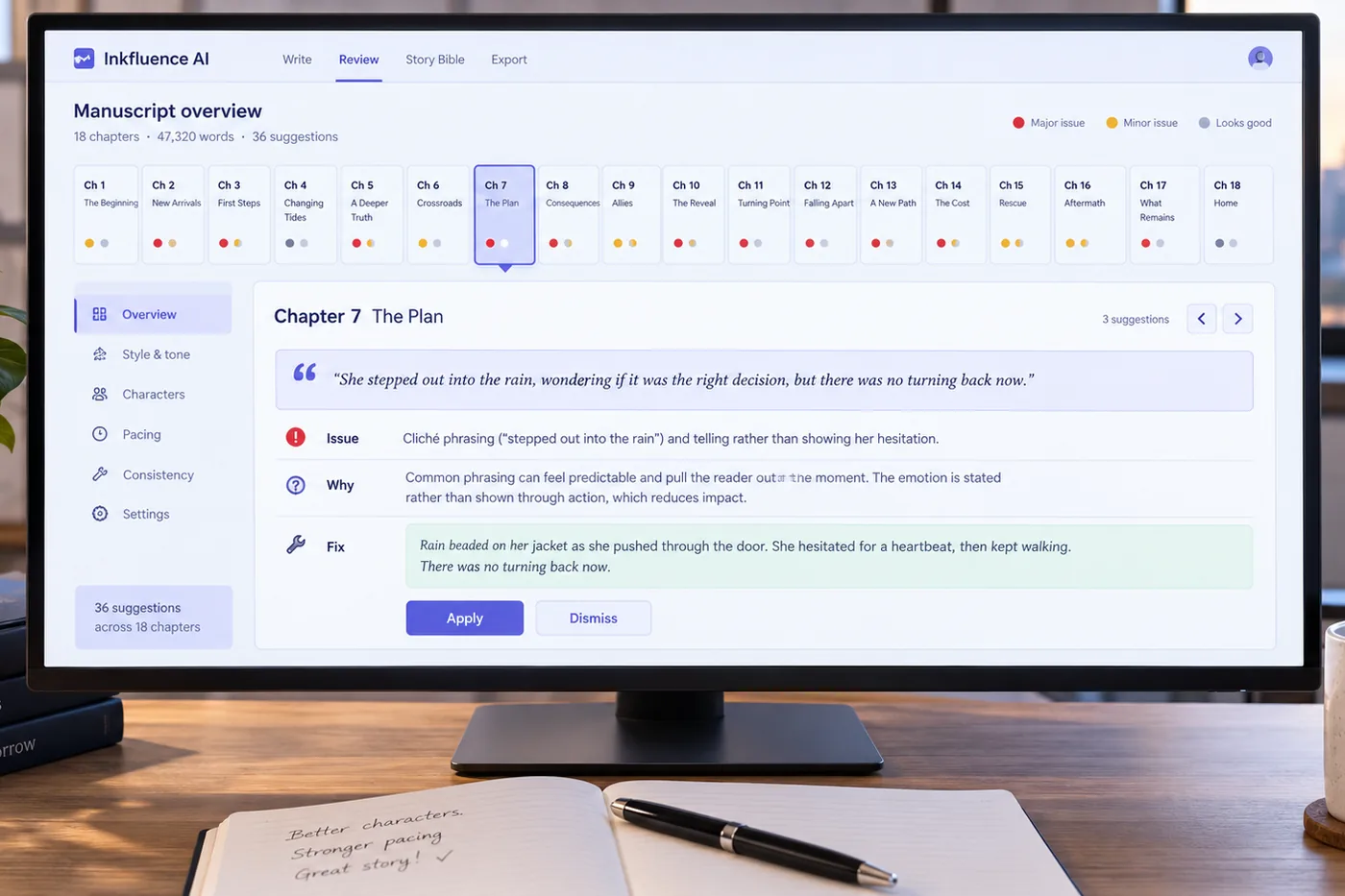
The whole-book pass has two outputs and they arrive together. The first is per chapter: up to six findings for each chapter, and every finding carries a passage quoted word for word from the text, four to fifteen words, so you can find it; a one-line statement of the issue; why it costs the reader; a replacement for the quoted passage in the same voice; a severity of high, medium or low; and a category, one of clarity, pacing, repetition, continuity, grammar or style. You apply a fix, which replaces exactly the quoted text, or dismiss it.
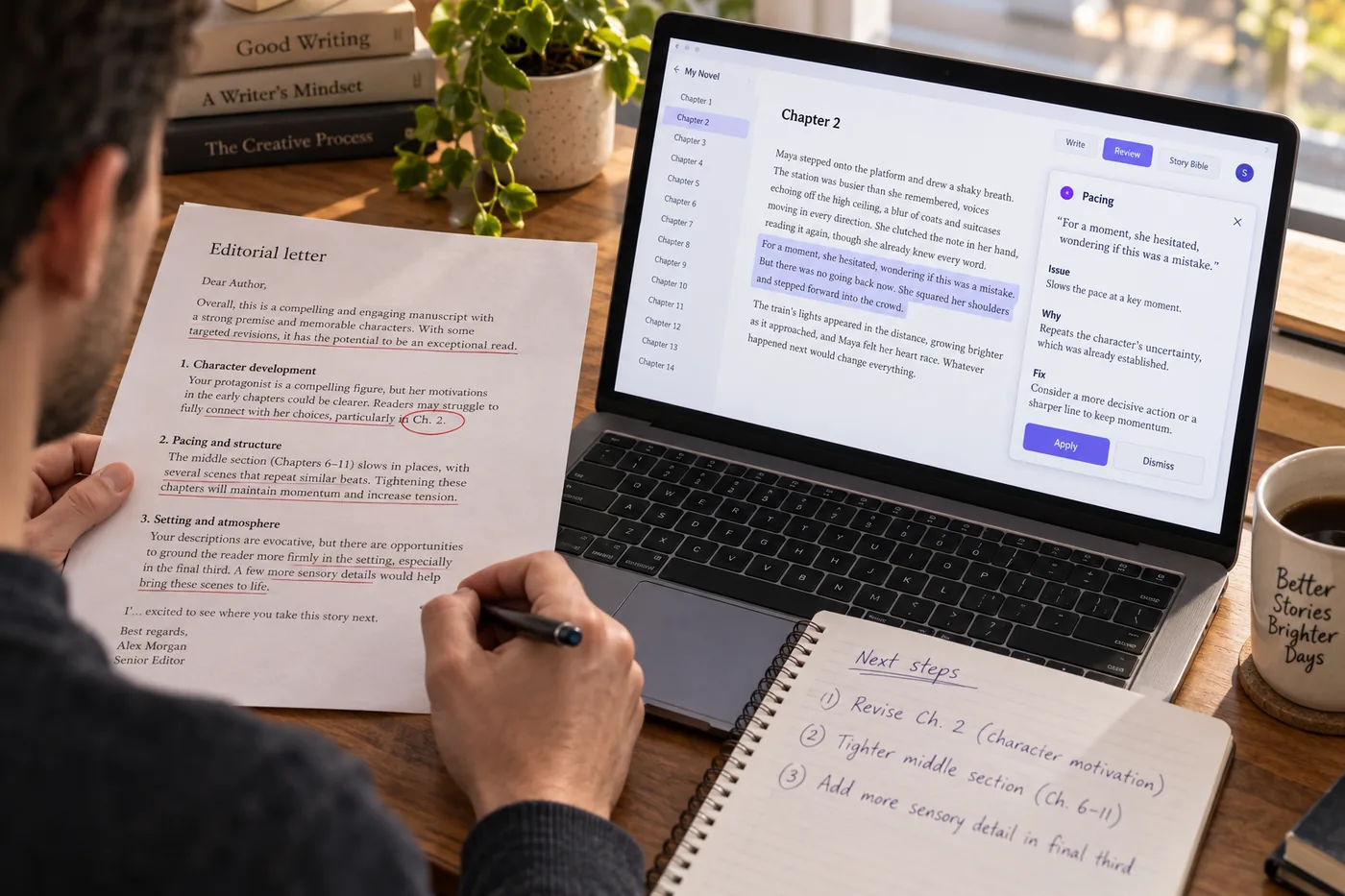
The second is the letter. It is written after every chapter has been read, from the findings, in plain prose: an opening verdict on the manuscript, then the three or four themes that run across chapters, each tied to the chapters where it shows, then the single change that would do the most good. Across the passes measured for this page the letters ran 281 to 424 words, median 343: long enough to be specific, short enough to act on in one sitting.
Both outputs land in the same panel you write in, next to the chapter they refer to, so the path from letter to chapter to sentence is a click, not a copy and paste between tools. The AI book writer that drafted the book and the editor that reviews it are one workspace.
What 55 editorial letters actually say
Every whole-book pass run in the editor up to 3 September 2026: 55 passes, a median of 18 chapters each, from one chapter to the cap of 40, and a median of 79 findings per book. The table gives the share of letters that raise each theme. Method at the bottom of the page.
| Theme the letter raises | Share of letters | What it looks like in the manuscript |
|---|---|---|
| Where a reader drifts or quits | 96% | The letter names the chapter, and usually the passage, where attention goes. It is the one thing almost every letter does. |
| Voice and tone | 89% | Registers that slip between chapters, narration that turns flat or over-formal, a voice that was set in chapter one and lost by chapter nine. |
| Repetition across chapters | 85% | The same image, phrase, opening move or explanation used again where the reader remembers the first time. |
| The opening | 78% | Whether the first chapter earns the second: hook, promise, and how long it takes to reach the story or the point. |
| Clarity | 78% | Passages that a first-time reader will misread, sequences that need a second pass, ideas introduced before they are explained. |
| Pacing | 76% | Chapters that stall, scenes that arrive too soon, middles that sag, and where to cut. |
| Continuity | 76% | Names, timelines, rules and facts that contradict an earlier chapter. |
| Structure and sequence | 75% | Chapters in the wrong order, arcs that resolve before they are built, sections that belong together. |
| Stakes and tension | 58% | What the reader has to care about, and where the manuscript forgets to remind them. |
| Character | 35% | Motivation, change and consistency; higher in fiction passes, near zero in guides. |
| Dialogue | 22% | Exchanges that carry no information or read the same for every speaker. |
| The ending | 11% | Rarely the problem. Endings are usually the chapter authors have thought hardest about. |
96%
of letters name where a reader would drift or stop. That is the developmental question, and it is answered almost every time.
79
findings in the median book. A manuscript with that many is normal. The letter exists so you do not have to read all 79 to know what to do first.
2%
of chapters in a whole-book pass come back with nothing. Even good chapters carry something; the grade tells you whether it matters.
Two readings. Endings are rarely the problem, at 11%, because they are the chapter authors have thought hardest about; openings, at 78%, are where the letters spend their time, which agrees with every acquiring editor who ever said they decide by page ten. And repetition across chapters, at 85%, is the theme an author cannot see from inside a single chapter, which is the case for reading the whole book at once rather than chapter by chapter.
Where the serious problems are
Of the 4,311 findings in those passes, 14% were graded high: problems a reader will hit, not preferences. This is where they fall. The overall category split across all reviews, including single chapters, is published on the AI book editor page.
| Category | Share of high-severity findings | How often the category is graded high | Reading |
|---|---|---|---|
| Clarity | 37.4% | 18% of clarity findings are high | The biggest source of serious problems: a reader who cannot follow the sentence does not reach the next one. |
| Grammar | 24.5% | 39% of grammar findings are high | Grammar is under a tenth of all findings, but when it is flagged it is usually a real error rather than a preference. |
| Continuity | 17.4% | 41% of continuity findings are high | The category most likely to be graded high. A contradicted fact breaks trust in a way a weak sentence does not. |
| Style | 8.3% | 4% of style findings are high | The most common finding overall and the least often serious: the accumulation, not the disaster. |
| Pacing | 6.6% | 6% of pacing findings are high | Pacing problems are usually medium: they cost momentum, not comprehension. |
The remaining few percent of high findings sit in rarer categories the review occasionally uses. One more number worth having: the high-severity rate by manuscript third is 14.1% in the first third, 13.4% in the middle and 14.7% in the last. The problems are spread evenly. The idea that a book is tight at the start and loose at the end, or the reverse, does not show up in the data; what changes across a book is the kind of problem, not the amount.
How the whole-book pass works
The manuscript is in the editor
Either the app wrote it, chapter by chapter from your brief, or you imported it as DOCX, PDF, EPUB or TXT and the chapters were detected from your headings. Importing is free and a file without headings goes through automatic chapter detection.
You start the pass from the AI panel
Open the panel, choose Review, then the whole-book pass. It runs in the background as one durable job; you can keep editing, and the panel reports progress chapter by chapter.
Every chapter is reviewed, up to 40
Each chapter goes through the same review as a single-chapter request: the book's brief and audience are in front of the reviewer, and for fiction written here the story bible is too, so a name or a rule that drifts is caught against the source rather than against memory.
The letter is written from the findings
With every chapter's findings in hand, the pass writes the editorial letter as a developmental editor would after a cover-to-cover read: a verdict, the cross-manuscript themes with chapter numbers, and one next step. Honest and specific beats flattering; the letter names where a reader would drift or quit.
You work from the letter down
Structural changes first, in the chapters the letter names; then the quoted findings in those chapters; then the selection tools for the sentences. Rerun the pass when the structure has moved.
How to read an editorial letter
A developmental letter is written in a particular order, and the order is the advice. The verdict at the top tells you whether the book is fundamentally working; if it says the opening does not earn the second chapter, that is the job, and nothing further down the letter matters until it is done. The themes in the middle are ranked by how much of the book they touch, not by how easy they are to fix, so the first one is usually the hardest and the most valuable. The closing next step is deliberately singular: one thing, done fully, beats five things started.
Read it once without the manuscript open, then once with it. On the second read, go to each chapter the letter names and see what the chapter's own findings say; the letter is the map, the findings are the terrain. Where you disagree, and you will, the quoted passage is there so the disagreement is about the text and not about a summary of it.
What not to do with it: apply all 79 fixes in order from chapter one. The letter exists so that you do not. A finding graded low in a chapter the letter says to cut is not worth your evening.
From the letter to the chapter
The chapter review is the same instrument the whole-book pass uses, pointed at one chapter, and it is where the letter's themes become editable text. Open the chapter the letter names and its findings are listed beside it: the quote, the issue, why it costs the reader, the fix, the grade. Applying a fix replaces exactly the quoted words; the editor reads the range back and checks it before it writes, and a finding whose passage has already changed marks itself out of date rather than guessing at a new location. Nothing is applied that you did not click.
Run the chapter review again after a structural change to a chapter, because the findings describe the chapter as it was when the pass ran. A chapter that has been cut in half will have new seams, and the review will find them.
If the book was written in the app, the review also has the plan and the story bible, and for fiction that is where continuity findings come from: the bible said the sister was younger, chapter twelve says older, and the finding quotes chapter twelve. The AI novel writer page describes the bible; imported books can have one pasted in.
From the finding to the fix
Some revisions are a sentence, and for those the selection tools are faster than any finding. Highlight a passage and the toolbar offers Proofread, Rewrite, Shorten, Expand, Softer, Punchier and a custom instruction; the result appears in a preview card with a word-level comparison you can toggle, and you replace, insert below, or try again. The tools draft in the book's voice because they read the chapter around the selection.
Some revisions are a decision, and for those there is the chat. It knows the brief, the plan, the story bible and the open chapter without any setup, so a question like "if I cut the flashback in chapter four, what in chapter nine stops making sense" gets an answer grounded in your chapter nine. When the answer is prose, it comes as a variant you can insert; when it is judgement, it comes as judgement.
None of this consumes chapter credits. Review, chat and quick actions draw on a daily AI assist allowance, separate from the chapters you write, so revising a book never competes with finishing it. The pricing page has both allowances side by side.
AI developmental editor vs a human developmental editor
Human rates are the Editorial Freelancers Association's 2025 survey medians, from more than 1,100 respondents. The comparison is about what each read is for, not which is better; the last row is the honest one.
| Route | Cost | What you get | Time |
|---|---|---|---|
| Inkfluence AI whole-book pass | One AI assist from the daily allowance: 3 free, 15 on Creator ($9.99), 100 on Premium ($19.99) | Up to 40 chapters, every chapter reviewed with quoted findings, then the letter | Minutes; runs in the background while you keep editing |
| Human developmental editor, fiction | 3.0 to 3.5 cents a word (EFA 2025 survey medians), so $2,400 to $2,800 on an 80,000-word novel | A letter, often margin notes, judgement about the market and your readers | Typically weeks; book in advance |
| Human developmental editor, non-fiction | 4.0 to 5.0 cents a word, so $2,400 to $3,000 on 60,000 words | Argument, sequence, audience fit, what to cut | Weeks |
| Manuscript critique services | Roughly $20 to $30 a report, or subscriptions of $20 to $30 a month | A report on plot, pacing, characters and comparable titles, without the fix | Minutes to hours |
What the human editor has that the pass does not: taste, a sense of the market, and the experience of a hundred other manuscripts in your genre. What the pass has that the human does not: a complete read in minutes, every finding quoted, and the ability to run again after each revision at no extra cost. Authors who can afford both run the pass first so the $2,400 read goes to a draft that has already had its openings and repetitions fixed. Authors who cannot afford both, which is most self-publishers, get a developmental read they would otherwise skip. Every type of edit, priced by genre with a calculator, is in our book editing cost guide.
AI developmental editing tools compared
Prices read from each vendor's page on 3 September 2026. Every tool here does something real; the column that separates them is what happens after the report.
| Tool | Price | The developmental output | After the report | Best for |
|---|---|---|---|---|
| Inkfluence AI | Free; Creator $9.99; Premium $19.99 a month | Whole-book pass: every chapter reviewed with verbatim quotes, issue, why and fix, then a 250 to 400 word editorial letter anchored to chapters | Chapter review, quick actions on the selection, chat about the book, and the same workspace writes, exports and publishes | Authors who want the diagnosis and the revision in one place |
| Marlowe (Authors A.I.) | Basic free; Pro $29.95 a report, $19.95 a month for 4, $159 a year for 48 | A critique report: plot, narrative arc, character, pacing, theme, conflict and setting analysis with key recommendations | The report only; revision happens in your own software | Novelists who want a bestseller-comparison report |
| AutoCrit | Free plan; Pro $30 a month, or $15 a month billed annually | Story Analyzer, an AutoCrit score, genre pacing comparisons, automated alpha and beta reader impressions | Interactive editing tools inside its own editor | Genre fiction authors who like numbers against genre norms |
| manuscripts.ai | Professional $29 a month or $300 a year; 7-day trial capped at 50,000 tokens | Structural, developmental, copy and line editing modes plus analysis reports | Editing inside its workspace | Authors who want several editing modes and are happy to meter tokens |
| ProWritingAid | Paid plans; critique reports are credit-priced on top | Chapter Critique, Manuscript Analysis and a Virtual Beta Reader report on up to 300,000 words | Grammar and style reports in Word, Docs and Scrivener | Authors who already draft elsewhere and want reports on the file |
| ChatGPT or Claude | Free; then a subscription | Whatever you paste, within the message limit, with no memory of the chapters you did not paste | Nothing book-shaped | One scene, not a manuscript |
Marlowe's comparison of your manuscript to bestsellers is a real feature the pass does not attempt, and AutoCrit's genre pacing norms are useful to a thriller writer. ProWritingAid's own line, that it is not there to write it for you, is a fair description of where it sits. The difference in kind is that the Inkfluence pass lives in the editor that wrote the book: the letter, the findings, the fixes, the export and the cover are one window. If you drafted in Sudowrite or a chatbot, the alternatives page covers moving the manuscript across.
Developmental editing for fiction: structure, stakes, continuity
In fiction passes the letter reads for the hook and how long it takes to arrive; whether tension rises or merely recurs; where the middle sags and which scene could carry the weight if moved; whether the point-of-view discipline holds; and continuity against the story bible, which is where the high-severity continuity findings come from. Character and stakes themes appear almost only in fiction letters, and in 35% and 58% of all letters respectively, so a novel's letter is usually longer on motivation than a guide's.
The finding that surprises novelists most is repetition across chapters: an opening move used four times, a simile that was striking once, a piece of backstory explained in chapters two, seven and eleven. A chapter-by-chapter read cannot see it; a whole-book read cannot miss it. Our novel-writer test has more on what AI-drafted fiction tends to repeat.
Genre writers should read the pacing findings against their genre's expectations rather than as a rule. A romance is allowed a slow middle chapter if it is doing the emotional work; the letter will flag the slowdown and you will decide whether it is earning its keep. The fiction authors page covers the writing side of the same workspace.
Developmental editing for non-fiction: argument, sequence, promise-keeping
A guide, workbook, course or business book has a different structure to protect: the promise made by the title and the introduction, and whether each chapter delivers its share of it. The letter for a non-fiction pass reads for ideas used before they are explained, for chapters that could swap places without anyone noticing, which is usually a sign that neither is necessary, for the reader being told the same thing in the introduction, the chapter opening and the summary, and for the book forgetting who it is for halfway through.
Clarity is the dominant high-severity category overall, and non-fiction is where it concentrates: a sentence that a first-time reader will misread is a broken instruction in a how-to book and a lost argument in a business one. The findings quote them, and the fix keeps the author's register rather than flattening it.
If the book started from an outline, the letter is also a check on the outline. Chapters that the plan gave a clear job and the draft did not deliver are the easiest structural fix there is, and the outline generator and the non-fiction authors page cover the planning side.
What it will not do
- It will not rewrite the book. Findings carry fixes for the quoted passage and quick actions rewrite a selection on request. Structural revision is yours; that is the point of a developmental edit.
- It does not produce tracked changes. Each fix shows the before and after with a word-level comparison before you apply it; there is no marked-up document to export.
- It caps a pass at 40 chapters. A longer book is reviewed to the cap and the letter says so. Split the manuscript, or run chapter reviews on the remainder.
- It does not know your market. Whether the book will sell, which comparable titles it sits beside, and what an acquiring editor in your genre wants this year are human questions.
- Its judgement is a model's. Every finding quotes the passage so you can disagree with the text in front of you. Disagreeing is part of the process, not a failure of it.
- A letter is not a verdict on you. The median book carries 79 findings and 2% of chapters come back clean. That is what a real manuscript looks like under a complete read.
Pricing and the daily allowance
The whole-book pass, chapter review, chat and quick actions share one daily AI assist allowance, counted on a rolling 24 hours from first use. They never consume chapter credits.
| Plan | Price | AI assists | Whole-book pass | Writing |
|---|---|---|---|---|
| Free | $0 | 3 AI assists a day | Yes, one whole-book pass is one AI assist | 5 chapters to write, then 5 more every month |
| Creator | $9.99 a month | 15 AI assists a day | Yes | 35 chapters a month |
| Premium | $19.99 a month | 100 AI assists a day | Yes | Unlimited |
One whole-book pass is one AI assist today, whatever the chapter count. On the free plan that means a complete developmental read of an imported manuscript costs nothing and leaves two AI assists for the chapters it names. Annual billing and the full allowance table are on the pricing page.
Who runs the pass
The finished-draft novelist
Has a complete manuscript, cannot afford $2,400 before knowing whether it works, and wants the letter a developmental editor would write. Runs the pass, revises the opening, reruns. The first-time authors page is the longer version.
The author who drafted here
Wrote the book from a brief with the AI book generator and knows the draft is material, not a book. The pass is the first thing they run before the rewrite in their own words.
The non-fiction expert
Knows the subject cold and cannot see where a beginner gets lost. Clarity findings, which carry the most high grades, are the ones they act on; the letter tells them which chapter to fix first.
The author with a human editor booked
Runs the pass before sending the file so the paid read goes to a draft without the obvious repetitions and contradictions, and the editor's letter can be about the things only a person can see.
After the revision the same workspace exports EPUB, print PDF and DOCX, narrates an audiobook, and the KDP guide covers the listing. A book that has had a whole-book read before publication is a different product from one that has not, and readers can tell by chapter three.
Sources and method
Our numbers. Every completed whole-book pass in the editor up to 3 September 2026: 55 passes, 4,311 findings, letters measured by word count. Theme shares are the proportion of letters whose text raises the theme; severity and category shares are over findings, with a handful of off-list categories the review occasionally uses left out of the category table. Position thirds divide each manuscript's chapters into first, middle and last. They are usage numbers from real books, not a benchmark, and they will be refreshed as the sample grows. The category split across all reviews including single chapters is homed on the AI book editor page.
Human rates. Editorial Freelancers Association, Editorial Rates: median ranges from a survey run November 2025 to January 2026 with more than 1,100 respondents. Developmental editing, fiction 3.0 to 3.5 cents a word; non-fiction 4.0 to 5.0 cents.
Tool prices. Read from each vendor's pricing page on 3 September 2026 and stated as found; where a page gave no figure the row says so. Inkfluence prices and allowances from the pricing page.
Rights and disclosure. US Copyright Office, Copyright and Artificial Intelligence. Amazon KDP content guidelines, which ask publishers to disclose AI-generated content at upload and treat AI-assisted editing as assistance.
AI developmental editor: frequently asked questions
What is an AI developmental editor?⌄
What does the editorial letter actually contain?⌄
How long a manuscript can it review?⌄
How is an AI developmental edit different from a grammar checker?⌄
Does it rewrite the book for me?⌄
How much does a developmental edit cost?⌄
Is the AI pass a replacement for a human developmental editor?⌄
What counts as high severity?⌄
Does it work on non-fiction?⌄
Does it work on fiction?⌄
Can I review a book I wrote somewhere else?⌄
Does the review show tracked changes?⌄
How often should I run the pass?⌄
Are the numbers on this page from real books?⌄
What can it not do?⌄
Who owns the edited book?⌄
How do I start?⌄
Related tools and reading
AI book editor
The editor the pass runs in: chapter review, quick actions, chat, and the full category numbers.
AI beta reader
The reader's-eye read: where attention drifts, and what the data says about which third of a book loses people.
AI novel writer
The story bible the fiction review checks continuity against.
AI book writer
Draft the book from a brief, then run the pass on it.
Sudowrite alternatives
Moving a manuscript across from a prose tool, at verified prices.
AI chapter generator
Add the chapter the letter says is missing, in the book's voice.
How to Write a Book
Where revision and editing fit in the whole process.
More on the tools hub, the learning centre, the best AI for editing a book comparison and the can AI write a novel essay.
Get the letter before you publish
Import or write the book, run the whole-book pass, read the letter. Three AI assists a day free, no card.
Review my book free