
Updated October 2026 · 11 steps · sources checked 17 October 2026
How to Write a Book: A Step-by-Step Guide From Idea to Published
Most books that never get finished stall in the same three places: no clear idea, no plan, and no routine. This guide walks through the whole job in eleven steps, with real word counts by genre, a planner that turns your target into a finish date, what editing costs, and the routes to publication.
By Sam May, founder of Inkfluence AI
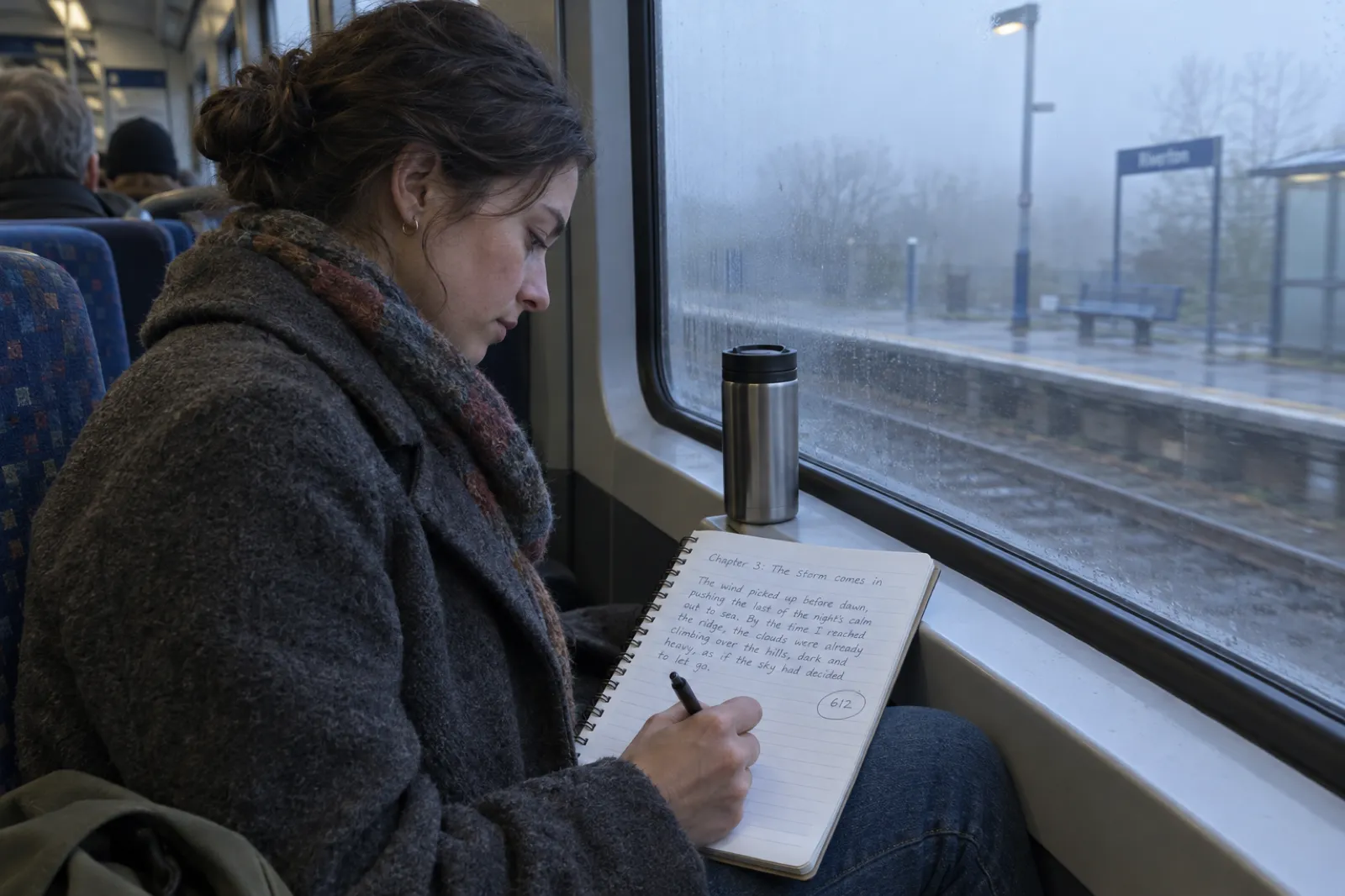
How do you write a book? The short answer
Write the idea in one sentence, decide who it is for and how long it should be, then outline it chapter by chapter. Draft in short, regular sessions until the first draft is done, without editing as you go. Then revise the structure, get readers' reactions, edit and proofread, package it with a title and cover, and publish.
Book writing facts, with sources
The numbers this guide relies on, each read from its source on 17 October 2026. Word counts are guidelines from people who sell books to publishers, not rules; self-published books vary more.
| Fact | What the source says | Source |
|---|---|---|
| Adult novel length | 80,000 to 89,999 words is "a good range you should be aiming for"; sci-fi and fantasy 100,000 to 115,000. | Writer's Digest, Chuck Sambuchino (2016) |
| Non-fiction length | Popular non-fiction: "70,000 to 120,000 words is about typical"; memoir 70,000 to 100,000. | Jericho Writers, Harry Bingham |
| Copyright | Your work is protected "the moment it is created and fixed in a tangible form"; registration is voluntary, but needed before suing over a US work. | US Copyright Office FAQ |
| Editing rates, fiction | Developmental 3.0 to 3.5 cents a word; copyediting 2.0 to 2.7 cents; proofreading 1.2 to 2.0 cents. | EFA 2026 rate chart (member survey) |
| Editing rates, non-fiction | Developmental 4.0 to 5.0 cents a word; copyediting 3.0 to 4.0 cents; proofreading 2.0 to 3.0 cents. | EFA 2026 rate chart (member survey) |
| Kindle ebook royalty | 70% of list price (without VAT) less delivery costs, for $2.99 to $12.99 on Amazon.com; 35% otherwise. Delivery averages $0.06 a sale. | KDP eBook Royalties and List Price Requirements |
| Paperback royalty | (Royalty rate x list price) minus printing costs; 60% at $9.99 and up on Amazon.com, 50% at $9.98 and below. | KDP Paperback Royalty |
| ISBN | Optional for ebooks on KDP; KDP gives free ISBNs for paperback and hardcover, usable only on KDP. | KDP: What is an ISBN and Imprint? |
| AI disclosure | KDP requires you to tell it about AI-generated text, images or translations; AI-assisted editing of your own writing need not be disclosed. | KDP Content Guidelines |
Step 1
Where do I start if I want to write a book?
Start by writing the book in one sentence. For fiction: who wants what, what stands in the way, and what is at stake. For non-fiction: who the reader is, what problem they have, and what they will be able to do by the end. If you cannot write that sentence yet, you are not ready to outline.
Two examples. Fiction: "A widowed lighthouse keeper finds letters proving her husband had a second family, and has one winter to decide whether to tell their daughter." Non-fiction: "A plain guide for first-time landlords who own one flat, covering the five legal duties and the money side, so they can let it out without an agent." Both sentences name a person, a problem and a reason to keep reading.
Test the idea before you commit months to it. Can you list ten things that happen, or ten things the reader learns? Would you want to read it? Is there a shelf for it, meaning comparable books published in the last five years? A book with no comparable titles at all is often hard to sell, however good it is.
If you are choosing between ideas, pick the one you would still care about after a hundred hours, because that is roughly what a first draft costs. For topic inspiration, our ebook ideas list is sorted by niche, the writing prompt generator sparks fiction, and the plot generator turns a vague idea into a premise with a conflict.
Step 2
Who is the book for?
Picture one specific reader and write for them. Their age, what they already know, what they read for fun and why they would pick up this book. A book written for everyone reads like it was written for no one, and it is impossible to describe, price or market.
Find three to five comparable titles ("comps"): recent books your reader already buys. Read their first chapters, their reviews and their tables of contents. One-star and three-star reviews are the most useful; they tell you what readers in this space wanted and did not get. Your book's job is to give it to them.
The reader also decides your voice and vocabulary. A children's book, a business book and a cozy mystery can share a topic and nothing else. If you are writing for children, check the age band first; our children's book word count guide covers picture books through middle grade.
Step 3
How many words should a book be?
For most adult novels, aim for 80,000 to 89,999 words; for science fiction and fantasy, 100,000 to 115,000; young adult, 55,000 to 79,999; picture books, 500 to 600. Those are Writer's Digest's ranges. Popular non-fiction runs 70,000 to 120,000 according to Jericho Writers, and short guides have no standard.
Typical length by genre, in words (main range from Writer's Digest; category romance and popular non-fiction from Jericho Writers)
| Genre | Writer's Digest (Sambuchino, 2016) | Jericho Writers (read 17 October 2026) |
|---|---|---|
| Adult fiction: literary, mainstream, romance, mystery, thriller, horror | 80,000 to 89,999 (90,000 to 99,999 "generally safe") | Thriller up to 120,000; crime 75,000 as a lower limit |
| Science fiction and fantasy | 100,000 to 115,000 | Fantasy up to 180,000 or more |
| Category romance | Not given separately | 50,000 to 60,000 (longer romances 75,000 to 100,000) |
| Westerns | 50,000 to 80,000 (65,000 "a solid number") | Not covered |
| Young adult | 55,000 to 79,999 | 50,000 to 70,000 |
| Middle grade | 20,000 to 55,000 | "The younger the child, the shorter" |
| Picture books | 500 to 600 words, for 32 pages | Not covered |
| Memoir | 80,000 to 89,999 | 70,000 to 100,000 |
| Popular non-fiction | Not covered | 70,000 to 120,000 |
Sources: Writer's Digest, "Word Count for Novels and Children's Books: The Definitive Post" and Jericho Writers, "How long is a novel?". Both are written for authors submitting to agents and publishers, where a manuscript far outside the range is a reason to say no. Self-published books are freer: plenty of successful romance and thriller series run shorter, and a practical guide can be 15,000 words if that is what the job takes.
For non-fiction, the better test is the comps from step 2. Look at the page counts of three recent books like yours on their retail listings; that tells you what readers in your niche expect to hold. A how-to that says everything in 30,000 words beats one padded to 70,000.
A target length is useful because it turns into a schedule, which is the next two steps. Pick a number now, even a rough one, and adjust it after the first draft.
Step 4
How do you outline a book?
List the chapters, one line each, in order. For fiction, each line is an event that changes something. For non-fiction, each line is a promise: what the reader will know or be able to do after that chapter. Then check the shape: does each chapter earn its place, and does the end pay off the beginning?
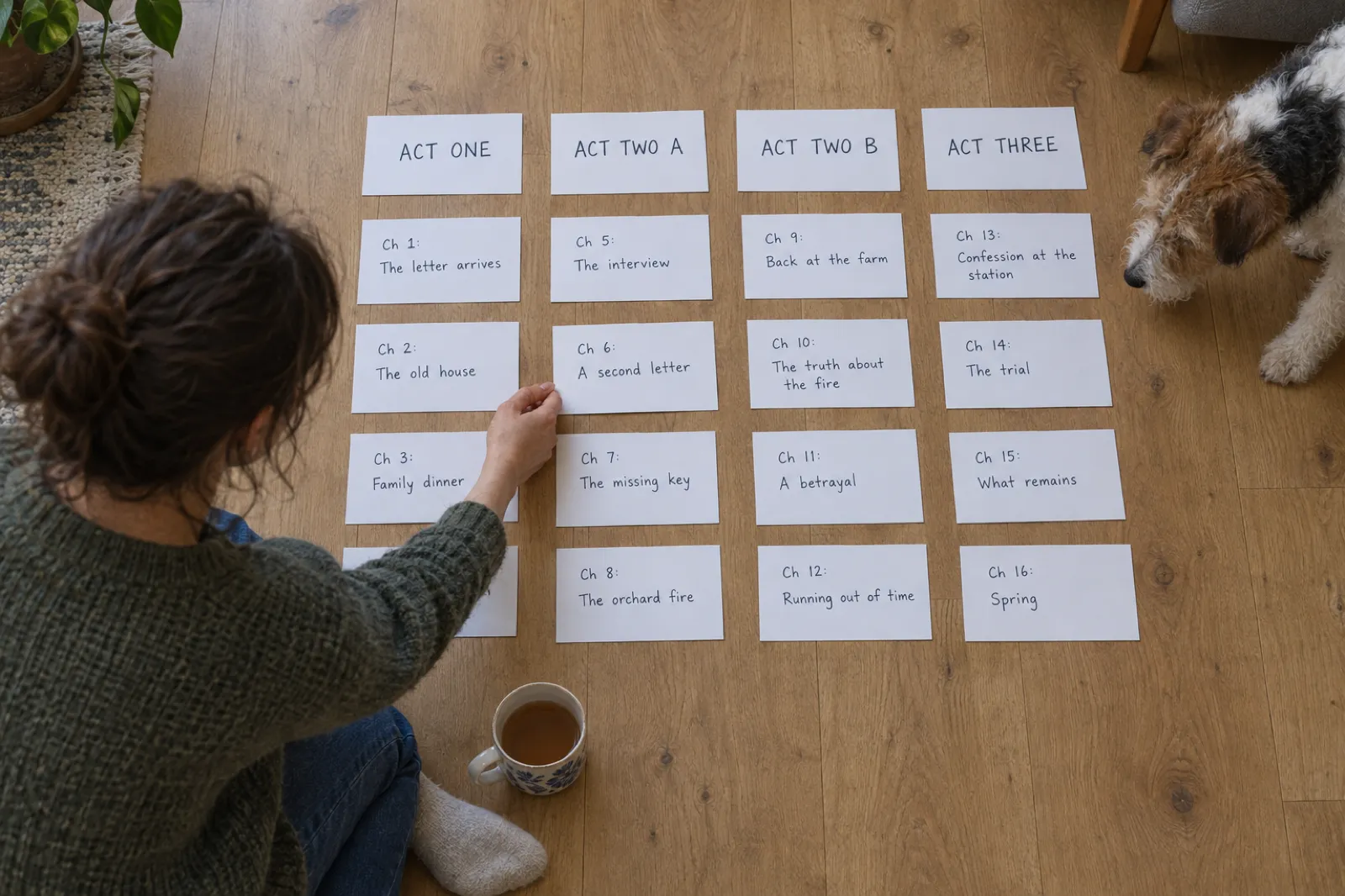
Outlining fiction
The simplest working structure has three parts. The first quarter sets up the character, their world and the problem, and ends with a choice they cannot take back. The middle half raises the cost: things get harder, a midpoint changes what the character believes, and everything falls apart near the end of it. The last quarter is the climax and what is left afterwards. You do not need a named method to use this; one line per chapter under those three headings is enough.
Keep a separate page of facts as you go: names, ages, eye colours, what each character knows and when they learned it. Continuity errors are one of the quickest ways to lose a reader's trust. The character name generator and the story bible generator help here.
Outlining non-fiction
Start from the end: what can the reader do on the last page that they could not on the first? Work backwards to the steps that get them there; each step is a chapter. Then give every chapter the same inner shape, for example a story or problem, the idea, how to apply it, and a summary. Readers of practical books like knowing what to expect.
Expect the outline to change during the draft. Its job is to stop you facing a blank page each morning, not to lock the book. If you want a starting structure to react to, the book outline generator builds a ten-chapter plan from a one-line idea.
Step 5
How long does it take to write a book? Plan yours
It takes as long as your target length divided by your real writing pace. An 80,000-word novel at 500 words a session, five sessions a week, is 160 sessions: 32 weeks for a first draft. Revision, readers and editing come after. Put in your own numbers below.
Writing sessions
170
Weeks to a first draft
34
First draft done by
Chapters at your length
29
If you hire editors (EFA 2026 rate chart ranges, per word)
From the Editorial Freelancers Association's 2026 chart, a survey of its members. Real quotes vary with the manuscript and the editor.
Choose a pace you can keep on a bad week, not the one you manage on a good day. 300 words a session, five days a week, finishes a 60,000-word draft in 40 weeks; that is a book in under a year from fifteen or twenty minutes a day. The 50,000-words-in-a-month challenge made famous by National Novel Writing Month works out at 1,667 words a day, which is a sprint, not a routine most people can hold.
The chapter length is your choice; it only changes how many chapters the planner shows. There is no fixed rule, and chapter lengths vary widely between genres and authors.
Step 6
How do you write the first draft without stalling?
Write at the same time, in the same place, for a set number of words, and do not edit while you draft. Leave notes like "[check date]" or "[better word]" and keep moving. A finished rough draft can be fixed; a perfect first chapter with nothing after it cannot.
- Stop mid-sentence. End each session knowing exactly what comes next, so tomorrow starts with momentum instead of a blank page.
- Write the scene you can see. You do not have to draft in order. If chapter 9 is vivid and chapter 4 is not, write 9.
- Count words, not hours. Hours spent "writing" include research, email and staring. A word target is honest.
- Protect the time. Early mornings, lunch breaks and commutes are where many books get written, because nobody else wants those hours.
- Expect the middle to sag. Around the halfway point many writers lose faith in the book. It is normal and it passes; the outline is what carries you through.
- Talk it out. If typing is the bottleneck, dictate. Many writers speak faster than they type, and a rough spoken draft is still a draft.
The hardest number in writing is finishing. On our own platform, the median AI-written book is 9,337 words, and 40.8% of books are exported at least once (counted to 15 September 2026; method on our AI book writing statistics page). Even when a machine writes the first draft, most books are short and most never leave the editor. A routine is what gets a book out.
Where can I write a book or a story online?
Any tool that saves your work and lets you export it will do. Google Docs and Word are fine for drafting. Reedsy Studio says its core writing and formatting tools are free. Wattpad suits serial stories with readers. A book app such as Inkfluence AI adds chapters, covers and publishing files in one place.
Google Docs or Word
Familiar and good for drafting and sharing with readers. Long books get unwieldy in one file; use one document per part, or headings and the outline pane.
Reedsy Studio
A browser book editor whose site says the core writing and formatting functions are free, with print-ready PDF and EPUB export. No AI drafting. Its page.
Wattpad
A reading community where writers post stories chapter by chapter and get comments as they go. Good for fiction and feedback; not built for producing print files.
Novel-writing software
Desktop and web tools built for long manuscripts, with binders, notes and corkboards. Our novel writing software comparison covers the main options.
Inkfluence AI
Write in a chapter editor yourself, dictate, or have AI draft chapters for you to rewrite, then design a cover and export PDF, EPUB, Word or a KDP package. We make it; details below.
A notebook
Still the most portable writing tool there is. Type it up weekly so nothing exists in only one copy.
Whatever you choose, back up. Keep the manuscript in at least two places, one of them off your computer. If you already have chapters in Word or a PDF, you can bring them into Inkfluence with manuscript import, which splits the file into chapters you can edit.
Step 7
How do you revise a book?
Put the draft away for a few weeks, then read it straight through as a reader would, making notes but no changes. Fix the big things first: structure, missing or extra chapters, a slow start, a weak ending. Only then work on paragraphs and sentences. Polishing a scene you later cut is wasted time.
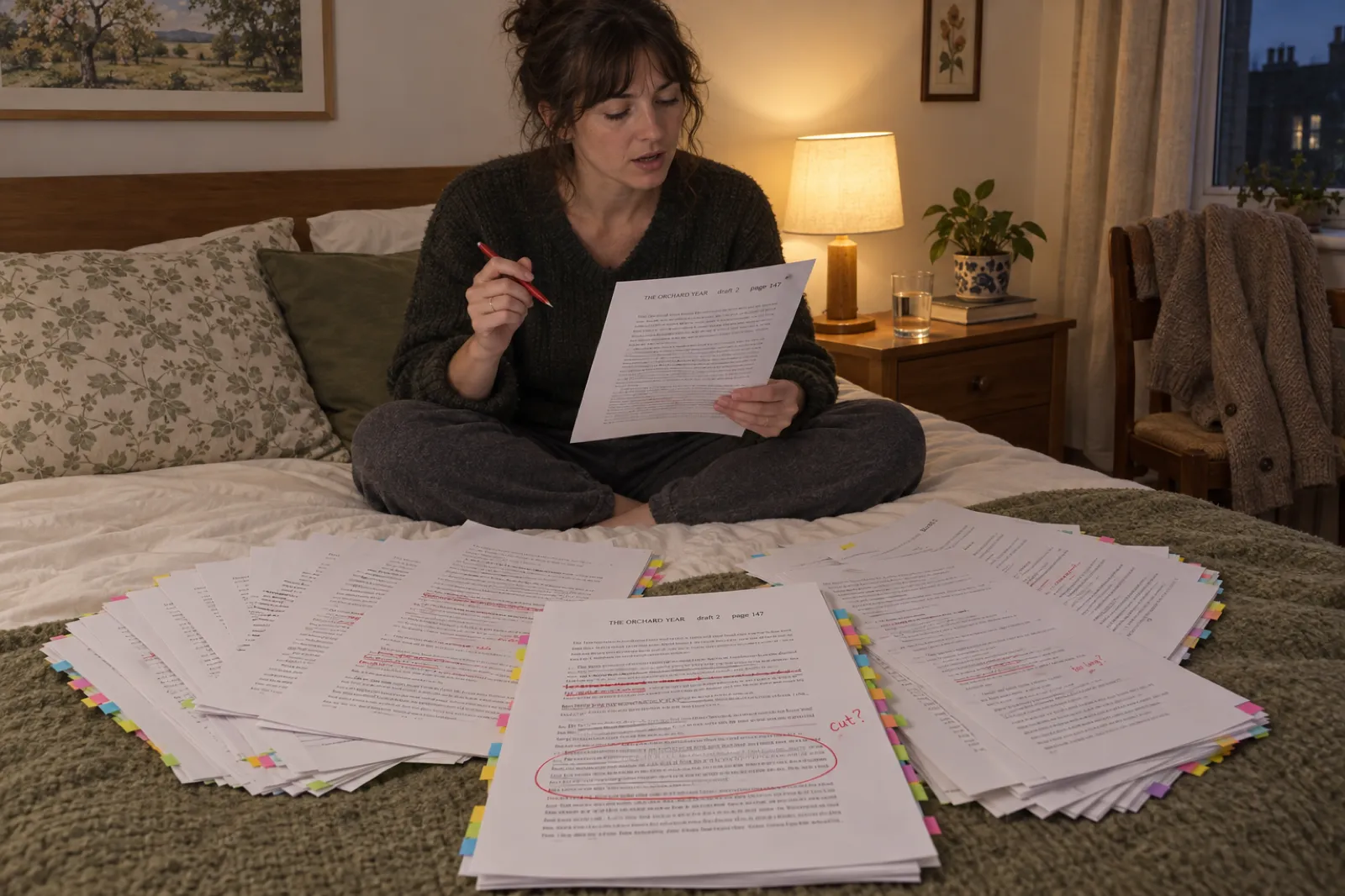
- The reread. One sitting if you can, on paper or a different device. Note where you got bored, confused or wanted more.
- The structural pass. Move, merge or cut chapters. Check that the first chapter makes a promise the last one keeps. For non-fiction, check each chapter delivers what its title says.
- The scene or section pass. Every scene should change something; every section should teach something. Cut what does neither.
- The line pass. Read aloud. Cut filler words, repeated phrases and long run-ups to the point.
Expect two or three rounds before anyone else sees it. A tool that flags problems can speed the reread; Inkfluence's editorial review reads a chapter or the whole book and lists what to fix and why, and the developmental editor page explains what it looks for. Treat it as a second opinion, not a verdict.
Step 8
What do beta readers do, and how many do you need?
Beta readers read the revised draft as ordinary readers and tell you where they lost interest, got confused or stopped believing. Three to five readers from your target audience is plenty for a first round. Ask specific questions, look for problems more than one reader mentions, and decide the fixes yourself.
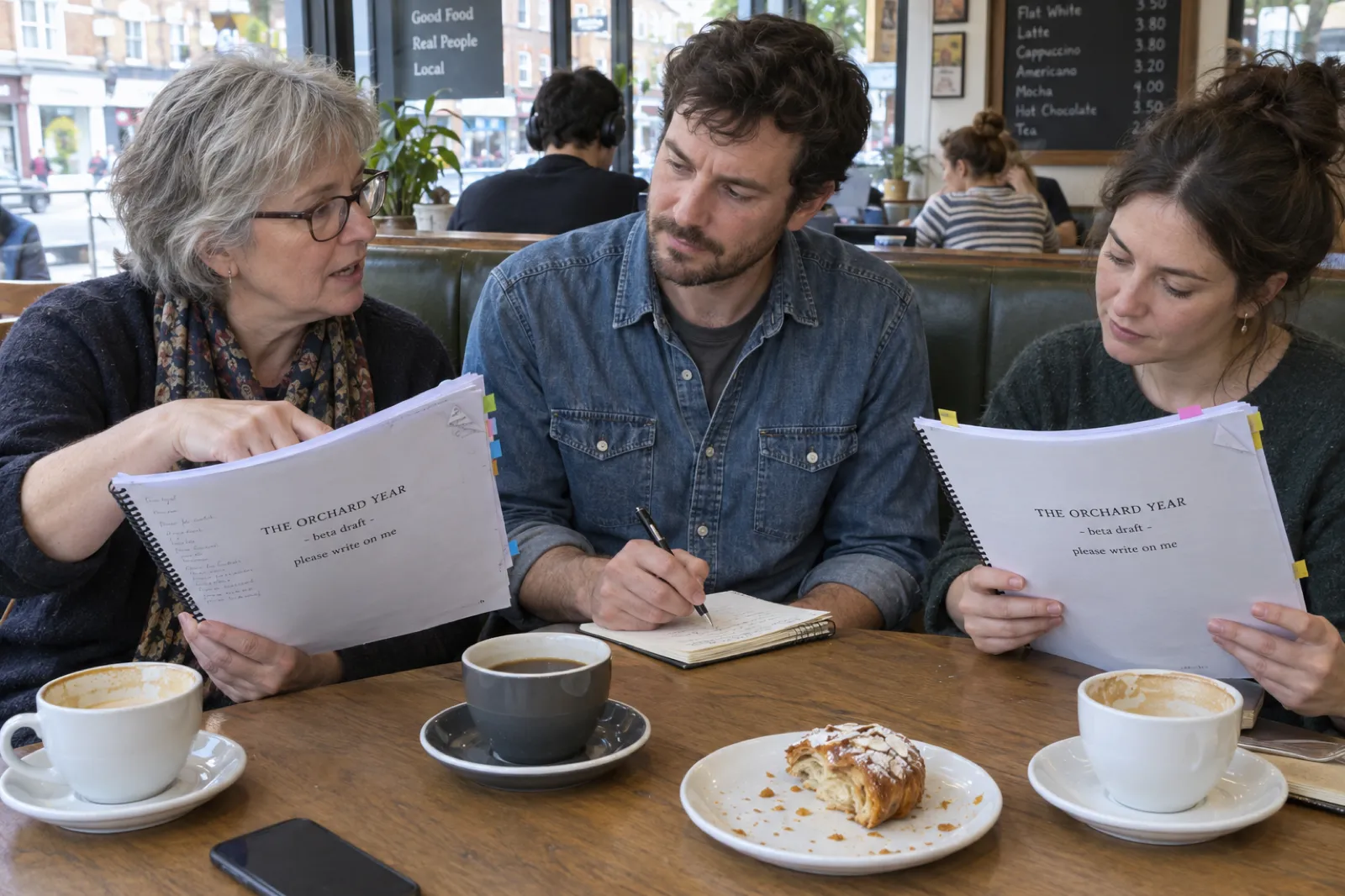
Good questions: Where did you put it down? Which character or idea did you care about most, and least? Was anything confusing? What did you expect to happen that did not? For non-fiction: Did you try anything from the book, and did it work? Avoid "Did you like it?", which only collects politeness.
Find readers through writing groups, genre reader communities and people who review books like yours. Friends and family are kind, which is lovely and not much use. Swapping manuscripts with another writer in your genre works well, because you both know what the job is.
One reader disliking something is taste; three readers stumbling at the same place is a fault in the book. If you want a quick read before people see it, our AI beta reader page explains what an automated read can and cannot tell you.
Step 9
What kinds of editing does a book need, and what do they cost?
There are four kinds, in this order: developmental (structure), line (sentences), copyediting (correctness and consistency) and proofreading (final typos). The Editorial Freelancers Association's 2026 rate chart puts fiction at 3.0 to 3.5 cents a word for a developmental edit and 1.2 to 2.0 cents for proofreading.
| Edit | What it covers | When | Fiction (cents/word) | Non-fiction | Memoir |
|---|---|---|---|---|---|
| Developmental edit | Structure, pacing, argument, character, what is missing. The big picture, usually as an editorial letter plus notes. | After your own revision, before line work | 3.0 to 3.5 | 4.0 to 5.0 | 3.5 to 4.5 |
| Line edit | Sentence by sentence: rhythm, clarity, word choice, voice. | Once the structure is settled | 2.7 to 3.5 | 3.5 to 5.0 | 3.0 to 4.0 |
| Copyedit | Grammar, spelling, consistency, facts that contradict each other, house style. | On the near-final text | 2.0 to 2.7 | 3.0 to 4.0 | 2.7 to 3.5 |
| Proofread | Last pass for typos and layout errors, ideally on the formatted pages. | After formatting, before publishing | 1.2 to 2.0 | 2.0 to 3.0 | 1.7 to 2.0 |
Rates from the EFA's 2026 rate chart, based on a survey of its members from November 2025 to January 2026 for work done in 2025. Worked example: an 80,000-word novel costs about $2,400 to $2,800 for a developmental edit, $1,600 to $2,160 for a copyedit and $960 to $1,600 for a proofread at those ranges. The planner above works this out for your length.
You do not have to buy all four. If your budget covers only one, a copyedit catches the errors readers notice most. A developmental edit is worth most on a first novel, where structural problems are likeliest. Ask for a sample edit of a few pages before you hire anyone, and check that the editor works in your genre.
Before you pay anyone, do what you can yourself: a spelling and grammar check, a read-aloud pass, and a consistency sheet for names and dates. Every error you catch is one an editor does not charge you to find. Our page on AI manuscript editing covers what software can catch.
Step 10
Title, cover and formatting: what does a finished book need?
A finished book needs a title that fits its genre, a cover that reads at thumbnail size, an interior formatted for each edition (an EPUB for ebooks, a print PDF at your trim size for paperbacks), front matter such as a copyright page, and a description. In the US, copyright protects your book from the moment you write it.
- Title. Short, concrete and honest about the genre. Our book title ideas page has hundreds of published examples sorted by pattern, and a checker for KDP's title rules.
- Cover. Look at the bestseller list in your category and match its conventions: fonts, colours, the kind of image. A cover's job is to say "this is the kind of book you like", not to illustrate a scene. See book cover design.
- Interior. Ebooks need a reflowable EPUB; paperbacks need a fixed PDF at your trim size with margins and page numbers. Our guide to formatting a book for KDP walks through both.
- Front and back matter. Title page, copyright page, contents, then at the back an author bio and a link to your next book or mailing list.
- ISBN. Optional for ebooks on KDP. KDP gives free ISBNs for paperback and hardcover, usable only on KDP; to publish the same print edition elsewhere, you buy your own from your country's ISBN agency.
- Description. The back-cover copy, which sells the book more than any other text. The book description generator shows the common shapes.
On copyright: the US Copyright Office says your work is protected from the moment it is fixed in a tangible form, and registration is voluntary, though it is required before you can sue over a US work and it brings other legal benefits. Other countries have their own rules; most protect a book automatically too.
Step 11
How do you publish a book?
There are two main routes. Traditional publishing: you query literary agents, an agent sells the book to a publisher, and the publisher pays you an advance and royalties and handles production. Self-publishing: you upload the files to Amazon KDP and other retailers yourself, keep control and a larger royalty, and pay for editing, the cover and marketing.
Traditional publishing
For fiction, agents expect a finished, revised manuscript. For most non-fiction, they expect a book proposal: an overview, the market and comparable titles, your platform, a chapter outline and sample chapters. You send a query letter to agents who represent your genre, usually many of them, and wait. It is slow and selective, but the publisher takes the financial risk and puts the book in bookshops.
Self-publishing
On Amazon KDP, a Kindle ebook earns 70% of the list price, less a small delivery cost, when it is priced from $2.99 to $12.99 on Amazon.com, and 35% outside that band. A paperback earns 60% of a list price of $9.99 or more on Amazon.com (50% below), minus the printing cost. Those figures are from KDP's help pages, read on 17 October 2026; our KDP royalties guide and the royalty calculator work out a real price.
You can stay exclusive to Amazon through KDP Select or go "wide" to other stores too; KDP Select vs wide compares the two. Selling direct, from your own site or marketplaces like Etsy and Gumroad, keeps more of each sale but means finding readers yourself; digital product ideas compares their fees. The full upload is in our KDP self-publishing guide and the self-publishing guide.
Be careful with paid "publishers"
Some companies sell publishing packages that cost thousands and deliver little a self-publisher could not do for less. A traditional publisher pays you, not the other way round. If a "publisher" asks for money to publish your book, read the contract closely, check what you keep, and compare the price with buying editing and a cover directly.
Can AI help me write a book?
Yes, at some steps more than others. AI is good at brainstorming, turning an idea into an outline, drafting chapters you then rewrite, and pointing out problems in a manuscript. It is weak at knowing what you mean, getting facts right without checking, and sounding like you. Use it as a tool inside the process above, not a replacement for it.
| Step | Where AI helps | Where it does not |
|---|---|---|
| Idea and outline | Ten versions of a premise in a minute; a first chapter plan to argue with | Knowing which idea you will care about for a hundred hours |
| First draft | A rough draft of each chapter to rewrite, especially for practical non-fiction | Your voice, your experience, your examples; facts it has not been given |
| Revision | Flagging slow chapters, repetition and continuity slips | Deciding what the book is really about |
| Packaging | Description drafts, cover art, formatting files | Knowing your market better than the comps you studied |
Two rules apply whatever tool you use. KDP's content guidelines require you to tell it about AI-generated text, images or translations when you publish, while AI-assisted editing of your own writing does not need disclosing; our guide to KDP's AI disclosure policy explains the difference. And the US Copyright Office's January 2025 report on copyrightability (on its AI page) concluded that prompts alone do not make you the author of what an AI writes; your own writing, and your creative changes and arrangement, are what can be protected. That is one more reason to rewrite an AI draft into your own words.
If you want the AI route in detail, these pages cover it so this one does not have to: the video walkthrough of writing a book with AI, the longer guide to writing a book with AI, AI book writing tools compared, and whether you can sell AI-generated books.
Where Inkfluence AI fits in the process
We make Inkfluence AI, so weigh this accordingly. It is a book writing app that covers several of the steps above in one place. Here is what it does at each, and its limits.
Outline (step 4)
On manual setup the app writes a chapter outline and pauses so you can rename, reorder, cut or add chapters before anything else is written.
Draft (step 6)
Write chapters yourself, dictate with the Voice button, or have AI draft chapters to rewrite. Your words today, this week and your writing days are tracked on the Journey page.
Revise (step 7)
The Review tab reads a chapter, or the whole book with an editorial letter, and lists findings with suggested fixes you apply or dismiss.
Package (step 10)
A cover designer on every plan, AI cover art on paid plans or credits, and PDF export on every plan; EPUB, Word and a KDP package (interior, wrap cover with spine, EPUB) on paid plans or credits.
Publish (step 11)
An Amazon listing kit, and listings on Etsy and Gumroad from the app on Creator and Premium, which also add an audiobook and translation of the finished book.
Bring your own draft
Import a Word document, EPUB or PDF and it is split into chapters; importing uses no chapter credits.
Limits, plainly. There is no word-count setting: an AI draft's length follows how many chapters you ask for, roughly 1,000 to 1,500 words a chapter, so it will not hit a genre target on its own. AI drafts need rewriting, fact-checking and your voice before they are yours. The app's menus are in English, though books can be written in many languages.
Prices. Free plan: 5 AI chapters to start and 5 more each month, the cover designer and PDF export. Creator $9.99 a month (35 AI chapters a month, EPUB, Word and KDP files); Premium $19.99 a month (unlimited chapters). Credit packs of 15 for $9.99, 25 for $12.99 and 50 for $24.99 never expire. Full details on the pricing page.
How to write a book in your genre
The eleven steps hold for every book, but each genre adds its own demands. These guides go deeper.
A novel
Plot, character and pacing over a long book.
A non-fiction book
Structure, research and chapter promises.
A memoir
Choosing the story inside a life.
A children's book
Age bands, page counts and read-aloud text.
A romance novel
Tropes, beats and the ending readers expect.
A business book
Turning expertise into a framework.
Mistakes that stop first books being finished
- Rewriting chapter one forever. Polish comes after the whole draft exists.
- Waiting for long free days. They rarely come. Short regular sessions beat them.
- Writing for everyone. Without a reader in mind, every decision is harder.
- Skipping the outline. Pantsing works for some writers, but most first books that stall have no plan past chapter three.
- Showing the first draft to everyone. Revise first; readers' time is limited and first impressions stick.
- Spending on publishing before editing. A great cover on an unedited book sells once and collects bad reviews.
If you are new to all of this, the beginner's guide to book writing apps covers the tools side for a first-time author.
How this guide was made
Who: Sam May, founder of Inkfluence AI. More on the about page.
Sources: word counts from Writer's Digest and Jericho Writers; editing rates from the EFA's 2026 rate chart; royalties, ISBN rules and AI disclosure from KDP's help pages; copyright from the US Copyright Office. All read on 17 October 2026 and linked where they are used. Inkfluence features were checked against our help centre and plan settings; the platform statistics are cited from their home page with its method. The five photographs are illustrations made for this page; the books in them are invented. AI tools helped with drafting, and every number was checked against its source.
Found something out of date? Tell us on the contact page.
Questions about writing a book
How do I start writing a book?
How many words is a book?
How long does it take to write a book?
Where can I write a book online for free?
Can AI help me write a book?
Do I need an agent to publish a book?
Do I need to copyright my book before publishing?
How much does it cost to edit a book?
Should I write the book or the outline first?
Related tools and guides
Ideas
Book title ideas
Published titles by genre and formula.
Tool
Book outline generator
A chapter plan from one line.
App
AI book writer
What the app does, chapter by chapter.
Data
Self-publishing statistics
Titles, incomes and sources.
Walkthrough
Create a book with AI
The app route, screen by screen.
Paperbacks on KDP Print
Trim sizes, proofs and pricing.
The book gets written one session at a time
Start with the one-sentence idea and a working title. The free plan gives you an editor, a word tracker and PDF export, with AI help when you want it.