
Book Length Calculator: Words to Pages, Spine Width and Print Cost
Put in a word count and see what the book becomes: how many printed pages at the trim you want, how thick the spine is, what Amazon charges to print a copy and what you keep from a sale. The page numbers come from typesetting real books through our KDP export, and the length guidance from the people who set the lines, not from a rule of thumb.
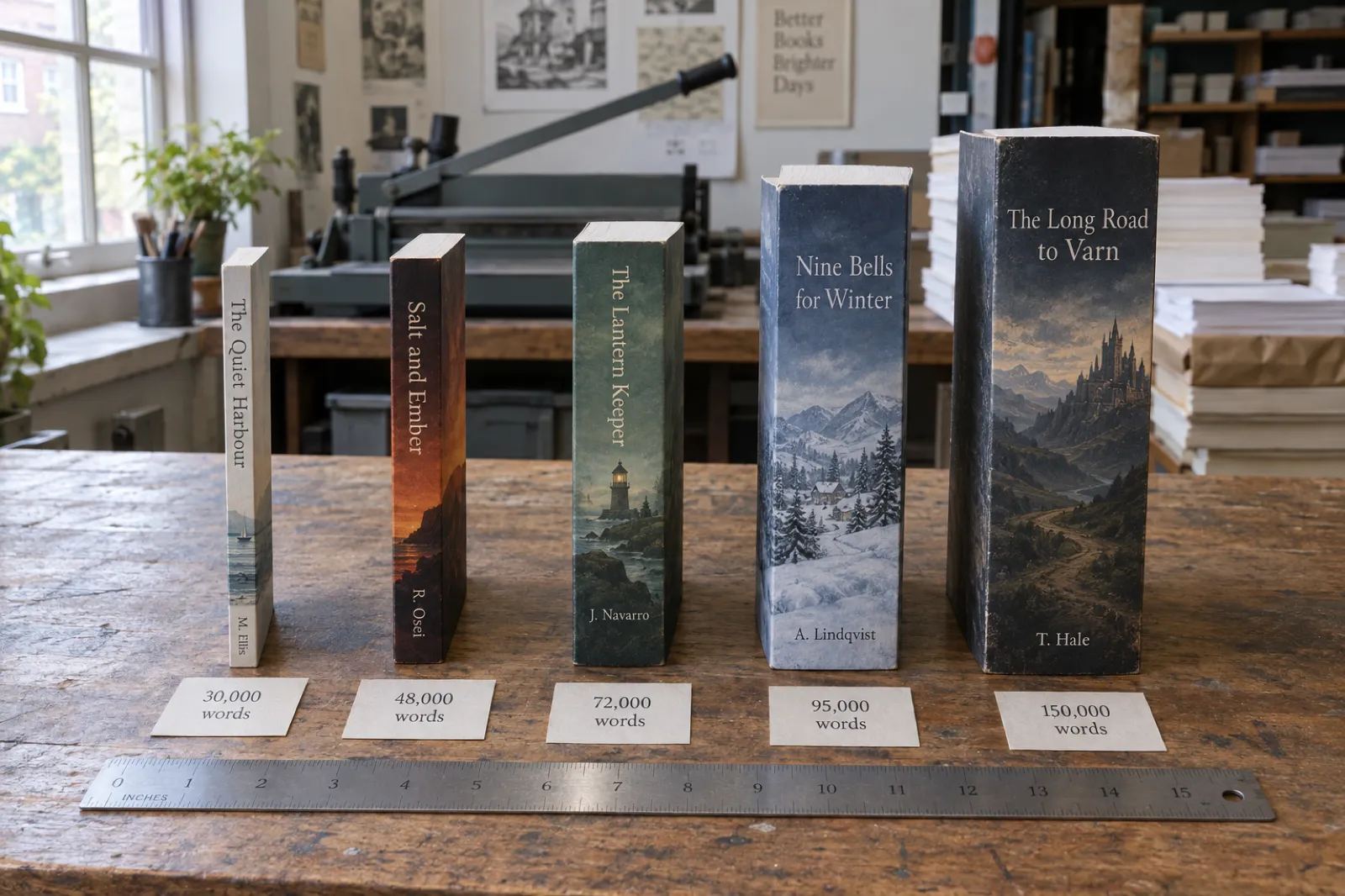
How long is a book?
A novel is 40,000 words or more by the definition the Science Fiction and Fantasy Writers Association uses, and most adult novels sold to publishers run about 70,000 to 110,000 words. At 6 x 9 inches an 85,000-word novel in 30 chapters prints to about 340 pages when it is dialogue-heavy and about 204 when it is written in long paragraphs. On Amazon KDP that dialogue-heavy edition costs $5.08 to print and earns about $1.51 a copy at $10.99.
Counted, not quoted
We counted every word and chapter of 19 public-domain books ourselves, from Metamorphosis (21,935 words) to Moby-Dick (208,458). The method is at the bottom of the table.
Typeset for real
Each book went through the same KDP export our authors use, printed on the same browser engine, so the page counts include the title page, copyright page and contents a real upload carries.
What it cannot know
Your font, margins and how much of your book is dialogue. The calculator gives a range, and it says how far off it was on the books we measured.
Book length calculator
Start from a type of book or type your own word count. Choose how your book reads on the page, the trim size and the paper. The calculator works out the printed pages, the spine, the KDP print cost and the royalty in three stores, how long it takes to read and how long it runs as an audiobook.
The page count is shown as a single number and a likely range. Use the single number to plan; use the range when something depends on it, such as whether a book clears KDP's 24-page minimum, whether it is thick enough for spine text, or whether it crosses the 110-page point where print cost starts to climb. If you have not decided how many chapters to use, start with one chapter for every 2,500 to 3,000 words and adjust.
Printed pages
-
Spine width
-
What it is
-
| KDP paperback | Print cost | Price at the 60% line | You keep a copy |
|---|---|---|---|
| Amazon.com | - | - | - |
| Amazon.co.uk | - | - | - |
| Amazon.de, .fr, .es, .it | - | - | - |
Reading time
-
As an audiobook
-
Closest classic
-
Estimates for the Inkfluence KDP export at default settings. Pages land within 10% of the real count for 13 of the 19 classics we typeset. Prices and costs are KDP's for black ink, checked 20 October 2026.
Know the length you want? Inkfluence AI writes a book to the number of chapters you ask for, then exports the KDP interior and full wrap cover at your trim, with the exact page count and spine.
Start your book freeHow many words are in a novel?
The clearest published line comes from awards, not publishers. The Science Fiction and Fantasy Writers Association defines its Nebula categories by word count, and the rules in force for the 2026 award year draw the lines this way (SFWA Nebula Rules):
| Length | Words | From our counts |
|---|---|---|
| Short story | fewer than 7,500 | none of the 19 |
| Novelette | 7,500 to 17,499 | none of the 19 |
| Novella | 17,500 to 39,999 | 8 books, from Metamorphosis (21,935) to The Turn of the Screw (39,466) |
| Novel | 40,000 or more | 11 books, from Peter Pan (47,112) to Moby-Dick (208,458) |
Those lines say what counts as a novel. They do not say what a publisher will buy. For that, the figures most agents and editors repeat come from Writer's Digest's long-running guide to word counts, which calls 80,000 to 89,999 words the safe range for a debut in mainstream, literary, romance, mystery, thriller and horror, with outer limits around 71,000 and 109,000, and puts science fiction and fantasy at 100,000 to 115,000 (Writer's Digest). Other sources differ at the edges, especially for young adult and fantasy, so treat these as a starting point and check the guidelines of the agents or imprints you are aiming at. Memoir and non-fiction lengths are in the word count table of our guide to writing a book, and every genre range is in how many words are in a novel, with a checker for your own draft.
| Genre | Words | Source |
|---|---|---|
| Literary and mainstream fiction | 80,000 to 89,999 safe; about 71,000 to 109,000 outer | Writer's Digest |
| Romance (single title) | 80,000 to 89,999 safe | Writer's Digest |
| Mystery, thriller, suspense | 80,000 to 89,999 safe | Writer's Digest |
| Horror | 80,000 to 89,999 safe | Writer's Digest |
| Science fiction and fantasy | 100,000 to 115,000; epic fantasy often longer | Writer's Digest |
| Category romance | 50,000 to 60,000 | Jericho Writers |
| Young adult | 55,000 to 79,999 | Writer's Digest |
| Middle grade | 20,000 to 55,000 | Writer's Digest |
Self-publishing has no gatekeeper, so these are market expectations rather than rules. Readers of a genre still notice when a book is much shorter or longer than its neighbours on the shelf, and on Amazon the page count sits right under the title. A 40,000-word romance sold at a full novel price will collect reviews that mention its length; a 160,000-word cozy mystery will cost more to print than its readers expect to pay. Picture books and children's chapter books follow their own rules, which we cover with our own picture-book data in children's book word count by age.
If you write with an AI book generator, length is set by the number of chapters rather than by a word target. In Inkfluence AI you say how many chapters you want in your prompt, up to 40 in one book on Premium, and each chapter in our own test books came out at roughly 2,000 words. A 40-chapter book therefore lands somewhere near 80,000 words, and you can add chapters to a finished book from the editor. The AI novel writer page shows how a novel is planned chapter by chapter. For novellas in particular, including what they earn on KDP, see novella vs novel.
19 classics, counted word by word and typeset for real
Most "famous book" word counts online are copied from page to page with no source. So we took the public-domain text of 19 well-known books from Project Gutenberg, removed the Gutenberg header and footer, counted every word and every chapter, and then typeset each one through the Inkfluence KDP export at two trim sizes, printing them on the same browser engine our production export uses. The page counts are what an author uploading that text to KDP today would actually get from us.
| Book | Words | Chapters | Pages, 6 x 9 | Pages, 5.5 x 8.5 | Spine, 6 x 9 | Print cost |
|---|---|---|---|---|---|---|
| Metamorphosis (Franz Kafka, 1915) | 21,935 | 3 | 43 | 50 | 0.097 in | $2.30 |
| The Strange Case of Dr Jekyll and Mr Hyde (Robert Louis Stevenson, 1886) | 25,574 | 10 | 60 | 69 | 0.135 in | $2.30 |
| Alice's Adventures in Wonderland (Lewis Carroll, 1865) | 26,441 | 12 | 75 | 84 | 0.169 in | $2.30 |
| A Christmas Carol (Charles Dickens, 1843) | 28,435 | 5 | 72 | 83 | 0.162 in | $2.30 |
| The Time Machine (H. G. Wells, 1895) | 32,377 | 16 | 76 | 87 | 0.171 in | $2.30 |
| Heart of Darkness (Joseph Conrad, 1899) | 37,907 | 3 | 72 | 85 | 0.162 in | $2.30 |
| The Wonderful Wizard of Oz (L. Frank Baum, 1900) | 39,272 | 24 | 110 | 125 | 0.248 in | $2.30 |
| The Turn of the Screw (Henry James, 1898) | 39,466 | 24 | 101 | 116 | 0.227 in | $2.30 |
| Peter Pan (J. M. Barrie, 1911) | 47,112 | 17 | 134 | 152 | 0.302 in | $2.61 |
| The Great Gatsby (F. Scott Fitzgerald, 1925) | 48,152 | 9 | 131 | 151 | 0.295 in | $2.57 |
| The War of the Worlds (H. G. Wells, 1898) | 59,875 | 27 | 145 | 167 | 0.327 in | $2.74 |
| Treasure Island (Robert Louis Stevenson, 1883) | 67,864 | 34 | 169 | 190 | 0.381 in | $3.03 |
| Frankenstein (Mary Shelley, 1818) | 74,975 | 24 | 164 | 188 | 0.369 in | $2.97 |
| The Picture of Dorian Gray (Oscar Wilde, 1890) | 78,545 | 20 | 180 | 208 | 0.405 in | $3.16 |
| Pride and Prejudice (Jane Austen, 1813) | 121,738 | 61 | 301 | 343 | 0.678 in | $4.61 |
| Dracula (Bram Stoker, 1897) | 161,050 | 27 | 328 | 379 | 0.739 in | $4.94 |
| Jane Eyre (Charlotte Bronte, 1847) | 184,452 | 38 | 445 | 513 | 1.002 in | $6.34 |
| Little Women (Louisa May Alcott, 1868) | 185,888 | 47 | 440 | 509 | 0.991 in | $6.28 |
| Moby-Dick (Herman Melville, 1851) | 208,458 | 135 | 521 | 603 | 1.173 in | $7.25 |
Method: Project Gutenberg plain text, counted from the first chapter heading to the end of the book (Frankenstein from its first letter, since the letters are part of the novel). Words are whitespace-separated tokens, so a hyphenated word counts once. Every chapter count matches the book's known structure. Pages are from the Inkfluence KDP export at default settings, printed on Chrome for Testing 131 as the production export is, and include the title, copyright, contents and introduction pages. Spine is pages times 0.002252 in (white paper, black ink); print cost is KDP's Amazon.com black-ink rate for a regular trim. Measured 20 October 2026. Free to reuse with credit to Inkfluence AI.
What the counts show
- The novella line is closer than it looks. The Turn of the Screw misses the SFWA novel line by 534 words. Peter Pan (47,112) and The Great Gatsby (48,152) only just clear it, so two of the best-known novels in English are shorter than many first drafts that writers worry are too short.
- Words alone do not set the page count. The Great Gatsby has 48,152 words and prints to 131 pages at 6 x 9; Pride and Prejudice has 2.5 times the words and prints to 2.3 times the pages, because its chapters are short and each one starts a new page.
- Chapter length is all over the place. From 1,544 words a chapter in Moby-Dick to 12,636 in Heart of Darkness, with a median of 2,771. Readers have never needed chapters of a set length.
- Trim moves the count by a fixed share. The same text at 5.5 x 8.5 printed to a median 15% more pages than at 6 x 9 across all 19 books.
- Every short book costs the same to print. All 8 classics that print to 110 pages or fewer at 6 x 9, from Metamorphosis to The Turn of the Screw, cost the same flat $2.30 on Amazon.com. Below about 110 pages, adding a chapter or a bonus story costs you nothing per copy.
- On a long book, the trim is a pricing decision. Pride and Prejudice prints to 301 pages at 6 x 9 and 343 at 5.5 x 8.5. That is $4.61 against $5.12 a copy: $0.51 less royalty on every sale just for choosing the smaller page.
- Long books cost real money to print. Moby-Dick at 6 x 9 is a 1.17-inch spine and $7.25 to print on Amazon.com before you earn anything.
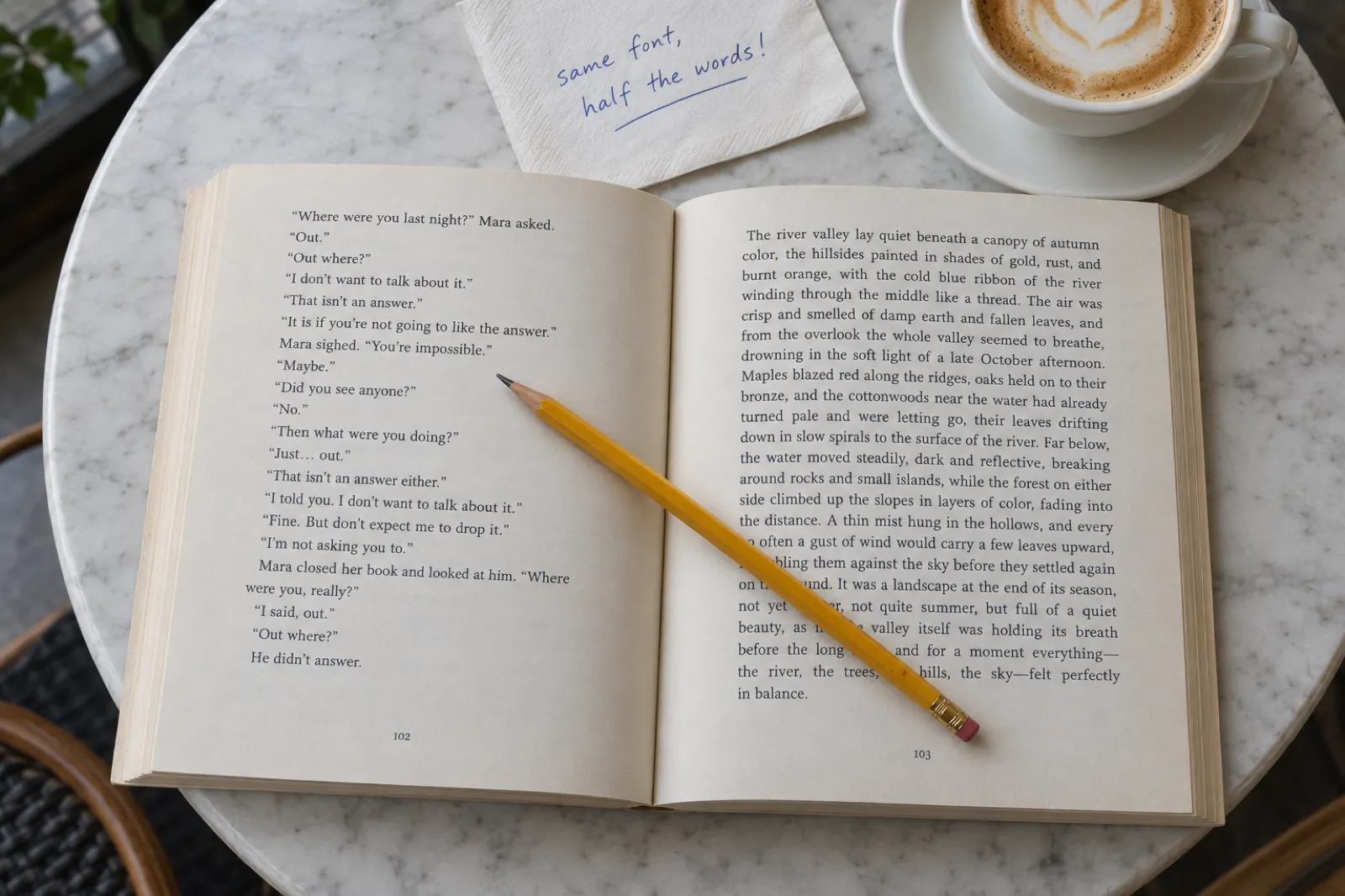
How many words fit on a page, and what changes it
The rule you will see everywhere is 250 to 300 words a page. That is a fair description of a double-spaced manuscript, and of dialogue-heavy fiction once it is typeset. It is not a description of books in general. On a full 6 x 9 page of our KDP export we measured:
| How the book reads | Words on a full 6 x 9 page | Measured on |
|---|---|---|
| Lots of dialogue, short paragraphs | about 268 | two dialogue-heavy novels made in Inkfluence AI |
| Non-fiction with headings | about 390 | a practical gardening guide made in Inkfluence AI |
| Long paragraphs, little dialogue | 472 (394 to 618) | the 19 classics above |
The spread inside one trim size is bigger than the spread between trim sizes. A page of quick back-and-forth dialogue leaves the right-hand side of most lines empty and starts a new line with every speaker, so the same 85,000 words print to about 340 pages as a dialogue-heavy thriller and about 204 as a book of long, dense paragraphs. Five other things move the count, roughly in order of size:
- Trim size. At 5.5 x 8.5 the body of the book runs about 15% more pages than at 6 x 9, and at 5 x 8 about 28% more. For the same dialogue-heavy 85,000 words that is 340 pages at 6 x 9, 388 at 5.5 x 8.5 and 428 at 5 x 8. The KDP trim size guide compares every size Amazon offers.
- Chapters. Each chapter starts on a new page, which leaves on average about half a page of white space at the end of the chapter before it. Sixty short chapters carry about 30 pages of that space; twelve long ones carry six.
- Front and back matter. A title page, copyright page, contents, dedication, acknowledgements and an author bio add 5 to 15 pages before a word of the story is counted. Our export adds a contents page for about every 22 chapters.
- Font size and leading. A bigger body face or more space between lines adds pages in proportion. Large-print editions, which KDP defines as 16-point type or bigger, run far longer than the standard edition of the same book. The typeface matters as well: in our six-font test the same novel ran 20% longer in the widest font than in the narrowest.
- Margins. KDP asks for a wider inside margin as a book gets thicker, so very long books lose a little more of each page to the gutter. Our export sets that inside margin from the real page count.
Ebooks have no fixed pages at all: a reader changes the font size and the text reflows. Amazon shows an estimated page count on a Kindle listing, but it is an estimate, and what matters for an ebook is the word count. For print, the only exact number is the one from your finished interior, which is why the KDP export reports the real page count and sizes the spine from it.
Want the exact page count? Write or import your manuscript, pick your trim, and the KDP export typesets it and tells you the page count, the spine width and the paper to select.
See the KDP exportFrom pages to a printed book: spine, print cost and royalty
Once you know the page count, three numbers follow from it, and all three matter before you set a price.
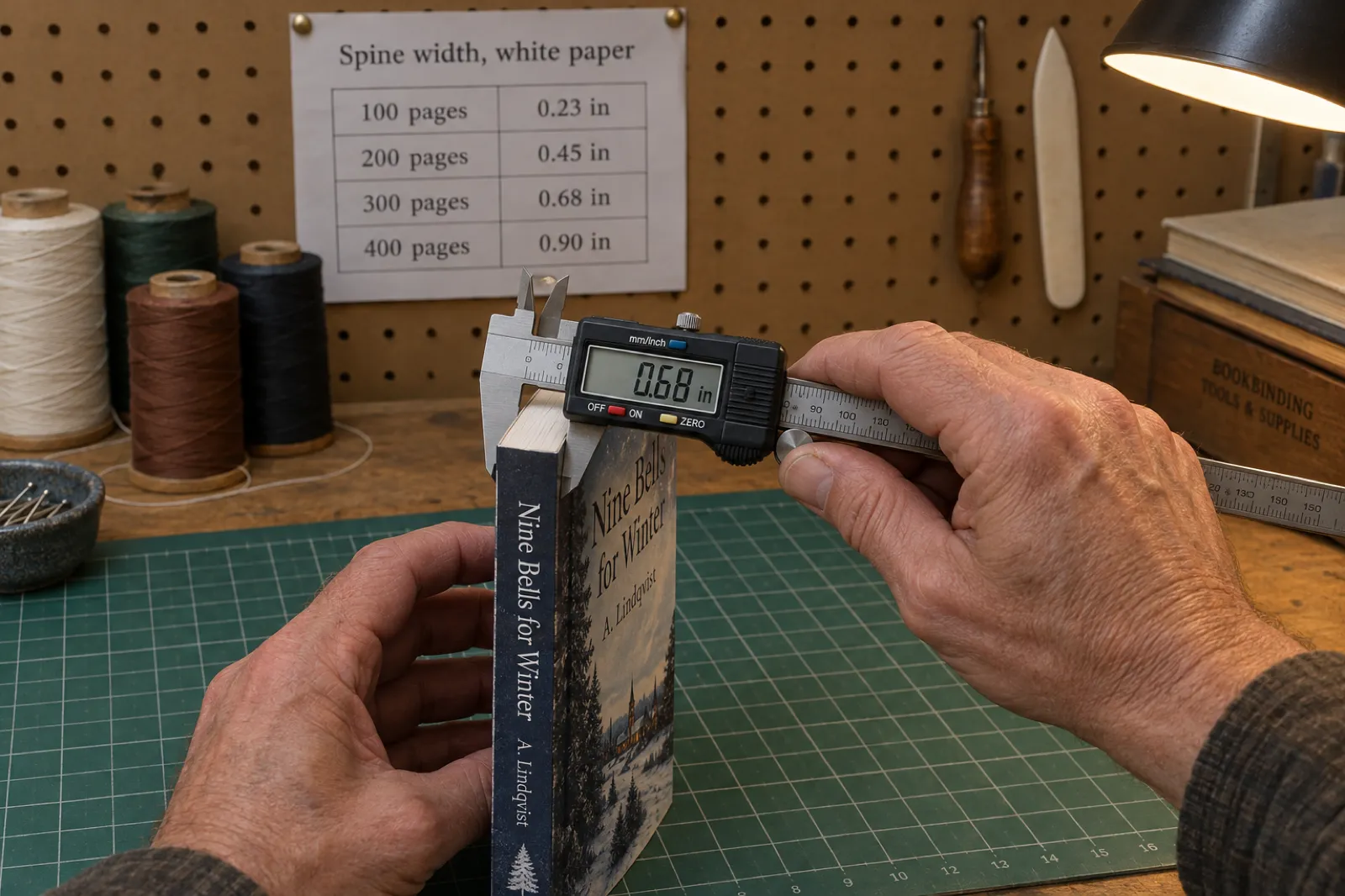
Spine width
Page count times paper thickness. For black ink on KDP that is 0.002252 inches a page on white paper and 0.0025 on cream, so a 300-page book is about 0.68 inches thick on white and 0.75 on cream. KDP prints spine text only on books of 79 pages or more, and asks for a little clear space around it, which is why very short books have blank spines. The KDP cover size and spine width guide walks through the full wrap cover.
Print cost
On Amazon.com, a black-ink paperback at a regular trim (6 x 9 and smaller) costs a flat $2.30 to print up to 110 pages, then $1.00 plus $0.012 a page. The UK and the European stores follow the same shape in their own currencies. That flat fee is why a 72-page novella and a 110-page one cost the same to print, and why page count starts to bite once a book passes about 110 pages: every 100 pages after that adds $1.20 to each copy.
Royalty, and the price that earns 60%
KDP pays 60% of the list price less printing on paperbacks priced at $9.99 or more on Amazon.com, and 50% below that. Each store has its own line: £7.99 on Amazon.co.uk and €9.99 on the European stores. If you set only a US price, KDP converts it for the other stores, and the converted price usually lands just under the line (about £7.47 and €8.90 from $9.99), which quietly drops those stores to 50%. Type the UK and European prices in yourself. Our royalty calculator compares KDP with other printers and ebook stores.
Worked example: an 85,000-word mystery in 30 chapters
- Dialogue-heavy at 6 x 9: about 340 pages, a 0.766-inch spine on white paper, $5.08 to print, and about $1.51 a copy at $10.99.
- The same book written in long paragraphs: about 204 pages, $3.45 to print, $2.54 a copy at $9.99.
- Mixed prose: about 240 pages, $3.88 to print, $2.11 a copy at $9.99.
- In the UK at £8.99 the dialogue-heavy edition keeps about £1.14; in Germany at €9.99, about €1.16.
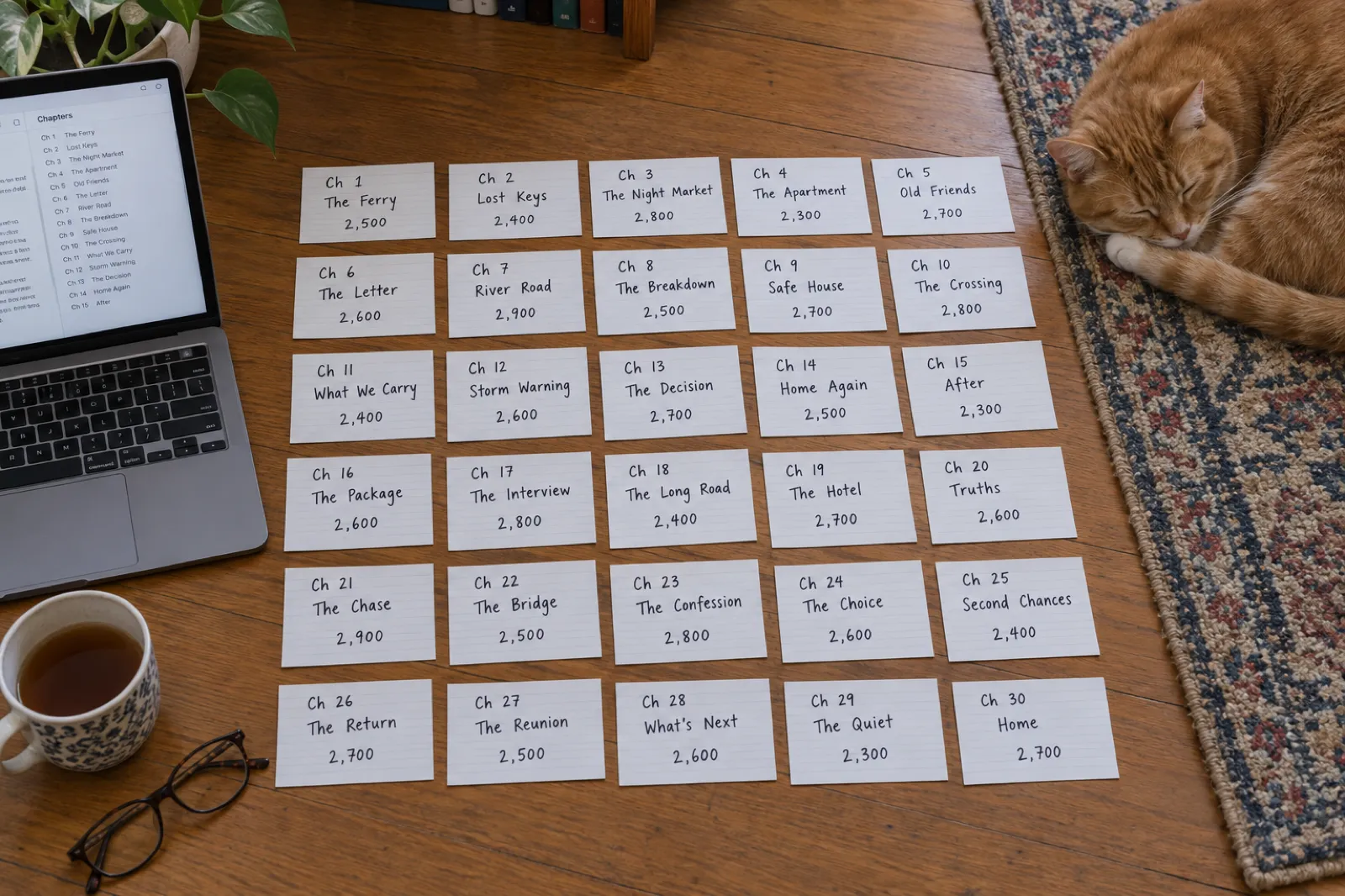
How many chapters should a book have?
There is no standard, and the books in our table show how wide the range is: Moby-Dick averages 1,544 words a chapter across 135 chapters, while Heart of Darkness averages 12,636 in 3. The median of the 19 is 2,771 words a chapter. A few working rules hold up better than any number:
- Work back from the length. Decide the word count first, then divide by the chapter length that suits the pace you want. 85,000 words at 2,500 words a chapter is 34 chapters; at 3,500 it is 24.
- Pace sets length. Thrillers and page-turners favour short chapters because every chapter end is a place a reader decides to keep going. Literary fiction and sagas take longer ones.
- Consistency matters more than size. Readers settle into a rhythm. A run of 2,000-word chapters followed by one of 9,000 reads like a mistake unless the story earns it.
- Every chapter costs a little paper. Each starts on a new page, so a book of very short chapters is a little thicker and a little dearer to print than the same words in fewer chapters.
For non-fiction, chapters follow the structure of the subject: one idea, method or step per chapter, usually 3,000 to 6,000 words, with headings inside. If you are planning a book from scratch, the free book outline generator lays out a chapter plan you can then write to, and the AI chapter generator writes a chapter at a time to that plan. Chapter lengths by genre, chapter counts for the classics and a chapter planner are on how many chapters in a book.
Plan it in chapters. Tell Inkfluence AI how many chapters you want and what the book is about; it outlines and writes every chapter, and you can add more from the editor whenever you like.
Write your book with AIHow long it takes to read, and to listen
The best evidence on reading speed is a 2019 review of 190 studies with 18,573 readers, which puts the average adult's silent reading rate in English at 260 words a minute for fiction and 238 for non-fiction (Brysbaert, Journal of Memory and Language, 2019). At that pace an 80,000-word novel takes about 5 hr 8 min to read and a 120,000-word one about 7 hr 42 min. Most readers fall somewhere between 200 and 320 words a minute for fiction, so treat the figure as the middle of a range.
Listening is slower than reading. Across 8,015 finished chapters of AI narration we measured a median of 164 words a minute, so an 80,000-word book runs about 8 hr 8 min as an audiobook. The pace depends heavily on the narrator; the audiobook length calculator shows the rate for each voice, and the AI audiobook generator turns a finished book into one.
How to hit the length you want without padding
- Choose the length from the shelf, not from a number you heard. Pick three recent books your readers would buy alongside yours and look at their page counts on Amazon. Convert back to words with the calculator above.
- Fix the chapter count before you draft. A 34-chapter plan for an 85,000-word thriller gives every chapter a budget of about 2,500 words, which is far easier to keep than a total.
- Track by chapter, not by day. When a chapter runs long, the plan tells you straight away which later chapter has to give.
- Cut from the front. Opening chapters are where drafts carry the most warm-up and backstory. Cutting there tightens the whole book.
- If it is still short, add story, not words. A subplot, a setback or a scene from another point of view adds length that readers count as value. Longer descriptions do not.
- Check the money before you commit to the trim. A book that crosses 110 pages starts paying for every extra page. Sometimes 6 x 9 instead of 5.5 x 8.5 is the difference between earning a dollar a copy and earning three.
If you are self-publishing on Amazon, the complete guide to self-publishing on Amazon KDP covers every setting from the ISBN to the price, and paperback publishing on KDP explains print options in detail. For a single copy for a gift or a proof, see how to print one copy of a book.
Book length questions
How many words are in a novel?
At least 40,000 by the definition the Science Fiction and Fantasy Writers Association uses for its Nebula Awards, which is the clearest published line. Most adult novels sold to publishers sit between about 70,000 and 110,000 words, with 80,000 to 89,999 the range Writer's Digest calls safe for mainstream, romance, mystery, thriller and horror, and 100,000 to 115,000 for science fiction and fantasy. Of the 19 classics we counted, the shortest novel is Peter Pan at 47,112 words and the longest is Moby-Dick at 208,458.
How many pages is an 80,000-word book?
It depends on how much of it is dialogue more than on anything else. In our KDP export at 6 x 9 inches, 80,000 words of dialogue-heavy fiction in 30 chapters comes to about 322 pages, the same words in mixed prose to about 228, and in long, unbroken paragraphs to about 192. At 5.5 x 8.5 add roughly 15% to the body pages, and at 5 x 8 roughly 28%.
How many words are on a page of a book?
On a full 6 x 9 page of our KDP export we measured about 265 to 270 words for dialogue-heavy fiction, about 390 for non-fiction with headings, and a median of 472 (394 to 618) for 19 long-paragraph classics. The common rule of 250 to 300 words a page describes a double-spaced manuscript or dialogue-heavy fiction, not a typeset book in general.
How many words is a novella?
17,500 to 39,999 words by the SFWA definition; a novelette is 7,500 to 17,499 and a short story under 7,500. In our counts, 8 of the 19 classics are novellas, and The Turn of the Screw misses being a novel by 534 words.
How many chapters should a book have?
There is no rule, and the classics prove it: they run from 1,544 words a chapter (Moby-Dick) to 12,636 (Heart of Darkness), with a median of 2,771. Work back from your word count: 85,000 words at 2,500 to 3,500 words a chapter is 24 to 34 chapters.
How do I work out my book’s spine width?
Multiply the page count by the paper thickness: 0.002252 inches a page on KDP white paper and 0.0025 on cream, for black ink. A 300-page book on white paper has a spine of about 0.676 inches. KDP prints spine text only on books of 79 pages or more.
How much does it cost to print a book on KDP?
For black ink at a regular trim such as 6 x 9 on Amazon.com, a flat $2.30 up to 110 pages, then $1.00 plus $0.012 a page. A 300-page paperback costs $4.60 to print. Paperbacks earn 60% of the list price less printing at $9.99 and up on Amazon.com (50% below), £7.99 and up on Amazon.co.uk, and €9.99 and up in the European stores.
How long does it take to read a book?
At the average adult silent reading speed of 260 words a minute for fiction (Brysbaert, 2019), an 80,000-word novel takes about 5 hr 8 min. Read aloud by an AI narrator at the median 164 words a minute we measured, the same book runs about 8 hr 8 min.
Is this calculator exact?
No, and no calculator can be without your finished layout. Our estimate lands within 10% of the real typeset page count for 13 of the 19 classics, with a median miss of 6%, and within one or two pages for the dialogue-heavy books we tested. Books built from very long paragraphs, such as Heart of Darkness, come out shorter than the estimate. Export your own interior for the exact count.
Related tools and guides
Write the book at the length you planned
Tell Inkfluence AI the idea and the number of chapters. It outlines the book, writes every chapter, designs the cover and exports a KDP-ready interior and wrap cover with the real page count and spine.