
How Many Words Are in a Novel? Word Counts by Genre, Checked
The short answer is 40,000 words or more, and most novels on the shelf run between 70,000 and 110,000. The useful answer depends on your genre and on whether you are querying agents or publishing yourself. Below are the published lines with their sources, the word counts of 19 well-known books that we counted ourselves rather than copied, and a checker that tells you where your own draft sits.
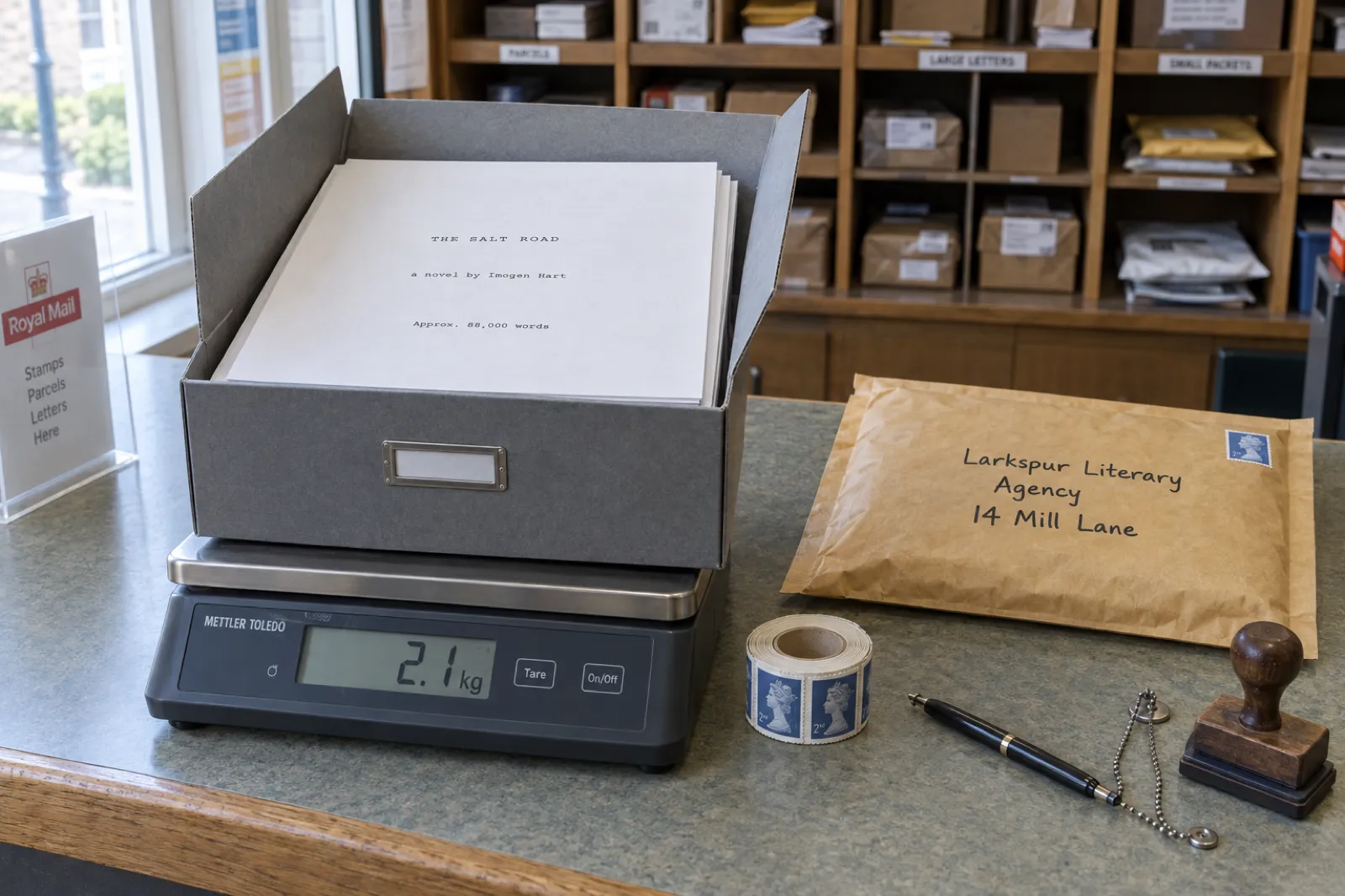
How many words is a novel?
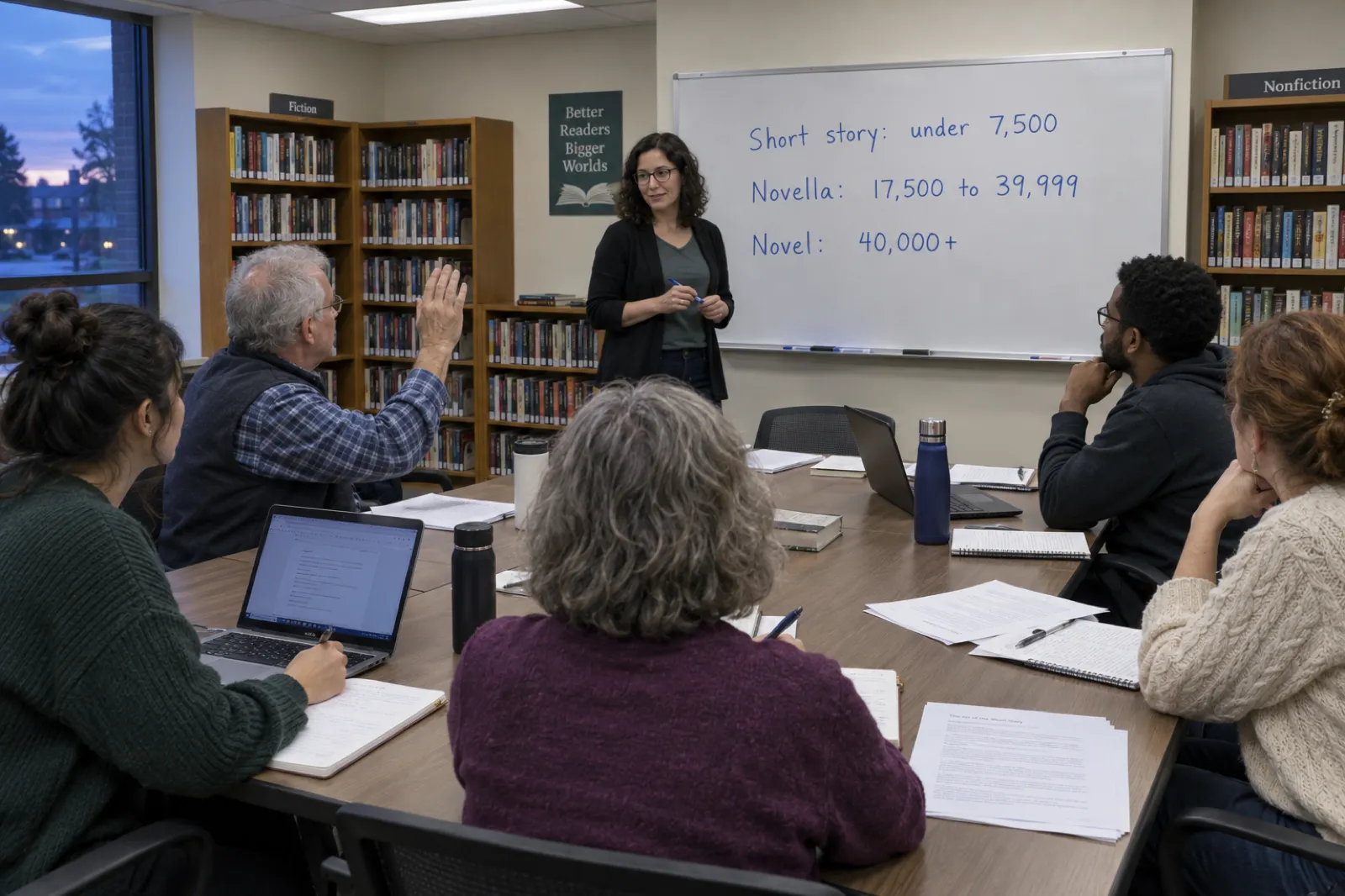
A novel is 40,000 words or more by the definition the Science Fiction and Fantasy Writers Association uses for its Nebula Awards; 17,500 to 39,999 words is a novella. For a debut sent to agents, Writer's Digest's guide puts the safe range at 80,000 to 89,999 words for mainstream, literary, romance, mystery, thriller and horror, and 100,000 to 115,000 for science fiction and fantasy. Of 19 well-known books we counted word by word, the shortest novel is Peter Pan at 47,112 words.
The line
40,000
words makes a novel in the SFWA definition. Below it is a novella.
The safe range
80-90K
for a debut in most adult genres, per Writer's Digest. 100,000 to 115,000 for science fiction and fantasy.
Counted, not copied
78,545
words: the median of the 11 classic novels we counted ourselves. A classic set, not today's market.
Where does your word count sit?
Type your word count, or the target you are writing to. The checker shows what it counts as, where it falls in each genre's range, which counted classics it sits between, and roughly how many printed pages it makes.
It counts as
-
Between these counted books
-
| Genre | Range | Your draft |
|---|---|---|
| Literary and mainstream | 80,000 to 89,999 (outer 71,000 to 109,000) | - |
| Romance | 80,000 to 89,999 (outer 71,000 to 109,000) | - |
| Mystery and thriller | 80,000 to 89,999 (outer 71,000 to 109,000) | - |
| Horror | 80,000 to 89,999 (outer 71,000 to 109,000) | - |
| Science fiction and fantasy | 100,000 to 115,000 | - |
| Category romance | 50,000 to 60,000 | - |
| Western | 50,000 to 80,000 | - |
| Young adult | 55,000 to 79,999 | - |
| Middle grade | 20,000 to 55,000 | - |
Ranges: Writer's Digest, and Jericho Writers for category romance; other sources differ at the edges. Pages assume dialogue-heavy fiction at 6 x 9 inches in our KDP export.
Need pages, spine and print cost too? The book length calculator turns the same word count into a printed book at three trim sizes, with KDP's print cost and royalty.
Open the calculatorWhere a novel starts: the published lines
Publishers do not publish a single definition of a novel. The clearest public lines come from awards, which have to decide which category a story enters. The Science Fiction and Fantasy Writers Association sets its Nebula categories by word count, and its rules for the 2026 award year draw them like this (SFWA Nebula Rules):
| Category | Words | Counted examples |
|---|---|---|
| Short story | fewer than 7,500 | a magazine story |
| Novelette | 7,500 to 17,499 | a long magazine story |
| Novella | 17,500 to 39,999 | Metamorphosis (21,935), The Strange Case of Dr Jekyll and Mr Hyde (25,574), Alice's Adventures in Wonderland (26,441), A Christmas Carol (28,435) |
| Novel | 40,000 or more | The Great Gatsby (48,152), Frankenstein (74,975), Pride and Prejudice (121,738) |
The line between novella and novel is closer to some famous books than you might expect. By our count The Turn of the Screw is 534 words short of a novel, and The Wonderful Wizard of Oz 728 short. On the other side, The Great Gatsby clears it by 8,152. Nobody would call Gatsby a short story, which is the point: the line is a category, not a judgement of whether a book feels complete.
For a full guide to the shorter lengths, including what changes when you publish a novella, see novella vs novel, and book length by category on the calculator page.
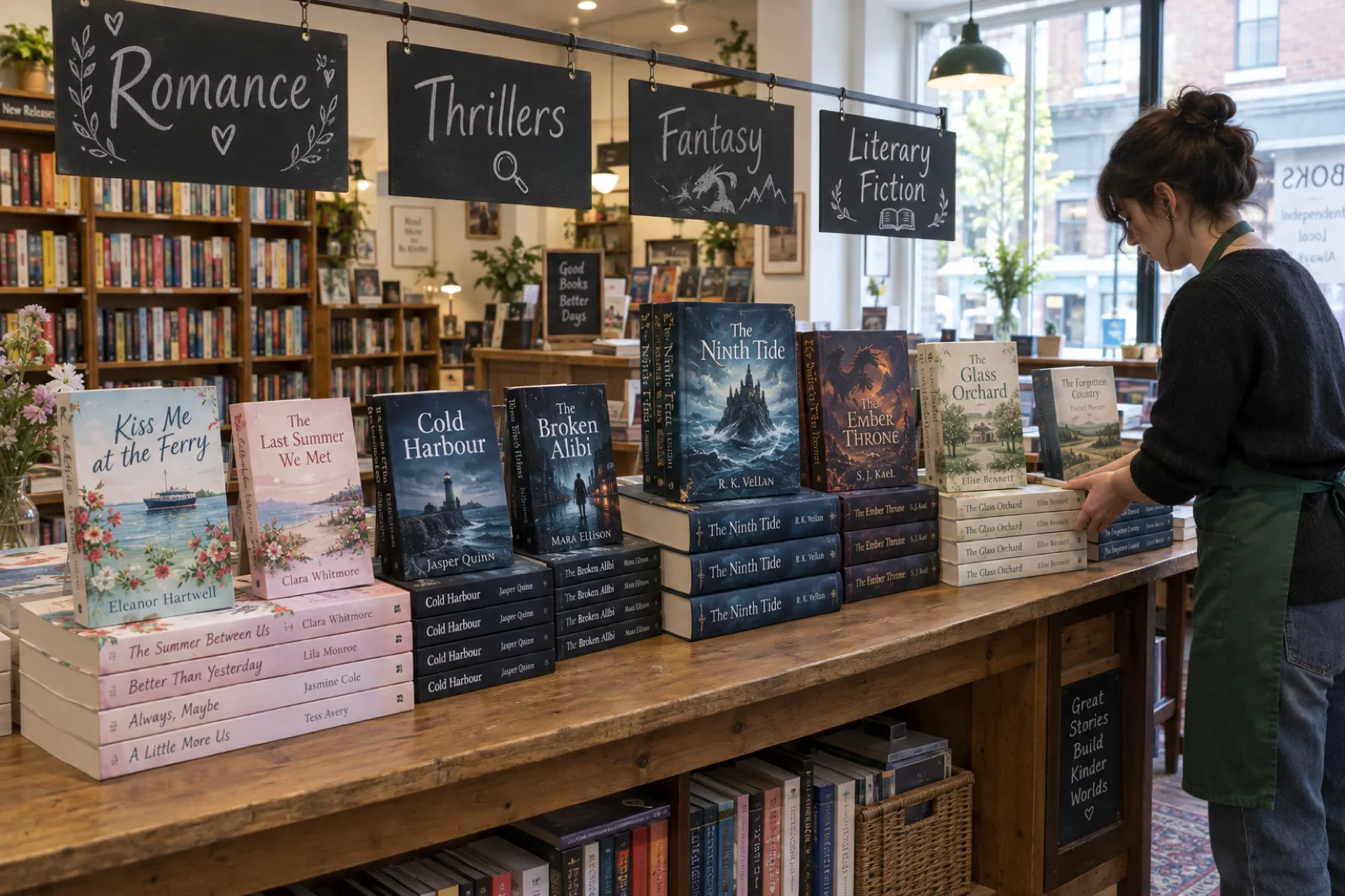
Novel word count by genre
The most quoted genre figures come from Writer's Digest's long-running guide to word counts, written for authors about to query agents (Writer's Digest). It gives a safe range and outer limits for adult fiction, a higher range for speculative fiction, and ranges for westerns, young adult and middle grade. Category romance, written to a publisher's line, comes from Jericho Writers' guide. Other sources differ at the edges, especially for young adult and fantasy, so check the guidelines of the agents or imprints you are aiming at.
| Genre | Safe range | Outer limits | Source |
|---|---|---|---|
| Literary and mainstream | 80,000 to 89,999 | 71,000 to 109,000 | Writer's Digest |
| Romance | 80,000 to 89,999 | 71,000 to 109,000 | Writer's Digest (category romance runs shorter) |
| Mystery and thriller | 80,000 to 89,999 | 71,000 to 109,000 | Writer's Digest |
| Horror | 80,000 to 89,999 | 71,000 to 109,000 | Writer's Digest |
| Science fiction and fantasy | 100,000 to 115,000 | - | Writer's Digest |
| Category romance | 50,000 to 60,000 | - | Jericho Writers |
| Western | 50,000 to 80,000 | - | Writer's Digest |
| Young adult | 55,000 to 79,999 | - | Writer's Digest |
| Middle grade | 20,000 to 55,000 | - | Writer's Digest |
What the ranges mean in practice
- Mainstream, literary and book-club fiction. 80,000 to 89,999 is the comfortable zone for a first novel. Literary fiction can run shorter when the book is tightly built; it is the genre where a 70,000-word novel is least likely to be questioned.
- Romance. Single-title romance sits in the same band as mainstream fiction. Category romance, written to a publisher's line with a set length, runs much shorter, about 50,000 to 60,000 words by Jericho Writers' figures, and each line publishes its own target. The AI romance novel writer plans a romance to either length. Many self-published romance series run shorter than single-title romance and release more often.
- Mystery and thriller. The same safe range, with cozy mysteries often at the shorter end and big conspiracy thrillers at the longer. Pace matters more than length: a thriller that drags at 90,000 words reads longer than one that moves at 110,000. See the AI mystery and thriller writer for how clues and reveals are planned across chapters.
- Horror. Usually in the mainstream band. Horror also suits the novella, where a single sustained dread does not have to stretch. Our AI horror story generator works at both lengths.
- Science fiction and fantasy. World-building takes words, so the range starts higher. Epic fantasy runs longer again. A long debut is a harder sell than a long book from an author readers already follow. The AI fantasy novel writer and sci-fi story generator keep the world's rules consistent over a long book.
- Young adult and middle grade. Shorter than adult fiction, and the spread inside each is wide. Our children's book word count guide goes through each age band with publishers' own figures and our picture-book data.
Memoir and non-fiction follow different expectations, set by the subject rather than the genre. Our guide to writing a book includes a word count table for them.
Writing in one of these genres? Inkfluence AI plans a novel chapter by chapter in your genre, keeps characters and plot consistent across the book, and writes to the number of chapters you choose.
See the AI novel writerHow many words are in famous novels?
Most lists of famous books' word counts are copied from page to page with no source. These are not. We took the public-domain text of each book from Project Gutenberg, removed the Gutenberg header and footer, and counted every word and chapter, then typeset each book through our KDP export to get a real page count. The full table of 19 books, with spine width and print cost, lives on the book length calculator; here are the novels.
| Novel | Words | Chapters | Pages at 6 x 9 |
|---|---|---|---|
| Peter Pan (J. M. Barrie, 1911) | 47,112 | 17 | 134 |
| The Great Gatsby (F. Scott Fitzgerald, 1925) | 48,152 | 9 | 131 |
| The War of the Worlds (H. G. Wells, 1898) | 59,875 | 27 | 145 |
| Treasure Island (Robert Louis Stevenson, 1883) | 67,864 | 34 | 169 |
| Frankenstein (Mary Shelley, 1818) | 74,975 | 24 | 164 |
| The Picture of Dorian Gray (Oscar Wilde, 1890) | 78,545 | 20 | 180 |
| Pride and Prejudice (Jane Austen, 1813) | 121,738 | 61 | 301 |
| Dracula (Bram Stoker, 1897) | 161,050 | 27 | 328 |
| Jane Eyre (Charlotte Bronte, 1847) | 184,452 | 38 | 445 |
| Little Women (Louisa May Alcott, 1868) | 185,888 | 47 | 440 |
| Moby-Dick (Herman Melville, 1851) | 208,458 | 135 | 521 |
Counted 20 October 2026 from Project Gutenberg texts; words are whitespace-separated tokens. Pages include the title, copyright, contents and introduction pages our KDP export adds. Method and the novellas: book length calculator.
Two things the counts show
First, classic novels sit all over the range: The Great Gatsby at 48,152 words and Dracula at 161,050 are both novels by any definition, and both still sell. Second, older books are often longer than today's debut guidance, partly because many were first published in parts or in magazines. Use them to see what a length feels like, not as a target. For a target, the genre ranges above, and the page counts of recent books in your genre on Amazon, are better guides.
How word count is measured
Word count sounds exact, but every program counts a little differently. Hyphenated words, numbers, words joined by a dash and stray spaces can each be counted one way or another, so the same manuscript can show slightly different totals in a word processor, a writing app and an online counter. For our classics we counted every run of characters separated by a space, which counts a hyphenated word once.
None of this matters much in practice, because word counts are used in round numbers. A query letter gives the length rounded to the nearest thousand ("complete at 88,000 words"), not 87,642. What does matter is counting the same thing each time:
- Count the story, not the extras. Leave out the title page, dedication, acknowledgements, author bio and any sample chapter of the next book. Chapter titles and a prologue or epilogue count, because they are part of the book a reader reads.
- Use one tool from first draft to final. Switching programs can make a draft look shorter or longer when nothing changed.
- Track by chapter. A running total per chapter shows where the book is long or thin, which a single total cannot.
Inkfluence AI shows the word count for each chapter and the whole book in the editor, so you can see where a draft stands at any point. The AI manuscript editor and developmental editor help with the cutting or adding once you know where it is needed.
Words to pages: manuscript pages and printed pages
There are two kinds of page, and mixing them up is the most common reason length advice seems to contradict itself. A manuscript page is a double-spaced page in 12-point type with one-inch margins, the format agents and editors ask for; it holds roughly 250 words, so an 80,000-word novel is about 320 manuscript pages. A printed page is a typeset page in a finished book, and it holds a lot more.
How much more depends mostly on dialogue. On a full 6 x 9 page of our KDP export we measured about 268 words for dialogue-heavy fiction and a median of 472 for the long-paragraph classics. So 80,000 words prints to about 322 pages as a dialogue-heavy thriller and about 192 as a book of long, dense paragraphs, both in 30 chapters. At 5.5 x 8.5 inches add about 15%, and at 5 x 8 about 28%.
The book length calculator does this conversion for any length, trim and style, and adds the spine width, KDP print cost and royalty. Our guide to KDP trim sizes explains how to choose the page size in the first place, and how many pages is a novel gives page counts for each genre, at two trims and in six fonts.
How long is a novel to read, or to listen to?
Readers think in hours more often than words. A large 2019 review of reading-speed studies by Marc Brysbaert put the average adult's silent reading of fiction at about 260 words a minute. At that pace an 80,000-word novel is about 5 hr 8 min of reading, a 50,000-word romance about 3 hr 12 min and a 110,000-word fantasy about 7 hr 3 min. Kindle's "time left in book" works the same way, from your own reading speed.
Narration is slower than silent reading. Across the audiobooks we measured for our audiobook length calculator, the median narrator read at 164 words a minute, so the same 80,000-word novel runs about 8 hr 8 min as an audiobook, and the 110,000-word fantasy about 11 hr 11 min.
The audiobook length calculator converts any word count to listening time at slow, average and fast narration. If you want the audiobook made from your manuscript, the AI audiobook generator narrates each chapter and exports MP3 files.
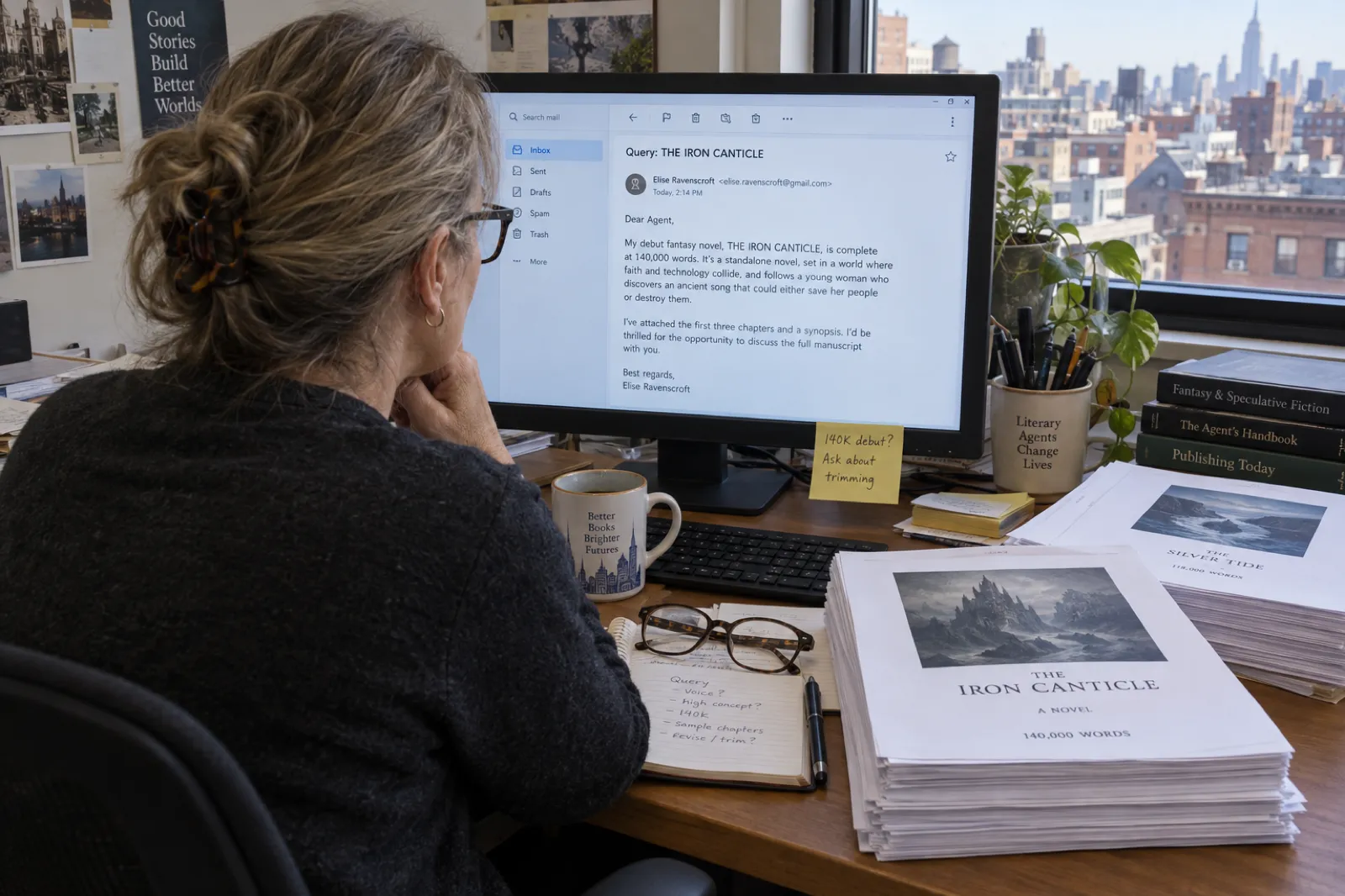
Why word count matters, and to whom
Agents and publishers
A query letter states the word count in its first lines, and an agent reading hundreds of queries uses it as a filter. A debut thriller at 160,000 words signals either a book that needs heavy cutting or a writer who has not looked at the market. Writer's Digest's advice, repeated by many agents, is that you cannot count on being the exception. If your draft is far outside the range, it is worth asking whether it is two books, or one book with a slow opening.
Readers
Readers do not count words, but they do see page counts and price. A romance reader who buys a full-priced book and finds a 40,000-word story will often say so in a review; a reader who picks up a 600-page thriller expecting a fast read may stall halfway. Matching the shelf around you is less about rules and more about meeting the expectation your cover and category set. Amazon prints the page count on every paperback and Kindle listing, right beside your description, so the two should promise the same kind of read; the book description generator drafts a blurb that fits the length and genre.
Your own costs, if you self-publish
In print, length is money. On Amazon KDP a black-ink paperback at 6 x 9 costs a flat $2.30 to print up to 110 pages and then $1.00 plus $0.012 a page, and royalties are 60% of the list price less that cost at $9.99 and up on Amazon.com. Using our book length model for dialogue-heavy fiction at 6 x 9 on cream paper:
| Words | Pages | Print cost | You keep at $9.99 | At $14.99 |
|---|---|---|---|---|
| 60,000 | 240 | $3.88 | $2.11 | $5.11 |
| 90,000 | 358 | $5.30 | $0.69 | $3.69 |
| 120,000 | 476 | $6.71 | loses $0.72 | $2.28 |
Ebooks have no print cost, so length matters less for what you earn per copy, though it still shapes what readers expect to pay. If you enrol in Kindle Unlimited, KDP pays by Kindle Edition Normalized Pages read, so a longer book that readers finish earns more per reader than a short one. The royalty calculator compares stores and formats side by side.
See your own numbers. Put your word count into the book length calculator to get pages, spine width, print cost and royalty in the US, UK and Europe.
Book length calculatorIf your draft is too long, or too short
Cutting a long draft
- Start at the beginning. First drafts carry the writer's warm-up: background, travel, a character waking up. Many novels improve when the first chapter or two are folded into what follows.
- Look for the second book. A 180,000-word draft is sometimes two complete arcs. Splitting it can give you a series rather than a cut; the AI book series writer plans the books that follow from where the first one ends.
- Merge characters and scenes that do the same job. Two friends who both give advice, or two scenes that show the same conflict, can usually become one.
- Trim inside scenes, not just whole scenes. Entering late and leaving early takes a few hundred words out of most scenes without losing anything a reader would miss.
- Keep a running total by chapter. Knowing which chapters run long tells you where to look first.
Growing a short draft
- Add story, not description. A subplot, a setback before the climax or a scene from a second point of view adds length that readers count as value.
- Let the big moments breathe. Short drafts often summarise the scenes a reader most wants to watch. Dramatise them.
- Check the middle. If the book goes straight from set-up to resolution, it is missing the escalation that most novels spend their middle on.
- Or keep it short on purpose. A tight 30,000-word story may be a strong novella. The calculator shows what it prints to and what it costs.
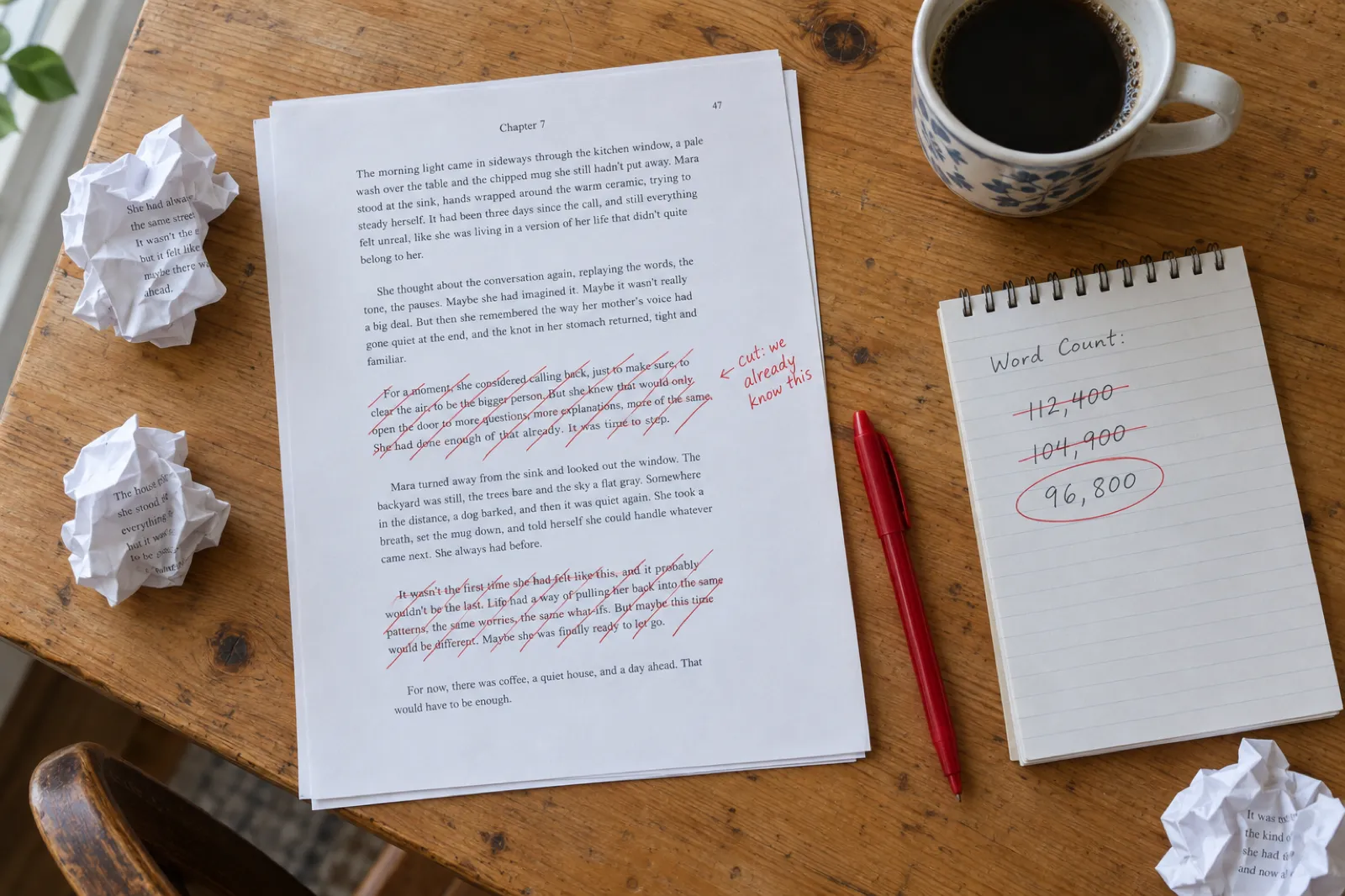
How many chapters, and how long each?
There is no rule for chapter length, and the classics show how wide the spread is. Dividing each book's words by its chapters, Moby-Dick runs about 1,544 words a chapter across 135 chapters, Pride and Prejudice about 1,996, and The Great Gatsby about 5,350 across just 9. The median across the 17 classics we counted with more than three chapters is about 2,560 words.
A practical way to plan is to work backwards from the target. At 2,500 words a chapter, an 80,000-word novel is 32 chapters; at 4,000 words, it is 20. Shorter chapters suit fast genres such as thrillers, where a chapter often ends on a turn that pulls the reader into the next one. Longer chapters suit books that stay with one place or one point of view for a while. Whatever you choose, chapters within one book tend to read best when they sit within a similar band, so a reader can feel the rhythm.
Planning the chapters early also shows whether the story has enough events to fill the length. The free plot generator suggests a story spine to hang them on, and the character bible generator keeps track of who is who across a long book. For chapter counts at every common length, with a planner, see how many chapters in a book.
How long does it take to write a novel?
The arithmetic is simple; the habit is the hard part. Drafting an 80,000-word novel takes:
| Words a day | Writing every day | Writing five days a week |
|---|---|---|
| 500 | 160 days (about 23 weeks) | about 32 weeks |
| 1,000 | 80 days (about 11 weeks) | about 16 weeks |
| 2,000 | 40 days (about 6 weeks) | about 8 weeks |
That is the first draft only. Revision usually takes as long again or longer: a second draft, feedback from readers, then copyediting. The popular 50,000-words-in-a-month challenge averages about 1,667 words a day, which produces a short novel or the first two thirds of a longer one.
A chapter outline before you start makes daily targets far easier to keep, because each day has a scene to write rather than a blank page. Beta readers can come in at the second draft; the AI beta reader gives a first read in minutes while you wait for human ones.
How long is a novel written with AI?
As long as you ask it to be, in chapters rather than words. AI book tools generate a book chapter by chapter, and the chapter count is the lever for length. In Inkfluence AI you say how many chapters you want in your prompt, up to 5 on the free plan and up to 40 in one book on paid plans. Each chapter in our own test books came out at roughly 2,000 words, so a 40-chapter book lands near 80,000 words, inside the safe range for most adult genres.
There is no word-count setting, and we do not promise an exact length: chapters vary with the scene they cover. If a finished book comes out short, add chapters from the editor and write them in the same voice; if you want a novella, ask for 12 to 18 chapters. Fiction is written in order with a running record of characters, places and events so later chapters stay consistent with earlier ones.
If you write the book yourself and use AI for parts of the work, the free book outline generator lays out a chapter plan at your target length, and the AI chapter generator drafts one chapter at a time to it. For the whole process, see how to write a book with AI.
Plan a novel at the length you want. Tell Inkfluence AI the idea, the genre and the number of chapters. It outlines and writes every chapter, then exports for Kindle and print.
Start your novel freeNovel word count questions
How many words is a novel?
40,000 words or more, by the definition the Science Fiction and Fantasy Writers Association uses for its Nebula Awards. Below that, 17,500 to 39,999 words is a novella. Most adult novels that publishers buy run about 70,000 to 110,000 words; Writer's Digest calls 80,000 to 89,999 the safe range for a debut in mainstream, literary, romance, mystery, thriller and horror, and 100,000 to 115,000 for science fiction and fantasy.
Is 50,000 words a novel?
Yes. 50,000 words clears the 40,000-word line, and it is about the length of The Great Gatsby (48,152 words by our count). It is short for most adult genres if you are submitting to agents, where 70,000 or more is the usual floor, but it is a normal length for a cozy mystery, a novella-length romance sold as a series, or a self-published book in a fast-paced genre.
Is 40,000 words long enough for a book?
It is the line between a novella and a novel in the SFWA definition, so a 40,000-word book is a short novel. The Turn of the Screw (39,466 words) and The Wonderful Wizard of Oz (39,272) both fall just under it. Printed at 6 x 9 inches, 40,000 words of dialogue-heavy fiction comes to about 164 pages.
How many words is a 300-page book?
Between roughly 70,000 and 120,000 words, depending on how much dialogue it has. On a full 6 x 9 page of our KDP export we measured about 268 words for dialogue-heavy fiction and a median of 472 for long-paragraph classics. Chapter openings, the contents page and front matter take some pages too. The book length calculator converts either way.
Can a novel be too long?
For a debut submitted to agents, yes: Writer's Digest puts the outer limit for most adult genres at about 109,000 words and treats anything over 110,000 as epic length that needs a reason. For self-publishing there is no rule, but print cost rises with every page past about 110 pages, so a 160,000-word paperback has to be priced higher to earn the same royalty.
Do debut novels need to be shorter?
The common advice is to stay inside the safe range for your genre, because an agent is taking more risk on a first novel and length is an easy reason to say no. We have not found published data comparing debut and established word counts, so treat that as editorial advice rather than a measured rule.
How many words is the average novel?
There is no published average across all novels that we could verify. Among the 11 novels in our counted set the median is 78,545 words, but that is a set of public-domain classics, not today's market. For a current benchmark, look at the page counts of recent books in your genre on Amazon and convert them with the book length calculator.
How long does it take to read an 80,000-word novel?
About 5 hr 8 min at the average adult silent reading speed of 260 words a minute for fiction measured in a 2019 review of 190 studies (Brysbaert).
How do I control the length of a novel written with AI?
Set the number of chapters. In Inkfluence AI you say how many chapters you want in your prompt, up to 5 on the free plan and up to 40 in one book on paid plans, and each chapter in our own test books came out at roughly 2,000 words. There is no word-count setting, and you can add chapters to a finished book from the editor.
Related tools and guides
Write a novel that lands in its range
Pick the genre and the number of chapters, and Inkfluence AI writes the novel in order, keeps the story consistent, designs the cover and exports for Kindle and print.