
How Many Chapters in a Book? Chapter Counts and Lengths, with a Planner
There is no rule for how many chapters a book should have, but there is a useful range, and it comes from two numbers you can plan with: how long the book is and how long you like your chapters. Below are chapter lengths with their source, the chapter counts of 17 classics we counted ourselves, figures by genre, and a planner that turns a word target into chapters, pages and the points where each act turns.
How many chapters are in a book?
Most novels have roughly 20 to 40 chapters. That follows from Jericho Writers' standard chapter length of 2,000 to 4,000 words: an 80,000-word novel, the middle of most adult genres' ranges, is 20 chapters at 4,000 words, 32 at 2,500 and 40 at 2,000. The classics vary far more. Of 17 we counted with real chapters, the median has 24 chapters of about 2,560 words, ranging from Moby-Dick at about 1,544 words a chapter to Dracula at about 5,965.
Standard chapter
2-4K
words for an adult novel, by Jericho Writers' bands. Thrillers run shorter, epic fantasy longer.
80,000 words
20-40
chapters at that standard length. 32 at 2,500 words a chapter.
Counted, not copied
2,560
words: the median chapter across 17 classics we counted from the full texts.
Chapter planner
Enter the length you are aiming for and the chapter length you like to write. The planner gives the number of chapters, what each one comes to in print and in reading time, and which chapters carry the turns of a three-act story.
Chapters
-
Each chapter
-
Whole book
-
Where the story turns
Pages assume dialogue-heavy fiction at 6 x 9 inches in our KDP export; reading time uses 260 words a minute for fiction (Brysbaert, 2019). The act split is the common convention, not a rule; move the turns to where your story needs them.
Turn the plan into an outline. The free book outline generator lays out a chapter-by-chapter plan with a title and a summary for each chapter.
Book outline generatorPlanning chapters across the acts
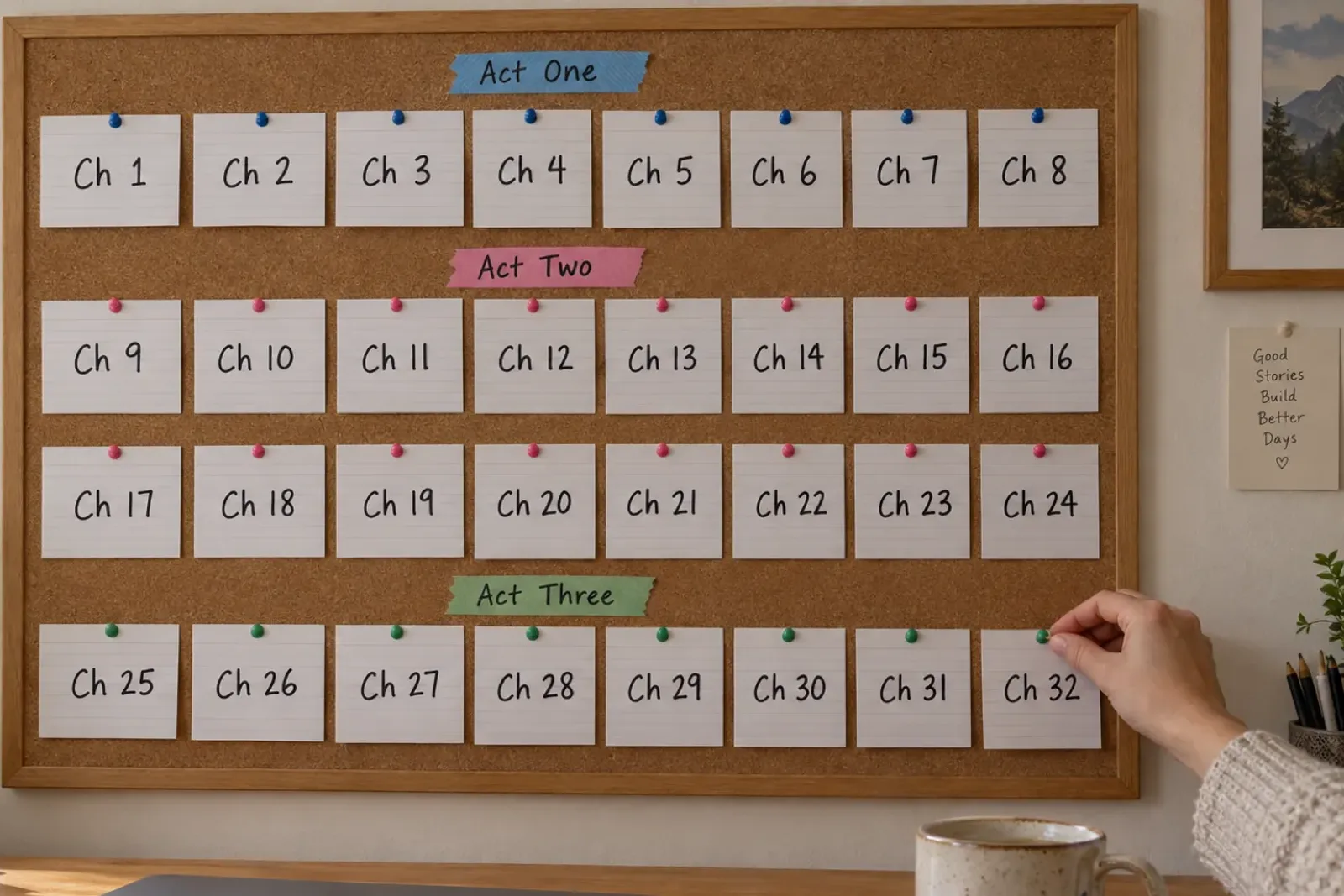
The planner splits the book the way most story-structure guides do: a first act of about a quarter, a second act of about half, and a final act of about a quarter, with a turn at the middle. It is a convention rather than a law, but it is a good first draft of a chapter plan because it tells you roughly where the big moments should land. In a 32-chapter novel, the first act ends around chapter 8, the midpoint falls around chapter 16, and the final act begins around chapter 25.
Working this way changes the question from "how many chapters?" to "what happens in each one?". If the first act needs only four chapters to set up the story, the second act has to carry more. If the middle feels thin when you list its chapters, that is the part of the book most likely to sag on the page as well, and it is far easier to fix in a list than in a draft.
Some writers prefer four equal parts, with the second act split at the midpoint, which the planner also offers. Either way, the free book outline generator turns the plan into chapter titles and summaries, and the character bible generator keeps track of who is who across a long book.
Chapters for common book lengths
Chapter count is simply the book's length divided by the chapter length. This table does the division for the lengths most novels are written to, at short, standard and long chapters:
| Book length | 1,500-word chapters | 2,500-word chapters | 4,000-word chapters |
|---|---|---|---|
| 50,000 words | 33 | 20 | 13 |
| 70,000 words | 47 | 28 | 18 |
| 80,000 words | 53 | 32 | 20 |
| 90,000 words | 60 | 36 | 23 |
| 100,000 words | 67 | 40 | 25 |
| 120,000 words | 80 | 48 | 30 |
In print, a 1,500-word chapter with plenty of dialogue is about 6.1 pages at 6 x 9 inches, a 2,500-word chapter about 9.8 and a 4,000-word chapter about 15.4. At average reading speed those take about 6, 10 and 15 minutes. That reading time is worth keeping in mind: many readers stop at chapter ends, so a chapter is also a reading session. On a Kindle the reader can even see the time left in the chapter, which makes a short chapter an easy one to start.
If you have not settled the book's total yet, start with how many words are in a novel, which gives the word ranges for each genre with their sources, and how many pages is a novel for what those words print to.
Chapter length by genre
The clearest published bands come from Harry Bingham's guide for Jericho Writers, which grades adult chapter lengths like this:
| Chapter length | Words | 80,000-word novel |
|---|---|---|
| Very short | 1,000 to 1,500 | 53 to 80 chapters |
| Short | 1,500 to 2,000 | 40 to 53 chapters |
| Standard | 2,000 to 4,000 | 20 to 40 chapters |
| Long | 4,000 to 5,000 | 16 to 20 chapters |
| Very long | over 5,000 | fewer than 16 chapters |
Bands from Jericho Writers, which calls chapters of 1,000 words or under too short for most adult fiction. The right-hand column is our division.
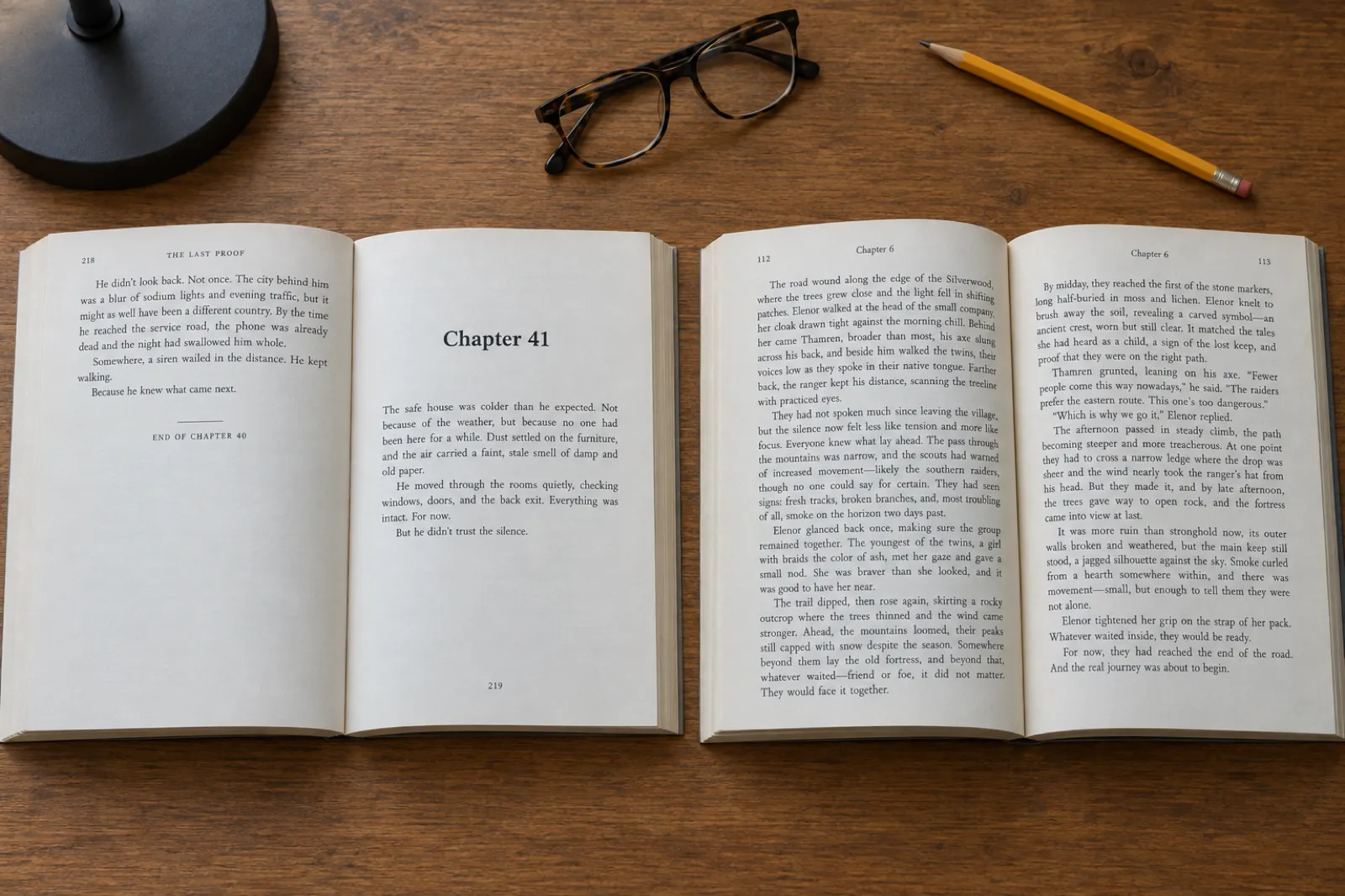
- Thrillers and action. The genre of the very short chapter. Jericho Writers points to James Patterson as the benchmark and notes his chapters rarely drop below 1,000 words. A chapter that ends on a turn and lasts five minutes is hard to stop at. The AI mystery and thriller writer plans chapter endings around reveals.
- Crime, young adult and literary fiction. The standard 2,000 to 4,000-word band, by Jericho Writers' reading.
- Romance. Chapters often alternate between the two leads' points of view, so the chapter count is usually even and the lengths roughly matched. The AI romance novel writer can plan the alternation.
- Epic fantasy and big historical fiction. Long chapters work here; Jericho Writers cites A Game of Thrones. A chapter that follows one character through a whole sequence of events gives the world room. The AI fantasy novel writer keeps track of who knows what across long chapters.
- Children's chapter books. Short chapters, set by age rather than genre. Our children's book word count guide goes through each age band.
Write to the chapter count you planned. Tell Inkfluence AI the idea, the genre and the number of chapters. It outlines every chapter, then writes them in order with the story kept consistent.
Start your book freeChapters in famous books, counted
Most lists of chapter counts are copied from page to page. We counted ours from the public-domain texts on Project Gutenberg, word by word and chapter by chapter, and typeset every book through our KDP export to get real pages. Two short books in three parts, Heart of Darkness and Metamorphosis, are left out, because a part is not a chapter.
| Book | Words | Chapters | Words a chapter | Pages a chapter |
|---|---|---|---|---|
| Moby-Dick (Herman Melville) | 208,458 | 135 | 1,544 | 3.9 |
| The Wonderful Wizard of Oz (L. Frank Baum) | 39,272 | 24 | 1,636 | 4.6 |
| The Turn of the Screw (Henry James) | 39,466 | 24 | 1,644 | 4.2 |
| Treasure Island (Robert Louis Stevenson) | 67,864 | 34 | 1,996 | 5 |
| Pride and Prejudice (Jane Austen) | 121,738 | 61 | 1,996 | 4.9 |
| The Time Machine (H. G. Wells) | 32,377 | 16 | 2,024 | 4.8 |
| Alice's Adventures in Wonderland (Lewis Carroll) | 26,441 | 12 | 2,203 | 6.3 |
| The War of the Worlds (H. G. Wells) | 59,875 | 27 | 2,218 | 5.4 |
| The Strange Case of Dr Jekyll and Mr Hyde (Robert Louis Stevenson) | 25,574 | 10 | 2,557 | 6 |
| Peter Pan (J. M. Barrie) | 47,112 | 17 | 2,771 | 7.9 |
| Frankenstein (Mary Shelley) | 74,975 | 24 | 3,124 | 6.8 |
| The Picture of Dorian Gray (Oscar Wilde) | 78,545 | 20 | 3,927 | 9 |
| Little Women (Louisa May Alcott) | 185,888 | 47 | 3,955 | 9.4 |
| Jane Eyre (Charlotte Bronte) | 184,452 | 38 | 4,854 | 11.7 |
| The Great Gatsby (F. Scott Fitzgerald) | 48,152 | 9 | 5,350 | 14.6 |
| A Christmas Carol (Charles Dickens) | 28,435 | 5 | 5,687 | 14.4 |
| Dracula (Bram Stoker) | 161,050 | 27 | 5,965 | 12.1 |
Counted 20 October 2026. Pages a chapter is the book's page count at 6 x 9 in our export divided by its chapters, so it includes a share of the front matter. Full method: book length calculator.
Sorted by chapter length, the list runs from Moby-Dick's many short chapters, some only a page or two, to The Great Gatsby, A Christmas Carol and Dracula, whose chapters average over 5,000 words. Among the novels of 40,000 words or more, the median has 27 chapters. The middle of the list, where Pride and Prejudice, Treasure Island and The War of the Worlds sit at around 2,000 words a chapter, is close to what Jericho Writers calls standard today.
One thing the old books do differently is structure above the chapter. Frankenstein opens with a series of letters before its first chapter, and Little Women was first published in two volumes, which our copy keeps as one book. Parts and volumes are a second level of division that most modern novels skip, though epic fantasy often brings them back.
Chapter counts in modern novels
For books still in copyright we cannot count the text ourselves. Jericho Writers' guide lists word and chapter counts for a set of well-known modern novels, which show the same spread as the classics:
| Novel | Words | Chapters | Words a chapter |
|---|---|---|---|
| Along Came a Spider | 106,000 | 97 | 1,090 |
| The Handmaid’s Tale | 96,400 | 46 | 2,100 |
| Talking to the Dead | 113,000 | 49 | 2,310 |
| The Fault in Our Stars | 65,750 | 25 | 2,630 |
| The Amazing Adventures of Kavalier and Clay | 216,000 | 75 | 2,880 |
| 1984 | 89,000 | 24 | 3,710 |
| Twilight | 118,000 | 25 | 4,720 |
| A Game of Thrones | 298,000 | 60 | 4,970 |
Figures as published by Jericho Writers (read 20 Oct 2026); words a chapter is our division and rounding.
A thriller with 97 chapters and a fantasy with 60 chapters of nearly 5,000 words are both bestsellers. The pattern is not a count but a fit: short chapters where the book wants speed, long ones where it wants immersion, and in every case chapters that end at a moment the reader wants to get past.

Where to end a chapter
Word counts give you a target, but the break itself should come from the story. Good places to end a chapter:
- On a question. Something has just happened that the reader needs explained: a door that should be locked is open, a character says one sentence too many.
- On a decision. The character has chosen, and the next chapter shows the cost.
- Before a change of place, time or point of view. The break does the work a transition paragraph would otherwise do.
- After a big scene has landed. Not every chapter needs a cliffhanger. A quieter ending after a big scene gives the reader a moment, and the contrast makes the next hook stronger.
What to avoid is the chapter that ends because it reached its word count, with everything resolved and nothing pulling forward. If a chapter runs long, look for the moment inside it that would make a better ending, and split there. If two short chapters do the same job, merge them. Asking a reader is the quickest check: the AI beta reader marks where attention drops, chapter by chapter.
What chapter count does to the printed book and the audiobook
In print
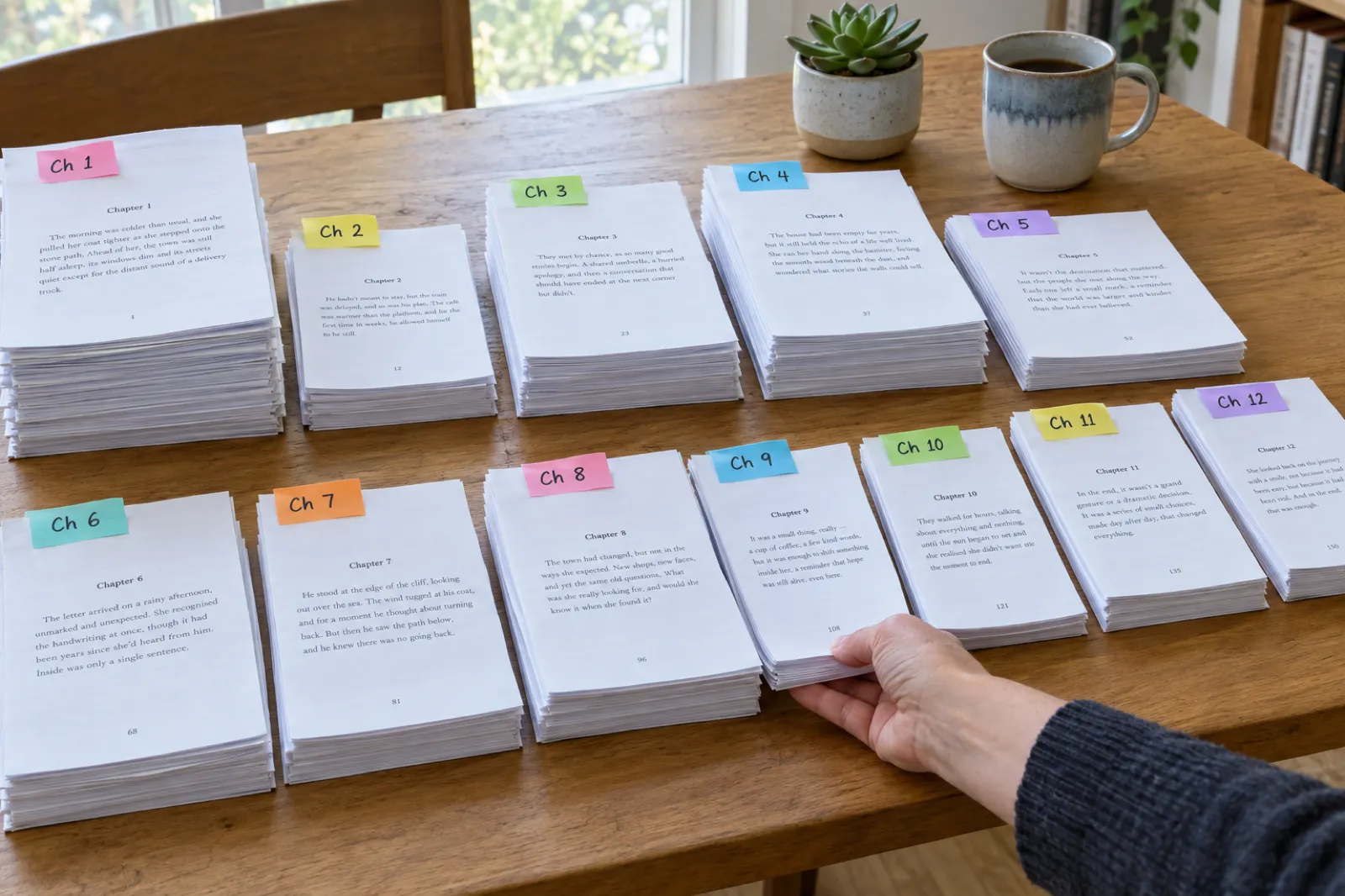
Every chapter starts on a new page, and the page before it usually ends part-empty, so more chapters means more pages for the same words. With our page model, 80,000 words of dialogue-heavy fiction at 6 x 9 inches is about 316 pages in 20 chapters, 322 in 32 and 338 in 60. A longer contents page adds a little more. On Amazon KDP, where a black-ink paperback above 110 pages costs $0.012 a page to print in the US, the difference between 20 and 60 chapters is about $0.26 a copy. That is small, but it is worth knowing if you are pricing close to the line; the royalty calculator shows what each sale pays.
In an audiobook
Chapters become the tracks a listener skips between. If you produce through ACX, Audible's production platform, its submission requirements ask for one chapter per file and no file longer than 120 minutes. At the median narration pace of 164 words a minute we measured, that is a chapter of about 19,000 words; any chapter longer than that has to be split into two files. A standard 2,500-word chapter runs about 15 minutes, and a 4,000-word chapter about 24.
The audiobook length calculator gives the running time of a whole book, and the AI audiobook generator narrates a finished manuscript one chapter at a time.
Revising chapter by chapter
Chapters are also the easiest unit to revise in. A whole draft is too big to hold in your head; a chapter is not. A few checks that work well one chapter at a time:
- Word count per chapter. List them. A chapter far longer than its neighbours is often two chapters; a run of very short ones may be one chapter split by habit.
- One job each. Write one line saying what changes in each chapter. If you cannot, the chapter may be marking time.
- The first and last lines. Read only the opening and closing lines of every chapter in order. They should make a rough version of the story on their own.
- Continuity. Names, dates, injuries and who knows what. These slip most often across chapter breaks, where the writer stopped and came back days later.
The AI developmental editor looks at structure and pacing across chapters, the AI manuscript editor works at the sentence level inside them, and the AI book editor brings both into one place.
How many chapters in a novella or a short novel?
A novella is 17,500 to 39,999 words in the definition the Science Fiction and Fantasy Writers Association uses for its awards. At standard 2,500-word chapters that is 7 to 16 chapters; at short 1,500-word chapters, 12 to 27. The short books in our counted set show both approaches:
| Book | Words | Chapters | Words a chapter |
|---|---|---|---|
| The Strange Case of Dr Jekyll and Mr Hyde | 25,574 | 10 | 2,557 |
| Alice's Adventures in Wonderland | 26,441 | 12 | 2,203 |
| A Christmas Carol | 28,435 | 5 | 5,687 |
| The Time Machine | 32,377 | 16 | 2,024 |
| The Wonderful Wizard of Oz | 39,272 | 24 | 1,636 |
| The Turn of the Screw | 39,466 | 24 | 1,644 |
A Christmas Carol tells its whole story in five long staves, one for each stage of the night; The Turn of the Screw and The Wonderful Wizard of Oz use two dozen short chapters for almost the same length. Neither is wrong. A short book with few chapters feels like a single sitting; one with many feels quick and episodic. The Wonderful Wizard of Oz, written for children, takes the second path.
For where the line between a novella and a novel falls, and the famous books on each side of it, see how many words are in a novel. For what a novella earns in print and as an ebook, see novella vs novel. A novella written with AI is simply a shorter chapter count: ask for 8 to 16 chapters in your prompt.
Common chapter problems, and the fix
- Every chapter exactly the same length. A draft written to a strict word count per chapter often pads quiet chapters and rushes big ones. Let the length follow the scene, and use the average only for planning.
- A first chapter that does too much. Long opening chapters usually carry backstory the reader does not need yet. If chapter one is twice the length of chapter two, look for where the story actually starts.
- A rushed last act. Writers often run out of patience before they run out of story. If your final quarter has far fewer words than your first, the ending may be summarised where it should be shown.
- Point-of-view switches mid-chapter. When chapters alternate between characters, a switch inside a chapter can confuse. Use a scene break, or start a new chapter.
- Chapter breaks in the wrong place. Ending a chapter just after a tense moment resolves gives the reader a natural place to stop. Ending it just before, or just as something new goes wrong, keeps them reading.
If you are publishing the result on Amazon, the AI novel generator for KDP takes the book from chapter plan to print-ready files, and our guide on how to use AI to write a book covers where AI helps and where your own judgement matters most.
Prologues, parts and chapter titles
Prologues and epilogues
A prologue sits before chapter one and an epilogue after the last chapter. Both count toward the book's word count, but neither is usually numbered as a chapter. Each earns its place when it does something a chapter cannot: a scene years before the story, a different narrator, or a glimpse of what happens after the ending. A prologue that is really chapter one with a different label is better as chapter one.
Parts and books
Long novels sometimes group chapters into parts, each with its own title page. Parts suit a story with clear movements, a change of setting or a jump in time, and they help readers find their place in a long book. They do not change how many chapters you need: a 120,000-word book in three parts still has 30 to 50 chapters at standard length.
Numbers or titles
Both are normal. Numbers keep the reader moving; titles add a little flavour and help in a contents page, especially in non-fiction, where a reader may jump straight to the chapter they need. Many novels use the point-of-view character's name as the title when chapters alternate. Whatever you choose, use it for every chapter. In the printed book each chapter starts on a new page, which our AI book formatter handles along with the contents page.
How many chapters in a non-fiction book?
Non-fiction chapters are set by the material rather than by pace. A how-to book usually gives each step its own chapter; a self-help or business book builds one idea per chapter; a cookbook or travel guide is divided by course or by place. We could not find a published genre-wide figure we would stand behind, so plan from the outline: list the steps or ideas the reader needs, in order, and that list is your chapter count.
Two practical checks. If one chapter is three times the length of the others, it probably holds two ideas. If several chapters are a page or two each, they may be sections of one chapter. Non-fiction with headings prints at about 390 words to a full 6 x 9 page in our export, so a 4,000-word chapter is ten or eleven pages. The AI business book writer and the guide to writing a book both start from that kind of outline.
Chapters in a book written with AI
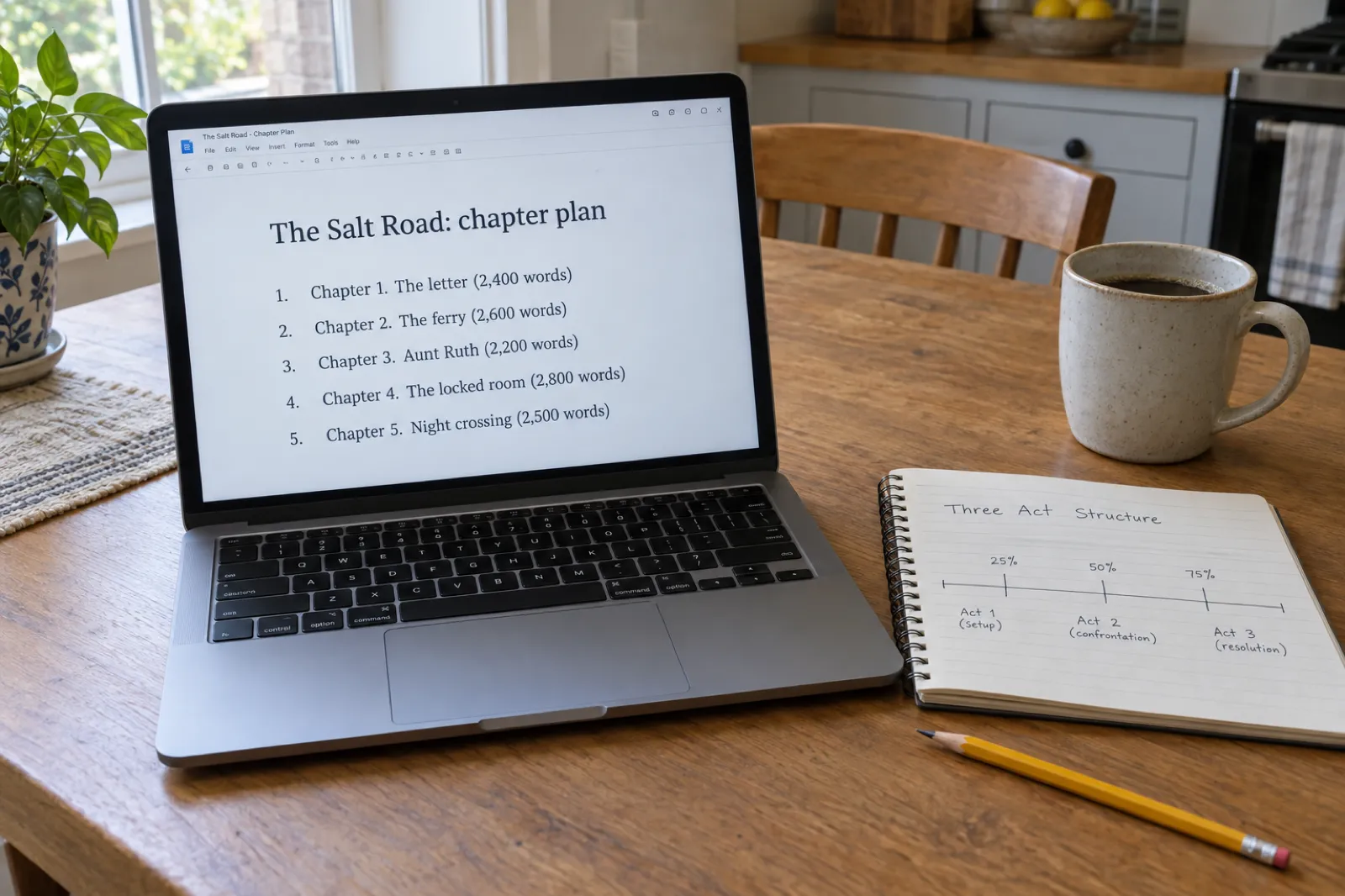
In Inkfluence AI the number of chapters is the main length control. You say how many you want in your prompt: up to 5 on the free plan and up to 40 in one book on paid plans. In a sample of recent adult fiction written in the app, the median chapter was about 2,146 words, so 40 chapters comes to roughly 85,000 words and 30 to roughly 64,000. Chapters vary with the scenes they cover, so treat those as estimates, not promises.
The outline comes first: each chapter gets a title and a summary of what happens in it. Fiction is then written in order, with a running record of characters, places and events so a later chapter does not contradict an earlier one. Once the book is written you can add chapters, reorder them and rewrite any one in the editor.
If you write your own chapters and want help with one at a time, the AI chapter generator drafts a chapter to your plan. For a whole novel, see the AI novel writer, or how to write a book with AI for the full process.
Need a story to divide? The free plot generator gives you a premise and a story spine, ready to split into acts and chapters.
Plot generatorChapter questions
How many chapters are in a book?
There is no fixed number. Most novels fall between about 20 and 40 chapters, because a typical adult chapter is 2,000 to 4,000 words (Jericho Writers' standard band) and an 80,000-word novel, the middle of most adult genres' ranges, divides into 20 to 40 chapters of that length. Of the 17 classics we counted with real chapters, the median has 24 chapters, but the range runs from 5 to 135.
How many chapters should an 80,000-word novel have?
About 20 chapters at 4,000 words each, 32 at 2,500 words or 53 at 1,500 words. Pick the chapter length that suits your genre and pace, then divide. Fast thrillers sit at the short end; literary fiction and fantasy often at the long end.
How long should a chapter be?
Jericho Writers puts the standard adult chapter at 2,000 to 4,000 words, with 1,000 to 2,000 counting as short and anything over 5,000 as very long. That is a band, not a rule: chapters inside one book often vary a lot, and the right length is the one that ends at a moment the reader wants to get past.
How many pages is a chapter?
At 6 x 9 inches with plenty of dialogue, a 1,500-word chapter is about 6.1 printed pages, a 2,500-word chapter about 9.8 and a 4,000-word chapter about 15.4, by our measurements of real KDP exports. Denser prose takes fewer pages.
Can a book have too many chapters?
Not in itself. Along Came a Spider has 97 chapters in about 106,000 words by Jericho Writers' figures, and Moby-Dick has 135 by our count. Very short chapters suit a fast book; in a slow, reflective one they can make the story feel choppy. Chapters that end without a reason to read on are the real problem, at any count.
Do prologues and epilogues count as chapters?
They count toward the word count but are usually not numbered as chapters. A prologue sits before chapter one and an epilogue after the last chapter. Use them only when they do a job a chapter cannot, such as a scene years earlier or later than the main story.
How many chapters does a non-fiction book have?
As many as it has main ideas or steps. A how-to book often gives each step its own chapter; a business or self-help book usually builds one argument per chapter. There is no genre-wide figure we could verify, so plan from your outline rather than a target count.
How do I set the number of chapters in an AI-written book?
In Inkfluence AI you say how many chapters you want in your prompt: up to 5 on the free plan and up to 40 in one book on paid plans. In a sample of recent adult fiction written in the app, the median chapter was about 2,146 words, so the chapter count is how you set the length.
Related tools and guides
Plan the chapters, then write them
Tell Inkfluence AI your idea, genre and chapter count. It outlines every chapter, writes the book in order, designs the cover and exports for Kindle and print.