One click, one complete character: a name, an age, a job, two details you would notice across a room, three personality traits, what they want, what they need, the flaw that gets in the way, what they are afraid of, the secret they are keeping, and a line of dialogue in their voice. Contemporary, fantasy, science fiction or historical. Free, unlimited, nothing to sign up for.
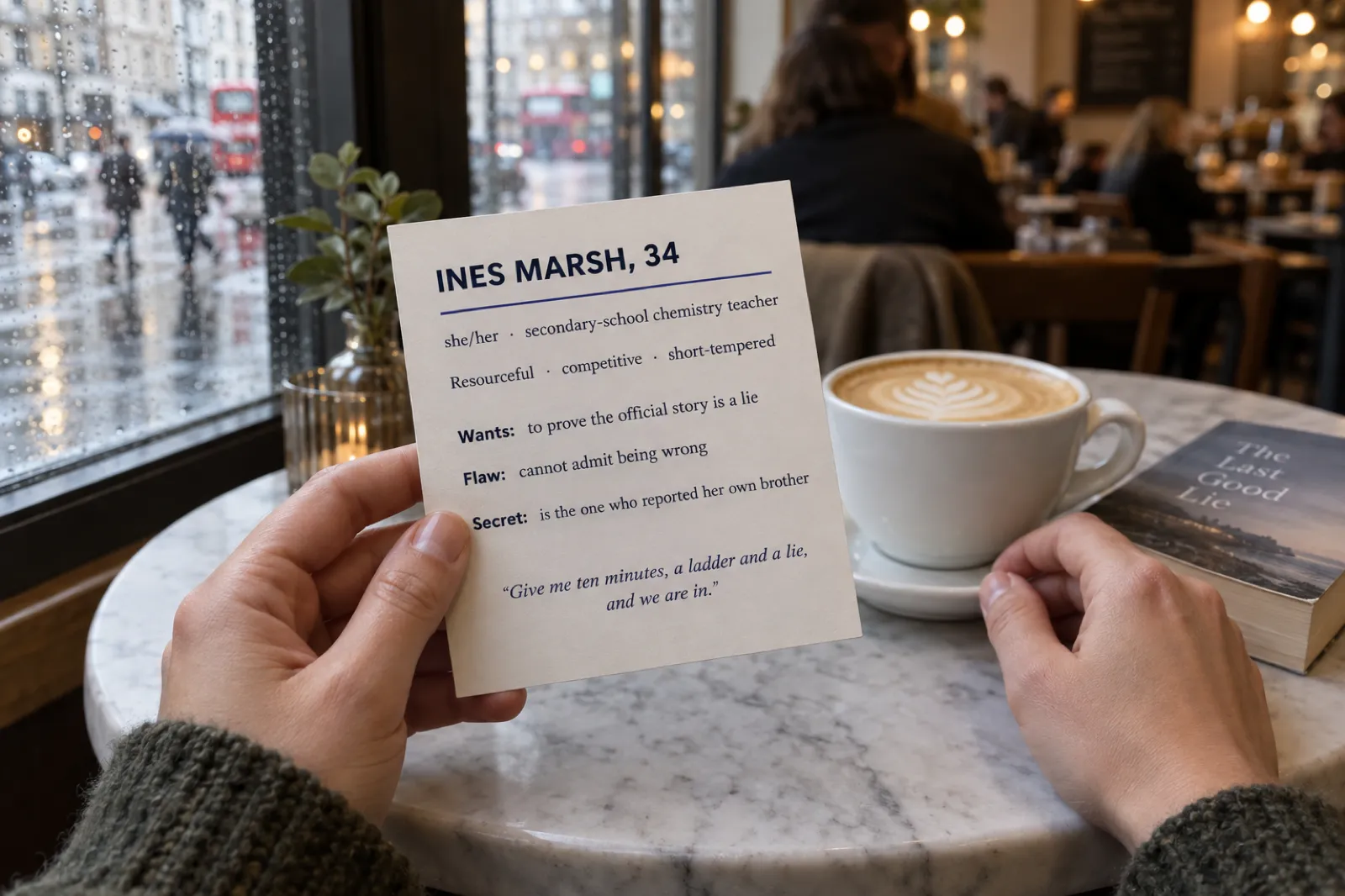
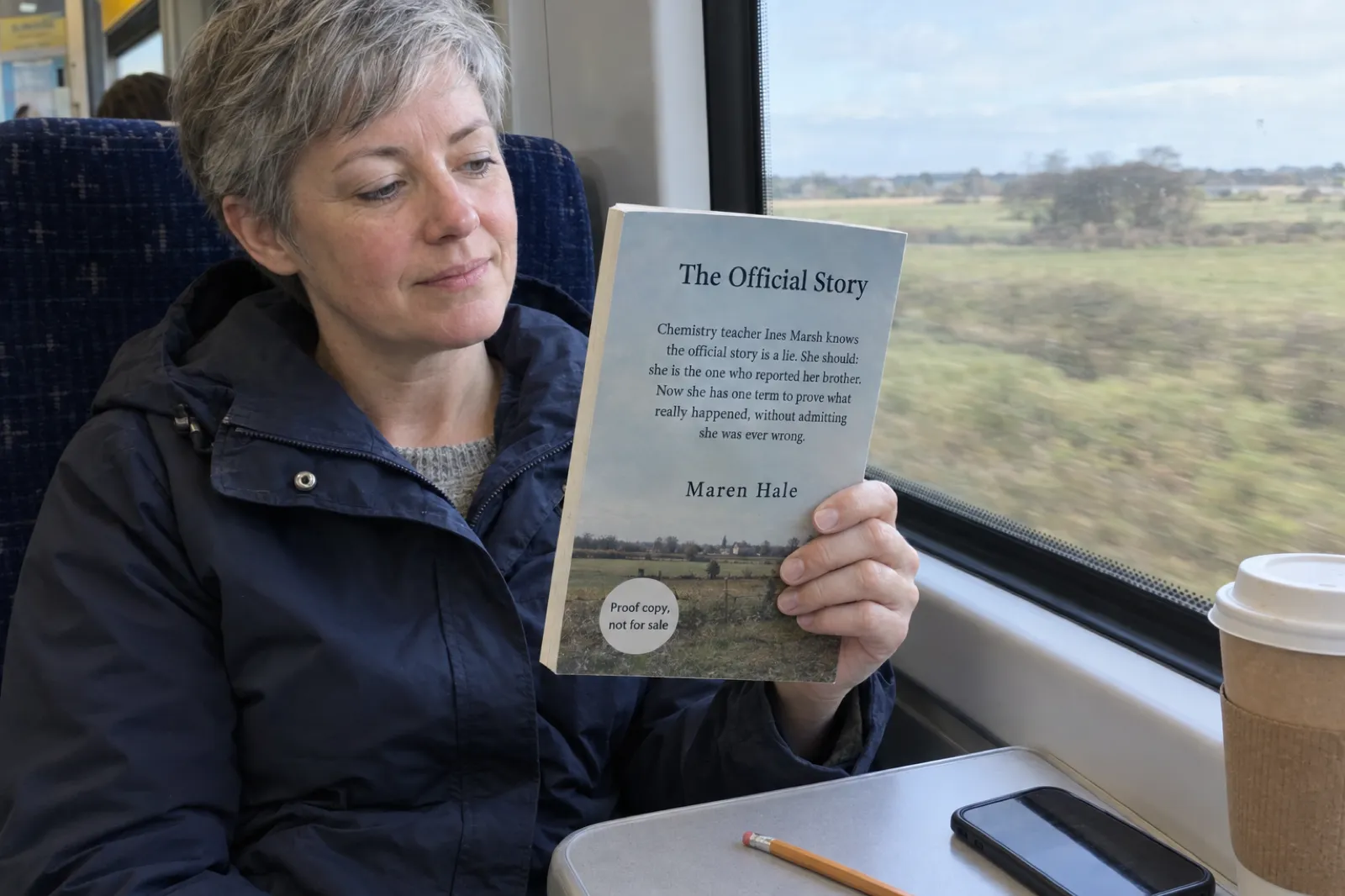
Ines Marsh is the generator's own output: the example below, printed. The want and the secret already make a story.
Quick answer
The random character generator below is free, unlimited and needs no account. Each click builds one complete character for a story, a role-play or an OC: name, age, pronouns, role, job, looks, three personality traits, a want, a need, a flaw, a fear, a secret, a backstory, a habit and a line of dialogue, with a story spark that ties the want to the secret. It works in four settings and six roles, keeps teenagers away from adult backstories and matches the voice to the personality. When a character is worth a book, send it to the Inkfluence AI writer.
Generate a random character
Leave everything on Any for a surprise, or set the setting, role, pronouns and age. Every click makes a new character.
Example below. Press New character for your own.
Protagonist · Contemporary (today)
Ines Marsh, 34
she/her · secondary-school chemistry teacher
Looks
a smile that arrives late; freckles that darken in summer
Personality
resourceful, competitive, short-tempered
Wants
to prove the official story is a lie
Needs
to let someone else lead
Flaw
cannot admit being wrong
Fear
loud crowds
Secret
is the one who reported her own brother
Backstory
lost a parent the week she left for university
Habit
reads the last page of a book first
"Give me ten minutes, a ladder and a lie, and we are in."
Story spark
Ines must prove the official story is a lie. The secret: Ines is the one who reported her own brother.
hand-written entries across jobs, looks, traits, wants, needs, flaws, fears, secrets and backstories
85
jobs, written separately for each of the 4 settings
32
lines of dialogue, two for each strength, so the voice fits
6
roles, each with its own set of wants
Counted from the generator's own lists on 24 Oct 2026. Three rules keep characters consistent: pronouns follow the character through every line, teenagers never draw an adult backstory or secret, and the dialogue line is chosen from the character's strongest trait.
What makes a character feel real
Most random character generators hand you a list of adjectives: brave, green-eyed, likes cats. Adjectives describe; they do not move. A character comes alive when they want something, lack something, and get in their own way. Every character from the generator carries the six parts below, because those are the parts a story can use.
A want
Something the character is chasing that the reader can picture: clear a name, find a sibling, keep a business open. The want gives every chapter a direction, because each scene either moves the character toward it or away.
A need
What the character actually lacks, usually without knowing it: to ask for help, to forgive themselves, to stop running. The best stories put the want and the need in conflict, so getting one costs the other.
A flaw that causes trouble
Not a cute quirk. A flaw is a habit of behaviour that makes things worse at the worst moment: cannot admit being wrong, lies to avoid conflict, acts first and thinks later. Plot is often just the flaw meeting pressure.
A secret
Something the character would rather the reader, or another character, never learned. A secret is a ticking clock you do not have to announce: the moment it comes out is a scene the reader is already waiting for.
Specific detail
Two concrete details beat a paragraph of description. A wristwatch that stopped years ago tells a reader more than "brown hair, average height", and it asks a question the story can answer.
A voice
A line of dialogue only this character would say. If you can hear them, you can write them. The generator ties the voice line to the character's strongest trait, so a resourceful character sounds resourceful.
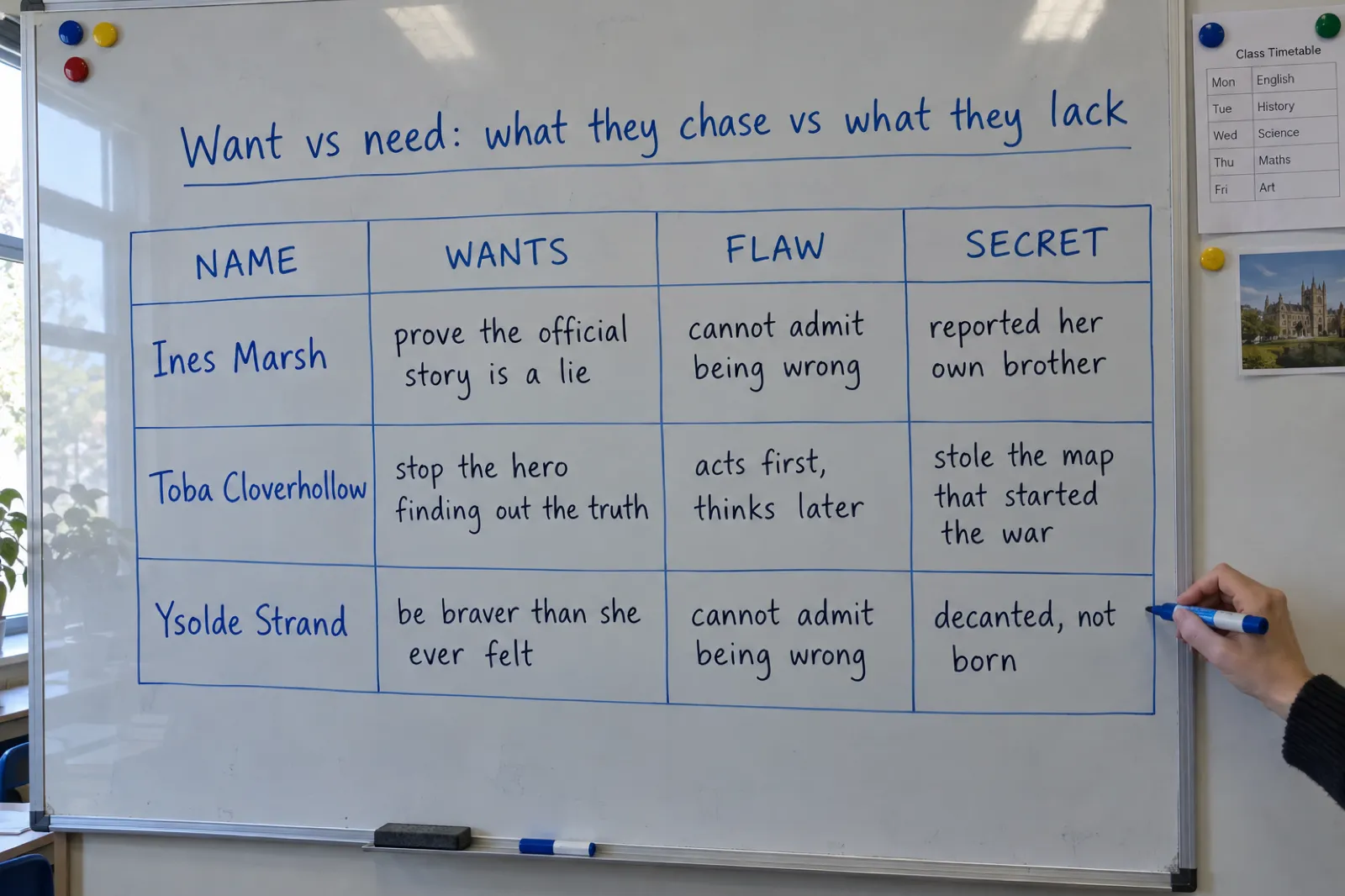
Three characters from the generator, one per setting, on a class whiteboard (lightly shortened by the teacher). The flaw column is where each plot starts.
Look at the sample above. Ines wants to prove the official story is a lie, and she is the one who reported her own brother. The reader does not know the secret yet; you do. Every scene with her brother now has two levels. Her flaw (she cannot admit being wrong) means the story's turning point is already set: the moment she has to say she was. Those few lines are already an outline.
How to turn a random character into a story
1
Generate until one surprises you
Press New character until a combination makes you ask a question. A kind villain, a mentor who wants to be wrong, a love interest with a second phone. That question is your story.
2
Keep the spine, change the rest
Want, flaw and secret are the spine. Change the name, the job and the looks freely; they are there to get you started, not to bind you.
3
Ask what the secret costs
Who would be hurt if it came out? When does it come out? Most plots are the answer to those two questions.
4
Build the people around them
Generate the same setting with another role: an antagonist whose want blocks the protagonist's, a friend whose fear is the protagonist's strength.
5
Write the voice line into a scene
Start a scene with the generated line of dialogue and write what happens next. If the character feels real by the end of the page, keep going.
Stuck on what happens to them? The plot generator gives three full plots a click, and the AI story generator writes a complete short story in twelve genres you can drop your character into.
Protagonist, villain, love interest: what each role needs
The Role setting changes what a character wants, because a villain and a best friend want very different things. These are the jobs each role does in a story, and the one thing each needs to do it.
Role
Job in the story
Must have
Tip
Protagonist
Carries the story; the reader lives inside their choices.
A want the reader can root for and a flaw that makes it hard to get.
Give them the decision at the climax. If someone else saves the day, the reader feels cheated.
Villain or antagonist
Makes the protagonist's want expensive.
A want of their own that makes sense from inside their head.
The generator gives villains a strength as well as a weakness on purpose: a kind villain is far more unsettling than a cruel one.
Love interest
Tests the protagonist's need, not just their heart.
A life and a goal that exist without the protagonist.
A love interest who wants something that would take them away gives you the central tension of most romance for free.
Mentor
Knows something the protagonist needs, and has a reason to hold back.
A past failure and one thing they still want.
Mentors work best when they are wrong about something important. The generator skews mentors older, as most novels do.
Best friend or sidekick
Gives the protagonist someone to talk to, and a reason to be better.
A problem of their own, even a small one.
A friend who is quietly struggling, and hiding it, is a subplot waiting to happen.
Rival
Wants the same thing as the protagonist, and might deserve it more.
Competence. A rival who is not good at the thing is not a rival.
Let the rival be right once. The reader will remember it.
A useful exercise: generate one character for each role in the same setting, then ask how each one's want blocks or helps the protagonist's. Six clicks gives you a cast; the friction between their wants gives you the plot. For a deeper profile of any of them (voice, motivation, flaw, backstory and a three-beat arc), use the character bible generator.
How to describe a character (and why two details beat ten)
People searching for a character description generator usually want help with the hardest part of introducing someone: what to say about how they look. The generator gives exactly two appearance details per character, on purpose. Readers build a face from two specific details faster than from a list, and the details that stick are the ones that suggest a story: a wristwatch that stopped years ago, the posture of someone once in uniform, paint under the fingernails.
Pick details that raise a question. Why did the watch stop? Whose ring is on the chain? A question is a reason to keep reading.
Describe in motion. "She tucked her hair behind one ear before every lie" does more work than "she had long hair".
Let other characters notice. What someone notices about a person says as much about the noticer as the noticed.
Skip the mirror. A character studying their own reflection is the most common way to stall an opening.
Avoid shorthand that judges bodies. The generator's looks are distinctive, not evaluative; describe what makes someone particular, not whether they are attractive.
Naming them is part of describing them. For real-world names by culture and era, use the character name generator; for elves, dwarves and other fantasy peoples, the fantasy name generator gives every name a meaning. Fantasy characters here already use it.
Personality and backstory: the strength, the neutral, the weakness
Every character gets three personality traits in a fixed shape: one strength, one neutral trait and one weakness. A character made only of strengths is a hero in an advert; one made only of weaknesses is hard to spend a book with. The neutral trait (private, methodical, superstitious, nostalgic) is the texture that makes them a person rather than a moral lesson.
The backstory is a single hook rather than a biography, because a backstory is only useful when it explains a present choice. "Spent a year living in a van after a breakup" explains why a character keeps every receipt and never unpacks. Write the backstory you need for the scene in front of you, and keep the rest in your notes.
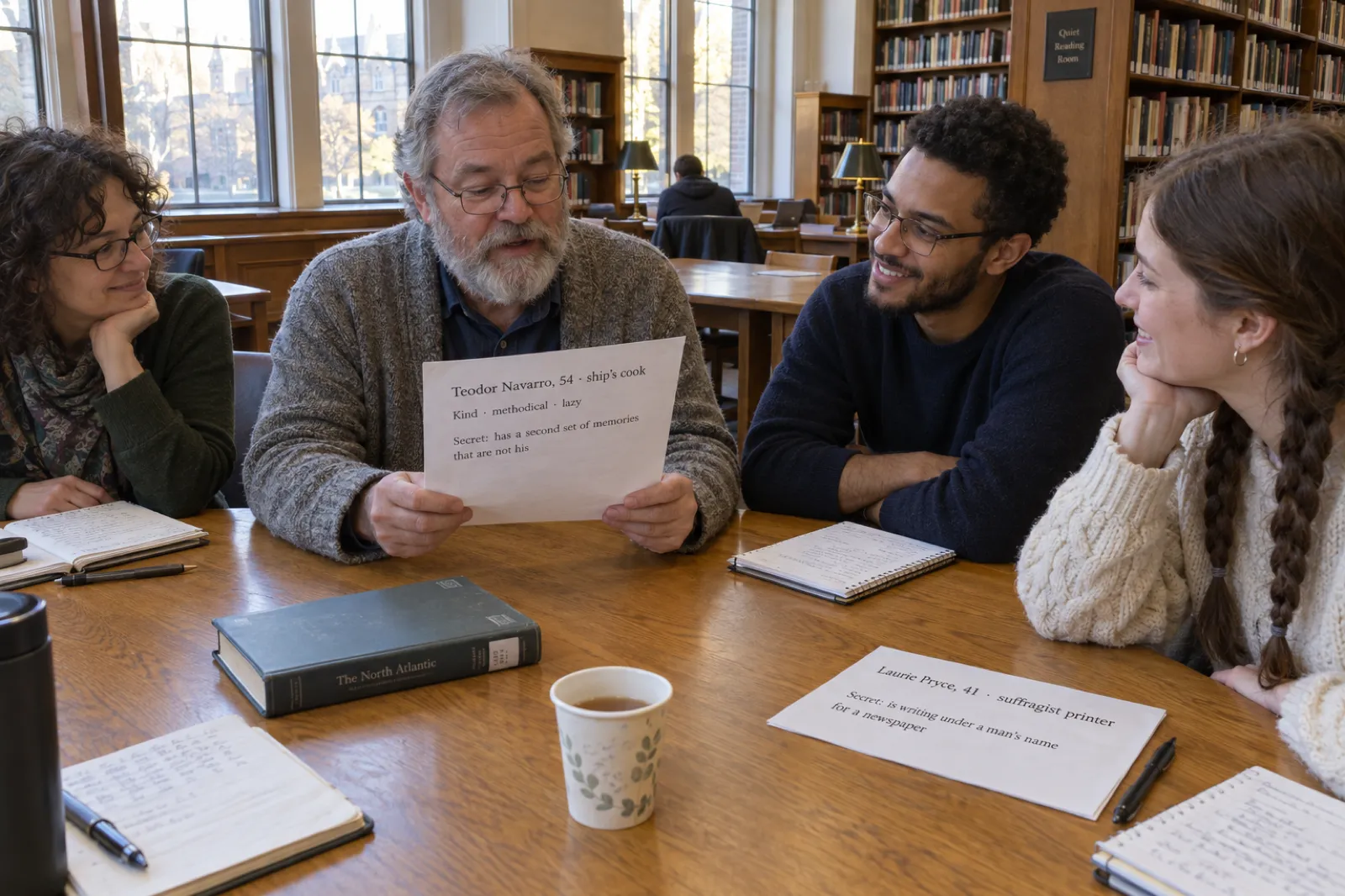
A writing-group warm-up: everyone generates a character, then writes the scene where their secret nearly comes out. Teodor and Laurie are real generator output.
The kind, lazy ship's cook with a second set of memories is a good example of why the shape works. Kind makes him likeable, lazy makes him human, and the secret makes him a story. A writing group can get a whole session out of one character like that.
Contemporary, fantasy, science fiction or historical: what changes
The Setting choice changes the parts of a character that depend on their world: the name, the job, the secret and the backstory. The want, need, flaw, fear and personality stay universal, because people in every century want the same things and get in their own way the same ways. That is also why a character from one setting often transplants well into another.
Setting
Names
Jobs, for example
Secrets, for example
Contemporary
A deliberately mixed modern pool, because a present-day cast comes from everywhere
night-shift nurse, locksmith, crossword setter
has a second phone nobody knows about; knows who really started the fire
Fantasy
Elvish, dwarvish, halfling, fae, orcish and old human names, each with a meaning
cartographer to a minor lord, hedge witch, gravedigger
stole the map that started the war; knows the prophecy was forged
Science fiction
Near-future names that mix cultures and invent a few
salvage diver, xenolinguist, memory therapist
was decanted, not born; knows the ship is off course and has kept quiet
is writing under a man's name for a newspaper; knows where the missing heir is buried
Try the same role in two settings and compare. A protagonist who must clear their name reads one way as a paralegal today and another as a governess in 1890, and the difference tells you which story you actually want to write. For a historical book, the AI novel writer keeps period detail consistent across chapters; for fantasy, the fantasy novel writer holds the magic rules and the map.
Twelve questions to ask a generated character
A generated character is a sketch. The fastest way to turn a sketch into a person is to interview them. Answer these in the character's own voice, out loud or on the page, and stop when you start to hear them argue back.
What do you want, and what would you give up to get it?
Who knows your secret, and who must never find out?
What did you do the last time your flaw cost you something?
What are you most proud of that nobody else noticed?
Who do you call at two in the morning?
What does your fear look like on an ordinary day?
What would your worst enemy say about you, and are they right?
What is in your pockets right now?
What do you lie about most often, and why that?
What would make you give up on what you want?
What do you need that you would never ask for?
How do you want this story to end, and how will it actually end?
Questions 2, 3 and 12 do most of the work. The gap between how the character wants the story to end and how it ends is, almost by definition, the plot. When you know the answers, the book outline generator can turn them into a chapter plan.
OC generator: original characters for fan works, art and roleplay
An OC, or original character, is a character you invented rather than borrowed from an existing story: a new student at a familiar academy, an extra crew member, a new face in someone else's world. People use OC generators for fan fiction, roleplay servers, webcomics and character art. The generator works well as one: every character arrives with a look to draw, a personality to play, and a secret to reveal.
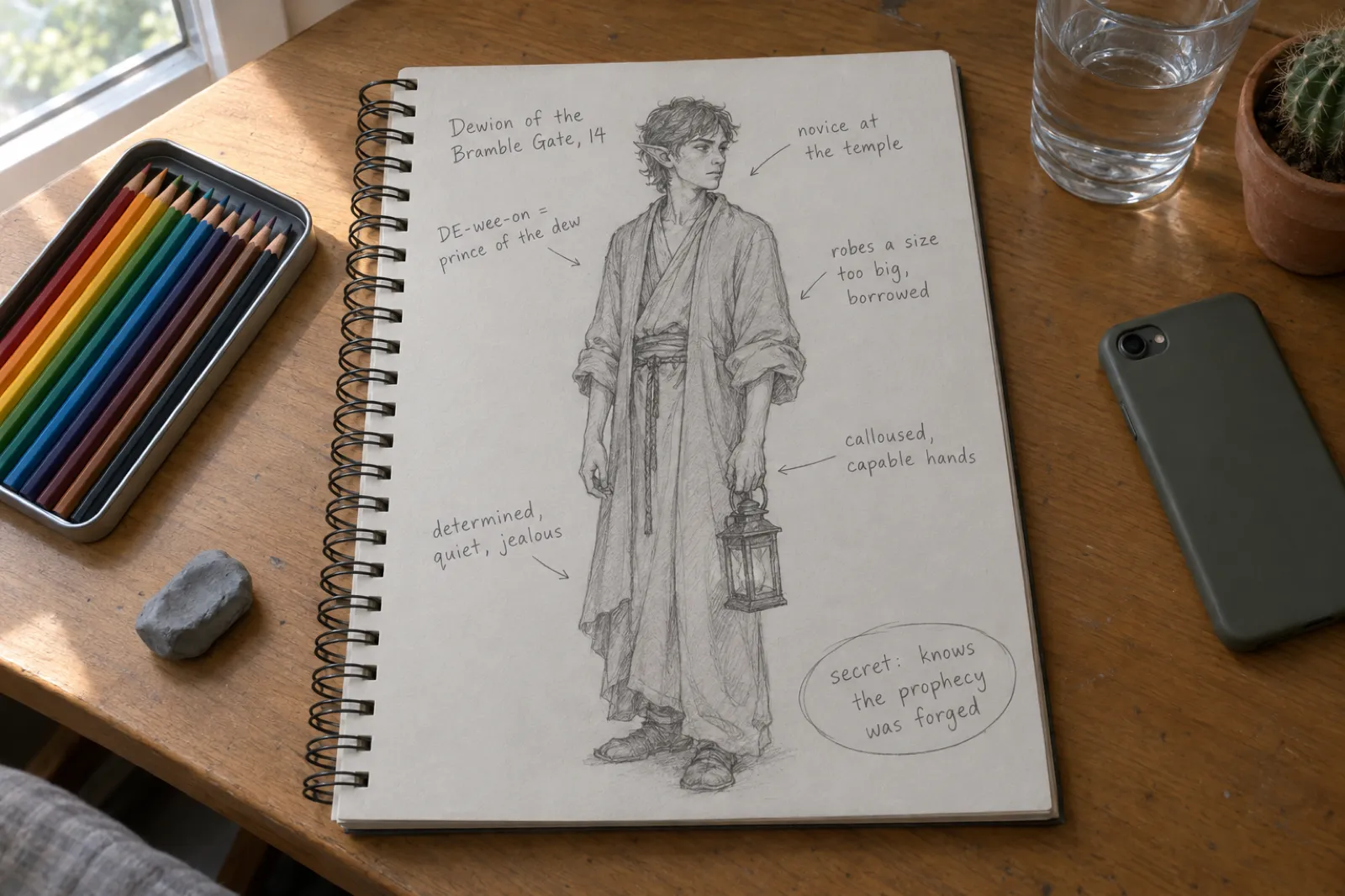
A fantasy OC from one click, drawn: the name and its meaning come from the fantasy name generator, the rest from this one (the artist turned "clothes a size too big" into temple robes).
If your OC lives in someone else's universe, use the generated character as a base and fit them to the canon's rules. Writing them into a longer fan work? The AI fanfiction writer writes multi-chapter fics around your characters, and the fanfiction prompt generator gives you the situation to drop them into.
NPCs for tabletop games, in one click
A game master needs three things from an improvised non-player character: a name, something they want from the party, and something they are hiding. The generator gives all three, plus a voice line to say in character. Set the setting to Fantasy, choose a role (a rival adventurer, a mentor with a past, a villain with a reason) and keep a few printed behind the screen.
Using a random character generator in the classroom
Teachers use character generators because a blank page stops more student writers than any lack of talent. A character with a want, a flaw and a secret gives a class something to argue about before anyone writes a word. Three exercises that work from about age eleven:
The secret scene. Everyone generates a character and writes the moment their secret nearly comes out, without ever stating it. Partners guess the secret from the scene.
Want against want. Pairs generate one protagonist and one antagonist in the same setting, then write a single conversation in which each tries to get what they want from the other.
Same person, two centuries. Generate a character, then switch only the setting to historical and rewrite the opening paragraph. Students see how setting changes job, voice and stakes.
The generator has no accounts and nothing to sign up for, so a class can use it on any school device. Ages can be set to teen for characters that suit younger writers; teen characters never draw adult backstories or secrets. Teachers building a whole unit can see how teachers use Inkfluence AI, and the writing prompt generator has prompts for daily warm-ups.
Five character mistakes a generator helps you avoid
The perfect hero
A character with no real weakness has nothing to overcome, so the story has nowhere to go. Every character here gets a weakness and a flaw, and they are not the same thing: one is a trait, the other is what the trait makes them do.
The villain with no reason
A villain who is evil because the plot needs one is forgettable. Villains here get a want that makes sense from inside their head, and a strength, which is what makes them frightening.
Everyone sounds the same
If you can swap two characters' lines without noticing, one of them is not a character yet. The voice line gives you a starting register for each, tied to the trait that defines them.
The love interest who exists for the hero
A love interest with no goal of their own is furniture. Love interests here want something that could pull them away, which is where romantic tension comes from.
Backstory instead of story
Three pages of childhood before anything happens lose readers. The generator gives one backstory hook, enough to explain a choice, and leaves the present tense to the story.
Once a draft exists, the AI novel editor checks it for exactly these problems: flat voices, a passive protagonist, a villain whose motive does not hold up. Our guide to how Inkfluence AI keeps a long book consistent explains how characters stay themselves across a whole novel.
From one character to a whole book
Plenty of novels began as a single character the author could not shake. When you press Write a book with this character, the Inkfluence AI dashboard opens with the character and the story spark in the start box. Add a sentence about the shape of the story (a mystery, a romance, a coming-of-age) and the AI writer takes it from there.
From character card to proof copy: the blurb is Ines's want, secret and flaw, in that order. The book, title and author are invented for this page.
Outline and story bible. The writer builds a chapter-by-chapter outline and a story bible of characters, places and rules, starting from your character.
Chapters in order. Fiction is written one chapter after another, each reading what came before, with a running record of who knows what, so a secret stays secret until you reveal it.
Edit. Rewrite in the editor, ask the assistant for a sharper first line, cut a scene, add your own.
Cover and export. Make a cover with the cover generator, write the blurb with the book description generator, and export a PDF free, or EPUB, Word and a print-ready KDP interior on a paid plan.
Audiobook and trailer. On Creator and Premium, turn chapters into an audiobook and make a vertical book trailer.
Read on their own pages on 24 Oct 2026. Each does a different job.
Generator
What you get
Best for
Springhole random generators
A large index of separate generators: human and humanoid profiles, character details, backstories, outfits, plus an OC creation kit
Digging into one aspect of a character at a time
Chaotic Shiny
Many separate generators, including modern, fantasy and simple characters, motives and attitudes, alongside worldbuilding tools
Gamers and worldbuilders who like to mix pieces
Adobe Firefly AI character generator
Character images from a text prompt, in a chosen art style
A picture of a character, not a written one
This generator
One complete written character per click (want, need, flaw, secret, voice and a story spark), consistent pronouns and ages, and a button that sends the character to an AI writer
A character that already contains a story, and the step from character to book
Random character generator: frequently asked questions
Is this random character generator free?
Yes, and unlimited. There is no sign-up and no limit on clicks: every character is assembled in your browser, so another one costs nothing. If you want the AI writer to turn a character into a book, the free plan writes 5 chapters a month with PDF export; Creator is $9.99 a month for 35 chapters and Premium is $19.99 a month for unlimited chapters.
What does each character include?
A name, age, pronouns, role, job, two appearance details, three personality traits (a strength, a neutral trait and a weakness), a want, a need, a flaw, a fear, a secret, a backstory hook, a habit, a line of dialogue in their voice, and a one-line story spark that puts the want and the secret together.
Is it AI?
Not in the language-model sense. The generator combines hand-written lists (326 entries, including 85 jobs, plus 32 voice lines tied to personality traits), with rules that keep the result consistent: teenagers never get an adult backstory, pronouns follow the character, and the voice matches the strongest trait. That is why it is instant and free. The Inkfluence AI writer is different: it writes a whole book from your character.
Can I use it to make an OC?
Yes. Original characters for fan works, art, roleplay or a webcomic are one of the main uses. Pick a setting, keep pressing New character until one clicks, then change anything you like. The fantasy setting uses names with meanings from our fantasy name generator, which helps if you are drawing or designing the character too.
Can I use it for Dungeons and Dragons or other tabletop games?
Yes, for NPCs especially. Choose Fantasy, set the role (a rival for the party, a mentor, a villain) and you get a name, a motive and a secret in one click, which is most of what an improvised NPC needs. Inkfluence AI is not affiliated with Wizards of the Coast, which owns Dungeons & Dragons.
Does it make pictures of characters?
No. This generator writes characters. If you need an image, AI image tools such as Adobe Firefly make character pictures from a description; you can paste the looks and personality from a character here into one as your prompt.
Can I publish a book with a character from here?
Yes. You can use any character you generate without credit. Names and short phrases are not protected by copyright in the United States, and the generator's combinations are starting points for you to change. If you use the AI writer for the book itself, Amazon KDP asks you to disclose AI-generated text when you publish.
Can I keep the name and reroll everything else?
Use Copy to save a character you like, then generate again. For a name with a meaning, the fantasy name generator and the character name generator let you pick a name first and build around it.
Can I turn a character into a book?
Yes. Press Write a book with this character and the Inkfluence AI dashboard opens with the character and the story spark in the start box. The AI writer builds an outline and a story bible that tracks every character, writes the chapters in order, and gives you an editor, a cover and export.
Sources
All read on 24 Oct 2026. Other tools change their pages; if a description here and the tool's own page disagree, the tool's page wins.
Inkfluence AI plan settings and the generator's own lists, read 24 Oct 2026: chapter, audiobook and video allowances; entry, job and voice-line counts.
Dungeons & Dragons is a trademark of Wizards of the Coast. Springhole, Chaotic Shiny, Adobe, Firefly, Amazon and KDP are trademarks of their owners. Inkfluence AI is independent and not affiliated with or endorsed by any of them.
Send your character to the Inkfluence AI writer and get an outline built on their want and secret, a story bible that keeps them consistent, chapters in order, an editor, a cover and an export. Free to start, no card.