Updated November 2026 · free, unlimited, no sign-up

Free AI Ebook Prompt Generator: Write the Prompt, Then the Whole Ebook

Tell it your topic, the kind of ebook, who it is for, the tone and how many chapters. It writes a complete ebook prompt with a reader, a promise, a structure, a voice and the rules to follow, in three formats, every time you click. Copy one, or send it straight to Inkfluence AI and get the whole book written.

By Sam May, founder of Inkfluence AI

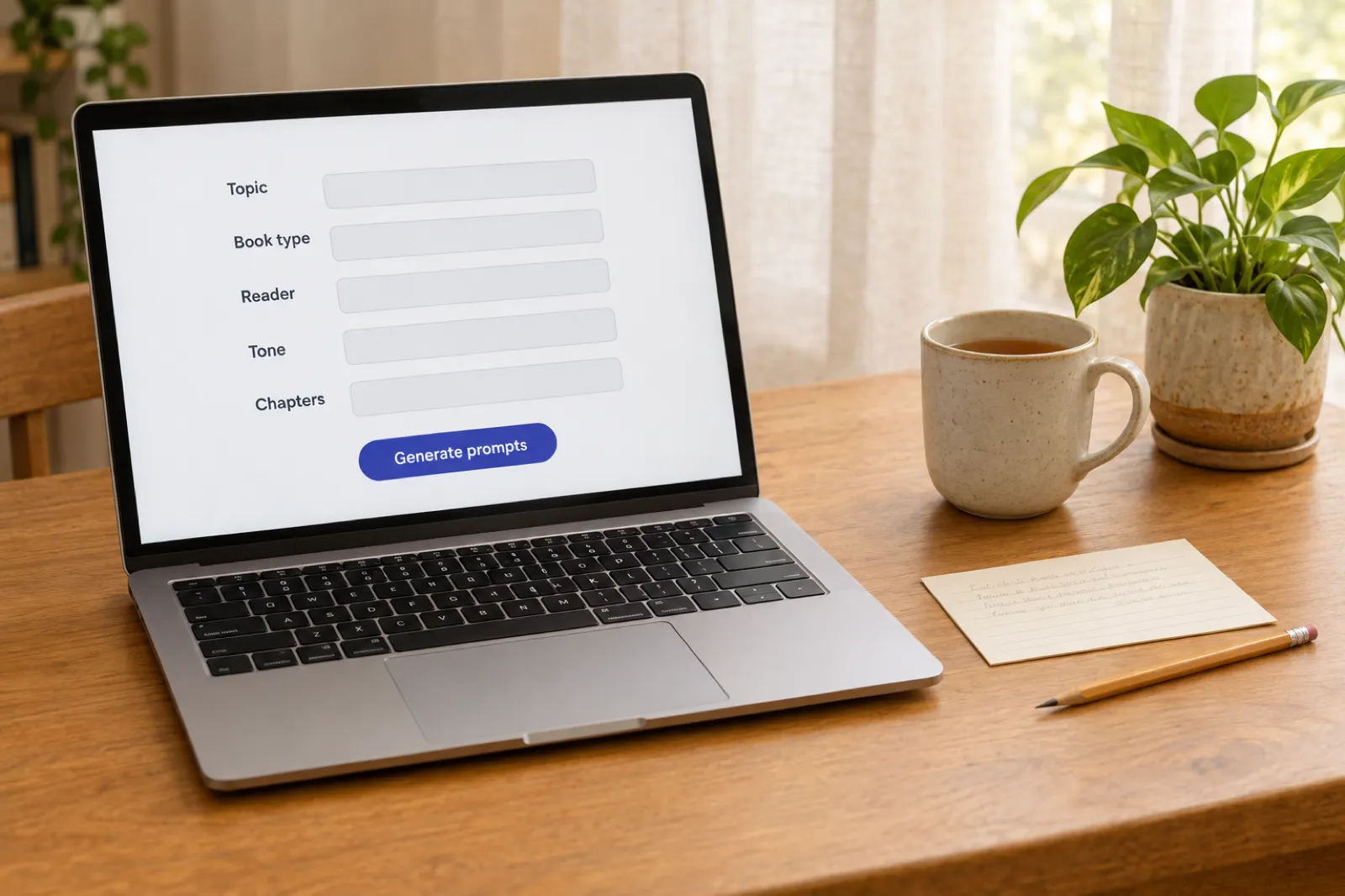
A laptop on a honey-coloured wooden desk showing a form with the fields Topic, Book type, Reader, Tone and Chapters and a Generate prompts button, beside a mug of tea, a handwritten index card, a pencil and a potted plant

What is an ebook prompt generator? The short answer

An ebook prompt generator writes the brief an AI needs to write a good ebook. Instead of typing "write an ebook about budgeting" and hoping, you get a prompt that names one reader, promises them a result, sets the number of chapters and what goes in each, describes the voice and lists what to avoid. Those five parts are the difference between a generic draft and one that reads like it was written for someone.

The generator below is free, has no limit and runs entirely in your browser. Each prompt it writes can be copied into any AI tool, or sent to the Inkfluence AI ebook generator with one click, where it becomes an outline, full chapters, a cover and a PDF or EPUB. Looking for ready-made prompts to use inside a chapter instead? The library of 50+ AI writing prompts for ebooks covers that.

5 parts

in every strong prompt on this page: reader, promise, structure, voice and constraints.

12 book types

the generator writes for, from a five-chapter lead magnet to a novel or a picture book.

1,000 to 1,500

words: roughly what one chapter runs in Inkfluence AI, which is why the chapter count sets the length.

0 sign-ups

to use the generator. Prompts are built in your browser, so you can make as many as you like.

Generate your ebook prompt

Fill in what you know and leave the rest: an empty Reader box gets a sensible reader for the book type. Press Generate prompts for a full brief, a paragraph version and a short version. Press it again for new wording, as many times as you like.

Extras in every chapter (optional)

Your prompts will appear here. Type a topic, choose a book type and press Generate prompts.

Write this book opens Inkfluence AI with the prompt already in the idea box, so you can read it, change anything and press Go. Every prompt here stays under 1,900 characters, which fits the hand-off in full. Need the chapter plan first? Paste your topic into the book outline generator.

The five parts of a strong ebook prompt

Every good ebook brief, whether it goes to a human ghostwriter or an AI, answers the same five questions. The topic is not one of them: the topic says what the book is about, and the five parts decide what kind of book it becomes.

The generator fills in all five. When you write your own, go in this order, because each part shapes the next: the reader decides the promise, and the promise decides the structure.

Part 1

Reader: who the book is for

One specific person, described by their situation rather than their age bracket. "Nurses on rotating shifts" tells the AI what their days look like, what they already know and which examples will land. "Everyone" tells it nothing, so it writes for nobody.

Ask yourself: Who is reading, what is their situation, and what have they already tried?

Part 2

Promise: what changes for them

The result the reader has by the last page, said in their words. A promise gives every chapter a job: move the reader one step closer. Without it, chapters drift into general information about the topic.

Ask yourself: What can the reader do, have or understand at the end that they could not before?

Part 3

Structure: how the book is built

The chapter count and the shape of each chapter: what it opens with, what it teaches and how it ends. This is where you ask for exercises, checklists or case studies. It is also the only reliable way to set length.

Ask yourself: How many chapters, and what does every chapter contain?

Part 4

Voice: how it sounds

Two or three plain words for the tone, plus a comparison the AI can picture: "like a colleague who sorted their own money out". A named comparison does more than a stack of adjectives.

Ask yourself: Who would the reader want to hear this from, and how would that person talk?

Part 5

Constraints: what to keep out, or keep to

The guard rails: no investing advice, metric and cup measures, no made-up statistics, keep the main character's name the same. Constraints are where you protect the reader and your reputation.

Ask yourself: What must the book never do, and what must it always do?

Not a part

Length in pages or words

Asking for "a 100-page ebook" or "30,000 words" rarely works with any AI writer, because the model cannot count its own output reliably. Ask for a number of chapters instead. In Inkfluence AI a chapter runs roughly 1,000 to 1,500 words, so the chapter count is the length control.

Each part, weak and strong

The same budgeting book, part by part. The weak column is what most people type; the strong column is what the generator writes.

PartWeakStrong
Readerwho it is for"for beginners""for nurses on rotating shifts who feel they never know where their pay goes"
Promisewhat changes"help them with money""by the end, they keep a simple budget in 10 minutes a week"
Structurechapters and their shape"make it long""8 chapters, an exercise in each, every chapter opening with a short shift-work scenario"
Voicehow it sounds"engaging and professional""warm, plain English, like a colleague who sorted their own money out"
Constraintsthe guard rails(none)"no investing advice, no shaming, and assume no spreadsheet skills"

Before and after: weak ebook prompts made strong

A one-line prompt is not wrong, just unfinished. The AI still has to decide who the book is for, what it should achieve and how it should sound, and when it decides for you it picks the most average answer. That is where the "generic AI book" feeling comes from. Each pair below starts with a prompt people really type.

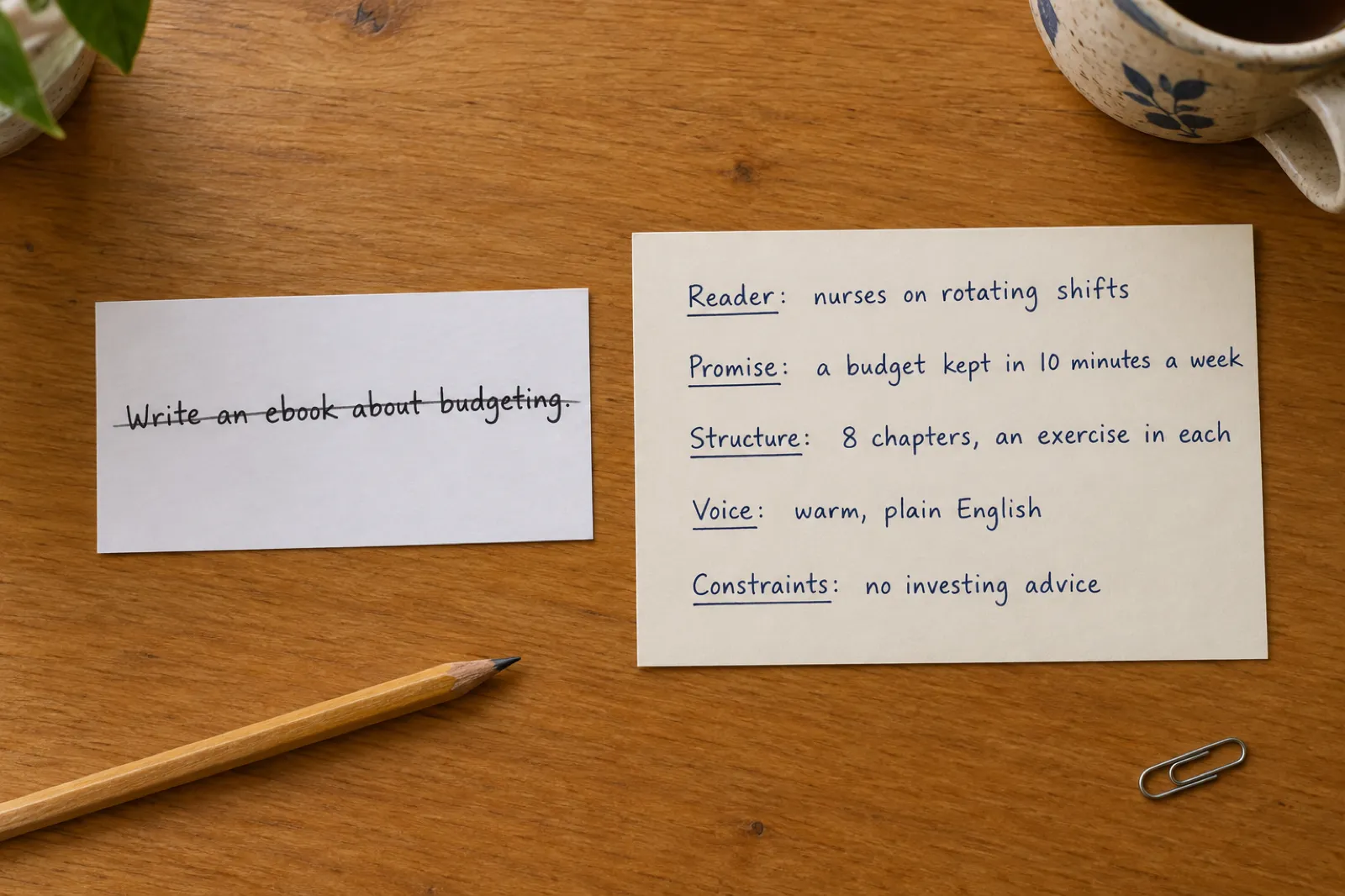
Two index cards on a wooden desk: a small white card reading Write an ebook about budgeting, crossed out in pencil, and a larger cream card reading Reader: nurses on rotating shifts, Promise: a budget kept in 10 minutes a week, Structure: 8 chapters, an exercise in each, Voice: warm, plain English, Constraints: no investing advice
The same budgeting book, before and after. The strong card answers the five questions the weak one leaves to the AI.

Example 1: "Write an ebook about budgeting."

Before

Write an ebook about budgeting.

After

Write a practical how-to ebook about budgeting for nurses on rotating shifts who feel they never know where their pay goes. Promise: by the end, they keep a simple budget in 10 minutes a week. Structure: 8 chapters, an exercise in each, every chapter opening with a short shift-work scenario. Voice: warm, plain English, like a colleague who sorted their own money out. Constraints: no investing advice, no shaming, and assume no spreadsheet skills.

What changed: A reader with a real schedule, a result you can measure in minutes, and a constraint that keeps the book inside what a budgeting guide should cover.

Write this book

Example 2: "Write a social media guide for my business."

Before

Write a social media guide for my business.

After

Write a short free guide for owners of independent cafés on turning social media followers into regulars. Reader: café owners who post now and then but see no change at the till. Promise: a weekly posting plan that takes under an hour. Structure: 5 chapters: what to post, when to post, how to write captions, how to turn followers into visits, and a four-week plan. Voice: friendly and concrete, with café examples throughout. Constraints: no paid advertising advice, no follower-count promises, and end with a placeholder for my booking link.

What changed: The reader and the promise come from the business behind the book. The chapter list does the AI's planning for it, so nothing important gets left out.

Write this book

Notice what the strong versions leave out: "make it engaging", "high quality", "act as a world-class expert". Those phrases change very little. Specific facts about the reader and the result change everything. For more on why drafts go flat and how to fix them after the fact, read how to avoid generic AI book output.

Ebook prompt examples by book type

The five parts stay the same across every kind of book, but what goes in them changes. A workbook prompt has to say how much of each chapter is exercises. A cookbook prompt has to fix the layout of every recipe. A picture book is counted in pages. Here are six full prompts to use as they are or adapt, each with a note on the line that matters most.

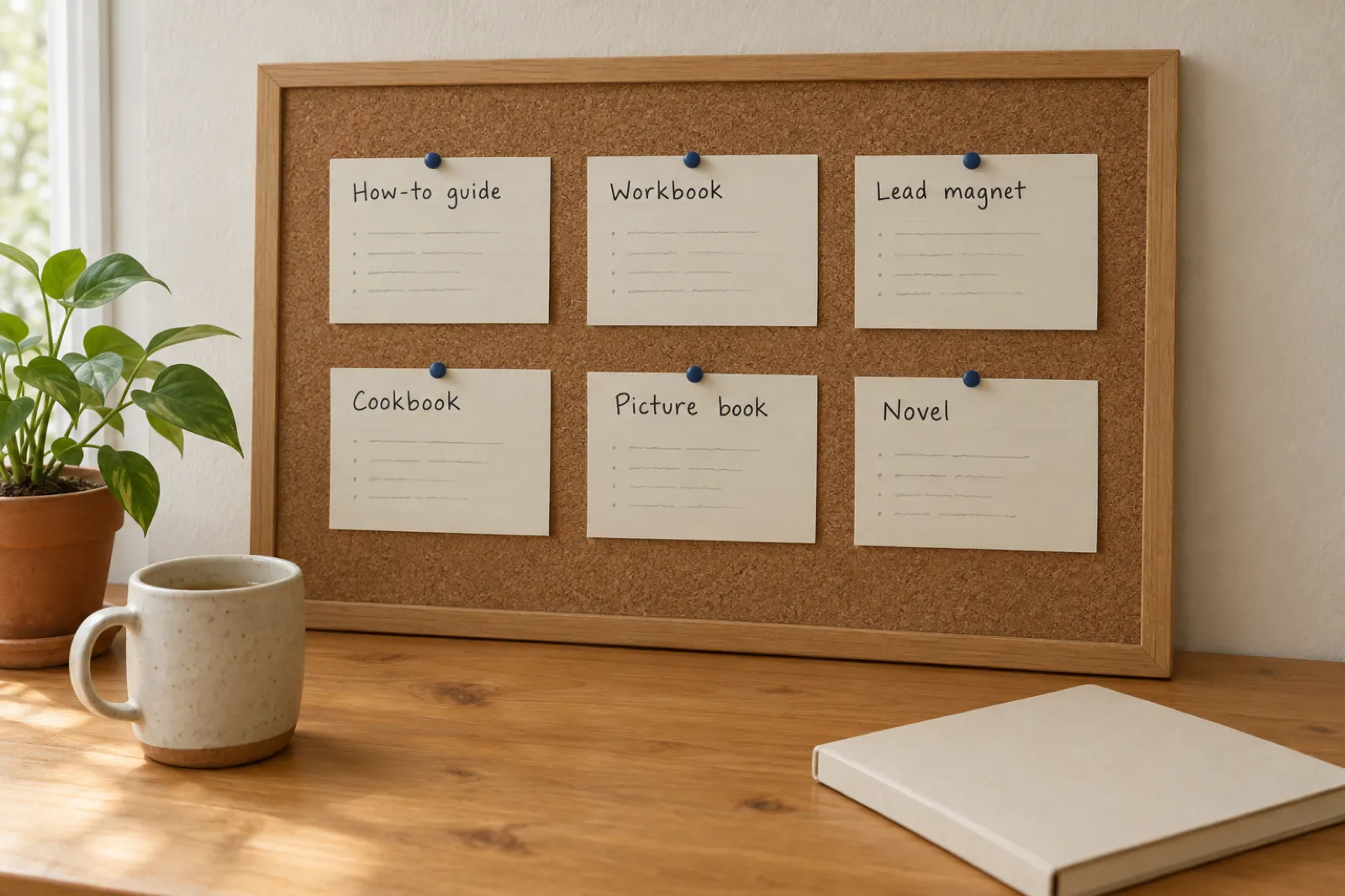
A cork board above a wooden desk with six cream index cards pinned in two rows, headed How-to guide, Workbook, Lead magnet, Cookbook, Picture book and Novel, beside a mug, a plant and a closed notebook
The six book types in the examples below. The generator covers twelve.

How-to guide

Write a practical how-to ebook about starting a vegetable garden in a small backyard. Reader: first-time gardeners with a busy job and a yard about the size of a parking space. Promise: by the end, they have planted, watered and harvested at least three easy crops and know what to grow next season. Structure: 8 chapters in the order they will do the work, from choosing a spot to saving seeds. Each chapter opens with a common worry, teaches one job in numbered steps and ends with a short checklist. Voice: warm and plain, like a neighbour leaning on the fence. Constraints: assume no special tools, give timings by season rather than by month, and define every gardening term the first time it appears.

Why it works: The season-based timing is a constraint that keeps the book useful in any climate. The checklist at the end of each chapter turns reading into doing. More on this kind of book: the AI ebook generator.

Write this book

Workbook

Write a workbook that helps freelance writers set and keep a weekly writing schedule. Reader: freelancers juggling client work who keep putting their own projects last. Promise: in six weeks, the reader has a schedule they have kept for at least three weeks running. Structure: 6 chapters, one per week. Each has a short lesson (no more than a third of the chapter), then two or three exercises with space to write, then one reflection question. Voice: encouraging and practical. Constraints: every exercise must take under fifteen minutes, label each exercise clearly so the pages print well, and avoid productivity jargon.

Why it works: A workbook prompt has to say how much is teaching and how much is doing. "No more than a third" stops the lessons swallowing the exercises. More on this kind of book: the workbook generator.

Write this book

Lead magnet

Write a short free guide I can give away as a lead magnet for my bookkeeping business. Topic: five ways to cut a small business's weekly admin time. Reader: owners of one-to-five-person businesses who do their own books on Sunday nights. Promise: each tip saves time this week without buying new software. Structure: 5 short chapters, one tip each, with a quick example and a two-line action step. Voice: friendly, plain and brief. Constraints: no sales pitch inside the chapters, end the last chapter with one clear next step and a placeholder [booking link], and keep it easy to skim on a phone.

Why it works: Lead magnets fail when every page sells. This prompt keeps the pitch to one placeholder at the end, so the guide earns the click first. More on this kind of book: the lead magnet generator.

Write this book

Cookbook

Write a cookbook of quick vegetarian dinners for busy weeknights. Reader: working couples who start cooking after 6pm and want something better than pasta again. Promise: dinner on the table in about 30 minutes, from a weekly shop that fits in one bag. Structure: 8 chapters grouped by base (pasta, rice, beans, eggs, tray bakes, soups, salads, sides), four recipes in each. Every recipe has servings, active time, ingredients with quantities and a numbered method. Voice: friendly and encouraging. Constraints: use ingredients from a normal supermarket, give metric and cup measures, and note common allergens.

Why it works: Cookbooks live or die on consistency. Naming the parts of every recipe gets the same layout in chapter one and chapter eight. More on this kind of book: the AI cookbook generator.

Write this book

Children's picture book

Write a 12-page children's picture book about a shy hedgehog who learns to make a friend at the autumn fair. Reader: children aged 3 to 6, read aloud by a parent at bedtime. Promise: a gentle story about being brave in small steps, ending warm and reassuring. Structure: one short scene per page, one to three sentences each, with a repeated line children can join in with. Voice: soft, rhythmic and calm. Constraints: simple words a young child knows, every page suggests one clear picture, and the hedgehog's name and look stay the same throughout.

Why it works: Picture books are counted in pages, not chapters. "Every page suggests one clear picture" helps the text and the illustrations agree. More on this kind of book: the AI picture book maker.

Write this book

Novel

Write a cosy mystery novel about a retired lighthouse keeper who finds a stranger's diary washed up after a storm. Reader: adult readers who like gentle mysteries with small-town characters. Promise: a fair-play puzzle the reader could solve, and a satisfying reveal in the final chapters. Structure: 20 chapters. Each moves the investigation forward with one discovery and ends on a question. Plant every clue before the reveal. Voice: close third person on the keeper, warm with dry humour. Constraints: keep names, places and the timeline consistent, show feelings through action and dialogue, and no graphic violence.

Why it works: For fiction, the promise is the kind of ending the reader is owed. "Plant every clue before the reveal" is the one line that most improves a mystery draft. More on this kind of book: the AI novel writer.

Write this book

Still choosing a topic? Start with ebook ideas or the best ebook niches, then come back with one. The generator also writes prompts for self-help, business books, study guides, travel guides, devotionals and memoirs. For those, see the AI self-help book writer, the AI business book writer and the AI journal generator.

How many chapters to ask for

Length is the part of a prompt people most often get wrong, because the natural way to say it ("about 50 pages") is the one AI writers handle worst. Inkfluence AI does not take a page or word target. It takes a chapter count, from your prompt or from the chapter setting in manual setup, and writes each chapter to roughly 1,000 to 1,500 words. So decide the number of chapters and put it in the prompt.

The right number depends on the job the book does. A lead magnet should be read in one sitting; a novel needs room for a full arc. These ranges are where most books of each type land. If you want to see what a chapter count means for a printed book, the book length calculator turns words into pages, and how many chapters in a book goes deeper on each genre.

Book typeChapters to ask forWhy
Lead magnet3 to 5Short enough to read in one sitting, which is the point of a free guide.
Workbook6 to 8One chapter per week or per module keeps the exercises paced.
How-to guide8 to 10One step or skill per chapter, in the order the reader will do them.
Self-help8 to 12Room for a story, an idea and an experiment in every chapter.
Business or authority book10 to 12Mindset, method and proof need space without padding.
Cookbook6 to 10Group recipes by meal or base; say how many recipes go in each chapter.
Study guide8 to 12Match the units or topics of the course the reader is taking.
Travel guide6 to 10One chapter per area or per day of the trip.
Devotional7 to 31A week or a month of readings; long runs can be written across several months on the free plan.
Memoir12 to 20One period or turning point per chapter.
Novel20 to 30Each chapter carries one key event; novels are written in order.
Children's picture book10 to 16 pagesCounted in pages, one picture per page. The app keeps picture books between 10 and 16.

Plan around your plan, too. The free plan covers 5 chapters a month, which is exactly a lead magnet or a short guide. A 10-chapter how-to book fits inside Creator, which covers 35 chapters a month. A 25-chapter novel is a Premium job, or a free start topped up with a credit pack. The full numbers are in the table further down.

Tone words that work in a prompt

The tone menu in the generator has six settings because those six cover almost every ebook. Each one turns into a description the AI can act on rather than a single adjective. Here is what each is for, and the phrase the generator uses so you can borrow it.

Warm and encouraging

Self-help, parenting, health habits, first-time anything. Phrase: "like a friend who has been where the reader is".

Plain and practical

How-to guides, checklists, technical topics. Phrase: "short sentences, everyday words, no filler".

Expert and authoritative

Business and authority books, professional guides. Phrase: "like an experienced practitioner explaining their method".

Friendly, with some humour

Hobbies, cooking, travel, lead magnets for consumer brands. Phrase: "a little humour, never silly".

Calm and reflective

Devotionals, memoir, journals, grief and wellbeing. Phrase: "unhurried, with room to think".

Bold and direct

Sales, fitness, money and productivity. Phrase: "say what works and what does not, without hype".

Two rules make any tone work better. Add a person: "like a patient driving instructor" says more than "patient and clear". And say what to avoid in the same breath: "friendly, never silly". To match your own voice later, the AI book editor can rewrite passages in it.

Prompting a novel or a picture book is different

Non-fiction prompts are about the reader's problem. Fiction prompts are about the story's engine: who wants what, what stands in the way, and what kind of ending the reader has been promised. When you pick Novel in the generator, the five parts change meaning. The topic becomes the premise. The promise becomes the payoff (a fair-play mystery, a happy ending, a twist that was planted early). The structure says what each chapter has to do. The voice becomes point of view and narration. Constraints become the rules of the world and what to keep consistent.

Inkfluence AI writes novels one chapter at a time, in order, with a story memory that tracks who knows what, where everyone is and what has already happened. That is why a novel takes longer than a non-fiction book, whose chapters are written at the same time. Need a cast or a plot first? Try the random character generator, the plot generator or the AI story bible generator. For something shorter, use the short story generator or the fanfiction prompt generator.

Picture books are counted in pages, not chapters. Inkfluence AI keeps them between 10 and 16 pages, with one illustration per page, so the generator offers those counts when you pick Children's picture book. The prompt asks for one short scene per page and one to three sentences each, because a picture book's words have to leave room for the pictures. Each illustrated page uses one picture from your plan's monthly allowance or one credit. The free AI children's book generator page walks through the whole process.

Eight ebook prompt mistakes, and the fix for each

We read a lot of prompts. These are the patterns that most often turn a good idea into a flat book, roughly in order of how much damage they do.

  1. Writing for everyone. "For beginners" or "for anyone interested in" gives the AI no examples to reach for. Fix: describe one reader's situation in a sentence, including what they have already tried.
  2. A topic that is really a shelf. "Fitness", "marketing" and "parenting" are sections of a bookshop. Fix: shrink the topic to one problem a real person has this month. A short ebook on a narrow problem feels complete; a short ebook on a huge topic feels thin.
  3. Asking for pages or words. The AI cannot count its own output, so "a 100-page ebook" comes back shorter or padded. Fix: ask for a number of chapters.
  4. Stacking adjectives instead of describing a voice. "Engaging, informative, professional, conversational" cancel each other out. Fix: two tone words and one comparison.
  5. No promise. Without a result to work towards, every chapter becomes general information. Fix: one sentence on what the reader can do at the end.
  6. Asking the AI to invent facts. Prompts that ask for "statistics and studies" invite made-up numbers. Fix: add "do not invent statistics; use [source] placeholders where a figure would help", then add real sources while you edit.
  7. Hiding the most important rule at the end of a long paragraph. Long prompts bury their own constraints. Fix: use the labelled brief format, so each rule sits on its own line.
  8. Treating the first draft as the book. The prompt gets you a strong draft, not a finished book. Fix: plan an editing pass in your own words, add your stories and real examples, and read the whole thing in preview before you publish.

Once a book exists, prompting moves inside the editor: rewriting a chapter, changing its tone, adding an example. That is a different skill, covered in how to prompt AI for better book chapters.

From prompt to finished ebook in Inkfluence AI

A prompt is a starting point. Here is everything that happens after it, step by step, so you know what to expect and where your own work comes in.

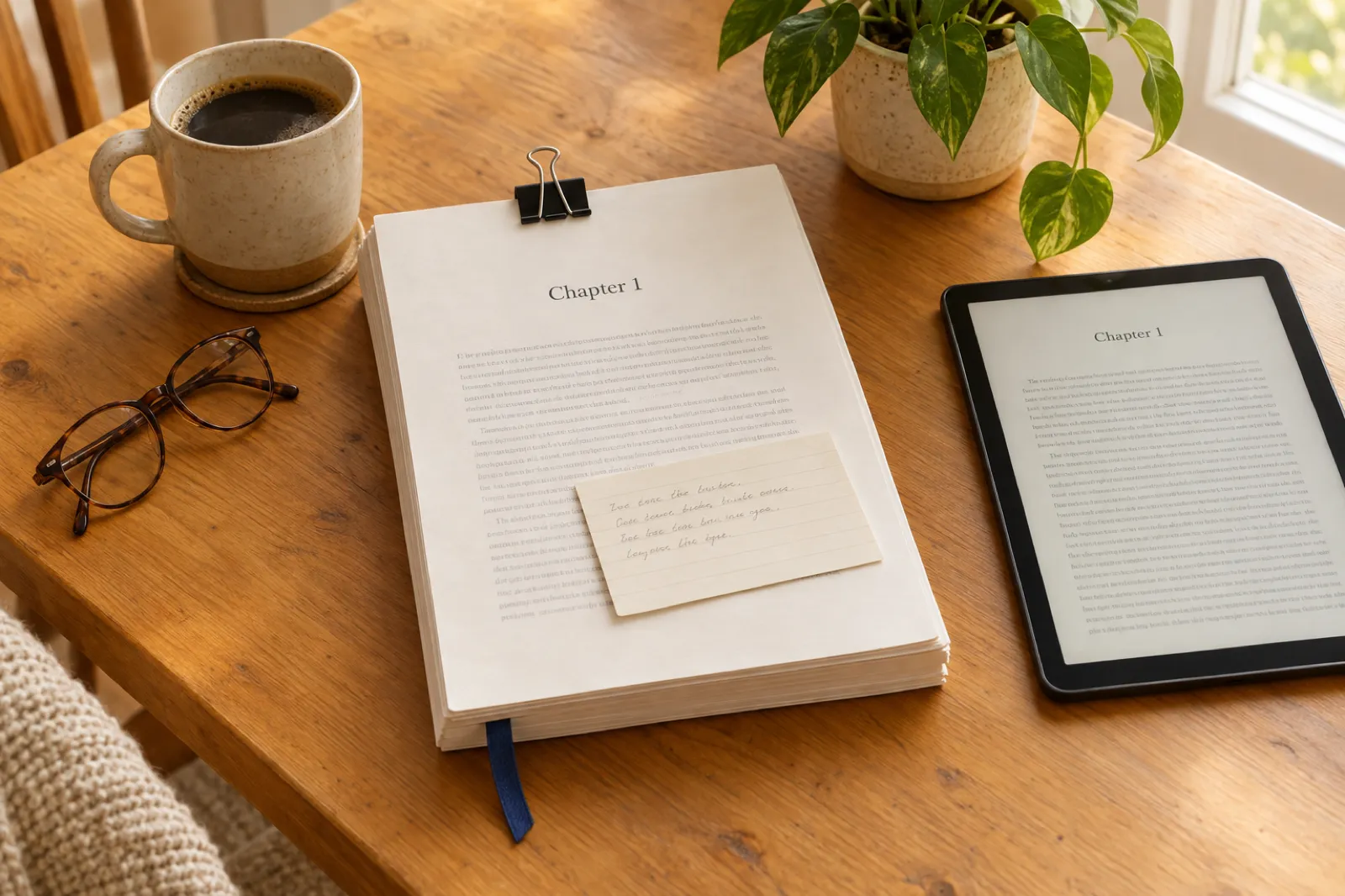
A thick printed book draft held with a bulldog clip and open at Chapter 1, with a handwritten prompt card resting on top, beside a tablet showing the same Chapter 1 page, a mug of coffee, reading glasses and a plant
The prompt card, the printed draft it became and the same chapter as an ebook.
  1. Step 1

    Hand over the prompt

    Press Write this book, or paste the prompt into the idea box on your dashboard. Check the chapter count is in it. You can write the prompt in another language and the book comes back in that language.

  2. Step 2

    Check the outline

    Inkfluence AI turns the prompt into a title, a subtitle and a chapter plan. This is the cheapest moment to change direction: a chapter in the wrong place costs one edit now and a rewrite later. The book title generator helps if the working title is not right yet.

  3. Step 3

    Let it write the chapters

    Non-fiction chapters are written at the same time, so a full draft usually takes a few minutes. Novels are written in order, with a story memory that keeps characters and events consistent. See the AI chapter generator for how that works.

  4. Step 4

    Edit in your own words

    Read every chapter. Add your stories, fill the placeholders, cut what you would never say. The editor's AI assistant can rewrite a passage, change its tone or review a chapter. The free plan gets 3 assists a day, Creator 15 and Premium 100.

  5. Step 5

    Add a cover and the extras

    Make a cover with the AI book cover generator, write the store blurb with the book description generator and an about-the-author page with the author bio generator.

  6. Step 6

    Export and publish

    Download a PDF on any plan. Paid plans add EPUB, DOCX and a KDP-ready print file; the AI book formatter and PDF ebook maker pages show the layouts. EPUB follows the W3C EPUB 3.3 standard that most ebook stores accept.

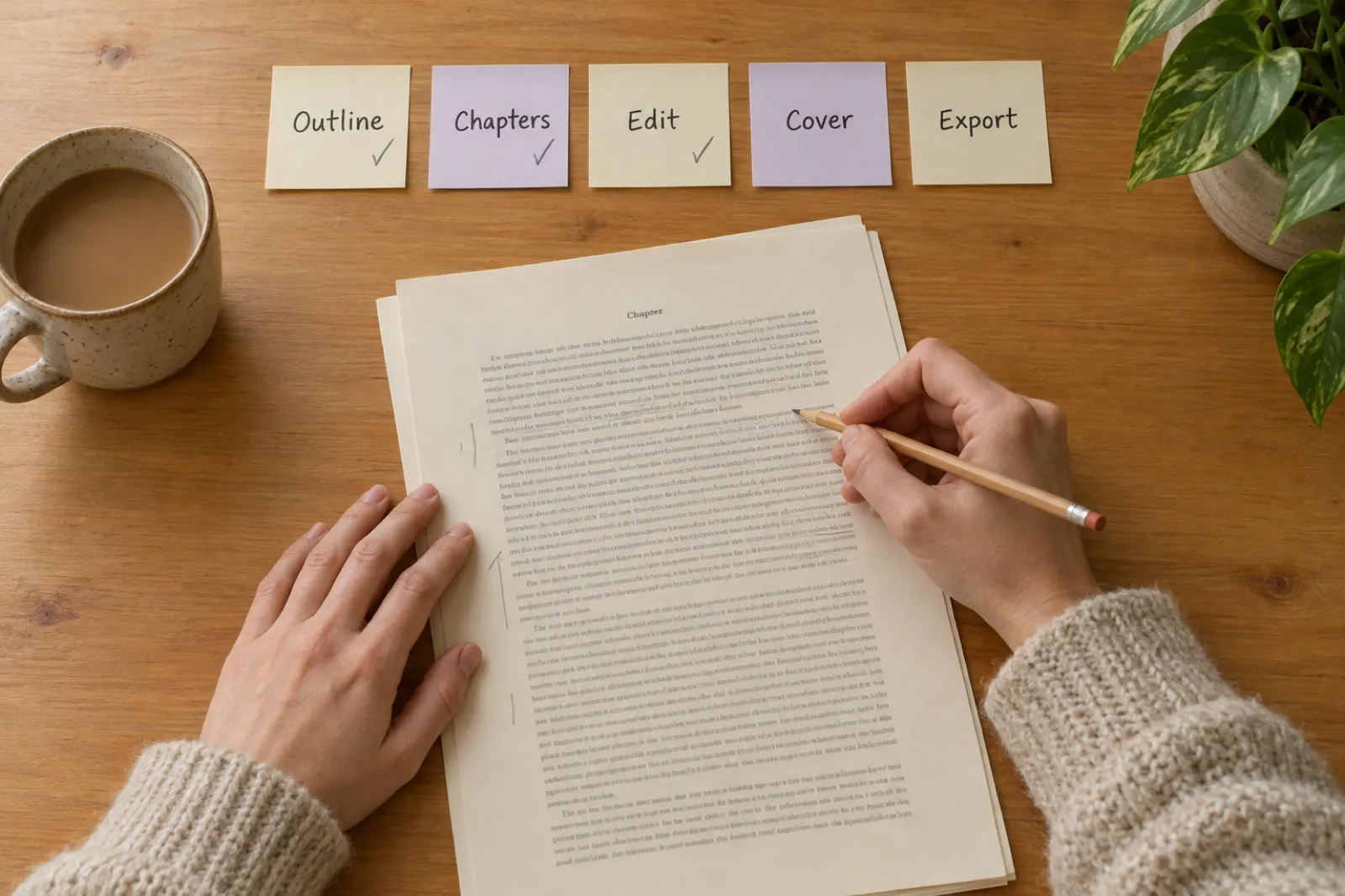
Hands in an oatmeal sweater editing a printed chapter with a pencil, below five sticky notes in a row reading Outline, Chapters, Edit, Cover and Export, the first three ticked
Outline, chapters, edit, cover, export: the editing pass is where the book becomes yours.

After that, the same book can go further: narrate it with the AI audiobook generator, publish it in another language with the AI book translator, or check what it could earn with the ebook income calculator. For the long version of the whole process, read how to create an ebook.

Publishing an ebook written from a prompt: disclosure and rights

Two questions come up as soon as a prompt becomes a book you want to sell. The answers below come from the sources, read on 6 November 2026.

Do I have to tell Amazon?

Yes, if the AI wrote it. KDP's content guidelines ask you to disclose AI-generated content (text, images or translations) when you publish or edit a book, and that includes AI text you later edited. Content you wrote yourself and only refined with AI tools counts as AI-assisted, which you do not need to disclose. Our guide to the KDP AI disclosure policy walks through the form.

Who owns the book?

Our terms say you keep the rights to what you create. Copyright is a separate matter: the US Copyright Office has said prompts alone do not give you enough control to be the author of what an AI writes, while the parts you write, select, arrange or change yourself can be protected. More detail in can AI-written books be copyrighted.

Both answers point the same way: the prompt gets you a draft, and your editing makes the book yours. Selling on Amazon? The free KDP tools cover royalties, spine width and keywords.

What it costs to turn the prompt into a book

The prompt generator is free forever. Writing the book uses chapters from your plan. These are the current plans; the pricing page always has the latest.

PlanPriceChaptersGood for
Freeno credit card$05 chapters a month (up to 5 in one book)A lead magnet or a short guide, PDF export
Creator15 AI assists a day$9.99 a month or $89 a year35 chapters a month, about 4 booksRegular ebooks, EPUB, DOCX and KDP export
Premium100 AI assists a day$19.99 a month or $179 a yearUnlimited chaptersNovels, series and publishing at volume
Credit packsone-time, no subscription15 for $9.99, 25 for $12.99, 50 for $24.99One credit per chapterFinishing one longer book

More on each step: the AI book writer, and for experts and coaches, the AI non-fiction book writer.

Ebook prompt generator: FAQ

What is an ebook prompt generator?
An ebook prompt generator writes the instructions you give an AI book writer: who the ebook is for, what it promises, how many chapters it has, how it should sound and what it must avoid. This one is free and runs in your browser. You fill in a topic, book type, reader, tone and chapter count, and it gives you ready-to-use prompts in three formats every time you click.
Is this ebook prompt generator free?
Yes. It is free with no sign-up, and you can generate as many prompts as you like because they are built in your browser, not on our servers. Turning a prompt into a book in Inkfluence AI is free to start too: the free plan covers 5 chapters a month with PDF export and no credit card.
What should a good ebook prompt include?
Five parts: the reader (one specific person and their situation), the promise (what changes for them by the last page), the structure (chapter count and what every chapter contains), the voice (two or three tone words plus a comparison) and the constraints (what the book must never or always do). Most weak prompts have only the topic.
How long should an ebook prompt be?
Between about 60 and 200 words works well. Shorter than that and the AI fills the gaps with guesses; much longer and the important lines get lost. Every prompt the generator makes stays under 1,900 characters, so the Write this book button can hand the whole thing to Inkfluence AI.
How do I control how long my ebook is?
With the chapter count. In Inkfluence AI a chapter runs roughly 1,000 to 1,500 words, so more chapters means a longer book. There is no page or word target to set, so put the number of chapters in your prompt, or choose it in the generator.
Can I use these prompts with other AI tools?
Yes. Copy any prompt and paste it wherever you like. A general chatbot will usually write one chapter at a time and needs you to carry the plan between messages; Inkfluence AI takes the whole prompt, plans the chapters and writes the full book, then lets you edit, add a cover and export it.
Does it work for novels and children's picture books?
Yes. Pick Novel or Children's picture book and the prompt changes shape: a novel gets a premise, point of view and the kind of ending the reader is owed, and a picture book is counted in pages (10 to 16) with one short scene per page. Novels are written in order in Inkfluence AI, with a story memory that keeps names and events straight.
Do I need to tell Amazon KDP that my ebook used AI?
KDP asks you to disclose AI-generated content (text, images or translations) when you publish or edit a book. If the AI wrote the chapters from your prompt, that counts as AI-generated, even if you edited it afterwards. Content you wrote yourself and only refined with AI tools counts as AI-assisted, which KDP does not ask you to disclose.
Who owns an ebook written from my prompt?
Inkfluence AI's terms say you keep the rights to what you create. Copyright is a separate question: the US Copyright Office says prompts alone do not make you the author of what an AI writes, while the parts you write, select, arrange or change yourself can be protected. That is another good reason to edit the draft properly.
Can I write the prompt in another language?
Yes. Write the prompt in your language, or ask for the book in a specific language, and Inkfluence AI writes the book in it. The generator itself writes its prompts in English, so translate the prompt first or simply add "Write the book in Spanish" (or your language) at the end.
What happens when I press Write this book?
Inkfluence AI opens with your prompt already in the idea box. Read it, change anything you like and press Go. You sign up free before the book starts. Non-fiction chapters are written at the same time, so a full draft usually takes a few minutes; novels are written chapter by chapter in order.

Write the prompt. Then write the book.

Generate a prompt above, or bring your own idea. Inkfluence AI plans the chapters, writes the draft and gets it ready to export, and you make it yours.

No credit card. 5 chapters a month on the free plan.