
How to Create a Meal Prep Ebook with AI (Watch One Become a Book in 3 Minutes)

A meal prep ebook is a plan a reader can follow: what to cook on prep day, what to buy, how to store it and what to eat on each day of the week. In the video above James takes a weight loss meal prep plan book from the Health & wellness book type to a ten-chapter book with a cover, ready to export, in under three minutes. The chapters themselves take about a minute and a half. This page follows the same steps and adds what the video has no time for: how to structure a 30-day high-protein plan week by week, what to put in the prompt, how to check AI recipes, nutrition and storage times, what a weight-loss book can and cannot claim, where to sell it, and numbers from the 1,031 meal prep books people have made on Inkfluence AI.
Disclosure: Inkfluence AI is our product. Product details on this page were checked against the app on 28 October 2026.
1,031
meal prep and meal plan books made on Inkfluence AI by 849 people
215
of them are 30-day plans, the most common length named, ahead of 7-day (147)
60%
were exported to a finished file; 27 were listed on Gumroad or Etsy
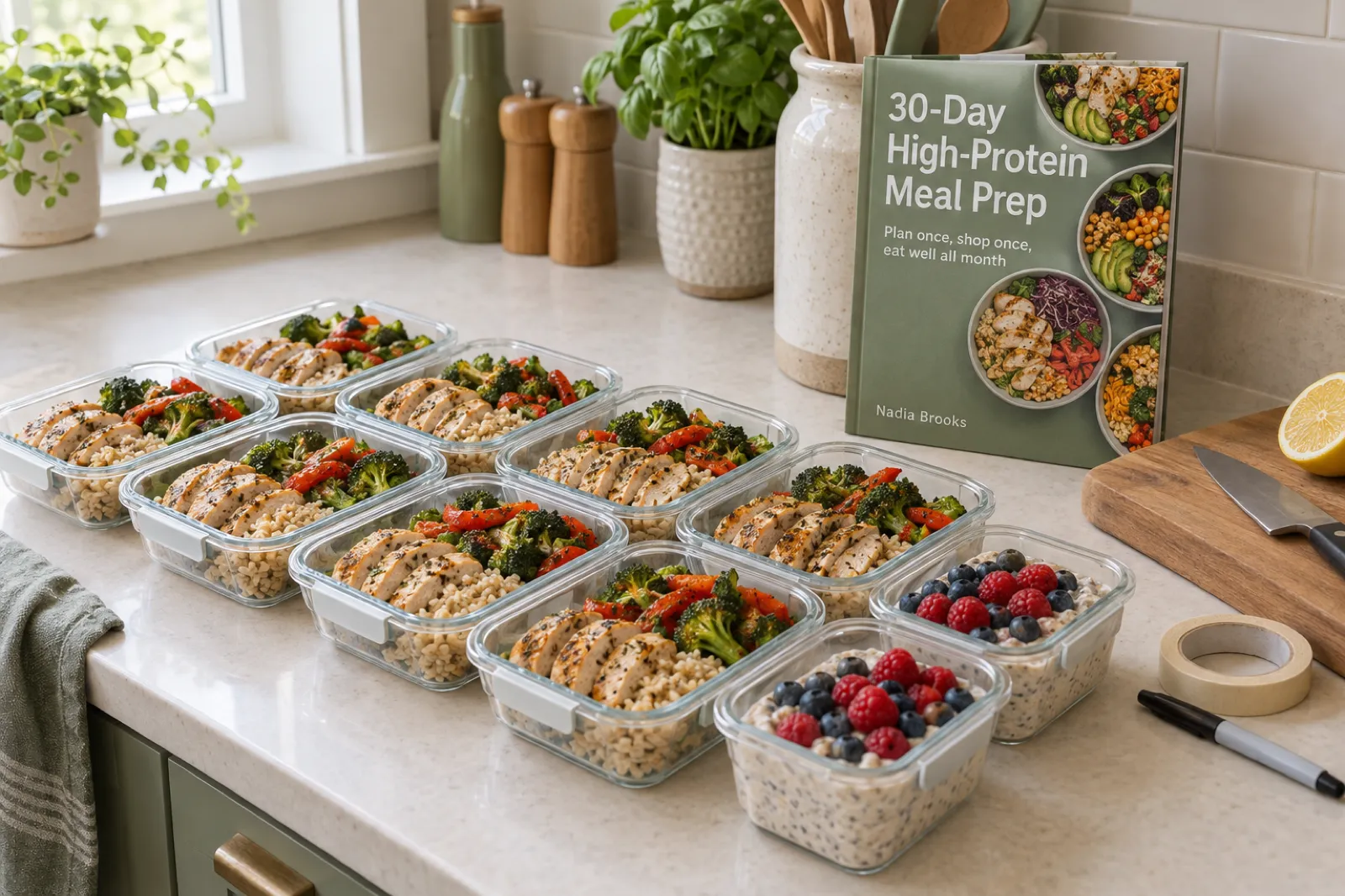
How do you make a meal prep ebook with AI?
Decide who the plan is for, how many days it runs and what the food is built around, then in Inkfluence AI start a new book, choose the Health & wellness book type and describe the plan in one or two sentences, such as "a 30-day high-protein meal prep plan for busy professionals, one prep day a week, with a menu, shopping list and storage notes for every week". Keep the recommended ten chapters, check the plan, and write the book. Then check every recipe, quantity and storage time, add a cover, preview it and export it as a PDF, EPUB or KDP package to sell on Etsy, Gumroad or Amazon. If you want a recipe collection rather than a plan, the cookbook video is the better walkthrough.
What the video covers, in order
- Pick the Health & wellness book type and add the prompt
- Choose the chapter count (ten here) and Quality or Speed
- The plan builds chapter by chapter: delete, move up or down, or add chapters
- Design the cover while the chapters write in the background
- The finished book in about a minute and a half, then editing with the tools in the sidebar
- The cover: a stock image, or an AI cover from a prompt in a style such as Vintage, Bold or Photographic
- Preview as a PDF or print book and as an ebook, then export as PDF, KDP or ebook for Etsy, Gumroad or Amazon
A meal prep book is a plan, not a recipe collection
The difference matters before you type a word. A cookbook answers "what can I make?": it is a set of recipes a reader dips into. A meal prep book answers "what do I do this week?": it tells the reader what to buy on Saturday, what to cook on Sunday, how to pack it, how long each box keeps and what to eat on Thursday when the first batch runs out. The recipes are in there, but they serve the plan. A reader who buys a 30-day meal prep book wants to stop deciding, and the book earns its price by deciding for them.
That changes the structure. A cookbook is organised by dish or by course. A meal prep book is organised by time: weeks, prep days and the days in between. Each week needs a menu grid, a shopping list that matches the recipes exactly, an order of work for the prep session, and storage and reheating notes. The parts that make it a plan, rather than recipes in a different order, are the shopping list and the storage notes, and they are also the parts a first draft gets wrong most often.
The subject is popular for a reason. Of the 1,031 meal prep and meal plan books made on Inkfluence AI, 508 named a length in days and the 30-day plan was the single most common shape. The angles readers pay for are practical ones: budget (357 books), weight loss (302), family meals (235), high protein (188) and plant-based (176). Most combine two, like the video's weight loss plan or the YouTube description's high-protein one.
Which book type: Health & wellness, Cookbook or Day challenge?
Three book types on the New Book screen can make a meal prep book, and they make different books. The video uses Health & wellness, and for a plan-led book it is the right default.
| Book type | What it makes | Length on screen | Pick it when |
|---|---|---|---|
| Health & wellness (the video) | A guide in chapters: here, one chapter per week plus setup, storage and swaps | 10 chapters recommended, 1,650 to 1,800 words a chapter | The book is a plan the reader follows week by week |
| Cookbook / Food | A recipe book, one full recipe per chapter | 20 chapters recommended, 950 to 1,050 words a chapter | The book is a bank of prep-friendly recipes |
| Day challenge | A day-by-day programme; each chapter is one day | 30 chapters recommended, 600 to 1,050 words a day | The reader follows it one day at a time |
The tile descriptions give the same hint: Health & wellness says "Nutrition, fitness, mental health, sleep", and Cookbook / Food says "Recipes, meal plans, kitchen tips". People use all three. Of the meal prep books on the platform, 435 were written in the recipe format, 173 as health guides and 91 as day challenges. Our advice: Health & wellness for the plan, and if you also want a recipe bank, make it as a second book with the Cookbook tile and sell the two together. The cookbook walkthrough covers that format, and the sleep and stress reset video shows the Day challenge format in detail.
How to structure a 30-day meal prep book in ten chapters
The video makes a ten-chapter book, and ten is the number the Health & wellness type recommends. It also happens to be a very good shape for 30 days: four week chapters carry the plan, and six chapters around them carry everything a reader needs to follow it. This is the outline we would aim for. The plan the app writes will not match it word for word, which is fine; use it to check that nothing is missing.
- How this plan works. Who it is for, what a week looks like, how many prep days, how portions are set, and how to use the shopping lists. One page a reader can come back to.
- Kitchen setup and storage. The containers to buy, labelling, the fridge and freezer temperatures, and how long each kind of dish keeps. This is where the food safety rules live (more on those below).
- Week 1 (days 1 to 7). The menu grid, the shopping list, the prep-day order of work, and the recipes.
- Week 2 (days 8 to 14). Same layout, different proteins and vegetables, so the reader is not eating the same box for a month.
- Week 3 (days 15 to 21). Same layout again. A good week 3 reuses a sauce or a grain from week 1 so the shopping gets easier.
- Week 4 (days 22 to 30). Nine days, so it carries two extra days: a "use it up" day for leftovers and one fresh-cook day.
- Breakfasts and snacks. Overnight oats, egg muffins, yogurt pots: the things that keep and can be rotated across every week.
- Swaps. Vegetarian, dairy-free and budget swaps for each main protein, and what to do when a shop is out of something.
- Freezing, thawing and reheating. Which dishes freeze, how to thaw them safely, and how to reheat them so they are hot all the way through.
- After day 30. How to build your own week from the recipes in the book, so the reader keeps going without buying another plan.
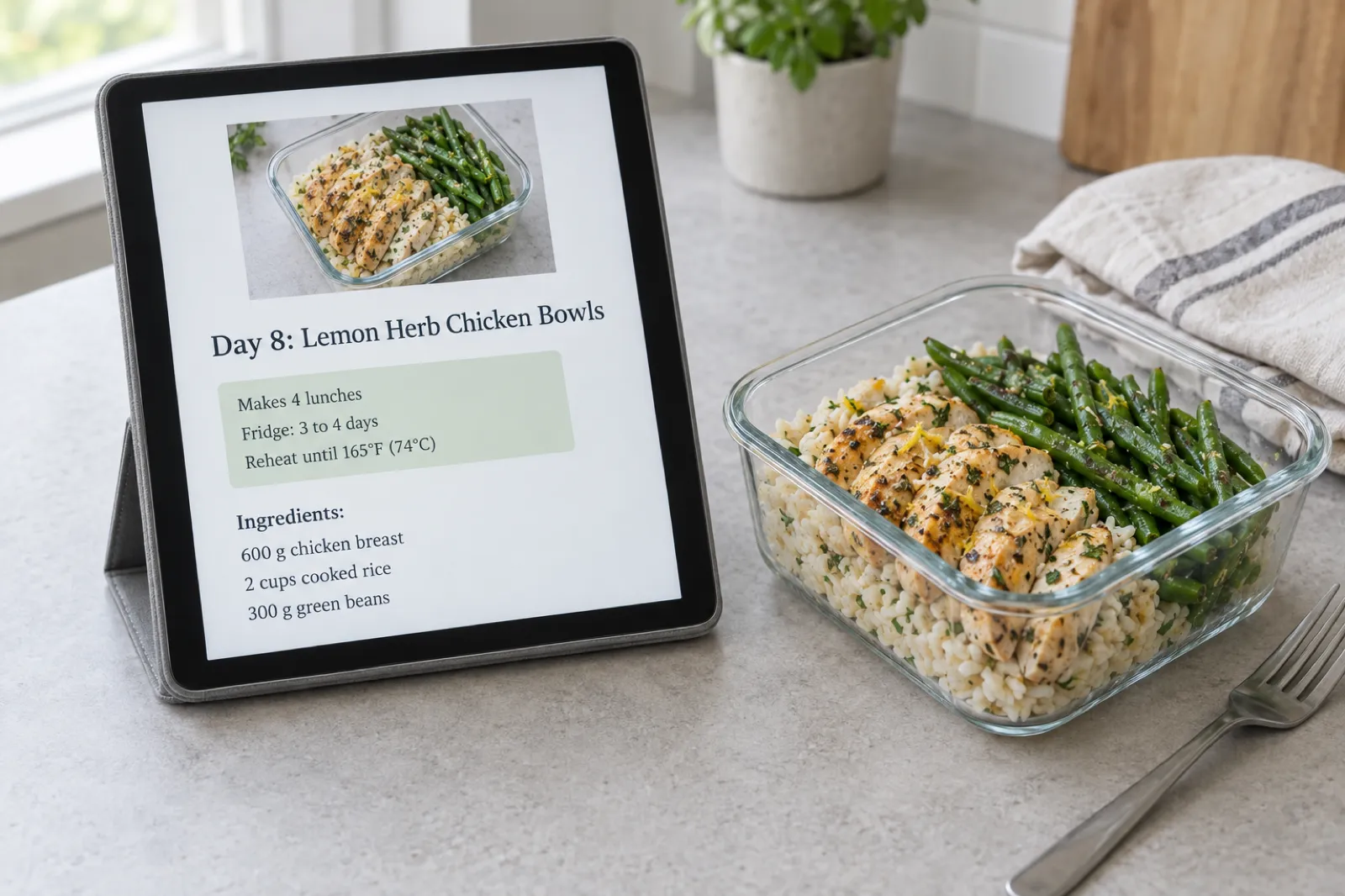
The same shape scales. A 7-day starter is chapters 1, 2, 3 and 9 plus a short "what next". A 12-week programme, which 44 of the meal prep books on the platform were, needs more week chapters and a paid plan's longer chapter limit (up to 40 in the plan). If you would rather give every day its own chapter, the Day challenge type does that at thirty chapters, and each day becomes "Day 8: Lemon herb chicken bowls" with that day's meals and any prep for tomorrow.
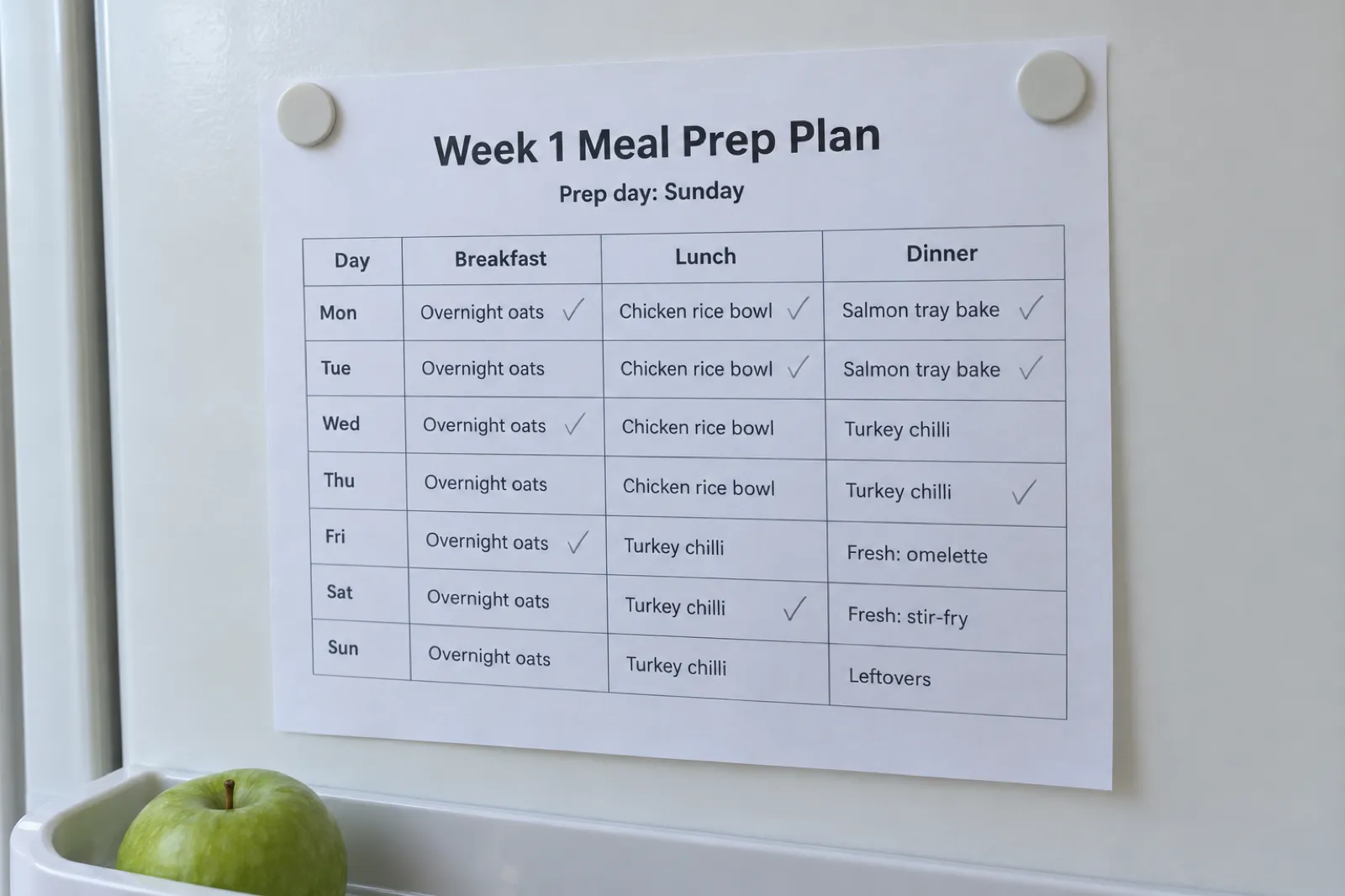
What every week chapter should hold
The week chapters are the book. Give them the same five parts in the same order every week, so a reader who has done week 1 knows exactly where to look in week 3.
- The menu grid. Seven rows, one per day, and a column for each meal the plan covers. Mark which meals come from the prep day and which are cooked fresh or come out of the freezer.
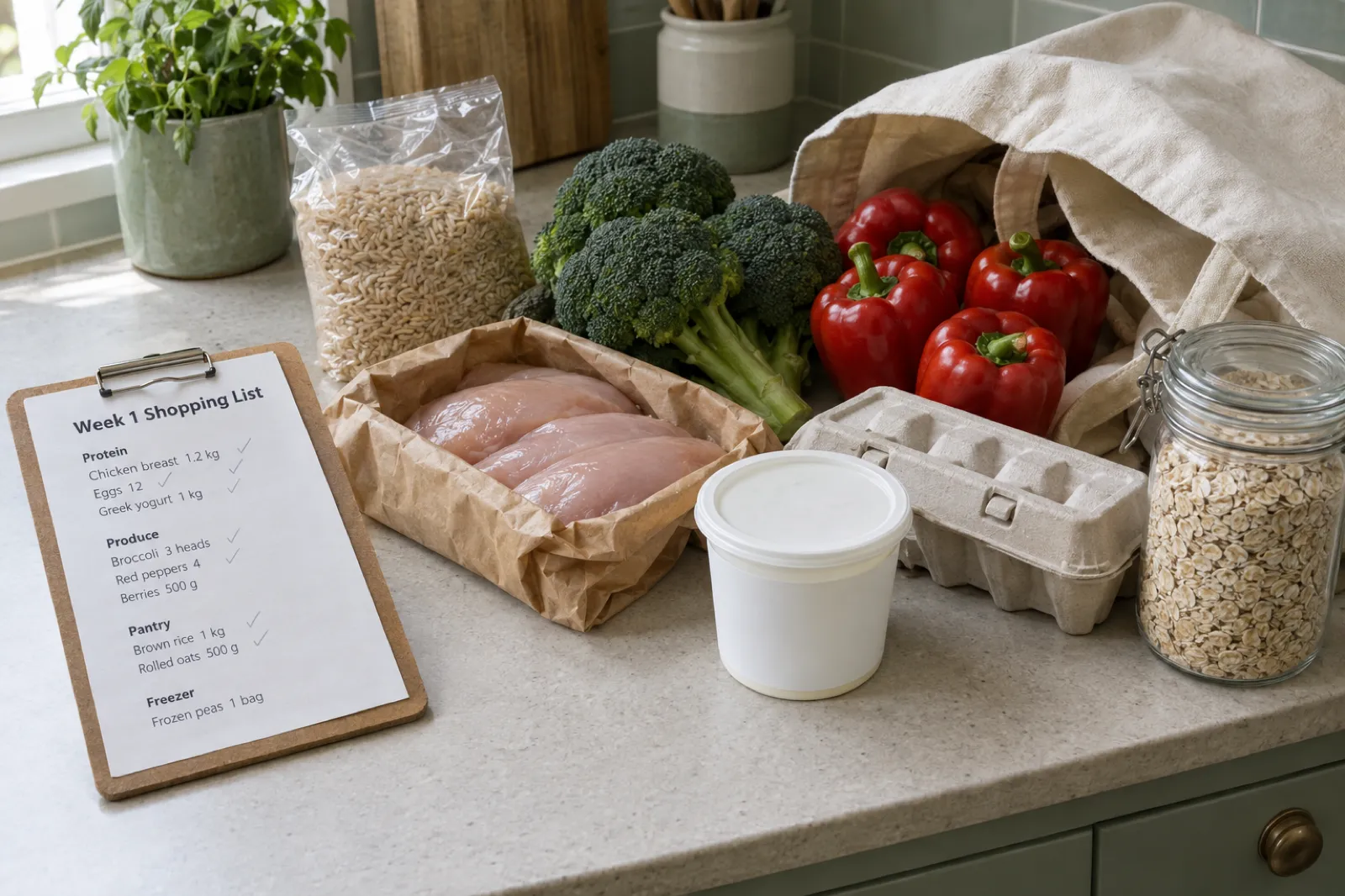
- The shopping list. Grouped by where things are in a shop (protein, produce, pantry, dairy, freezer), with quantities that add up to exactly what the recipes use.
- The prep-day order of work. What goes in the oven first, what simmers while you chop, when to cool and portion. This is the part readers thank you for.
- The recipes. Portions, ingredients in the same units as the shopping list, short numbered steps, and the safe cooking temperature where it matters.
- Storage and reheating notes. For every dish: fridge days, whether it freezes, and how to reheat it.
The fourth part is the one AI writes easily and the first, second and fifth are the ones that need you. A model will happily write a delicious recipe for Thursday that needs an ingredient the shopping list forgot, or say a fish dish keeps for five days. The checks further down catch both.
Shopping lists a reader can actually use
A good shopping list is the quiet reason a meal prep book gets good reviews. Three rules make one work. First, group by shop section rather than by recipe, so the reader walks the shop once. Second, total the quantities across the week's recipes: if three recipes use chicken breast, the list says "chicken breast 1.2 kg", not three separate lines. Third, use the units people buy in (a bag, a tin, a head of broccoli, 500 g) rather than the units recipes use (two tablespoons, half a cup), and list the pantry staples the plan assumes the reader already has in a short "check you have" box at the top.
Ask for this shape in the brief ("a shopping list for each week, grouped by aisle, with totals") and then check it against the recipes yourself. It is a ten-minute job per week with a pencil, and it is the check that most separates a sellable book from a draft.
The prep day: an order of work
Most meal prep plans fail on the prep day, not on Thursday. A reader who opens the book on Sunday afternoon to a list of eight recipes, each written as if it were the only thing being cooked, will spend four hours and give up by week 2. The fix is an order of work that runs the recipes in parallel. A typical two-hour session for the week above looks like this:
- Oven on. Trays of vegetables and the salmon or chicken go in first, because they take longest and need no attention.
- Grains on the hob: rice or quinoa in one pan, the chilli simmering in another.
- Chop and wash while those cook: salad vegetables, herbs, fruit for breakfasts.
- Make the overnight oats and sauces.
- Cool, then portion: hot food is spread out to cool and goes into the fridge within two hours of cooking.
- Label every lid with the dish and the day it should be eaten by, and put the end-of-week portions straight into the freezer.
Ask for "a prep-day order of work for each week" in the brief and the model will write one. Then do it once in your own kitchen with a timer. If your session takes three hours, the book should say three hours; readers forgive a long prep day, not a dishonest one.
Storage rules your book has to get right
This is the section where a meal prep book can hurt someone, so it is the one to check line by line against a primary source rather than trust to a draft. The core numbers are simple and well documented.
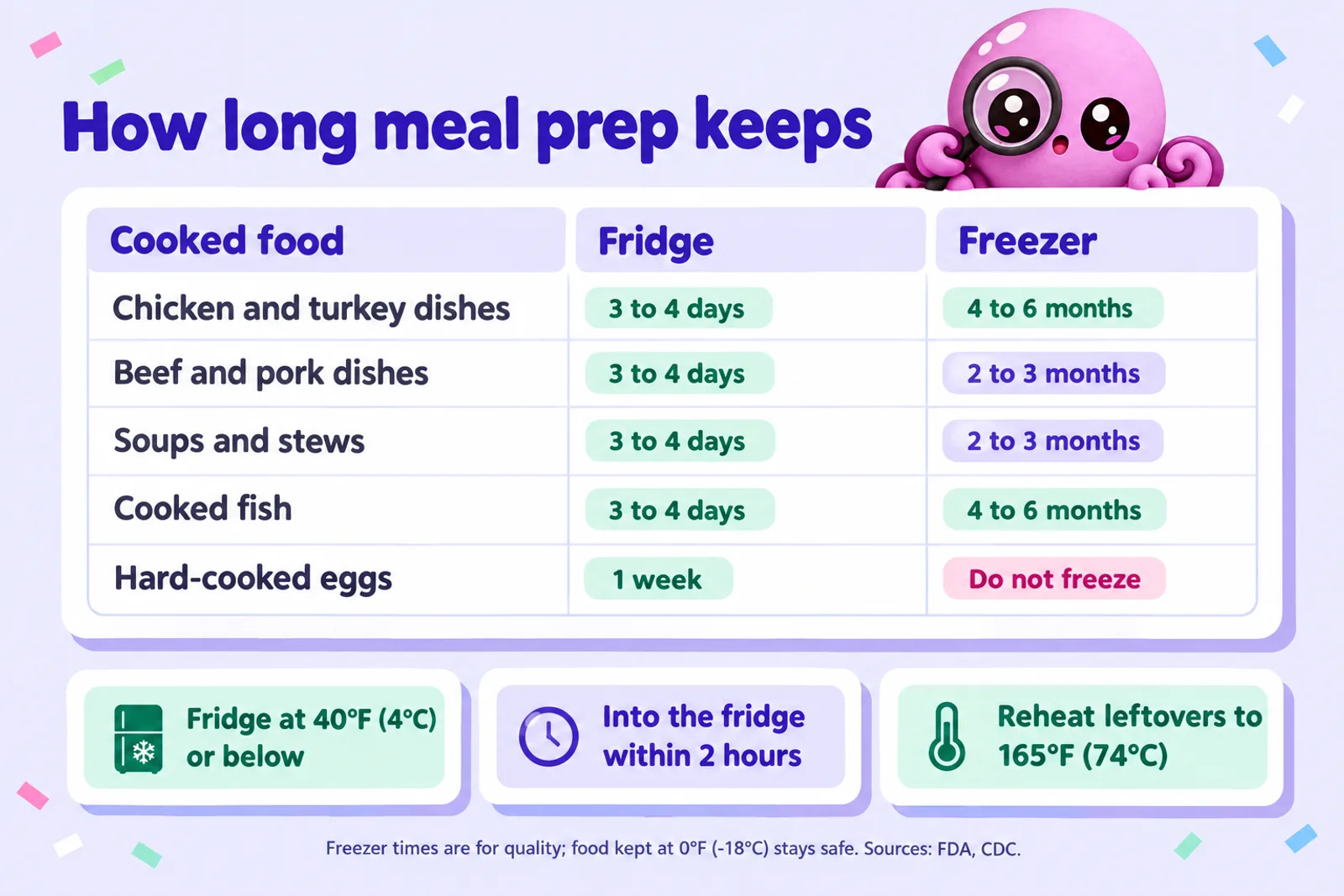
- Fridge time. The FDA refrigerator and freezer storage chart gives three to four days in the fridge for cooked meat and meat dishes, cooked poultry dishes, soups and stews, and cooked fish, and a week for hard-cooked eggs. In the UK the Food Standards Agency says to eat leftovers within 48 hours or freeze them. If you sell to both, write to the stricter number or give both.
- Temperatures. The CDC's four steps to food safety say to keep the fridge at 40°F or below and the freezer at 0°F or below, and to refrigerate cooked leftovers within two hours (one hour if the food has been somewhere above 90°F). The FSA says to set a fridge between 0 and 5°C.
- Cooking and reheating. The CDC's safe internal temperatures: 165°F for all poultry and for leftovers and casseroles, 160°F for ground meat, 145°F for whole cuts of beef, pork and lamb (with a three-minute rest) and for fish. A recipe that says "cook until done" should give the number.
- Freezing. The FDA chart notes that food kept frozen at 0°F stays safe indefinitely, and its freezer times (two to three months for cooked meat dishes and soups, four to six months for cooked poultry dishes and cooked fish) are for quality. Thaw in the fridge, in cold water or in the microwave, never on the counter, as the CDC puts it.
Two practical consequences shape the whole book. First, a single Sunday prep day cannot safely cover seven days of cooked meals from the fridge alone, so the plan needs either a second, shorter prep day midweek or a freezer step for the end-of-week portions. A brief that says "one prep day a week" should also say "freeze the Friday to Sunday portions" or the plan will quietly assume a week in the fridge. Second, every recipe should carry its own storage line, because readers do not flip back to chapter 2 at 7 pm on a Wednesday.
Build a meal prep brief
What to put in the prompt: the length, the goal, the reader, the prep days, the meals the plan covers and any diet, plus a request for the parts that make it a plan. Pick them below. The builder writes the brief, sketches the chapter plan to check the app's plan against, and opens the brief in your dashboard.
Your brief
A 30-day high-protein meal prep plan for busy professionals, covering lunches and dinners, with one prep day on Sunday and the Friday to Sunday portions frozen. Each week gets a menu, a shopping list grouped by aisle with totals, a prep-day order of work, recipes with portions, and fridge, freezer and reheating notes for every dish.
A chapter plan to check against
From the brief to a finished book
Write the brief: what the prompt needs
The video types a short prompt for a weight loss meal prep plan and still gets a complete book, because the book type does a lot of the work. A better brief gets a better plan, and for meal prep the extra words are cheap. Six things belong in it: the length (30 days), the goal (high-protein), the reader (busy professionals), the meals covered (lunches and dinners), the prep days (one on Sunday, with the end of the week frozen), and any diet (vegetarian, dairy-free). Then one sentence that asks for the plan's working parts: a menu, a shopping list grouped by aisle with totals, a prep-day order of work, recipes with portions, and storage notes for every dish.
The reader changes the book more than anything else. Gym-goers want bigger portions and simple repeats; new parents want one-handed breakfasts and food that freezes; shift workers need meals that work at 3 am; students need a budget and a single hob. A plan for "everyone" ends up with a prep day nobody can fit into their week. Leave out what you do not care about, and say plainly what you do: "no fish", "under $60 a week" and "no recipe longer than 30 minutes" each make a better plan.
Check the plan, then write the book
After you generate, the plan appears chapter by chapter, as in the video, under the heading "Here's your plan". Every chapter has a title and a short summary, and you can rename, reorder, remove or add chapters before you click Write the book. Read it against the ten-chapter outline above. Three edits are worth making on almost every first plan: make sure there is one chapter per week rather than one per meal type; make sure storage and reheating get a chapter of their own; and add a swaps chapter if the plan has none. Changing the plan costs nothing; only writing does.
On paid plans you also choose a generation mode: Quality for "best structure and depth (slightly slower)" or Speed for "faster generation with concise output". For a meal prep book with long shopping lists and recipes, Quality is the better default. While the chapters write, the screen offers to let you design your cover while you wait, which is what the video does; in the video the whole book is ready in about a minute and a half.
How to check AI recipes and nutrition
AI writes fluent recipes. Fluent is not the same as right, and a meal prep book has more moving parts than most: the same ingredient appears in a recipe, a shopping list and a storage note, and all three have to agree. Work through this list for every week chapter before you export anything you intend to sell.
- Quantities add up. Total each ingredient across the week's recipes and compare it with the shopping list. Check that the portions match the number of meals the menu grid says the batch covers.
- Cooking temperatures are stated. Poultry to 165°F, ground meat to 160°F, whole cuts and fish to 145°F, using the CDC's numbers. Add Celsius if you sell outside the US.
- Storage lines match the chart. No cooked dish in the fridge for more than four days by the FDA chart; nothing frozen that should not be (the chart says hard-cooked eggs do not freeze).
- Allergens are flagged. The FDA lists nine major food allergens: milk, eggs, fish, crustacean shellfish, tree nuts, peanuts, wheat, soybeans and sesame. Mark them on each recipe, and check that a "dairy-free" week really is.
- Nutrition numbers are yours or absent. AI estimates of calories and protein look precise and often are not. If you print them, calculate them from your exact quantities using a database such as USDA FoodData Central, and say they are estimates. Otherwise describe portions and leave the numbers out.
- Cook it. At least one prep day per week, in your own kitchen, before the book is sold. It is the only check that catches a 40-minute recipe that takes 90, and it gives you real photos, which matter on Etsy (below).
The editing tools are where the video points: open the book, click edit, and the tools are in the sidebar. Use the AI assistant to rewrite a recipe in your layout, to make a shopping list match the recipes once you have found the gaps, or to add a storage line to every recipe in a chapter. Regenerate a chapter that missed the point entirely rather than patching it line by line.
High-protein and weight-loss books: what to say and what not to
The video makes a weight loss meal prep plan, and the YouTube description's version is high-protein. Both are popular (302 and 188 books on the platform, and 95 are both), and both sit close to health advice, which changes what a responsible book says.
- Describe the plan, not an outcome. "Thirty days of high-protein lunches and dinners you can prep in two hours a week" is fair. "Lose 10 pounds in 30 days" is a promise. The FTC's health products compliance guidance expects health claims to be backed by competent and reliable scientific evidence, and says an honest testimonial is not enough on its own. Its Gut Check guide lists seven weight-loss claims that are almost always false, including weight loss of two pounds or more a week for a month without dieting or exercise, and substantial weight loss for all users. Keep anything like them out of the book and the listing.
- Anchor protein to a source. "High-protein" needs a reference point. The Dietary Guidelines for Americans, 2025 to 2030 say to prioritise protein foods at every meal and set a protein goal of 1.2 to 1.6 grams per kilogram of body weight a day, adjusted to individual calorie needs. Quote that, cite it, and let readers work out their own number rather than printing one target for everyone.
- Point to a professional. A meal plan is not treatment. Readers who are pregnant, have diabetes, kidney disease or a history of eating disorders, or take medication affected by diet should talk to a doctor or registered dietitian first. Say so at the front of the book. Of the meal prep books on the platform, 69 mention diabetes; those need this note more than any.
Not medical or nutrition advice. This page explains how to make a meal prep book with AI. It is not medical or dietary advice, and neither is a meal prep book. Anyone with a health condition, or who is planning a significant change to what they eat, should talk to a doctor or registered dietitian.
Cover tips for a meal prep book
The video shows both routes. The stock library has 436 images today (the video says "over 400"), including 28 food photos and 34 wellness photos; you search, pick and the photo becomes the cover, though some are reserved for paid plans. Or open the AI tab in the cover designer, pick a style and describe the look; the video points out Vintage, Bold and Photographic among the ten styles, and Photographic ("realistic cinematic photo") suits food best. AI covers come with paid plans (Creator includes 10 a month and Premium 30, then credits); the cover design guide covers type and thumbnails, and the AI book cover generator page shows the styles.
Three things sell a meal prep cover. Put the length and the goal in the title in large type ("30-Day High-Protein Meal Prep"), because that is what buyers compare at thumbnail size. Show prepped food in containers rather than a single plated dish, because containers say "plan" and a plate says "recipe". And if you can, use a photo of your own prep day: it is the most honest cover you can have, and on Etsy a real result is now part of the rules for recipe products.
Extras that make a meal prep book worth more
The plan is the product, but a few short pages at the back turn a good plan into one people keep on the fridge. None of them takes long, and the AI assistant can draft each one from the chapters you already have.
- A blank weekly planner. The same menu grid as the week chapters, empty, so the reader can plan week 5 on their own. It is the page that makes "after day 30" real.
- A blank shopping list in the same shop sections, and a "pantry staples" list of what the plan assumes is already in the cupboard.
- A reheat-at-a-glance page. Every dish in the book, its fridge days, whether it freezes, and how to reheat it, on one page. Readers print this one.
- A conversions table. Cups to grams for the main ingredients, and Fahrenheit to Celsius for the oven and the safe temperatures, if you sell in more than one country.
- A container guide. How many containers the plan needs, what sizes, and which go in the freezer.
Two more routes are worth a thought once the English book is finished. About one in ten meal prep books on the platform is written in another language, most often Portuguese, Spanish and French; you can write the plan in that language from the start by typing the brief in it, or, on Creator and Premium, use the book translator to make a translated edition you can list on its own. Either way the recipes, lists and storage notes need the same checks in the new language (plus metric units, and the local storage advice, such as the FSA's 48 hours in the UK). An audiobook is the weaker fit for this subject: shopping lists and menu grids are read cell by cell, so if you make one, turn the tables into sentences first or keep the audio to the "how this plan works" and storage chapters.
Preview, export, and where to sell
Preview the book as a PDF or print book and as an ebook, as the video does, and check that the tables and shopping lists hold together on a phone screen as well as on A4. Then export: a PDF on every plan, and an EPUB for Kindle and e-readers, a KDP package for a paperback, or a DOCX for Word with a paid plan or credits. A meal prep plan is one of the few ebooks people genuinely print, so the PDF matters most; which format goes where is its own short guide, and paperback publishing on KDP covers the print route.
- Etsy. Meal plans sell well there as printable downloads, and you can publish straight from the book once your shop is connected. Since 22 October 2026 Etsy requires the information buyers rely on in recipes, patterns and instructions to be your own work, not generated by AI, with an actual result shown in the listing; AI-assisted downloads still need disclosure. For Etsy, sell a plan built around your own tested recipes, use AI for the plan, lists and writing around them, and show photos of the real food. What changed on Etsy in October 2026 quotes the policy in full, and Etsy's AI disclosure, explained covers the wording.
- Gumroad. Good for selling to an audience you already have, such as clients or followers, and also publishable straight from the book. Etsy or Gumroad compares the two.
- Amazon KDP. Upload the EPUB for Kindle and the KDP package for a paperback. KDP's content guidelines require you to tell Amazon about AI-generated text, images or translations when you publish, even if you edited them substantially; content you wrote and improved with AI tools counts as AI-assisted and needs no disclosure. Our KDP AI disclosure guide walks through the form.
- As a lead magnet. Nutritionists, personal trainers and fitness coaches give a one-week plan away for an email address and sell the full 30 days or include it in coaching. The lead magnet video shows that route, and the pages for nutritionists, personal trainers and fitness coaches cover how they use it.
Whichever store you use, the listing needs the same care as the book: what the reader gets each week, how long the prep day takes, the diet it suits, no promises about weight, and the not-medical-advice note where buyers will see it. How to price an AI-created ebook and how to sell fitness ebooks cover pricing and bundles for this market, and the selling walkthrough video shows Etsy and Gumroad publishing on screen.
What 1,031 meal prep books say about how people make them
These figures come from the meal prep and meal plan books people have actually made on Inkfluence AI up to 28 October 2026, the day this video went up, read from the books themselves. Nothing about any single book or person is published, only counts.
meal prep and meal plan books made by 849 people
1,031 non-fiction books whose title or brief is about meal prep, meal plans or batch cooking had been made on Inkfluence AI by 28 October 2026, by 849 people. 264 say it in the title. The pace rose from 63 in March 2026 to 189 in July, the busiest month so far.
Sample: every non-fiction book on the platform, 133,648 books scanned. Counted 28 October 2026.
30-day plans, the most common length named
Of the 508 meal prep books that named a length in days, 215 were 30-day, 147 were 7-day, 41 were 90-day and 28 were 21-day. Another 122 named weeks instead, most often 12 weeks (44) or 4 weeks (42).
Sample: 508 books that named a day count in the title or brief. Counted 28 October 2026.
exported to a finished file
620 of the 1,031 meal prep books, 60.1%, were exported to a finished file at least once. 46 had an AI cover, 27 were listed on Gumroad or Etsy and 6 were turned into an audiobook.
Sample: all 1,031 books. Counted 28 October 2026.
- 1,031 books by 849 people. Most people made one: the plan they wanted to follow, or the one their clients needed. 264 put meal prep or a meal plan in the title; the rest are books where it is part of the brief.
- Thirty days leads. 508 named a length in days: 30-day (215), 7-day (147), 90-day (41) and 21-day (28). Another 122 named weeks, most often 12 weeks (44) or 4 weeks (42).
- Practical angles win. Budget (357), weight loss (302), family meals (235), high protein (188) and plant-based (176) are the most common. 95 books are both high-protein and weight loss, the combination the video and its description cover. 69 mention diabetes and 56 keto or low-carb.
- The recipe format is the most used, and not the only one. 435 were written in the cookbook's recipe format, 173 as health guides (the video's book type), 104 as practical guides, 91 as day challenges, 84 as workout plans and 51 as workbooks.
- Short books, finished. Of the 282 with a recorded length, the median is 5 chapters and 7,791 words, about 1,173 words a chapter, which says most people start with a five-chapter plan.
- They get used. 620 of the 1,031, 60.1%, were exported to a finished file at least once. 46 had an AI cover, 27 were listed on Gumroad or Etsy, and 6 became audiobooks.
- About one in ten is not in English. 98 were written in 16 other languages, most often Portuguese (42), Spanish (15) and French (13).
- The subject is growing. From 63 books in March 2026 to 189 in July, the busiest month so far, and 113 in October to the 28th.
How it was counted. Every non-fiction book on Inkfluence AI whose title or brief mentions meal prep, meal plans or meal planning, batch cooking, food prep or a prep day, counted once whether or not it was finished. Terms were matched as whole words in English and in Spanish, Portuguese, French, German, Italian and Indonesian. Fiction, poetry and picture books are left out. Length and angle (high-protein, weight loss, budget, family, plant-based, diabetes, keto or low-carb) are read from the title or brief; chapters and words come from books with a recorded length of at least 2,000 words; export means a file was downloaded at least once. 133,648 books were scanned. Counted 28 October 2026. No title, brief or account is published.
The wider picture across every kind of book is on the AI book writing statistics page.
Six meal prep briefs, and what each one plans
Length, goal, reader and one constraint, in a sentence or two each. Every one maps to a plan with a clear job for each chapter.
- "A 30-day high-protein meal prep plan for busy professionals, lunches and dinners, one prep day on Sunday with the end of the week frozen." The YouTube description's book. Four week chapters around chicken, turkey, salmon and beans, with a freezer step built into every week.
- "A 4-week calorie-aware meal prep plan for weight loss, high in protein, two prep days a week, with portions described rather than calorie counts." The video's subject, written carefully: portions instead of numbers the author cannot check, and a front note on talking to a doctor.
- "A 7-day budget meal prep plan for university students with one hob and a microwave, under $40 for the week." The free-plan starter and a natural lead magnet: one week, one shopping list, five chapters.
- "A 12-week meal prep programme for gym-goers training four days a week, bigger portions on training days." The long version: twelve week chapters plus setup and storage, on a paid plan.
- "A 21-day plant-based high-protein meal prep plan for people cooking for one, with freezer-friendly batches." Smaller batches, beans, lentils, tofu and tempeh, and a freezer chapter that does real work.
- "A 14-day family meal prep plan for parents of toddlers, dinners only, with one-pan recipes and no added salt for little ones." Family meals are the third most common angle; this one plans the dinner and lets breakfast and lunch stay normal.
What does not work is a brief with no reader, no length and no prep days. "A meal prep book" gives the plan nothing to decide with; it will come back as a recipe collection with a chapter on containers, which is a cookbook, and a different book.
Six mistakes particular to meal prep books
- A week in the fridge. A single Sunday cook that feeds Monday to Sunday from the fridge breaks the three-to-four-day rule. Freeze the end of the week or add a midweek prep.
- Shopping lists that do not match the recipes. The most common flaw in a first draft, and the one buyers notice first in the shop.
- Eight recipes and no order of work. Recipes written one at a time turn a two-hour prep day into four. Ask for the order of work, then test it.
- Precise numbers nobody calculated. "412 calories, 38 g protein" printed from an estimate is worse than no number. Calculate from your quantities or describe portions.
- The same lunch for 30 days. Rotate proteins and vegetables week to week, and reuse sauces and grains so the shopping stays simple.
- A cure on the cover. "Lose 20 pounds in 30 days" is a claim you cannot support and a platform may reject. "Thirty days of high-protein meals, prepped in two hours a week" is honest and sells.
This video, or the other guides?
Full video transcript
This is how you create a weight loss meal prep plan book with Inkfluence AI in a few minutes. First, select from the book type health and wellness. Add in your prompt. Then select the number of chapters you want your book to be. For this, we've gone for 10 chapters. You then choose the generation type, so either quality or speed.
As you can see, Inkfluence AI is beginning to piece together my book in real time. Chapter by chapter, it's keeping me up to date. Now, as you can see, we've got the plan for our 10-chapter book. I can delete chapters. I can move chapters up or down. And I can also add in new chapters. As it's being built, I don't have to wait. I can also start designing my book cover whilst the chapters generate in the background.
As you can see, it's only been a few minutes, but Inkfluence AI has now created the outline and my book in just a minute and a half. You can then download your book if you're happy, or we'd recommend going through and editing to make it your own. You can click edit and the tools are in the sidebar.
Now, you can choose an AI-generated cover or a cover from our stock images. We've got over 400 stock images to choose from. Or if you want to create an AI book cover for your book, go to AI in the designer. Choose from the style. So, as you can see, there's vintage, bold, photographic. Add in your prompt. Click generate. And Inky will create your book cover for you.
As you can see, we've now got our AI-generated book cover and a full weight loss meal prep plan book created with Inkfluence AI in under 3 minutes. You can then review your book and go through and make sure you're happy with the content and see how it will look in both PDF or print as well as an ebook. When ready, you can then export your book and upload it to Etsy, Gumroad, or Amazon. You can download it as a PDF, KDP, or ebook.
Meal prep ebook FAQ
How do you make a meal prep ebook with AI?+
Decide who the plan is for, how many days it runs and what the food is built around (high protein, a budget, plant-based), then in Inkfluence AI start a new book, pick the Health & wellness book type and describe the plan in one line. Keep the recommended ten chapters, check the plan, and write the book. Then check every recipe, quantity and storage note, add a cover, preview it and export it as a PDF, EPUB or KDP package. In the video above the whole book is written in about a minute and a half.
How should a 30-day meal prep book be structured?+
Week by week, not recipe by recipe. Ten chapters work well: how the plan works, kitchen setup and storage, one chapter for each of the four weeks (days 22 to 30 sit in week 4), then breakfasts and snacks, swaps, freezing and reheating, and what to do after day 30. Each week chapter carries the menu grid, a shopping list grouped by aisle, the prep-day order of work, the recipes with portions, and fridge and freezer notes for every dish.
Which book type should I choose: Health & wellness, Cookbook or Day challenge?+
Health & wellness for a plan-led meal prep book, which is what the video uses: ten chapters recommended and roughly 1,650 to 1,800 words a chapter, enough for a week's menu, shopping list and recipes. Cookbook / Food when the book is a recipe collection, one recipe per chapter, with twenty recommended. Day challenge when every day is its own chapter, thirty recommended at 600 to 1,050 words a day.
Can I make a meal prep book on the free plan?+
You can make a short one. The free plan writes up to five chapters a book and exports a PDF, which suits a one-week or two-week starter plan. A full ten-chapter, 30-day book needs a paid plan, which allows up to 40 chapters in the plan and adds the Quality or Speed choice. AI covers, EPUB, DOCX and the KDP package come with paid plans or credits.
Are AI-generated recipes safe to publish?+
Not without checking. Read every recipe as if you were cooking it: quantities, cooking times, and that meat, poultry and fish reach safe internal temperatures (165°F for poultry, 160°F for ground meat, 145°F for whole cuts with a three-minute rest, per the CDC). Check allergens against the nine major allergens the FDA lists, check the storage notes against the FDA storage chart, and cook the recipes before you sell the book. Etsy now also requires recipes in a listing to be your own work, not generated by AI.
Should I include calories and macros?+
Only if you can stand behind every number. AI estimates of calories and protein are often plausible and wrong. Either calculate them from a nutrient database such as USDA FoodData Central using your exact quantities, or leave numbers out and describe portions instead. If you print numbers, say how they were calculated and that they are estimates.
Can I sell a meal prep ebook on Etsy?+
Yes, with care. Etsy allows AI-assisted digital downloads with disclosure, but since 22 October 2026 it requires the information buyers rely on in recipes, patterns and instructions to be your own work, not generated by AI, and listings to show an actual result made with your instructions. For Etsy, use your own tested recipes and let AI help with the plan, the shopping lists and the writing around them. Gumroad and Amazon KDP are the other two routes the video names.
Do I have to disclose AI on Amazon KDP?+
Yes, for AI-generated content. KDP asks you to tell it when text, images or translations in a new book were created by an AI-based tool, even if you edited them substantially afterwards. Content you wrote yourself and improved with AI tools counts as AI-assisted and does not need to be disclosed.
What can I claim in a weight-loss meal prep book?+
Describe the plan, not an outcome. "Thirty days of high-protein lunches and dinners you can prep in two hours a week" is a fair description; "lose 10 pounds in 30 days" is a promise you cannot support. The FTC expects health claims to be backed by competent and reliable scientific evidence, and its Gut Check guide lists weight-loss claims that are almost always false. Add a note that the book is not medical advice and that readers with a health condition should talk to a doctor or dietitian before changing their diet.
How long does meal prep keep in the fridge?+
Three to four days for most cooked dishes, according to the FDA storage chart: cooked meat and poultry dishes, soups and stews, and cooked fish. Hard-cooked eggs keep a week. Keep the fridge at 40°F (4°C) or below and get cooked food into it within two hours. In the UK the Food Standards Agency says to eat leftovers within 48 hours. That is why a 30-day plan needs two prep days a week or a freezer.
How many people make meal prep books on Inkfluence AI?+
By 28 October 2026, 849 people had made 1,031 non-fiction books on Inkfluence AI whose title or brief is about meal prep or meal plans. The 30-day plan is the most common length named (215 books), ahead of 7-day (147). Weight loss (302) and budget (357) are the most common angles, and 188 are high-protein.
Sources to check your book against, and to cite in it
Each is primary: the body that publishes the guidance or the rule, not a summary of it. All were checked on 28 October 2026.
How long cooked food keeps
Cooked meat, poultry, fish, soups and stews: 3 to 4 days in the fridge; freezer times are for quality.
FDA, Refrigerator and Freezer Storage Chart (PDF)Temperatures and the two-hour rule
Fridge 40°F or below, freezer 0°F or below, leftovers chilled within 2 hours, safe internal cooking temperatures.
CDC, Four Steps to Food SafetyThe UK rule for leftovers
Fridge between 0 and 5°C; eat leftovers within 48 hours or freeze them.
Food Standards Agency, How to chill, freeze and defrost food safelyAllergens to flag
Milk, eggs, fish, crustacean shellfish, tree nuts, peanuts, wheat, soybeans and sesame.
FDA, Food AllergiesProtein guidance
Protein foods at every meal; 1.2 to 1.6 g per kg of body weight a day, adjusted to calorie needs.
Dietary Guidelines for Americans, 2025 to 2030 (PDF)Nutrition numbers
Nutrient values by food, to calculate calories and protein from your own quantities.
USDA FoodData CentralHealth and weight-loss claims
Claims need competent and reliable scientific evidence; seven weight-loss claims that are almost always false.
FTC, Health Products Compliance Guidance and FTC, Gut CheckAI disclosure on Amazon
Disclose AI-generated text, images or translations when you publish; AI-assisted content needs no disclosure.
Amazon KDP, Content GuidelinesRelated tools
Related reading
- How to make a cookbook with AI: the recipe-book sibling of this video.
- How to create an air fryer cookbook with AI: the air fryer recipe book on video.
- How to write a cookbook with AI: recipe structure, testing and photography.
- How to write a health or wellness ebook you can sell: claim wording, the disclaimer and store rules.
- How to create a sleep and stress reset guide with AI: the day-by-day wellness format on video.
- How to create a workbook: trackers and printable pages.
- Can you sell AI-generated books?: the rules store by store.
- Profitable digital product niches: where meal plans sit among printables.
- How to write a non-fiction book with AI: the full non-fiction walkthrough.

A reader, a length, a prep day. Then generate.
Pick Health & wellness, say who the plan is for, how many days it runs and when the cooking happens, and check the plan before anything is written. A five-chapter starter is free; a full 30-day book comes with a paid plan.