
How to Make a Cookbook with AI
Watch a complete recipe book get built from a single line of description, with real ingredient lists and numbered methods, then exported ready for print.
By Sam, Founder of Inkfluence AI · Updated September 2026
The short answer
Describe the cookbook in one line, say how many recipes you want, and click create. Each chapter is generated as a complete recipe: an at-a-glance block with servings and timings, an ingredient list with quantities, numbered method steps, and notes on variations. In the video that prompt is simply a cookbook of fajita recipes, and the finished book comes back ready to edit in the cookbook generator, then out through the formatter as a print-ready file.
The one thing that changes the result most: name the number. "A cookbook of fajita recipes" and "a 30-chapter cookbook of fajita recipes, one recipe per chapter" produce very different books, because recipe count follows chapter count. And treat what comes back as a tested-by-you first draft, not as a tested recipe. See what AI recipes can and cannot be trusted for below.
The six steps in the video
- 1
Describe the cookbook you want
Type what the book is in one line, for example a cookbook of fajita recipes. Name the cuisine, the constraint or the occasion rather than just the word cookbook.
- 2
Say how many recipes you want
Recipe count follows chapter count, so ask for it explicitly: a 30-chapter cookbook of fajita recipes, one recipe per chapter.
- 3
Create the book
Click Create my book. Each chapter is generated as a full recipe rather than prose about food.
- 4
Review the recipes in the editor
Every recipe arrives with an at-a-glance block, an ingredient list, numbered instructions and chef notes. Edit quantities, swap ingredients or rewrite a method exactly as you would any chapter.
- 5
Add photography or illustrations
Generate an image per recipe from the editor, or upload your own food photography if you have shot the dishes yourself.
- 6
Design the cover and export
Build a cover, then export a print-ready PDF for KDP paperback or an EPUB for ebook stores.
Transcript
Opening of the walkthrough, transcribed verbatim.
It's James from Inkfluence AI and today I'm going to be showing you how to make a cookbook with AI.
So, what we're going to do is we're going to add in what cookbook we want to create. Now, I'm feeling in the mood for some fajitas. One of my favourites. So, we're going to do a cookbook about fajitas with different recipes.
We're then going to do create my book and Inkfluence AI is going to piece together, as you can see, fajitas for every night.
Now, creating cookbooks through Inkfluence AI is incredibly straightforward, really easy, and you get some amazing recipes for you to try out yourself. Or if you then wanted to sell the book on Etsy, Gumroad, and Amazon, then you can inspire others to cook as well.
What every recipe chapter contains
A cookbook lives or dies on consistency. A reader who finds servings at the top of one recipe and buried in a paragraph three recipes later stops trusting the book. Every recipe chapter is built to the same six blocks, whether the book has eight recipes or eighty. It is the same principle behind every book type on the platform, from a children’s book to a business book: the format decides the structure, so you never have to hold it in your head.
| Block | What it holds | Why it earns its place |
|---|---|---|
| At a Glance | Servings, prep time, cook time, difficulty | The decision block. A reader chooses a recipe on time and yield before reading a word of the method. |
| Introduction | A short lead-in to the dish | Kept deliberately short. Long personal essays before a recipe are the most complained-about pattern in modern cookbooks. |
| Ingredients | Quantity plus item, in order of use | The shopping list. Quantity first is what makes it scannable in a supermarket. |
| Instructions | Numbered steps | Numbered rather than prose so a cook can find their place again after looking away from the page. |
| Chef Notes & Variations | Substitutions, make-ahead, storage | Where a recipe becomes reusable. Handles the missing ingredient without a second recipe. |
| Quick Version | A shortened method | The weeknight path. Most recipes get cooked under time pressure, not at the weekend. |
A generated recipe, reproduced in full
Descriptions of AI output are easy to write and impossible to check, so here is an actual chapter, unedited, from a vegan recipe book built the same way as the fajita book in the video. Judge the quality yourself rather than taking a claim about it.
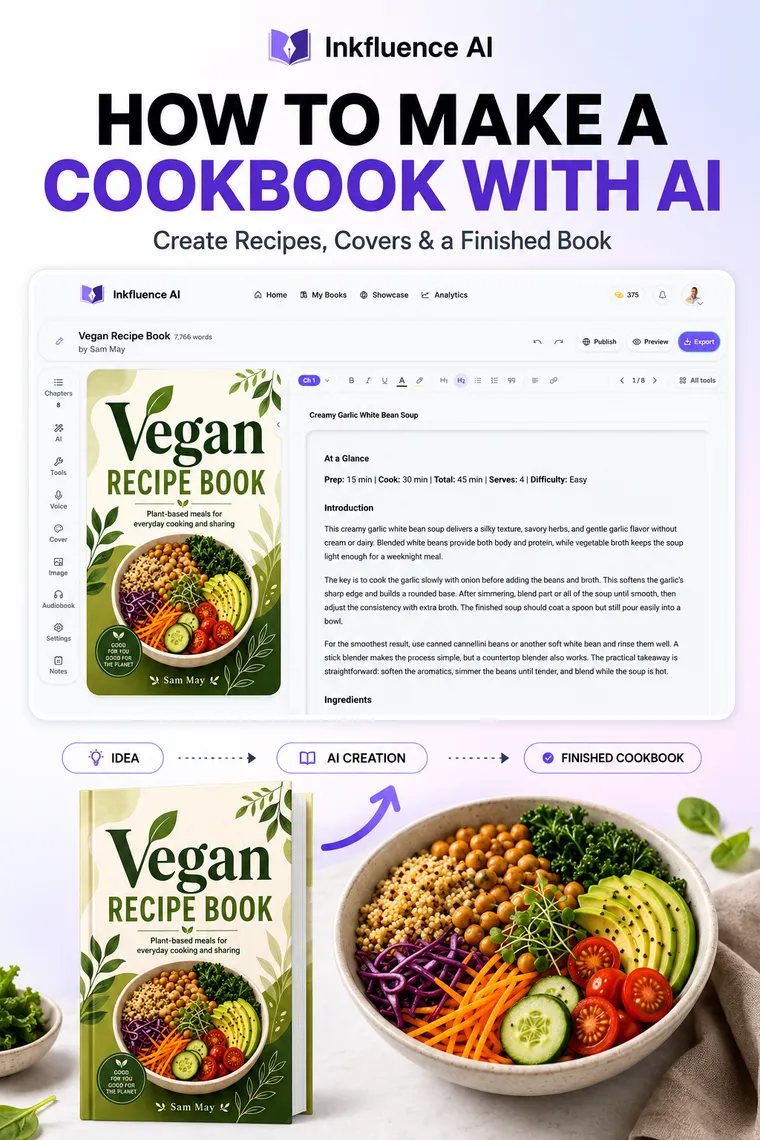
Chapter 1 · Vegan Recipe Book
Creamy Garlic White Bean Soup
At a Glance
Prep: 15 min · Cook: 30 min · Total: 45 min · Serves: 4 · Difficulty: Easy
Introduction
This creamy garlic white bean soup delivers a silky texture, savory herbs, and gentle garlic flavor without cream or dairy. Blended white beans provide both body and protein, while vegetable broth keeps the soup light enough for a weeknight meal.
The key is to cook the garlic slowly with onion before adding the beans and broth. This softens the garlic’s sharp edge and builds a rounded base. After simmering, blend part or all of the soup until smooth, then adjust the consistency with extra broth.
For the smoothest result, use canned cannellini beans or another soft white bean and rinse them well. A stick blender makes the process simple, but a countertop blender also works.
Three things are worth noticing, because they are what separates a usable recipe from a paragraph about food. The timings sit at the top, before any prose, so a reader deciding what to cook tonight does not have to read to find out it takes ninety minutes. The method explains the why, not just the what: cook the garlic slowly to soften its sharp edge. That is the difference between a recipe someone follows once and one they learn from. And it names the failure mode, telling you which beans blend smoothly rather than assuming.
What it has not done is cook the soup. That is still your job before you sell it, for the reasons in the section below. The same structure applies whether you are building a full cookbook, a short lead magnet of ten recipes, or a meal-planning workbook.
How many recipes should a cookbook have?
There is no rule, but there are conventions, and picking the wrong length is the most common reason a cookbook does not sell. Too few and it reads like a sample; too many and it takes months to test. Match the count to what the book is for.
| Book type | Recipes | Why that number |
|---|---|---|
| Free lead magnet | 5–10 | Enough to prove you can cook, short enough to read in one sitting and to give away without hesitation. |
| Niche digital collection | 25–35 | The Etsy and Gumroad sweet spot. A month of dinners, priced as a real product, testable in a fortnight. |
| Full paperback cookbook | 50–80 | What a buyer expects from a printed book with a spine. Below roughly fifty a paperback feels thin in the hand. |
| Reference or all-in-one | 100+ | Only worth it if the breadth is the selling point. Testing this many honestly is a serious project. |
| Single-subject deep dive | 15–25 | One technique or ingredient explored properly. Depth is the promise, so fewer recipes with more explanation is right. |
Whichever you choose, say the number in the prompt. And be realistic about testing: at a couple of recipes an evening, thirty recipes is a fortnight of cooking and a hundred is most of a season. That constraint, not the writing, is what should decide the length of your first book. If you are unsure which niche can support a full-length book at all, start with niche demand research before you generate anything.
Writing a prompt that produces a full book
The single most common disappointment with an AI cookbook is a book with eight recipes when the author wanted fifty. It is almost always the prompt, and it is almost always the same omission: the number was never stated. Recipe count follows chapter count, so a request that does not name a number gets a default.
| Prompt | What you get |
|---|---|
| A cookbook of summer roll recipes | A short book at the default chapter count, recipes in whatever format the model chooses. |
| A 50-chapter cookbook of summer roll recipes, one recipe per chapter | Fifty recipes, one per chapter, consistently structured. |
| A 50-chapter cookbook of summer roll recipes, one per chapter. Write in German. Ingredients as quantity plus item in metric, then numbered steps. | Fifty recipes in German with metric quantities and numbered methods, formatted the way you asked rather than the way it defaulted. |
Three things worth naming every time: the number of recipes, the unit system if you care about metric or imperial, and the language if it is not English. Everything else you can fix in the editor afterwards; those three are much faster to get right up front. The same principle applies across formats, and there is a fuller treatment in our guide to writing AI book prompts.
What AI recipes can and cannot be trusted for
This is the part most pages on this topic skip, and it is the part that decides whether your book gets recommended or returned. A generated recipe is a well-informed first draft. It is not a tested recipe, because nothing has been cooked.
Generally reliable: ratios and methods for well-established dishes. A fajita marinade, a tomato sauce, a standard braise. These are heavily documented patterns and the output usually reflects them accurately, which is why the fajita book in the video is a reasonable thing to generate.
Check carefully: baking, where a ratio error does not just taste wrong but fails; anything involving preserving, canning or fermentation, where errors are a safety matter rather than a quality one; cooking times for unfamiliar cuts or equipment; and any dietary or allergen claim, which you should verify against a reliable source yourself rather than take on trust. Publishing a recipe labelled gluten-free that is not is a real problem, not an editorial one. The same care applies to the AI disclosure Amazon asks for at upload.
The practical rule: cook anything you intend to sell. Testing is the work that separates a cookbook someone recommends from one they abandon after the first failure, and it is the one part of making a cookbook that no tool removes. Generate the book in an afternoon, then spend the fortnight cooking from it.
Photography, and whether you need it
Cookbooks are the most visual category in publishing, and it is the main reason they are expensive to produce traditionally. You have two routes. You can generate an image per recipe from the editor, which is fast and gives a coherent look across the book. Or you can upload your own photographs of dishes you have actually cooked.
If you are selling the book, real photographs of the real dish are worth the effort. Readers are unusually good at spotting food that has never been cooked, and a generated image of a dish that does not match the recipe underneath undermines the whole book. A reasonable middle path is generated imagery for section openers and real photographs for the recipes themselves, with the cover generator tying the look together. Whichever you choose, our guide to images in ebooks covers resolution and file size for print.
One practical note for print: photographs need more resolution than screens do. A picture that looks sharp in the editor can print soft, so check image quality in the exported PDF rather than in the browser, especially at larger trim sizes.
Getting a cookbook ready to print and sell
Cookbooks have their own format conventions and they exist for a reason. Trim size matters more than in other categories, because a recipe needs the ingredient list and the method visible together. 8 x 10 inches is the common KDP choice for an illustrated cookbook; 6 x 9 is fine for a text-led recipe collection without full-page photography. Our paperback printing guide covers trim sizes, bleed and spine width in detail.
For selling, a cookbook is one of the better digital products because it has an obvious use and an obvious audience. Beyond Amazon KDP, cookbooks do well on direct channels like Etsy and Gumroad, where a niche recipe collection can find its readers without competing against every cookbook ever published. Niche is the whole game here: a general cookbook competes with everything, while a book of thirty slow-cooker recipes for one person competes with almost nothing. Our niche research guide covers how to find that gap.
If you want a comparison of the tools in this space before committing, we maintain a ranked breakdown at best AI cookbook generator, and a fuller written walkthrough in how to write a cookbook with AI.
Frequently asked questions
Can AI write a cookbook?
Yes, and the distinction that matters is between writing recipes and formatting recipes you already have. Inkfluence AI generates the recipes themselves: each chapter comes out with an ingredient list with quantities, numbered method steps, prep and cook times, and notes on variations. Most tools described as cookbook software are typesetting tools that expect you to arrive with the recipes already written.
How do you get more recipes in an AI cookbook?
Ask for a specific number of chapters and say one recipe per chapter. Recipe count tracks chapter count, so "a cookbook of summer roll recipes" produces far fewer than "a 50-chapter cookbook of summer roll recipes, one recipe per chapter". Naming the number is the single biggest difference between a thin book and a full one.
Are AI-generated recipes safe to cook?
Treat them as a well-informed first draft, not as tested recipes. Ratios, methods and timings for familiar dishes are usually sound because they follow well-established patterns, but nothing has been cooked in a kitchen. Test anything you intend to publish, and be especially careful with baking, where small ratio errors matter, with preserving and canning, where they are a safety issue, and with allergen or dietary claims, which you should verify yourself rather than trust.
What structure does each recipe chapter follow?
Six blocks: At a Glance for servings and timings, a short Introduction, the Ingredients list, numbered Instructions, Chef Notes and Variations, and a Quick Version for when the reader is short on time. That structure is applied to every chapter so a fifty-recipe book stays consistent from front to back, which is the part that usually falls apart when a cookbook is assembled by hand.
Can you make a cookbook in another language?
Yes. Write the prompt in the language you want the book in and state it explicitly, for example "write the whole book in German". Recipes generate natively in that language rather than being translated afterwards, so quantities and cooking terms read correctly rather than word-for-word.
How do you get metric or imperial units?
Ask for them in the prompt. "List ingredients as quantity plus item in metric units" produces "2 peppers" and "400 g chopped tomatoes" rather than a bare list of ingredient names. If you want both, say so and each ingredient carries the conversion.
Can you add your own photographs?
Yes. You can upload your own food photography for any recipe, or generate an image per recipe if you have not shot the dishes. Uploading real photographs of food you have actually cooked is worth doing if you intend to sell the book, because readers can tell.
Can you sell an AI-assisted cookbook?
Yes. You keep full rights to what you create on every plan and keep the revenue from your own channels. Amazon KDP asks you to disclose AI-generated content at upload, which is a declaration rather than a barrier, and Etsy and Gumroad both accept digital cookbooks. The commercial risk is not the disclosure, it is publishing untested recipes.
What size should a cookbook be for print?
Larger trims suit cookbooks because a recipe needs the ingredient list and the method visible together without the reader turning a page mid-cook. 8 x 10 inches is the common choice on KDP for illustrated cookbooks; 6 x 9 works for text-led recipe collections without full-page photography.
How long does it take to make a cookbook?
The generation itself is minutes: the video builds a complete fajita cookbook in a single session. The honest answer for a book you intend to sell is longer, because testing the recipes is the part that takes real time and is the part that decides whether anyone recommends the book.
Keep reading
AI cookbook generator
The tool from the video, and what it writes rather than formats.
How to write a cookbook with AI
The longer written walkthrough, including niche selection.
Paperback publishing on KDP
Trim sizes, bleed and spine width for a printed cookbook.
Turn a book into an audiobook
The other video walkthrough, for when the book is finished.
Create a travel guide with AI
The sister video: another practical format, one place per chapter instead of one recipe.
Make your cookbook
Describe the recipes you want, name how many, and get a structured cookbook back to edit and publish. No credit card.
Start your cookbook free