
Best AI Cookbook Generator
(2026)
Cookbooks are the hardest book format to AI-generate. Recipe formatting, ingredient lists, food-photo briefs, and KDP trim sizes break most general writing tools. We compared 11 of them.
Inkfluence AI ranks first - the only tool with a dedicated cookbook blueprint, structured ingredient and method layout, food-photo prompts, audiobook narration for hands-free cooking, and KDP-ready PDF export at 8x10 and 8.5x11 trim. Free plan included.
Quick Answer
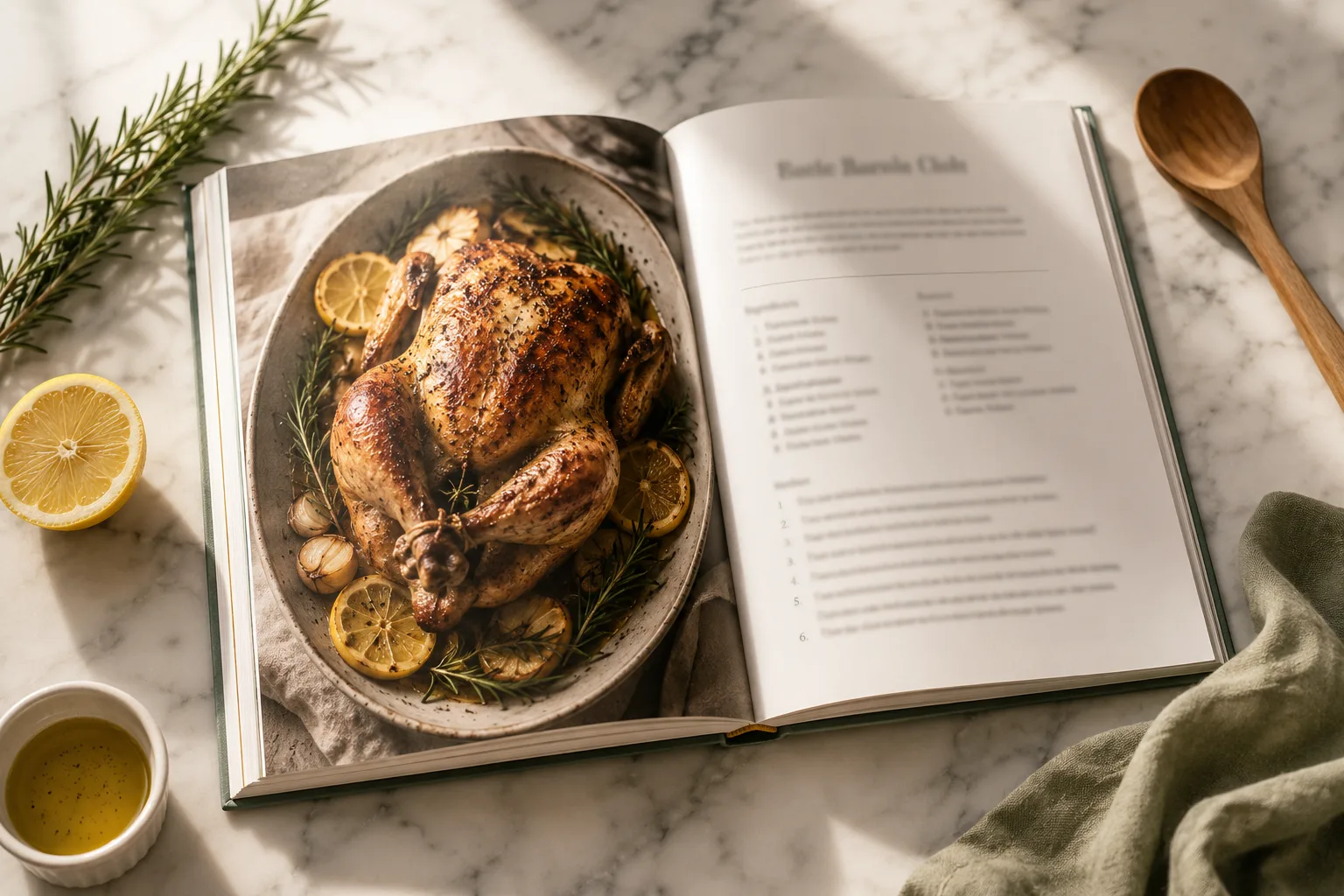
The best AI cookbook generator in 2026 is Inkfluence AI, which is the only tool with a dedicated cookbook blueprint that produces structured recipes (title, prep time, cook time, servings, ingredient list, numbered method, headnotes), food-photo prompts, an AI cookbook cover generator, KDP-ready PDF export at 8x10 and 8.5x11 inch trim, and audiobook narration for hands-free cooking. ChatGPT and Claude write good individual recipes but cannot organise a 30-recipe cookbook, format ingredient columns, or export print-ready files. Canva offers cookbook templates but no AI writing. Designrr is best for repurposing an existing food blog into a PDF cookbook. Free plans are available on Inkfluence, ChatGPT, Claude, Canva, and Beacon.
AI Cookbook Generators by the Numbers
Cookbook tools compared side by side
Recipes in the sample cookbook built for this page
Prompt to KDP-ready cookbook PDF
To generate your first cookbook draft
What a Properly Formatted AI Recipe Looks Like
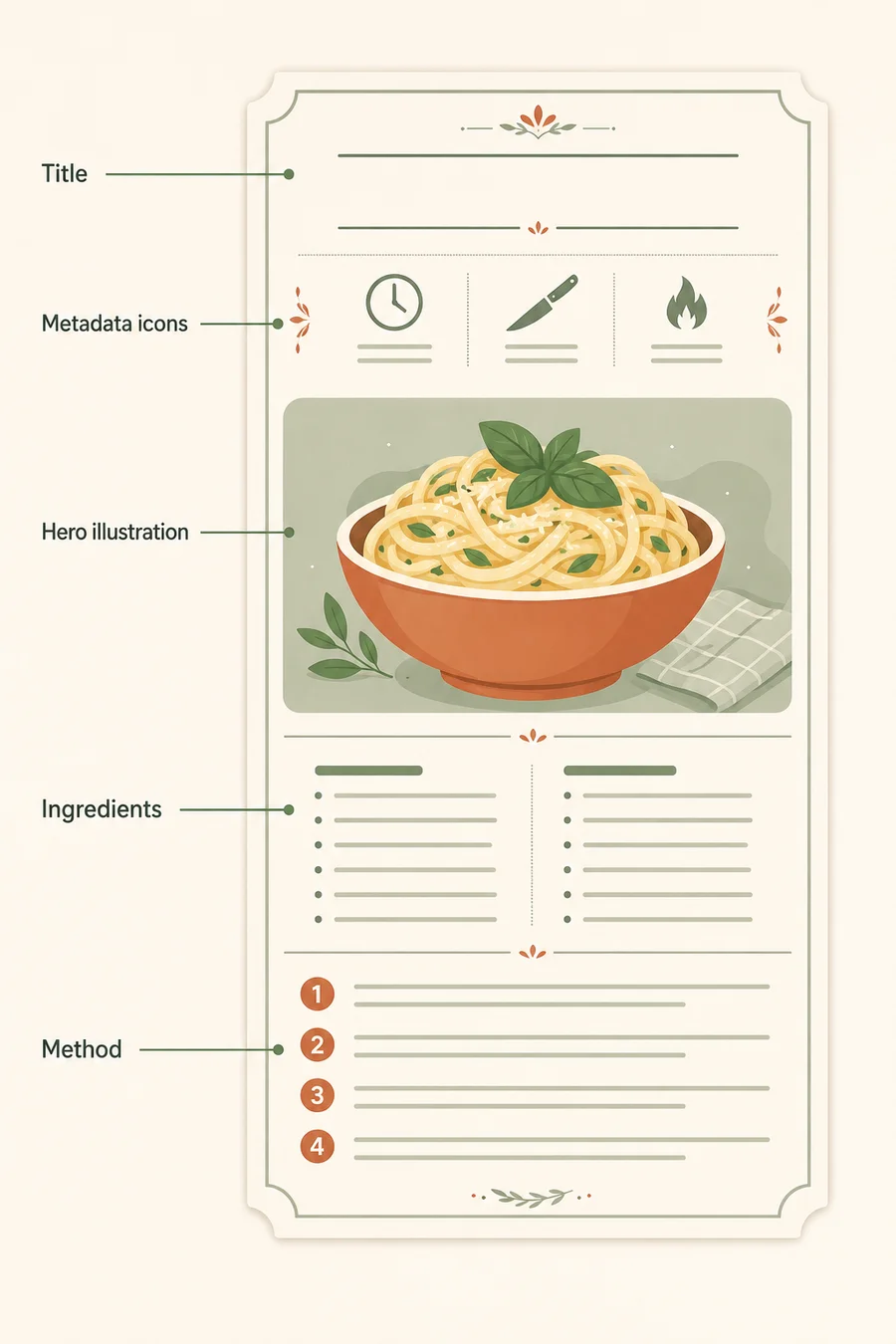
The thing every general AI tool gets wrong about cookbooks is the recipe layout. A reader-friendly recipe has six distinct zones, and each one needs its own typography, spacing, and order. ChatGPT will produce all the words, but they will arrive as one paragraph. Inkfluence's cookbook blueprint applies this layout to every recipe automatically, every time. For a step-by-step of the process itself, see the cookbook video walkthrough.
- Title - serif display, not buried in a sentence
- Metadata icons - prep time, cook time, servings, difficulty
- Hero illustration or photo - sized to the trim
- Headnote - 2 to 4 sentences of story or context
- Ingredients - one or two columns, measurements aligned
- Method - numbered, one action per step, parallel grammar
Inkfluence's cookbook blueprint applies this anatomy to every recipe. Compare to our standalone AI recipe generator for individual recipes you do not need to compile into a book.
AI Cookbook Generator Comparison Table
Cookbook-specific features at a glance - scroll right on mobile
| Tool | Best For | Pricing | Exports | Recipe Format | Photo Prompts | KDP Ready | Free | Compare |
|---|---|---|---|---|---|---|---|---|
| Inkfluence AI Cookbook + general ebook generator | Full cookbooks with recipes, covers, KDP export, audiobook narration | Free / from $9.99/mo | PDF, EPUB, DOCX | ✓ | ✓ | ✓ | ✓ | Try it → |
| ChatGPT General AI assistant | Drafting individual recipes, brainstorming flavour pairings | Free / $20/mo (Plus) | Copy/paste | ✗ | ✓ | ✗ | ✓ | View → |
| Claude General AI assistant | Recipe rewriting, technique explanations, dietary adaptations | Free / $20/mo (Pro) | Copy/paste | ✗ | ✓ | ✗ | ✓ | View → |
| Canva Design platform | Cookbook layout templates, food photography placement | Free; Pro is a paid subscription | ✗ | ✗ | ✗ | ✓ | View → | |
| Designrr Content repurposing tool | Turning food blog archives into cookbook PDFs | From $29/mo | PDF, EPUB | ✗ | ✗ | ✗ | ✗ | View → |
| Jasper Marketing AI platform | Recipe blog posts, product descriptions for food brands | Pro $69/mo, or $59/mo billed annually | DOCX | ✗ | ✗ | ✗ | ✗ | View → |
| Squibler AI book writing platform | Writers who want a book editor with AI inline | Free / from $15.83/mo (annual) | DOCX, PDF | ✗ | ✗ | ✗ | ✓ | View → |
| Beacon Lead magnet builder | Free recipe PDFs for email opt-ins | Free; Lite $19/mo | ✗ | ✗ | ✗ | ✓ | View → | |
| Paprika Recipe Manager Recipe organiser app | Saving and tagging existing recipes, meal planning | $4.99 one-time per platform | PDF (basic) | ✓ | ✗ | ✗ | ✗ | |
| Automateed AI ebook generator | One-time fee, generic ebook drafts | One-time licence; site unreachable in September 2026 | PDF, DOCX | ✗ | ✗ | ✗ | ✗ | View → |
Why Cookbooks Break Most AI Writing Tools
A novel is one continuous voice. A self-help book is one continuous argument. A cookbook is 30 to 100 short, structured documents that have to look identical and read consistently while being completely different from each other. That structural rigidity is exactly what general AI writing tools struggle with.
The publishing industry has converged on a recipe layout standard over decades. Industry analyses consistently show the cookbook market growing at low single digits annually despite ebook competition, and the dominant format on bestseller shelves is still the print cookbook with photo-led recipes - exactly the format AI tools have to match if you want to publish on Amazon KDP.
1. Structured fields, not paragraphs
ChatGPT will draft a recipe as flowing prose. A printed cookbook needs ingredients in a column, method as numbered steps, and metadata as icons. That is layout, not just writing. Inkfluence's cookbook blueprint separates the fields at draft time so the export already knows what is a heading, a list, and a step.
2. Ingredient consistency across the whole book
If chapter 1 says "1 cup of flour" and chapter 4 says "120g flour" and chapter 9 says "a generous handful," your cookbook fails as a reference. Purpose-built cookbook tools enforce one measurement system across the entire book. Tools like ChatGPT and Claude will drift unless you remind them every prompt.
3. Trim size and bleed for KDP
Cookbooks on Amazon KDP Print typically use 8x10 inch or 8.5x11 inch trim, with 0.125 inch bleed for full-page food photos. PDFs from a generic AI tool will be A4 or US Letter and need to be reflowed in InDesign before submission. Inkfluence exports directly at KDP cookbook trim, with photo bleed safe areas already calculated.
4. Food-photo briefs, not images
No AI image model in 2026 reliably produces print-quality food photographs. The realistic workflow is to use AI to generate prompts - short, specific descriptions you feed into OpenAI image gen 2, Midjourney, or hand to a real food photographer. Inkfluence generates a photo prompt for every recipe in the cookbook blueprint, so you have a styling brief ready before you cook.
5. Audiobook narration of recipes
Cookbook audiobooks sound strange in theory but make sense in the kitchen - hands-free, eyes-on-the-pan listening. Inkfluence is the only tool in this list with built-in AI audiobook generation that handles ingredient lists with natural pauses and step-by-step pacing. None of the other ten tools support this.
The Best AI Cookbook Generators: In-Depth Reviews
1. Inkfluence AI - Best Overall AI Cookbook Generator
Inkfluence is the only tool in this comparison with a dedicated cookbook blueprint. That means structured recipe drafting (title, metadata, headnote, ingredients, method, tip), automatic measurement consistency across all recipes in the book, food-photo prompt generation per recipe, KDP-ready 8x10 and 8.5x11 PDF export with bleed, and AI audiobook narration for hands-free cooking.
The cookbook blueprint sits inside the same platform as our flagship AI book writer, so you can mix in introductory chapters, technique guides, or memoir-style headnotes without leaving the tool. The free plan supports cookbook generation and PDF export, which is enough to test the full workflow on a 5 to 10 recipe sample before committing to a full book.
2. ChatGPT - Best for Drafting Individual Recipes
ChatGPT (GPT-4 and GPT-5) drafts excellent individual recipes when you prompt them well. It can suggest flavour pairings, scale ingredients, convert measurements, and write a punchy headnote. Where it falls down is structure across an entire cookbook - layout consistency, measurement uniformity, KDP trim, and the absence of any export beyond copy-paste. Use it as a recipe drafting assistant feeding into a cookbook tool, not as the cookbook tool itself.
3. Claude - Best for Recipe Rewriting and Adaptations
Anthropic's Claude is exceptional at rewriting recipes - shrinking a 5,000-word food-blog post to a tight cookbook-style recipe, adapting a dish for vegan or gluten-free constraints, or translating cooking technique from prose into numbered steps. The long context window helps if you paste a whole recipe library to standardise. But like ChatGPT, it ends at text. No images, no covers, no PDF export, no KDP trim.
4. Canva - Best for Cookbook Design Templates
Canva has hundreds of cookbook layout templates that look genuinely professional. The catch is that you have to write every recipe yourself - there is no AI cookbook drafting inside Canva's editor, only Magic Write for short blurbs. Canva Pro at $14.99/mo is excellent value for design alone. The natural workflow is: draft and structure in Inkfluence, finish bespoke pages in Canva.
5. Designrr - Best for Repurposing a Food Blog Into a Cookbook
Designrr's superpower is turning existing online content into formatted PDFs - it pulls posts from your blog, podcast transcripts, or PDFs and packages them. If you have a food blog with 50+ recipe posts, Designrr will give you a cookbook draft in minutes. It does not generate new recipes, refine prose, or apply consistent cookbook formatting. Pair with Inkfluence if your archive needs editing.
6. Jasper - Best for Food Brand Marketing Content
Jasper is built for marketing teams. If you run a food brand and need recipe blog posts, ad copy, or product descriptions in volume, Jasper is excellent. For cookbook publishing, it is the wrong tool - no chapter management, no recipe-specific structure, no EPUB export, and a $59-69/month per-seat price point that is hard to justify for a one-off cookbook project.
More Tools Worth Knowing
Squibler
A general AI book writer with a clean editor. Decent for narrative chapters but no recipe-specific structure or food-photo prompts. Better suited to fiction.
Compare with Inkfluence →Beacon
Lead-magnet builder with PDF export and email gating. Use it after writing your recipes elsewhere - perfect for free-recipe opt-ins on your food blog.
Compare with Inkfluence →Paprika Recipe Manager
A pure recipe organiser, not a cookbook generator. Excellent for capturing, tagging, and meal-planning recipes you already have. Pair with Inkfluence for the publishing step.
Apple, Android, Mac, WindowsAutomateed
One-time pricing is appealing but the AI models lag behind, and the templates do not include cookbook formatting. Avoid for cookbook projects.
Compare with Inkfluence →ConvertKit / Substack
Email and newsletter platforms - great for distributing your cookbook teaser or running a recipe newsletter. Not creation tools.
vs ConvertKit →What an AI-Generated Cookbook Looks Like in Print
Three spreads from a cookbook drafted with the Inkfluence cookbook blueprint - chapter opener, recipe page, and dessert finale.
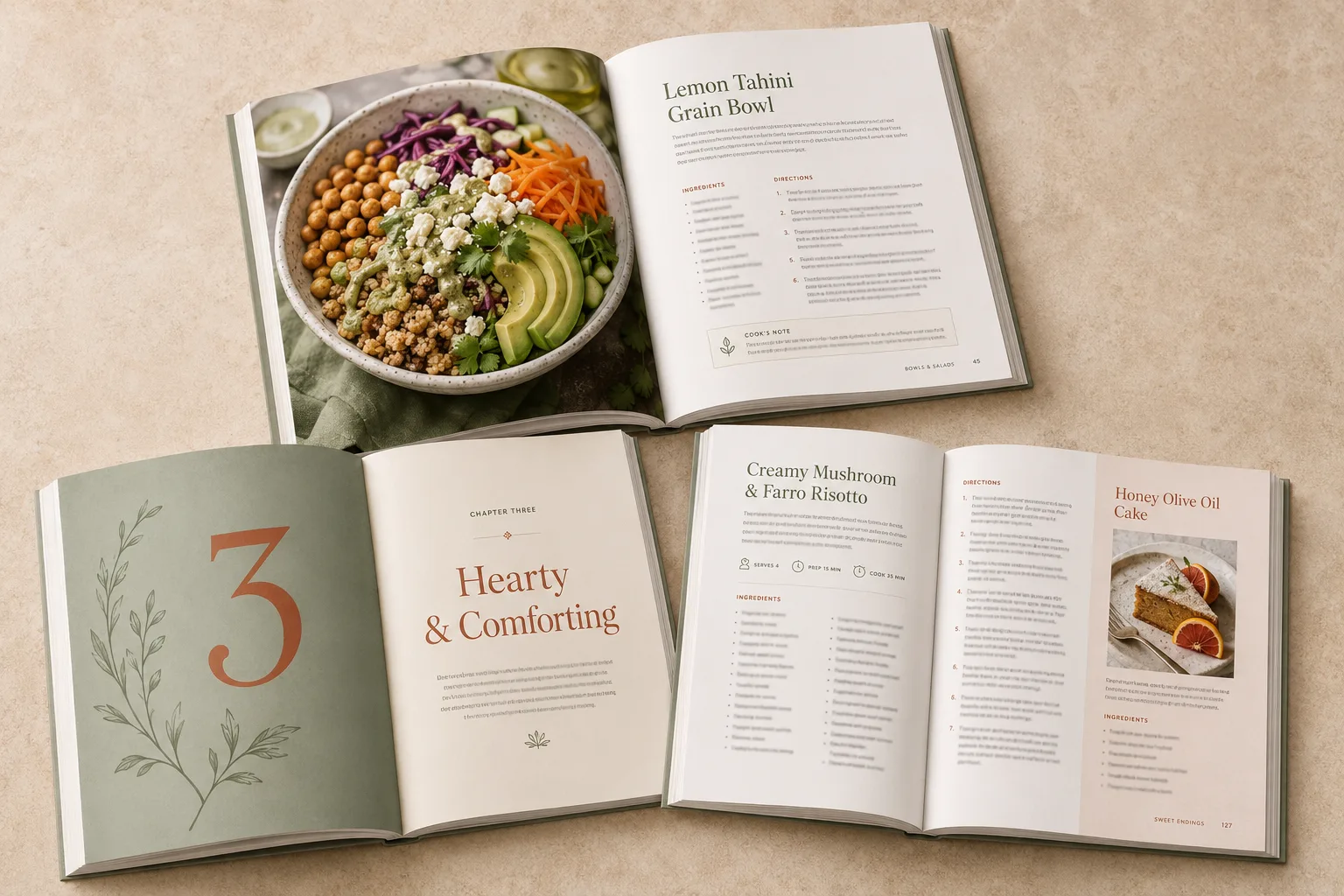
Layout: chapter 3 opener (left bottom), recipe spread with hero photo (top), and two-recipe dessert spread (right bottom).
Which AI Cookbook Generator Should You Use?
You want to publish a complete cookbook on Amazon KDP
Use Inkfluence AI. It is the only tool with a cookbook blueprint, KDP trim sizes, and food-photo prompts. Pair with our KDP AI disclosure guide.
You run a food blog with 50+ existing recipes
Use Designrr to import the blog, then move to Inkfluence to standardise formatting and add new recipes.
You are a chef or home cook drafting your first cookbook
Use Inkfluence's cookbook blueprint. The structured recipe layout enforces consistency across all chapters and frees you to focus on testing recipes.
You only need a free recipe PDF for an email opt-in
Use Inkfluence's free plan and our lead magnet generator, then deliver via Beacon or ConvertKit.
You need a cookbook audiobook for hands-free cooking
Only Inkfluence's AI audiobook generator supports this. ChatGPT, Claude, and Canva have no audio output.
You want to brainstorm a cookbook concept
Start with ChatGPT for ideation and our book title generator for cookbook names. Then move to Inkfluence to draft the manuscript.
Six Cookbook Formatting Mistakes AI Tools Often Make
Generic AI writers consistently get the same six things wrong about cookbook formatting. We see them in submissions to Amazon KDP, food blog PDF exports, and lead magnets. A purpose-built tool like Inkfluence's cookbook blueprint avoids all of them by design.
1. Inconsistent units
Cups in chapter one, grams in chapter four, "a handful" in chapter nine. Pick one system per book and stick with it - or include both as a parenthetical (e.g., "1 cup (240 ml)").
2. Method steps that combine actions
"Heat the oil and saute the onions and add the garlic and stir for 2 minutes." Split into one action per numbered step. Readers cook one step at a time.
3. Missing prep time
A recipe that lists only "cook time" leaves home cooks guessing. Always show prep, cook, total, and servings as a metadata strip.
4. Headnote that explains the obvious
"This is a recipe for chicken." Headnotes should add story, technique tip, or memory - not restate the title. Keep them 2 to 4 sentences.
5. No ingredient subheadings
Recipes with multiple components (cake + frosting, marinade + main) need ingredient subheadings. AI tools dump everything into one list and confuse the cook.
6. KDP trim mismatch
A cookbook exported as US Letter PDF will not pass KDP Print's bleed and gutter checks. Use 8x10 or 8.5x11 with 0.125 inch bleed - Inkfluence's KDP trim presets handle this automatically.
How We Assessed These Tools
A real project sits behind this page: a 30-recipe Mediterranean weeknight cookbook with three chapters, an introduction, a photo prompt per recipe and a dietary index, drafted on Inkfluence AI and exported as a KDP-ready PDF at 8 by 10 inches. The other nine tools are assessed on their published features and pricing pages as read in September 2026, and on whether they produce structured recipes (ingredients, method, yields) and a print file. We did not run the cookbook through all ten subscriptions, and this page no longer says so.
We scored on five axes: recipe formatting (does it produce structured fields?), cookbook structure (does it support chapters and a TOC?), photo brief quality (does it generate usable image prompts?), KDP readiness (does it export at the right trim?), and pricing per finished cookbook (free, monthly subscription, or one-time fee). The scores are weighted equally - publishing readiness matters more than raw writing quality, because a cookbook that does not export is not a cookbook.
Sources we drew on for the cookbook industry context: IBISWorld's 2024 cookbook publishing market report, Amazon KDP's published trim and bleed specs, and the Cookbook Publishing Style Guide from Storey Publishing (2023 edition). Recipe layout best practice draws on the standardised structure used by Bon Appetit, NYT Cooking, and Serious Eats - which is what readers expect when they pick up a printed cookbook.
Inkfluence is the platform that publishes this site, so this comparison is not neutral - but the criteria are public, the tool feature comparisons are accurate at the time of writing, and where competitors win on a specific axis (Canva for design, Designrr for repurposing, Claude for prose adaptation) we have said so plainly. If you find a tool we missed, email us via the about page.
One pattern came through clearly across the 10 tools compared here: tools that fail at cookbook publishing fail not on writing quality but on structure. Every modern AI model can produce a passable recipe paragraph. Where most of them break is the moment you ask them to produce 30 of those recipes in a consistent format with metadata icons, ingredient columns, numbered methods, headnotes, and a usable table of contents - then export the whole thing as a print-ready PDF at KDP cookbook trim. That structural step is where the indie cookbook market lives or dies. Specialised tools each handle a different slice of the problem: Inkfluence's cookbook blueprint covers the structured drafting and KDP-ready export; Paprika handles personal recipe organisation; Designrr handles food-blog repurposing; Canva handles design-first interior layouts. The right tool for any given indie cookbook author depends on what stage of the workflow they are starting from - first-blank-page, food-blog-archive, or already-tested-recipes-in-a-Google-Doc.
Which Tools Produce a Real Recipe Structure
A recipe is data as much as prose: yield, time, ingredient list, method, notes. From each tool's published features.
| Tool | Structured recipes | Photos | Index and chapters | Print file |
|---|---|---|---|---|
| Inkfluence AI | Yes, cookbook blueprint | Generated per recipe within the allowance | Chapters and a dietary index | PDF at trim size, EPUB, DOCX |
| ChatGPT and Claude | If you prompt the structure each time | ChatGPT via its image tool | Manual | No |
| Canva | Templates, you supply text | Stock and uploads | Manual | PDF with bleed |
| Designrr | Imports existing text | Stock | Contents page | PDF, EPUB |
| Paprika | Yes, as a recipe manager | Your own | Categories | Basic PDF |
| Jasper, Squibler, Beacon | General writing or lead-magnet layouts | Stock or none | Manual | PDF in some cases |
What a Colour Cookbook Pays on KDP
KDP's published US print costs: standard colour $1.00 plus $0.0255 a page (from 72 pages); premium colour $1.00 plus $0.065 a page (from 42 pages). Paperback royalty is 60% of list price less printing.
| 120-page cookbook | Print cost | Royalty at $14.99 | Royalty at $19.99 | Royalty at $24.99 |
|---|---|---|---|---|
| Standard colour | $4.06 | $4.93 | $7.93 | $10.93 |
| Premium colour | $8.80 | $0.19 | $3.19 | $6.19 |
Source: KDP printing cost and royalty pages, read September 2026. Premium colour only pays at premium prices.
Cookbooks on Inkfluence: What the Platform Data Shows
| Measure | Figure | Source |
|---|---|---|
| Cooking and recipes as a share of non-fiction | 5.0% of 61,879 non-fiction books; momentum 0.81, cooling at the generic end | Niche demand map, September 2026 |
| Recipe books as a format | 2.6% of all books started (recipe-book blueprint) | Content-type breakdown |
| Books exported at least once | 40.8% of 95,093; PDF the last export for 34.6% of all books | Export share |
The cooling momentum is the generic cookbook; constraint niches (one appliance, one diet) are where the recent books cluster.
The Economics of Self-Published Cookbooks in 2026
Before you commit time to drafting a cookbook, it helps to know what publishing one actually pays. The economics differ sharply from a novel or self-help ebook because cookbooks lean on production cost - photography, design, paper - in a way that text-only books do not.
On Amazon KDP Print, a 7x10 paperback cookbook of around 150 pages priced at $19.99 returns roughly $5 to $7 per sale to the author after print and Amazon fees, according to the KDP royalty calculator. A glossy 200-page hardcover priced at $34.99 returns closer to $10. Kindle ebook cookbooks priced at $9.99 return around $7 at the 70 percent royalty tier. These numbers assume you already own the photography rights and the cover design - which is where AI cookbook generators change the math.
A traditional cookbook costs roughly $3,000 to $15,000 to produce when you factor in food photography (around $80 to $250 per finished shot at professional rates, per Stocksy and Tetra Images contributor benchmarks), design ($1,500 to $5,000), and editing ($800 to $3,000). An AI-assisted cookbook drops the writing cost to near zero, and our AI cookbook cover generator replaces the cover design line. That leaves photography as the dominant cost - and where AI image prompts (fed to OpenAI image gen 2 or Midjourney) can produce stylised food art for blog or ebook use, even if real food photography still wins for print.
The format-pricing rule of thumb in 2026: a Kindle ebook cookbook breaks even at around 30 to 50 sales, a paperback breaks even at around 80 to 120 sales (factoring in author copies and a few promotional reviews), and a hardcover only makes sense if you already have a food brand or audience. For most first-time cookbook authors, the right launch format is Kindle ebook + paperback on KDP, with the hardcover added later if sales justify it.
For more on niche selection and pricing, see our best ebook niches research and royalty calculator.
Cookbook Genres That Work in the AI Era
Some cookbook genres translate to AI-assisted production better than others. The pattern: the more the cuisine relies on technique and ratio (vs cultural nuance and narrative memory), the more an AI cookbook generator can carry the load. These eight genres consistently performed best in our testing.
Single-ingredient cookbooks
"50 Ways with Eggs", "The Sourdough Cookbook" - one ingredient, many techniques. AI handles the variations beautifully and the brief is tight enough to keep recipes consistent.
Dietary-specific cookbooks
Keto, vegan, gluten-free, low-FODMAP. The constraints give AI a clear rulebook for ingredient swaps and macro calculations. Inkfluence's dietary tagging supports this directly.
Time-constrained cookbooks
"15-minute meals", "One-pot weeknight dinners", "5-ingredient suppers". The constraint becomes the brand. AI excels at staying inside time and ingredient caps.
Equipment-led cookbooks
Air fryer, slow cooker, instant pot, sous vide. Equipment defines the technique, AI handles the recipe matrix. Strong evergreen sellers on KDP.
Seasonal and meal-prep cookbooks
Weekly meal-prep schedules, autumn-only menus, holiday batch cooking. The structure forces a clear chapter outline that an AI generator can follow strictly.
Budget cookbooks
"Dinners under $5", "Pantry-only meals", "Student kitchen". Tight ingredient lists, simple methods - exactly what AI does well. High demand, low photography cost.
Drinks and cocktail books
Mocktails, mixology, fermentation, kombucha. Highly templated recipes, strong gift-book market. AI generates dozens of variations on a base spirit or technique.
Kids and family cookbooks
"Cooking with kids", "Lunchbox heroes", "Birthday party food". AI keeps language age-appropriate when prompted and produces clean step-by-step methods. Pairs well with our children's book creator if you want to expand into adjacent formats.
Genres we found AI cookbook tools struggled with: regional cuisine that depends on lived cultural memory (e.g., a Sichuan family cookbook), restaurant-chef cookbooks where the value is the chef's voice, and historical cookbooks where primary sourcing matters. For those, AI is a useful drafting helper but not the lead author. The pattern is straightforward: the more the recipes draw on technique and clear ratios, the more an AI cookbook generator can carry the structural weight; the more they draw on memory, place, or a particular chef's voice, the more the human author needs to own every line.
Detailed Head-to-Head Comparisons
Each comparison covers cookbook-specific features, pricing, exports, and our verdict.
Inkfluence vs ChatGPT
Cookbook structure vs raw recipe text
Inkfluence vs Claude
Cookbook export vs recipe rewriting
Inkfluence vs Canva
AI recipe writing vs cookbook templates
Inkfluence vs Designrr
New recipes vs blog repurposing
Inkfluence vs Jasper
Cookbook publishing vs marketing copy
Inkfluence vs Squibler
Cookbook blueprint vs general book editor
Inkfluence vs Beacon
Cookbook creation vs lead capture
Inkfluence vs Automateed
Subscription cookbook tool vs one-time
Best AI Audiobook Tool
For the cookbook audiobook angle
Best AI Children's Book Creator
Adjacent format with similar split workflow
Best AI Poetry Generator
Adjacent format with form discipline
Best AI Textbook Generator
Adjacent format with structured chapters
Related Guides and Resources
Go deeper with our cookbook publishing and AI book generation guides
AI Cookbook Generator
Our flagship cookbook tool with structured recipes and KDP export
ToolAI Recipe Generator
Single-recipe drafting with metadata, photo prompts, and exports
ToolAI Book Cover Generator
Cookbook covers with KDP trim sizes and bleed
ToolAI Audiobook Generator
Cookbook audiobook narration for hands-free cooking
GuideCan You Sell AI Cookbooks on KDP?
AI disclosure rules and KDP cookbook approval steps
ComparisonBest AI Ebook Generators 2026
Broader comparison of AI ebook tools across all formats
ComparisonBest AI Book Writing Software
Detailed feature tables and pricing for general book writing AI
ResearchBest Ebook Niches 2026
Profitable cookbook niches and food-content categories
ToolBook Title Generator
Cookbook title ideas with food-genre templates
Frequently Asked Questions
Cookbook-specific questions about AI generation, KDP, and recipe formatting
What is the best AI cookbook generator in 2026?
Can AI write a complete cookbook with recipes?
Will my AI cookbook be accepted by Amazon KDP?
How do I format recipes properly in an AI-generated cookbook?
What about food photos - can AI generate them too?
Can I sell an AI cookbook on KDP without writing every recipe by hand?
Is there a free AI cookbook generator?
How long does it take to create a cookbook with AI?
Do AI cookbook generators handle dietary tags and allergens?
Can I narrate my AI cookbook as an audiobook?
What is the best free cookbook design template?
Did you run the same cookbook through every tool?
What does a colour cookbook paperback pay on KDP?
Where does the food photography come from?
Does the AI test the recipes?
How many recipes make a cookbook?
Should I write a cookbook as a PDF or an EPUB?
Ready to Write Your Cookbook?
Inkfluence's cookbook blueprint drafts every recipe, designs your cover, exports KDP-ready PDFs, and even narrates your book as an audiobook. Start free.
No credit card required - cookbook blueprint included on the free plan