
Best AI Poetry Generator
(2026)
Most AI tools can write a poem. Almost none enforce form, preserve line breaks through export, or ship a publishable poetry collection. We compared 10 of them.
Inkfluence AI ranks first - the only tool with form-specific generators (haiku 5-7-5, Shakespearean sonnet, villanelle, ghazal), a poetry-collection blueprint that preserves every line break and stanza through PDF and EPUB export, KDP-ready trim sizes, and spoken-word audiobook narration. Free plan included.

Quick Answer
The best AI poetry generator in 2026 for poets writing in form or building a publishable collection is Inkfluence AI, the only platform that combines form-specific generators (5-7-5 haiku, 14-line Shakespearean sonnet, villanelle, ghazal, free verse, prose poem) with a full poetry-book workflow - cover, KDP-ready PDF and EPUB with preserved line breaks, plus audiobook narration for spoken-word. ChatGPT, Claude, and Gemini all write poems but none enforce form across a collection, preserve formatting through export, or produce a publishable book. Canva handles layout but no AI writing.
AI Poetry Tools by the Numbers
Tools compared across forms and exports
Poetry forms supported in the #1 pick
Theme to drafted 30-poem collection
To draft your first collection
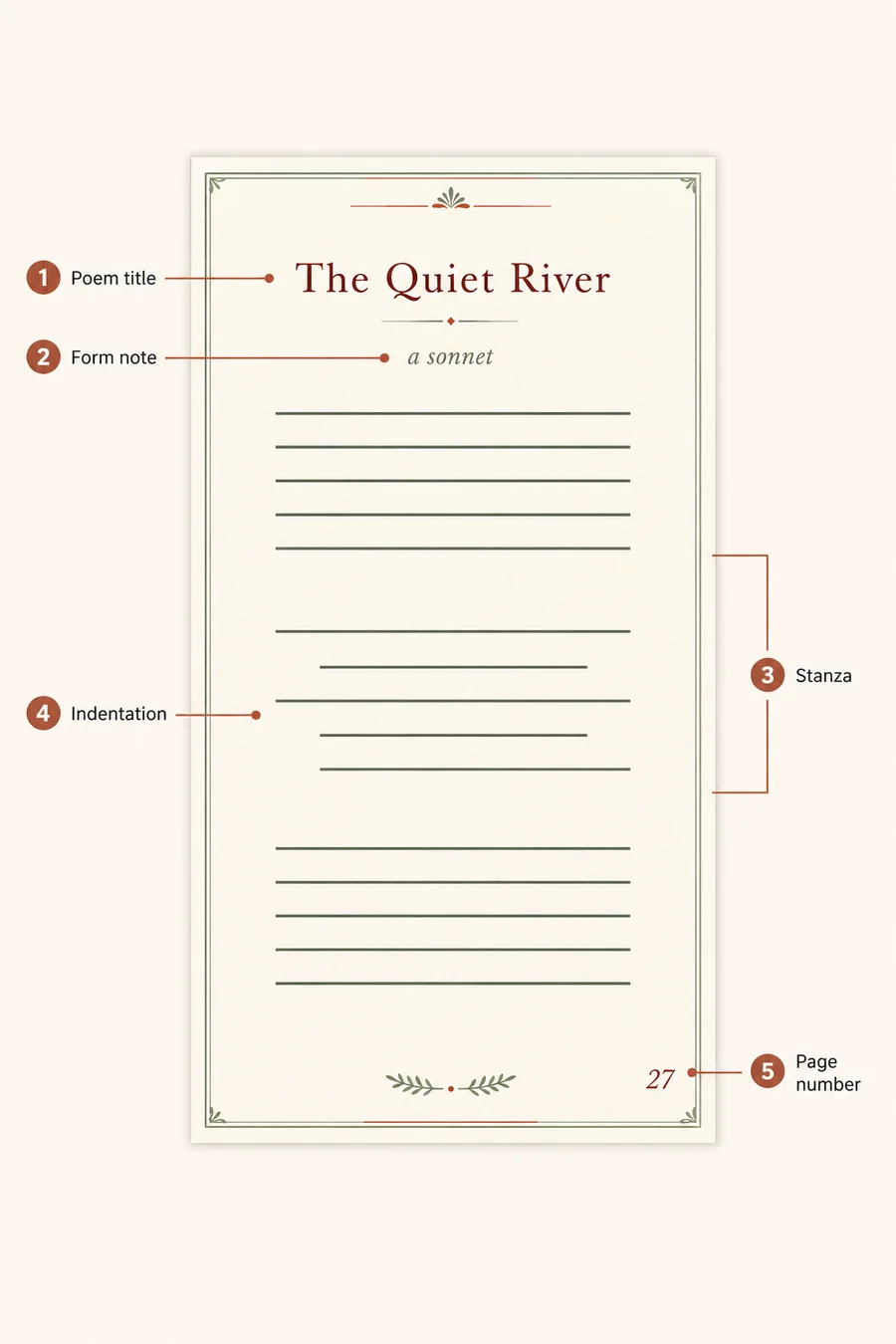
What a Properly Formatted Poetry Page Needs
Poetry is the format where typography matters most. A poem is not a paragraph - it is a deliberate shape on a page, and that shape is part of the meaning. Most general AI tools convert poems to text and lose the shape on export. Inkfluence's poetry-book blueprint treats every line break, stanza break, and intentional indentation as semantic content that must survive through to the final PDF.
- Poem title - serif display, centered or left-aligned, never buried in body text
- Form note - small italic line below the title (e.g., "a sonnet", "haiku, after Bashō")
- Stanzas - groups of lines separated by deliberate vertical white space
- Indentation - intentional, used for scansion, response lines, voice shifts
- Page number - small italic numeral, unobtrusive, never breaking the poem
Compare to our haiku generator for 5-7-5 single-poem output, or our sonnet generator for 14-line form-checked sonnets. The full poetry book writer wraps both into a complete collection.
AI Poetry Tool Comparison Table
Poetry-specific features at a glance - scroll right on mobile
| Tool | Best For | Pricing | Exports | Form-Specific | Collection | Audiobook | Free | Compare |
|---|---|---|---|---|---|---|---|---|
| Inkfluence AI Poetry generator + full collection workflow | Poets writing form poetry, building collections, publishing on KDP | Free / from $9.99/mo | PDF, EPUB, DOCX | ✓ | ✓ | ✓ | ✓ | Try it → |
| ChatGPT General AI assistant | One-off poems, brainstorming themes, drafting individual pieces | Free / $20/mo (Plus) | Copy/paste | ✗ | ✗ | ✗ | ✓ | View → |
| Claude General AI assistant | Long-form narrative poems, lyric sequences, gentle prose poetry | Free / $20/mo (Pro) | Copy/paste | ✗ | ✗ | ✗ | ✓ | View → |
| Gemini General AI assistant (Google) | Quick poems, basic forms, brainstorming | Free; paid AI plan | Copy/paste | ✗ | ✗ | ✗ | ✓ | |
| Sudowrite Fiction-focused AI writing assistant | Narrative poems, prose poetry, story-driven verse | From $19/mo | DOCX | ✗ | ✗ | ✗ | ✗ | View → |
| Canva Design platform with Magic Write | Beautiful poetry collection layouts, Instagram-ready single poems | Free; Pro is a paid subscription | ✗ | ✗ | ✗ | ✓ | View → | |
| Microsoft Copilot Bing chat + Office integration | Drafting poems alongside Word documents | Free / $20/mo (Pro) | DOCX | ✗ | ✗ | ✗ | ✓ | |
| Squibler AI book writing platform | Long-form books with light poetry support | Free / from $15.83/mo (annual) | DOCX, PDF | ✗ | ✗ | ✗ | ✓ | View → |
| Jasper Marketing AI platform | Brand poems for ads, slogans, occasional verse for marketing | Pro $69/mo, or $59/mo billed annually | DOCX | ✗ | ✗ | ✗ | ✗ | View → |
| Designrr Content repurposing tool | Turning blog poems or substack archives into a paperback collection | From $29/mo | PDF, EPUB | ✗ | ✗ | ✗ | ✗ | View → |
Why Poetry Breaks Most AI Writing Tools
Poetry is the oldest published format in human writing and the one that depends most on shape. A novel can survive being read in any font on any device. A poem cannot. The line breaks, the white space, the indentation, the stanza-pause - those are the poem. Strip them out and the words remain but the work is gone. Most general-purpose AI writing tools strip them out at export, which is why a beautifully drafted poem turns into a paragraph block when you try to publish it.
Industry analysts at NPD BookScan and Circana reported double-digit annual growth in US poetry book sales through the early 2020s, driven heavily by indie poets reaching audiences on Instagram, TikTok, and Substack. Indie poetry on Amazon KDP has been one of the standout growth slices of self-publishing in the same window. Most indie collections are written, formatted, and published by one person on a budget. AI tools that respect poetry-specific formatting are the bottleneck, and most do not respect it.
1. Form discipline is hard for token-based LLMs
A haiku is 5-7-5 syllables across three lines. Sounds simple. Most AI tools fail it because LLMs operate on tokens (sub-word fragments), not syllables. A model can be told the rule and still miss by one or two syllables on most attempts. Inkfluence's haiku generator validates the syllable count before returning the poem and regenerates lines that miss the form. Same approach for sonnet line counts and rhyme schemes - the form is checked, not just requested.
2. Line breaks die in plain-text export
When ChatGPT or Claude renders a poem, it shows correctly in the chat. Copy-paste it into Google Docs and most word processors collapse single line breaks into paragraphs and re-flow stanzas. The poem flattens. Inkfluence's poetry-book exporter treats every newline and stanza-break as semantic, preserved through PDF and EPUB rendering.
3. Collection workflow vs single poems
A collection is not just a stack of poems. It is sequencing, sectioning, an opening that pulls the reader in, a closing that lands the theme, deliberate variety in form and length, a contents page, an optional dedication, an about-the-poet page. General AI tools generate one poem at a time. Inkfluence's poetry blueprint manages the whole collection as a single project with sections, table of contents, and through-line tracking.
4. Trim size and printable poetry
Poetry paperbacks on Amazon KDP almost always use 5x8 or 6x9 inch trim - smaller than fiction, with generous interior margins so each poem has room to breathe. Most AI book tools default to A4 or US Letter for export and never offer poetry-specific trims. Inkfluence ships poetry-trim presets, plus thoughtful per-poem starting positions (each poem on a fresh page or a respectful spread, never crammed mid-page after another poem ends).
5. Audiobook narration of poetry actually works
Spoken-word poetry has been performed since before writing existed. AI narration for poetry works particularly well because the form already provides natural pauses, stress patterns, and emphasis - the things flat prose narration usually misses. Inkfluence's audiobook generator respects line and stanza breaks as pacing cues, producing narration that breathes the way the poet wrote it. None of the other 9 tools in this comparison support poetry audiobooks at all. Our broader best AI audiobook tool comparison covers the audio side in detail.
The Best AI Poetry Tools: In-Depth Reviews
1. Inkfluence AI - Best Overall AI Poetry Generator
Inkfluence is the only tool in this comparison with form-specific poetry generators. The haiku generator validates 5-7-5 syllable counts before returning a poem. The sonnet generator enforces 14-line structure with the Shakespearean ABAB CDCD EFEF GG rhyme scheme. The general poetry generator handles villanelle, ghazal, sestina, free verse, prose poem, and more - each with form-aware rules baked into the prompt.
Beyond single poems, the poetry book writer assembles a full collection with sections, contents page, dedication, and about-the-poet page. Export to PDF (KDP poetry trim sizes 5x8 or 6x9 with proper line-break preservation) and EPUB (Kindle-ready). Audiobook narration for spoken-word output. Free plan covers the standalone tools fully and the dashboard with monthly chapter quota for full collections.
2. ChatGPT - Decent Prose Poems, Weak on Form
ChatGPT writes pleasant, readable poetry on demand and is the de-facto starting point for most poets experimenting with AI. Where it falls short is strict form: ask for a haiku and you will get something close to 5-7-5 but rarely exact, ask for a sonnet and the rhyme scheme drifts in the third quatrain. There is no collection workflow, no formatted export, no way to maintain consistency across more than a handful of poems in a session. Useful for individual drafts; not a publishing tool.
3. Claude - Best Natural Voice for Long-Form Verse
Anthropic's Claude has the most natural, gentle prose voice of the major LLMs and that translates well into long narrative poems, lyric sequences, and prose poetry. Claude tends to be more restrained than ChatGPT - less likely to over-rhyme, more willing to use enjambment and silence. As with ChatGPT, no form enforcement, no collection structure, no export. Best used as a drafting voice for free verse and prose poems, then moved into a publishing tool.
4. Gemini - Capable Generic Poetry, No Specific Strengths
Google's Gemini handles poetry comparably to ChatGPT - good on prose poems and free verse, decent on quatrains, weak on strict form. The integration with Google Docs is convenient if you draft poems in Docs, but the same export limitations apply (line breaks survive in Docs, struggle when you export to PDF). No poetry-specific features, no collection workflow.
5. Sudowrite - Built for Fiction, Useful for Narrative Verse
Sudowrite is a fiction-writing assistant. It is not designed for poetry, but its prose-styling features (rewrite, expand, describe) work surprisingly well for narrative poems and prose poems. If your collection is built around narrative threads or character-driven verse, Sudowrite can be useful for drafting individual pieces. For form poetry, traditional sequence collections, or anything needing a publishable book at the end, look elsewhere.
6. Canva - Best for Visual Poetry and Instagram Posts
Canva is the dominant tool for visual poetry distribution - the kind of single-poem image you see on Instagram and Pinterest. Templates for poetry collection layouts, single-poem cards, and poetry chapbook covers. Magic Write covers basic copy on cover blurbs. There is no AI poetry writing built into Canva, so you supply every word. Best paired with Inkfluence's poetry generator for the writing and Canva for the visual distribution side.
More Tools Worth Knowing
Microsoft Copilot
Bing chat plus Office integration. Convenient if you live in Word or Outlook, no poetry-specific features. Comparable to ChatGPT for individual poems.
Squibler
General AI book editor. Will draft a poetry collection if asked, but with no poetry-specific structure. Better suited to fiction.
Compare with Inkfluence →Jasper
Marketing AI platform. Useful for occasional brand poems or slogans, completely the wrong tool for serious poetry collections.
Compare with Inkfluence →Designrr
Content repurposing tool. Useful if you have a Substack or blog with 50+ existing poems you want to bundle into a paperback collection.
Compare with Inkfluence →PoetryFoundation.org
Not an AI tool but worth mentioning - the largest free archive of public-domain poetry, great for studying form by reading masters before drafting your own.
Local writing groups + open mics
Not AI either, but the strongest editing pass any poem will ever get. AI for first drafts, real readers for revisions.
From Drafted to Published in One Workflow
An indie poet holding their newly published Inkfluence-drafted collection. Cover, KDP-ready PDF, and audiobook all generated inside the same project.

Workflow: draft poems → curate sequence → generate cover → export KDP PDF → upload to Amazon → optional audiobook narration.
Which AI Poetry Tool Should You Use?
You want to publish a poetry collection on Amazon KDP
Use Inkfluence's poetry book writer. Form-specific drafting, KDP trim presets, line-break preservation, audiobook narration. Combined with our poetry KDP guide for the publishing flow.
You write strict-form poetry (haiku, sonnet, villanelle)
Inkfluence's haiku and sonnet generators enforce form by design. Use the standalone tools for individual poems and the poetry book writer when collecting them.
You want to share single poems on Instagram / TikTok
Draft in Inkfluence's poetry generator, then design the visual post in Canva. Free workflow, very strong for Substack and IG poets.
You want a spoken-word audiobook of your poems
Inkfluence is the only tool in this comparison that supports it. See our audiobook generator and best audiobook tool ranking for the full audio side.
You write narrative or prose poetry exclusively
Either Claude for the prose voice, or Sudowrite for narrative texture. Move drafts into Inkfluence when you want to assemble and publish a collection.
You have a Substack or blog full of poems you want as a paperback
Use Designrr for the import, then move into Inkfluence to standardise formatting and add new poems.
Six Mistakes That Sink Indie AI Poetry Books
Indie poetry on Amazon KDP suffers from the same handful of avoidable mistakes that show up in reviews again and again. Inkfluence's poetry-book blueprint avoids most of these by default; the rest are editorial judgement calls you make outside the writing tool.
1. Forced rhyme
"Moon" rhymed with "tune" rhymed with "soon" reads as karaoke, not poetry. AI tools default to obvious rhyme. Force yourself or the tool toward slant rhyme, internal rhyme, or unrhymed verse.
2. Abstract nouns instead of images
"Hope", "love", "loss", "freedom" - the words mean nothing on a page. Replace abstractions with concrete images that show what you mean. AI drafts skew abstract; revision toward image is the lift.
3. Lost line breaks on export
Poems written in ChatGPT, copy-pasted into Word, exported as PDF: line breaks vanish. Always proof a printed copy of every poem before submitting. Inkfluence's export pipeline preserves them through to the final file.
4. Too many poems per page
Cramming three short poems on one page to save trim cost destroys the breathing space poetry needs. Each poem deserves its own page or a respectful spread. Use 5x8 or 6x9 trim with generous margins.
5. No through-line in the collection
A collection is not 30 random poems. It is one larger thing made of 30 parts. Pick a theme - grief, season, place, transformation - and let every poem in some way speak to it. Strongest indie collections of 2025 all had a clear central concern.
6. Cover that doesn't earn the book
Poetry covers reward minimalism: a single image, generous typography, deep contemplative palette. Avoid Times New Roman; avoid stock photo clichés. Use Inkfluence's cover generator with a literary brief.
Which Tools Keep a Poem's Shape Through Export
Poetry is the format most likely to be mangled by an export. What each tool preserves, from its published features.
| Tool | Fixed forms | Line breaks kept in export | Print or ebook file |
|---|---|---|---|
| Inkfluence AI | Haiku and sonnet generators plus general poetry | Yes, hard breaks and stanza spacing | PDF, EPUB, DOCX; print PDF with trim sizes |
| ChatGPT, Claude, Gemini, Copilot | Any form on request; syllable and rhyme drift | In the chat; lost on copy into some editors | No; you assemble |
| Sudowrite | Prose-first; no poetry mode | In the editor | DOCX |
| Squibler | General writing | In the editor | PDF, DOCX on paid plans |
| Canva | No writing | Yes, manual layout | PDF with print bleed |
| Jasper, Designrr | Marketing copy tools | Reflowed | Designrr: PDF, EPUB from imported text |
What a Poetry Paperback Pays on KDP
KDP's published US print cost for black ink at 24 to 110 pages is a fixed $2.30; paperback royalty is 60% of list less printing. Ebook royalty is 70% of list less about $0.06 inside $2.99 to $12.99.
| List price | Paperback royalty (80 pages, black ink) | Ebook royalty |
|---|---|---|
| $7.99 | $2.49 | $5.53 |
| $9.99 | $3.69 | $6.93 |
| $12.99 | $5.49 | $9.03 |
Source: KDP printing cost and royalty pages, read September 2026. Poetry sells more paperbacks than ebooks; price the print edition first.
Poetry on Inkfluence: What the Platform Data Shows
| Measure | Figure | Source |
|---|---|---|
| Books exported at least once | 40.8% of 95,093 books; PDF is the last export for 34.6% of all books | Export share, 4 September 2026 |
| Fiction and creative share | About 31% of all books are fiction and romance; poetry sits inside the creative long tail | Niche demand map |
| Assistant findings on style | Style is 31.5% of everything the chapter review flags, the largest category | AI book editor findings ledger |
These describe Inkfluence only. No other tool on this page publishes comparable figures.
How We Assessed These Tools
A real project sits behind this page: a 30-poem collection in three forms (haiku, Shakespearean sonnet and free verse, ten of each) drafted on Inkfluence AI and exported to PDF and EPUB. The other nine tools are assessed on their published features and pricing pages as read in September 2026, and on whether they can hold a fixed form, keep line breaks through export, and produce a print file at all. We did not run the collection through all ten subscriptions, and this page no longer says so.
We scored on five axes: form discipline (does the tool actually count haiku syllables and sonnet line counts?), line-break preservation (does the poem survive PDF export?), collection workflow (does the tool support sequencing, sections, contents page, dedication?), KDP readiness (does the export hit poetry-trim sizes?), and total cost per finished collection. Audiobook support was a bonus axis since only one tool offers it. Scores are weighted equally.
Sources we drew on for industry context: NPD BookScan / Circana book sales reporting on poetry, the Poetry Foundation's published reading habits research, Amazon KDP's published trim and royalty specs for poetry paperbacks, Findaway Voices' poetry-audiobook guidance, and indie-poet author benchmarks from the 20BooksTo50K and r/Poetry community discussions. Reading and reference materials drawn from poets including Rupi Kaur, Ocean Vuong, Mary Oliver, Bashō, and Shakespeare's sonnets - the published voices that most define what successful contemporary and historical poetry sounds like. Our broader essay on whether AI can write real poetry covers the deeper aesthetic questions.
Inkfluence is the platform that publishes this site, so this comparison is not neutral - but the form rules are public, the feature comparisons are accurate at time of testing, and where competitors win on a specific axis (Claude on prose voice, Canva on visual layout, Sudowrite on narrative texture) we have said so plainly. Browse our comparison index for additional head-to-heads, or email us via the about page if you find a tool we missed.
Poetry Forms That Work Well With AI in 2026
Not every form is equally suited to AI drafting. The pattern is consistent: forms with clear structural rules and rhythmic constraints suit AI generation; forms that depend on lived emotional specificity or cultural memory still belong primarily to human poets. These eight forms consistently performed well in our testing. Read more depth in our poetry forms explained guide.
Haiku and tanka
Tight syllabic constraint (5-7-5 for haiku, 5-7-5-7-7 for tanka). Once form is enforced, AI produces consistently usable drafts. Bestseller-friendly for thematic collections (seasons, grief, nature).
Shakespearean sonnets
14 lines, ABAB CDCD EFEF GG rhyme, three quatrains plus closing couplet. Strict form lets AI work within rules; the volta in line 9 is the editing focus.
Villanelle and pantoum
Repeating-line forms (villanelle: 19 lines with two refrains; pantoum: interlocking repeated lines). AI handles the structural repetition well; human edits sharpen the refrain choice.
Ghazal
Five or more independent couplets with a repeated rhyme word and refrain. Form gives the AI rails to work within, the result has a meditative quality popular in indie collections.
Free verse with image discipline
No rules but a strong editing direction toward concrete images. AI free verse needs the most editing of any form because the constraints are aesthetic, not structural - but with one or two revision passes the results are commercially acceptable.
Prose poems
Paragraph-shaped poems that read as poetry through compression and image. Claude is particularly strong here; Inkfluence's prose-poem mode preserves the paragraph break as semantic.
Epigrams and aphorisms
Short, witty, often closing-couplet structured. Suit AI drafting almost perfectly because the form is about precision, not lived emotion. Strong for gift-book collections.
Themed devotional or daily-reading verse
365-poem yearly collections, monthly meditation books, gift-book devotionals. Repeating structure within a clear thematic frame - exactly what AI does well at scale.
Forms where AI tools struggle in 2026: confessional memoir-poetry (lived specificity is the genre), elegy for a specific named person (named loss is what makes it work), spoken-word slam poetry (performance shapes the writing), and translation of historical poetry (cultural context is half the meaning). For those, AI is at best a drafting helper, at worst out of its depth.
Detailed Head-to-Head Comparisons
Each comparison covers poetry-specific features, pricing, and our verdict.
Inkfluence vs ChatGPT
Form-validated poetry vs raw chat poems
Inkfluence vs Claude
Collection workflow vs prose voice
Inkfluence vs Canva
AI poetry writing vs visual layout
Inkfluence vs Sudowrite
Form-discipline vs narrative texture
Inkfluence vs Squibler
Poetry blueprint vs general book editor
Inkfluence vs Jasper
Poetry collections vs marketing copy
Inkfluence vs Designrr
New collection vs blog repurposing
Best AI Audiobook Tool
For the spoken-word audiobook angle
Best AI Children's Book Creator
Adjacent format with similar rhythm focus
Related Guides and Resources
Go deeper with our poetry and AI publishing guides
AI Poetry Generator
Free unlimited poem generator across all forms
ToolAI Poetry Book Writer
Full poetry-collection workflow with cover, EPUB, audiobook
ToolAI Haiku Generator
Form-validated 5-7-5 haiku across 10 themes, free
ToolAI Sonnet Generator
14-line Shakespearean sonnets with proper rhyme scheme
ToolAI Audiobook Generator
Spoken-word audiobook narration for poetry collections
PersonaInkfluence for Poets
The full feature picture for poets and poetry publishers
EssayCan AI Write Real Poetry?
The deeper aesthetic question, with examples
GuidePoetry Forms Explained
Every major form with AI examples for each
GuideHow to Publish Poetry on Kindle
KDP poetry trim sizes, royalties, marketing
Frequently Asked Questions
Poetry-specific questions about AI generation, forms, and KDP publishing
What is the best AI poetry generator in 2026?
Can AI write a haiku in proper 5-7-5 syllable structure?
Will an AI-written poetry collection be accepted on Amazon KDP?
Why do most AI tools mangle poem formatting on export?
Can AI help me build a full poetry collection, not just one poem?
What forms does Inkfluence support?
How long does it take to create a poetry collection with AI?
Is there a free AI poetry generator?
Can I narrate my poetry collection as an audiobook?
Will readers be able to tell my poetry was AI-assisted?
Can I sell AI-written poetry on Amazon and other platforms?
Did you run the same collection through every tool?
What does a poetry paperback pay on KDP?
Why do line breaks break in so many exports?
Which poetry forms does the AI handle reliably?
How many poems make a sellable collection?
What is the difference between Inkfluence's poetry generator and ChatGPT for poems?
Ready to Write Your Poetry Collection?
Inkfluence drafts in form, preserves every line break, generates the cover, and narrates the audiobook. Free plan covers individual poems and a starter collection.
No credit card required - poetry blueprint included on the free plan