
Best AI Textbook Generator
(2026)
A textbook is not just text. It is a scaffolded learning experience - learning objectives, worked examples, practice exercises, summaries. Most AI tools write the words and skip the scaffolding. We tested 10 of them.
Inkfluence AI ranks first for indie textbook authors and course creators - dedicated study-guide, lesson-plan, and education-guide blueprints that structure every chapter pedagogically, KDP-ready export at 7x10 and 8.5x11 trim, and audiobook narration for adult-learner companion content. Free plan included.

Quick Answer
The best AI textbook generator in 2026 for self-publishing authors and course creators is Inkfluence AI, the only platform with dedicated lesson-plan, study-guide, and workbook blueprints that scaffold each chapter pedagogically (learning objectives, worked examples, practice exercises, chapter summary), with AI cover generation, KDP-ready PDF and EPUB export at 7x10 and 8.5x11 trim, and audiobook narration for adult-learner content. MagicSchool AI and SchoolAI are stronger for K-12 classroom materials but neither produces full textbooks. ChatGPT and Claude draft sections well but skip the scaffolding. Canva handles layout but no AI writing.
AI Textbook Tools by the Numbers
Tools tested across pedagogy and export
Chapter scaffolding zones in the #1 pick
Outline to first 12-chapter draft
To draft your first textbook
What a Textbook Chapter Actually Needs
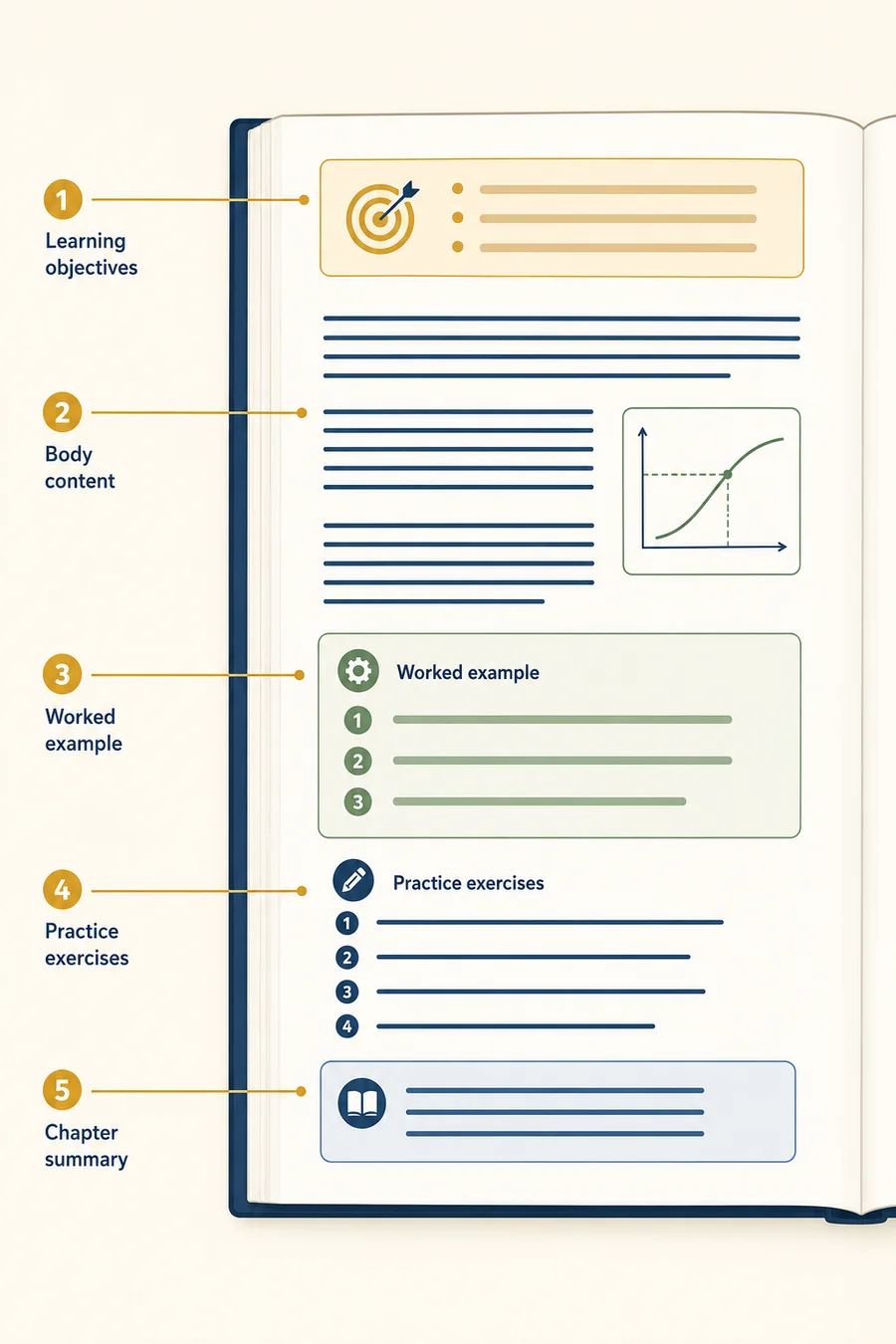
A novel chapter is just prose. A textbook chapter is a teaching unit with five distinct zones, each serving a pedagogical purpose. General AI tools write the body and skip the rest. Inkfluence's study-guide blueprint structures every chapter so the learner can find each zone exactly where they expect it.
- Learning objectives - 3 to 6 clear "by the end of this chapter you will be able to..." statements
- Body content - explanatory prose, definitions, diagrams, inline references
- Worked example - one or two step-by-step demonstrations of the chapter's central technique
- Practice exercises - 4 to 10 questions of increasing difficulty for retrieval practice
- Chapter summary - a tight recap of the objectives now achieved, plus key terms
Compare to our lesson plan generator for shorter classroom-unit output, or workbook generator for exercise-heavy companion books that pair with a lecture or course.
AI Textbook Tool Comparison Table
Textbook-specific features at a glance - scroll right on mobile
| Tool | Best For | Pricing | Exports | Scaffolding | Multi-Chapter | KDP Ready | Free | Compare |
|---|---|---|---|---|---|---|---|---|
| Inkfluence AI Textbook + study-guide + lesson-plan creator | Educators, course creators, and self-published authors building structured learning books | Free / from $9.99/mo | PDF, EPUB, DOCX | ✓ | ✓ | ✓ | ✓ | Try it → |
| ChatGPT General AI assistant | Drafting individual sections, brainstorming module structure | Free / $20/mo (Plus) | Copy/paste | ✗ | ✗ | ✗ | ✓ | View → |
| Claude General AI assistant | Long explanatory passages, gentle academic prose | Free / $20/mo (Pro) | Copy/paste | ✗ | ✗ | ✗ | ✓ | View → |
| Gemini General AI assistant (Google) | Drafting alongside Google Docs, Workspace integration | Free / from $19.99/mo (Advanced) | Google Docs | ✗ | ✗ | ✗ | ✓ | |
| MagicSchool AI K-12 educator platform | K-12 teachers building lesson plans, rubrics, IEPs | Free / from $9.99/mo (Plus) | DOCX, PDF | ✓ | ✗ | ✗ | ✓ | |
| SchoolAI K-12 platform with student-facing chat | Differentiated instruction, student-facing tutor sessions | Free / from $13.50/mo | DOCX | ✓ | ✗ | ✗ | ✓ | |
| Diffit Differentiation tool for teachers | Adapting reading materials to grade level, scaffolding worksheets | Free / from $14.99/mo | DOCX, PDF | ✓ | ✗ | ✗ | ✓ | |
| Canva Design platform | Textbook layout templates, infographics, worksheets | Free / $14.99/mo (Pro) | ✗ | ✗ | ✗ | ✓ | View → | |
| Designrr Content repurposing tool | Turning course transcripts or blog series into a printable textbook | From $29/mo | PDF, EPUB | ✗ | ✓ | ✗ | ✗ | View → |
| Squibler AI book writing platform | General long-form drafting with light scaffolding | Free / from $15.83/mo (annual) | DOCX, PDF | ✗ | ✓ | ✗ | ✓ | View → |
Why Textbooks Break Most AI Writing Tools
US textbook publishing is a multi-billion dollar category according to the Association of American Publishers' StatShot reports, with a quiet but profitable indie sub-category for self-published study guides, professional development books, test-prep materials, and online-course companion books. Most indie textbook authors are subject experts (teachers, working professionals, retired academics) who need help with the writing - not the subject. AI tools that respect pedagogical structure are the bottleneck.
Industry surveys of US college instructors have shown a steady year-over-year shift toward open-access and self-published textbooks since the late 2010s, driven by student-affordability concerns and the speed-to-update advantage of indie publishing. The bottleneck for most indie authors is production time, which is exactly what AI compresses.
1. Pedagogical structure is the whole point
A textbook's value isn't in its prose - it is in its structure. Learning objectives at the top tell the reader what to look for. Worked examples model the technique. Practice exercises let the reader try. Chapter summary consolidates. Strip those out and you have a long-form article, not a textbook. Inkfluence's study-guide blueprint bakes the structure into every chapter by default; ChatGPT will produce flowing prose that the learner cannot use to study from.
2. Multi-chapter coherence is non-trivial
A textbook builds. Chapter 1 establishes vocabulary that chapter 5 uses without redefining. Chapter 3's worked example references the framework from chapter 2. Most general AI tools handle each request in isolation and lose track of what was already taught. Inkfluence maintains chapter context across an entire book project, so terms introduced once stay consistent throughout.
3. Subject accuracy is non-negotiable
AI tools hallucinate confidently on technical subjects. A wrong date in fiction is a typo; a wrong formula in a calculus textbook can fail a student's exam. The 2026 best practice is hard: AI handles structure and prose; a subject matter expert checks every formula, every diagram caption, every claim. Successful indie textbook authors are subject experts who use AI to skip the prose-drafting time, not the expertise time. Our guide on preventing factual errors in AI nonfiction covers the verification workflow.
4. Trim size matters more than you think
Textbooks on KDP Print typically use 7x10 or 8.5x11 inch trim - significantly larger than the 6x9 fiction default - to fit diagrams, worked examples in side panels, and worksheets. Most AI book tools default to 6x9 and never offer education-appropriate trims. Inkfluence supports all common KDP trim sizes including 7x10 and 8.5x11 for textbook formats.
5. Audiobook is a real adult-learner format
Adult learners on commutes, in gyms, doing chores increasingly consume textbooks via audiobook. Subjects that survive the format conversion (history, business, social sciences, soft skills, professional development) hit a real audiobook market - particularly when paired with a printed companion that has the diagrams and exercises. Inkfluence's audiobook generator handles this. Math-heavy and code-heavy textbooks work less well on audio because readers need to see the equations, but for the vast majority of academic and professional development textbooks, audio is now a legitimate second SKU. Our broader best AI audiobook tool comparison covers the audio side in detail.
The Best AI Textbook Tools: In-Depth Reviews
1. Inkfluence AI - Best Overall AI Textbook Generator
Inkfluence is the only AI tool we tested with dedicated education blueprints. The study guide generator structures revision content with key concepts, practice questions, and chapter outlines. The lesson plan generator outputs standards-aligned plans for any subject and grade. The education-guide blueprint produces longer expository chapters for adult-learner non-fiction. Combined into a single book project, they build a full multi-chapter textbook with consistent terminology and pedagogical scaffolding throughout.
Beyond drafting, Inkfluence generates the cover, exports KDP-ready PDF (7x10 or 8.5x11 trim) and EPUB, and narrates the audiobook. The workbook generator produces the exercise-heavy companion that pairs naturally with a lecture course or self-study textbook. Free plan covers all three blueprints with monthly chapter quota - enough to draft a starter textbook without paying.
2. MagicSchool AI - Best for K-12 Classroom Materials
MagicSchool is the most popular AI tool among K-12 educators in 2026. It is purpose-built for the daily classroom workflow - lesson plans, IEPs, rubrics, parent communications, differentiated worksheets - rather than full textbooks. Output is consistent, classroom-appropriate, and quick to produce. Where it falls short for our purposes: there is no multi-chapter book workflow, no KDP-ready export, no cover generation. If you need K-12 classroom materials, MagicSchool first; if you need a publishable textbook, Inkfluence.
3. Claude - Best Prose Voice for Academic Writing
Anthropic's Claude has a particularly clear, gentle prose voice that suits academic and explanatory writing well. The long context window helps when you need to maintain consistency across an entire chapter draft. As with ChatGPT, Claude stops at text - no chapter scaffolding, no multi-chapter coherence across requests, no export. Best used as a drafting voice for individual sections, then moved into Inkfluence for the structural scaffolding and publishable export.
4. ChatGPT - Useful for Drafting Sections
ChatGPT (GPT-4 / GPT-5) is the de-facto starting point for most authors experimenting with AI. It drafts individual sections fluently, brainstorms chapter outlines, generates worked examples on request. Where it falls short for textbook authors is structure-at-scale: no built-in scaffolding, no chapter-to-chapter consistency, no export. Use it for individual section drafts feeding into a textbook tool, not as the textbook tool itself.
5. SchoolAI - Best for Live Differentiated Instruction
SchoolAI is K-12-focused like MagicSchool but with a stronger student-facing dimension - live tutor sessions, differentiated chat tutors per student, real-time classroom assistants. Excellent for in-classroom interactive use, weak as a textbook generator. The output is conversation-shaped, not book-shaped. Pair with Inkfluence if you need both classroom support and a published textbook.
6. Diffit - Best for Adapting Existing Texts
Diffit is a niche but excellent tool: paste any text and it generates differentiated reading materials at multiple grade levels with comprehension questions and vocabulary support. Brilliant for teachers adapting articles, primary sources, or existing readings. Not for original textbook authoring - Diffit transforms text, it does not generate it. Paired with Inkfluence (for the original draft) and Diffit (for the multi-grade-level adaptations), an indie author can ship a textbook with built-in differentiation.
More Tools Worth Knowing
Gemini
Google's AI integrated with Workspace. Convenient if you draft in Google Docs, no textbook-specific features. Comparable to ChatGPT for individual sections.
Canva
Design-only. Excellent textbook layout templates and infographics. Pairs well with Inkfluence (writing) for visual layouts of diagrams and worksheets.
Compare with Inkfluence →Designrr
Content repurposing. Useful if you have hours of recorded lectures or course transcripts you want to bundle into a printable textbook.
Compare with Inkfluence →Squibler
General AI book platform. Multi-chapter support but no textbook-specific scaffolding. Better suited to fiction.
Compare with Inkfluence →Curipod
Interactive AI lesson builder for live classes. Brilliant in-classroom, not a textbook tool.
Khan Academy / OpenStax
Not generators - but worth mentioning as the source of high-quality free open-access textbooks. Useful for studying structural conventions before drafting your own.
From Outline to Published Textbook in One Workflow
An indie educator holding their newly published Inkfluence-drafted textbook. Cover, KDP-ready PDF, and audiobook all generated inside the same project.

Workflow: draft chapters → generate cover → export KDP PDF at 7x10 trim → upload to Amazon → optional audiobook narration.
Which AI Textbook Tool Should You Use?
You want to publish a self-study textbook on Amazon KDP
Use Inkfluence's study guide generator for the chapter scaffolding plus the cover generator. Pair with our factual accuracy guide for verification.
You are a K-12 teacher building lesson plans and classroom materials
Use MagicSchool AI or SchoolAI as your daily driver. Add Inkfluence's lesson plan generator when you want PDF export for parent communications or principal review.
You are a course creator building a course companion textbook
Use Inkfluence's workbook generator for the exercise-heavy companion plus study guide generator for the prose textbook. Our course creator tool handles the lesson side.
You have hours of recorded lectures you want to package as a textbook
Use Designrr for the import, then move into Inkfluence to add scaffolding and KDP export.
You want a textbook plus an audiobook companion
Inkfluence is the only tool in this comparison that supports both within one project. See audiobook generator and our broader audiobook tool ranking.
You are adapting existing readings for differentiated grade levels
Diffit is purpose-built for this. Combine with Inkfluence for the original textbook draft.
Six Mistakes That Sink Indie AI Textbooks
Indie textbooks on Amazon KDP suffer from the same handful of avoidable mistakes that show up in reviews repeatedly. Inkfluence's study-guide blueprint avoids most of these by default; the rest are subject-expertise judgement calls outside the writing tool.
1. Skipping learning objectives
A chapter without clear "by the end of this chapter you will..." statements is a Wikipedia article, not a textbook. Always open every chapter with 3 to 6 objectives.
2. AI-generated factual errors
AI hallucinates dates, formulas, citations, and edge cases confidently. A subject-matter expert (you) must verify every factual claim before publishing. Never skip this step.
3. No worked examples
Telling the reader the technique is not enough; show them step-by-step at least once per chapter. AI tends to skip this; insist on it in the chapter prompt.
4. Inconsistent terminology across chapters
Chapter 2 calls it "the framework"; chapter 7 calls it "the model"; chapter 10 calls it "the approach". Pick one term per concept and stick with it. Inkfluence's multi-chapter coherence reduces this; manual proof confirms it.
5. Wrong KDP trim
A 6x9 trim cramps textbook diagrams. Use 7x10 for prose-heavy textbooks and 8.5x11 for diagram-heavy or worksheet-heavy books. Set trim before exporting.
6. No back matter
Glossary, index, and answer key are what learners reach for after they read. Even a basic glossary at the end raises perceived quality significantly. Don't skip back matter.
How We Tested These Tools
We ran the same brief through every tool: a 12-chapter introductory textbook called Foundations of Behavioural Economics for adult self-study, with each chapter expected to include learning objectives, body content, a worked example, 6 to 10 practice exercises, and a chapter summary. Drafts were then exported to PDF and EPUB where the tool supported it directly, or after manual mastering in Word + Vellum where it did not. Where a tool could not produce a usable artifact at all (Curipod, Diffit standalone for full books) we logged it as a miss and moved on.
We scored on five axes: pedagogical scaffolding (does the tool produce learning objectives, worked examples, exercises, summary?), multi-chapter coherence (do terms stay consistent across chapters?), KDP readiness (does the export hit education trim sizes?), subject accuracy (how often did we catch hallucinated facts on a single subject expert review pass?), and total cost per finished textbook. Audiobook support was a bonus axis since only Inkfluence offers it. Scores are weighted equally.
Sources we drew on for industry context: the Association of American Publishers StatShot reports on US textbook publishing revenue, industry surveys of indie and open-access textbook adoption in higher education, Amazon KDP's published trim and royalty specs for educational books, and indie textbook author benchmarks from the 20BooksTo50K and r/Selfpublish community discussions. Pedagogical structure references draw on Bloom's taxonomy and the standard learning-objectives-first chapter shape used by major academic publishers including Pearson, McGraw Hill, and OpenStax. Our broader essay on factual accuracy in AI nonfiction covers the verification workflow.
Tools we deliberately excluded from the head-to-head: Notion AI (excellent for knowledge management, not a textbook tool), Grammarly (style assistant, not a generator), Quillbot (paraphrasing tool, not a generator), and a half-dozen K-12 specific tools that overlap MagicSchool's territory without distinguishing themselves. We also excluded the "AI textbook" startups whose product is essentially a ChatGPT wrapper with an education-themed interface - the underlying model and output quality are the same as ChatGPT direct, so we treated ChatGPT as the representative for that whole category. If you have shipped a real differentiated AI textbook tool we should have tested, email it in.
Inkfluence is the platform that publishes this site, so this comparison is not neutral - but the pedagogical structure is public, the feature comparisons are accurate at time of testing, and where competitors win on a specific axis (MagicSchool on K-12 daily classroom workflow, Diffit on differentiated reading, Claude on prose voice) we have said so plainly. Browse our comparison index for additional head-to-heads, or email us via the about page if you find a tool we missed.
Textbook Categories That Work With AI in 2026
Not every textbook subject is equally suited to AI drafting. The pattern is consistent: subjects where the structure is well-defined and the prose can be templated work well; subjects where lived experience or rigorous primary research is the genre still belong primarily to human experts. These eight categories consistently performed well in our testing.
Test prep books
SAT, GRE, MCAT, professional certifications. Highly templated structure, evergreen demand, repeat-revenue if you update annually. Strongest indie textbook category on KDP.
Professional development
Project management, leadership, sales, communication. Adult-learner audience that converts well to audiobook companion. AI handles the structured frameworks reliably.
Introductory subject textbooks
Intro to economics, intro to philosophy, intro to data science. Standard chapter structures, predictable scaffolding. Best when written by an actual teacher of the subject.
Language learning workbooks
Vocabulary drills, grammar exercises, dialogues. Repetitive structure suits AI drafting; the exercises pair with our workbook generator output.
How-to and skill-acquisition books
Cooking technique, knitting, woodworking, photography. Step-by-step content with worked examples is exactly what AI drafts well at scale.
History and social sciences survey textbooks
Long-form expository chapters, primary-source quotation, timeline structures. AI drafts the survey prose; the author verifies dates and citations.
Soft skills and personal development
Communication, time management, mental health-adjacent self-help. Worked example structure adapts naturally to scenario-based teaching.
Religious and devotional study guides
Bible study guides, Quran study, theological study. Existing primary text plus structured commentary - exactly the pattern AI drafts cleanly. See our devotional generator.
Categories where AI tools struggle in 2026: graduate-level research-driven monographs (the value is the original research), highly mathematical advanced topics (equation typesetting and correctness are difficult), case-method professional textbooks (the cases need to be real), and any subject where currency matters more than scaffolding (cutting-edge fields where last quarter's textbook is already out of date). For those, AI is a structural helper at best - draft the chapter shells, then let the subject expert fill the substance.
The pattern is consistent across all the categories above: AI does the structural lifting (chapter shape, learning objectives, transitions, summaries), the human author does the subject lifting (worked example accuracy, exercise quality, factual claims, diagram captions). Authors who try to ship the AI draft untouched end up with the one-star reviews that sink indie textbooks before they find an audience. Authors who use AI for the scaffold and their own expertise for the substance ship books that compete with traditional publishers' offerings on Amazon - at a fraction of the production time and cost.
The most reliable indie-textbook business model in 2026 is what publishers call the "instructor-author" pattern: an active classroom teacher, working professional, or recently-retired specialist who already teaches the subject and uses AI to compress their lecture notes and worked-out problem sets into a publishable book. Their domain expertise carries the credibility; AI carries the prose-drafting time. This is the model behind the most successful indie textbook clusters on KDP - test prep, professional development, niche introductory texts in fields where major publishers are slow to update.
Detailed Head-to-Head Comparisons
Each comparison covers textbook-specific features, pricing, and our verdict.
Inkfluence vs ChatGPT
Pedagogical scaffolding vs raw chat sections
Inkfluence vs Claude
Textbook structure vs academic prose voice
Inkfluence vs Canva
AI textbook writing vs design templates
Inkfluence vs Squibler
Education blueprints vs general book editor
Inkfluence vs Designrr
New textbook draft vs lecture repurposing
Best AI Audiobook Tool
For the adult-learner audiobook companion
Best AI Poetry Generator
Adjacent format with form-discipline pattern
Best AI Children's Book Creator
Educational format for K-6 learners
Best AI Ebook Generators
Broader ebook tool comparison
Related Guides and Resources
Go deeper with our education and AI publishing guides
AI Study Guide Generator
Structured revision materials with key concepts and practice questions
ToolAI Lesson Plan Generator
Standards-aligned lesson plans for any subject and grade
ToolWorkbook Generator
Exercise-heavy companion books with fillable sections
ToolAI Course Creator
Build the lesson side; pair with the textbook for the prose
ToolAI Email Course Generator
Drip-style email-based mini-courses on any subject
ToolAI Audiobook Generator
Adult-learner audiobook companion for prose-heavy textbooks
GuidePreventing Factual Errors in AI Nonfiction
Verification workflow for AI-drafted technical content
GuideStudy Guides for Students
Building effective study guides for school and university
GuideHow Teachers Use AI for Lesson Plans
Real classroom workflows from K-12 educators
Frequently Asked Questions
Textbook-specific questions about AI generation, pedagogy, and KDP publishing
What is the best AI textbook generator in 2026?
Can AI write a complete textbook with chapters and exercises?
What pedagogical structure does Inkfluence support for textbooks?
Will an AI-generated textbook be accepted on Amazon KDP?
Can AI textbook tools handle math, science, and technical subjects?
How is Inkfluence different from ChatGPT for writing a textbook?
Can teachers use AI to build classroom materials, not just textbooks?
How long does it take to create a textbook with AI?
Is there a free AI textbook generator?
Can I sell AI-written textbooks on Amazon KDP?
Should I structure a textbook by chapter or by module?
Can I narrate my AI textbook as an audiobook?
Ready to Write Your Textbook?
Inkfluence drafts every chapter with learning objectives, worked examples, and practice exercises baked in. Cover, KDP-ready PDF, EPUB, and audiobook companion all in one project. Free plan covers a starter draft.
No credit card required - education blueprints included on the free plan