
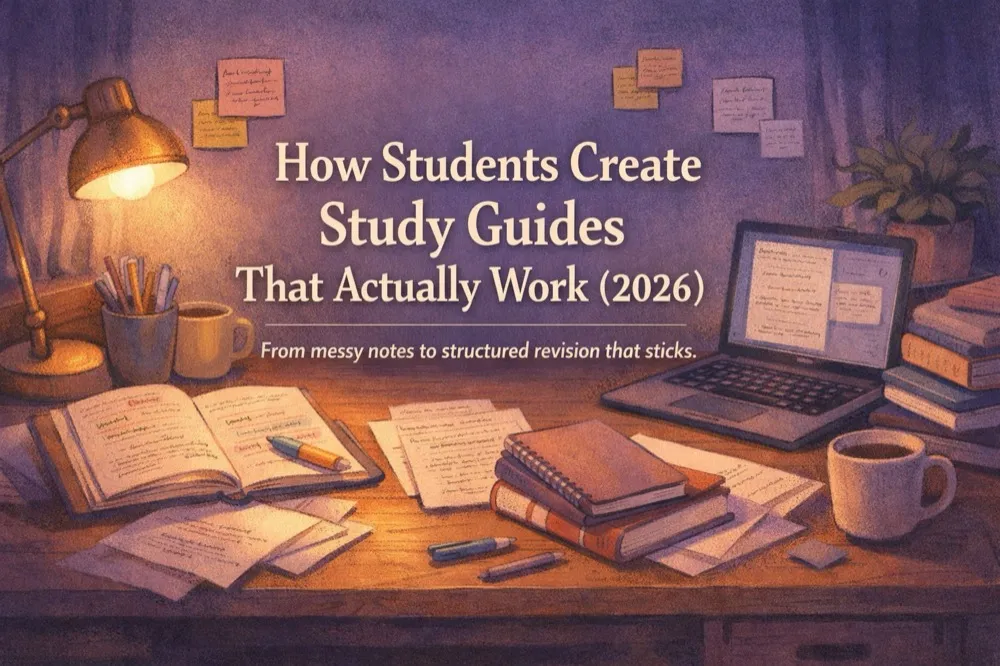
How Students Create Study Guides That Actually Work (2026)
Learn how top students use AI to transform messy notes into structured study guides. A practical guide to creating revision materials that improve retention and exam performance.
Quick Answer
The most effective study guides use hierarchical structure, active recall prompts, and visual clarity to transform scattered notes into exam-ready material. AI study guide generators like Inkfluence AI create structured study guides from lecture notes, textbook content, or topic descriptions in minutes - with chapter organisation, practice questions, and PDF export included.
The students who consistently perform well on exams share a common trait that has nothing to do with raw intelligence. They know how to transform scattered information into structured understanding. They create study guides that actually work.
Most students never learn this skill. They highlight textbooks that they never revisit. They take notes that become unreadable within days. They spend hours "studying" material that fails to stick. The gap between struggling and succeeding often comes down to one capability: turning chaos into clarity.
This guide breaks down how students are creating study materials that improve retention, reduce exam anxiety, and actually lead to better grades. Not through working harder, but through working smarter with better systems.
Why Traditional Study Methods Fail
The standard approach to studying is fundamentally broken.
Students sit in lectures and frantically write everything down, creating notes that capture information in the order it was presented rather than the order it makes sense. They highlight textbooks with no strategy, turning pages yellow without improving comprehension. They reread the same material multiple times, confusing familiarity with understanding.
When exam time arrives, they face a mountain of disorganised material and not enough time to make sense of it. The result is predictable: stress, cramming, and performance that falls short of potential.
The problem is not effort. The problem is the absence of a system that transforms raw information into retrievable knowledge.
What Makes a Study Guide Actually Effective
Effective study guides are not just condensed notes. They are tools designed for retrieval, organised around how memory actually works.
Hierarchical Structure
Information flows from broad concepts to specific details. You can see the relationship between ideas at a glance. Major themes contain subtopics, which contain supporting facts. This mirrors how the brain organises and retrieves information: through meaningful connections rather than isolated facts.
Active Recall Triggers
The best study guides do not just present information. They prompt you to retrieve it. Questions replace statements. Gaps invite completion. Concept connections require thought. Passive reading feels productive but produces weak memory traces. Active retrieval builds durable understanding.
Visual Clarity
Headers, bullet points, tables, and white space are not decoration. They reduce cognitive load, letting your brain focus on understanding rather than parsing dense paragraphs. A well-formatted guide is easier to navigate, easier to review, and easier to remember.
Appropriate Length
A 50-page study guide is just your notes with extra steps. The discipline of condensation forces prioritisation. If you cannot fit a topic into a reasonable length, you have not yet understood what matters most.
The Progressive Study System
The most effective students do not create study guides the week before exams. They build them progressively throughout the semester.
Weekly: Capture and Clean
After each week's lectures, spend 30 minutes converting raw notes into structured summaries. Remove redundancy, add headers, clarify confusing points while the material is still fresh. This weekly investment prevents the overwhelming backlog that makes exam preparation stressful.
Monthly: Connect and Consolidate
At the end of each month, combine your weekly summaries into topic-level guides. Look for connections between weeks. Identify themes that span multiple lectures. This consolidation reveals the structure of the course that individual lectures obscure.
Pre-Exam: Compress and Test
Before exams, compress your monthly summaries into revision sheets. These are the essential concepts, formulas, and frameworks you need to have immediately accessible. Add self-test questions. Create flashcard-style prompts. The goal is a tool for active recall, not passive review.
This layered approach means you are always building on organised material. You never face the chaos of an entire semester's worth of unprocessed notes.
Study Guide Formats by Subject
Different subjects require different approaches. The format that works for chemistry will not work for history.
| Subject Type | Recommended Format | Key Elements to Include |
|---|---|---|
| Sciences | Concept maps and process diagrams | Formulas, definitions, worked examples, common mistakes |
| Humanities | Thematic essays and timelines | Key arguments, supporting quotes, historical context |
| Languages | Vocabulary lists and grammar tables | Example sentences, conjugation patterns, exceptions |
| Mathematics | Formula sheets and problem type catalogues | Step-by-step solutions, when to use each approach |
| Business and Economics | Framework summaries and case studies | Models, real-world applications, graphs and diagrams |
The specific format matters less than the principle: your study guide should match how you will need to use the information on the exam.
Turning Messy Notes Into Structured Guides
The biggest obstacle to creating effective study guides is the transformation process itself. Taking 50 pages of scattered notes and restructuring them into a coherent 15-page guide requires significant time and mental energy.
This is where AI tools change the equation.
Tools like Inkfluence AI can take unstructured input and produce organised output in minutes. You upload your notes, specify the structure you want, and receive a draft that would have taken hours to create manually. This is not a niche use case: as of August 2026, students and educators have created more than 2,300 study guides on Inkfluence AI (the full category breakdown lives in our digital-product demand study), making it one of the most common book types on the platform.
The same technology that powers lecture note transformation works with voice-dictated notes too: dictate your study session summary and turn the transcript into a guide (see our guide on turning voice notes into revision guides), combine multiple source documents, and generate clean PDFs ready for annotation.
This does not replace understanding. You still need to engage with the material, test yourself, and fill gaps in knowledge. But it removes the friction that prevents most students from creating organised materials in the first place.
A Worked Example: Psychology Exam Preparation
Consider how this works in practice with a typical scenario.
Starting point: A psychology student preparing for an exam on memory and cognition. They have 30 pages of lecture notes, 15 pages of textbook highlights, 3 voice recordings from study group discussions, and assorted handouts.
The traditional approach: Spend 8 to 10 hours manually reviewing everything, creating summaries, and hoping the important points stick. Finish exhausted, still unsure what will actually appear on the exam.
The systematic approach:
- Upload all materials to an AI structuring tool
- Generate a hierarchical outline of major topics and subtopics
- Review the outline and flag areas needing more depth
- Expand key sections with specific examples and test questions
- Export as a clean, annotatable PDF
The result: A 12-page study guide with clear sections on memory types, key theories and researchers, process diagrams, common exam questions with model answers, and 20 self-test prompts. Created in 2 hours instead of 10.
The time saved goes toward actually studying the material rather than organising it.
The Self-Testing Component
A study guide without a testing component is incomplete.
The research is clear: retrieval practice dramatically outperforms rereading for long-term retention. Every time you successfully recall information, you strengthen the memory trace. Every time you passively reread, you create the illusion of understanding without the reality.
Your study guide should include:
- Concept questions: "What are the three stages of memory encoding?"
- Application questions: "Given this scenario, which memory theory best explains the outcome?"
- Comparison questions: "What distinguishes short-term memory from working memory?"
- Prediction questions: "What would happen if this process were disrupted?"
Build these questions as you create the guide. If you cannot formulate a good question about a section, you may not understand it well enough yet.
Common Mistakes to Avoid
- Creating too late: Starting your study guide the week before the exam means working with rusty material and insufficient time for revision.
- Making it too long: If your study guide is 50 pages, you have not condensed. You have copied. Aim for 10 to 20 pages maximum per course.
- Skipping the testing component: A guide you cannot quiz yourself from is not a study guide. It is just organised notes.
- Ignoring format: Dense paragraphs kill retention. Use headers, bullets, tables, and white space deliberately.
- Never updating: Your understanding evolves. Your study guide should too. Add insights, correct errors, and refine explanations as you learn more.
- Creating but not using: The most beautiful study guide is worthless if it sits in a folder. Schedule specific review sessions.
Tools That Remove Friction
- AI Ebook Generator: Transform notes into formatted study guides
- Book Outline Generator: Structure your guide before filling in content
- AI Study Guide Generator: Turn a subject into a structured guide with summaries and self-test questions
- AI PDF Generator: Create clean, printable revision materials
The goal is not to outsource your learning. It is to remove the administrative friction that prevents you from engaging deeply with material.
Building the Habit
The students who benefit most from this approach are not the ones who create one perfect study guide. They are the ones who build a sustainable system.
Block 30 minutes after your last class each week for note consolidation. Set a monthly reminder to combine weekly summaries. Treat study guide creation as part of learning, not separate preparation.
Over time, you accumulate a library of well-organised materials that make exam preparation straightforward rather than stressful. The work is distributed across the semester rather than compressed into a panic-filled final week.
This is the difference between students who consistently perform well and those who ride the rollercoaster of cramming and forgetting.
Create Better Study Guides Today
Stop wasting hours on disorganised notes. Transform your materials into structured study guides that actually improve exam performance.
See the Student PlaybookFrequently Asked Questions
How long should a study guide be?
For a typical course, aim for 10 to 20 pages maximum. If your guide is longer, you have not condensed enough. The discipline of compression forces you to identify what actually matters. A shorter, focused guide beats a longer comprehensive one.
Should I handwrite or type my study guide?
Type for structure and organisation, then handwrite key sections for memory encoding. Research shows handwriting improves retention, but typed documents are easier to restructure, search, and update. The best approach combines both: type the guide, then handwrite summaries of critical sections.
When should I start creating study guides?
Start from week one. Build progressively throughout the semester rather than cramming everything before exams. Weekly consolidation of 30 minutes beats a 15-hour marathon the week before finals.
Can AI really help with studying?
AI excels at restructuring and formatting, which are the tedious parts of study guide creation. You still need to understand the material and engage with it actively. But AI removes the friction that prevents students from creating organised revision materials in the first place. The time saved goes toward actual learning.
What is the difference between notes and a study guide?
Notes capture information as you receive it, in the order it was presented. A study guide restructures that information for retrieval, organised around how you will need to use it. Notes are input-focused. Study guides are output-focused. The transformation from one to the other is where real learning happens.

Founder, Inkfluence AI
Sam is the founder of Inkfluence AI. He built the platform to make book creation accessible to everyone - from first-time authors to seasoned publishers.
Helpful links
Ready to Create Your Own Ebook?
Start writing with AI-powered tools, professional templates, and multi-format export.
Get Started FreeRelated Articles
 Guides
 Selling AI Coloring Books on Amazon KDP: The 2026 Rules, Specs, and Math
Are AI coloring books allowed on KDP? Yes, with disclosure. The part nobody covers: the AI workflow that passes review, style consistency across 30 pages, the interior specs that cause rejections, and the royalty ladder that decides your price.
 Guides
 How to Make an Adult Coloring Book in 2026: From Idea to Printed Pages
The modern walkthrough: what makes line work read as "adult", the three ways to create pages (draw, convert, generate), how to assemble a real book instead of a stack of pages, and the fork between KDP paperbacks, Etsy printables, and printing at home.
 Guides
 Consistent Characters in AI Children's Books: Why They Drift, and Every Method That Fixes It (2026)
The fox on page 3 never matches the fox on page 7, until you understand why. The four methods for character consistency in AI illustration, compared honestly, plus the page-7 test to run before trusting any tool's claim.
Get ebook tips in your inbox
Join creators getting weekly strategies for writing, marketing, and selling ebooks.