
Turn Lecture Notes Into Study Guides (2026): Fast AI Workflow
Turn raw lecture notes into a structured study guide fast. Learn the 2025 workflow for converting slides, recordings, and notes into revision-ready materials.
Quick Answer
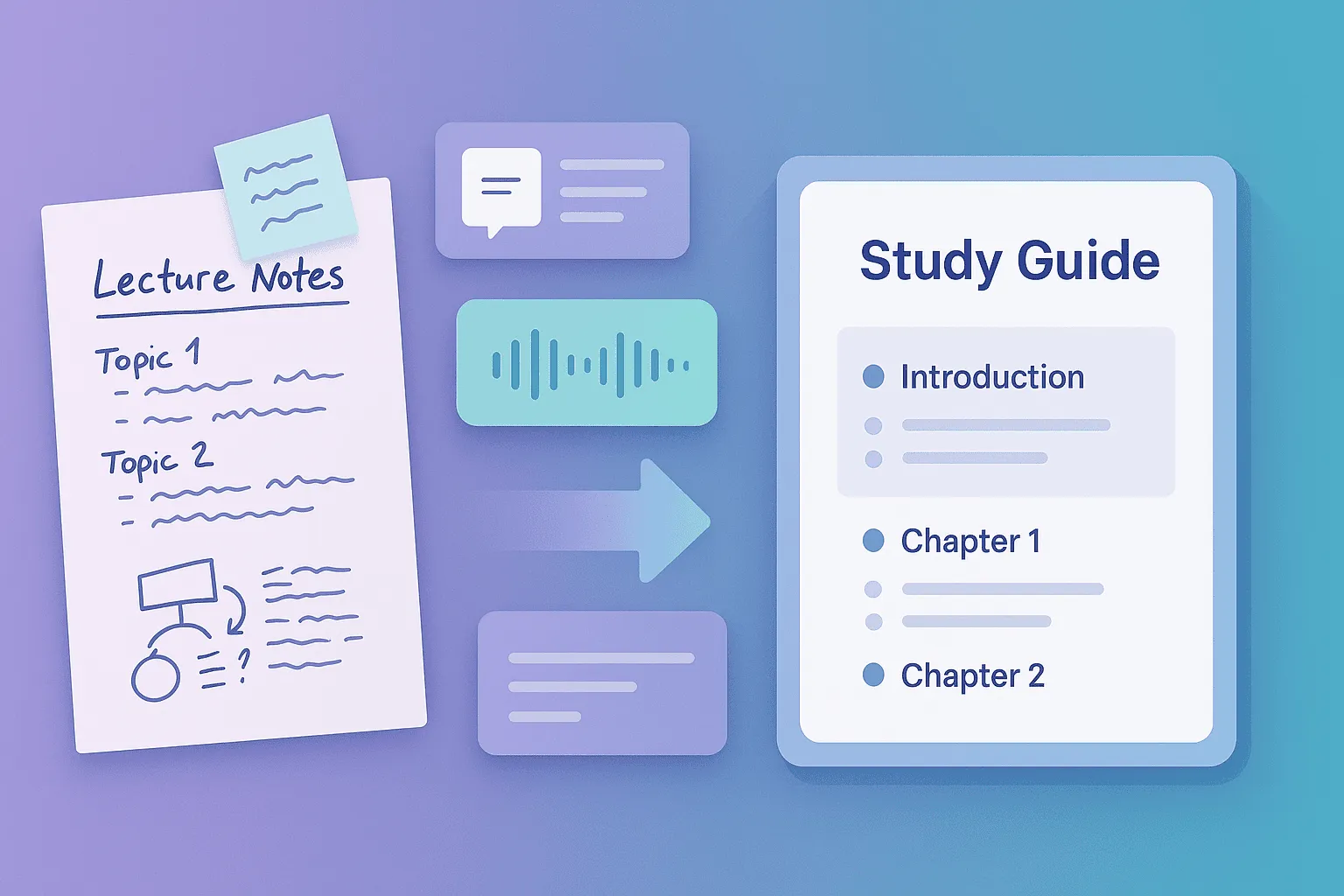
You can turn raw lecture notes, slides, and recordings into a structured study guide using AI. Tools like Inkfluence AI reorganise fragmented notes into chaptered, hierarchical revision material with headings, summaries, and practice questions - then export as PDF. The workflow takes minutes instead of hours of manual rewriting.
The Quiet Evolution of Learning
The shift in how people learn didn't arrive loudly. It crept in quietly, the same way digital habits always do - slowly, then suddenly. Students began recording lectures instead of writing everything by hand. Teachers uploaded slides instead of giving printed outlines. Professionals saved screenshots, dictated thoughts into their phones, bookmarked articles, highlighted PDFs, and collected fragments that never turned into anything complete. The problem wasn't the lack of information. It was the lack of coherence.
- Voice to revision: turn voice notes into revision guides
- Note strategy: why voice notes outperform typed notes
- Structuring help: book outline generator
In 2025, turning raw, scattered notes into a structured study guide stopped being an optional part of learning and became the core of it. And the people who adapted fastest weren't the ones taking the best notes; they were the ones who learned how to transform their notes into clarity. Inkfluence sits directly inside this shift, because the same narrative principles that changed ebook creation have now changed academic learning too: information is no longer valuable unless it is shaped.
Why the Traditional Approach to Studying Collapsed
For decades, studying was treated as a manual ritual. You wrote notes in a lecture, rewrote them at home, summarised chapters before exams, and hoped that repetition created understanding. But repetition solves almost nothing in a world where information comes from everywhere. Students no longer experience subjects in linear order. They experience them in fragments. A lecturer's aside becomes more important than a full slide. A voice note contains more insight than three pages of typed text. A borrowed PDF explains the concept better than the textbook ever did.
The old advice - rewrite your notes, highlight the key points, summarise the chapters - doesn't work anymore because it assumes the problem is remembering. But the real problem today is structure. People don't struggle because they forget information. They struggle because they never fully understood how the information fits together.
A proper study guide doesn't reduce information; it reshapes it. It reveals a hierarchy of ideas. It connects what seemed isolated. It slows down the noise of the academic environment and gives the learner one place where things finally make sense. And this is exactly why the modern shift has been so dramatic: learners don't want prettier notes. They want a clearer mind.
The Three Emotional States Behind Modern Study Behaviour
Every search query about turning notes into study guides comes from one of three psychological states. And the reason certain articles rank - and others never do - is because Google has become exceptionally good at detecting which pages understand these states.
Overwhelm
The first is overwhelm. This is the student who has attended every lecture, captured every slide, highlighted every article, and still feels like nothing is sticking. They don't want methods. They want orientation. They are drowning in fragments and simply want someone to show them where the structure begins.
This is exactly the audience who benefits from converting voice notes into revision guides or learning why voice notes outperform typed notes for retention. They need a workflow that transforms chaos into clarity without adding more work.
Compression
The second is compression. This learner understands the material, at least superficially, but cannot condense it into something they can carry into an exam. They are not looking for definitions; they want direction. They want the content reshaped into something they can rehearse and recall. They want the narrative of the subject, not its raw parts.
The same principles that power lead magnet creation or book outline generation apply here: structure makes content memorable. A well-organised study guide isn't just easier to review - it's easier to understand in the first place.
Ambition
The final state is ambition. This is the student or professional who wants mastery, not survival. They want clarity, not summaries. Their study guide is not just a revision tool; it is a framework for thinking. They aren't preparing for an exam - they are preparing for competence. The pages that win this audience are the ones that understand how deep understanding is formed: through structured explanation, not scattered notes.
Inkfluence aligns with all three because it does not merely convert text; it imposes structure. It takes the chaos of a semester and reshapes it into something coherent, navigable, and buildable. The same AI-powered writing technology that creates professional ebooks can transform scattered lecture notes into comprehensive study materials.
Why Turning Notes Into a Study Guide Works Differently in 2025
The quiet truth of modern learning is that notes are no longer documents - they are data sources. Voice recordings, AI transcripts, screenshots, typed notes, slides, and articles all blend into a single learning ecosystem. The job of the learner is no longer to rewrite everything manually; it is to synthesise these materials into a narrative they can follow.
This is why the idea of a "study guide" has changed so dramatically. It is no longer a summary written at the end of the semester. It is a living document that sits between the student and the subject - absorbing, organising, filtering, and clarifying the material in real time. The pressure is not to know everything. The pressure is to structure everything.
And structure is the one thing modern learners consistently lack. They have information, not direction. They have fragments, not flow. They have content, not understanding. The study guide resolves this tension, giving shape to a world that otherwise feels academically chaotic.
Why Narrative Structure Helps Students Learn Faster
Long before search engines rewarded narrative content, the human mind relied on narrative structure for learning. People understand ideas not because they memorise them, but because they understand the story the ideas tell. A good study guide mirrors this natural cognitive pattern. It doesn't present information as isolated facts. It presents it as progression.
When students turn notes into a study guide, they are not "rewriting information." They are rewriting their own mental model of the subject. They are asking themselves: What is the core idea? What supports it? What contradicts it? What does the lecturer emphasise? How does this concept lead to the next?
These are narrative questions, not organisational ones. And this is why AI-powered restructuring works so well: it imposes narrative on information that previously had none. It gives momentum to learning. It gives shape to understanding. It gives the student something their raw notes never gave them - a path.
Just as ebook SEO now rewards narrative structure over keyword stuffing, effective study guides succeed by creating coherent learning narratives rather than disconnected fact lists.
How AI Transforms Note-Taking Into Understanding
AI tools like Inkfluence do not make studying easier by reducing thinking. They make studying easier by reducing noise. They take the unstructured reality of modern academic life and reorganise it into clarity. A lecture recording becomes a clean explanation. A messy voice note becomes a coherent insight. A set of slides becomes a smooth conceptual sequence.
The value isn't in automation. The value is in transformation. Students don't need help writing notes; they need help turning notes into something that resembles understanding. And the more fragmented academic life becomes, the more essential this transformation becomes. For the principles behind what makes the finished guide effective, see our companion piece on how students create study guides that actually work.
Inkfluence's workflow is not about summarising. It is about shaping. It doesn't give you less information; it gives you a better version of the information you already have. The same technology that powers professional PDF creation and audiobook generation can restructure academic content into formats that actually support learning.
The Modern Student's Content Workflow
The 2025 student's workflow looks radically different from previous generations. They record lectures on their phones, photograph whiteboards, save slides to cloud drives, highlight PDFs on tablets, dictate voice notes while walking between classes, and collect article screenshots from late-night research sessions. None of these materials exist in isolation, and none of them were created with a cohesive study plan in mind.
The challenge isn't capturing information - smartphones solved that problem years ago. The challenge is synthesis. How do you take five different formats of the same concept and turn them into one coherent explanation? How do you identify which lecturer's comment was the actual key insight versus surface-level context?
This is precisely the problem that converting notes and voice recordings into structured content solves. Modern study guides aren't just summaries - they're cognitive frameworks that connect fragmented learning into unified understanding.
Why Study Guide Articles Rank So Well for Emerging Queries
This topic is growing because the behaviour behind it is growing. Students, teachers, and professionals are increasingly studying across multiple devices, sources, and formats. They no longer see a subject as a linear book. They see it as a constellation of materials that need to be connected.
Search engines recognise this shift. When users search for "turn lecture notes into a study guide," "voice notes for revision," or "convert class notes into structured study material," Google interprets these as signals of a deeper need: the need for cognitive clarity in an overloaded world.
This makes the topic durable. It makes it evergreen. It makes it high intent. And it makes it perfect for a platform like Inkfluence, which doesn't simply store information but reorganises it into usable knowledge.
The search behaviour mirrors broader trends we see in content marketing and digital content creation: people want tools that impose structure on chaos, not tools that add more features to an already overwhelming landscape.
Practical Applications Across Different Learning Contexts
The study guide transformation workflow isn't limited to traditional students. Professionals use it to consolidate conference notes, training materials, and industry research. Teachers use it to create resource packets from years of curriculum development. Researchers use it to synthesise literature reviews and field observations.
What unites these applications is the same core need: turning scattered information into actionable understanding. Whether you're a teacher creating course materials, a student preparing for exams, or a consultant organising client research, the workflow remains consistent: collect, structure, clarify, refine.
The same principles that make effective lead magnets also make effective study guides: clear structure, logical progression, focused content, and genuine utility. The format changes, but the cognitive architecture remains the same.
The Future of Studying Belongs to Those Who Can Reshape Information
The most profound change in 2025 is that students have stopped treating learning as a storage problem and started treating it as a structuring problem. They no longer ask, "How do I memorise all this?" They ask, "How do I make sense of all this?" Study guides are the answer to that question - not as summaries, but as cognitive frameworks.
Inkfluence sits at the centre of this transformation. Students bring fragments, and the platform returns structure. They bring confusion, and the platform returns clarity. They bring volume, and the platform returns meaning.
The shift is already happening. Learning is no longer about note-taking. It is about knowledge shaping. And the learners who adapt to this new reality - the ones who understand that study guides are not a convenience but a necessity - will move through their academic worlds with an ease that feels almost unfair.
Because clarity has always been the real advantage. And in 2025, the tools that deliver clarity - whether through ebook creation, documentation generation, or the AI study guide generator - are the ones that will define how knowledge work actually gets done.

Founder, Inkfluence AI
Sam is the founder of Inkfluence AI. He built the platform to make book creation accessible to everyone - from first-time authors to seasoned publishers.
Helpful links
Ready to Create Your Own Ebook?
Start writing with AI-powered tools, professional templates, and multi-format export.
Get Started FreeRelated Articles
 Guides
 Selling AI Coloring Books on Amazon KDP: The 2026 Rules, Specs, and Math
Are AI coloring books allowed on KDP? Yes, with disclosure. The part nobody covers: the AI workflow that passes review, style consistency across 30 pages, the interior specs that cause rejections, and the royalty ladder that decides your price.
 Guides
 How to Make an Adult Coloring Book in 2026: From Idea to Printed Pages
The modern walkthrough: what makes line work read as "adult", the three ways to create pages (draw, convert, generate), how to assemble a real book instead of a stack of pages, and the fork between KDP paperbacks, Etsy printables, and printing at home.
 Guides
 Consistent Characters in AI Children's Books: Why They Drift, and Every Method That Fixes It (2026)
The fox on page 3 never matches the fox on page 7, until you understand why. The four methods for character consistency in AI illustration, compared honestly, plus the page-7 test to run before trusting any tool's claim.
Get ebook tips in your inbox
Join creators getting weekly strategies for writing, marketing, and selling ebooks.