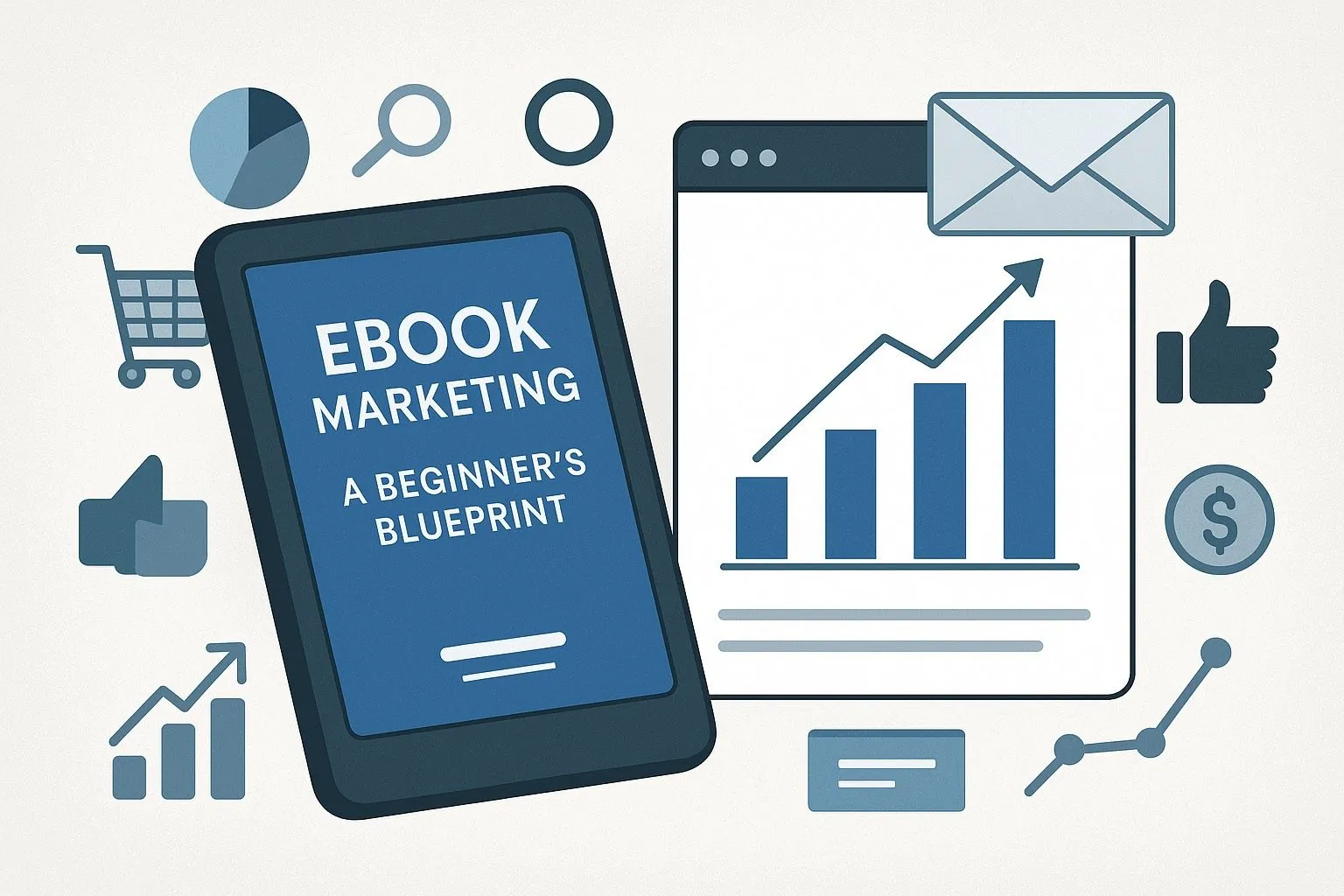
Ebook Marketing for Beginners: The 2026 Blueprint
A beginner-friendly roadmap showing how to market an ebook from scratch: choosing the right topic, positioning it strategically, building assets, launching effectively, and turning your ebook into a long-term lead generation engine.
Quick Answer
Ebook marketing for beginners starts with three foundations: choosing a topic with proven demand, building an email list before launch, and using a structured 30-day launch plan. Ebooks remain one of the highest-converting lead magnets and digital products. Create yours with an AI ebook generator, then follow this blueprint to promote it effectively.
Ebooks have quietly become one of the most reliable tools in modern digital marketing. They attract leads, build authority, nurture trust, educate audiences, and convert readers into customers. The best part? You don't need to be a marketer or a seasoned author to use them effectively. You simply need a structured approach - a blueprint that explains how to position your ebook, promote it, and turn it into an engine for growth.
In 2025, ebook marketing looks different from even two years ago. Audiences skim more. Algorithms change faster. Markets are noisier. And yet, the power of long-form, high-value content has only increased. People still want depth. They still want clarity. They still want transformation. An ebook remains one of the few resources that can deliver all of that in one place.
This guide is a beginner-friendly roadmap that shows exactly how to market an ebook from scratch: choosing the right topic, positioning it in the market, preparing your assets, launching strategically, building distribution channels, and using post-launch momentum to create long-term value. The goal is simple - make your ebook impossible to ignore.
Why Ebooks Still Work in 2025
If you spend any time in creator communities, you'll see a familiar story: attention spans are shrinking, content is shorter, and everyone wants things "quick." Yet ebooks continue to be downloaded in record numbers. The reason isn't contradictory - it's logical.
Short-form content captures attention, but ebooks convert it.
People may skim tweets and scroll past videos, but when they download an ebook, they're committing to a deeper relationship with the creator. They want insight, direction, structure, and value they can't get from posts or clips. When someone gives you their email in exchange for 15 or 30 pages of expertise, that's an active signal of trust.
Businesses know this. That's why ebooks remain one of the few digital assets that consistently generate leads even as platforms, algorithms, and trends change.
Ebooks work because they deliver transformation. And transformation is timeless.
Step 1: Start With a Topic That Actually Has Demand
Most ebook marketing challenges begin long before the launch. They start with a topic chosen in isolation - something interesting to the creator, but not necessarily relevant to the audience. A successful ebook aligns three forces: what your audience wants, what you can teach, and what moves them toward a meaningful outcome.
The most effective ebook topics answer a question people are already asking, or solve a problem people already have. In 2025, that could be anything from building an audience to starting a side business to improving health, productivity, or financial habits. But the specific topic matters less than the transformation it promises.
Readers are not buying information. They're buying progress - a clearer path, fewer mistakes, a faster route to the result they want. The more directly your ebook speaks to a real, urgent, emotional problem, the easier it becomes to market.
This is why creators who use AI to generate multiple outlines often outperform those who rely solely on intuition. Tools like Inkfluence AI can turn vague ideas into structured chapter plans, helping creators refine their topics before they even start writing.
A good ebook topic is not just something you "know." It's something your reader needs.
Step 2: Position Your Ebook So It Stands Out
In crowded markets, the hook matters as much as the content. Ebook positioning is the art of defining who the ebook is for, what it helps them achieve, and why it is uniquely effective. The title, subtitle, and overall promise set expectations long before people read a page.
Strong positioning doesn't require hype. It requires clarity. Readers should immediately understand the transformation offered: a system, a path, a set of insights that moves them closer to their goal.
In 2025, the most successful ebooks use highly specific framing. Instead of broad themes like "Guide to Social Media," winning creators choose focused angles like "The 30-Day Instagram Playbook for Coaches" or "Zero-Budget Content Strategy for Beginners." The more specific the ebook, the easier it is to target the right audience - and the easier it is to market.
When your ebook feels tailor-made for someone's exact situation, it becomes irresistible. Learn more about creating ebooks that sell.
Step 3: Build Your Ebook With a Marketing Mindset
Marketing isn't something that happens after the ebook is finished. It begins during the creation process. The structure of the ebook should naturally lead readers toward deeper engagement with your brand. That doesn't mean being salesy. It means creating opportunities for readers to take the next step.
Successful ebooks follow a smooth narrative arc: they acknowledge the reader's current state, outline the challenges they face, teach them the necessary frameworks, and end with clear next actions. The writing should be structured, concise, and easy to navigate. Long paragraphs, inconsistent formatting, and unclear transitions weaken conversions.
This is why many creators now rely on AI-powered writing systems. Instead of wrestling with writer's block or disorganised drafts, they can generate structured chapters, refine the tone, and polish the flow without losing time or momentum. Inkfluence AI, for example, doesn't just write paragraphs - it builds entire chapters with built-in logical structure, flow, and pacing. A well-organised book is significantly easier to market.
Because ultimately, readers share books that feel genuinely helpful.
Step 4: Create High-Impact Marketing Assets
Even the best ebook won't market itself. To launch effectively, you need assets that capture attention, draw people into the promise, and make the ebook feel visually compelling. The most important assets include a cover image, preview pages, landing page visuals, short promotional copy, and social media teasers.
This is where design tools shine. Canva and Adobe Express are excellent for creating promotional graphics and social posts. But your assets must be consistent - the same colour palette, typography, and visual style across every touchpoint. Consistent branding increases perceived value and makes the ebook look like a real product rather than a casual PDF.
In 2025, most successful ebook creators pair AI writing with design tools. Inkfluence AI provides the structured content, while a design tool gives the marketing visuals an extra layer of polish. The two together create presentation that feels premium without requiring a professional designer. See our guide on ebook design best practices.
A strong marketing asset doesn't just look good; it communicates the transformation your book offers in seconds.
Step 5: Publish on a Purpose-Built Landing Page
A landing page is the centrepiece of your ebook marketing funnel. It is where people decide whether to exchange their email or money for your content. The design should be simple, uncluttered, and conversion-focused - a clear headline, a benefit-driven description, a preview of what's inside, social proof if available, and a frictionless call to action.
Creators often make the mistake of hiding their ebook deep on a blog or inside a complicated website. In reality, the landing page needs to stand alone, with a direct URL and a clear message. Visitors should understand within three seconds what the ebook is about and why they should download it.
Modern landing page builders make this easy, but AI-assisted copywriting helps even more. When the landing page language reflects the ebook's core transformation, downloads increase dramatically.
Good landing pages don't push; they guide.
Step 6: Launch With a Clear Distribution Plan
An ebook launch doesn't need to be loud, but it must be intentional. The simplest and most effective distribution strategy starts with your warmest audiences - your existing followers, email subscribers, or clients. These people are most likely to download the book immediately and give early feedback.
From there, distribution branches into channels that match your audience's habits. For some creators, that means X (Twitter) threads that summarise ebook insights. For others, LinkedIn posts highlighting outcomes. For some, short video teasers on TikTok or Instagram. The best creators also repurpose sections of the ebook into micro-content to build anticipation.
The key is consistency. An ebook launch isn't a one-day event. It is a multi-week campaign where insights, quotes, and stories from the book surface across your platforms. In 2025, algorithms reward content that creates conversation, and ebooks provide a rich source of ideas worth discussing.
The more your ebook appears across different touchpoints, the more discoverable it becomes. Explore additional strategies in our complete ebook marketing guide.
Step 7: Turn the Ebook Into a Long-Term Asset
The most effective ebook marketers treat their book not as a one-off project but as a living asset. After the initial launch, the ebook continues to generate traffic, leads, and authority - especially when paired with a long-term content strategy.
Creators use ebooks as the foundation for newsletters, course modules, coaching programs, and lead magnets tied to specific offers. Chapters become blog posts. Frameworks become carousel posts. Quotes become short videos. The book becomes a hub of content rather than a static document.
This is why structured generation matters. When your ebook has clear chapters, logical progression, and strong internal framing, it becomes infinitely easier to repurpose. And when the book is professionally formatted, readers continue sharing it long after the launch.
A well-marketed ebook is not a moment. It's a system.
The 2025 Blueprint in One Sentence
Ebook marketing in 2025 isn't about hacks or trends - it's about creating something genuinely helpful, packaging it clearly, and distributing it consistently.
Creators who use modern tools to remove friction - AI for writing, clean design for visuals, strong landing pages for conversions - are the ones who win. The process is faster than ever, but the goals remain the same: earn trust, deliver value, and guide readers toward action.
If your ebook teaches something meaningful, solves a real problem, and is positioned clearly, marketing becomes not only simple, but enjoyable.
Ready to create and market your first ebook? Try Inkfluence AI free and see how quickly you can turn your expertise into a professional digital product that attracts the right audience.

Inkfluence AI Team
Tips, tutorials, and strategies from the Inkfluence AI team to help you write, publish, and sell ebooks faster.
Helpful links
Ready to Create Your Own Ebook?
Start writing with AI-powered tools, professional templates, and multi-format export.
Get Started FreeRelated Articles
 Marketing
 How to Market an Ebook in 2026: Complete Strategy (Before and After Launch)
A practical ebook marketing playbook for 2026 covering pre-launch prep, launch week tactics, Amazon KDP SEO, social media promotion, email list building, content repurposing, and long-term sales strategies.
 Marketing
 Ebook Marketing for Beginners: How to Sell Your First 100 Copies in 2026
A practical ebook marketing guide for first-time authors. Learn how to promote your ebook using free and paid strategies that work in 2026.
 Marketing
 Ebook Marketing Strategy 2026: The Complete Guide to Selling More Books
Learn proven ebook marketing strategies for 2026. From pre-launch planning to Amazon KDP optimization, email funnels, and paid ads. Step-by-step guide for authors.
Get ebook tips in your inbox
Join creators getting weekly strategies for writing, marketing, and selling ebooks.