
AI Ghostwriter: How Experts Turn Knowledge Into Books Without Writing
You have expertise worth sharing. You do not have months to write a book. AI ghostwriting bridges the gap - turning your frameworks, methods, and insights into polished manuscripts. Here is how it works.
Quick Answer
AI ghostwriting tools let experts, consultants, and coaches turn their knowledge into published books without writing a single page themselves. Inkfluence AI handles the full pipeline: you describe your expertise and ideas, the AI generates a structured outline and chapters, you review and refine, then export as a formatted PDF or EPUB ready for Amazon KDP, Gumroad, or your own website.
Every experienced professional has a book inside them. The consultant with a methodology that transforms businesses. The coach with frameworks that change lives. The entrepreneur who learned lessons worth millions. The specialist who sees their industry more clearly than anyone else.
The problem is rarely the knowledge. The problem is the writing.
Traditional ghostwriting solves this, but at a cost few can justify. Human ghostwriters charge $20,000 to $100,000 or more. They require months of interviews, rounds of revisions, and extensive back-and-forth. For most experts, this route is either unaffordable or impractical.
Enter AI ghostwriting.
- AI writing tool: AI ghostwriter
- Book creation: AI book writer
- Lead generation: lead magnet generator
- Strategy guide: lead magnets that convert
In 2026, AI has matured enough to handle the heavy lifting of book production. You provide the expertise - the frameworks, the stories, the insights. The AI handles the prose generation, the structural organization, the formatting. What once required a year and a small fortune now takes weeks and a fraction of the cost.
This is not about replacing human creativity. It is about removing the barrier between expertise and expression.
Updated August 2026
What AI Ghostwriting Actually Means
The term "ghostwriting" traditionally describes someone writing content attributed to another person. A busy CEO hires a writer. They collaborate. The writer produces the manuscript. The CEO's name appears on the cover. In practice it sits between two things people already understand: an AI ghostwriter produces the draft the way a human ghostwriter would, while you supply the expertise and judgement that only you have.
AI ghostwriting follows the same model, but the writer is software. You remain the expert. The AI handles the translation of your knowledge into written form.
Here is what that looks like in practice:
You provide the substance. Your frameworks, methodologies, case studies, insights, and perspectives. This is the intellectual property - the actual value.
The AI generates the prose. It takes your structured input and produces readable, organized content. It handles transitions, elaboration, and formatting.
You refine the output. You review, adjust tone, add personal stories, remove anything that does not sound like you, and ensure accuracy.
The result is a book that contains your expertise, reflects your perspective, and carries your name - produced in a fraction of the time traditional writing requires.
Who Benefits Most From AI Ghostwriting
AI ghostwriting is not for everyone. It works best for experts who have clear knowledge to share but lack the time, inclination, or writing fluency to produce manuscripts traditionally.
Consultants and Advisors
You have spent years developing methodologies that solve real problems. Your clients pay premium rates for your frameworks. But articulating those frameworks in book form? That requires a different skill set - one you may not have developed because you were busy becoming an expert in your actual field.
A book crystallizes your methodology. It becomes a calling card, a lead generation tool, and a way to serve clients before they even hire you. AI ghostwriting makes this achievable. The consultant workflow shows this process in detail.
Coaches and Educators
Coaches build transformation through conversation and relationship. Writing is often not their primary mode of communication. Yet a book can scale that coaching impact - reaching people who may never book a session but can still benefit from the frameworks.
Whether it is a mindset transformation guide, a goal-setting workbook, or a comprehensive program overview, AI ghostwriting turns coaching expertise into shareable, scalable resources.
Business Owners and Entrepreneurs
Building a business teaches lessons that business school never could. Those lessons - about team building, product development, market positioning, customer psychology - have value far beyond your own company. But you are running a business. You do not have six months to write.
AI ghostwriting lets entrepreneurs document their expertise without stepping away from operations. The book becomes an asset that works while you work.
Subject Matter Experts
Technical experts, medical professionals, financial specialists, HR leaders - anyone with deep domain knowledge can benefit. You understand things that most people do not. Translating that understanding into accessible language requires writing skill that domain expertise does not automatically provide.
AI bridges that gap. You explain the concepts. The AI makes them readable.
The Economics Are Finally Reasonable
First, the verified market rates so the comparison is honest. Per Reedsy's 2026 pricing data and current industry guides: We break the comparison down properly in AI versus a human ghostwriter on cost, including where a human is still the better spend.
| Route | Typical cost (2026) | Timeline |
|---|---|---|
| Human ghostwriter, non-fiction book | $18,000 to $50,000 ($15-30k mid-level for 40-60k words) | 4 to 9 months |
| Human ghostwriter, novel | $3,500 to $18,000 | 3 to 6 months |
| Elite ghostwriter (bestseller credits) | $75,000 to $250,000+ | 6 to 12 months |
| AI ghostwriting platform | $0 to $30/month | Draft in minutes, edited book in days to weeks |
The gap is not subtle. What you trade for it: a human ghostwriter interviews you and shapes the material for you, while an AI platform gives you the draft instantly and leaves the shaping and lived detail to you. The rest of this guide is about doing that part well.
Let's be explicit about costs, because this is where AI ghostwriting becomes compelling.
Traditional ghostwriting: $20,000-$100,000+ for a full manuscript. 6-12 months of collaboration. Additional costs for editing, formatting, and design.
DIY book writing: "Free" in monetary terms. 6-18 months of nights and weekends. Often never completed because writing is hard and life intervenes.
AI ghostwriting: A few hundred dollars in software subscriptions. 4-8 weeks of focused work. Your time investment shifts from writing to reviewing and refining.
The math changes everything. A consultant charging $300/hour who spends 100 hours writing a book has invested $30,000 of opportunity cost. If AI reduces that to 30 hours of review and refinement, the savings are substantial - even before considering the faster time to publication.
This is why AI ghostwriting is not "cheating." It is resource allocation. You are an expert in your domain. Your time is best spent on expertise, not on learning to write well. AI handles what you are not optimized for.
What You Still Need to Provide
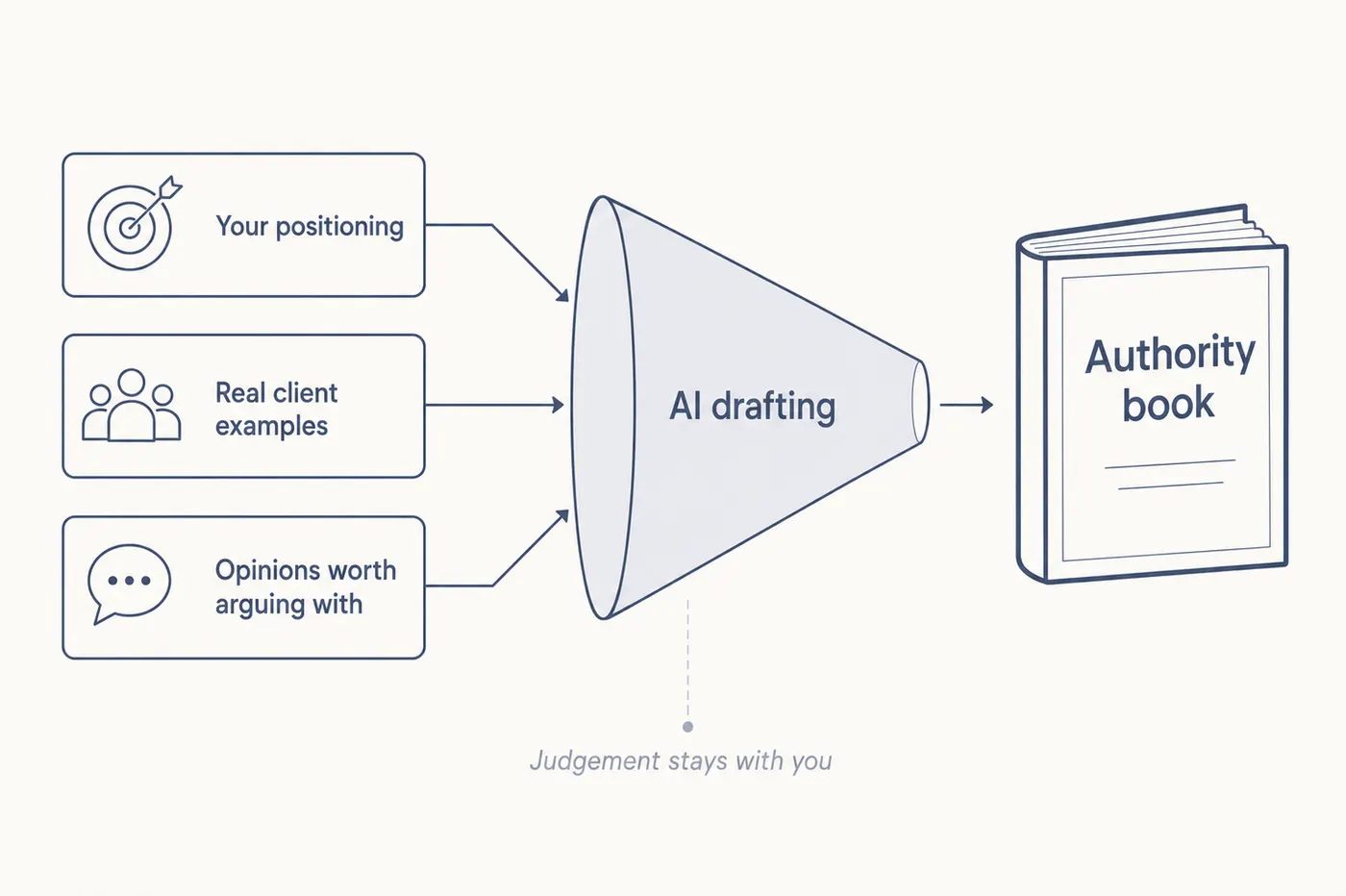
AI ghostwriting is not magic. It does not invent expertise you do not have. Here is what you must bring to the process: This is the part no tool removes. You bring the positioning, the real examples and the opinions worth disagreeing with, and it is also why generic output is almost always a symptom of a thin brief rather than a weak model.
Clear frameworks and methodologies. What do you actually know? What are your unique approaches? What have you figured out that others have not? This is the core intellectual property - and it must come from you.
Stories and examples. AI cannot tell your client stories, your origin story, or your hard-won lessons. These narratives are what make books memorable. You need to capture them, even in rough form.
Point of view. What do you believe that is contrarian or different? What does your industry get wrong? What would you tell someone if you had their undivided attention? AI can articulate, but the perspective must be yours.
Editing judgment. AI output needs refinement. You must be able to recognize what sounds like you, what needs cutting, and what needs expansion. This is lighter than writing from scratch, but it requires engagement.
The Process: From Expertise to Manuscript
Here is how AI ghostwriting typically works for non-fiction expertise books:
Phase 1: Knowledge Extraction
Document everything you know about your topic. This is not polished writing - it is brain dumping. Frameworks, processes, lessons, stories, opinions, answers to common questions. Some people record voice notes. Some create bullet point lists. Some use mind maps.
The goal is to externalize your expertise in any form - rough is fine. AI cannot read your mind, but it can work with raw material.
Phase 2: Structure Development
Organize the raw material into a logical book structure. What needs to come first? What builds on what? Where are the natural chapter breaks? What is the transformation arc for the reader?
AI tools like Inkfluence AI's book writer can help generate structure options, but you need to validate that the sequence makes sense for your audience and material.
Phase 3: Content Generation
This is where AI does the heavy lifting. Working chapter by chapter, you provide your raw notes, key points, and any stories to include. The AI generates readable prose - expanding bullet points into paragraphs, creating transitions, organizing information clearly.
A chapter that might take days to write from scratch can be generated in minutes. Inkfluence writes complete chapters in real-time - you can watch the words appear.
Phase 4: Refinement and Voice
AI-generated content needs your editing. Read every section. Adjust phrasing that does not sound like you. Add stories the AI could not know. Remove generic filler. Ensure accuracy - AI can confidently state things incorrectly.
This phase is crucial. It is what separates a generic AI document from a book that reflects your actual expertise and personality.
Phase 5: Production
Once the manuscript is solid, production includes professional editing, formatting for different platforms, cover design, and export. Modern tools handle much of this - multi-format publishing is now straightforward.
Common Concerns (And Why They Are Often Overblown)
"Won't it sound generic?"
Only if you skip the refinement phase. AI generates a foundation. Your editing adds the voice, the stories, the specific examples that make it yours. The output quality depends heavily on your input and revision effort. We cover 9 specific techniques in our guide to avoiding generic AI book output.
"Is it ethical to use AI for a book with my name on it?"
Consider what ghostwriting has always been. No one questions books written by traditional ghostwriters. The intellectual property, frameworks, and expertise are yours. The production method is simply more efficient. What matters is that the content is accurate and valuable - not who typed the words.
"Can AI handle my specialized field?"
AI is better at some domains than others, but the knowledge extraction phase addresses this. You are providing the specialized content. AI is organizing and articulating it. For highly technical material, more revision may be needed - but the time savings still apply.
"What about my unique voice?"
Voice comes from editing, not first drafts. Even human ghostwriters require multiple rounds to capture an author's voice. AI is no different - except you can iterate faster. The more you refine, the more it sounds like you.
What AI Ghostwriting Cannot Do
Setting appropriate expectations matters. AI ghostwriting is powerful, but it has limits: It also cannot decide what your book is for. A business book written to win speaking engagements and a self-help book written to build a coaching practice need different structures, and that judgement stays with you.
It cannot invent expertise. If you do not actually know the subject, AI cannot fake it. The output will be generic, surface-level, or incorrect. AI amplifies existing knowledge - it does not create it.
It cannot replace human judgment. AI may write something plausible but wrong. It may miss nuance that matters in your field. You must review everything and catch errors.
It cannot tell your stories. Your client transformations, your origin narrative, your hard lessons - these must be captured and provided. AI cannot access experiences it was not given.
It cannot guarantee a bestseller. A book's success depends on content quality, market fit, positioning, and promotion - not just production efficiency. AI helps you produce faster; the rest still requires strategy.
The Strategic Value of an Expertise Book
Why bother writing a book at all? For experts, the strategic benefits compound: This is the reason thought leaders and coaches keep returning to the format: a book is the only asset that argues your case while you are asleep.
Authority positioning. A book signals expertise in a way that no amount of social media content can match. It creates a category-of-one positioning for speaking, consulting, and premium client work.
Lead generation. Books function as extended lead magnets. Prospects who read your book arrive pre-sold on your methodology. Sales conversations start from trust rather than skepticism.
Scalable teaching. You cannot be everywhere. A book can. It allows you to share your expertise with thousands simultaneously, creating impact beyond one-on-one interactions.
Legacy and documentation. Your methodologies exist in your head. A book externalizes them - creating something that persists beyond individual engagements.
AI ghostwriting makes these benefits accessible to experts who previously could not justify the time or cost of traditional book production.
Getting Started: First Steps
If you are considering AI ghostwriting for your expertise, here is how to begin: Practically, that means three artefacts before you draft anything: a one-sentence promise, a chapter outline you actually believe in, and an author bio that earns the reader's attention. The editing pass comes later and matters more than most people expect.
Start capturing. Every insight, framework, client story, and lesson - document it somewhere. Voice memos, notes apps, messy documents. Do not worry about organization yet. Just externalize.
Identify your core thesis. What is the main argument or transformation your book will deliver? This becomes your organizing principle.
Outline roughly. What are the main sections? What sequence makes sense? This does not need to be final - just a starting structure.
Choose your tool. Platforms like Inkfluence AI are designed for this workflow. They handle structure, generation, formatting, and export in one place.
Commit to the editing phase. AI generates the foundation. Your refinement makes it a real book. Plan for this investment.
The experts who will establish authority in the coming years are those who can translate their knowledge into scalable formats. AI ghostwriting has removed the barrier. The question is no longer whether you can write a book - it is whether you will.
💡 Ready to turn your expertise into a book? Try the AI Ghostwriter - from frameworks to finished manuscript, without the traditional writing burden.
Frequently Asked Questions
How long does it take to create a book with AI ghostwriting?
Most expertise books can be produced in 4-8 weeks with dedicated effort. The knowledge extraction phase takes 1-2 weeks (capturing your expertise). Generation takes 1-2 weeks. Refinement and production take another 2-4 weeks. Compare this to 6-12 months for traditional writing or ghostwriting.
Do I still need to do work, or does AI handle everything?
You must provide the expertise, frameworks, and stories. You must review and refine AI output. AI handles prose generation, organization, and formatting. Think of it as a 70/30 split - AI does 70% of the production labor, but you must do the 30% that requires actual expertise.
Will readers know it was written with AI?
Not if you do the refinement phase properly. AI generates a foundation; your editing adds voice, stories, and nuance. The result reads as your book because it contains your expertise and has been refined to sound like you.
What types of books work best with AI ghostwriting?
Non-fiction expertise books are ideal: methodology guides, how-to books, business books, coaching frameworks, and professional development content. These rely on structured knowledge that experts can provide and AI can articulate.
Is it ethical to publish a book created with AI help?
Yes. Traditional ghostwriting has existed for decades without ethical concern. The expertise, frameworks, and intellectual property are yours. AI is a production tool - more efficient than hiring a human ghostwriter, but serving the same function.
What if my field is highly specialized?
The more specialized your field, the more important your knowledge extraction phase becomes. AI articulates what you provide. For technical or specialized content, plan for additional review to ensure accuracy, but the workflow still applies.

Founder, Inkfluence AI
Sam is the founder of Inkfluence AI. He built the platform to make book creation accessible to everyone - from first-time authors to seasoned publishers.
Helpful links
Ready to Create Your Own Ebook?
Start writing with AI-powered tools, professional templates, and multi-format export.
Get Started FreeRelated Articles
 AI Writing
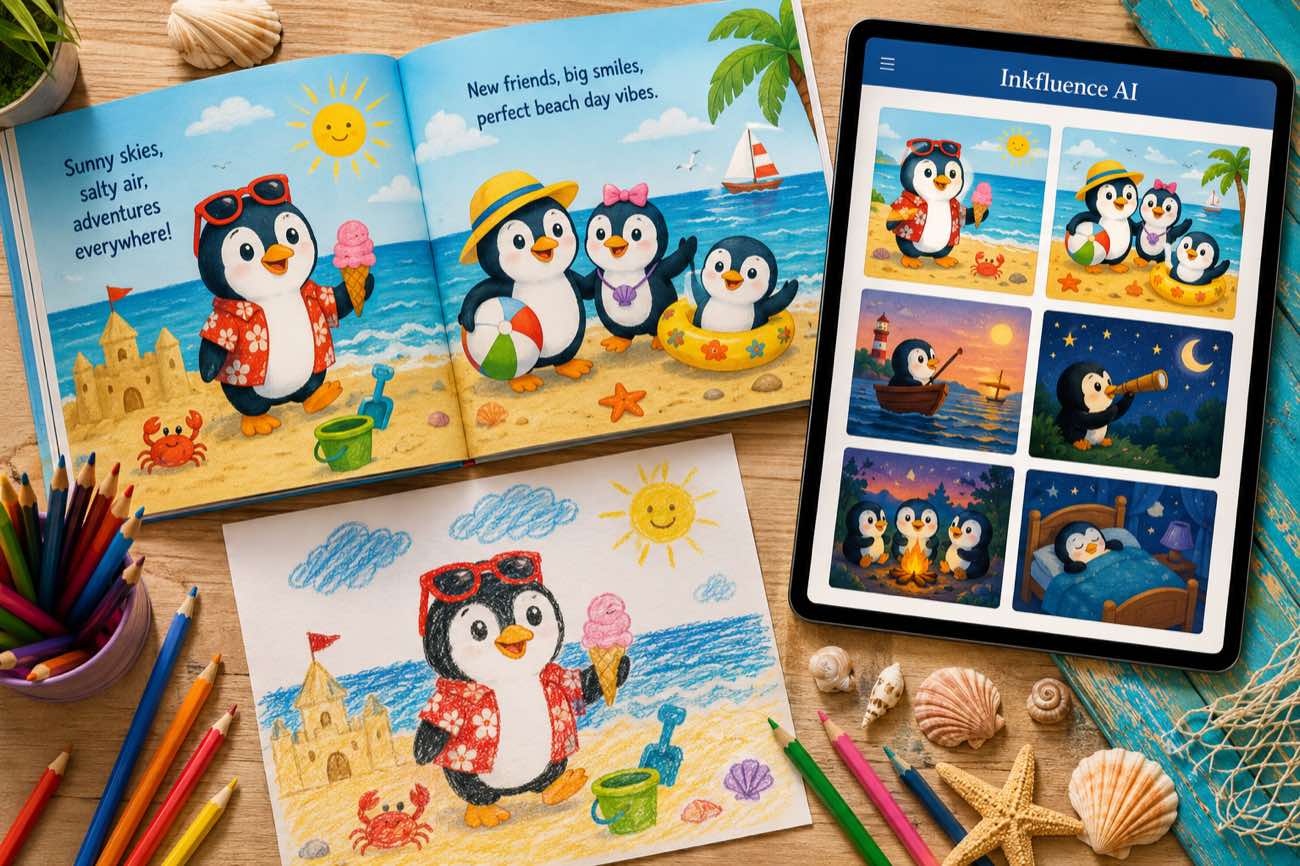
 How to Make a Children's Picture Book with AI: Idea to Printed Book in a Day
The complete 2026 workflow for making a fully illustrated children's picture book with AI: age-band word counts, page planning, consistent characters, cover design, and publishing it on Amazon KDP with the right disclosure.
 AI Writing
 The 9 Best Ebook Creators in 2026: AI, Formatting, and Design Tools Compared
Not every "ebook creator" does the same job. We compare the 9 best tools of 2026 across three categories: AI generators that write the book, formatting tools that typeset it, and design tools that make it beautiful, with verified pricing for each.
 AI Writing
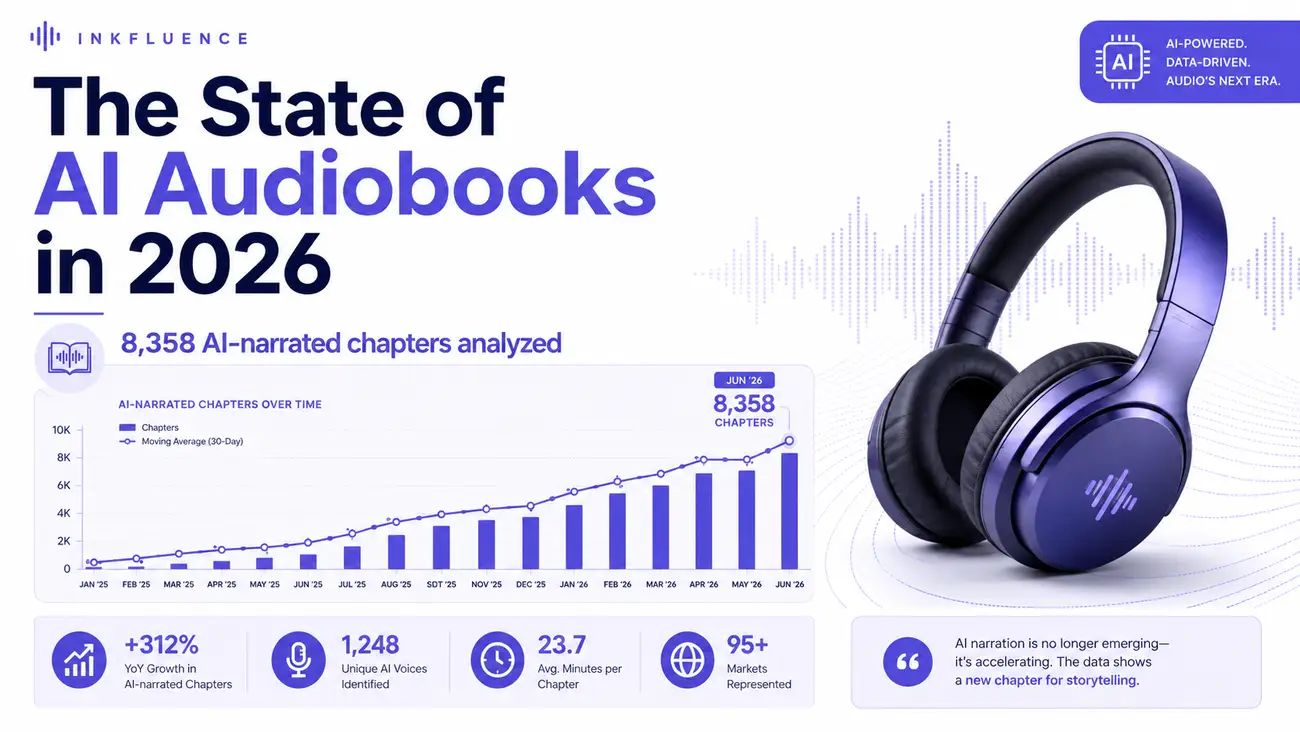
 The State of AI Audiobooks in 2026: What 8,358 AI-Narrated Chapters Reveal
We looked at 8,358 chapters our users narrated into audiobooks with AI. Monthly narration grew from a handful of chapters in late 2025 to nearly 3,000 a month by mid-2026, 99% of jobs finished cleanly, and listeners consistently pick natural, conversational voices over dramatic ones. Here is the first-party data and what it means for authors.
Get ebook tips in your inbox
Join creators getting weekly strategies for writing, marketing, and selling ebooks.