
How to Prevent Factual Errors in AI-Generated Non-Fiction Books
AI can write compelling prose, but it can also confidently state things that are wrong. Here is a practical verification workflow for non-fiction authors using AI tools - from source checking to expert review to reader trust.
Quick Answer
AI writing tools can "hallucinate" - generate plausible-sounding but incorrect facts, statistics, dates, and attributions. Non-fiction authors using AI must verify every factual claim before publishing. The most effective approach is a 3-layer verification workflow: flag claims during editing, cross-reference with authoritative sources, and have a subject-matter reviewer check the final draft. Inkfluence AI generates structured non-fiction with genre-awareness that reduces hallucination risk, but no AI tool eliminates the need for human fact-checking on non-fiction content.
Why This Matters
One wrong statistic can destroy reader trust in your entire book
Non-fiction credibility is binary. Either your reader trusts you or they do not. A single obviously wrong fact - a date that is off, a statistic from a study that does not exist, or a misattributed quote - makes readers question everything else in the book. When you are using AI to assist with writing, the risk of confidently-stated incorrect facts is real and must be actively managed.
This article provides a concrete, repeatable verification workflow that adds minimal time but dramatically reduces the risk of publishing errors in AI-assisted non-fiction.
The uncomfortable truth about AI writing tools in 2026: the better they get at producing fluent, confident prose, the harder it becomes to spot the errors. A robotic-sounding AI puts you on guard. A natural-sounding one lulls you into thinking it must be right.
This is not a flaw limited to any one tool. Language models generate text by predicting the most likely next word, not by looking up facts in a database. They can produce text that reads like an authoritative source while being entirely fabricated. Understanding this limitation - and building a workflow around it - is the key to using AI responsibly for non-fiction.
What Actually Goes Wrong: Types of AI Factual Errors
Not all AI errors are the same. Understanding the categories helps you know what to look for during verification:
Fabricated statistics
AI generates convincing-sounding numbers. "According to a 2024 Harvard study, 67% of entrepreneurs..." - the study may not exist. The number may be invented. This is the most common and most dangerous type of error in non-fiction because readers trust numbers.
How to catch it: Search for the exact statistic. If you cannot find the original source within 2 minutes, the stat is likely fabricated.
Misattributed quotes
"As Albert Einstein once said..." followed by something Einstein never said. AI mixes up attributions constantly because many quotes are misattributed across the internet - and the training data reflects that noise.
How to catch it: Search the exact quote in quotation marks. If it only appears on quote aggregation sites, it is probably misattributed.
Outdated information
AI models are trained on data up to a certain date. Tax laws change. Medical guidelines get updated. Technology evolves. AI may state something that was true in 2023 but is no longer accurate. Especially dangerous in health, finance, and legal content.
How to catch it: For any time-sensitive fact (laws, guidelines, prices, statistics), verify the current state directly from the official source.
Confident nonsense
Plausible sentences that are meaningless on close reading. "The amygdala processes goal-setting through cortical feedback loops" sounds scientific but may be combining real neuroscience terms in a way that an expert would immediately flag as wrong.
How to catch it: If a sentence sounds impressively technical, look up the specific mechanism described. If it does not match any real explanation, the AI is confabulating.
Conflated concepts
Blending two related but different things into one. Mixing up two historical events, conflating two similar studies, or combining features of two different products. The AI knows both concepts exist but merges them.
How to catch it: When the AI describes a specific event, study, or product, verify the details separately. If two facts seem surprisingly convenient together, they may be from different sources.
The 3-Layer Verification Workflow
This workflow adds roughly 15-20 minutes per chapter but catches the vast majority of factual errors. It scales from a 5-chapter business guide to a 15-chapter technical reference.
Layer 1: Flag During Editing (5 minutes per chapter)
As you read each chapter in the editor, highlight every factual claim. You are not verifying yet - just flagging. Look for:
- Any specific number, percentage, or statistic
- Named studies, surveys, or research
- Direct quotes attributed to a person
- Dates of events
- Claims about how something works (mechanisms, processes)
- Product features or pricing
- Legal or regulatory statements
A typical non-fiction chapter will have 8-15 flagged claims. Some will be obviously correct ("the sun rises in the east") - skip those. Focus on specific, verifiable assertions.
Layer 2: Cross-Reference (10 minutes per chapter)
For each flagged claim, spend 30-60 seconds searching for the original source. Your verification hierarchy:
- 1. Official sources first - Government websites, peer-reviewed journals, official organization pages. If the AI cites "a WHO study," go to who.int and search.
- 2. Authoritative secondary sources - Major news outlets, established industry publications, university websites. These can confirm or deny most claims quickly.
- 3. Cross-check across multiple sources - If a statistic only appears on one website (especially a blog), it is likely fabricated or misquoted. Legitimate statistics appear in multiple places.
Decision rule: If you cannot verify a claim in 60 seconds, either replace it with a verified alternative, remove it, or rewrite the sentence to be less specific ("research suggests" instead of "a 2023 Stanford study found that 73%...").
Layer 3: Expert or Peer Review (Once Per Book)
Before publishing, have someone with subject knowledge read the full manuscript. This does not need to be a paid professional review - it can be:
- A colleague who works in the field
- A beta reader who is already knowledgeable about the topic
- A subject-matter expert you know personally
- A professional fact-checker (for high-stakes content like health or finance books)
Ask them specifically: "Does anything in here strike you as wrong, outdated, or oversimplified?" Domain experts catch errors that no amount of Googling will find because they know the nuances that search results do not surface.
High-Risk Categories That Need Extra Scrutiny
Some book types carry higher factual risk than others. Here is where to be most vigilant:
| Book Category | Risk Level | Primary Risks | Minimum Verification |
|---|---|---|---|
| Health / Medical | Very High | Outdated guidelines, wrong dosages, misrepresented studies | Professional medical review mandatory |
| Finance / Legal | Very High | Outdated tax laws, wrong regulatory info, jurisdiction-specific errors | Professional review + jurisdiction check |
| Technical / How-To | High | Outdated tool versions, wrong syntax, deprecated methods | Test every procedure described |
| History / Biography | High | Wrong dates, conflated events, misattributed actions | Verify every date, name, and event |
| Business / Marketing | Medium | Fabricated case studies, wrong revenue figures, outdated strategies | Cross-reference company data and statistics |
| Self-Help / Personal Dev | Lower | Misattributed quotes, wrong study citations, oversimplified science | Verify quotes and any scientific claims |
| Recipes / Cookbooks | Lower | Wrong measurements, unsafe temperatures, allergen omissions | Test recipes, verify cooking temperatures |
Important: For health, legal, and financial content, AI output should be treated as a first draft that must be reviewed by a qualified professional before publication. No AI tool - no matter how advanced - replaces professional expertise in fields where errors can cause real harm. For the claim wording, disclaimers and platform rules that apply to wellness books, see our guide to writing a health or wellness ebook.
How to Reduce Errors at Generation Time
Verification catches errors after generation. But you can reduce the number of errors in the first place by how you set up your project:
Do This
- Be specific in your topic description - "Marketing strategies for B2B SaaS companies with $1M-10M ARR" will produce more accurate content than "marketing strategies"
- Provide your own data points - If you have real statistics, include them in the project description. The AI will weave them in rather than inventing alternatives
- Include "do not fabricate statistics" in your guidance - Some AI tools accept additional instructions. Explicitly requesting that uncertain facts be flagged as such helps
- Choose the right book type - A tool that adjusts its approach for business books vs cookbooks vs health guides will produce more genre-appropriate and accurate content. Inkfluence AI supports 33 book types for this reason
Avoid This
- Do not trust specific numbers without verifying - "42% of people..." is exactly the kind of detail AI invents. Numbers look authoritative but are the most frequently fabricated element
- Do not leave named sources unchecked - "A 2023 McKinsey report found..." - check that the report exists before publishing
- Do not publish time-sensitive content without date-checking - Prices, laws, software features, and statistics change. Verify anything that could be outdated
- Do not assume the AI is right because it sounds confident - This is the fundamental trap. The more fluent the prose, the more carefully you should fact-check it
Free Tools for Fact Verification
You do not need expensive tools to verify AI-generated claims. These free resources cover 90% of fact-checking needs:
Google Scholar (scholar.google.com)
Search for any study or statistic. If the AI claims a study exists, Scholar will either find it or confirm it is fabricated. Also useful for finding the actual source of commonly cited statistics.
Quote Investigator (quoteinvestigator.com)
Traces the origin of famous quotes. Invaluable when AI attributes a quote to a specific person - many widely-attributed quotes are actually anonymous or from different sources.
Exact phrase search (Google in quotes)
Put the exact statistic or claim in quotation marks. If the exact phrase returns zero results, the AI likely fabricated it. If it returns multiple authoritative sources, it is verified.
Statista (statista.com - limited free access)
Industry statistics database. Many stats have free previews. Useful for verifying market size, adoption rates, and trend data that AI frequently cites in business content.
Official organization websites
WHO for health stats, IRS for tax info, SEC for financial regulations. Always prefer official sources over secondary reporting. If the AI says "according to the WHO," check who.int directly.
Building Reader Trust Through Transparency
Beyond accuracy, how you present information affects reader trust:
- Hedge when appropriate. "Research suggests" and "current evidence indicates" are more honest than "studies prove" when you are drawing from general knowledge rather than a specific study. Readers respect nuance more than false authority.
- Remove unverifiable claims instead of guessing. It is better to have fewer statistics than to include ones you cannot verify. A strong argument with no numbers is more trustworthy than a weak argument with fabricated data.
- Include a sources or references section. Even if your book is not academic, listing the major sources you drew from demonstrates that the content has a factual foundation. Readers can then verify for themselves.
- Add a "Note on AI Assistance" if appropriate. For non-fiction that uses AI as a writing tool, a brief note in the acknowledgments or author bio about your process builds trust. "Written with AI assistance, all facts independently verified" is a strength, not a weakness.
- Update after publication. If you discover an error after publishing, correct it and note the update. Ebook formats make this easy - you can update the file on KDP, Gumroad, or Etsy and existing buyers receive the correction.
Write verified non-fiction with AI
Inkfluence AI generates structured non-fiction across 33 book types with genre-appropriate quality controls. Full editing tools let you verify and refine every chapter before exporting to PDF, EPUB, or DOCX.
Start writing freeFrequently Asked Questions
What safeguards do AI ebook platforms have to prevent factual errors?
Most AI tools reduce errors by using genre-specific writing approaches, context-aware generation that maintains consistency, and quality controls that filter generic filler. However, no platform can guarantee factual accuracy. The author is always responsible for verification in non-fiction.
Do AI writing tools hallucinate less than ChatGPT?
Purpose-built book tools with genre awareness tend to produce fewer hallucinations than generic chatbots because they constrain the generation to specific structures and tone. But all language models can generate incorrect information. The risk is reduced, not eliminated.
How long does fact-checking an AI-generated book take?
With the 3-layer workflow described above, expect 15-20 minutes per chapter for flagging and cross-referencing. A 10-chapter business book takes roughly 3-4 hours of verification. This is time well spent compared to the damage a published factual error can cause.
What types of facts are most commonly wrong in AI-generated content?
Specific statistics and percentages, attributed quotes, named studies or research, dates of events, and time-sensitive information like pricing or regulations. These are the highest-priority items to verify.
Should I disclose that my book was written with AI assistance?
It depends on the platform and your audience. Amazon KDP requires disclosure. For other channels, it is a judgment call - but "written with AI assistance, all facts independently verified" is increasingly seen as a mark of transparency rather than a weakness.
Can AI analyze my draft for potential factual errors?
You can use a separate AI tool (like ChatGPT or Claude with web access) to fact-check specific claims after generation. Ask it to verify statistics, check dates, and identify unsourced assertions. This is not a replacement for human verification but can speed up the flagging process.
Are there book types where factual accuracy matters less?
For fiction, fantasy, personal essays, and creative writing, factual accuracy is less critical since the content is inherently invented. For non-fiction of any kind - including self-help, business, health, education, and how-to guides - every factual claim should be verified.
Related Reading
- How to Ensure AI Book Content is Original - 6-step originality workflow for AI-assisted authors
- Best Practices for Co-Writing a Book With AI - How to stay in control while using AI as a writing partner
- What Types of Books Are Best Suited for AI-Assisted Creation? - Which genres work best with AI tools and which need more human input
- 10 Red Flags When Choosing an AI Ebook Platform - Warning signs and questions to ask before committing to any tool
- How to Avoid Generic AI Book Output - 9 techniques to make AI content feel original and specific

Founder, Inkfluence AI
Sam is the founder of Inkfluence AI. He built the platform to make book creation accessible to everyone - from first-time authors to seasoned publishers.
Helpful links
Ready to Create Your Own Ebook?
Start writing with AI-powered tools, professional templates, and multi-format export.
Get Started FreeRelated Articles
 AI Writing
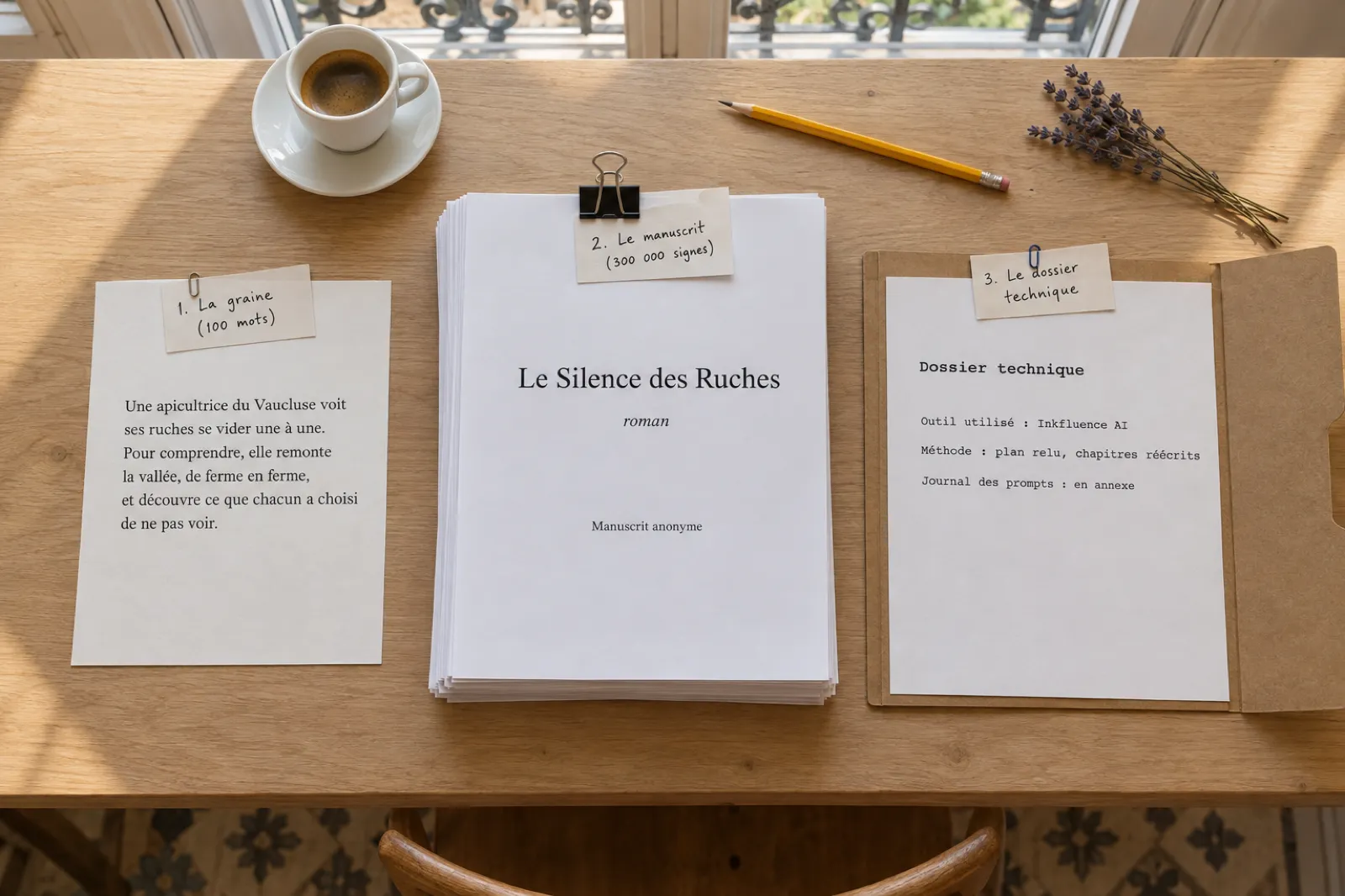
 Prix Pascal: The New Literary Prize for Novels Written with AI, and How to Enter by 30 November 2026
France's new Prix Pascal is a literary prize that asks entrants to say how they used AI instead of hiding it. The rules in plain English, what 300,000 characters means in words and chapters, the technical file, and a five-week plan to submit a French novel on time.
 AI Writing
 Sudowrite vs Novelcrafter (2026): Price, Built-in AI vs Your Own Key, Story Bible vs Codex
Sudowrite ($10 to $59 a month, AI built in) against Novelcrafter ($4 to $20 a month, AI from your own provider): price, how the AI is paid for, Story Bible against Codex, drafting, editing, export and series, read on both vendors' sites on 17 October 2026, with a picker.
 AI Writing
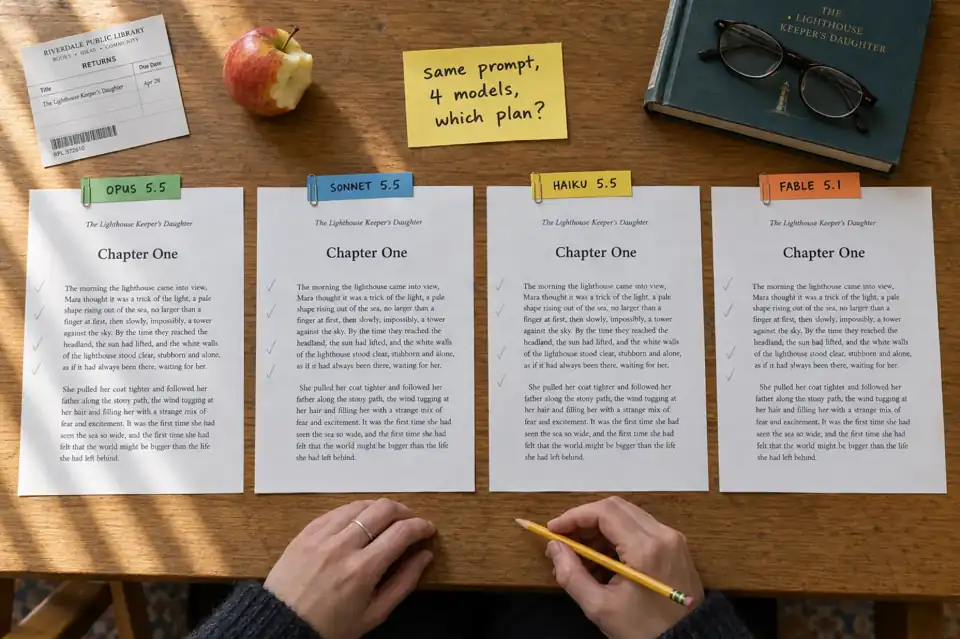
 Which Claude Model Is Best for Writing? Opus 5.5, Sonnet 5.5, Haiku 5.5 and Fable 5.1 Compared (October 2026)
Which Claude model should you write with in October 2026? Opus 5.5, Sonnet 5.5, Haiku 5.5 and Fable 5.1 compared on what Anthropic actually publishes: which plan includes each one, API prices, context and output limits, speed, and what each is built for. Plus the maths of fitting a whole book, and when a book tool is the better pick.
Get ebook tips in your inbox
Join creators getting weekly strategies for writing, marketing, and selling ebooks.