
Why AI Ebooks Lose Their Voice After Chapter 5 (And What to Look For)
Most AI-written ebooks read beautifully for three chapters, then quietly fall apart. The tone shifts, the vocabulary creeps, and by chapter eight it reads like a different author. Here is why it happens, how to spot it as a reader or buyer, and what to look for in a tool that holds one voice across a whole book.
Quick Answer
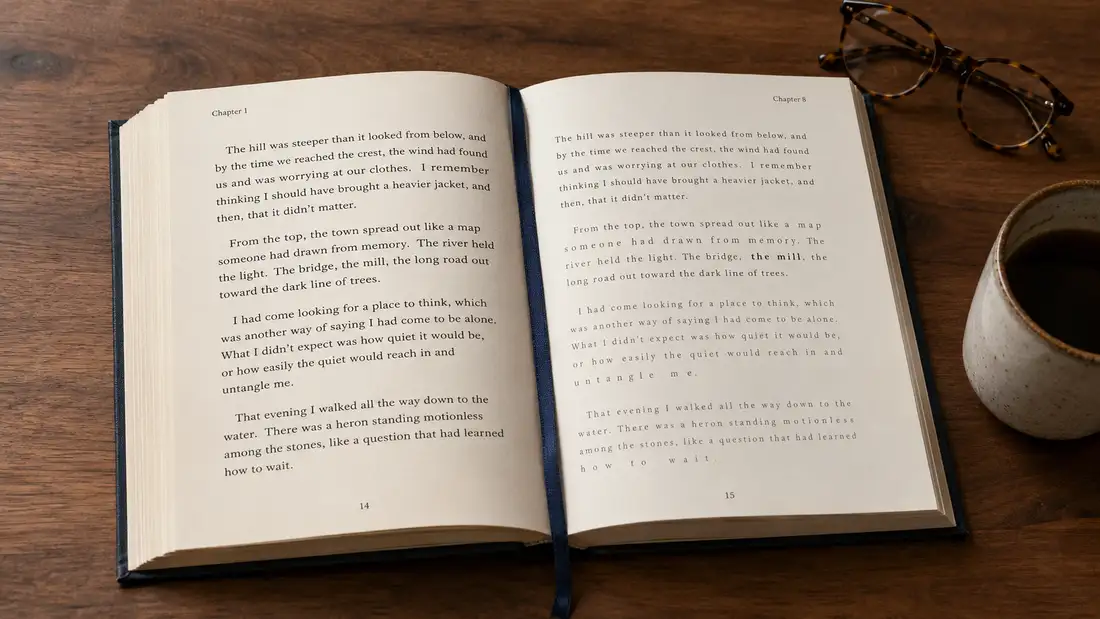
AI ebooks lose their voice because most AI tools write each chapter as a separate task, with nothing holding the thread between them. Chapter one sounds warm and direct; by chapter eight the tone has drifted, the vocabulary has crept, and the structure has changed, so the book reads like several different authors stitched together. The fix is not better prompting, it is using a tool built to hold one consistent voice across the entire book. A dedicated AI ebook writer keeps tone, vocabulary, and structure steady from the first page to the last, so readers never feel the seams.
Why This Matters
Readers cannot always name it, but they always feel it.
A reader rarely thinks "the authorial voice destabilised around chapter five." They think "I got bored," or "this felt off," or they simply stop reading. Voice drift is the single most common reason an AI-written ebook reads as cheap, even when each individual chapter looks fine in isolation.
If you are buying AI tools to write a book, or buying an AI-written book to read, this is the failure mode to watch for. Spotting it takes about two minutes once you know what to look for.
There is a specific, repeatable pattern to how AI ebooks fall apart, and it almost always starts around the same place: chapter five.
The opening chapters are usually strong. The author was fresh, the prompt was detailed, the AI had a clear target. Then the book gets longer, the context gets thinner, and somewhere in the back third the voice quietly changes. Same topic, same outline, but a different feel. This guide breaks down why that happens, how to catch it, and what actually prevents it.
What "losing the voice" actually means
"Voice" is the sum of the small, consistent choices that make a book feel like one person wrote it: sentence rhythm, how formal or casual the tone is, which words get reached for, how each chapter opens, how ideas are framed. When those choices stay steady, the reader relaxes into the book. When they wobble, the reader feels a low-grade friction they usually cannot name.
Voice drift is when those choices change over the length of the book without anyone deciding they should. It is not the same as a generic-output problem, where every chapter sounds identically bland. Drift is the opposite: the chapters are individually fine, but they do not sound like they belong to the same book.
The four symptoms of voice drift
Once you know the pattern, it is hard to unsee. Voice drift shows up as four distinct symptoms, usually together:
1. Tone drift
Chapter one is warm and conversational. Chapter eight is suddenly formal and corporate, or vice versa. The emotional temperature of the book changes without the subject changing.
2. Vocabulary creep
New pet words appear and take over. A book that never said "leverage" or "robust" in the first 10,000 words is suddenly full of them. The diction shifts under the reader's feet.
3. Structural inconsistency
Early chapters open with a story, later ones open with a definition or a bulleted list. The reader loses the rhythm they had learned to expect from each chapter.
4. Persona and POV drift
The "I" of the book changes. The confident mentor of chapter two becomes a hedging explainer by chapter nine. In fiction, a character's way of speaking slips. The narrator stops being one person.
Anatomy of voice drift
Same book, twelve chapters, one consistent voice vs a drifting one
Held voice: every chapter shares the same fingerprint
Ch 1
Ch 2
Ch 3
Ch 4
Ch 5
Ch 6
Ch 7
Ch 8
Ch 9
Ch 10
Ch 11
Ch 12
Drifting voice: the fingerprint changes chapter by chapter
Ch 1
Ch 2
Ch 3
Ch 4
Ch 5
Ch 6
Ch 7
Ch 8
Ch 9
Ch 10
Ch 11
Ch 12
Chapters 1 to 3 hold steady, the drift starts around chapter five, and by the back third the book reads like a different author. This is the pattern readers feel even when they cannot name it.
Why it happens around chapter five
The reason is structural, not mysterious. Most AI writing tools generate each chapter as a separate request. The model writes chapter one, then is asked to write chapter two, then chapter three, and so on. Unless something deliberately carries the voice forward, each new chapter is a fresh start, and a fresh start drifts.
Early on, the drift is invisible because the opening chapters are close together and the original instructions are still doing most of the work. As the book grows, the distance between "how chapter one sounded" and "what the model is doing right now" widens. By chapter five there is enough accumulated distance that the voice has visibly moved. This is the same reason a general chatbot like ChatGPT struggles with book-length projects: it is excellent at any single chapter and unreliable at making chapter nine sound like chapter one.
Prompting harder does not fix this. You can write the most detailed style instructions imaginable and the drift still creeps in, because the problem is not the quality of the instruction, it is that nothing is holding the instruction steady across the whole book. The fix has to be built into the tool, not bolted on by the writer.
A worked example: chapter one versus chapter eight
Here is what it looks like in practice. Imagine a self-help book that opens like this in chapter one: "You already know what you need to do. The hard part was never the knowing." Short sentences. Direct address. Warm and a little blunt. A reader settles into that voice immediately.
By chapter eight, with nothing holding the thread, the same book might open: "It is important to recognise that behavioural change is a multifaceted process influenced by a range of psychological factors." Same author, supposedly. But the warmth is gone, the sentences have doubled in length, and the second-person "you" has been replaced by a detached, essay-style register. Nothing in that sentence is wrong. It just is not the same book the reader started.
That gap is voice drift, and it is the difference between a book a reader finishes and recommends, and one they quietly abandon at 60 percent.
What voice drift actually costs you
If you are publishing the book, drift is not a cosmetic problem. It shows up directly in the things that determine whether a book succeeds.
Reviews and returns
Readers who feel the seams leave reviews that say things like "started strong but lost me" or "felt disjointed in the back half." On Amazon KDP, where you can publish AI-assisted books freely, those reviews suppress the book, and ebook returns climb when readers feel the second half was not what they paid for.
Abandoned reads and dead series
A reader who abandons your book at chapter eight does not buy book two. For anyone building a series or a body of work, voice consistency is what turns a one-time reader into a returning one. Drift quietly caps your catalogue at single sales.
The credibility tax
For non-fiction especially, a drifting voice reads as "this was churned out," which is exactly the impression an author trying to build authority cannot afford. The whole point of writing a book is to be taken seriously, and a book that sounds like four different people undermines that on every page after chapter five.
Test it yourself before you trust it
Generate a few chapters free, run the two-minute read-aloud test, and see whether the voice holds. No credit card, full commercial rights, 5 chapters to start plus 5 more every month.
Try the AI Ebook Writer freeVoice drift looks different in fiction and non-fiction
The underlying cause is the same, but the symptoms surface differently depending on what you are writing, and knowing which to watch for makes it easier to catch.
In non-fiction
Drift shows up as register and framework wobble. The early chapters teach with stories and plain language; the later ones slide into jargon, abstraction, and list-after-list structure. A cookbook that opened each recipe with a warm headnote suddenly drops them. A business guide that promised a friendly mentor turns into a textbook. The reader stops feeling guided.
In fiction
Drift shows up as character and narration slippage. A character who spoke in clipped, guarded sentences in chapter two becomes chatty and over-explaining by chapter twelve. The narrator's distance from the action shifts. Tense or point-of-view conventions wobble. This is why long-form fiction is the hardest test for any AI writer, and why a dedicated AI novel writer with real continuity handling matters more for novels than for short non-fiction.
The length threshold
Short pieces rarely drift. A 5,000-word lead magnet is usually safe because the whole thing fits in a single coherent stretch. The danger zone starts around 15,000 words and grows from there, which is exactly the range where most real books live. If you are writing anything book-length, this is not an edge case, it is the default risk.
How to spot a drifted ebook in two minutes
Whether you are evaluating a tool you bought or a book you are thinking of buying, here is the fastest test. It works on any ebook, AI-written or not.
- 1.Read the first 200 words of chapter one aloud. Note the tone: warm, formal, punchy, academic. Note how the chapter opens.
- 2.Jump to a chapter in the back third and read its first 200 words aloud. Does it sound like the same person? Does it open the same way?
- 3.Scan for pet words. Pick a distinctive word from the late chapter and search the early chapters for it. If it is everywhere late and absent early, that is vocabulary creep.
- 4.Check the "I." Is the author or narrator the same person at the end as at the start? Same confidence, same relationship with the reader?
If chapter one and a late chapter feel like two different authors, the book has drifted. A book that holds its voice will pass all four checks without effort, and you can apply the same test when comparing the best AI ebook generators before you commit to one.
What to look for in a tool that holds voice
You do not need to understand the engineering. You need to know what outcome to demand. When you are choosing an AI ebook writer, look for these signals that it was built to hold one voice across a whole book:
It is built for whole books, not snippets
Tools designed around long-form writing treat the book as one project. Tools designed around marketing copy or single documents treat each chapter as a one-off, which is where drift lives.
It lets you set a voice once
You define the audience, tone, and intent at the start, and the tool applies it everywhere. You should not be re-pasting style instructions into every chapter.
You can read real output before you commit
A confident tool shows you actual sample chapters, not template thumbnails. Read a late chapter and an early one, run the two-minute test.
It handles the whole length you need
A 5,000-word lead magnet rarely drifts. A 30,000-word guide or a full novel is where consistency is hard and where it matters most. Test at the length you actually plan to write.
This is exactly the gap Inkfluence AI was built to close. It is a writing-first tool: you set the voice once, and it holds across the whole book, so chapter twelve reads like chapter one. You can read real sample chapters across six genres on the page, run the two-minute test yourself, and start writing free with no credit card. If you want the wider context first, the guide to avoiding generic AI output and our breakdown of how to evaluate AI writing quality cover the next layer down.
Write a book that sounds like one author, start to finish
Set your voice once and let it hold across every chapter. Free plan: 5 chapters to start plus 5 more every month, full commercial rights, no credit card.
Try the AI Ebook Writer freeFrequently asked questions
Why do AI-written books sound different in later chapters?
Because most AI tools write each chapter as a separate task with nothing carrying the voice forward. As the book grows, the distance from the original instructions widens and the tone, vocabulary, and structure drift. It usually becomes visible around chapter five.
Can better prompting fix AI voice drift?
Only partially. Detailed style instructions help the first few chapters, but they do not hold across a full book because the problem is structural, not instructional. The reliable fix is a tool built to maintain one voice across the whole project rather than per chapter.
How can I tell if an ebook was written by drifting AI?
Read the first 200 words of chapter one and a late chapter aloud. If they sound like different authors, or open in different ways, or use noticeably different vocabulary, the book has drifted. The test takes about two minutes.
Does voice drift happen with short ebooks too?
Rarely. A 5,000-word lead magnet is short enough that the voice usually holds. Drift becomes a real problem from roughly 15,000 words upward, which is why it matters most for full-length guides and novels.
Which AI ebook tool holds voice best across a full book?
Look for writing-first tools built around whole books rather than snippets or marketing copy. Inkfluence AI is designed to hold one voice from the first chapter to the last; you can read real sample chapters and run the two-minute test before committing.

Founder, Inkfluence AI
Sam is the founder of Inkfluence AI. He built the platform to make book creation accessible to everyone - from first-time authors to seasoned publishers.
Helpful links
Ready to Create Your Own Ebook?
Start writing with AI-powered tools, professional templates, and multi-format export.
Get Started FreeRelated Articles
 AI Writing
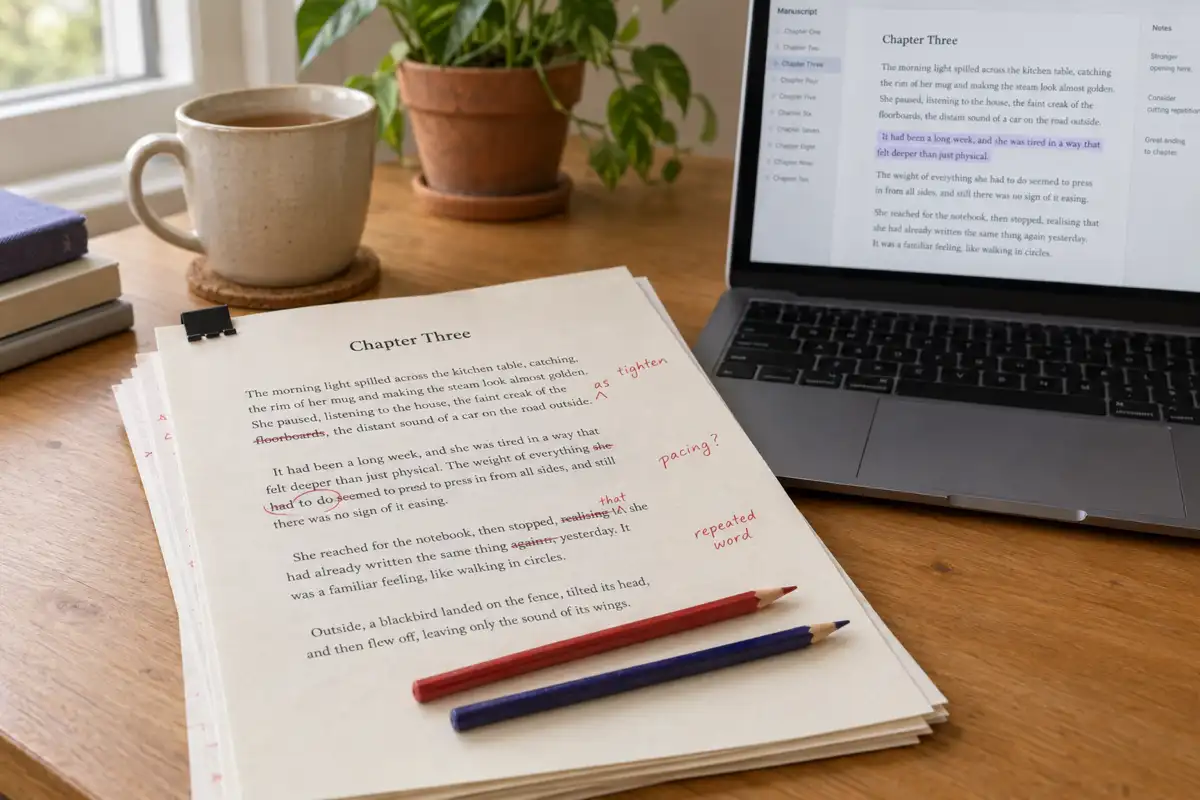
 Best AI for Editing a Book (2026): 9 Tools Compared by Editing Job
Which AI should edit your manuscript? We compare ProWritingAid, Grammarly, AutoCrit, Sudowrite, Novelcrafter, ChatGPT, Claude, the free checks in Google Docs and Word, and Inkfluence AI by the job each does best: grammar, line editing, story feedback, or editing and publishing in one place. Prices checked 2 October 2026.
 AI Writing
 How to Make a Children's Picture Book with AI: Idea to Printed Book in a Day
The complete 2026 workflow for making a fully illustrated children's picture book with AI: age-band word counts, page planning, consistent characters, cover design, and publishing it on Amazon KDP with the right disclosure.
 AI Writing
 The 9 Best Ebook Creators in 2026: AI, Formatting, and Design Tools Compared
Not every "ebook creator" does the same job. We compare the 9 best tools of 2026 across three categories: AI generators that write the book, formatting tools that typeset it, and design tools that make it beautiful, with verified pricing for each.
Get ebook tips in your inbox
Join creators getting weekly strategies for writing, marketing, and selling ebooks.