
AI Ebook Writer vs Generator vs Creator vs Maker: Which Do You Actually Need?
Every AI book tool calls itself a writer, a generator, a creator, or a maker, and most buyers cannot tell them apart. Here is what each term actually means, which one matches your goal, and why the smartest move is usually not to pick just one.
Quick Answer
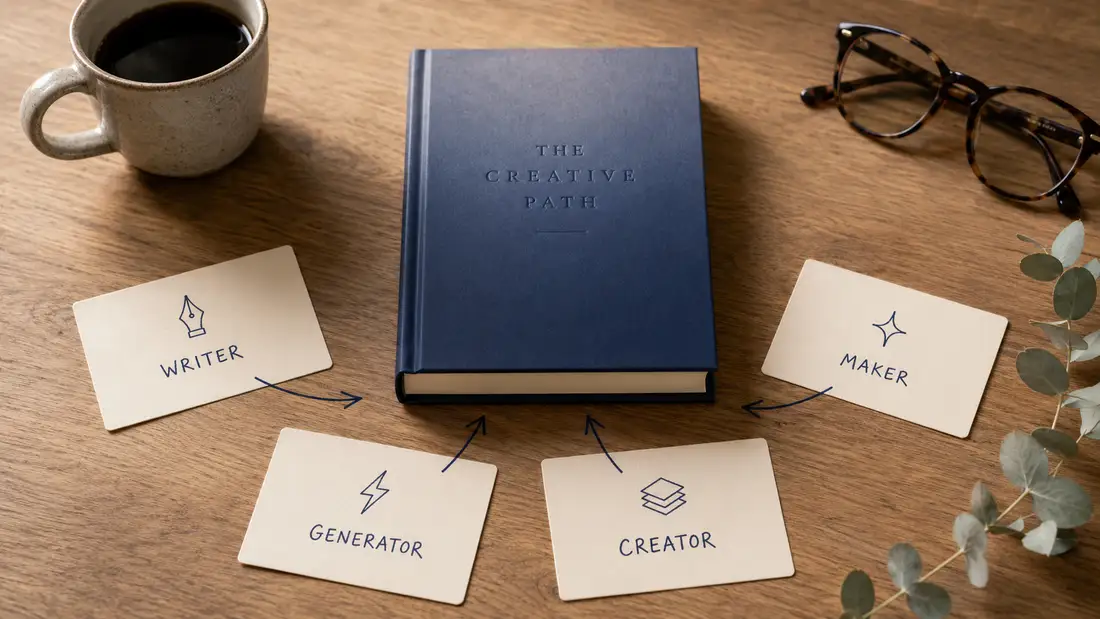
The four terms signal different emphases. An AI ebook writer is about the prose and holding one voice across a whole book. An AI ebook generator is about speed, turning one prompt into a complete ebook fast. An AI ebook creator is about the full studio, writing plus cover plus export in one place. An AI ebook maker (or free ebook creator) is about zero-friction, getting a usable book out quickly and usually free. In practice these jobs overlap, and the smartest move is a single tool that does all four rather than stitching together separate apps.
Why This Matters
The labels are marketing. The differences are real.
Search "AI ebook" anything and you get a wall of tools using these four words almost interchangeably. The words are loose, but the priorities behind them are not. Pick the wrong emphasis and you end up with a tool that is fast but soulless, or beautiful but thin, or free but capped at the worst possible moment.
This guide cuts through it: what each term tends to mean, the question each one answers, and a simple way to decide what you actually need before you spend a cent.
Here is the uncomfortable truth: there is no industry standard for these words. One company's "generator" is another's "creator." But the words are not random either, they cluster around four genuinely different priorities, and knowing which priority matters most to you is the whole game.
AI ebook writer: the prose
An AI ebook writer emphasises the actual writing. The question it answers is "will this read like a real book?" The priority is prose quality and, above all, consistency: a voice that holds from chapter one to chapter twelve instead of drifting halfway through.
What it is best at
Long-form coherence. A writer-first tool is built to keep tone, vocabulary, and structure steady across tens of thousands of words. This is the hardest thing for AI to do and the thing that most separates a book readers finish from one they abandon. If you have ever read an AI book that lost its voice after chapter five, you have felt the absence of this.
Who it is for
Authors who care how the book reads: non-fiction writers building authority, memoirists, and especially novelists, where a dedicated AI novel writer needs to track character voice and continuity across a full manuscript. If the words matter more than the speed, this is your emphasis.
AI ebook generator: the speed
An AI ebook generator emphasises automation and speed. The question it answers is "how fast can I get from an idea to a finished file?" You give it a topic and it produces a structured, formatted ebook in one pass, outline through export.
What it is best at
Throughput. A generator is the right framing when you want volume: producing complete drafts quickly, testing multiple book ideas, or shipping a steady stream of guides. The emphasis is on getting a whole book out of a single prompt with minimal back-and-forth.
Who it is for
Solopreneurs and creators who value momentum over fine-grained control, people testing a niche before committing, and anyone who would rather edit a fast first draft than build one slowly. If your bottleneck is starting, a generator removes it.
AI ebook creator: the full studio
An AI ebook creator emphasises the end-to-end workflow. The question it answers is "can one tool take me all the way to a publishable product?" Creator framing implies writing plus cover design plus formatting plus export, not just the text.
What it is best at
Completeness. A creator-first tool wants to hand you a finished, sellable artifact: the manuscript, a cover, the right export formats, sometimes even an audiobook. It is the difference between "here is your text" and "here is your book, ready to upload."
Who it is for
Self-publishers who do not want to juggle a writing app, a design app, and a conversion tool. If you are heading to Amazon KDP and want a print-ready file plus a cover without learning three programs, the creator emphasis is what you want.
AI ebook maker: the quick, free entry
An AI ebook maker, often branded as a free ebook creator, emphasises low friction. The question it answers is "can I just make something, right now, without paying or committing?" Maker framing leans casual, fast, and free-tier-first.
What it is best at
Getting started. A maker is the right framing for a first-timer, a lead magnet, or a quick experiment. The point is to remove every barrier between you and a usable book: no credit card, no learning curve, no big commitment.
Who it is for
People who want to try before they invest, coaches and marketers who need a quick lead magnet, and anyone who would be put off by a paywall on their very first attempt. It is the gentlest on-ramp into AI book creation.
Side by side
The four terms, decoded
Writer
The prose
Answers: will it read like a real book?
Priority: voice consistency
Best for: authority, memoir, novels
Generator
The speed
Answers: how fast to a finished file?
Priority: throughput
Best for: volume, testing niches
Creator
The full studio
Answers: all the way to publishable?
Priority: completeness
Best for: KDP self-publishers
Maker
The quick, free entry
Answers: can I just make one now?
Priority: low friction
Best for: first-timers, lead magnets
Four words, four emphases, one underlying job: turning an idea into a finished book.
Which one do you actually need?
Forget the labels for a second and answer one question: what is your real bottleneck? Your answer points to the emphasis that matters.
- Ifyou keep starting books and abandoning them because the AI output sounds generic or inconsistent, you need writer strengths: prose and voice.
- Ifyou have ten book ideas and no time, you need generator strengths: speed and throughput.
- Ifyou are publishing to Amazon and dread the design and formatting, you need creator strengths: an end-to-end studio.
- Ifyou just want to try this without paying or committing, you need maker strengths: a free, frictionless start.
Notice that most real projects need more than one of these. You want a fast first draft (generator) that actually reads well (writer), comes out as a finished product (creator), and lets you start free (maker). That is the catch with picking a single-emphasis tool: you solve one bottleneck and inherit the other three.
Not sure which you need? Start free and find out.
One workflow that writes, generates, designs, and exports, with a real free tier. 5 chapters to start plus 5 more every month, full commercial rights, no credit card.
Try Inkfluence AI freeThree real scenarios
Abstract definitions only get you so far. Here is how the decision plays out for three common projects, and why almost none of them are served by a single-emphasis tool.
The consultant writing an authority book
Maria is a pricing consultant writing a 35,000-word book to win higher-value clients. Her priority is unmistakably "writer": the book has to sound like her, sharp and credible, the whole way through, because a single drifting chapter undermines the authority she is trying to build. But she also needs it to look professional (creator) and she would rather not spend three weekends formatting. The wrong move is a pure generator that spits out a fast but generic draft. The right move is a tool that leads with prose quality and still finishes the job. If this is you, start at the AI ebook writer.
The creator testing five book ideas
Tom runs a newsletter and wants to test which of five topics resonates before committing to one. His priority is "generator": speed and throughput, so he can produce five quick drafts and see what lands. Polishing all five would be wasted effort. Once a winner emerges, he switches gears and treats that one like Maria's, investing in voice and finish. A tool that only does slow, careful writing would make his testing phase painful. The AI ebook generator framing fits the testing stage.
The coach who just wants a lead magnet
Priya needs a 12-page guide to grow her email list by next week and has never used an AI book tool. Her priority is "maker": free, fast, no commitment, no learning curve. She does not need a novel-grade voice engine or a print-ready KDP package, she needs a clean PDF today. A heavyweight studio would be overkill. The free ebook creator is the right on-ramp, and she can graduate to the fuller workflow if the lead magnet works.
The pattern across all three: the right emphasis depends on the stage, not just the person. Maria, Tom, and Priya could all end up using the same tool, just leaning on different strengths at different moments. That is the case for one flexible workflow over four narrow apps.
What to ignore when you see these labels
Two things are not worth weighting in your decision. First, the label itself: a tool calling itself a "generator" may well write better than one calling itself a "writer," because the words are marketing, not specifications. Judge the output, not the noun. Second, feature-count bragging: a long feature list does not help if the tool drops your voice at chapter six or hides the export you need behind a higher tier. Run a real test on a real chapter at the length you actually plan to write, the same way you would check for voice drift, and let that decide.
Why you may not have to choose
The whole "writer vs generator vs creator vs maker" question assumes these are separate tools. They do not have to be. The reason the terms blur together in marketing is that the underlying job, idea to finished book, is one job, and a tool built around the whole job covers all four emphases at once.
What an all-in-one workflow looks like
You start free (maker), describe your book and get a complete structured draft quickly (generator), the draft holds one voice across every chapter (writer), and you finish with a cover and KDP-ready export in the same place (creator). No exporting from one app to import into another, no voice resetting when you switch tools, no separate subscriptions.
The hidden cost of stitching tools together
Every handoff between separate tools is where quality leaks out. Move your draft from a generator into a design app and the formatting breaks. Write in one place and narrate in another and the audiobook never matches the book. Three tools also means three subscriptions and three learning curves. The single-workflow approach is not just more convenient, it protects the consistency that makes a book feel finished.
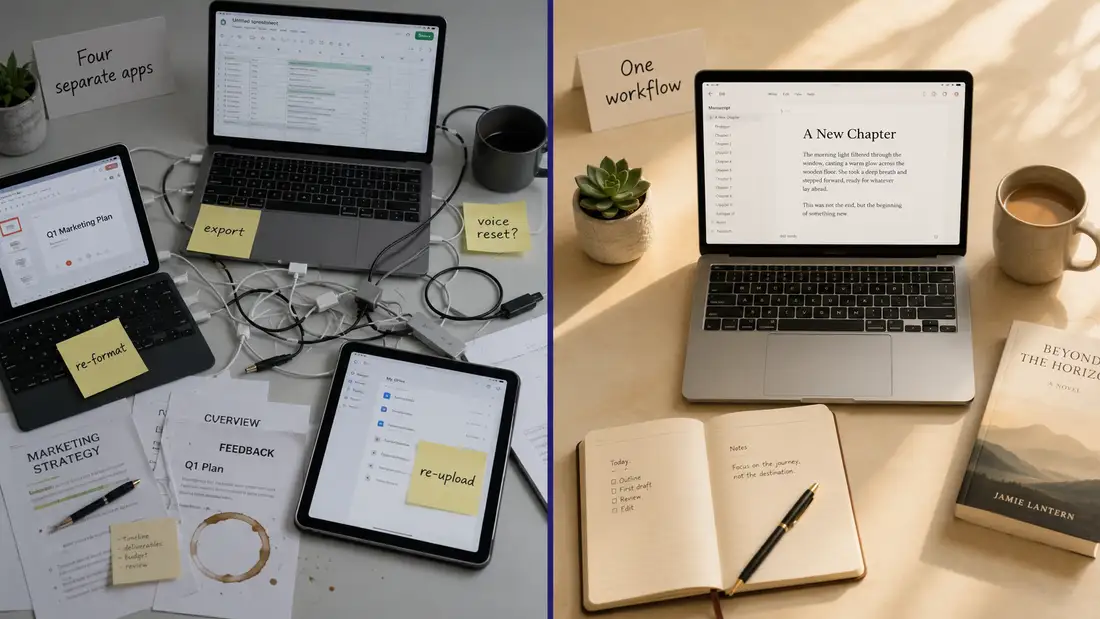
This is exactly how Inkfluence AI is built: one place that writes with a consistent voice, generates fast, designs the cover, and exports to PDF, EPUB, DOCX, or a print-ready KDP package. You can read the full how-to-write-an-ebook guide for the step-by-step, or just start and let the tool cover whichever emphasis your project needs.
Write, generate, design, and ship, in one place
Stop choosing between fast and good, or free and finished. Get all four in a single workflow.
Start writing your ebook freeFrequently asked questions
Is there a real difference between an AI ebook writer and an AI ebook generator?
The terms are not standardised, but in practice "writer" emphasises prose quality and voice consistency across a full book, while "generator" emphasises speed, turning a prompt into a complete draft fast. Many tools do both; the label tells you what they lead with.
What is an AI ebook maker?
"Maker" usually signals a quick, low-friction, free-tier-first tool aimed at first-timers and fast experiments. It is the gentlest on-ramp, focused on getting a usable book out with no payment or learning curve.
Which is best for publishing on Amazon KDP?
Lean toward the "creator" emphasis, an end-to-end tool that produces the manuscript, a cover, and a print-ready export in one place. That removes the design and formatting steps that trip up most first-time KDP authors.
Do I need separate tools for each of these jobs?
No. Because idea-to-finished-book is really one job, a single all-in-one tool can cover writing, generation, design, and export at once. Stitching together separate apps adds cost, learning curves, and quality loss at every handoff.
Which one does Inkfluence AI count as?
All four. Inkfluence is built around the whole job: it writes with a consistent voice, generates complete drafts fast, designs the cover, and exports to PDF, EPUB, DOCX, or a KDP package, with a real free tier so you can start without committing.

Founder, Inkfluence AI
Sam is the founder of Inkfluence AI. He built the platform to make book creation accessible to everyone - from first-time authors to seasoned publishers.
Helpful links
Ready to Create Your Own Ebook?
Start writing with AI-powered tools, professional templates, and multi-format export.
Get Started FreeRelated Articles
 AI Writing
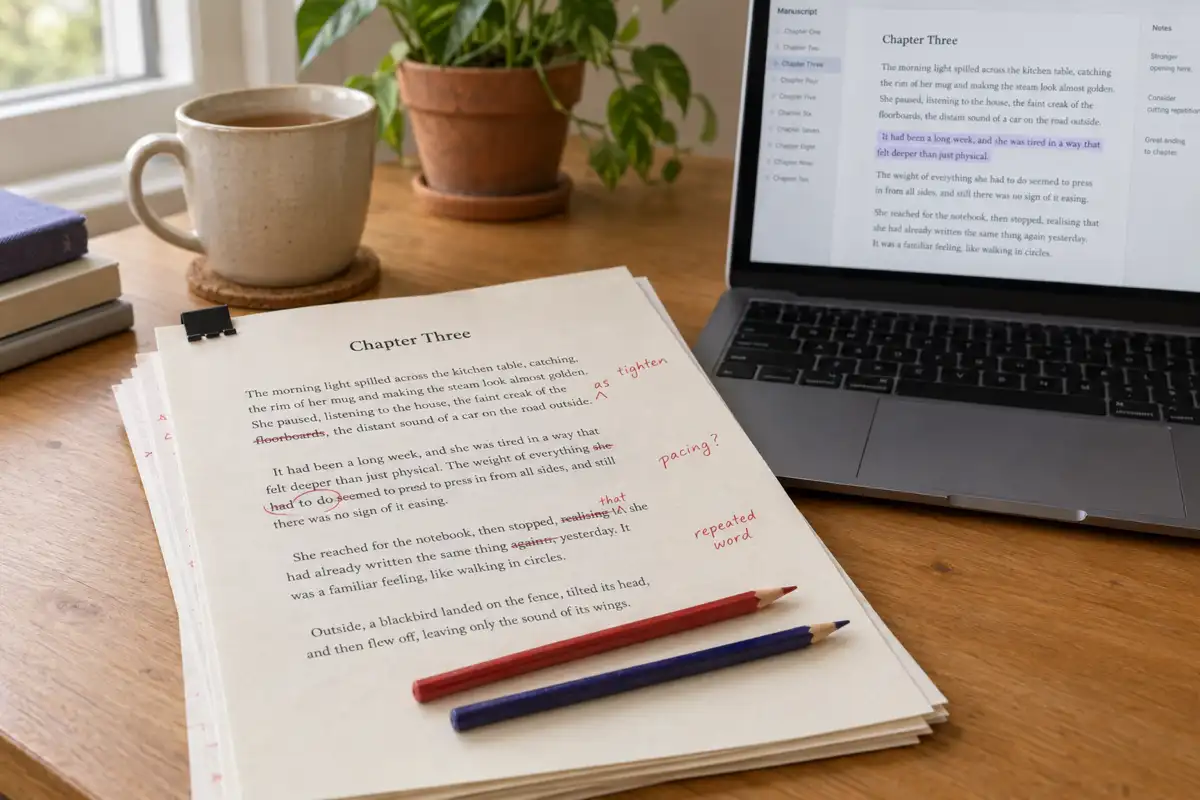
 Best AI for Editing a Book (2026): 9 Tools Compared by Editing Job
Which AI should edit your manuscript? We compare ProWritingAid, Grammarly, AutoCrit, Sudowrite, Novelcrafter, ChatGPT, Claude, the free checks in Google Docs and Word, and Inkfluence AI by the job each does best: grammar, line editing, story feedback, or editing and publishing in one place. Prices checked 2 October 2026.
 AI Writing
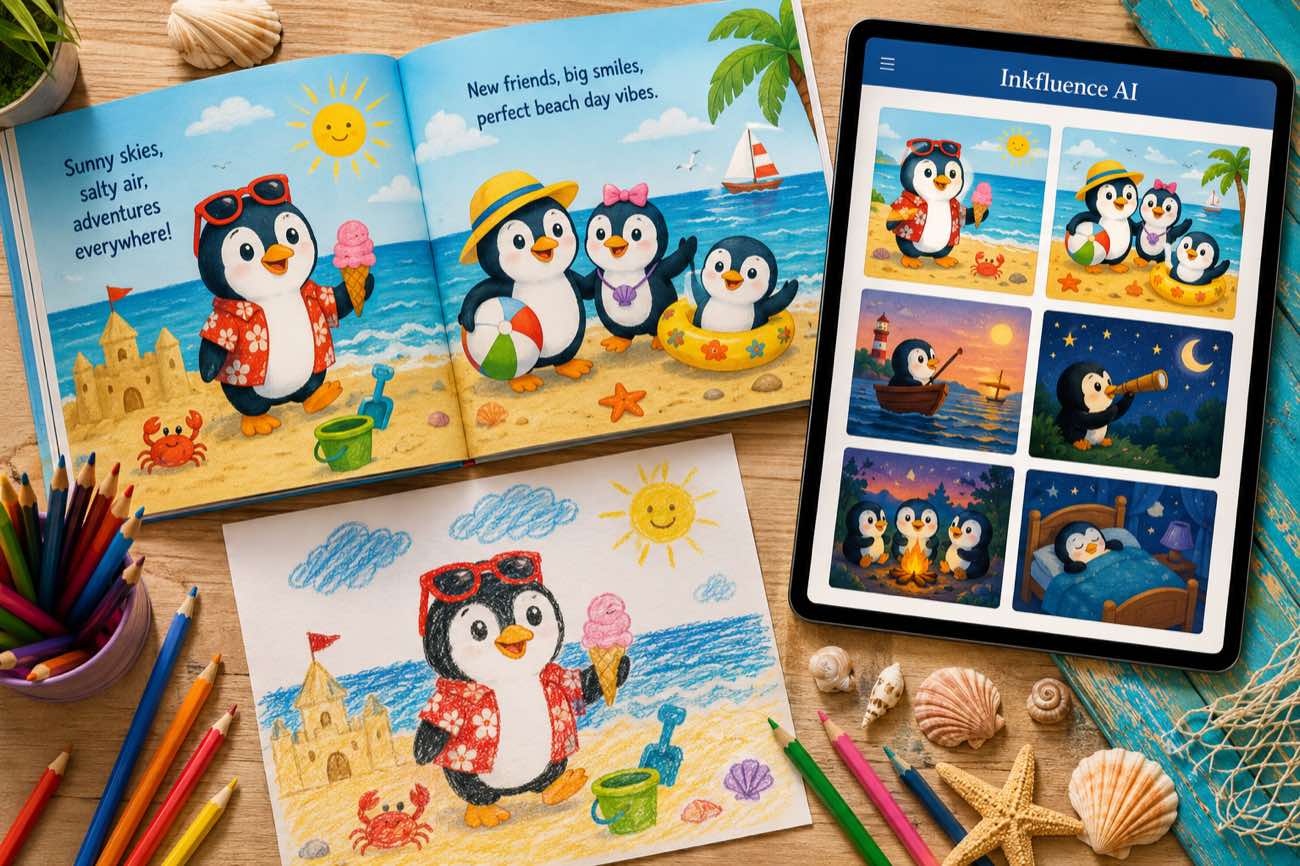
 How to Make a Children's Picture Book with AI: Idea to Printed Book in a Day
The complete 2026 workflow for making a fully illustrated children's picture book with AI: age-band word counts, page planning, consistent characters, cover design, and publishing it on Amazon KDP with the right disclosure.
 AI Writing
 The 9 Best Ebook Creators in 2026: AI, Formatting, and Design Tools Compared
Not every "ebook creator" does the same job. We compare the 9 best tools of 2026 across three categories: AI generators that write the book, formatting tools that typeset it, and design tools that make it beautiful, with verified pricing for each.
Get ebook tips in your inbox
Join creators getting weekly strategies for writing, marketing, and selling ebooks.