
How to Write an Ebook in 2026: Complete Step-by-Step Guide
Most ebook advice focuses on tactics. This guide focuses on what actually matters: finding something worth saying, saying it clearly, and getting it into hands that need it.
Quick Answer
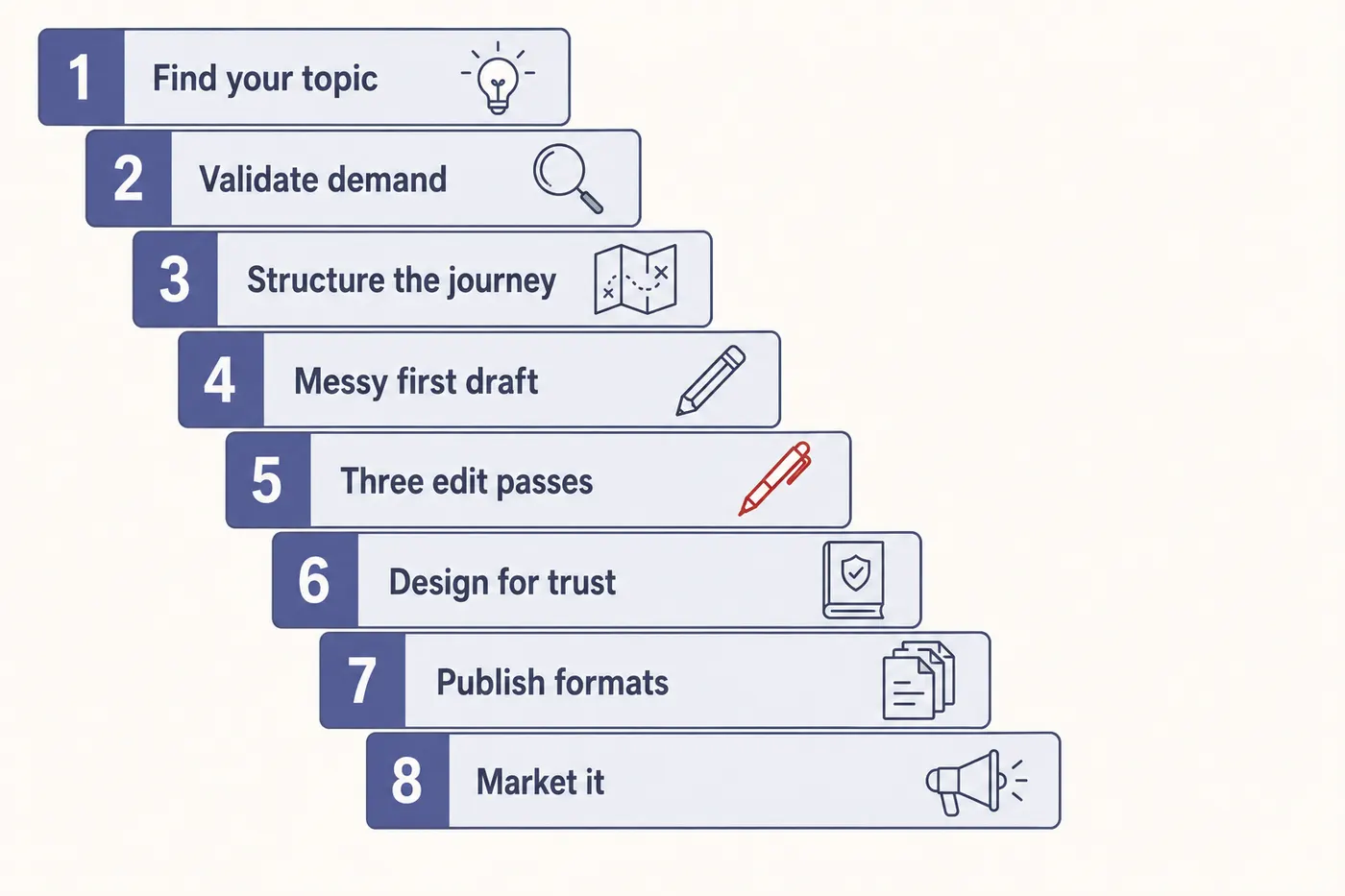
To write an ebook (or create an ebook step by step, if you are starting from nothing), follow eight steps: pick a problem you have personally solved, validate demand, structure the book around a clear transformation, draft fast (with AI assistance via Inkfluence AI if you want a full first draft in minutes), edit in three passes, design for trust, publish in PDF and EPUB, then market it deliberately. A typical finished ebook runs about 8,500 words across 8 chapters. The bar is not expertise - it is usefulness: one step ahead of your reader is qualified.
Updated August 2026
The 8 steps at a glance:
The Real Reason Most Ebooks Never Get Written
It is not lack of time. It is not lack of knowledge. It is not even lack of writing skill. The reason most ebooks die in the planning stage is simpler and more uncomfortable: people do not actually believe they have something worth saying.
This doubt masquerades as practical concerns. "I need to do more research." "I should wait until I have more experience." "Someone else has probably already written this." But underneath these reasonable-sounding objections is a quieter fear: Who am I to write a book?
Here is the truth that experienced authors understand: you do not need to be the world's foremost expert. You need to be one step ahead of your reader. The person struggling with their first email marketing campaign does not need advice from a Fortune 500 CMO. They need advice from someone who figured out email marketing last year and still remembers what it felt like to be confused.
If you have solved a problem that others still face, you are qualified to write about it. If you have learned something the hard way that could save others time or pain, you have something worth saying. The bar is not expertise. The bar is usefulness.
Step 1: Find a Topic You Have Actually Lived
The worst ebook topics come from asking "what sells?" The best come from asking "what do I know that others need?" If nothing obvious comes to mind, work from demand rather than memory: our list of ebook ideas that actually sell and the low-competition niche guide are both built from what readers are already searching for.
Start with problems you have actually solved. Not theoretical knowledge from courses you have taken, but lived experience from challenges you have navigated. The meal planning system that actually worked for your chaotic schedule. The client onboarding process that stopped the endless back-and-forth emails. The study method that finally made organic chemistry make sense.
These personal solutions become powerful ebooks because they carry the weight of reality. You know which shortcuts do not actually work. You know which advice sounds good but fails in practice. You know the emotional journey from confusion to clarity because you walked it yourself.
Step 2: Validate That People Actually Want It
Once you have a candidate topic, validate it. Search Reddit and Quora for people asking questions your ebook would answer. Look at Amazon's Kindle store to see what exists and, more importantly, what gaps remain in your niche. Check if the top-ranking ebooks are thin, outdated, or poorly reviewed. These signals tell you whether demand exists and whether you can offer something meaningfully better. The fastest validation shortcut is to check whether a niche is crowded before you commit: our niche breakdown shows where demand outruns supply.
The validation step matters because writing an ebook requires sustained effort. You want to invest that effort in something people actually want.
Step 3: Structure the Book as a Journey
Structure is not a creative constraint. It is a gift to your reader. A well-structured ebook carries readers from where they are to where they want to be without losing them along the way. If the shape will not come, generate a starting outline with the book outline generator and then rearrange it until the order feels inevitable.
The most reliable structure follows a simple arc: establish the problem clearly, introduce your framework for solving it, walk through the implementation in detail, and end with a path forward. This is not formulaic. It is respectful of how people actually learn and change.
The opening needs to do more than introduce your topic. It needs to make readers feel understood. Describe their situation accurately. Name the frustrations they feel. Explain why the obvious solutions have not worked. When readers feel seen in your opening pages, they trust you to guide them through the rest.
The middle is where most ebooks fail. Not because the information is wrong, but because it is not organized around the reader's journey. Each section should answer the question the reader has at that moment, then naturally raise the next question. This creates momentum. The reader is not just absorbing information but being pulled forward.
The ending matters more than people realize. A reader who finishes your ebook and thinks "that was interesting" has received less value than a reader who finishes and thinks "I know exactly what to do next." Give them a concrete first step. Give them a simple framework they can remember. Give them permission to start imperfectly.
If structure feels overwhelming, AI ebook tools can generate comprehensive outlines in seconds. Use them as starting points, then adjust based on your specific knowledge and your reader's specific needs.
What a finished ebook actually looks like (first-party data)
So you are aiming at something real rather than a guess, here is the shape of a typical finished ebook, measured across the 79,000+ books created on Inkfluence AI as of August 2026: the average book runs about 8,500 words across roughly 8 chapters, a typical chapter lands between 1,000 and 2,000 words, and about 41% of books get exported to a finished file, which makes finishing itself the single biggest filter. Practical how-to guides are the most common type of ebook people write, slightly ahead of fiction. A focused 8-chapter book you finish beats a 30-chapter epic you abandon.
Step 4: Write the Messy First Draft
Professional writers have a secret: they do not write polished prose on the first try. They write rough drafts that embarrass them, then edit until the embarrassment fades. The difference between professional writers and everyone else is not talent. It is process. This is also the step people most often outsource to software: an AI book writer will produce a complete structured draft you can then argue with, which is far easier than arguing with a blank page.
Before the craft advice, be honest with yourself about which drafting route fits your situation. Each one trades time against money against control:
| Drafting route | Time to first draft | Typical cost | Best for |
|---|---|---|---|
| Write it yourself | 4 to 12 weeks | $0 | Personal stories, strong existing writing habit |
| AI draft, then edit yourself | Minutes for the draft, days for the edit | $0 to $30/mo | First-time authors, practical non-fiction, tight deadlines |
| Hire a ghostwriter | 2 to 6 months | $5,000 to $50,000+ | Established brands with budget and no time |
The middle route is why more first ebooks get finished now than ever: the draft appears in minutes, and your effort goes into the part only you can do, making it sound like you and checking it is true.
The first draft is for getting ideas out of your head and onto the page. Nothing more. Write it fast. Write it badly. Write it without stopping to fix sentences or check facts. The goal is completion, not quality. You cannot edit a blank page, but you can edit a messy draft into something good.
Write like you talk. Imagine a specific person sitting across from you, someone who has the problem your ebook solves. Explain it to them. Use the words you would actually use in conversation. The biggest mistake non-writers make is trying to sound "writerly." Clarity beats cleverness every time.
Short sentences work better than long ones. Paragraphs should be shorter than you think. White space is not wasted space. It is breathing room. Your reader is not trying to appreciate your prose style. They are trying to solve a problem. Help them.
For many people, the hardest part is starting. Set a timer for 25 minutes and write without stopping. Do not research. Do not outline. Do not edit. Just write. When the timer goes off, take a break, then do it again. This simple technique, sometimes called the Pomodoro method, has helped more people finish ebooks than any other approach.
Step 5: Edit in Three Separate Passes
Editing is not one task. It is three separate tasks that most people try to do simultaneously, which is why editing feels overwhelming and never seems to end. For the line-level pass, the AI book editor and manuscript editor catch the repetition and pacing problems that are almost impossible to see in your own prose.
The first pass is structural. Read your draft asking only: does this make sense as a journey? Are there gaps where I assumed knowledge the reader does not have? Are there sections that could be cut without losing value? Are things in the right order? Resist the urge to fix sentences during this pass. You might cut those sentences entirely.
The second pass is for clarity. Now you look at individual sections and paragraphs. Is each point as clear as it could be? Are there places where an example would help? Are there sentences that sound smart but do not actually say much? Cut the filler words: really, very, just, actually, basically. Replace vague claims with specific details.
The third pass is mechanical. Spelling. Grammar. Typos. Consistency. This is where tools like Grammarly help, but do not rely on them entirely. Read your work aloud. Your ear catches awkwardness your eye misses. If a sentence trips you up when speaking, it will trip up your reader too.
Get feedback before calling it finished. Not from friends who will tell you everything is great, but from people in your target audience who will tell you where they got confused. Ask specific questions: What was unclear? What was missing? What was unnecessary? The answers will surprise you.
Step 6: Design for Trust
Readers judge your ebook before reading a single word. The cover. The formatting. The typography. These visual choices communicate whether your content is professional or amateur, trustworthy or suspicious. This is not fair, but it is true. Two assets carry most of that trust: the cover, which you can build with the AI book cover generator, and the book description, which is the only sales copy most readers will ever see.
Your cover does not need to be artistic. It needs to clearly communicate what the ebook is about and look professional. Readable title. Relevant imagery or colors. No clip art. No WordArt. No cramming ten different fonts onto one cover. When in doubt, simple and clean beats complex and clever.
Interior design is about readability. Choose fonts that are easy on the eyes. Georgia, Garamond, and similar serif fonts work well for body text. Leave generous margins. Use consistent heading styles. Add white space between sections. A cramped, cluttered layout makes readers tired before they have learned anything.
Visual hierarchy guides readers through your content. Headings should be clearly larger than body text. Subheadings should be clearly smaller than headings but larger than body text. Important points can be bolded sparingly. This structure lets readers skim effectively and return to sections they need.
If design intimidates you, use templates. Canva offers free ebook templates. Google Docs can produce clean PDFs with minimal effort. Inkfluence AI generates covers and formats chapters automatically. Professional design has never been more accessible to non-designers.
Step 7: Publish in the Right Formats and Places
A finished ebook sitting on your hard drive helps no one. The final step is distribution, and your strategy here depends on what you want the ebook to accomplish. Getting the files right matters more than people expect, so start with the export and publishing guide, use the PDF ebook maker for a print-clean file, and follow the Amazon KDP walkthrough if that is your main channel. Selling direct as well? Gumroad keeps more of each sale.
If your goal is list building, your ebook becomes a lead magnet. Readers give their email address in exchange for the download. This works because you are offering genuine value upfront, which builds trust before you ever pitch anything. Tools like ConvertKit, Mailchimp, and Gumroad make this easy to set up. The ebook lives on your website or a landing page, and the email sequence that follows nurtures new subscribers into customers. Understanding how ebook funnels work will help you maximize this approach.
If your goal is direct revenue, you have options. Amazon KDP puts your ebook in front of millions of readers and pays a 70% royalty on ebooks priced between $2.99 and $12.99 (35% outside that band), though you compete with countless other titles. Selling on your own website through Gumroad or Payhip lets you keep more revenue and own the customer relationship. Each approach has tradeoffs in reach versus control. If you publish on Amazon, use our Amazon KDP SEO checklist to choose keywords and optimize your listing.
If your goal is authority building, the distribution strategy is different still. Free downloads without an email gate maximize reach. Guest posts on relevant blogs with your ebook as a resource establish expertise. Podcast interviews where you reference your ebook create ongoing visibility. The ebook is not the product. The ebook is proof that you know what you are talking about.
Whatever your goal, create both PDF and EPUB versions. PDF works for downloads and printing. EPUB works for e-readers and mobile devices. Most tools can export to both formats without extra work.
Step 8: Market It Like You Mean It
Publishing is not a marketing strategy. "Build it and they will come" is not how the internet works. Your ebook needs active promotion, and the promotion should start before you finish writing. Marketing is far easier when it is planned rather than improvised, which is what the 30-day ebook launch checklist is for.
Talk about your ebook while creating it. Share your progress on social media. Write blog posts on topics your ebook covers. Send emails to your list about what you are working on. This builds anticipation and creates an audience ready to download or buy on launch day.
When you launch, make it an event. Not a single social media post, but a coordinated push across every channel you have. Email your list. Post multiple times on social platforms. Reach out to people who might share it with their audiences. The launch window is when you have the most energy and momentum. Use it.
After launch, the ebook needs ongoing marketing. Add calls to action in your blog posts. Mention it in podcast interviews. Create Pinterest pins or Instagram graphics for relevant chapters. Update it annually and re-promote the new edition. The ebooks that generate sustained results are the ones that get sustained promotion. Learn the fundamentals of ebook marketing strategy and commit to executing them.
What Actually Happens Next
You will publish your ebook and some people will download it. Some of those people will read it. Some of those readers will find it genuinely helpful. Some of those helped readers will tell others about it. And some of those referrals will become readers themselves.
This is the real reward of writing an ebook. Not the revenue, though that can be meaningful. Not the authority, though that accumulates over time. The real reward is creating something that helps people you will never meet solve problems you once struggled with yourself.
Your first ebook will not be perfect. It does not need to be. It needs to be useful enough that readers finish it knowing more than when they started. It needs to be clear enough that they can act on what they learned. It needs to exist.
Perfection is procrastination disguised as standards. Ship the ebook. Get feedback. Improve the next one. The people who build successful ebook businesses did not start with masterpieces. They started with something good enough to publish, then got better through repetition.
Frequently Asked Questions
How long does it take to write an ebook?
Traditional ebook writing takes 2-6 months depending on length and complexity. With AI ebook generators like Inkfluence, you can create a complete first draft in minutes - literally watch it write chapter by chapter. The key is separating drafting (instant) from editing (deliberate). Most successful authors spend 20% on initial creation and 80% refining.
How many pages should an ebook be?
Ebook length depends on purpose. Lead magnets work best at 15-30 pages. Paid ebooks typically range 50-150 pages. Full-length non-fiction books run 150-300 pages. Focus on delivering complete value rather than hitting a page count - shorter, focused ebooks often outperform longer generic ones.
Do I need to be an expert to write an ebook?
No - you need to be one step ahead of your reader, not the world expert. If you have solved a problem others still face, you are qualified. Readers want clarity and relatability over credentials. Many successful ebooks share lived experience rather than academic expertise.
What format should I publish my ebook in?
Two formats cover everything in 2026: PDF for desktop reading, printing, and lead magnets, and EPUB for e-readers, mobile, and every major store. Amazon Kindle accepts EPUB uploads and no longer accepts the old MOBI format for new reflowable books, so you can skip MOBI entirely. Most AI ebook generators export both automatically.
How do I choose a topic for my ebook?
Start with problems you have actually solved - not theoretical knowledge, but lived experience. Validate by searching Reddit, Quora, and Amazon to see if people ask questions your ebook would answer. The best topics create a moment of recognition: readers feel you understand their specific situation.
What are the steps to create an ebook from start to finish?
The same eight steps in this guide, whether you call it writing or creating an ebook: choose a lived-in topic, validate demand, structure the transformation, draft (manually or with an AI generator), edit in three passes, design for trust, export to PDF and EPUB, then market it. The full process is repeatable: your second ebook is dramatically faster than your first because steps one to three become instinct.
You have something worth saying. You know something that others need to know. The only question is whether you will say it. The tools exist. The process is learnable. The audience is waiting.
Start writing.
Ready to begin? Start building with Inkfluence AI to generate your first outline and see how quickly ideas become chapters. Or explore profitable ebook niches to find a topic where your knowledge meets market demand. On a deadline? The weekend book sprint schedule compresses this whole process into 48 hours.

Founder, Inkfluence AI
Sam is the founder of Inkfluence AI. He built the platform to make book creation accessible to everyone - from first-time authors to seasoned publishers.
Helpful links
Ready to Create Your Own Ebook?
Start writing with AI-powered tools, professional templates, and multi-format export.
Get Started FreeRelated Articles
 Guides
 Selling AI Coloring Books on Amazon KDP: The 2026 Rules, Specs, and Math
Are AI coloring books allowed on KDP? Yes, with disclosure. The part nobody covers: the AI workflow that passes review, style consistency across 30 pages, the interior specs that cause rejections, and the royalty ladder that decides your price.
 Guides
 How to Make an Adult Coloring Book in 2026: From Idea to Printed Pages
The modern walkthrough: what makes line work read as "adult", the three ways to create pages (draw, convert, generate), how to assemble a real book instead of a stack of pages, and the fork between KDP paperbacks, Etsy printables, and printing at home.
 Guides
 Consistent Characters in AI Children's Books: Why They Drift, and Every Method That Fixes It (2026)
The fox on page 3 never matches the fox on page 7, until you understand why. The four methods for character consistency in AI illustration, compared honestly, plus the page-7 test to run before trusting any tool's claim.
Get ebook tips in your inbox
Join creators getting weekly strategies for writing, marketing, and selling ebooks.