
Children's Book Illustration Cost in 2026: Illustrator Rates, Per-Page Prices and What AI Changes
What a children's book illustrator charges in 2026, from named and dated sources: per page, per spread, per cover and per book, plus the rights uplift, how many illustrations a picture book needs, a cost calculator, and an honest look at what AI art does well and badly.
Quick Answer
A professional illustrator for a self-published picture book usually costs about $1,500 to $11,000. Reedsy reports $1,540 to $4,950 for a 24-page book; the Australian Society of Authors' rates put 14 colour pages plus a cover near $8,600, and 20% more if you take the copyright. An AI-illustrated picture book on Inkfluence AI costs $9.99, one month of Creator.
Checked on 13 October 2026. Every rate on this page comes from a named source we read that day, linked in Sources. Australian dollar and pound figures are converted at the Reserve Bank of Australia's rates for 13 October 2026 (1 AUD = 0.6961 USD = 0.5267 GBP, so GBP 1 = about $1.32). Inkfluence AI's prices and limits were checked in our product code the same day. Where a figure people often quote could not be traced to its source, we left it out and say so.
Search for what a children's book illustrator costs and you will find answers from $300 to $25,000. Most of that spread comes from comparing different things: a spot drawing against a whole book, a student against a veteran, a flat fee against an advance on royalties. This guide pins each number to a source, shows the maths per page and per spread, and puts AI illustration next to it with its real price and limits. If you are budgeting a whole book, our guide to self-publishing a children's book on Amazon KDP covers printing and upload; this page is about the pictures.
Children's book illustration cost at a glance (checked 13 October 2026)
These are the figures for a typical picture book: about 14 illustrated pages and a cover. Rows are cheapest first. US dollar figures for non-US sources are conversions, rounded.
| Route | What the source says | For a 14-page book + cover | Rights |
|---|---|---|---|
| Inkfluence AI, Creator plan (our pick for budget and speed) | $9.99 a month; 20 AI illustrations a month, cover and character sheet included | $9.99 | AI images are not protected by US copyright; your text is |
| Inkfluence AI, no plan | 2 credits a page (words + picture), cover and sheet included | 28 credits: $19.98 (two 15-credit packs) | As above |
| Inkfluence AI, Premium plan | $19.99 a month; 50 AI illustrations a month | $19.99 covers three 14-page books | As above |
| Reedsy marketplace (US) | $1,540 to $4,950 for a 24-page picture book, average over the past three years; quotes normally include concepts, typography, interior design and cover | $1,540 to $4,950 for the book | Set in each contract |
| UK, entry-level illustrator | GBP 1,500 to GBP 3,000 a picture book (publishing.co.uk, indicative) | About $1,980 to $3,970 | Flat fee + copyright assignment is the UK indie norm, per the same source |
| Australian Society of Authors, full book | 32-page picture book A$6,409 and up (rates for 2026/27) | From about $4,460 | +20% if copyright is assigned |
| UK, mid-tier illustrator | GBP 3,000 to GBP 6,000 a picture book | About $3,970 to $7,930 | As UK above |
| Australian Society of Authors, per page | A$778 a colour full page, A$1,495 a cover | A$12,387, about $8,620 | +20% if assigned: about $10,350 |
| Australian Society of Authors, per spread | A$1,035 a colour double-page spread | 14 spreads + cover A$15,985, about $11,130 | +20% if assigned: about $13,350 |
| UK, established illustrator | GBP 6,000 to GBP 12,000 a picture book | About $7,930 to $15,860 | As UK above |
| Trade publisher | The publisher pays the illustrator an advance against royalties | $0 to the author | Publisher contract |
What a picture book's illustrations cost, by source (USD)
Bar length = cost / $15,860 (the top of the UK established tier). Two-tone bars are ranges: the pale part runs to the low figure, the solid part from low to high. Indigo = Inkfluence AI. Sources and conversions as in the table above.
Inkfluence AI, Creator month
$9.99 for up to 16 pages
Inkfluence AI, credits only
$19.98 for 14 pages (28 credits)
Hybrid: illustrator cover + AI pages
About $1,051 (ASA cover rate + one Creator month)
Reedsy, 24-page book
$1,540 to $4,950
UK entry-level
About $1,980 to $3,970
ASA full 32-page book
From about $4,460
UK mid-tier
About $3,970 to $7,930
ASA, 14 full pages + cover
About $8,620
ASA, 14 spreads + cover
About $11,130
UK established
About $7,930 to $15,860
The sources agree more than search results suggest: most self-published picture books land between about $1,500 and $11,000 for the art. The ASA's per-page figures sit above Reedsy's because one is a recommended professional rate and the other is what clients actually paid. And AI is not a cheaper version of the same line: it is a different kind of product, roughly 75 to 1,000 times cheaper, with trade-offs we cover below.
See your own book painted first
Write a picture book, paint every page from one character sheet, and look at it as facing pages before you decide whether to hire an illustrator. One month of Creator covers a book of up to 16 pages.
Start a picture bookThe rate sources, one by one
A rate is only as good as where it came from. Here is what each source is, what it measured, and how far to trust it.
Australian Society of Authors: recommended rates (2026/27)
The ASA is the professional body for Australian writers and illustrators, and it publishes book illustration rates for "A4-size projects, commissioned by self-publishing authors, or non-publisher companies or organisations". That is exactly the situation of an indie author hiring an illustrator, which makes it the most directly relevant published rate card we found. The rates were reviewed in November 2024, raised by 3.3% in July 2026, and the next review is due in November 2026.
| ASA item (2026/27) | AUD | About USD |
|---|---|---|
| Roughs, colour (per rough) | A$110 | $77 |
| Colour illustration, quarter page or chapter head | A$345 | $240 |
| Colour illustration, half page | A$547 | $381 |
| Colour illustration, full page | A$778 | $542 |
| Colour illustration, double-page spread | A$1,035 | $720 |
| Black and white, full page | A$523 | $364 |
| Black and white, double-page spread | A$661 | $460 |
| Cover | A$1,495 | $1,041 |
| Full book, 32-page picture book | A$6,409+ | $4,461+ |
The terms around the table matter as much as the numbers:
- Copyright assignment adds 20%. The ASA's model is a commission plus royalties. If the illustrator assigns copyright to you instead, it says to raise the fee by 20% to make up for the royalties and future income they give up.
- Moral rights stay with the illustrator. They keep the right to be credited, whatever you buy; the credit line usually goes on the copyright page (see the picture-book version in our copyright page template).
- Bundles have a floor. Quote each component, or agree a package that does not undercut the combined total by more than 15%.
- One-off single pictures add 20%. A lone illustration on a flat fee, for private or editorial use, is priced higher than a page within a book.
- Superannuation (Australia's compulsory pension contribution) may be payable on top, and a written agreement should be in place before work starts.
Note the gap between the per-page rates and the full-book line. Fourteen colour full pages and a cover come to A$12,387, about twice the A$6,409 starting figure for a 32-page book. The full-book line is marked with a plus sign and described as based on a standard trade picture book, so read it as a starting point for a simple book, and the per-page rates as what a fully painted book adds up to.
Reedsy: what its illustrators actually charged
Reedsy is a marketplace where authors request quotes from vetted freelancers. Its children's book cost guide (last updated 14 October 2025) says that over the past three years, "the average children's book illustrator on Reedsy has charged between $1,540 and $4,950 for a 24-page picture book". It adds that a picture book illustrator's quote normally covers draft concepts, typography, interior design and the cover, and that the price depends on experience, style and how many double-page, full-page or half-page pictures the book needs.
One correction to a figure that circulates widely: "$4,950 average for a 24-page book" is not what Reedsy says. $4,950 is the top of its range of averages, not the average. Spread evenly over 24 pages, the range works out at about $64 to $206 a page with the cover included; that per-page figure is our arithmetic, not Reedsy's.
UK ranges from a publishing services firm
For the UK, publishing.co.uk (a UK self-publishing services firm; page updated 24 September 2026) gives these ranges for a picture book: entry-level illustrators GBP 1,500 to GBP 3,000, mid-tier GBP 3,000 to GBP 6,000, established GBP 6,000 to GBP 12,000, and graduating illustration students sometimes GBP 500 to GBP 2,000. It says flat fee plus full copyright assignment is the standard model for indie picture books, that a royalty share (25% to 50% of royalties) is cheaper up front but expensive on a book that sells, and that UK illustrators registered for VAT add 20%. Treat these as one firm's indicative ranges rather than a survey: they fit with the other two sources, which is the main reason we include them.
Trade publishing: the publisher pays
If you are writing for a traditional publisher, the illustration bill is not yours: as the ASA puts it, trade publishers pay illustrators advances and royalties rather than a commission. Those advances are often small. In the ASA's 2025 survey of Australian authors and illustrators (10 December 2025), 33% received no advance and 60% one under A$5,000. A picture-book text is normally submitted on its own and the publisher pairs it with an illustrator.
Graphic Artists Guild Handbook (US)
The Graphic Artists Guild's Handbook: Pricing & Ethical Guidelines is the standard US reference (17th edition, MIT Press, November 2025). Its tables are in the printed book, and the children's book figures quoted second-hand online ("$3,000 to $25,000" is common) do not name an edition, so we have not used them.
Left out: budget gig-marketplace prices (their listing pages would not load for us to check on 13 October) and unsourced "average cost" figures on agency and software-vendor pages.
How many illustrations does a picture book need?
Cost scales with the number of pictures, so count before you ask for quotes. A traditional picture book is 32 printed pages, of which a few go to the title page, copyright and endpapers; the story runs across roughly 12 to 14 double-page spreads (our children's book word count guide breaks the page count down by age). Some books paint every spread edge to edge; others mix full spreads, single pages and small spot pictures, which is why per-page and per-spread rates both exist.
On Inkfluence, a story picture book has 10 to 16 pages (14 by default), each with one painting and a few read-aloud lines, plus a cover and a character sheet. Of the 303 story picture books made on Inkfluence between the 29 August launch and 12 October 2026, 143 used 14 pages, 74 used 16 and 42 used 10. So a typical book needs about 14 interior pictures, one cover and one character reference: 16 images in all. That is also why this page prices a "14-page book plus cover" throughout.
| Book type | Typical pictures | Pricing unit that fits |
|---|---|---|
| Board book (ages 0 to 3) | 8 to 12 single pages | Full page |
| Picture book (ages 3 to 8) | 12 to 16 spreads or pages + cover | Spread or full page, or a whole-book fee |
| ABC or counting book | 10 to 26 pages, one subject each | Full or half page |
| Early reader / chapter book | 8 to 15 spot or half-page pictures | Quarter or half page |
| Colouring book | 20 to 40 line-art pages | Full page, black and white |
If you have not planned the pages yet, our guide to planning a children's book with AI lays out the spread-by-spread structure, and how to write a children's book with AI covers the text itself.
Worked examples: one 14-page book priced five ways
Same book, 14 illustrated pages plus a cover, priced from each source. Every line shows its working.
- ASA spread rate: 14 x A$1,035 + A$1,495 cover = A$15,985, about $11,127. With copyright assigned (x1.2): A$19,182, about $13,353.
- ASA full-page rate: 14 x A$778 + A$1,495 = A$12,387, about $8,623. With copyright assigned: about $10,347.
- Reedsy range: $1,540 to $4,950 for a 24-page book with the cover included. Scaled to 14 pages, about $898 to $2,888, but most illustrators price a book, not a page count, so expect a quote nearer the unscaled range.
- Hybrid: an illustrator paints only the cover at the ASA rate (about $1,041) and AI paints the 14 pages on one month of Creator ($9.99): about $1,051.
- Inkfluence AI: one month of Creator, $9.99 (14 of the 20 monthly illustrations; cover and character sheet included). Without a plan, 28 credits, which two 15-credit packs cover for $19.98.
For the rest of what publishing costs (editing, formatting, ISBN, printing), see the real cost of publishing an AI book; for the same human-vs-AI question on the writing side, AI vs a ghostwriter: the cost. Editing on its own, including the flat fee picture-book editors often charge, is in how much book editing costs.
Calculator: illustrator vs AI vs hybrid for your book
Pick a rate source or type in a quote you have been given. The AI figures are Inkfluence's live prices (checked in our code on 13 October 2026); an Inkfluence story picture book runs 10 to 16 pages, so the AI and hybrid lines only show inside that range.
Illustrator = pages x rate + cover (x1.2 if copyright is assigned). ASA rates converted at 1 AUD = 0.6961 USD (RBA, 13 Oct 2026). Reedsy range ($1,540 to $4,950 for 24 pages) divided per page, cover included. AI: Creator $9.99 a month (20 illustrations), Premium $19.99 (50), or 2 credits a page from packs of 15 ($9.99), 25 ($12.99) and 50 ($24.99). Hybrid = cover fee + one Creator month.
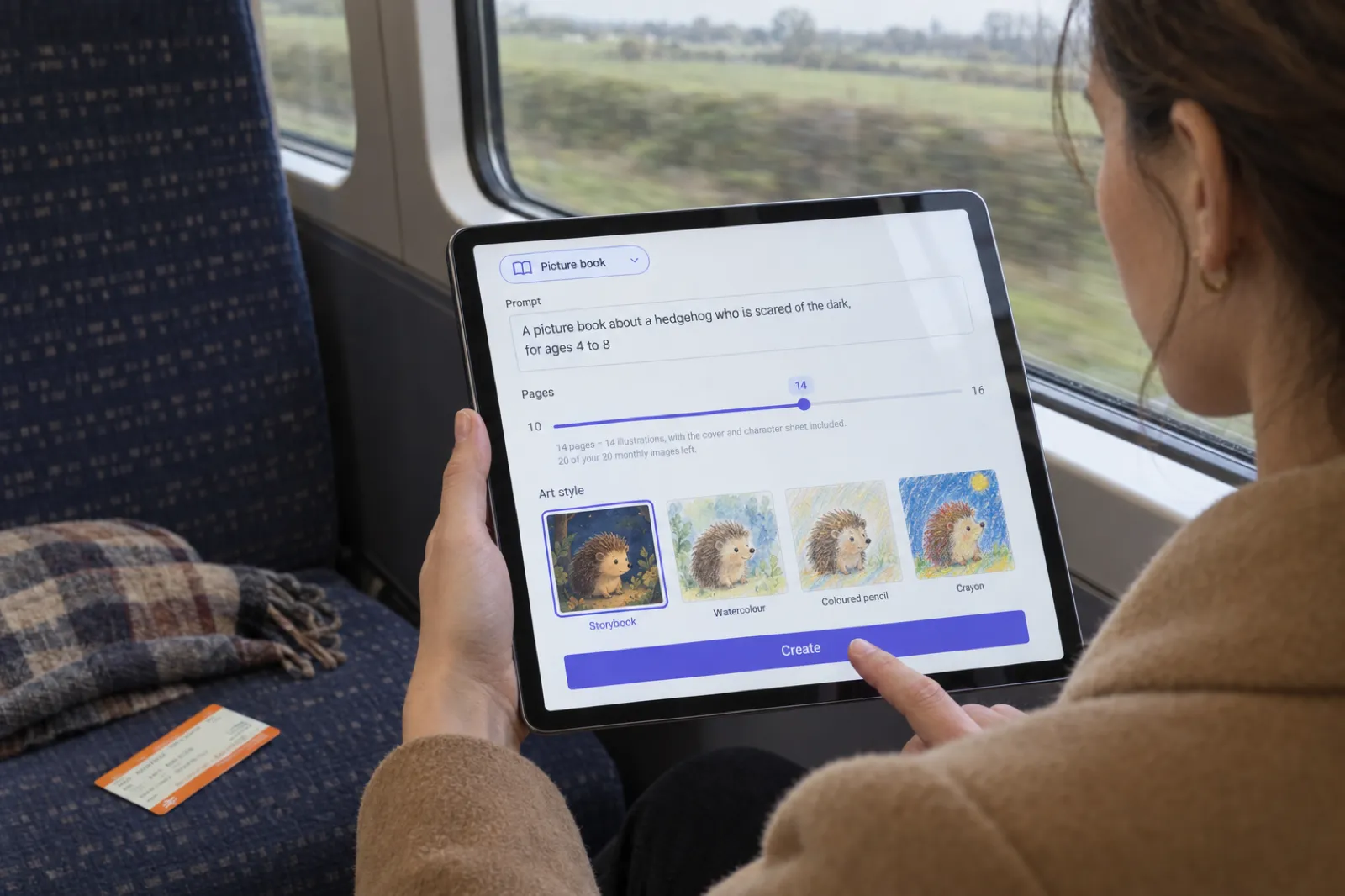
Price it, then paint it
The start screen shows the exact cost for the page count you pick before anything is generated: images from your monthly allowance on Creator or Premium, or credits without a plan.
Make my picture bookWhat moves an illustrator's quote up or down
Two quotes for the same manuscript can differ by a factor of five. Roughly in order of effect:
- Experience. The UK tiers above double at each step. At the top you pay for a portfolio of published books.
- Number and size of pictures. At the ASA rates a spread costs a third more than a full page, and a half page 70% of one. Spot pictures on white cost far less than 14 painted spreads.
- Rights. Copyright, or exclusive merchandise and animation use, adds 20% or more. A licence to print the book only is cheaper.
- Detail. Painted backgrounds, crowds and complex settings take longer than a character on flat colour.
- Revisions and extras. Quotes include set revision rounds; changes after final art are charged. Character design, back cover, text layout and print-ready files may or may not be included, so ask.
- Timeline. Rush jobs cost more; picture books take months from roughs to final art.
What AI changes, and what it does not
AI illustration changes two numbers completely: cost (dollars instead of thousands) and time (minutes instead of months). It changes much less about whether a book is good. Here is an honest account from building a picture book tool, including where it falls short.
| Area | AI does well | AI does badly, or not at all |
|---|---|---|
| Cost and speed | A whole book painted in minutes for a few dollars; redo any page instantly | Cheap to make means cheap to copy: many similar-looking books compete for the same shelf |
| Character consistency | Strong when every page is painted from one character reference | Small details drift: a scarf changes colour, a pet's collar disappears, a hairstyle shifts |
| Hands, feet, counting | Usually fine at picture-book scale | Extra or merged fingers, the wrong number of objects in a counting book; check every page |
| Style | Clean, familiar picture-book looks: storybook, watercolour, crayon, coloured pencil | A distinctive personal style that is recognisably yours; precise art direction of a single brushstroke |
| Visual storytelling | Paints what the page describes | The picture that tells more than the words: a hidden detail, a joke in the background, a page turn built for surprise. This is where good illustrators earn their fee |
| Lettering in pictures | Inkfluence keeps the text out of the painting and sets it in the page layout | Signs, labels and speech bubbles painted inside the art often come out misspelled |
| Ownership | You may use and sell the book | In the US the AI images themselves are not protected by copyright (see below) |
Consistency is a method, not luck
The commonest complaint about AI picture books is a hero who changes from page to page. The fix is structural: paint a reference first, then every page from it. Inkfluence paints a character sheet before anything else (front view, side view and three expressions, plus any companion animal), then the cover and every page from that sheet, in your chosen art style. Our guide to consistent characters in AI children's books explains the method and what to write in the character description to help it (hair, glasses, clothes and their colours, a pet and its collar).
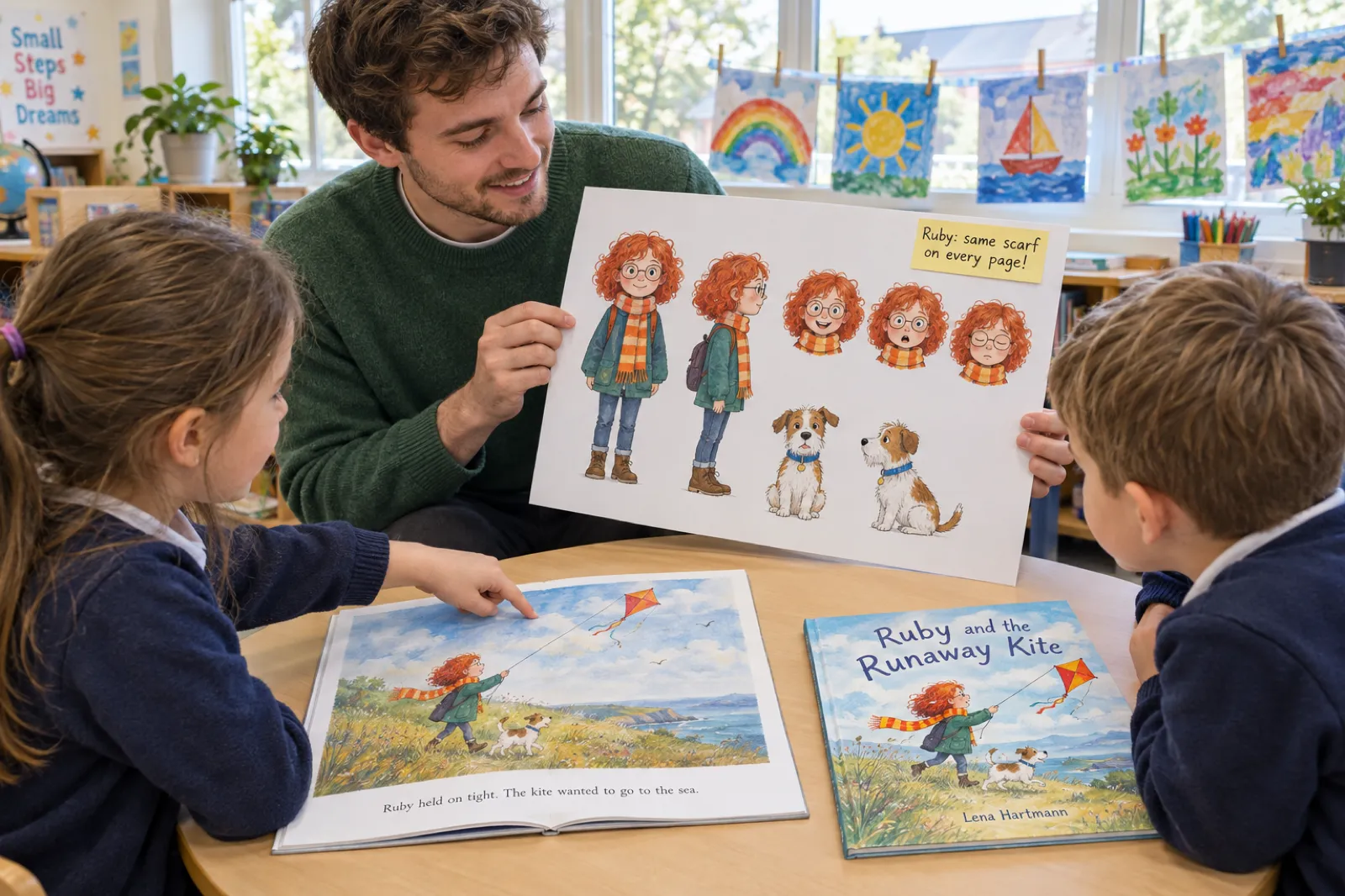
Check every page like an art director
Even with a sheet, read the book like an art director before you publish: check the hero's clothes and colours against the sheet, count fingers on any hand near the front, count objects wherever the text names a number, and look for backgrounds that contradict the words. On Inkfluence you can repaint a single page from the same character sheet (Image, then Generate Illustration, in that page) or swap in your own picture for it, so one bad page does not mean redoing the book.
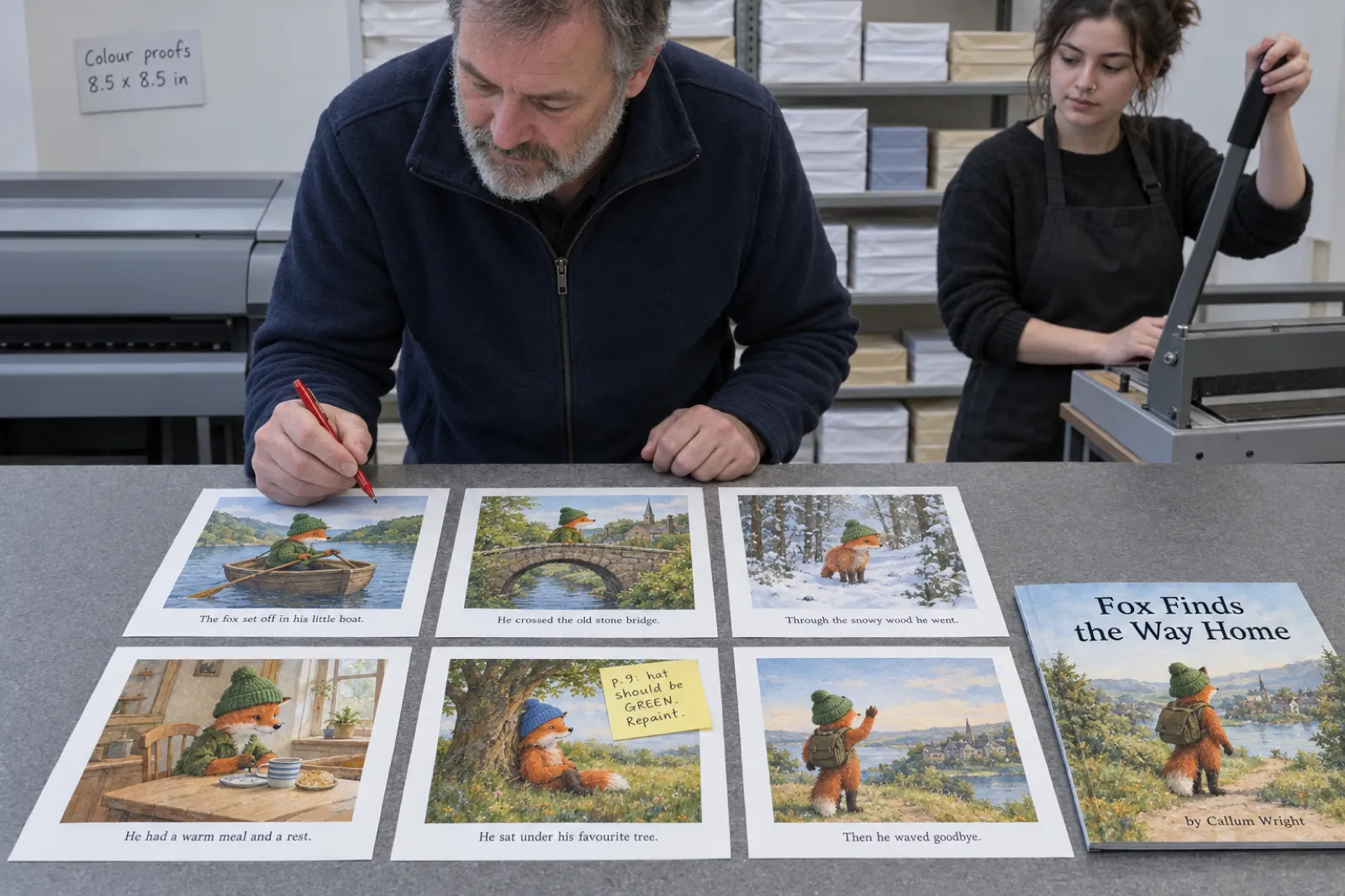
What AI does not replace
The best illustrators add a second story the text never mentions: the cat always somewhere in the frame, the expression that undercuts what a character says. An AI tool paints what the page describes, consistently, but has no opinions about your story. If that second layer is the point of your book, budget for a person. If you need a clear, warm, consistent book for a child, a class or a gift, AI does the job at a price that makes the book possible at all.
Paint a test book before you spend thousands
Make the whole book with AI first and read it as facing pages. If it works, publish it. If you still want an illustrator, you have a finished dummy to brief them with.
Try it on my storyKDP's AI disclosure rule for illustrated books
Amazon KDP asks every publisher to declare AI-generated content when they publish a book or edit and republish one. For picture books the rule bites mainly on the art. From KDP's content guidelines (checked 13 October 2026):
- AI-generated content means "text, images, or translations created by an AI-based tool".
- "AI-generated images include cover and interior images and artwork."
- It counts as AI-generated "even if you applied substantial edits afterwards".
- Using AI tools to "edit, refine, error-check, or otherwise improve" content you created yourself is AI-assisted, and you do not need to declare it.
So an AI-painted interior or cover is declared, and a hand-painted book you only spell-checked with AI is not. A hybrid book with a human cover and AI pages is declared for the interior images. Our full guide to the KDP AI disclosure policy walks through the questions, and publishing AI-generated books on KDP covers the rest of the upload.
Who owns AI illustrations?
This is the question that should most shape a human-versus-AI decision for a book you hope to build on. In the US:
- The Zarya of the Dawn decision (21 February 2023). An 18-page comic book whose images were made with an AI image tool. The Copyright Office concluded the author owned "the Work's text as well as the selection, coordination, and arrangement of the Work's written and visual elements", but that the AI-generated images "are not the product of human authorship". It reissued the registration to cover only her own material.
- The Copyright Office's January 2025 report (Part 2: Copyrightability) concluded that "prompts alone do not provide sufficient human control to make users of an AI system the authors of the output", that purely AI-generated material is not protected, and that human authors are protected for their own expression that is perceptible in the output and for creative selection, arrangement or modification of it, judged case by case.
What that means for a picture book: your story text is yours and protected; your arrangement of text and pictures is protected; the AI pictures themselves are not, so you cannot stop someone else reusing a picture. A commissioned illustrator's work, assigned to you in writing, is fully protected. If you plan a character brand (a series, plush toys, an animated short), that difference is worth paying for. Our guide can AI-written books be copyrighted? covers the registration process, and this is general information, not legal advice for your country.
When to hire a human illustrator, and when AI is the right call
Use AI (Inkfluence) when
- The book is a gift, a family keepsake or a one-off for a child or grandchild
- You are a teacher making class readers or a book with your pupils
- You want to test a story and a market before investing in art
- You publish a series of low-priced books where $5,000 a title cannot pay back
- You need a dummy to brief an illustrator or pitch an idea
- The book is an ABC, counting or colouring book with one subject a page
Hire an illustrator when
- The character is a brand you want to license, protect and sell beyond the book
- The book's appeal is a distinctive art style
- The pictures need to tell a second story the words do not
- You need large-format, high-resolution print art (posters, big hardcovers)
- You are entering awards or shops that do not take AI-illustrated books
- You want to support the person who draws it, and the budget allows
Before you set the budget, set the price. A 32-page square paperback in premium colour costs $4.20 to print on Amazon.com, and at a $12.99 list price earns about $3.59 a copy (KDP's printing cost and royalty pages, checked 13 October 2026). At that royalty, a $5,000 illustration bill needs about 1,400 copies to pay back; a $9.99 one needs three. Our KDP royalties guide and royalty calculator run the numbers for other prices, and how to sell children's books covers where the sales come from.
Three hybrid routes and what they cost
You do not have to pick one side. These three combinations are common, and each solves a different problem.
1. Human cover, AI interior (about $1,050)
The cover sells the book, so it gets the human budget: an illustrator paints the cover (A$1,495, about $1,041, at the ASA rate) and AI paints the pages. The catch is matching. The cover and the interior must look like one book, so give the illustrator the character sheet and a few AI pages as reference, and ask them to work in the same style. The interior is still AI-generated for KDP's disclosure question.
2. AI dummy, human final art (illustrator fee + $9.99)
Make the whole book with AI first, revise the words against real pictures, then commission an illustrator with a finished dummy: composition, character and pacing already worked out. You still pay the full fee, but the brief is far clearer. Tell the illustrator up front that the dummy is AI-made and that you want their own art, not a copy of it.
3. Your own art (or your child's), laid out as a book ($9.99 or less)
If someone in the family draws, use their pictures. On Inkfluence you can click a page's illustration and choose Swap image to put in your own picture (a scan, a photo, a drawing), and no illustration allowance is used for it. The Fill and Whole switch decides whether the picture runs edge to edge with the text over it, or sits uncropped with the text in its own band, which suits scanned drawings. Scan at 300 DPI if the book will be printed.
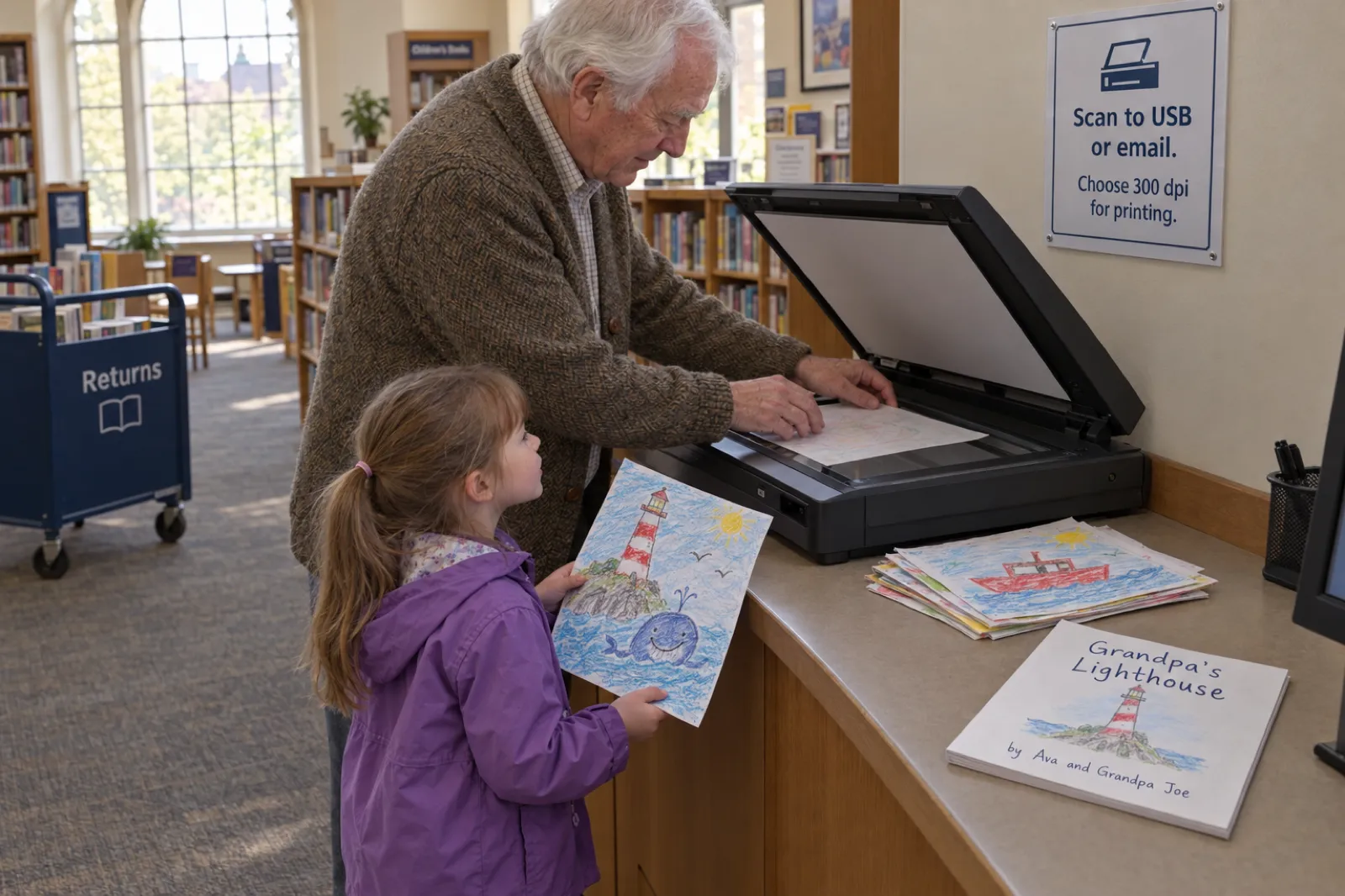
For gift books built around a real child, see the personalised children's book maker, the personalised Christmas book and the book for grandparents. Teachers making class books should start with our page for teachers.
Mix your own pictures with AI pages
Paint the book with AI, then swap in your own drawings, photos or a commissioned cover page by page. Swapped pictures do not use your illustration allowance.
Start my bookIf you commission an illustrator: the brief and the contract
Hiring a person is the right call for many books. These are the steps that protect both of you.
The brief
- The finished text, split into pages or spreads, with notes on what each picture must show (and what the words already say, so the picture does not repeat it).
- Trim size and format: for example 8.5 x 8.5 in, paperback, premium colour. KDP's bleed page size is the trim plus 0.125 in wide and 0.25 in tall, so 8.625 x 8.75 in for a square book with art to the edges, with text kept inside the margins.
- Resolution and colour: 300 DPI for print, and the file format you need.
- The cover: front only, or the full wrap with back cover and spine. Our KDP cover size and spine width calculator gives the exact wrap size for your page count.
- Style references, three to five books whose look you like, and the age of the reader.
The contract
Advice from the Association of Illustrators (AOI), the UK body, given to illustrators at the London Book Fair and reported by Creative Bloq (18 March 2024), shows what a fair contract covers:
- A kill fee if the book is cancelled: 25% before roughs are delivered, 50% after roughs, 100% after final artwork.
- Payment in stages: a third on signing, a third on delivery of roughs, a third on delivery and acceptance of final art.
- Not "payment on publication", which leaves the illustrator unpaid if the book slips.
Add the ASA's points: rights in writing (book licence only, or full assignment for 20% more), the illustrator's credit, the number of revision rounds, and a signed agreement before work starts. Ask for layered files and a print-ready PDF, and agree who does the text layout.
Making the AI version on Inkfluence
Inkfluence AI is our top pick if budget and time decide the book, because it writes the story, paints a character sheet, a cover and every page from that sheet, and exports the files Amazon needs, all in one place. The steps:
- Choose Picture book in the format grid (under Fiction & stories), or ask for "a picture book about..." in the prompt box.
- Describe the main character's look: hair, glasses, clothes and colours, a pet and its collar. This drives the character sheet.
- Pick the page count (10 to 16, 14 by default), the age band (2-5, 4-8 or 6-10) and an art style: Storybook, Watercolour, Coloured pencil, Crayon, Ink and wash, Vintage, Comic or Felt and clay. The start screen shows the cost before you create the book.
- Watch it paint. The character sheet comes first, then the cover, then every page, while the story is written.
- Edit and check every page: change the words, repaint a page from the same sheet, or swap in your own picture.
- Export. The Book tab in the export preview shows facing pages. The KDP package exports the interior at 8.5 x 8.5 in (padded with blank pages to KDP's 24-page minimum, art inside the margins) and a full-wrap cover, as our children's KDP guide explains.
| Plan | Price | Picture books |
|---|---|---|
| Creator | $9.99 a month or $89 a year | 20 AI illustrations a month: one book of up to 16 pages; cover and character sheet included |
| Premium | $19.99 a month or $179 a year | 50 a month: three 14-page books, or three 16-page books |
| No plan (credits) | Packs of 15 ($9.99), 25 ($12.99) or 50 ($24.99) | 2 credits a page, cover and sheet included: 12 pages fit in 25 credits; 14 pages need 28 |
| Beyond the monthly allowance | 1 credit an extra image | An ABC book of 26 pages on Creator: 20 from the allowance + 6 credits |
The limits, stated plainly: illustrated picture books are a paid feature (a plan or credits; the free plan does not paint them), story books run 10 to 16 pages, KDP picture-book interiors keep the art inside the margins rather than bleeding off the edge, and we do not make hardcover covers. More: the AI children's book illustrator and book illustration generator pages show the styles, the ABC book maker and colouring book generator cover the other formats, and the picture book video lesson shows the whole run. For how Inkfluence compares with other tools, see our best AI children's book creators comparison. Prices: pricing page.
Make the whole picture book for $9.99
Story, character sheet, cover and a painting on every page, then the KDP package at 8.5 x 8.5 in. Creator includes 20 illustrations a month, enough for a book of up to 16 pages.
Make my picture bookThe rest of the budget
Illustration is the biggest line, but not the only one. With figures from the same sources:
| Item | Typical cost | Source |
|---|---|---|
| Developmental edit, picture book (~1,000 words) | $374 (average quote) | Reedsy |
| Copy edit, picture book | $231 (average quote) | Reedsy |
| Interior designer (formatting) | $250 to $750 | Reedsy |
| ISBN for a KDP paperback | $0 (free KDP ISBN) | KDP |
| Printing, 32-page square premium colour | $4.20 a copy, taken from each sale | KDP printing cost |
| Proof and author copies | Printing cost plus shipping | KDP |
Reedsy puts editing, illustration, cover and formatting together at $2,387 to $4,400 on its marketplace. On Inkfluence the illustration, layout and KDP files are inside the plan price, leaving editing and proof copies. For a single printed copy for a child, see how to print one copy of a book; for colouring books as a business, selling AI colouring books on KDP.
Frequently asked questions
How much does it cost to illustrate a children's book in 2026?
A professional illustrator for a self-published picture book usually costs about $1,500 to $11,000. Reedsy reports $1,540 to $4,950 for a 24-page book; the Australian Society of Authors' 2026/27 rates put 14 colour pages plus a cover near $8,600. An AI picture book on Inkfluence AI costs $9.99 (one month of Creator).
How much should an illustrator charge per page for a children's book?
The Australian Society of Authors recommends A$778 (about $542) for a full colour page and A$1,035 (about $720) for a double-page spread when a self-publishing author commissions the work, rising 20% if the illustrator assigns copyright. Spreading Reedsy's 24-page range evenly gives roughly $64 to $206 a page, cover included.
How much do you pay an illustrator for a 32-page picture book?
The Australian Society of Authors lists a full 32-page picture book at A$6,409 and up (about $4,460 at the 13 October 2026 exchange rate), before any 20% copyright uplift. A UK publishing services firm puts UK picture books at GBP 1,500 to GBP 12,000 depending on the illustrator's experience.
Do children's book illustrators get royalties?
In trade publishing, yes: the publisher pays the illustrator an advance against royalties. For self-published books most illustrators work for a flat fee, because few indie authors can administer royalties. The Australian Society of Authors suggests adding 20% to the fee when the illustrator assigns copyright and gives up royalties.
Do I need to hire an illustrator if I am submitting to a publisher?
Usually not. In trade publishing the publisher commissions and pays the illustrator, so a picture-book author normally submits the text alone. Hiring your own illustrator is a self-publishing cost.
How much does an AI picture book cost on Inkfluence AI?
On Creator ($9.99 a month) a book of up to 16 pages is covered by the 20 monthly illustrations, and the cover and character sheet are included. Premium ($19.99) includes 50 a month, enough for three 14-page books. Without a plan, a picture book costs 2 credits a page: a 14-page book is 28 credits, which two 15-credit packs ($19.98) cover.
Can AI keep a character consistent across a children's book?
It can if every page is painted from a fixed character reference. Inkfluence paints a character sheet first, then every page and the cover from it. Small drift (a scarf colour, a missing accessory) can still happen, so check every page and repaint any that slip.
Do I have to disclose AI illustrations on Amazon KDP?
Yes. KDP asks you to declare AI-generated content, and its guidelines say AI-generated images include cover and interior images and artwork, even if you edited them heavily afterwards. Using AI only to edit or check your own work is "AI-assisted" and does not need disclosing.
Can I copyright AI-generated illustrations in my children's book?
In the US, not the AI-generated images themselves. The Copyright Office's Zarya of the Dawn decision (February 2023) protected the author's text and her selection and arrangement of text and images, but not the images the AI made. Your own text and any art you draw or substantially change by hand can be protected.
Is it cheaper to illustrate a children's book with AI?
Yes, roughly 75 to 1,000 times cheaper for the art: about $10 to $20 for a 14-page book against roughly $1,500 to $11,000 for a commissioned illustrator. The trade-offs are style control, print resolution and copyright in the images, so some books are still better with a human.
Sources
Every external fact on this page was read on the source below on 13 October 2026. Inkfluence AI facts and our usage counts were checked in our product code and data the same day.
- Australian Society of Authors: Book Illustrations (rates of pay) (FY 2026/27 rates, reviewed November 2024, 3.3% WPI increase July 2026; copyright +20%, bundles, moral rights, superannuation), checked 13 Oct 2026
- Australian Society of Authors: 2025 survey, creator income (10 December 2025; 33% no advance, 60% under A$5,000), checked 13 Oct 2026
- Reedsy: How Much Does It Cost to Publish a Children's Book? (last updated 14 October 2025; $1,540 to $4,950 for a 24-page picture book; editing and formatting quotes), checked 13 Oct 2026
- publishing.co.uk: Children's Book Illustrators for Hire in the UK (updated 24 September 2026; UK tiers, students, flat fee vs royalty share, VAT), checked 13 Oct 2026
- Graphic Artists Guild: Handbook, Pricing & Ethical Guidelines, 17th edition (MIT Press, November 2025), checked 13 Oct 2026
- Creative Bloq: 7 must-know tips for illustrators negotiating a book contract (18 March 2024; AOI kill fees and staged advance), checked 13 Oct 2026
- Reserve Bank of Australia: exchange rates (13 October 2026, 4.00 pm: 1 AUD = 0.6961 USD = 0.5267 GBP), checked 13 Oct 2026
- KDP: Content Guidelines, artificial intelligence content, checked 13 Oct 2026
- KDP: Paperback Printing Cost (premium colour 24 to 40 pages, $4.20 large trim), checked 13 Oct 2026
- KDP: Paperback Royalty (60% at $9.99 and up, minus printing), checked 13 Oct 2026
- KDP: Set Trim Size, Bleed, and Margins (bleed page size), checked 13 Oct 2026
- KDP: Fix Paperback and Hardcover Formatting Issues (300 DPI images), checked 13 Oct 2026
- US Copyright Office: Zarya of the Dawn letter (21 February 2023), checked 13 Oct 2026
- US Copyright Office: Copyright and Artificial Intelligence, Part 2: Copyrightability (29 January 2025), checked 13 Oct 2026
Related reading
- How to Self-Publish a Children's Book on Amazon KDP (2026)
- Best AI Children's Book Creators
- How to Make a Children's Picture Book with AI
- AI Children's Book Creator and AI Storybook Generator
- How to Format a Book for Amazon KDP (2026)
- AI Book Cover Generator
- Write a Children's Book
- Children's Book Word Count and Page Count by Age
- Book Copyright Page Template

Founder, Inkfluence AI
Sam is the founder of Inkfluence AI. He built the platform to make book creation accessible to everyone - from first-time authors to seasoned publishers.
Helpful links
Ready to Create Your Own Ebook?
Start writing with AI-powered tools, professional templates, and multi-format export.
Get Started FreeRelated Articles
 Children's Books
 Children's Book Word Count and Page Count by Age (2026): Board Books to Middle Grade, with Real Picture-Book Data
How many words and pages a children's book needs, from board books to young adult, with every range sourced to a publisher or editor and dated, words per page from real picture books by age band, and a word-budget calculator that checks KDP's 24-page minimum.
 Publishing
 Do You Need an ISBN? Free vs Bought, Cost by Country, and Which Formats Need One (2026)
When a self-published book needs an ISBN and when it does not, what one costs in the US, UK, Canada, Australia, New Zealand, India, Germany, Italy and France (checked at each agency on 13 October 2026), free ISBNs from KDP, IngramSpark and Draft2Digital, and a picker that tells you how many you need.
 Publishing
 IngramSpark AI Policy (2026): What It Accepts, the Setup Question and the "Assisted By" Credit
IngramSpark accepts AI-drafted books with significant human editing and the "Assisted By - Generative AI" credit, and refuses works created solely with generative AI. Its exact wording, covers and translations, how it differs from KDP, a checker for your book, and an editing workflow.
Get ebook tips in your inbox
Join creators getting weekly strategies for writing, marketing, and selling ebooks.