
The AI Storybook Generator
That Makes Tonight's Story Permanent
One idea in, a real storybook out: a story with a beginning, a wobble, and a warm ending, told in read-aloud pages, starring whoever you love most.
Story writing is free, no card. Illustrated mode paints every page with the same characters throughout and exports a print-ready book. 30+ writing languages, 59 translation languages, full commercial rights.
Quick Answer
An AI storybook generator turns one idea into a complete children's storybook: a real story arc told in short read-aloud pages, age-banded language from toddler to age ten, and, in illustrated mode, painted art on every page with the same characters kept consistent throughout. On Inkfluence AI, story writing is genuinely free (5 chapters plus 5 monthly, full commercial rights, no card); the fully illustrated picture-book mode is on paid plans with transparent image allowances. Finished storybooks export as print-ready PDFs and EPUBs for Amazon KDP, and can be translated into 59 languages with the layout kept.
Storybook, picture book, story: which one do you mean?
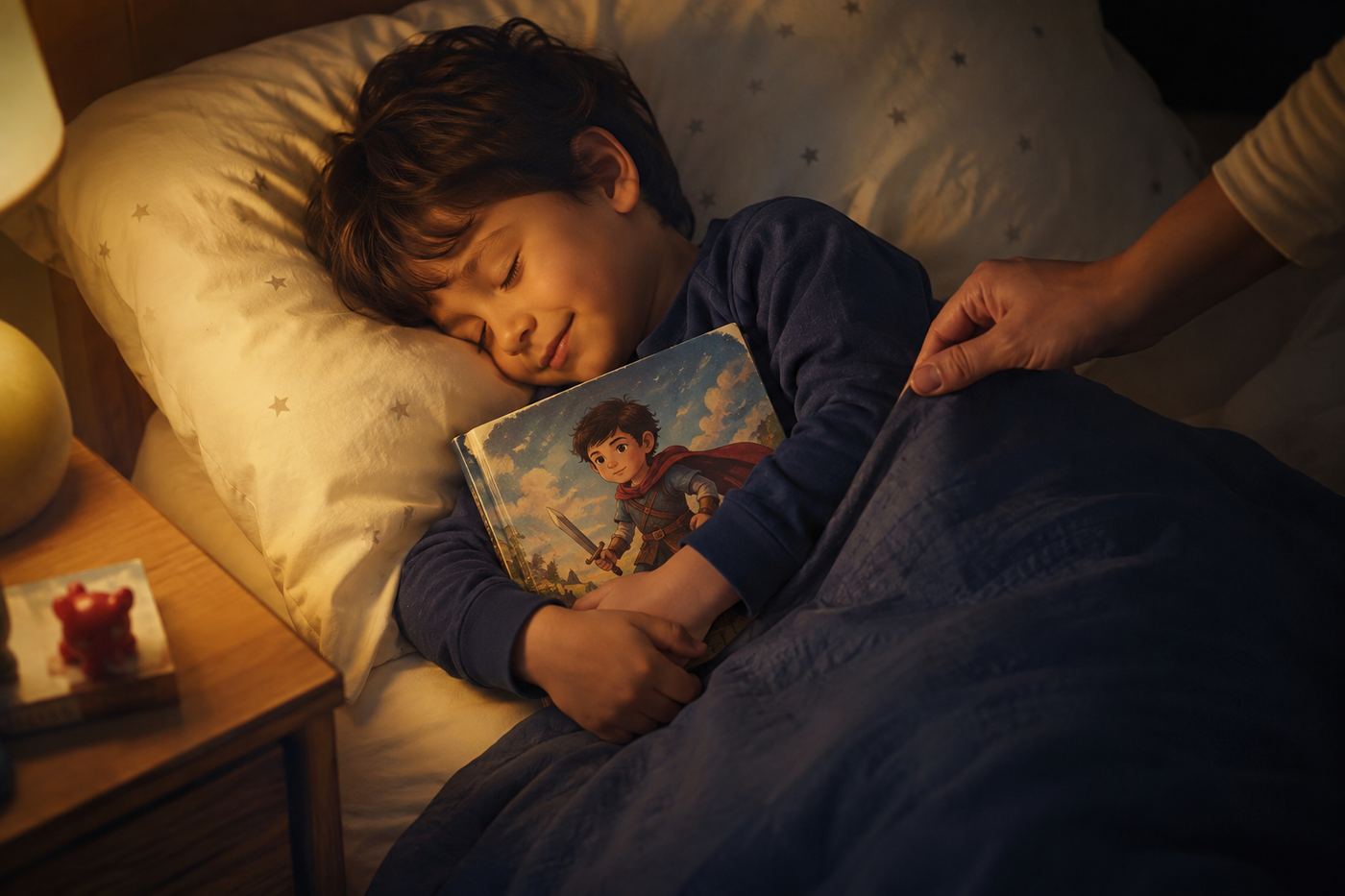
Everyone says "storybook" and means something slightly different, so the generator meets you wherever you are. If you mean a bedtime tale for tonight, write one free in minutes and read it from the screen. If you mean an illustrated book like the ones on the shelf, that is picture-book mode: around 14 painted pages, the same characters throughout, a cover with the title lettered into the art, and a print-ready square PDF. If you mean a longer story for a child who reads alone, that is a kids' story or chapter book, with vocabulary tuned to their age.
Same story engine underneath in every case: a story with one clear problem, tries and small failures, a turn, and a warm resolved ending, because children notice when a story does not really end, and they are right.
The oldest trick in children's books, automated
Put the child in the story (the same personalization the free plan does at no cost). "A brave girl named Ella and her corgi Biscuit face the rainy day" beats any franchise character for a four-year-old named Ella with a corgi named Biscuit. Describe them in one line and the story builds around them; in illustrated mode, the description drives how they are drawn on every page, consistently, from the character reference the book locks before painting.
Personalized storybooks are also the gift category that never misses: birthdays, new siblings, first days of school, grandparents' visits, a personalized Christmas book for December. Generate, print, wrap, or make it a fully illustrated picture book for the big occasions; the personalized children's book maker shows how to describe your child so the pictures match.
Written to be read aloud at 8pm
Read-aloud writing is a craft with rules: sentences an adult can say in one easy breath, rhythm that varies page to page (a single line, then a fuller moment, the variance is the pacing), openings that differ every page, refrains a child can join in on, and endings that land on comfort. The storybook engine writes to those rules deliberately (they are unpacked in our children's book craft guide), which is the difference between a story that gets requested again and one that gets politely finished.
And when the story earns shelf status, it graduates: illustrate it, translate it for grandparents who read in another language (59 languages, layout kept), export it, print it. Tonight's improvisation becomes a real object with a spine.
How the storybook engine actually writes
A storybook that works is engineered, not just generated, and it helps to know what the engine is doing with your one-line idea. First it plans the arc before writing a word (the same discipline our outline tool exposes): who the story is about, the one clear problem, the tries and small failures in the middle, the turn, and the warm landing. Children notice when a story does not really end; the plan exists so it always does.
Then each page is written against read-aloud rules rather than prose rules. Sentences are kept sayable in one adult breath. Page lengths deliberately vary, a single line here, a fuller moment there, because the variance is the pacing a listener feels. Openings differ page to page (a sound, a spoken line, the weather, a question to the listener) so consecutive pages never start the same way, and where the story allows, a page ends leaning toward the turn of the next one.
Vocabulary rides the age band you chose (the bands themselves are mapped in our children's book guide): a toddler book trusts pictures and rhythm with a few words per page, an early-reader book carries more text and slightly longer thoughts, and the engine holds the band consistently instead of drifting formal mid-book, which is the most common tell of chat-generated stories.
In illustrated mode the same discipline extends to the art: the cast is locked in a character reference before painting, the story world is decided once and held on every page, and each illustration depicts what its page's text says rather than a generic scene. The full mechanics of that consistency are in our character consistency guide.
Storybook generator vs printed personalization services
The other way families get personalized books is the printed-gift services: pick a pre-written template story, insert a name and a look-alike avatar, and a hardcover arrives in the post. Lovely products, and worth knowing how the two approaches differ:
| Template gift services | Inkfluence AI | |
|---|---|---|
| The story itself | Pre-written template; the name changes, the plot does not | Written fresh around your child, their dog, their exact worry |
| Editing | Limited to name and dedication fields | Every line editable |
| Cost shape | Per-book, typically the price of a hardcover gift | Story free; illustration by subscription; print wherever you like |
| Repeatability | One story per purchase | Tonight's story, and tomorrow's, and the sequel |
| Selling rights | Personal use | Full commercial rights: publish and sell yours |
If you want one beautiful object with zero effort, the gift services are exactly that. If you want the storytelling itself, repeatable, editable, sellable, that is what a generator is for (the wider cost comparison lives in the real cost of publishing an AI book).
Storybook prompts to start from
"A bedtime storybook for ages 3 to 5 about Luna, a small owl who is sure the moon follows her home, and the night she decides to follow it back."
Calm premise, gentle wonder, built-in sleepy ending.
"A storybook for my daughter Nia, age 5, who loves dinosaurs and hates broccoli, where a very polite triceratops comes to dinner."
Real kid + real quirk: the formula for "read it again".
"A storybook about a lighthouse keeper's cat who thinks she turns the light on every night with her purring. For ages 4 to 8, cozy and funny."
A premise with a smile in it writes pages with smiles in them.
"A gentle storybook for a child whose grandpa is far away: every week they mail each other one impossible thing."
Books that hold a feeling: distance, new sibling, big move. The generator handles tender briefs well.
Starting free? The free-tier breakdown covers exactly what tonight costs: nothing.
A storybook for every occasion that needs one
Birthdays
The birthday kid as the hero of their own quest, illustrated and printed in time for the party. The gift that outlasts every toy on the table.
New sibling
The big-sibling promotion story, starring the promoted (see what free covers: this one, entirely). The single most requested "book that does a job".
First day of school
Nerves, a friendly twist, a triumphant pickup. Read it the week before; watch the morning go smoother.
Grandparents
A story about their weekend together, translated into Grandma's first language with the layout kept. Both editions, one book. To put Grandma in the story too, see the personalized book for grandparents.
Bedtime, chronically
A rotating cast of calm adventures tuned to your child's current obsession, generated faster than they change obsessions, with narrated versions for the car.
Classroom and gifts at scale
Teachers print themed sets (see the lesson plan generator for the teaching side); sellers list personalized-feeling storybooks on Etsy where the gift market lives.
From screen to shelf: making the keepsake real
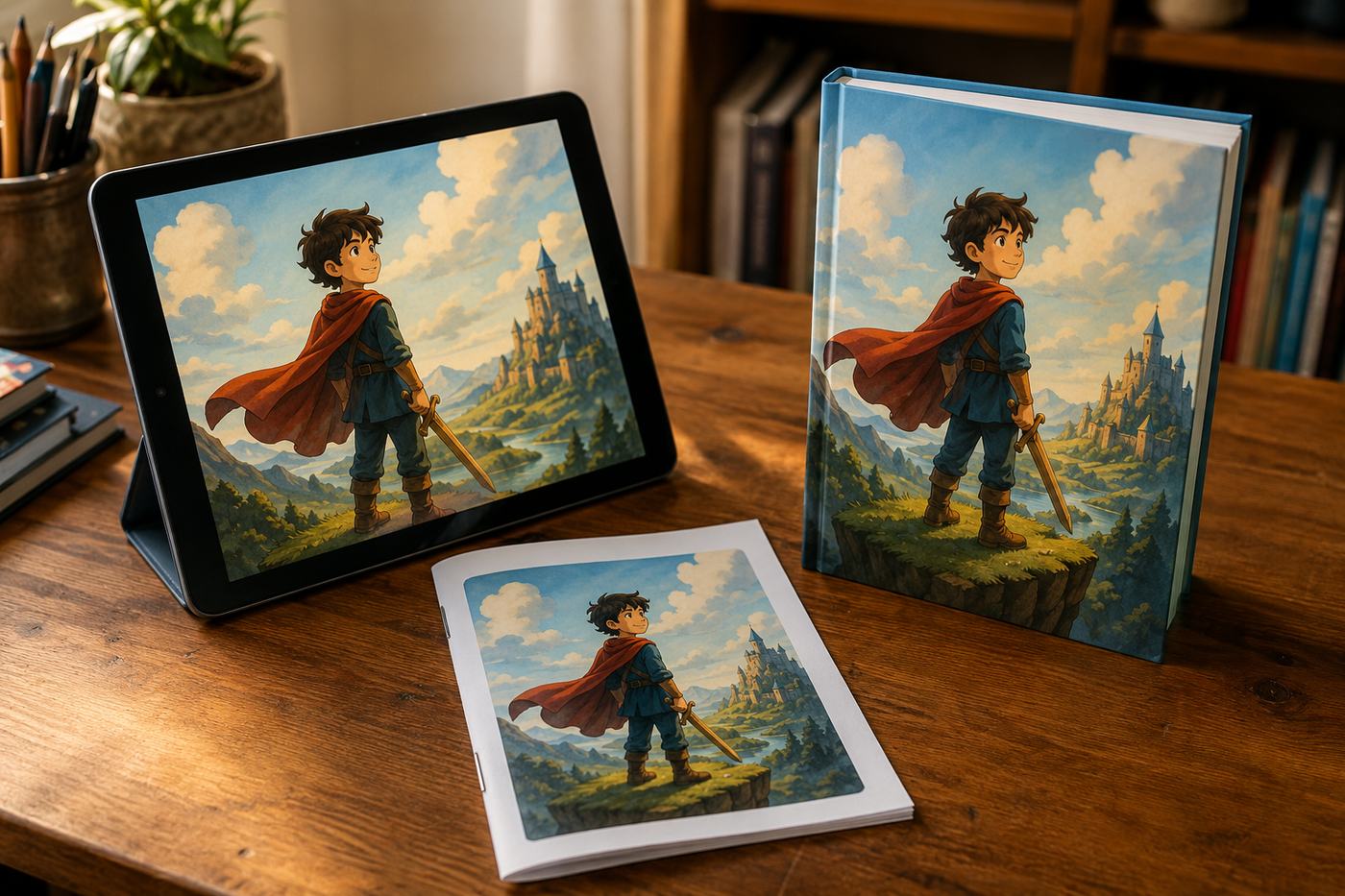
A storybook earns its printing the empirical way: it gets requested three nights running. When one does, the path to a physical book is short. The illustrated edition exports as a print-ready square 8.5" x 8.5" PDF, the standard picture-book trim, with full-bleed art and the text placed on each page's calm zone. From there, print it anywhere: a copy shop for tomorrow, a photo-book service for a hardcover gift, or Amazon KDP for a real listed book that grandparents can order themselves, which for many families is the entire point.
The digital edition matters too: EPUB with the illustrations embedded reads on any tablet for travel bedtimes, and the PDF prints single pages on demand for the fridge-door gallery. One book, every format the household actually uses.
If you sell rather than gift, everything on this page is commercially yours: list the book on KDP (answer the AI disclosure honestly at setup, per our disclosure guide) or as an Etsy printable. The personalized-feeling storybook is one of the gift market's most reliable sellers for the same reason it works at home: nobody else is selling that exact story. The listing playbook is in the Etsy guide.
Storybooks in the language your family actually speaks
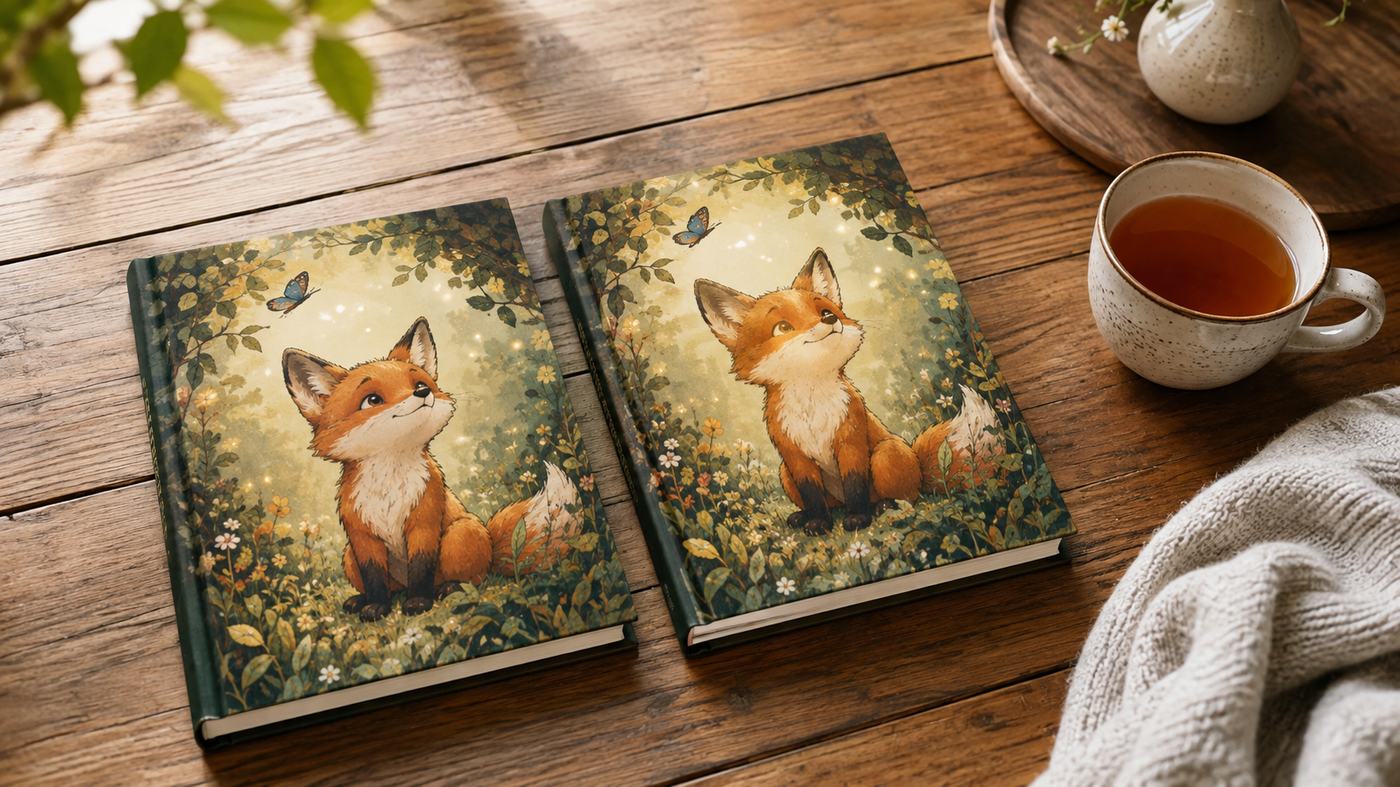
Write the story in any of 30+ languages from the start, or write it once and translate it into any of 59 languages with every page and illustration kept in place. For bilingual households this is quietly the best feature in the building: the same bedtime story in English for one parent and Spanish, Polish, or Tagalog for the other, and a copy for the grandparents that reads like it was written for them, because it was.
Language learners use it in reverse: simple storybooks in the target language, at a vocabulary level you control, about topics the learner already loves. This is not a niche request: across 100,000+ books generated on Inkfluence, roughly 1 in 6 is written in a language other than English (first-party platform data), with Spanish, French, and Portuguese leading.
Storybook generator FAQ
What is an AI storybook generator?
An AI storybook generator turns one idea into a complete children's storybook: a real story with a beginning, a problem, and a warm ending, told in short read-aloud pages, and, in illustrated mode, painted art on every page with the same characters throughout. Inkfluence AI generates the full book from a single prompt, with the story free to write and the fully illustrated version on paid plans.
Is there a free AI storybook generator?
Story writing is genuinely free on Inkfluence: 5 chapters when you start plus 5 more every month, no card, full commercial rights, editable, exportable to PDF. The illustrated storybook mode, where AI paints every page, is part of the paid plans, priced transparently: Creator $9.99/month with 20 images, Premium $19.99/month with 50. Our free children's book generator page breaks the split down honestly.
What's the difference between a storybook and a picture book?
In everyday use they overlap heavily; in publishing terms a picture book is the physical format (a large illustrated book, around 32 pages, read aloud to ages 2-8) while 'storybook' emphasizes the story itself and gets used across a wider age range. Practically: if you want a picture on every page, use picture-book mode; if you want a longer tale in chapters for an older child, use a kids' story or chapter book.
Can my child be the hero of the storybook?
Yes, and it is the single best trick in children's books: describe your child (name, look, pet, favorite things) and the story is written around them. In illustrated mode the description also drives how they are drawn on every page, consistently.
Can it write bedtime stories?
Yes. Bedtime is the storybook's home turf: calm arcs, warm endings, read-aloud rhythm an adult can deliver at 8pm on autopilot. Ask for a bedtime story and the pacing lands soft rather than exciting.
How long does it take?
A text storybook generates in minutes. A fully illustrated storybook takes around ten minutes more while every page is painted, and you can watch pages appear as they finish.
What ages does it write for?
Toddler read-alouds (ages 2-5, a few words per page) through confident young readers around ten. Pick the age band and vocabulary, rhythm, and page length adapt to it.
Can I make the storybook in another language, or bilingual?
Stories can be written in 30+ languages, and a finished book can be translated into 59 languages with the layout and illustrations kept, so a bilingual household can have both editions of the same book.
Can I print it or sell it?
Yes. Export PDF (including the print-ready square trim for illustrated books) or EPUB, and sell on Amazon KDP, Etsy, or Gumroad. You own full commercial rights on every plan; Amazon requires AI-content disclosure at setup, which is a form answer, not a barrier.
How is this better than a chatbot bedtime story?
A chat window gives you disposable text. A storybook generator gives you the book: pages, illustrations with consistent characters, a cover, and files you can print, gift, translate, or sell. The story your child loves tonight can be on their shelf next week.
Can I edit the story after it generates?
Every line. Swap a word your child would not know, rename anyone with one click, cut a page, or regenerate a chapter entirely. The best storybooks in the library are usually generated once and then tuned by the person who knows the listener.
Can it make a storybook audiobook?
Yes: any finished book can be narrated with 49 voices, which turns the storybook into car-journey material and gives the designated bedtime reader an occasional night off.
What should be in a good storybook prompt?
Three things: who it stars (your child, a shy dragon), what wobbles (the fear, the problem, the mystery), and the age. One sentence covering those beats a paragraph of instructions, and everything else is editable afterwards.
Can I make a storybook series with the same characters?
Yes. Keep the same character descriptions across prompts, or duplicate a finished book as the starting point; in illustrated mode the character reference keeps the cast visually identical across books, which is what turns a hit bedtime story into a shelf.
Related tools and guides
AI Picture Book Maker
The fully illustrated version: art on every page, consistent characters.
Children's Book Illustration Cost
Illustrator rates per page and per book, and what AI changes.
Children's Book Word Count by Age
How long a bedtime story should be at each age, with a words-per-page calculator.
Halloween Story Generator
A Halloween bedtime story starring your child, not too scary, ready on the 31st.
Free AI Children's Book Generator
Exactly what's free and what illustration costs, honestly.
AI Chapter Book Generator
For readers who have graduated to reading alone.
AI ABC Book Maker
Alphabet and counting books with a guaranteed A to Z.
AI Story Writer
Stories for every age, not just the small ones.
How to Write a Children's Book
The craft guide behind the generator.
"Read it again" starts here
Write tonight's story free. Keep the good ones forever.
Make a Storybook